The keywords describe persons, concepts, places, and elements of language associated with the quotations. By clicking (once) on a keyword, only the quotations associated with that keyword appear in the list and on the page. To display everything, click on the keyword «All». You can copy a direct link to only the quotations matching the selected keywords by clicking on the link icon    at the top right of the list, or a link to the quotations associated with a given keyword by right-clicking on the keyword itself. Clicking on a second (or third) keyword further restricts the displayed quotations to those sharing the selected keywords. Clicking on an already-selected keyword deselects it. Hovering over a keyword for a while displays an explanation of the keyword. The key icon   to the right of the quotations displays, on mouse hover, the keywords associated with that quotation and also makes it possible to select the quotations associated with one (or more) of these keywords according to the same mechanism as for the main list. A left-click on the key icon provides a direct link to the quotation concerned. After the keywords, in parentheses, appears the year (or the precise date if possible) of the quotation’s first publication online. On touch screens, the behaviour is different (and explained by this notice, modified).
The keywords describe persons, concepts, places, and elements of language associated with the quotations. By tapping a keyword, only the quotations associated with that keyword appear in the list and on the page. To display everything, tap the keyword «All». You can copy a direct link to only the quotations matching the selected keywords by tapping the link icon    at the top right of the list. A touch (tap) on a second (or third) keyword further restricts the displayed quotations to those sharing the selected keywords. touch (tap) on an already-selected keyword deselects it. A long press (½ second) followed by a release displays an explanation of the keyword, without selecting the keyword. The key icon   to the right of the quotations displays, on touch, the keywords associated with that quotation and also makes it possible to select the quotations associated with one (or more) of these keywords according to the same mechanism as for the main list. A second touch on touch screens) on the key icon provides a direct link to the quotation concerned. After the keywords, in parentheses, appears the year (or the precise date if possible) of the quotation’s first publication online. On computers with a mouse, the behaviour is different (and explained by this notice, modified).
This list presents, in historical chronological order, for each quotation its speaker, its date and a brief excerpt or summary, as well as a direct link to the quotation.
This list presents, in reverse-chronological order, the updates made to this page since its first publication online in May 2000, in particular the alterations, additions and modifications made to quotations already published, and gives the first-publication dates for each quotation. A given quotation may therefore appear several times. This list makes it possible to discover the most recent additions, which were previously very hard to spot. The publication date of a quotation is also shown, in the dynamic tooltip that appears on hovering over the key icon    associated with each quotation, in parentheses after the keywords associated with the quotation.
Click here to display all the quotations.
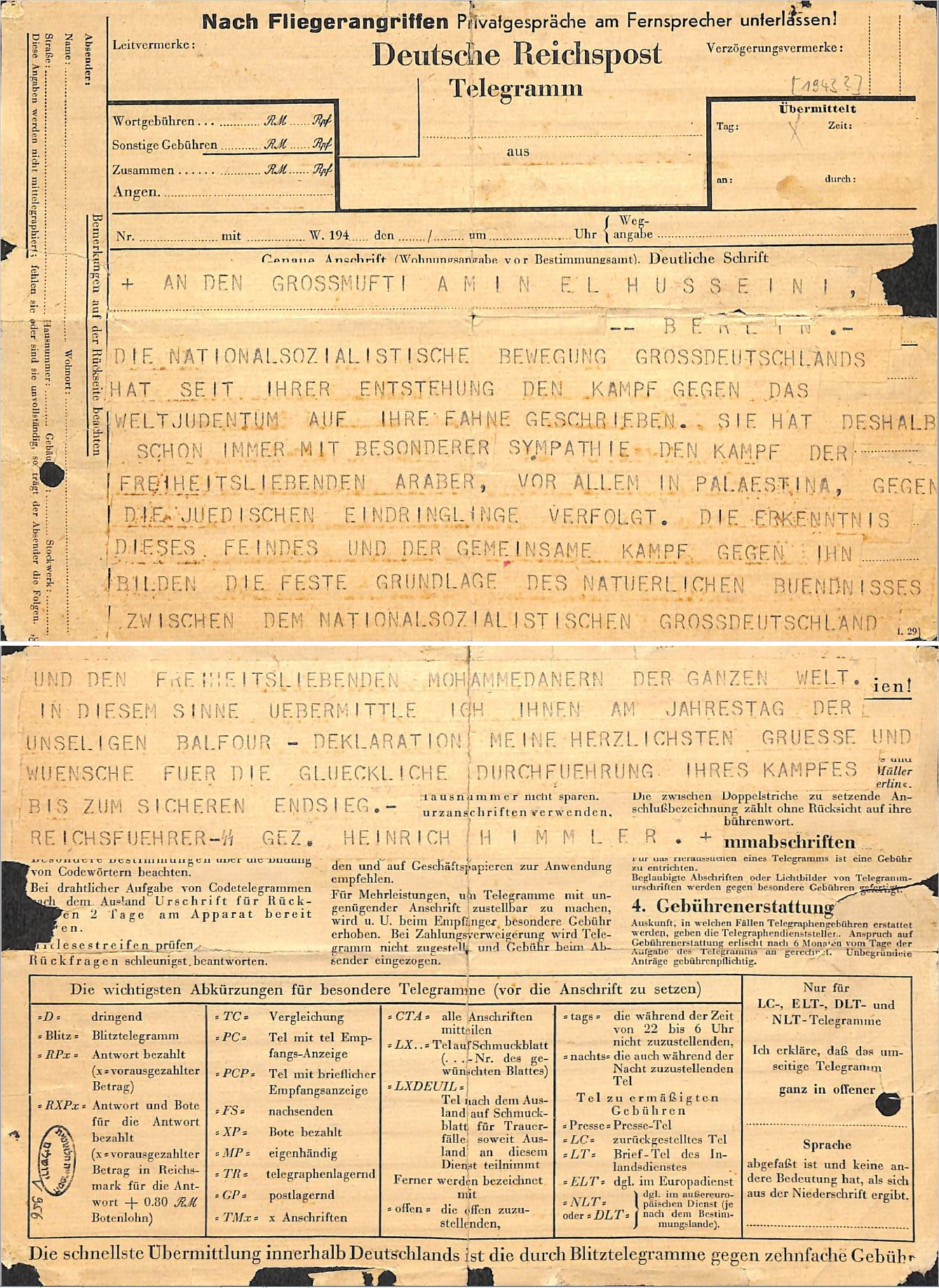
Quotations relating to Arabs or emanating from Arabs, or relating to Muslims or to Islam.
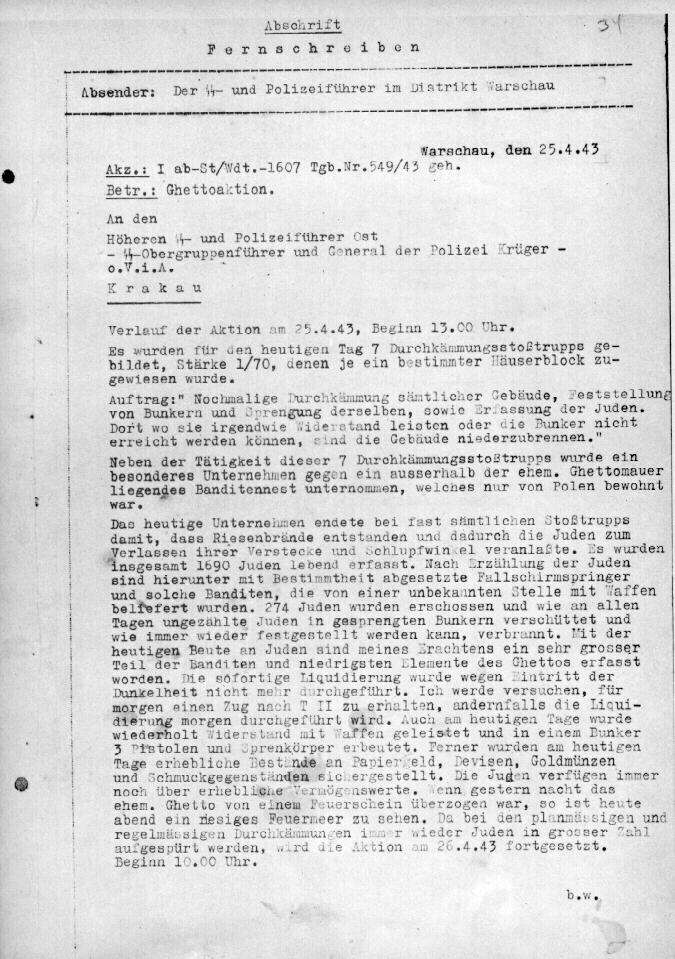
Quotations in which the camouflage term Aktion (action), Judenaktion (Jewish action) appears, in fact designating a killing operation or one preparing the murder of Jews. It is sometimes an abbreviated form of Sonderaktion (special action), a term associated with another camouflage formula for mass murder, Sonderbehandlung (special treatment, see this keyword). We include quotations using the term «operation», in the same sense. See also the keyword «coded language».
Quotations in which a variant of ausrotten (to exterminate, in German) appears, in particular Ausrottung (extermination) or ausgerottet (exterminated).
Quotations explicitly expressing classic antisemitic elements (other than biological racism).
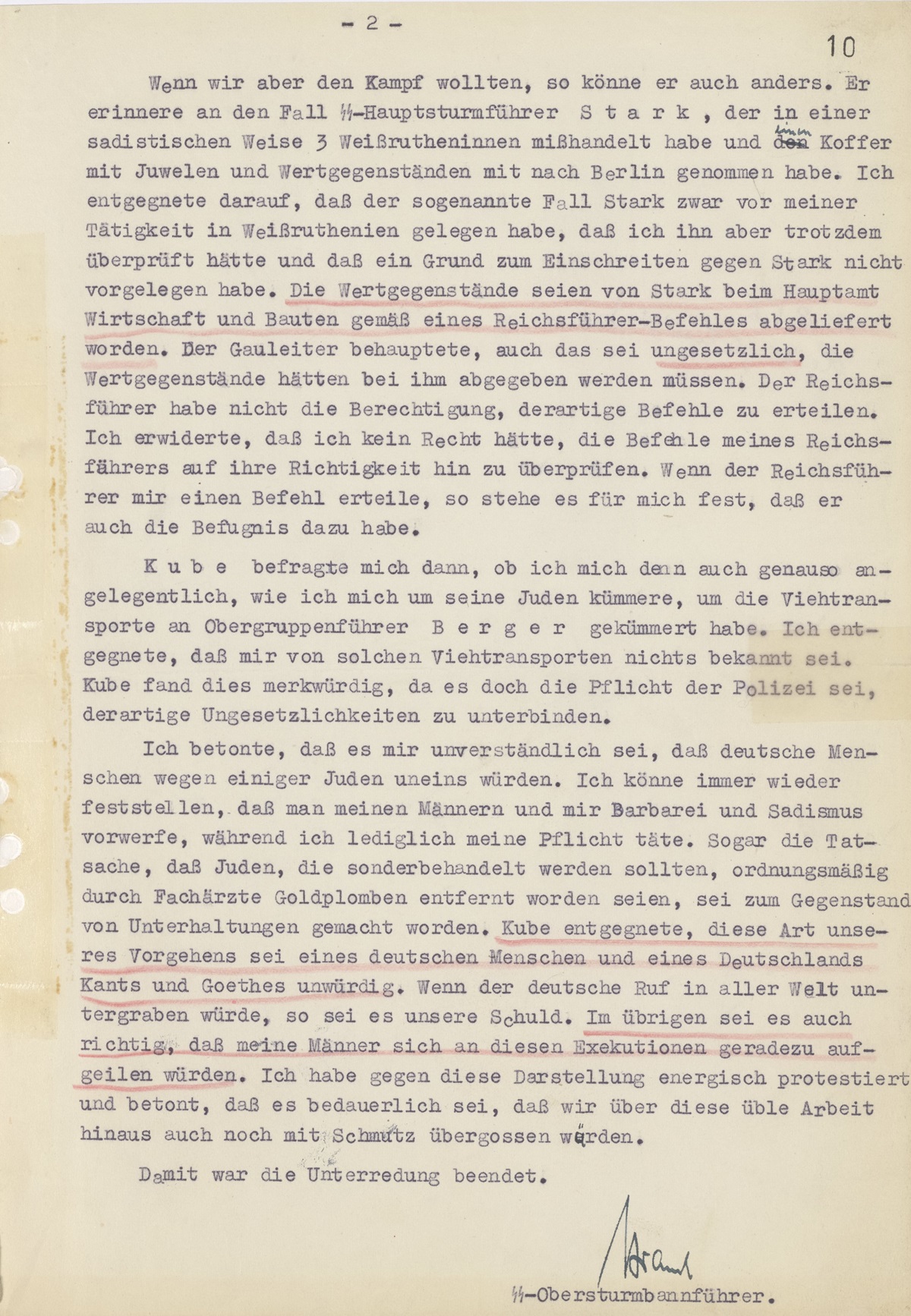
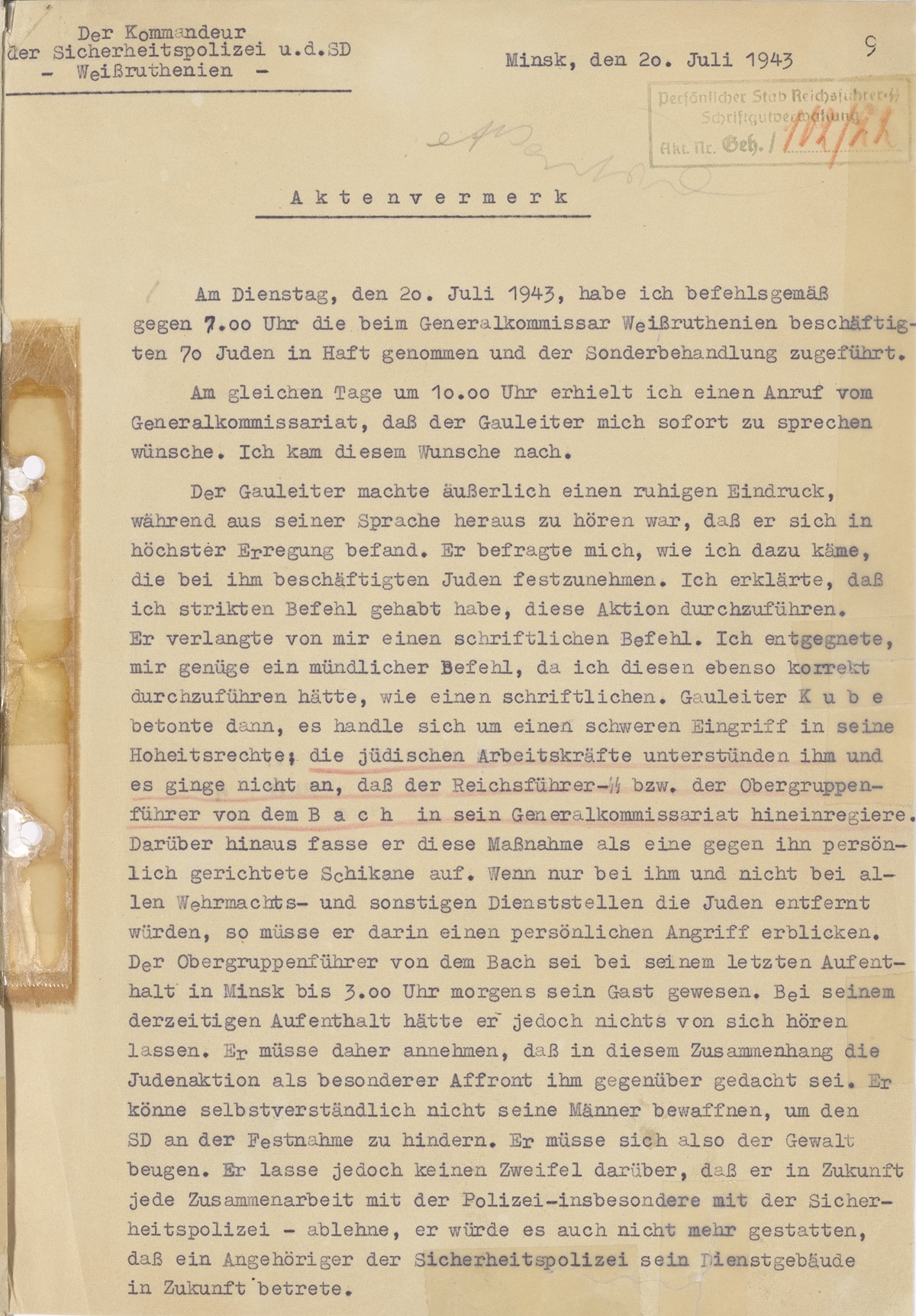
Quotations relating to the fate of the Jews in Belarus or in the Generalkommissariat Weißruthenien, which partly covers Soviet Belarus.
Quotations involving the SS officer Paul Blobel.
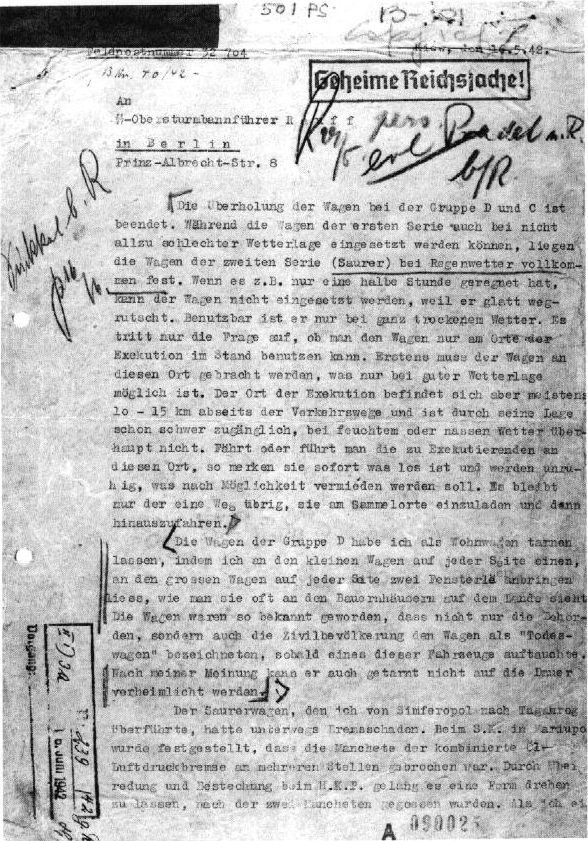
Quotations relating to the use of gas vans as a means of mass murder.
Quotations involving collaborators with the Nazi regime or events relating to collaboration.
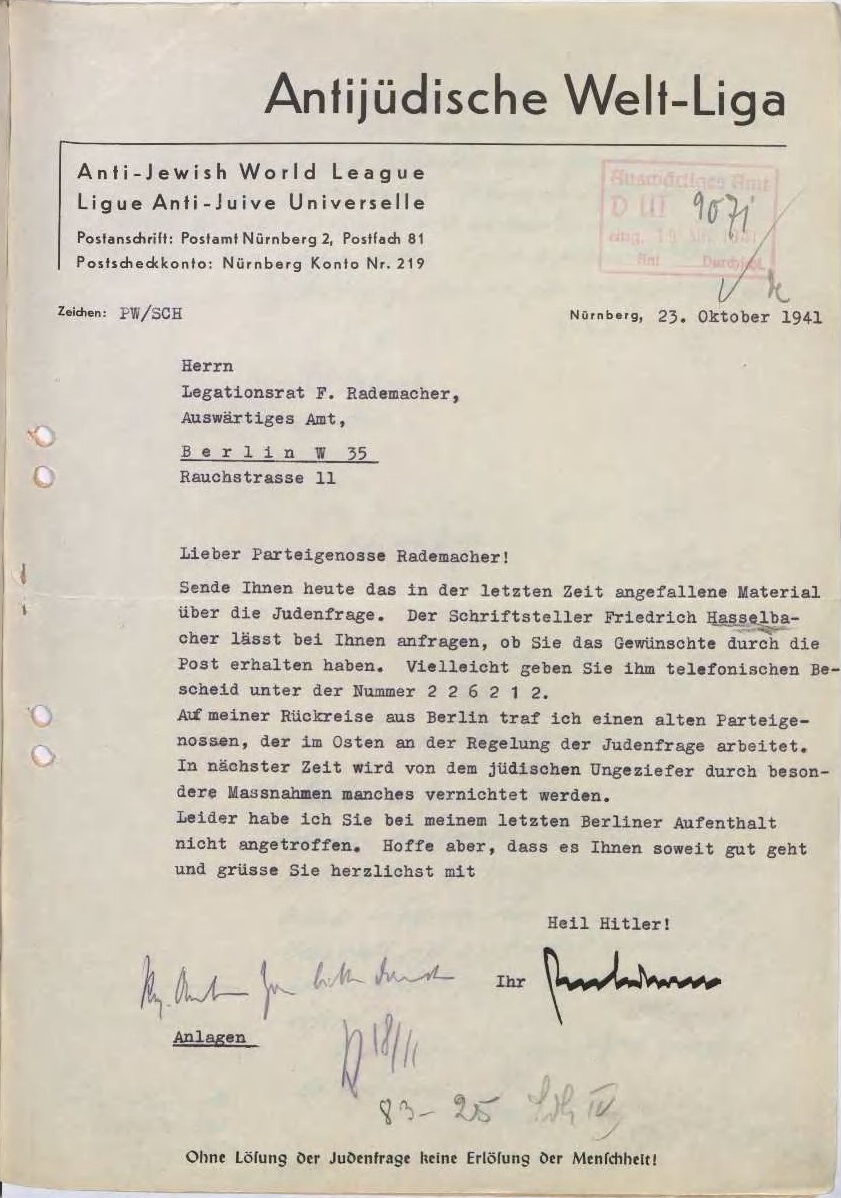
Quotations taken from private letters and correspondence as well as from intimate or personal diaries kept during the war.
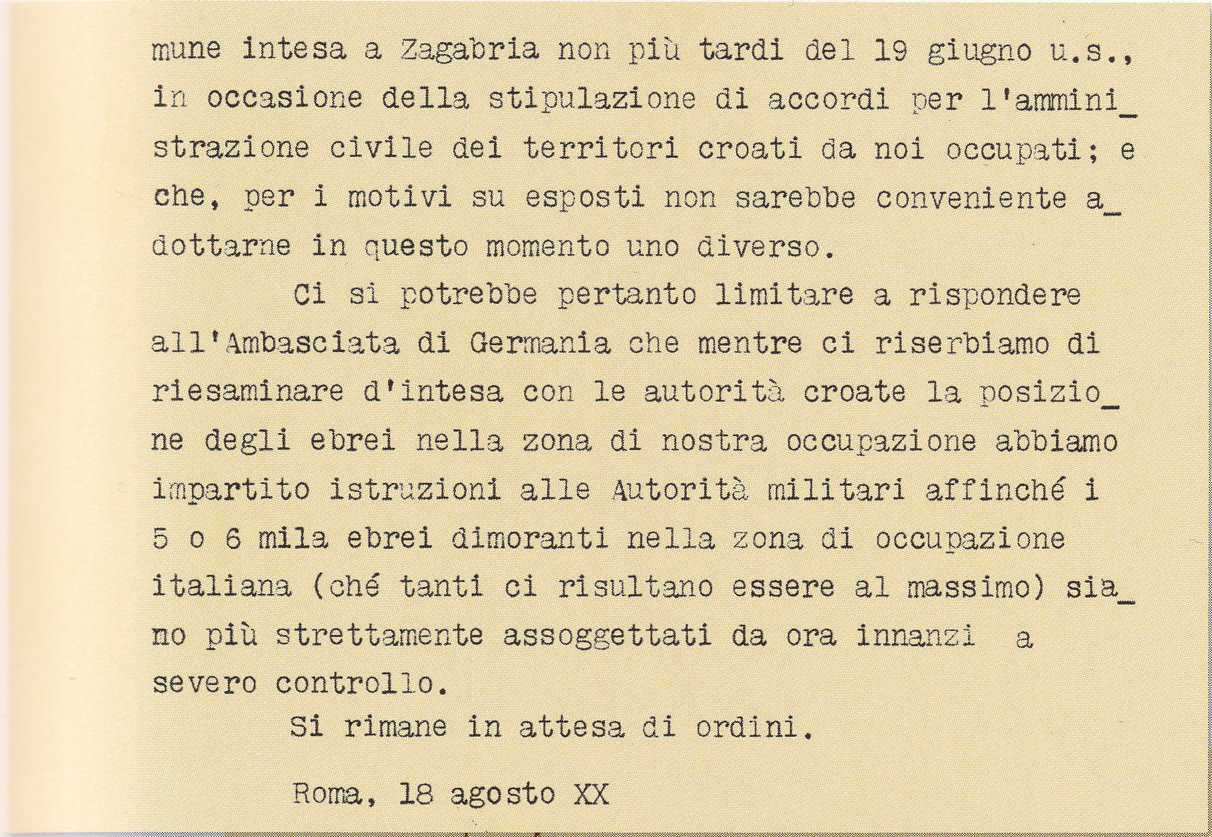
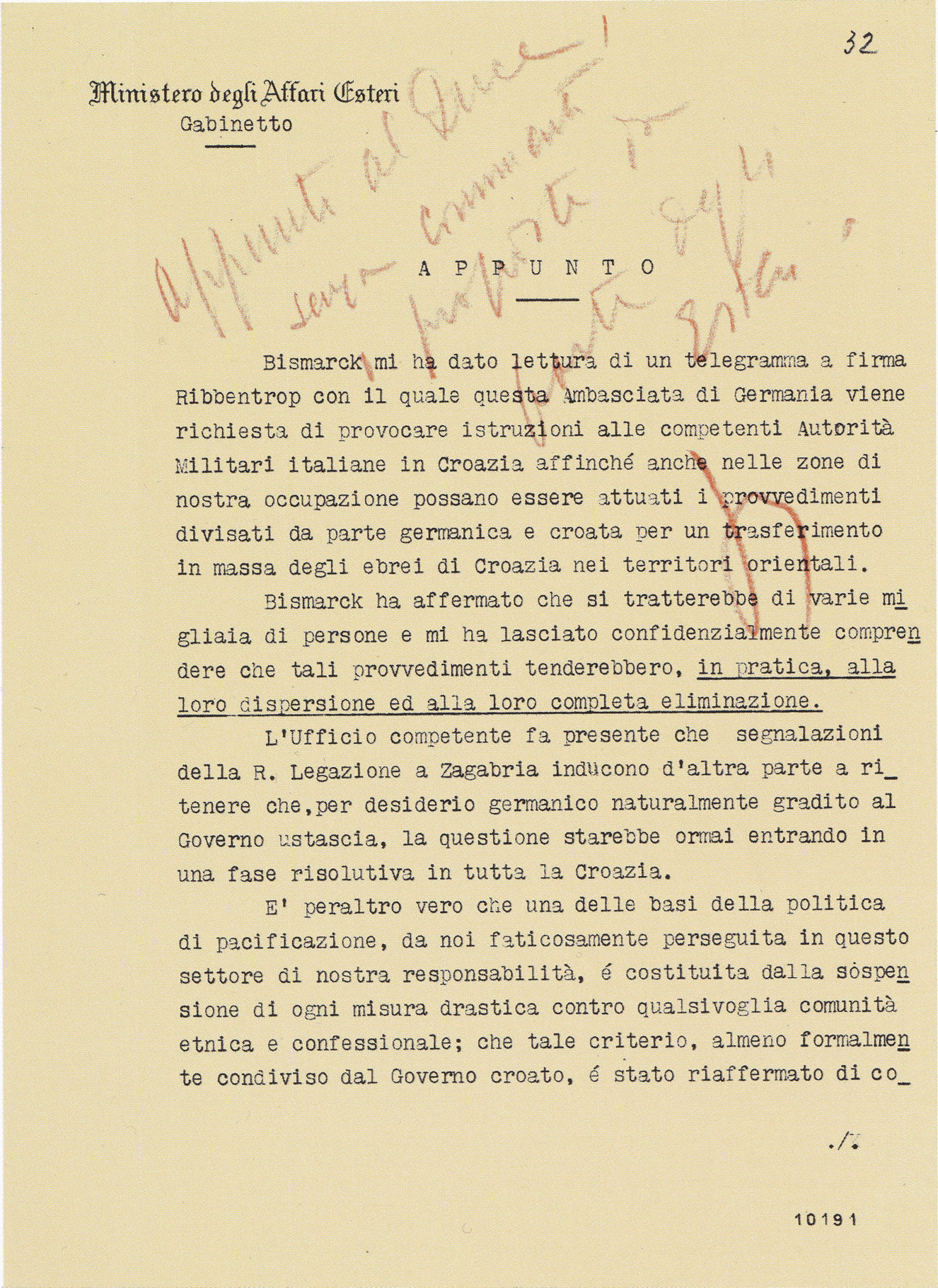
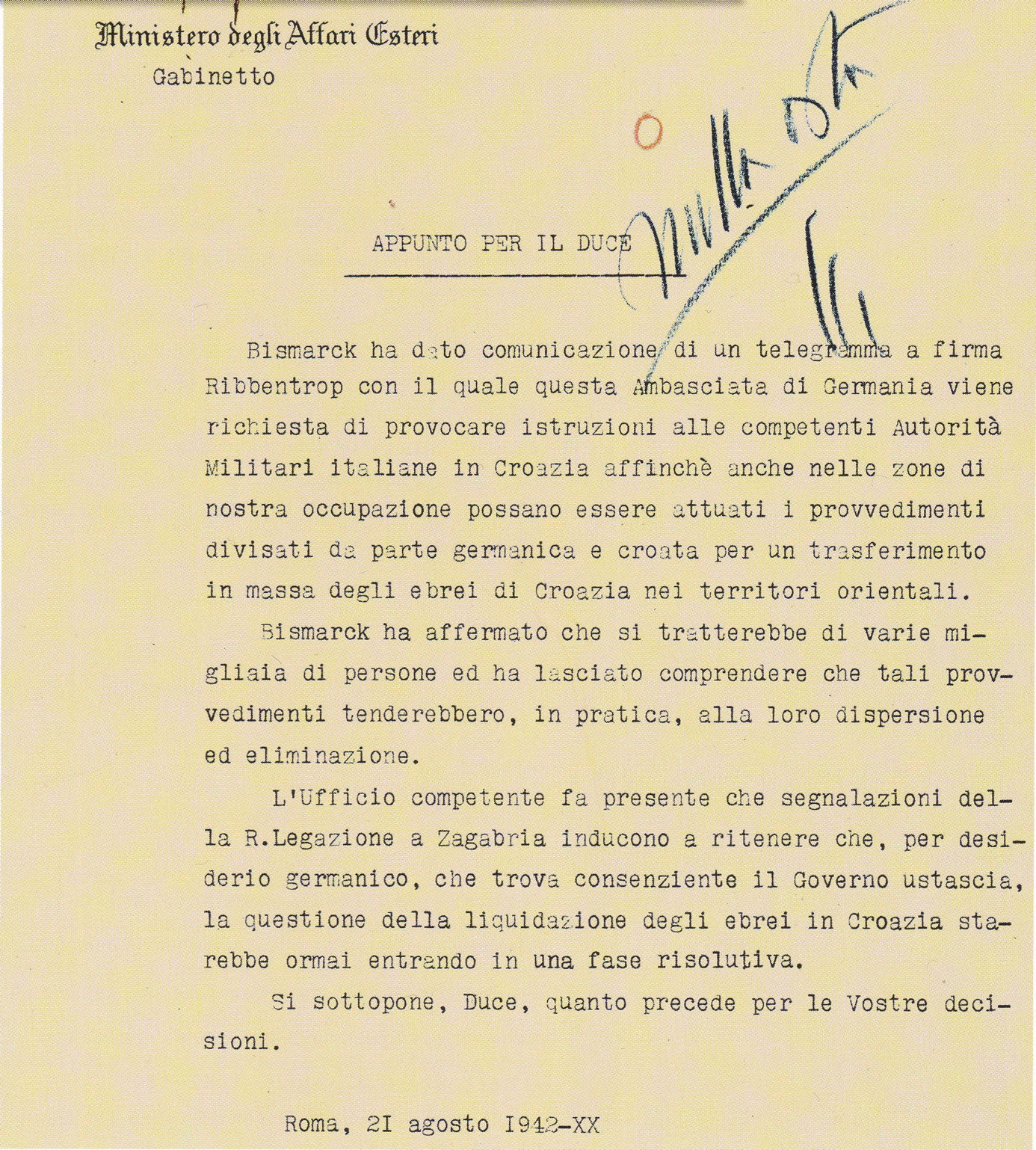
Quotations relating to events taking place in Croatia or connected with Croatia.
Quotations explicitly mentioning acts of cruelty or identifying cruel behaviour.
Quotations explicitly associating the «deportation», the «transport», the «displacement» of the Jews with their murder. This is sometimes coded language (see this keyword).
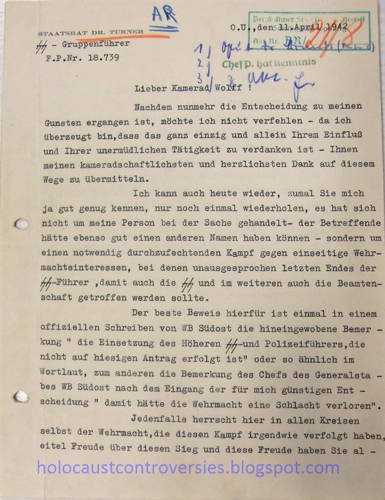
Quotations for which fuller treatments of the original documents are provided on PHDN or, at the very least, a facsimile.
Quotations relating to the action or role of Adolf Eichmann, or to documents of which he is the recipient or author.
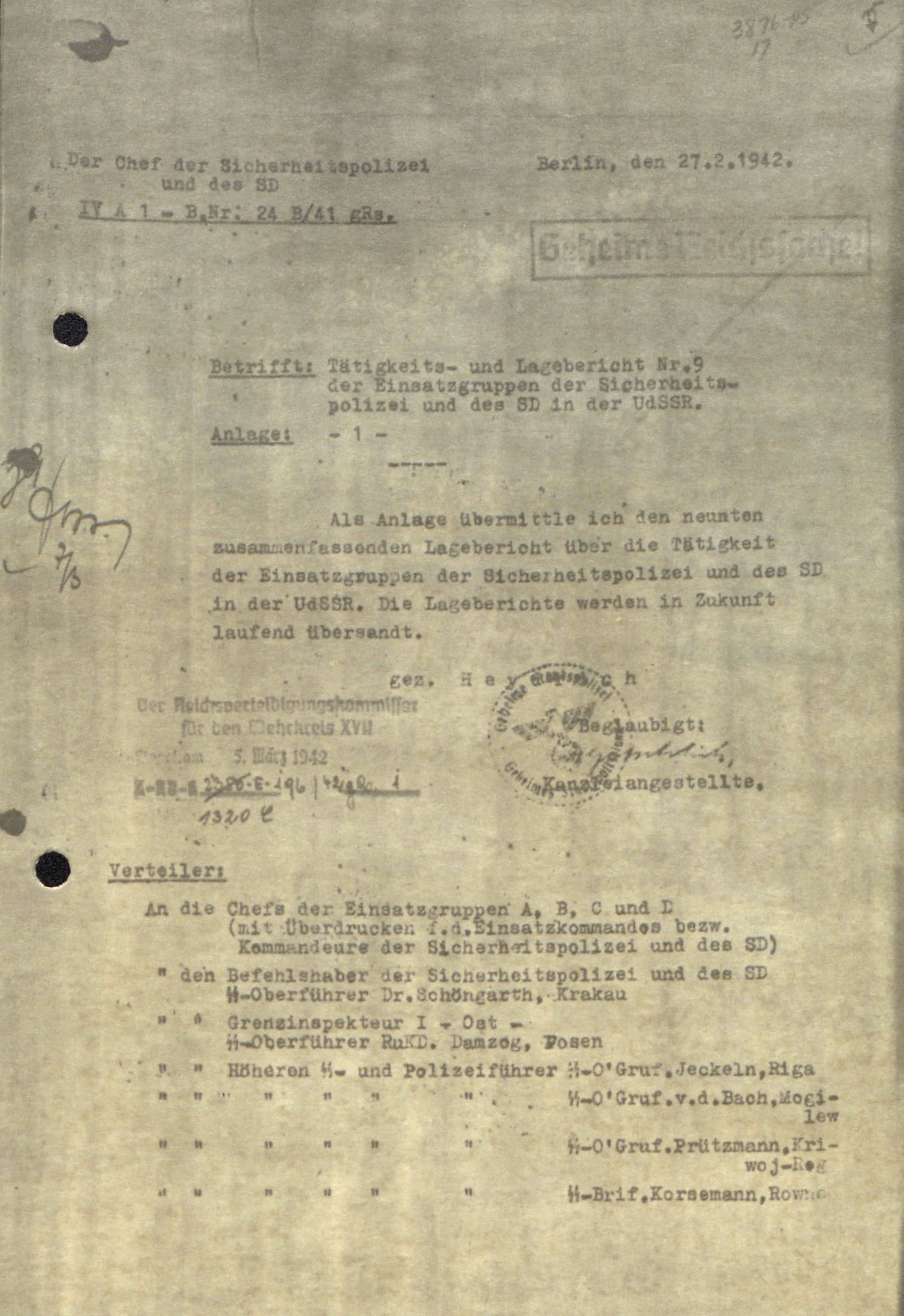
Quotations relating to the action of the Einsatzgruppen.
Quotations explicitly mentioning the fate of Jewish children or the murder of Jewish children.
Quotations designating the Jews as «the enemy» (der Feind) or «the enemies» of the German people, of our people, of the Aryans, of the Reich, of humanity, or again «our enemies», etc. The Jews are presented as the paradigmatic enemy, the worst enemy, the enemy par excellence, to the point that one of these expressions is sometimes used implicitly to designate the Jews without their being named. This designation, which is a chimerical projection, obviously legitimises any «measure» taken or to be taken against the Jews.
Quotations using the camouflage terms of «evacuation» (Evakuierung) or «resettlement» (displacement, Umsiedlung), or notions of «migration/emigration» to designate the massacre of the Jews, in documents where this meaning is explicitly revealed. See also the keyword «coded language».
Quotations explicitly mentioning Europe as the place where the fate of the Jews unfolds.
Quotations mentioning persons or events connected with the so-called «euthanasia» operation of murdering the sick and disabled by the Nazis (in particular Operation T4).
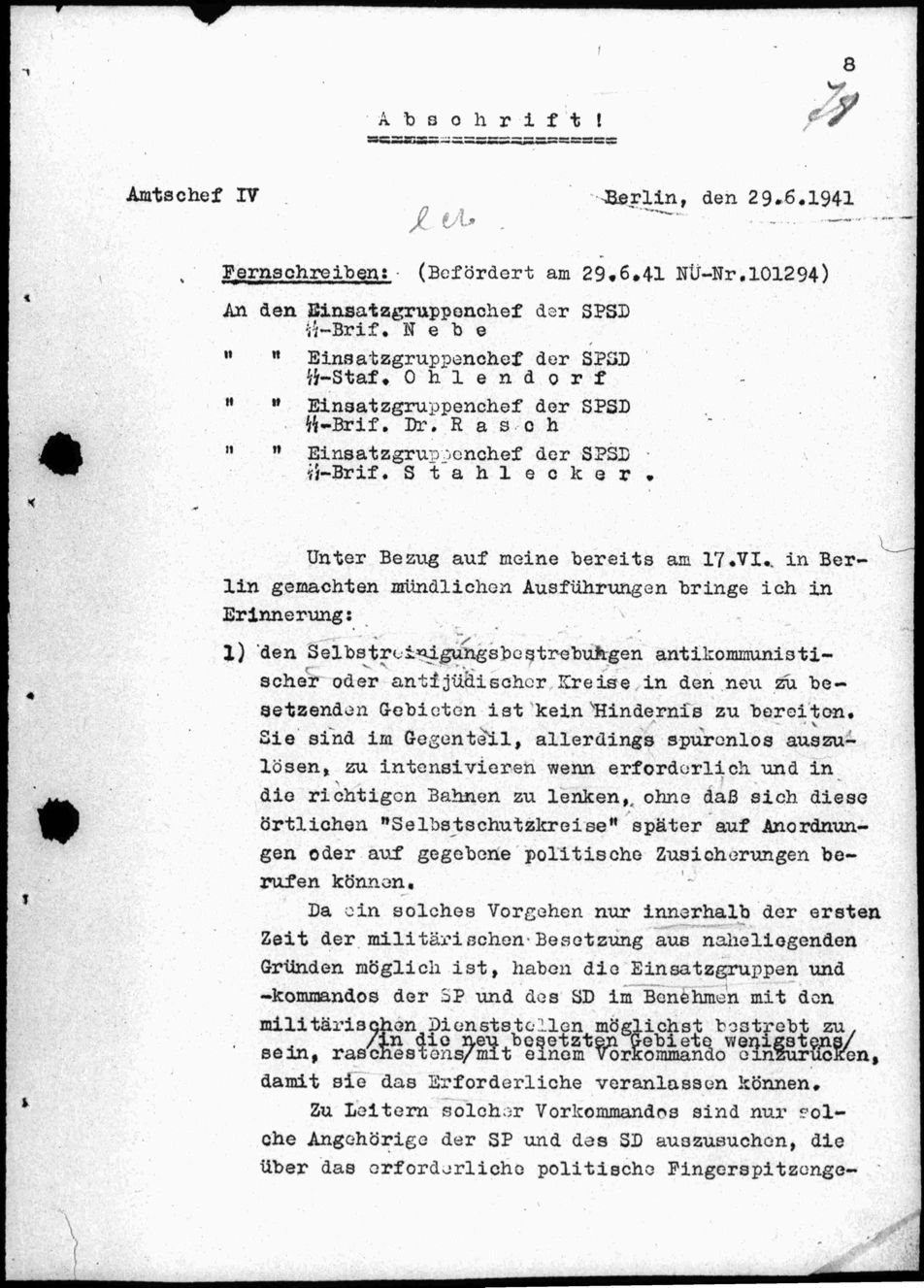
Quotations explicitly mentioning the plan or undertaking aimed at the extinction, the complete disappearance of the Jews.
Quotations mentioning the weapon of hunger against the Jews or the circumstances of famine they undergo.
Quotations mentioning the desire or the fantasy of putting the Jews to death, without this being clearly expressed as a plan to come or in the course of being carried out.
Quotations explicitly mentioning the fate or the murder of Jewish women.
Quotations concerning France.
Quotations by or mentioning the Nazi dignitary Hans Frank.
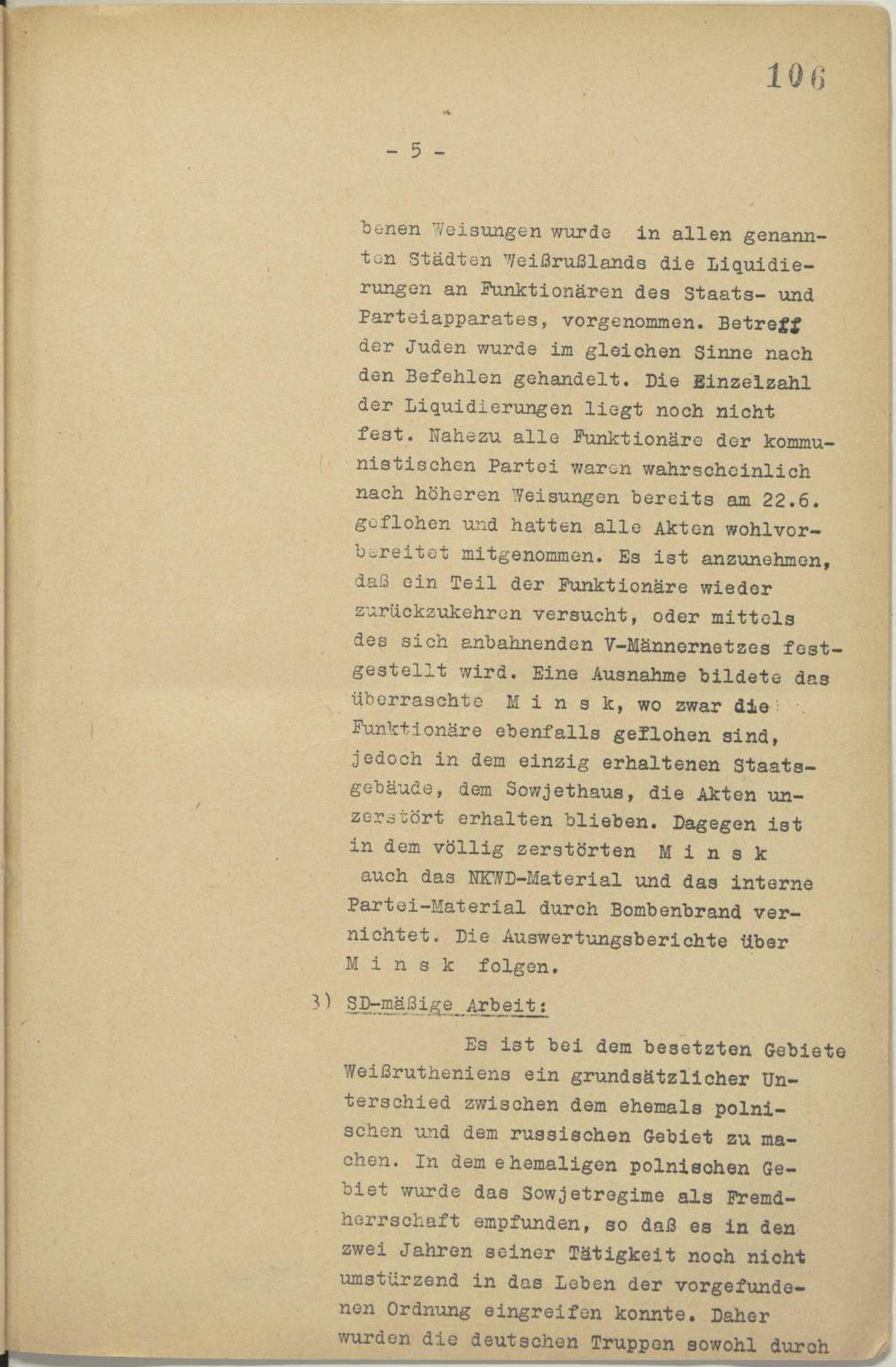
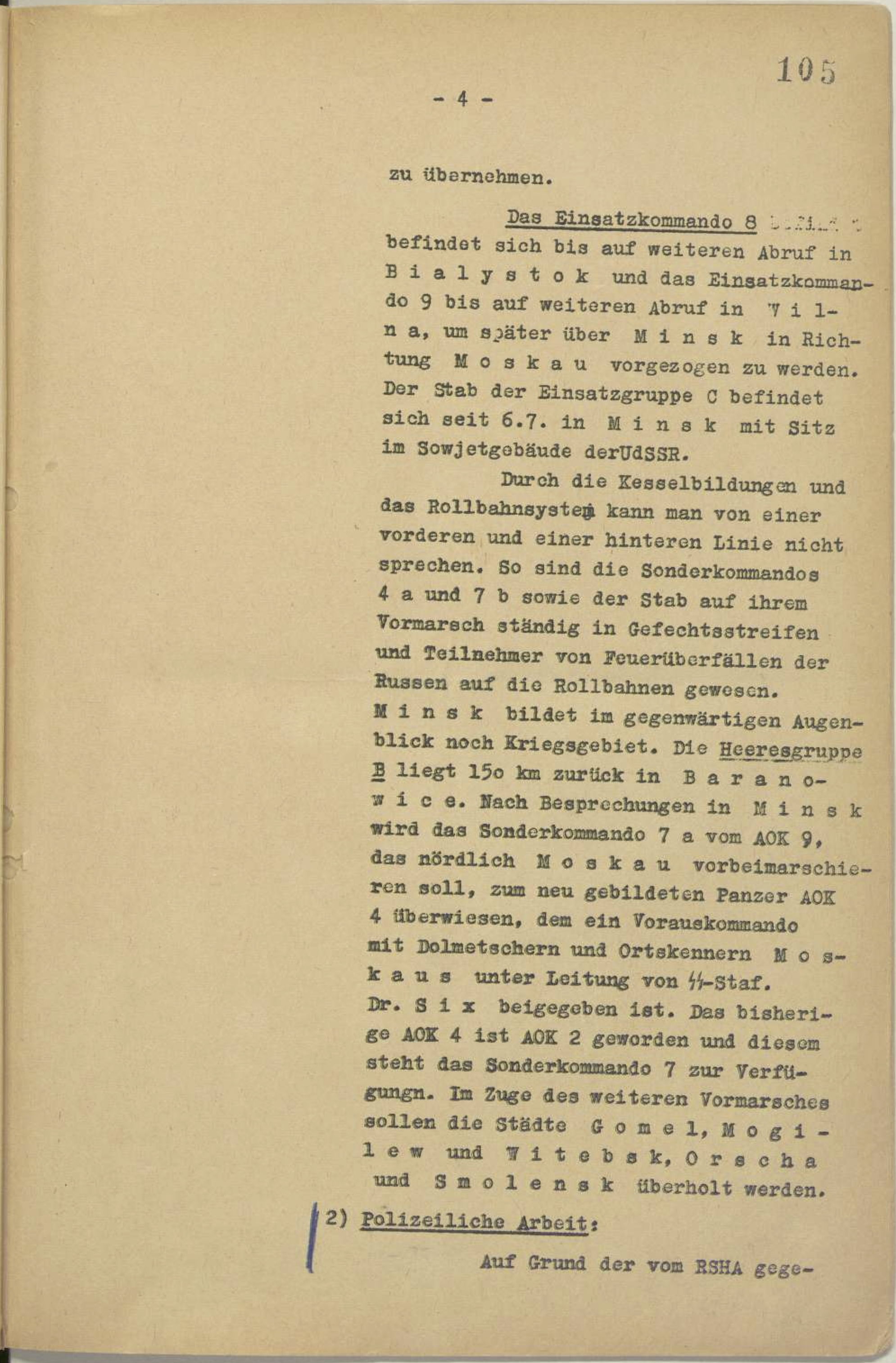
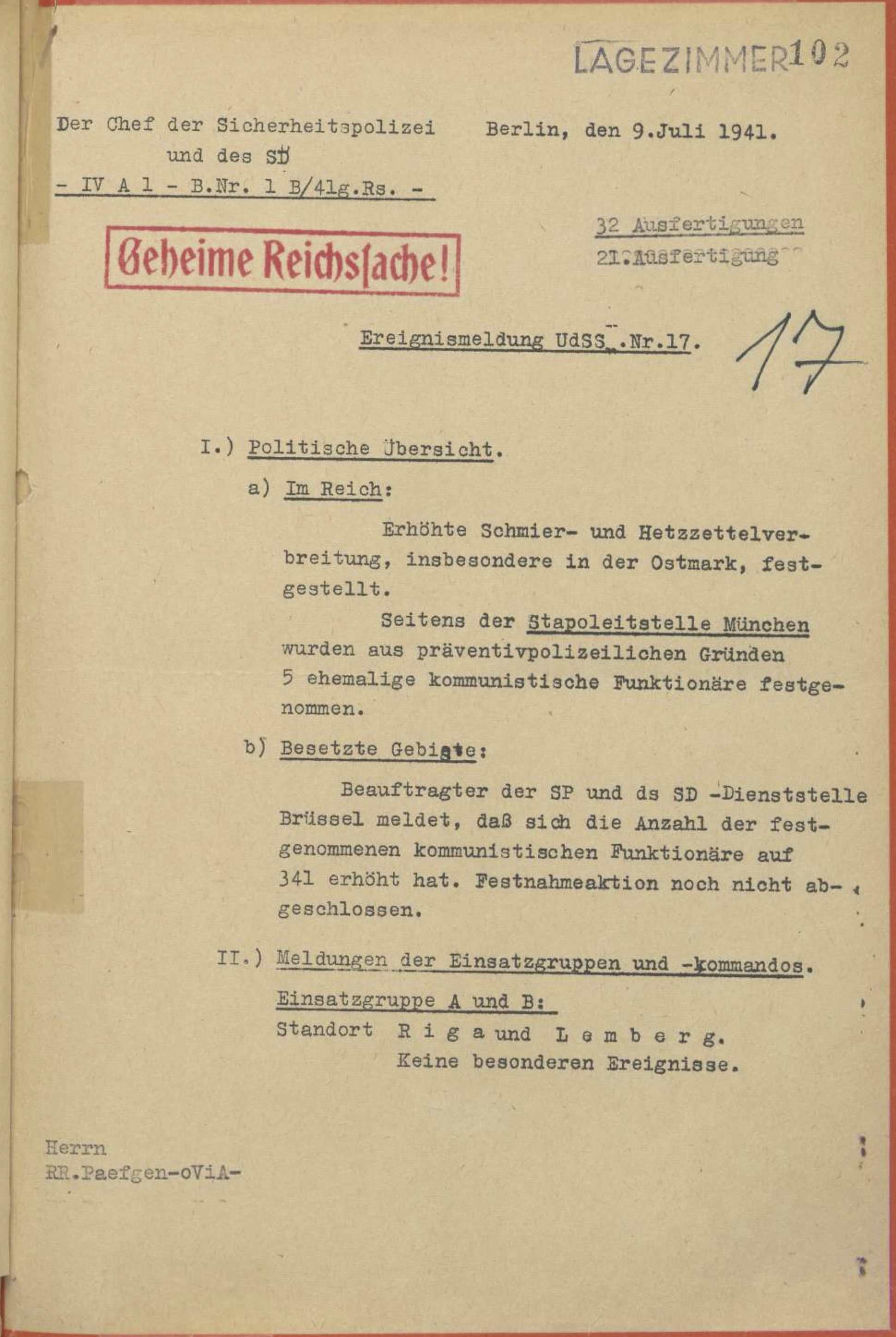
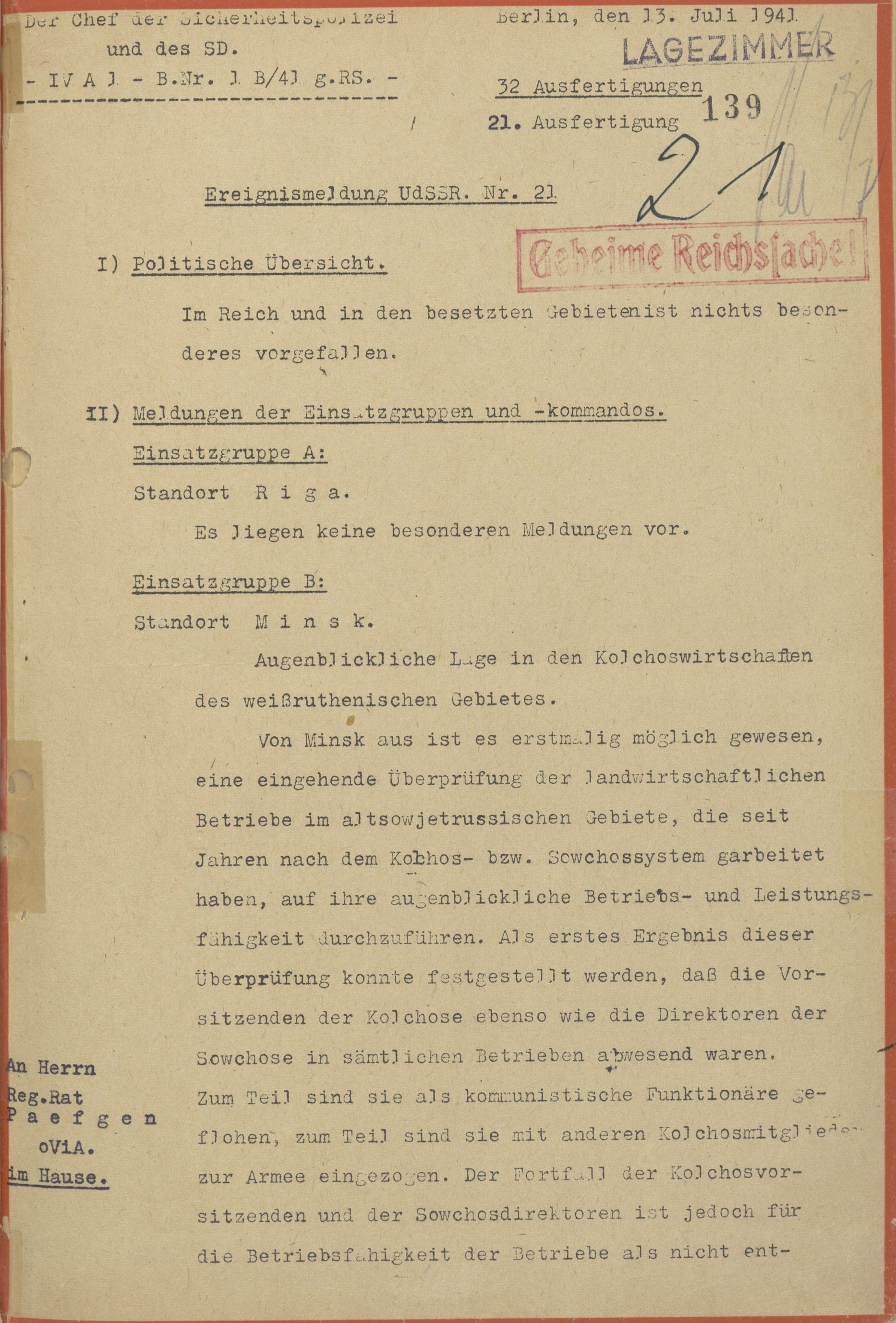
Quotations with an explicit or implicit connection to murder by gassing (gas vans, gas chambers, industrial killing centres, etc.).
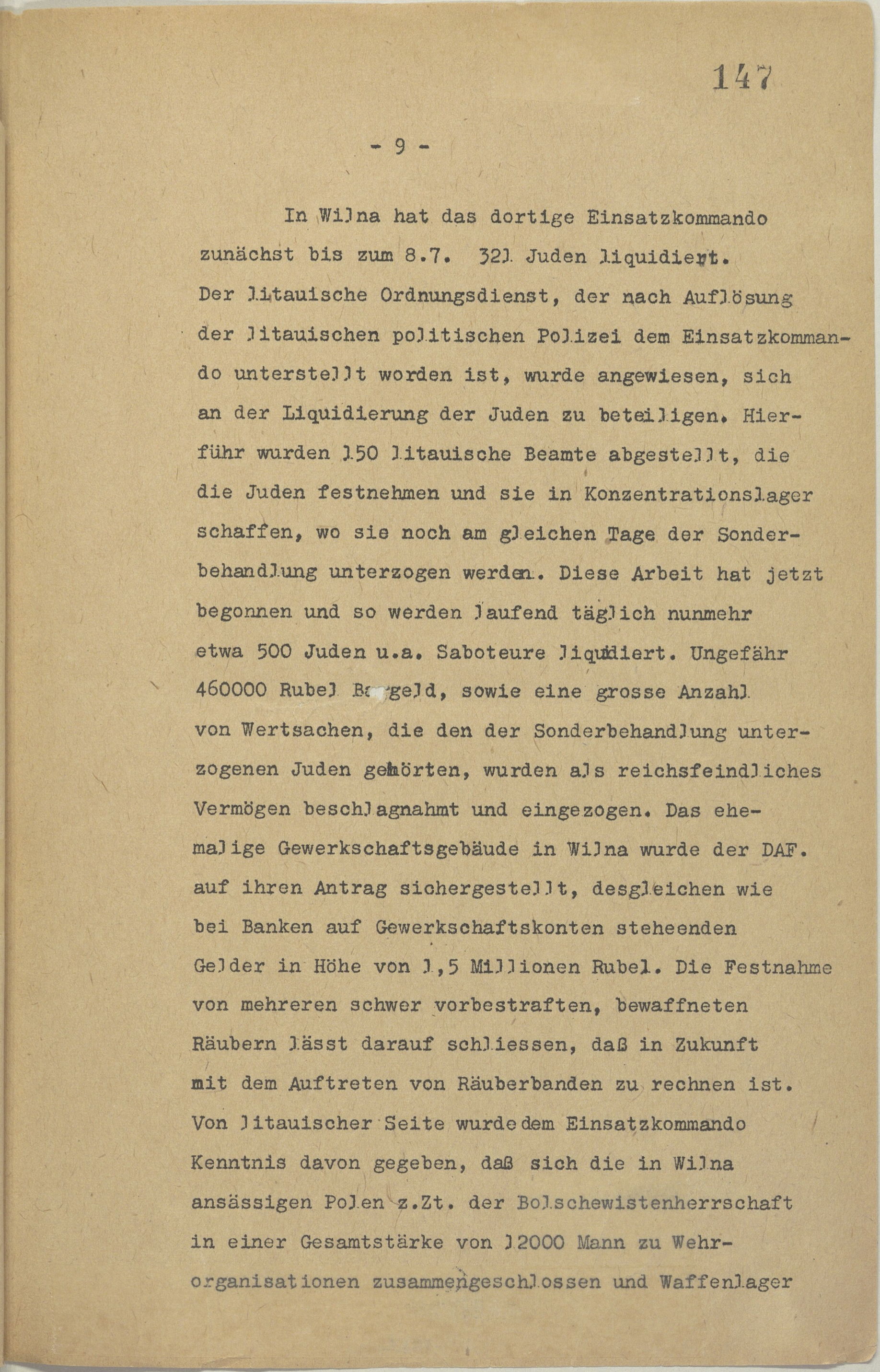
Quotations mentioning the ghettos or a particular ghetto where the Jews were temporarily confined before their murder.
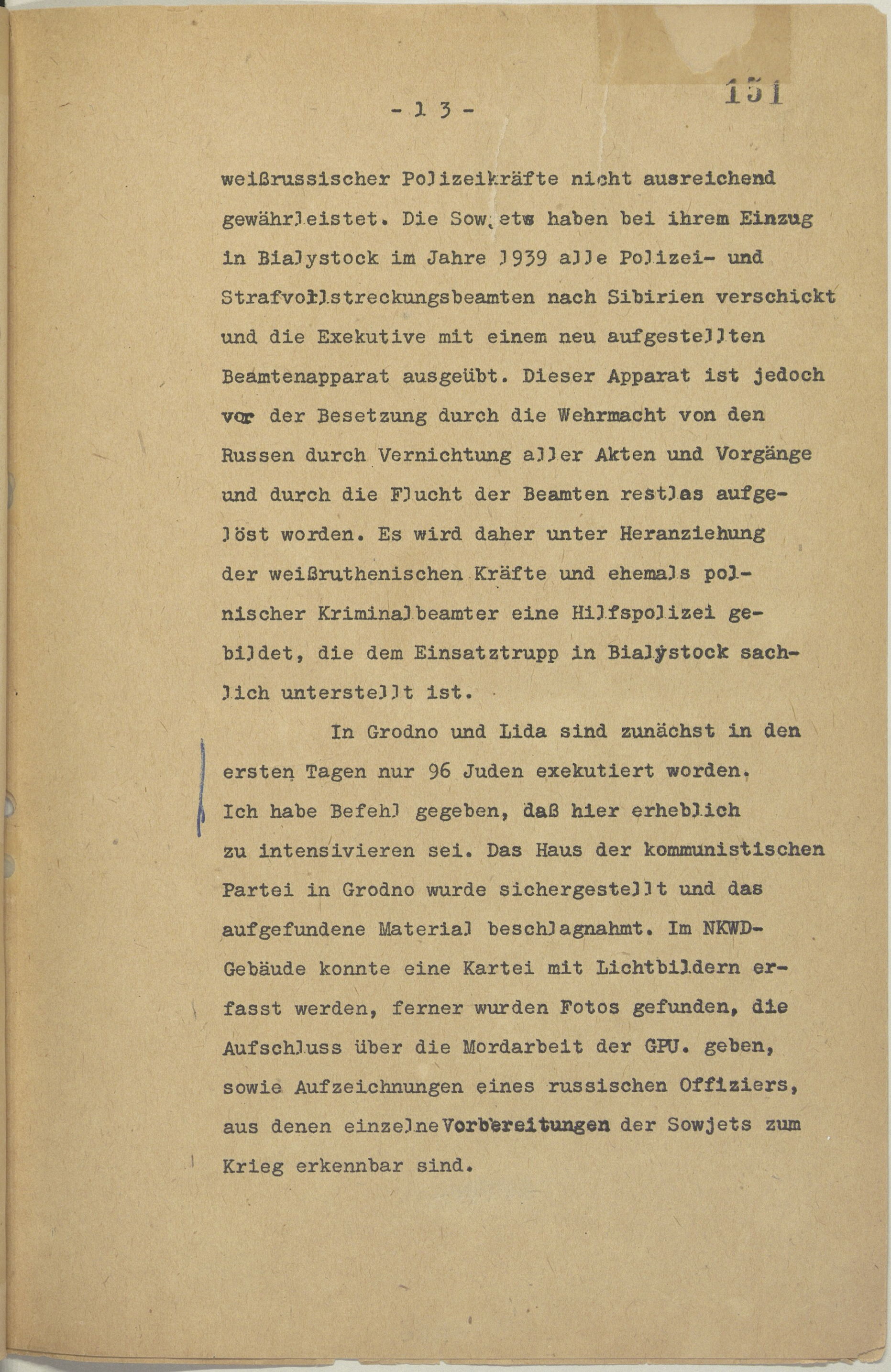
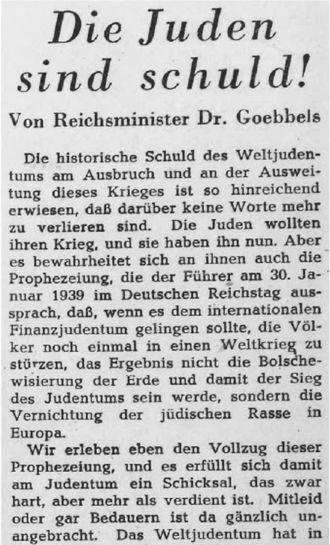
Quotations emanating from the Nazi propaganda chief Joseph Goebbels or mentioning him.
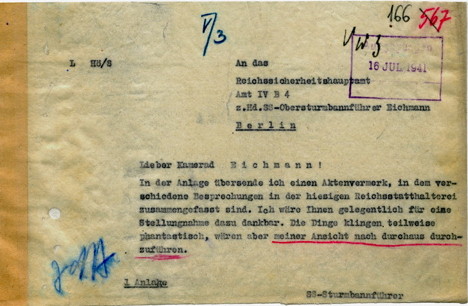
Quotations relating to events in the General Government (the part of occupied Poland not annexed to the Reich, including Warsaw).
Quotations from the diary of the German oppositionist Ulrich von Hassell, very close to senior Nazi officials of the General Government in Poland.
Quotations emanating from the Reichsführer-SS Heinrich Himmler, the number two of the Nazi regime, or mentioning him.
Quotations mentioning Hitler or Hitler’s links with the enterprise of exterminating the Jews. The statements made by Hitler about the Jews appear on another dedicated PHDN page.
Quotations invoking «humanity» (Menscheit), opposing the Jews to «humanity», the whole of human beings, human beings in general most often, a whole from which the Jews are excluded, they being at best constitutive of a «sub-humanity», of which humanity must be purged, freed. More rarely, the Jews are opposed to «Aryan humanity», the Nazi paradigm, the elite of «humanity».
Quotations emanating from or relating to Reinhard Heydrich, Himmler’s right-hand man.
Quotations relating to the fate reserved by the Nazis for the Jews considered «unfit for work».
Quotations mentioning information about the extermination of the Jews outside Nazi circles or the milieus supposedly alone in the know.
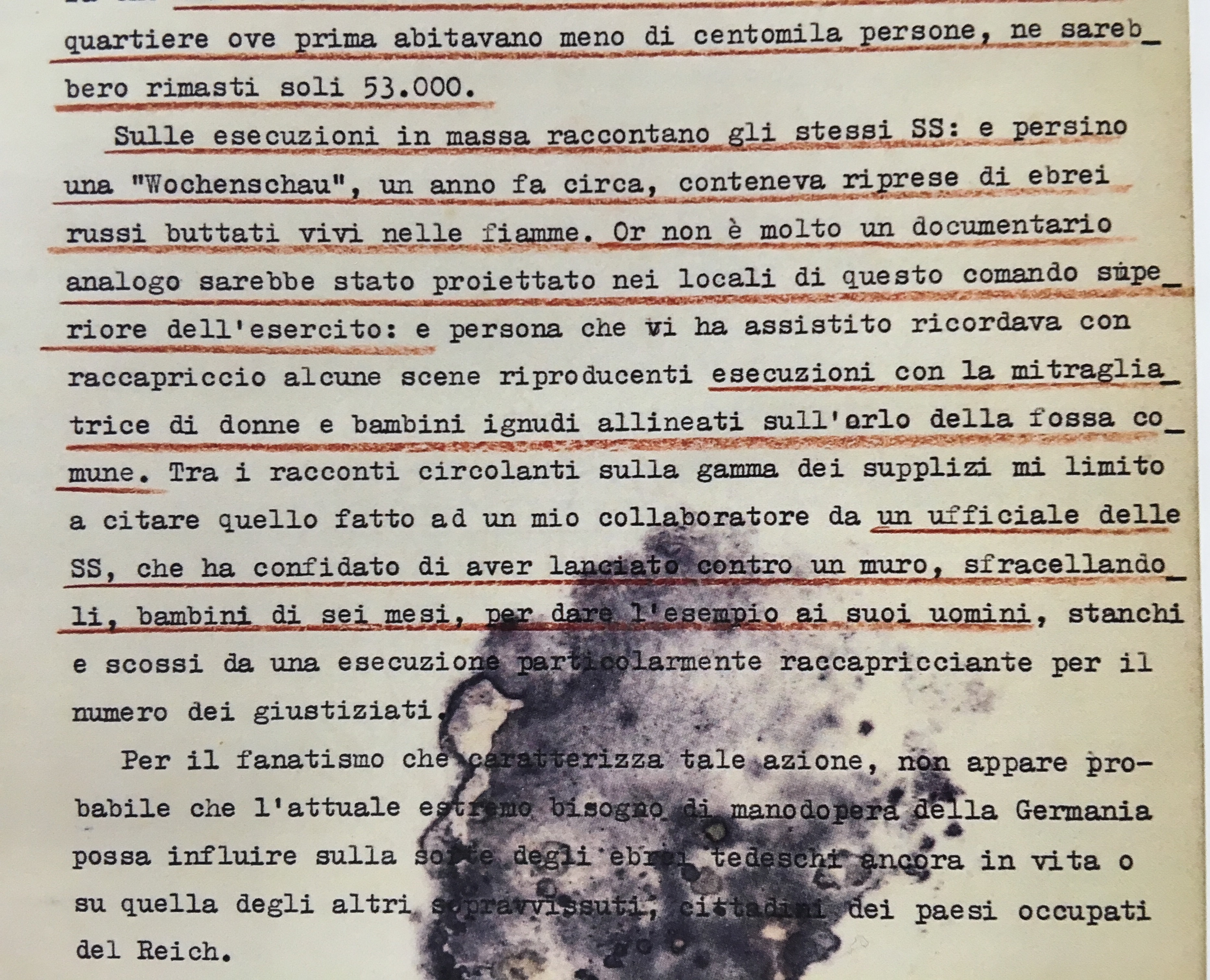
Quotations involving Italian actors.
Quotations relating to the fate of German Jews or to German Jews.
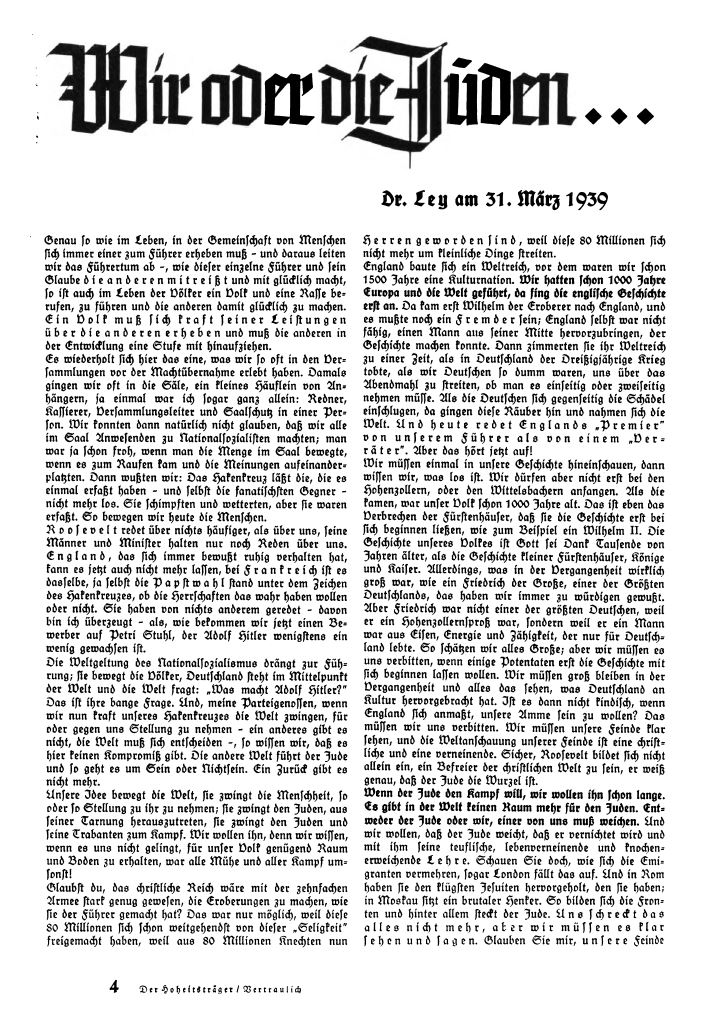
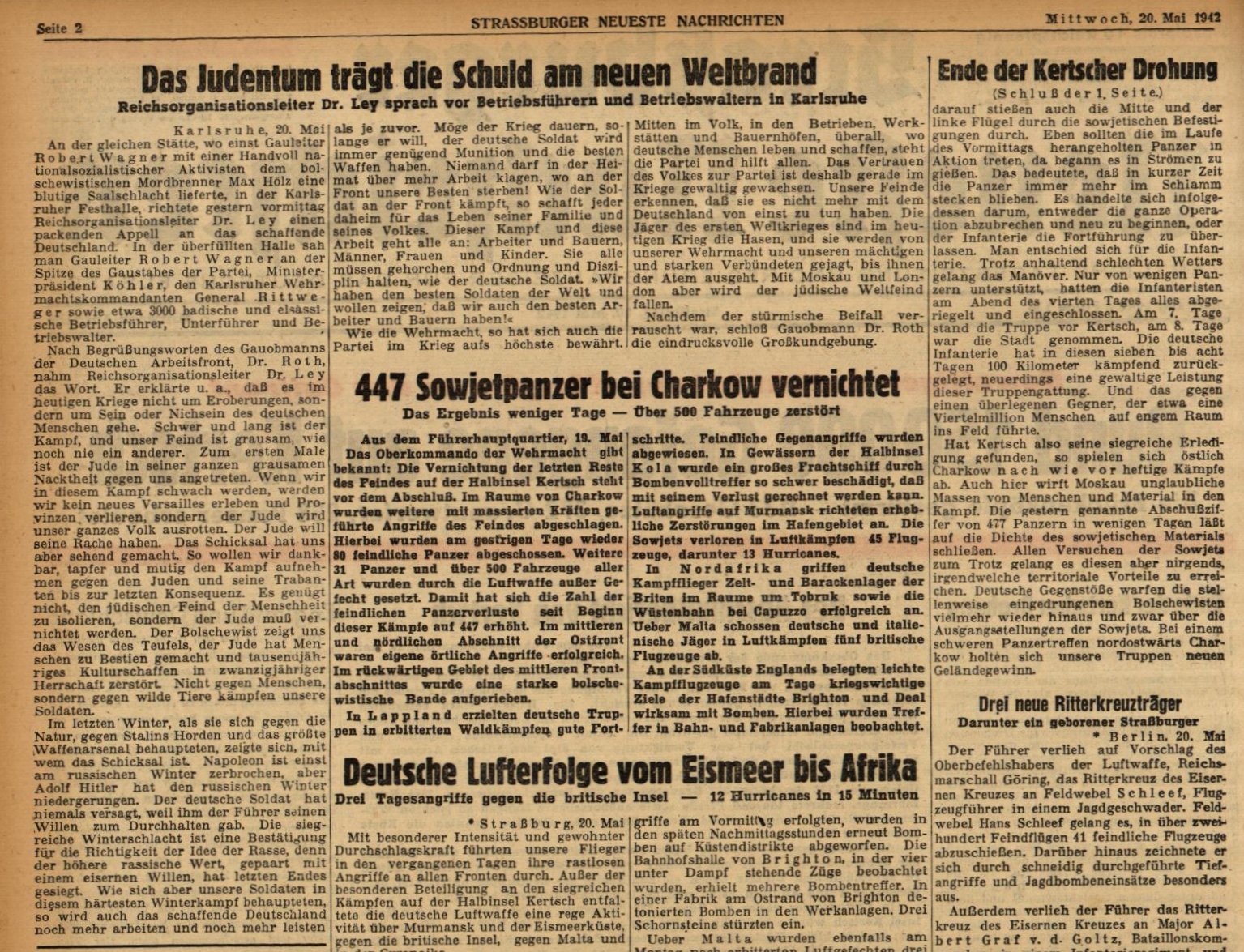
Quotations emanating from the Nazi dignitary Robert Ley. He is one of the propagandists to have been the most candid, both about the desire and the plan of the extermination of the Jews, and about its implementation, all within an extremely violent antisemitic discourse.
Cases where coded language, camouflage terms or euphemisms are used in documents but where their real meaning of mass murder of the Jews also appears explicitly (mainly evacuation, resettlement, special treatment, special action, but also in certain cases deportation, transport).
Quotations mentioning the expression «liquidation» of the Jews in its various forms (liquidieren, liquidierung, liquidation, liquidiert)
Quotations mentioning the city or the ghetto of Lodz (Litzmannstadt) in the Warthegau.
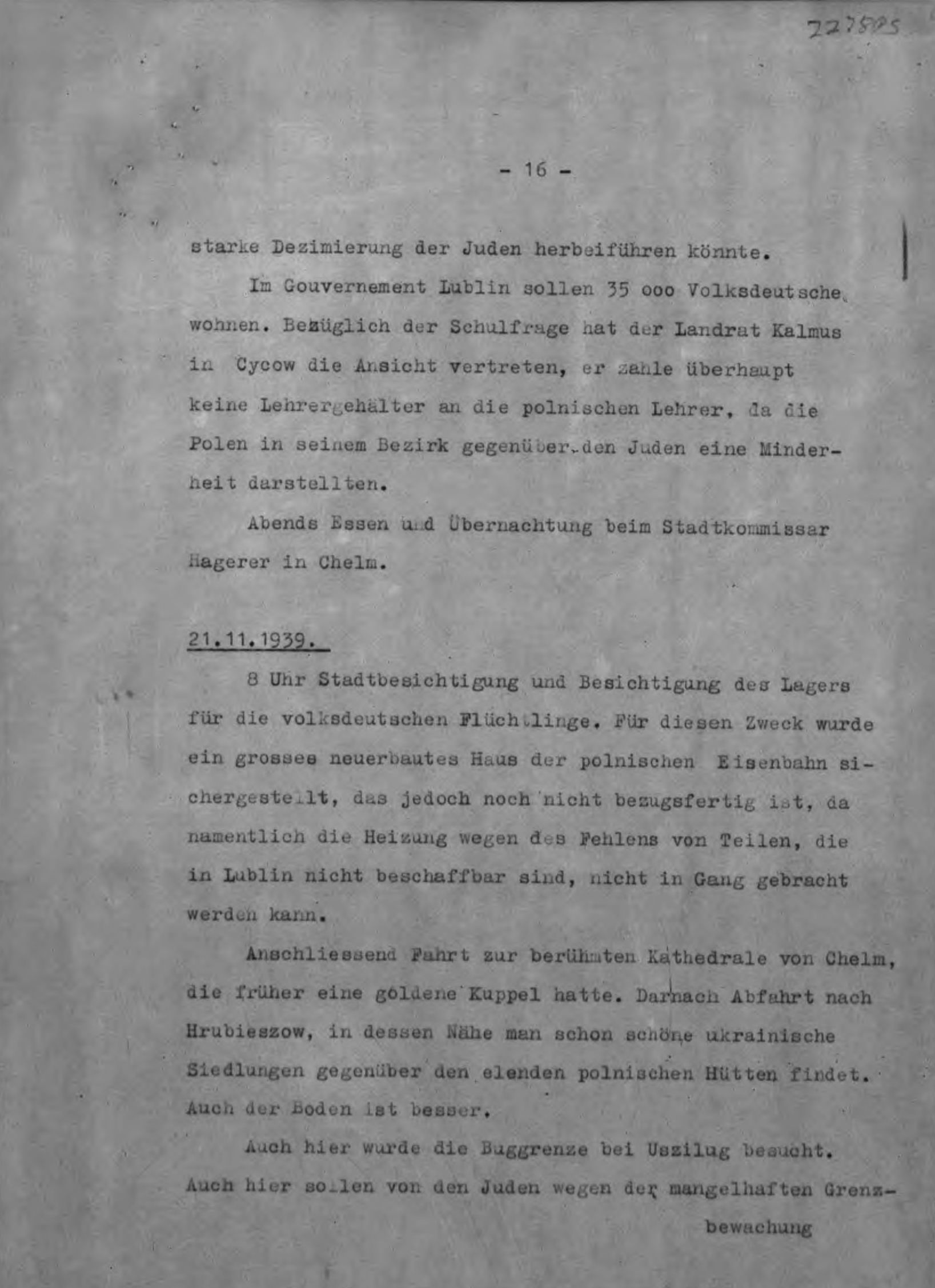
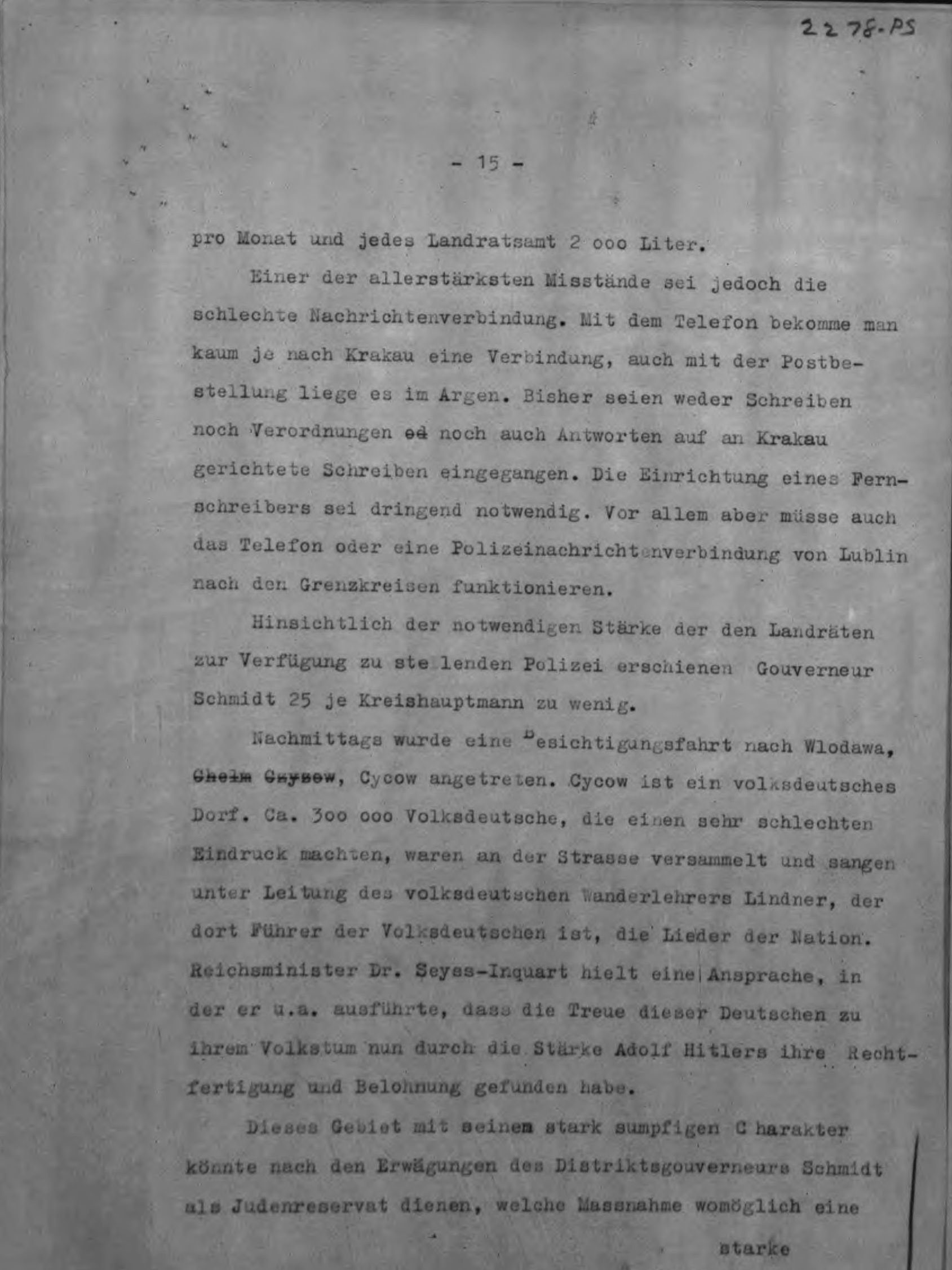
Quotations relating to the city of Lublin in Poland.
Quotations mentioning the diseases the Jews fall victim to or of which they are considered carriers.
Quotations relating to the fate of the Jews throughout the world or in connection with the whole of humanity.
Quotations explicitly mentioning, often with figures, murdered Jews.
Quotations connected with Mussolini (in particular what Mussolini was informed of).
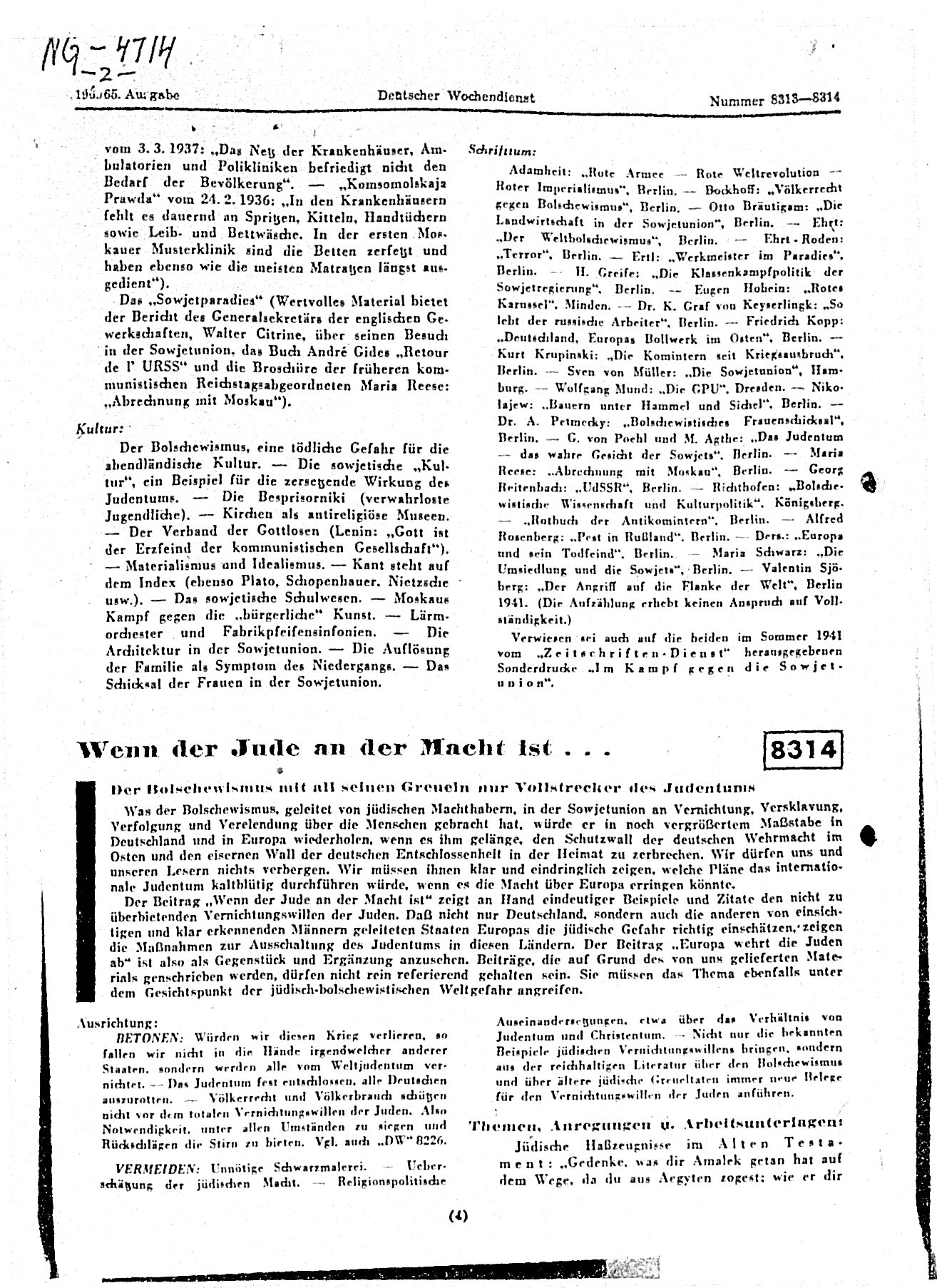
Quotations from documents produced during the Nuremberg trials between 1946 and 1948, or from documents forming part of the documentary corpora assembled for those trials, or linked to such documents.
Quotations relating to men or to actions of the German opposition to the Nazis and to their knowledge of the extermination of the Jews.
Quotations mentioning the existence of orders or instructions connected with the murder of the Jews.
Quotations relating to events that occurred in the Baltic states (Estonia, Latvia, Lithuania).
Quotations identifying or comparing the Jews to parasites (lice, bacilli, etc.) or relating to a «sanitary» or zoological (various animals) vision of the Jews.
Quotations mentioning pogroms or «spontaneous» massacres of Jews by local populations.
Quotations relating to Poland (including places already covered by other keywords).
Quotations relating to the fate of Poles or to Poles, in particular compared with that of the Jews.
Quotations relating to (or remarks made in) the city of Posen (Poznan).
Quotations containing accusations against the Jews attributing to them acts or plans that were in fact systematically those of the Nazis or their allies towards them. This is one of the main rhetorical mechanisms of exterminatory antisemitism, for it justifies in the eyes of the Nazis all the measures taken, all the abuses including mass murder, against the Jews as self-defence «preventive» measures. From the displayed if not internalised certainty of being the target of a plan (totally fictitious and fantasised in fact) of extermination on the part of the Jews follows the «necessity» of killing the Jews, the first to do so. The Jews are murdered because they are guilty (in reality chimerically) in the eyes of the Nazis of wanting to persecute if not annihilate the Germans, and because the Nazis see in the extermination of the Jews the necessary condition of their own survival and of the success of their plan of racial domination.
Quotations relating to the plan of collective murder of the Jews, to come or in the course of being carried out.
Quotations relating to Hitler’s «prophecy» of 30 January 1939, in which he had announced «the annihilation of the Jewish race» in Europe in the event of a new war.
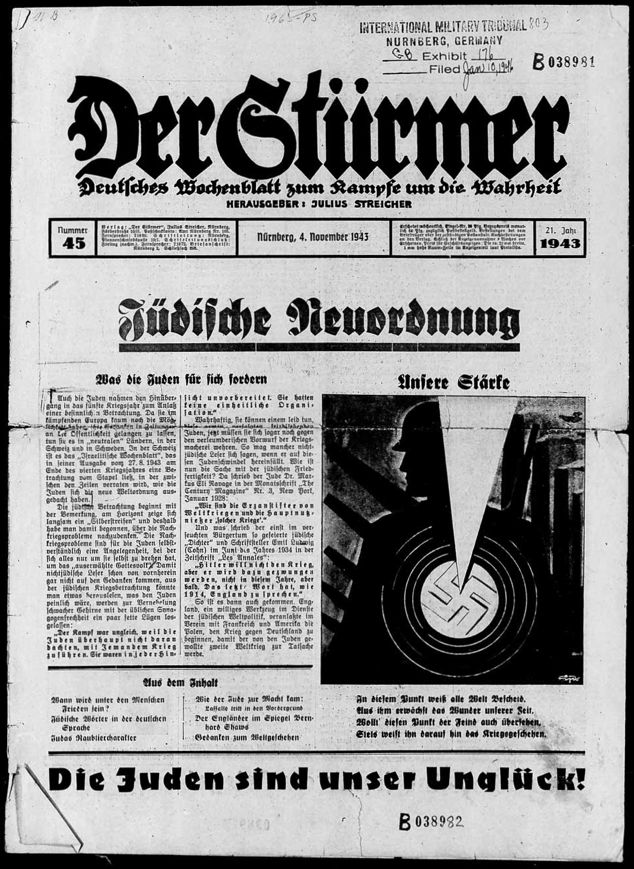
Quotations or remarks relating to the murder of the Jews made publicly (speeches and newspapers, including before «limited» but significant audiences).
Quotations setting out a racist (in the biological sense) vision of the Jews and justifying their extermination by racist considerations (inferiority, etc.).
Quotations in which the notions of a «radical», «uncompromising», «complete», «definitive» solution, etc., appear, which mark the extreme (murderous) character of the fate envisaged for the Jews.
Quotations reporting the actual carrying-out of the collective murder of the Jews.
Quotations relating to Operation Reinhard (the extermination of the Jews of the General Government in the three industrial killing centres of Belzec, Sobibor and Treblinka).
Quotations in which the persecution and murder of the Jews are justified as «reprisals», sanctions, for behaviours or intentions ascribed to the Jews.
Quotations emanating from the Nazi dignitary Alfred Rosenberg, one of the principal and most violent Nazi theorists and Reich Minister for the Occupied Eastern Territories.
Quotations relating to events taking place in Romania or connected with Romanians or the Romanian regime.
Quotations in which the secret character of the collective murder of the Jews is explicitly mentioned.
Quotations relating to events that occurred in Serbia.
Quotations relating to the massacres of Jews by execution with rifle, machine gun or pistol.
Quotations by or relating to ordinary soldiers of the German army.
Quotations evoking the sterilization of the Jews as a means of their extinction.
Quotations involving or emanating from the SS-Obersturmbannführer Eduard Strauch, one of those principally responsible for the mass massacres in Belarus.
Quotations in which the Nazi euphemism «special treatment (Sonderbehandlung)», or even «special action» (Sonderaktion) (or even the single adjective «special») is used transparently to designate the murder of the Jews. See also the keyword «coded language«.
Quotations concerning the murder of Roma.
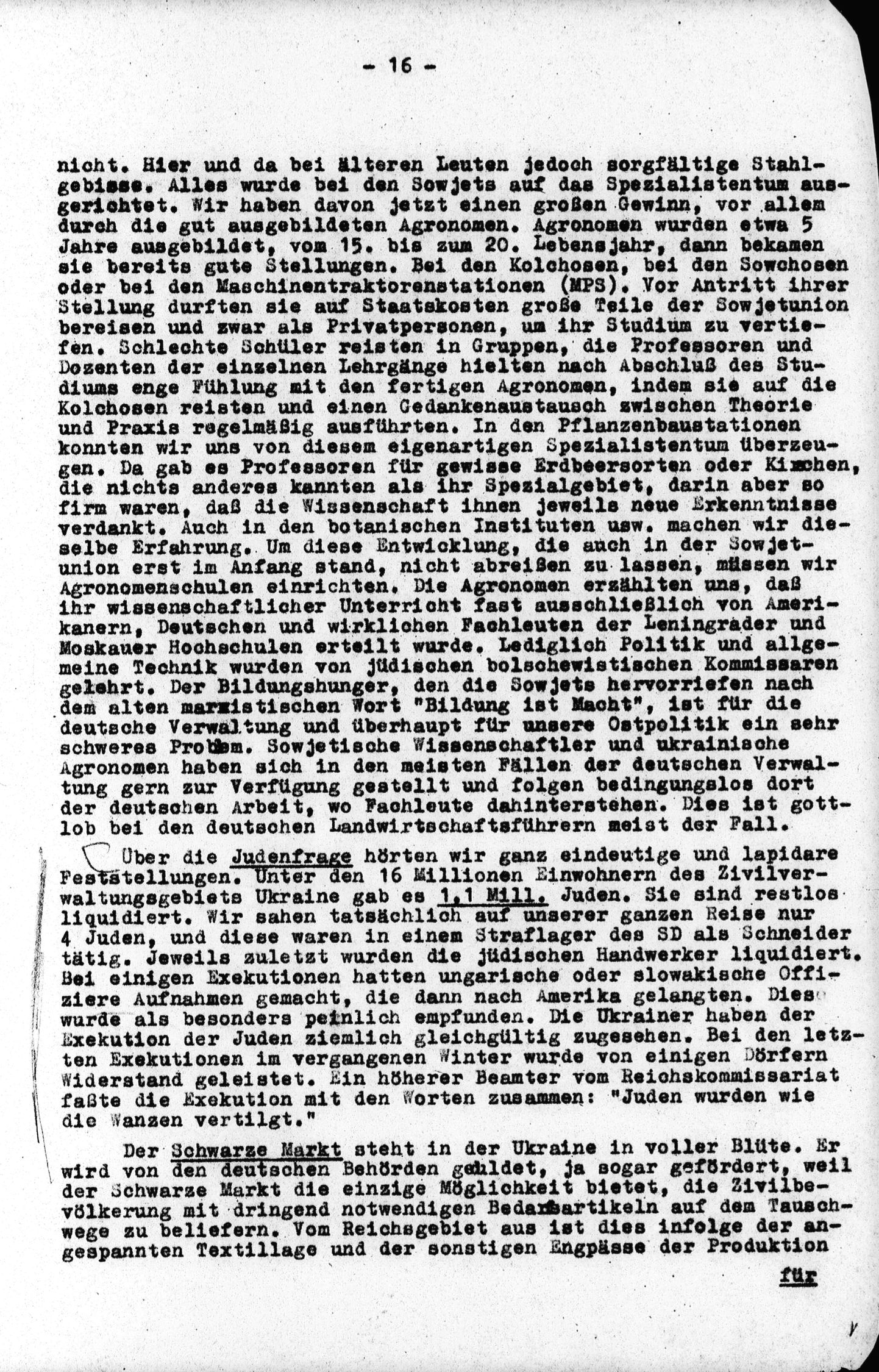
Quotations relating to the fate of the Jews in Ukraine.
Quotations relating to the fate of the Jews in the USSR (Russia and Belarus, possibly Eastern territories unspecified, excluding Poland).
Quotations relating to the fate of the Jews in Warsaw.
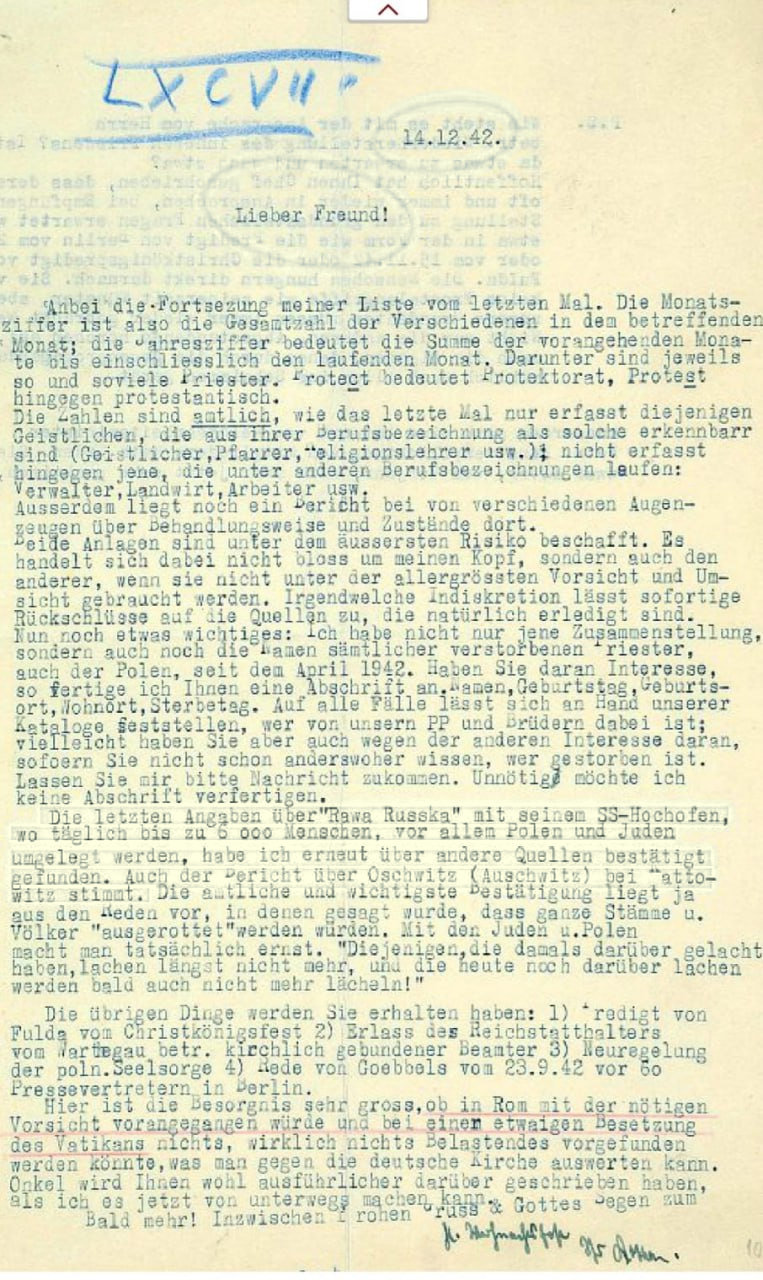
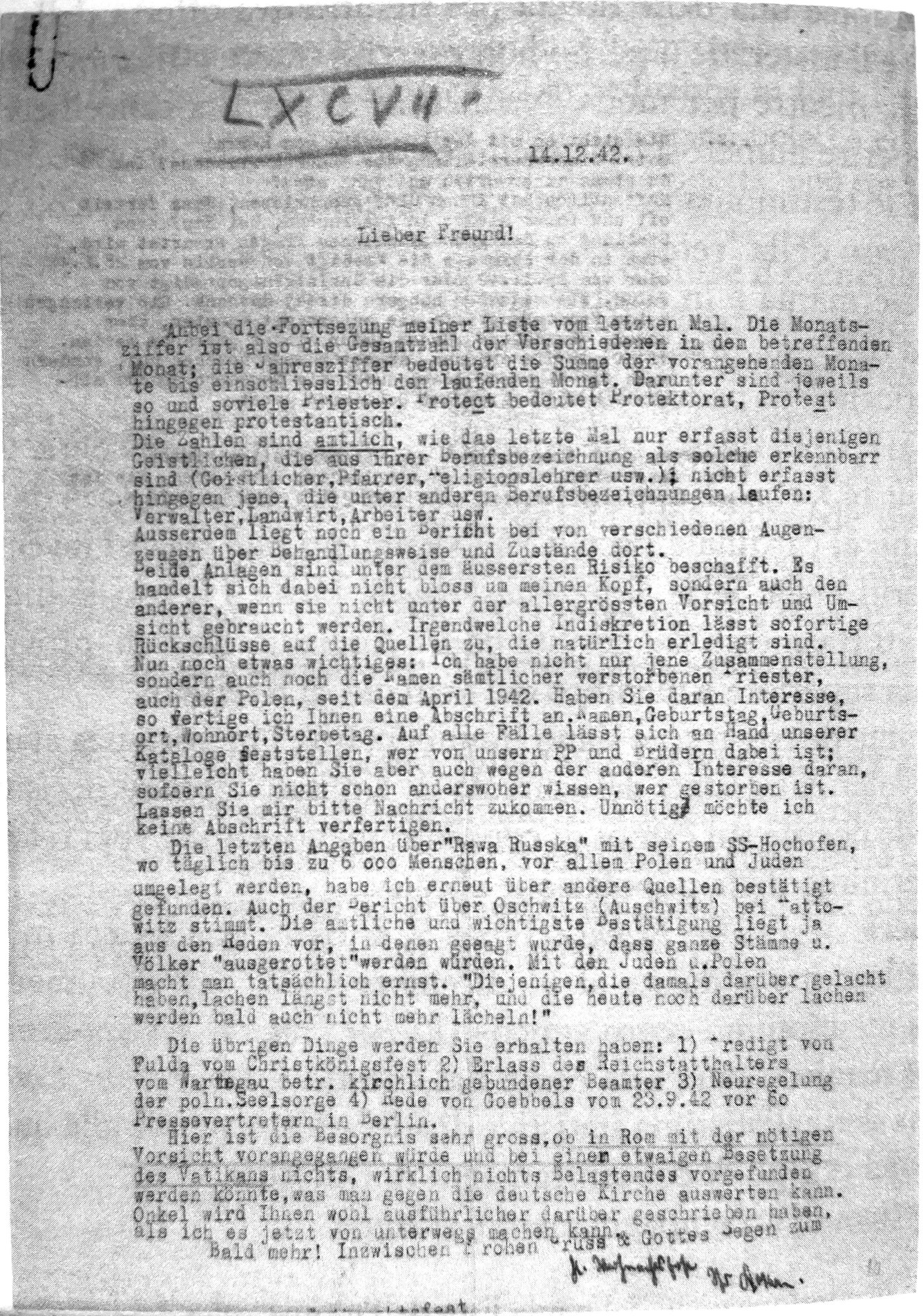
Quotations relating to information about the fate of the Jews emanating from the Vatican or addressed to the Vatican, or possibly involving a Catholic official ex officio.
Quotations in which a variant of vernichten (to annihilate, in German) appears, in particular Vernichtung (annihilation) or vernichtet (annihilated).
Quotations relating to the fate of the Jews of Vilnius (Vilna, Wilno) in Lithuania.
Quotations relating to the fate of the Jews in the Warthegau, the Reichsgau of Wartheland (one of the parts of Poland annexed to the Reich, including in particular Posen and Lodz).
Quotations connected with the role of the Wehrmacht, the regular German army, in the murder of the Jews.
No keyword is selected or excluded… The direct link to only the quotations matching the chosen keyword has been copied to your clipboard:
The direct link to only the quotations matching the selected keywords has been copied to your clipboard:
The direct link to the current quotation has been copied to your clipboard:
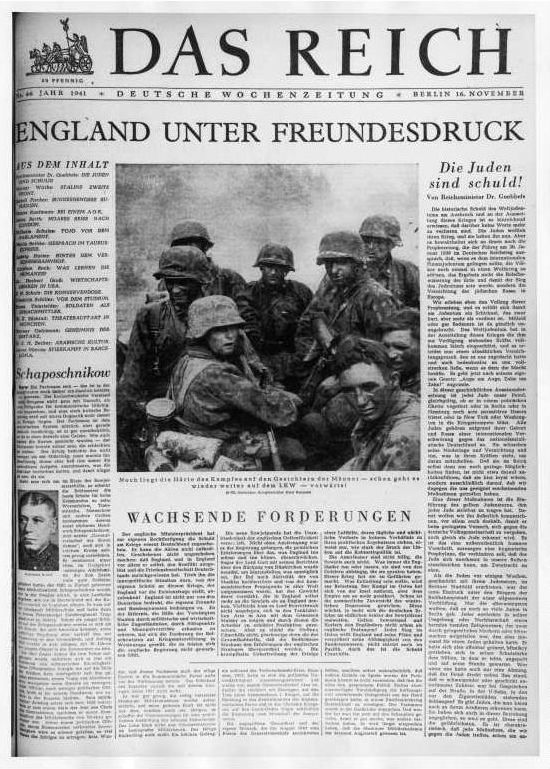
1. Memorandum by J. K. Roberts of 21/11/1938 (FO, 371/21638), cited by Russell Wallis «The Alexander memorandum», Patterns of Prejudice, vol. 53, no. 1, 2019, p. 55. Russell Wallis offered a first discussion of the memorandum in his Britain, Germany and the Road to the Holocaust: British Attitudes towards Nazi Atrocities, London: I. B. Tauris, 2014, p. 191-193. Franz Pfeffer von Salomon was supreme chief of the SA between 1926 and 1930 and a Nazi deputy in the Reichstag from 1932. He was expelled from the Nazi party and the Reichstag after Rudolf Hess's flight to Great Britain in 1941. Nonetheless, he had indeed been, during the first years of the Nazi party, a close associate of Hitler. In 1929, in the issue of 3 August of the Völkischer Beobachter, he wrote in an article calling the members of the SA to discipline: «Beware of all confrontations, do not forget that our settling of scores with the Jews will not take place in ridiculous individual confrontations, but in the future extermination of these international enemies of the peoples, carried out by our public power» (»Parteigenossen! SA- und SS-Mann! Hitlerjunge!«, Völkischer Beobachter, 3.8.1929, cited by Mark A. Fraschka, Franz Pfeffer von Salomon. Hitlers vergessener Oberster SA-Führer, Göttingen: Wallstein Verlag, 2016, p. 384: «Hüte Dich vor allen Zusammenstößen, vergiss weiter nicht, dass unsere Abrechnung mit den Juden nicht in lächerlichen Einzelzusammenstößen erfolgt, sondern in einer dereinstigen durch unsere staatliche Gewalt durchgeführten Vernichtung dieser internationalen Völkerfeinde»). 2. Norbert Frei & Johannes Schmitz, Journalismus im Dritten Reich, München: Beck, 1999, p. 102. 3. «Juden, was nun?», Das Schwarze Korps, Zeitung der Schutzstaffeln der NSDAP und Organ der Reichsführung SS, no. 47, 24 November 1938. The article is legible on the (unpublished) scan of the original that we provide. It is quoted in full in Götz Aly et alii, (ed.), Die Verfolgung und Ermordung der europäischen Juden durch das nationalsozialistische Deutschland 1933–1945, Band 2: Deutsches Reich 1938—August 1939, München: Oldenbourg Verlag, 2009, dok. 176, p. 498-503 (p. 500 for the passage translated here). Below the complete German extract containing this passage in question (the bold figures in the original article and we have italicised the parts we have translated): «Weil es notwendig ist, weil wir das Weltgeschrei nicht mehr hören und weil uns schließlich auch keine Macht der Welt daran hindern kann, werden wir also die Judenfrage nunmehr ihrer totalen Lösung zuführen. Das Programm ist klar. Es lautet: völlige Ausscheidung, restlose Trennung! Was bedeutet das? Das bedeutet nicht nur die Ausschaltung der Juden aus der deutschen Volkswirtschaft, die sie durch ihren Mordanschlag und durch ihre Kriegs- und Mordhetze verwirkt haben. Das bedeutet viel mehr! Es kann keinem Deutschen zugemutet werden, daß er länger mit Juden als mit einer abgestempelten Rasse von Mördern und Verbrechern und Todfeinden des deutschen Volkes unter einem Dach lebt. Die Juden müssen daher aus unseren Wohnhäusern und Wohnvierteln verjagt und in Straßenzügen oder Häuserblocks untergebracht werden, wo sie unter sich sind und mit Deutschen so wenig wie möglich in Berührung kommen. Man muß sie kennzeichnen und ihnen ferner das Recht nehmen, in Deutschland über Haus- und Grundbesitz oder über Anteile an diesem zu verfügen, denn es kann einem Deutschen nicht zugemutet werden, daß er der Gewalt eines jüdischen Grundherren untersteht und diesen durch seiner Hände Arbeit ernährt. In die Kriminalität Das in jeder Beziehung auf sich beschränkte Parasitenvolk wird aber in dieser Isolierung, da es zu eigener Arbeit weder willens noch fähig ist, verarmen. Mögen die Juden heute auch noch Milliarden ihr eigen nennen, mag es unter ihnen auch noch viele hundert Millionäre geben, mag der einzelne sogenannte „arme“ Jude auch noch hinreichend viel verschoben und versteckt haben, so werden sie, da ihnen die Lebensader des Parasiten abgeschnitten ist, ihr Kapital doch sehr bald aufgezehrt haben. Und wenn wir, was sich als notwendig erweisen wird, die reichen Juden zwingen werden, ihre „armen“ Rassegenossen zu erhalten, werden sie allesamt ihrer ureigensten, blutbedingten Veranlagung gemäß in die Kriminalität absinken. Dann möge aber niemand glauben, daß wir dieser Entwicklung ruhig zusehen können. Das deutsche Volk hat nicht die geringste Lust, in seinem Bereich Hunderttausende von Verbrechern zu dulden, die durch Verbrechen nicht nur ihr Dasein sichern, sondern auch noch Rache üben wollen! Am wenigsten haben wir Lust, in diesen Hunderttausenden verelendeten Juden eine Brutstätte des Bolschewismus und eine Auffangorganisation für das politisch-kriminelle Untermenschentum zu sehen, das durch den natürlichen Ausleseprozeß am Rande unseres eigenen Volkstums abbröckelt. Wollten wir das dulden, so wäre das Ergebnis eine Verschwörung der Unterwelt, wie sie vielleicht in Amerika, gewiß aber nicht in Deutschland möglich und denkbar ist. Im Stadium einer solchen Entwicklung ständen wir daher vor der harten Notwendigkeit, die jüdische Unterwelt genau so auszurotten, wie wir in unserem Ordnungsstaat Verbrecher eben auszurotten pflegen: mit Feuer und Schwert. Das Ergebnis wäre das tatsächliche und endgültige Ende des Judentums in Deutschland, seine restlose Vernichtung». The entirety of this passage is rarely quoted in the literature. It was however, at the latest in 1973, by B. A. Sijes, «Die Endlösung der Judenfrage» in B. A. Sijes et alii, Essays über Naziverbrechen Simon Wiesenthal gewidmet, Amsterdam/Wien: Wiesenthal Fonds/Bund Jüdischer Verfolgter des Naziregimes, 1973, p. 61-63. Let us note however that this passage is identified and also figures in the documents produced in 1947 for the sixth of the «minor» Nuremberg trials, the IG Farben Trial, which one can consult in the NARA roll M892 roll 31, on the 9th and 10th pages of the series NI-12333 (views 56 and 57 of the roll). Since 2025, one can finally find online the entirety of the original text of the article. The American national archives (NARA: National Archives and Records Administration) carried out, from the 1950s, an immense campaign of microfilming (photographs and storage of the images on microfilms) of the documents produced mainly by Nazi Germany and Fascist Italy, including the documentary corpus assembled for the Nuremberg trials. About seventy thousand reels of microfilm, each able to comprise up to one thousand five hundred views, were produced. Historians have since explored this documentary ocean and cite the documents they find there by referring to the NARA, to the name of the collection or to its numerical abbreviation (for example M892), to the reel number (roll 31 or R 31, for example) then, in principle, to the number of the view (the image in the microfilm) corresponding to the document cited. 4. Translated from the German original, Robert Ley, speech at Innsbruck (Anprache auf der Konstituierenden Sitzung des Gauarbeitskammer), 10 May 1939, 19th minute of the speech, transcribed in Walter Roller & Susanne Höschel (eds), Judenverfolgung und jüdisches Leben unter den Bedingungen der nationalsozialistischen Gewaltherrschaft, vol. 1, Tondokumente und Rundfunksendungen 1930-1946, Potsdam: Verlag für Berlin-Brandenburg, 1996, no 82a, p. 151 (it is an altogether remarkable collection of transcriptions of 160 Nazi antisemitic speeches broadcast on the radio, preserved by the archives of the German Radio, the Deutsche Rundfunkarchiv of Frankfurt am Main). Also translated in part (in a different way) in Peter Longerich, «Nous ne savions pas»: Les Allemands et la Solution finale 1933-1945, Editions Héloïse d’Ormesson, 2008, p. 184. 5. Ley declared: «If the Jew wants to fight, that fulfils our own long-standing desire. There is no more place for the Jews in the world. It is us or the Jew, one of us must clear off. And we want the Jew to clear off, to be annihilated, he and his diabolical doctrine of decay and negation of life» («Wenn der Jude den Kampf will, wir wollen ihn schon lange. Es gibt in der Welt keinen Raum mehr für den Juden. Entweder der Jude oder wie, einer von uns muß weichen. Und wir wollen, daß der Jude weicht, daß er vernichtet wird und mit ihm seine teuflifche, lebenverneinende und knochenerweichende Lehre): Robert Ley, «Wir oder die Juden…», speech of 31 March 1939 quoted in Die Hoheitsträger, 3, May 1939, p. 4. To our knowledge, the German original has never been quoted before us. This speech is integrally translated into English by Randall L. Bytwerk, here.
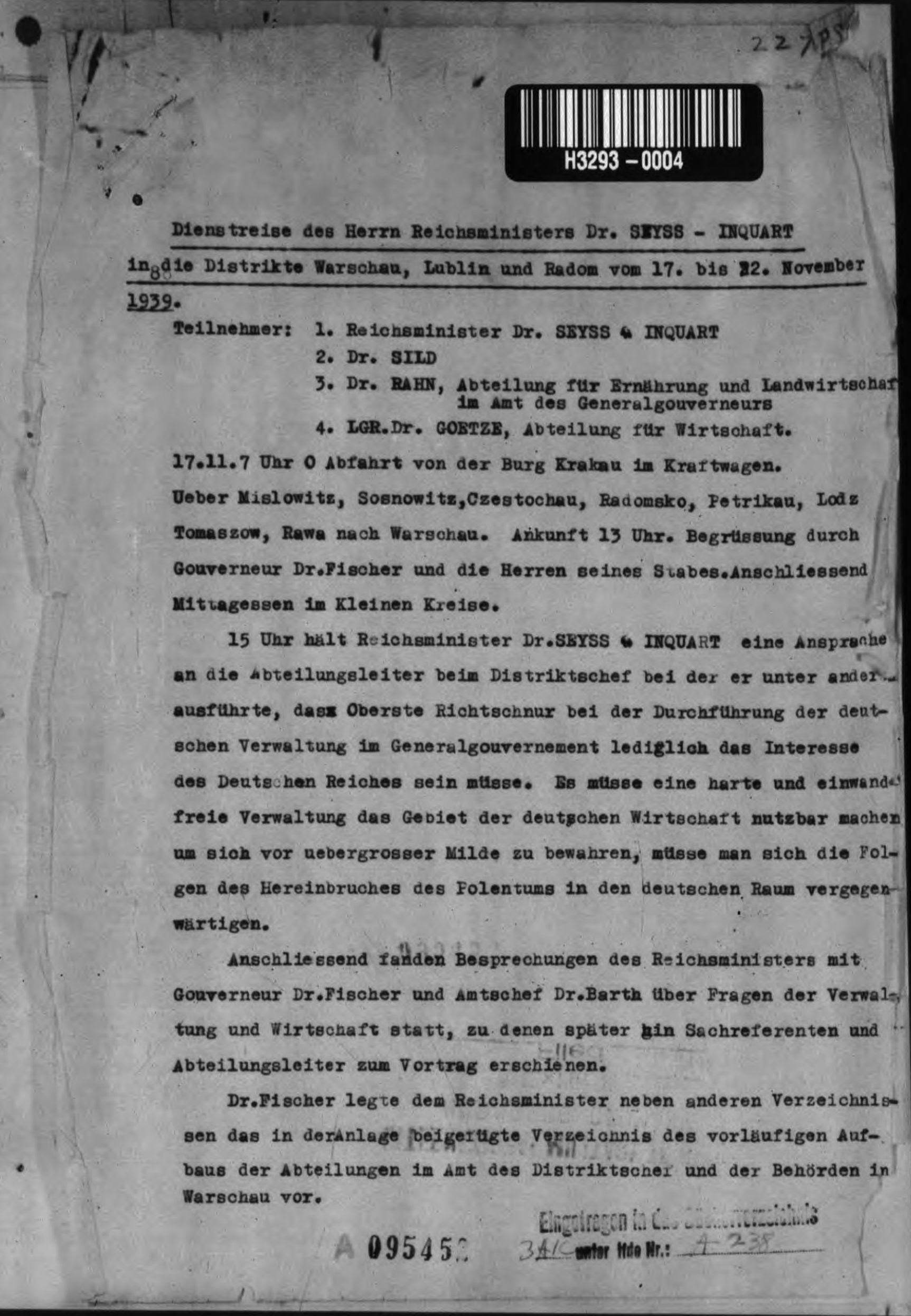
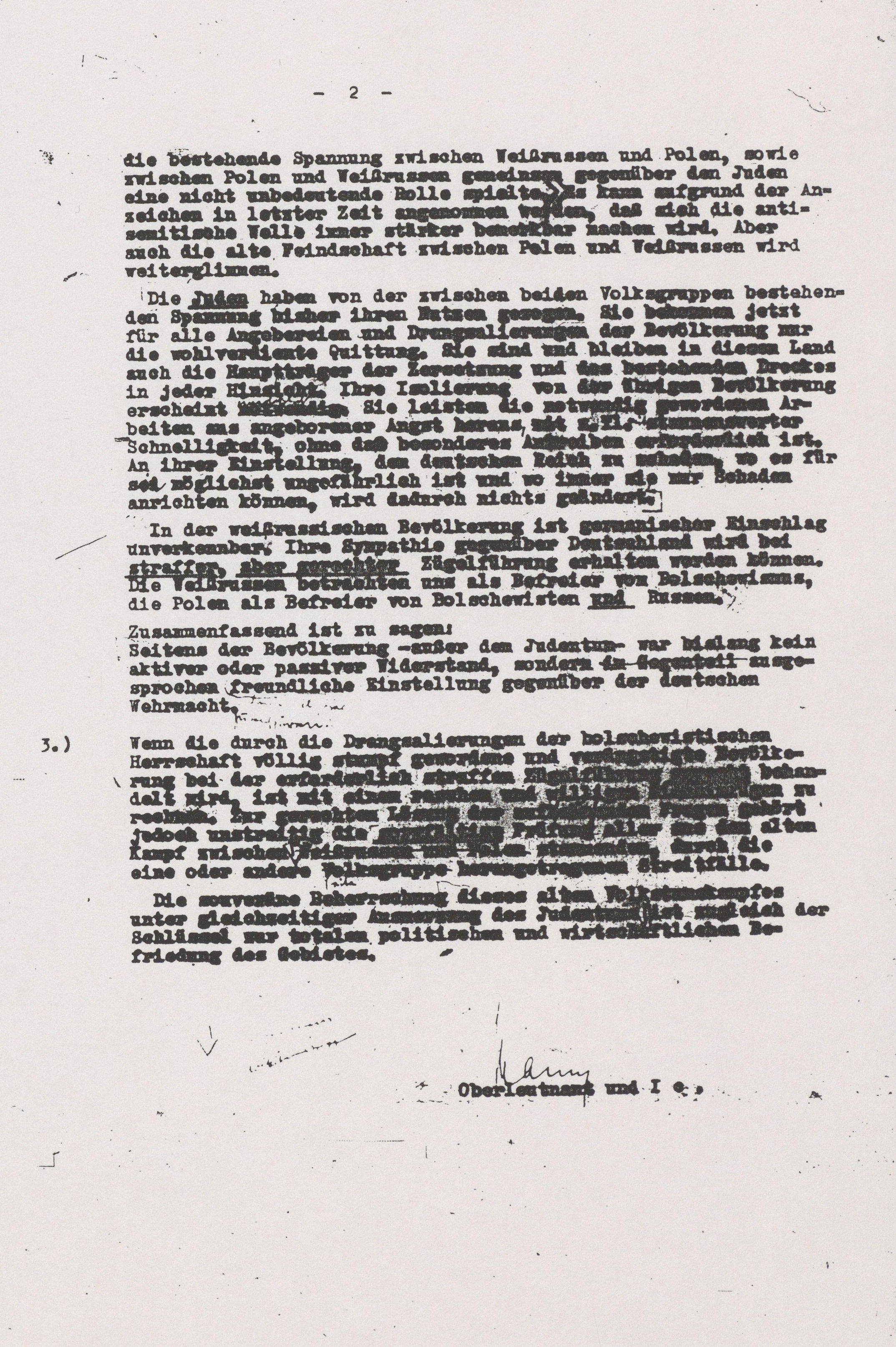
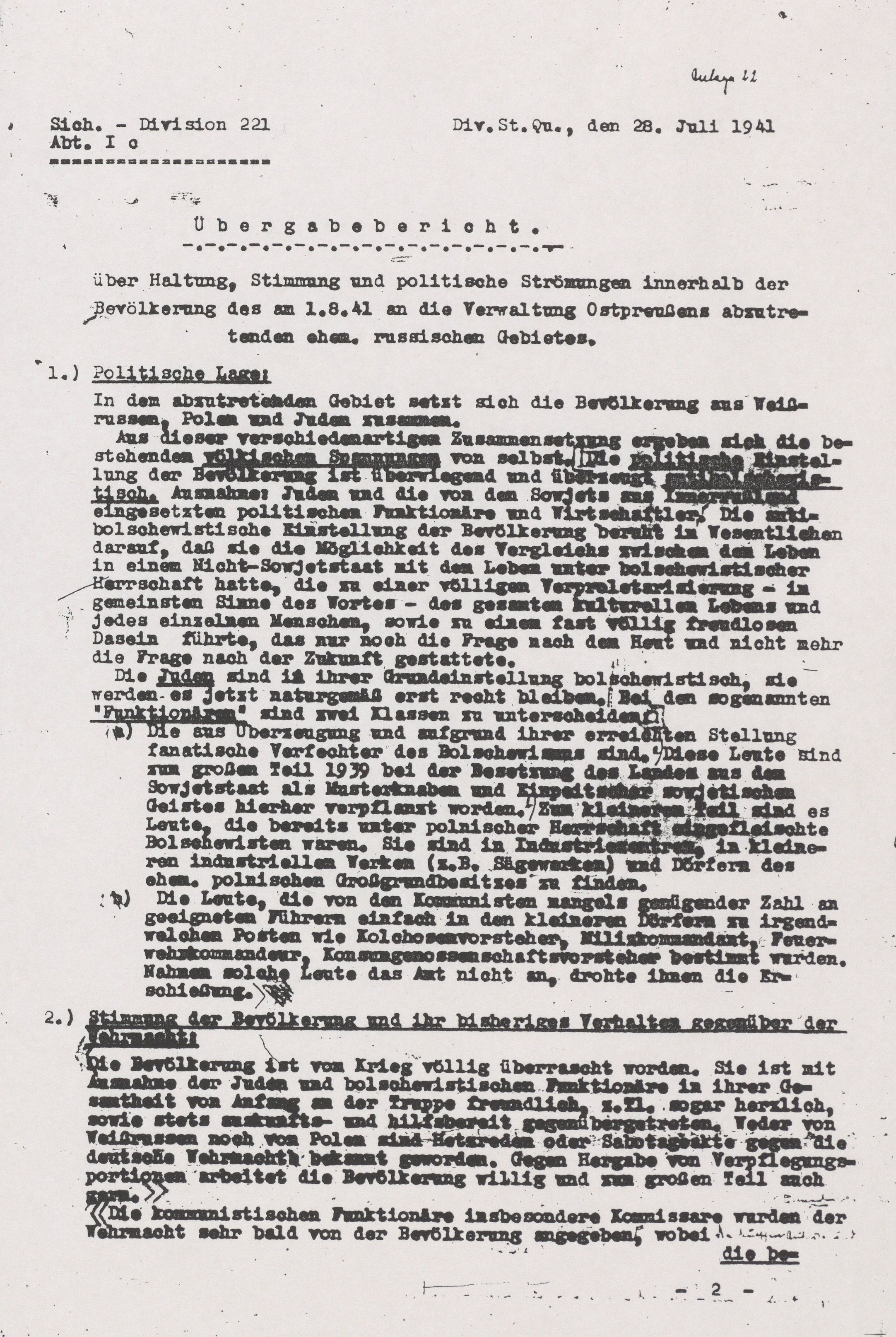
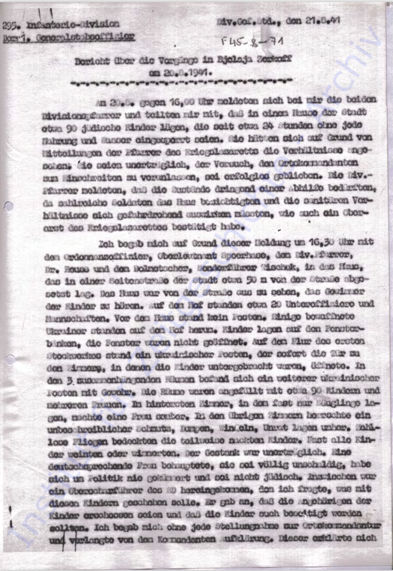
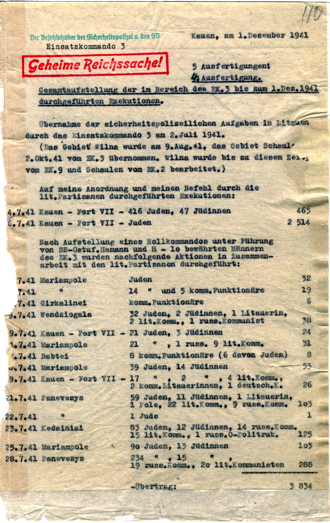
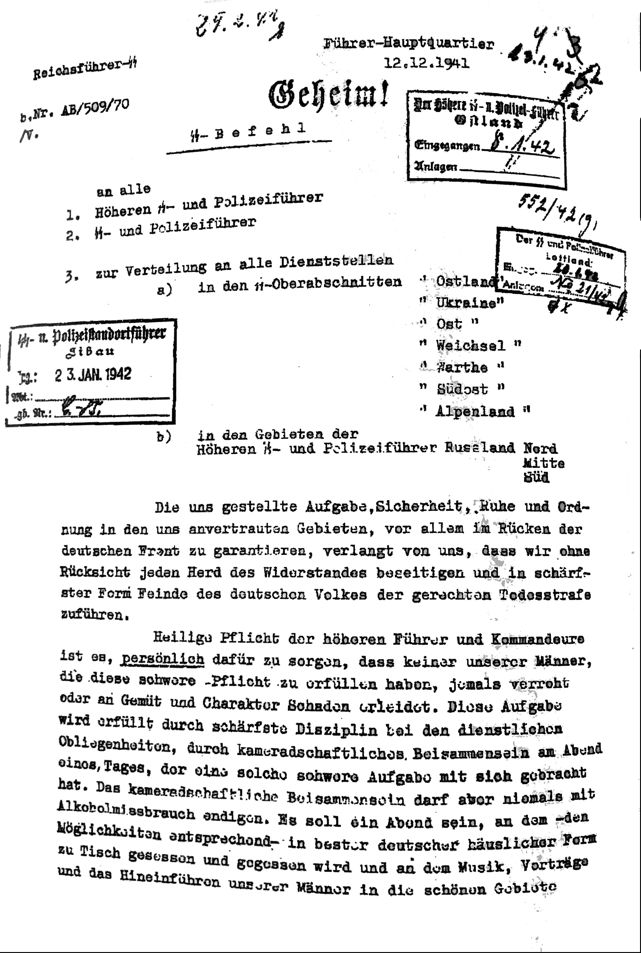
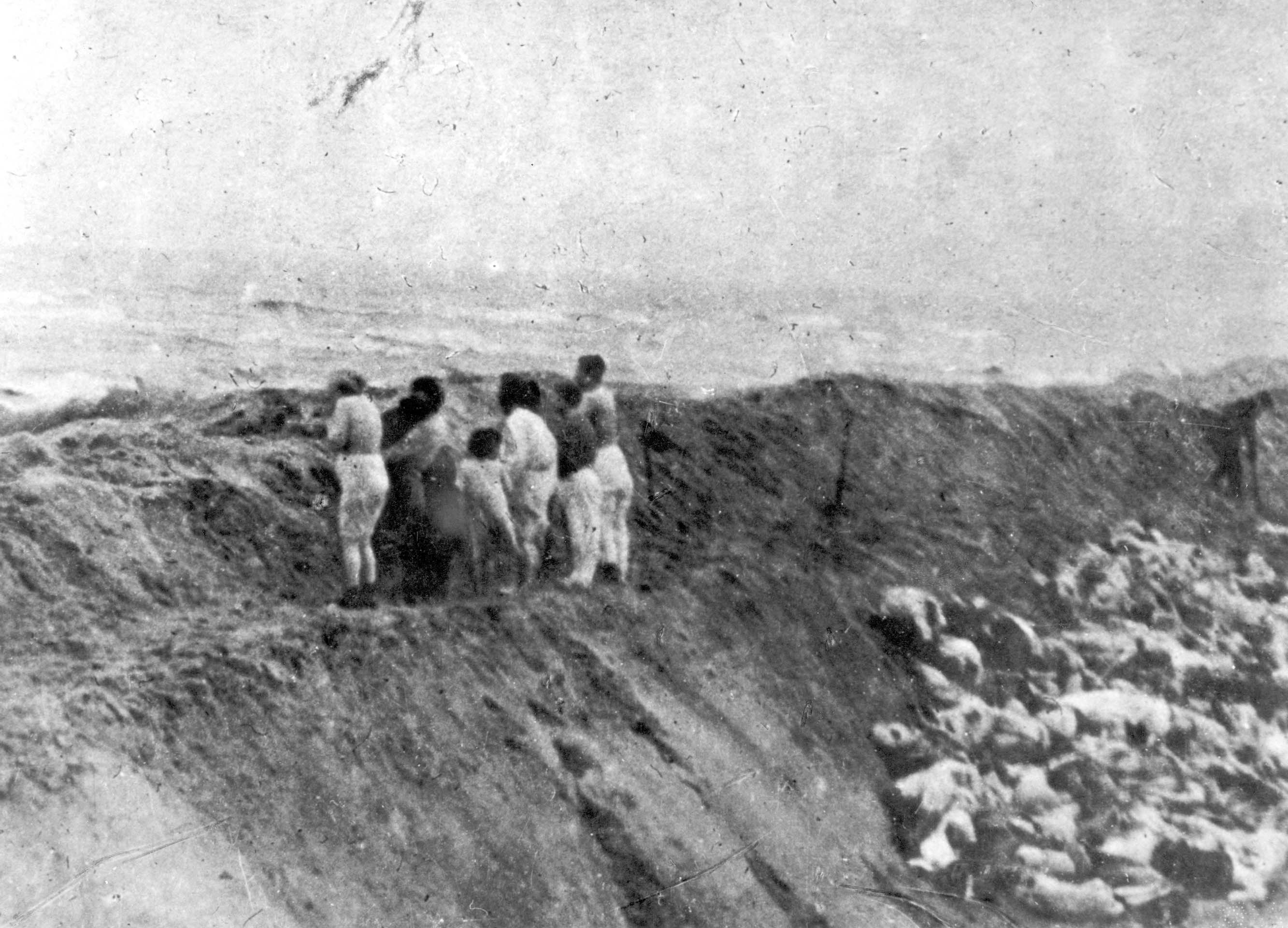
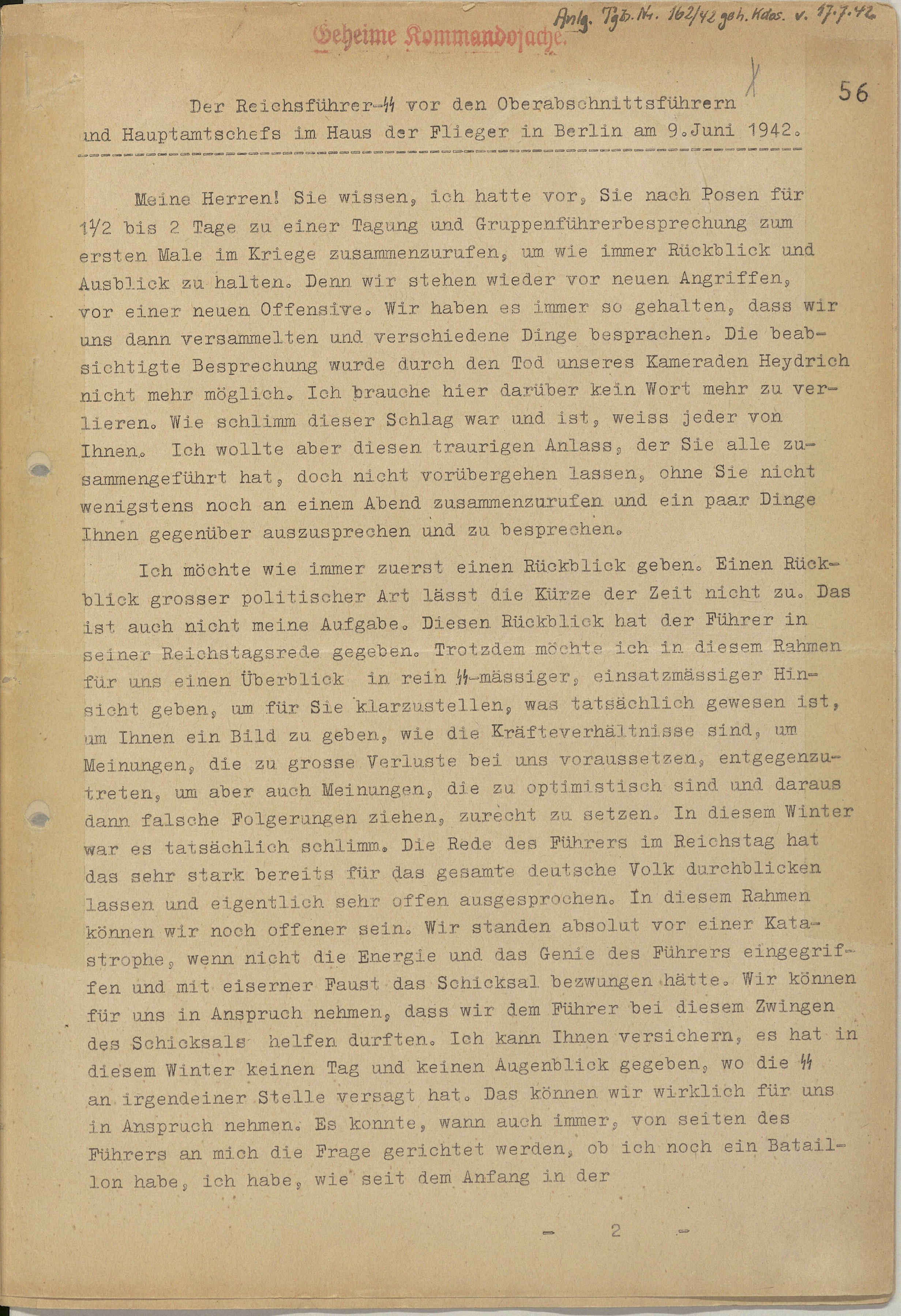
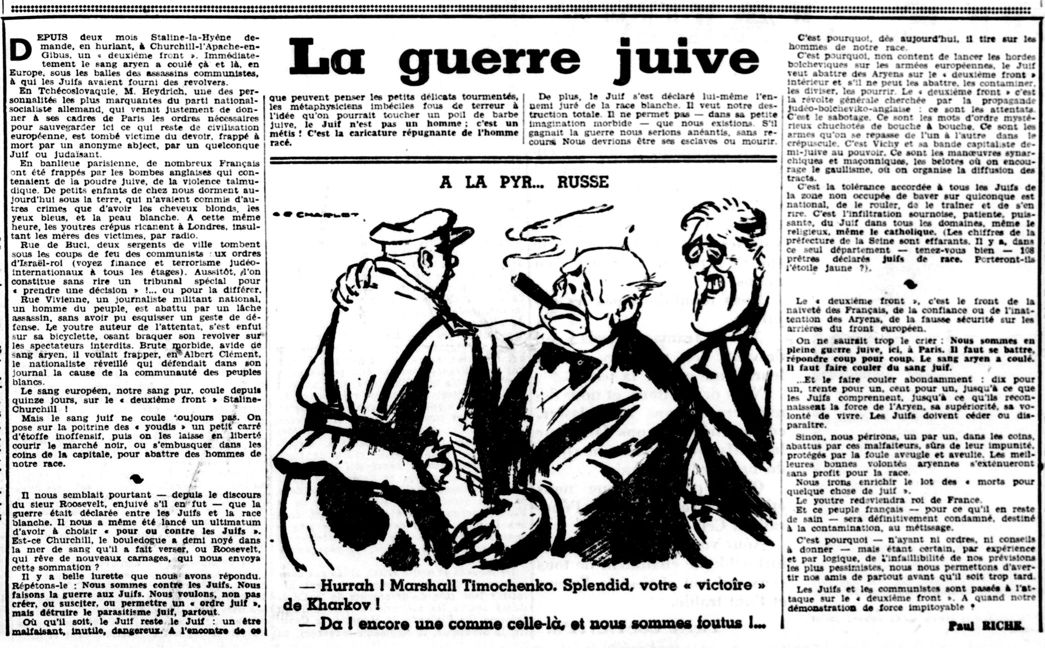
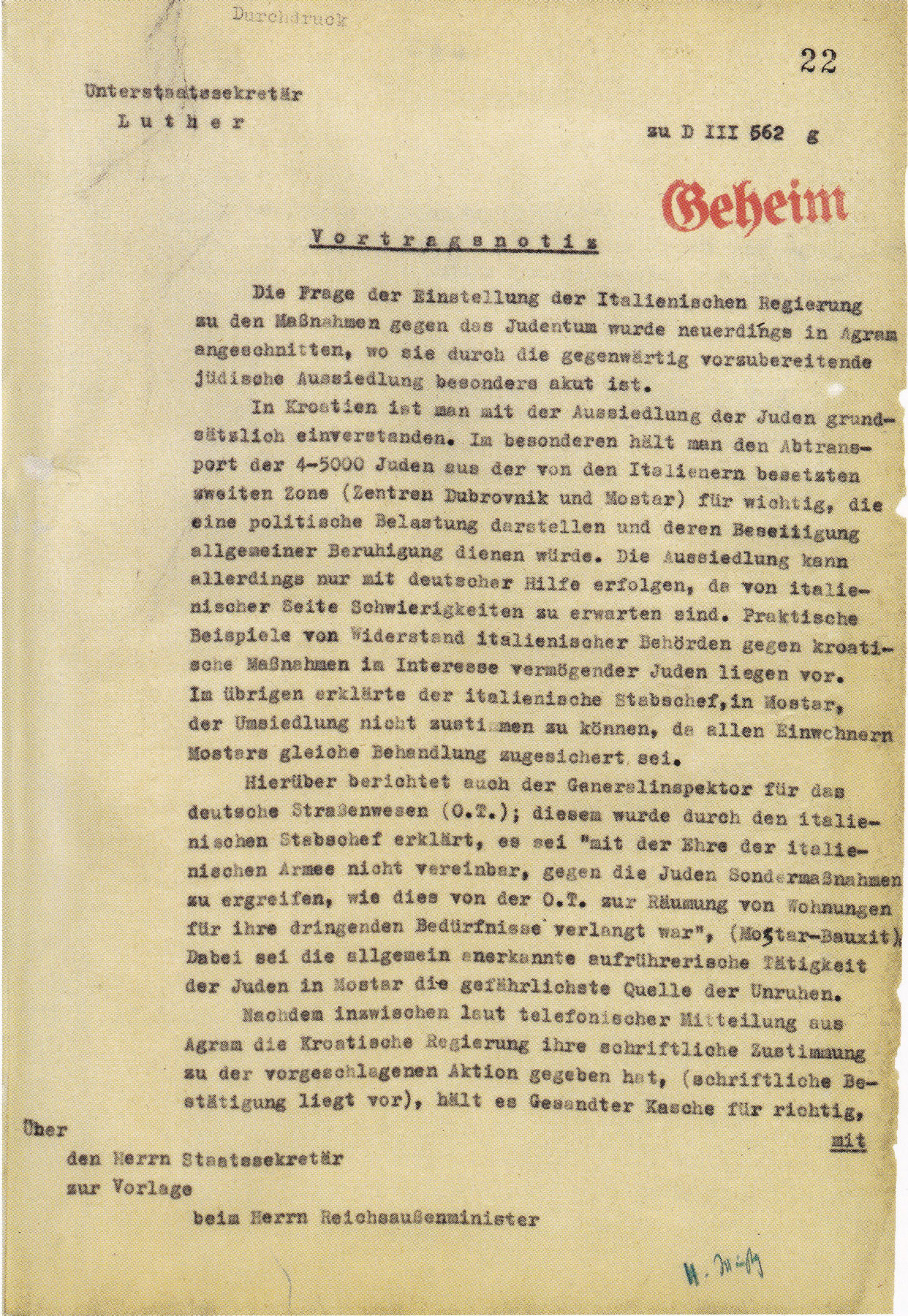
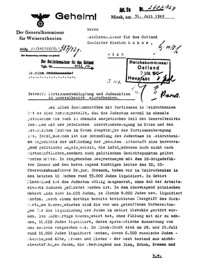
6. German original, document 2278-PS, Trial of the Major War Criminals before the International Military Tribunal, IMT Nuremberg, vol. XXX, p. 84 et seq., p. 95 for the quoted passage (Dieses Gebiet mit seinem stark sumpfigen Charakter könnte nach den Erwägungen des Distriktsgouverneurs Schmidt als Juden-reservat dienen, welche Maßnahme womöglich eine starke Dezimierung der Juden herbeiführen könnte, also here…). The complete original document is available in the form of the photostat made for the framework of the Nuremberg Trial. It is online (pointed out by Nicolas Bernard) here… We draw from it the reproductions presented (re-cropped and inverted by us). 7. Jürgen Hagemann, Die Presselenkung im Dritten Reich, Bonn, 1970, p. 146. German original: «Vertrauliche Information: Neben den polnischen Flüchtlingsstrom tritt der jüdische Flüchtlingsstrom. Die Juden werden nach Möglichkeit in das Gebiet um Lublin verpflanzt. Es sind bereits von der SS Anordnungen getroffen, daß noch in dieser Woche z.B. aus Lodz 20 000 Juden den Marsch in das Innere des Landes antreten müssen… Für diese Völkerwanderung sind die Ernährungsgrundlagen nicht vorhanden». Cited notably (in English) by Peter Longerich, Holocaust. The Nazi Persecution and Murder of the Jews, New York: Oxford University Press, 2010, p. 154. 8. Cited by Christopher Browning, Nazi Policy, Jewish Workers, German Killers, Cambridge University Press, 2000, p. 8. German original in Faschismus-Getto-Massenmord. Dokumentation uber Ausrottung und Widerstand der Juden in Polen während des Zweiten Weltkrieges, Jüdisches historisches Institut, Tatiana Berenstein, Artur Eisenbach et alii (eds.), Frankfurt am Main, 1962, p. 46, cited notably by Michael Wildt, Geschichte des Nationalsozialismus, Vandenhoeck & Ruprecht, Göttingen 2008, p. 150. Same pagination in the 1960 edition of Faschismus-Getto-Massenmord… The passage is quoted at the latest in 1957 in T. Berenstein, A. Eisenbach, A. Rutkowski (eds.), Eksterminacja Żydów na ziemiach polskich w okresie okupacji hitlerowskiej (Zbiór dokumentów), Warszawa: Żydowski Instytut Historyczny, 1957, p. 34. 9. Cited by Sybille Steinbacher, Musterstadt Auschwitz. Germanisierungspolitik und Judenmord in Ostoberschlesien (Darstellungen und Quellen zur Geschichte von Auschwitz, Institut für Zeitgeschichte, Band 2), K. G. Saur Verlag, Munich, 2000, p. 120. English version in Peter Longerich, Holocaust. The Nazi Persecution and Murder of the Jews, New York: Oxford University Press, 2010, p. 154. 10. Cited by Götz Aly and Susanne Heim, Vordenker der Vernichtung: Auschwitz und die deutschen Pläne für eine neue europäische Ordnung, Hamburg: Hoffmann und Campe, 1991, p. 204: «Viele Deutsche sehen wohl zum ersten Mal in ihrem Leben Juden in solchen Massen. Die Ghettos gehören zu dem Schmutzigsten, was man sich vorstellen kann. […] Die Vernichtung dieses Untermenschentums läge im Interesse der ganzen Welt. Diese Vernichtung ist aber eines der schwierigsten Probleme. Mit Erschießungen kommt man nicht durch. Auch kann man Frauen und Kinder nicht schießen lassen. Da und dort rechnet man auch mit Verlusten bei den Evakuierungstransporten, und auf dem Transport von 1 000 Juden, der von Lublin aus in Marsch gesetzt wurde, seien 450 umgekommen. […] Sämtliche mit der Judenfrage befaßten Stellen sind sich über die Unzulänglichkeit all dieser Maßnahmen im Klaren. Doch ist eine Lösung dieses komplizierten Problems noch nicht gefunden». 11. Translated from the German original, Robert Ley, speech before German workers at Lodz (first 5 minutes of the speech), December 1939, transcribed in Walter Roller & Susanne Höschel (eds), Judenverfolgung und jüdisches Leben unter den Bedingungen der nationalsozialistischen Gewaltherrschaft, vol. 1, Tondokumente und Rundfunksendungen 1930-1946, Potsdam: Verlag für Berlin-Brandenburg, 1996, 91, p. 158. One finds the English translation of the same passage in Jeffrey Herf, «The Jewish War: Goebbels and the Antisemitic Campaigns of the Nazi Propaganda Ministry», Holocaust and Genocide Studies, vol. 19, n. 1, spring 2005, p. 57. 12. Karl Haushofer: Leben und Werk, vol. ii: Ausgewählter Schriftwechsel, 1917-1946, ed. Hans-Adolf Jacobsen, Boppard am Rhein, 1979, no. 226, cited by Peter Longerich, Politik der Vernichtung. Eine Gesamtdarstellung der nationalsozialistischen Judenverfolgung, Piper Verlag, 1998, p. 261. 13. Dieter Pohl, Von der "Judenpolitik" zum Judenmord: Der Distrikt Lublin des Generalgouvernements 1939-1944, Frankfurt: Peter Lang, 1993, p. 52: «die evakuierten Juden und Polen sollten sich selbst ernähren und von ihren Landsleuten unterstützen lassen, da diese Juden genug hätten. Falls dies nicht gelänge, sollte man sie verhungern lassen». French version in Saul Friedländer, Les Années d’Extermination, Editions du Seuil, 2008, p. 71-72. 14. «Die Juden interessieren mich überhaupt nicht. Ob die etwas zu futtern haben oder nicht, ist für mich die allerletzte Frage». Hans Frank, Das Diensttagebuch des deutschen Generalgouverneurs in Polen 1939-1945, Werner Prag and Wolfgang Jacobmeyer (eds), Stuttgart: Deutsche Verlags-Anstalt, 1975, p. 186. See also Peter Longerich, Holocaust. The Nazi Persecution and Murder of the Jews, New York: Oxford University Press, 2010, p. 154. 15. Cited by Christopher Browning, The Origins of the Final Solution. The Evolution of Nazi Jewish Policy, September 1939-March 1942, University of Nebraska Press, Yad Vashem, 2004, p. 120. Browning provides the German original: «Völlig gleichgültig, um nicht zu sagen wünschenswert, ist uns das rasche Absterben der Juden insolange als die Begleiterscheinungen das öffentliche Interesse des deutschen Volkes unberührt lassen; sofern jedoch weisungsgemäss (Reichsführer SS) dieses Volk staatlichen Interessen dienstbar zu machen ist, müssen die primitivsten Voraussetzungen hierzu geschaffen werden». 16. Ibid., p. 460. Original: «Tuberkulose und außerdem nicht übertragbare Kinderkrankheiten, sowie andere Krankheiten, die ein rapides Ansteigen der Sterblichkeitsziffer zur Folge haben interessieren die deutsche Gesundheitsbehörde nicht.» (Peter Klein, Die »Gettoverwaltung Litzmannstadt« 1940-1944. Eine Dienststelle im Spannungsfeld von Kommunalbürokratie und staatlicher Verfolgungspolitik, Hamburger Edition, 2009, p. 210). 17. Walter Manoschek, ed., »Es gibt nur eines für das Judentum: Vernichtung«: Das Judenbild in Deutschen Soldatenbriefen, 1939-1944, Hamburg, 1997, p. 17, cited by Saul Friedländer, Les Années d’Extermination. L’Allemagne nazie et les Juifs 1939-1945, éditions du Seuil, 2008, p. 216. In German: «Wenn man diese Menschen so betrachtet, bekommt man so den Eindruck, daß die wirklich keine Berechtigung haben, überhaupt auf Gottes Erdboden zu leben» (cited after the edition Walter Manoschek, Ibid., Hamburger Edition, 1995 p. 17). 18. Such a mention of the murders of the disabled is not isolated in Goebbels's diary. On 1st May 1940, he already noted: «At the Führer's. Bouhler reports on the procedures for liquidating the insane, so necessary and currently underway. Still secret. It raises great difficulties» («Beim Führer. Bouhler berichtet über das Liquidationsverfahren an Irren, das so notwendig ist und jetzt durchgeführt wird. Noch geheim. Es bereitet große Schwierigkeiten»), Joseph Goebbels, Die Tagebücher von Joseph Goebbels, Teil I, Aufzeichnungen 1923-1941, Band 8, April - November 1940, ed. Elke Fröhlich, München: K. G. Saur, 1998, p. 87. Passage already cited in 1987 in an older and partial edition of the Goebbels Diary. One notes the involvement of Hitler in this explicitly secret operation. On 5 September 1941, Joseph Goebbels returns to these murders: «Bouhler is preparing a film on euthanasia: in a cultural film, he wants to show the appalling clinical pictures that can be observed in the asylums for the insane. […] I think the essential thing is to give the whole German population an idea of this problem, so that the liquidation of persons who are no longer fit for life is made psychologically a little easier for us» («Bouhler bereitet einen Film über die Euthanasie vor, d. h. er will in einem Kulturfilm die grauenvollen Krankheitsbilder zur Darstellung bringen, die man in den Irrenanstalten beobachten kann. […] ich bin der Meinung, es ist die Hauptsache, der deutschen Bevölkerung überhaupt einen Eindruck in dieses Problem zu verschaffen, damit uns die Liquidierung dieser nicht mehr lebensfähigen Menschen psychologisch etwas leichter gemacht wird»), Joseph Goebbels, Die Tagebücher von Joseph Goebbels, Teil II. Band 1, Diktate 1941-1945. Juli-September 1941, ed. Elke Fröhlich, München: K. G. Saur, 1996, p. 364. Our translation is slightly different from the one proposed for this entry in Journal de Joseph Goebbels, 1939-1942, Paris: Tallandier, 2009. 19. Our translation from the German original: «Mit Bouhler Frage der stillschweigenden Liquidierung von Geisteskranken besprochen. 40 000 sind weg, 60 000 müssen noch weg. Das ist eine harte, aber auch eine notwendige Arbeit. Und sie muß jetzt getan werden. Bouhler ist der rechte Mann dazu» (Joseph Goebbels, Die Tagebücher von Joseph Goebbels, Teil I, Aufzeichnungen 1923-1941, Band 9, Dezember 1940 - Juli 1941, ed. Elke Fröhlich, München: K. G. Saur, 1998, p. 119). In earlier editions of the Goebbels Diary, based on materials of poorer quality than the scholarly edition we cite, begun in 1993, one sometimes finds the figure of 80 000 instead of 40 000. This is the case in Elke Fröhlich (ed.), Die Tagebücher von Joseph Goebbels. Sämtliche Fragmente, Teil I, Band 4 1.1.1940-8.7.1941, Munich: K.G. Saur, 1987 p. 485 and in Ralf Georg Reuth (ed.), Joseph Goebbels Tagebücher, Band 4: 1941-1942, München: Piper, 1992, p. 1525 (which relies in part on Elke Fröhlich's 1987 edition). This leads us to put forward the hypothesis that the source used by these first editions presented a legibility problem which the discovery of a nearly complete copy of the Goebbels Diary in the Moscow archives in spring 1992 made it possible to resolve, allowing an erroneous 80 000 to be corrected to 40 000, in the edition produced from 1993 onwards. This figure of 40 000 is moreover more consistent with what is known of the pace of the murders. For the complex history of the sources and editions of the Goebbels Diary, see Hörst Möller, «Le Journal de Goebbels. Histoire d’un texte», in Hörst Möller & Pierre Ayçoberry (eds.), Joseph Goebbels. Journal 1943-1945, Paris: Tallandier, 2005. These are extracts from the Goebbels Diary, translated from the German edition we cite, coordinated by Elke Fröhlich from 1993, which has long been authoritative among the historian community. The study by Hörst Möller that we cite is the translation of his «Die Tagebücher von Joseph Goebbels. Quelle, Überlieferung, Edition», in Klaus Oldenhage, Hermann Schreyer & Wolfram Werner (eds.), Archiv und Geschichte. Festschrift für Friedrich P. Kahlenberg, Düsseldorf: Droste Verlag, 2000. In the passage of the Goebbels Diary that we quote, we found it difficult to translate the adjective «stillschweigenden», stricto sensu «tacit» in the sense of passed over in silence, informal, unofficial. We think that here the term designates both the secret and illegal character of the measure (even if it was ordered, in secret, by Hitler), hence our choice to render it by «confidential». A partial edition of Goebbels's diary in French offers for the same passage the following translation: «Discussed with Bouhler the silent liquidation of the mentally ill. 40 000 have already been eliminated, 60 000 still have to be. It is hard work but also necessary. And it must be done now. Bouhler is the right man» (Joseph Goebbels, Journal. 1939-1942, Paris: Tallandier, 2009, p. 238). 20. Cited in Pierre-André Taguieff (dir.), L’antisémitisme de plume, 1940-1944, études et documents, Berg International, Paris, 1999, p. 535-536 (partial facsimile on p. 534). The facsimile presented here was made by us. It is entirely unpublished. The vociferations of Jean Mamy/Paul Riche had been pointed out at the latest in 1964 in Michèle Cotta, La Collaboration, 1940-1944, Paris: Armand Collin, 1964, p. 141. 21. Walter Gross, «Die Rassenpolitischen Voraussetzungen zur Lösung der Judenfrage», Welkampf, April-September 1941, p. 52, cited by David Bankier, «The Use of Antisemitism in Nazi Wartime Propaganda», in Michael Berenbaum and Abraham J. Peck (editors), The Holocaust and History. The Known, the Unknown, the Disputed and the Reexamined, Indiana University Press, 1998, p. 45. In German: «Und soweit es sich um die historische Erscheinung des Juden in Europa handelt, glauben wir, dass diese Todesstunde unwiderruflich gekommen ist» (Dirk Rupnow, Vernichten und Erinnern. Spuren nationalsozialistischer Gedächtnispolitik, Wallstein Verlag, Göttingen, 2005, p. 217). 22. Walter Manoschek, ed., »Es gibt nur eines für das Judentum: Vernichtung«: Das Judenbild in Deutschen Soldatenbriefen, 1939-1944, Hamburger Edition, 1995 p. 25. French translation in Walter Manoschek, «Il n’y a qu’une seule solution pour les Juifs: l’extermination. L’image du Juifs dans les lettres des soldats allemands (1939-1944).», Revue d’Histoire de la Shoah, no 187, July-December 2007, p. 25. German original (complete, without the interpolations): «Während ich noch beim Abendessen saß, wurde auch über die Judenfrage im Generalgouvernement und überhaupt in der Welt gesprochen; für mich ist es sehr interessant, solche Gespräche anzuhören. Zu meinem Erstaunen waren sich schließlich doch alle einig, daß die Juden ganz von der Welt verschwinden müßten. Ja, die Engländer und die Juden sollten den Bombenangriffen ihrer Landsleute ausgesetzt werden, aber das sind alles nur Wünsche. Die Juden müßten mal alle weg bezw. kaltgestellt werden, dann würde es bald anders aussehen in der Welt.» 23. Robert Ley, Schmiede des Schwertes - Der deutsche Arbeiter im Großdeutschen Freiheitskampf - Reden und Reportagen aus der Kriegsarbeit Dr. Leys, Zentralverlag der NSDAP., Franz Eher Nachf., München, 1942, p. 231. The Nazis' will to exterminate the Jews was expressed publicly and published officially (in this instance the collection in question carries a preface by Reichsmarshall Hermann Göring). This passage is quoted partially in Stéphane Bruchfeld & Paul A. Levine, Erzählt es euren Kindern: der Holocaust in Europa, Bertelsmann, 2000, p. 59, English version in Stéphane Bruchfeld, Paul A. Levine, Tell ye your children. A book about the Holocaust in Europe 1933-1945, Regeringskansliet, Stockholm, 1998, p. 33. A French edition of this work exists: Dites-le à vos enfants. Histoire de la Shoah en Europe, 1933-1945, Ramsay, 2000. 24. Jean Méricourt, «Les Juifs vont payer», Au Pilori, 26 June 1941, cited by Laurent Joly, Dénoncer les Juifs sous l’Occupation, Paris: CNRS Éditions, p. 140. Laurent Joly does not fail to mention also «the sadly famous eulogy, of the extermination of the jews by sterilisation and extinction, Jacques BOUVREAU, 14 juillet 2142. Le dernier Juif vient de mourir!, Au Pilori, 23 July 1942» (p. 204). 25. Cited by Philippe Marguerat, «Le IIIe Reich, l’invasion de l’URSS et le génocide juif (juin-juillet 1941)», Revue Historique, no. 597, January-March 1996, p. 158. German original: «Den Selbstreinigungsbestrebungen antikommunistischer und antijüdischer Kreise in den neu zu besetzenden Gebieten ist kein Hindernis zu bereiten. Sie sind im Gegenteil, allerdings spurenlos auszulösen, zu intensivieren wenn erforderlich und in die richtigen Bahnen zu lenken, ohne daß sich diese örtlichen Selbstschutzkreise später auf Anordnungen oder auf gegebene politische Zusicherungen berufen können.» (Peter Longerich & Dieter Pohl (ed.), Die Ermordung der europäischen Juden. Eine umfassende Dokumentation des Holocaust 1941-1945, Munich: Piper, 1989, p. 118-119. The document is quoted in full by Bert Hoppe et alii, (ed.), Die Verfolgung und Ermordung der europäischen Juden durch das nationalsozialistische Deutschland 1933–1945, Band 7: Sowjetunion mit annektierten Gebieten I, München: Oldenbourg Verlag, 2011, p. 137). 26. Monika Stolarczyk-Bilardie, «La rétention de l’information en provenance de Pologne, 1941-1942», Revue d’Histoire de la Shoah, 2023/2, no 218, p. 212-213. 27. Monika Stolarczyk-Bilardie, «La rétention de l’information en provenance de Pologne, 1941-1942», Revue d’Histoire de la Shoah, 2023/2, no 218, p. 218. Monika Stolarczyk-Bilardie provides the shelfmark of the document: ASRS [Historical Archives of the Secretariat of State of the Vatican, Section for Relations with States], AA.EE.SS., Stati Ecclesiastici 688a, fo 385-386, Seconda relazione del Sig. Malvezzi su la situazione religiosa in Polonia, 7 July 1941. 28. Monika Stolarczyk-Bilardie, «La rétention de l’information en provenance de Pologne, 1941-1942», Revue d’Histoire de la Shoah, 2023/2, no 218, p. 219. 29. Cited by Christopher Browning, The Origins of the Final Solution. The Evolution of Nazi Jewish Policy, September 1939-March 1942, University of Nebraska Press, Yad Vashem, 2004, p. 260 and 314. «Die Juden sind Freiwild […] Man kann den Juden nur noch einen gut gemeinten Rat geben: Keine Kinder mehr in die Welt zu setzen. Sie haben keine Zukunft mehr.» 30. Cited by Christopher Browning, The Origins of the Final Solution. The Evolution of Nazi Jewish Policy, September 1939-March 1942, University of Nebraska Press, Yad Vashem, 2004, p. 267. In German: «[…] daß auf diese Weise die Judenfrage wohl nicht gelöst werden kann. Am sichersten wäre sie durch Sterilisierung aller männlichen Juden zu lösen.» (in Helmut Krausnick & Hans-Heinrich Wilhelm, Die Truppe des Weltanschauungskrieges: die Einsatzgruppen der Sicherheitspolizei und des SD, 1938-1942, Stuttgart: Deutsches Verl, 1981, p. 208). 31. German original: «Auf Grund der vom RSHA gegebenen Weisungen wurden in allen genannten Städten Weißrußlands die Liquidierungen an Funktionären des Staats- und Parteiapparats vorgenommen. Betreffs der Juden wurde im gleichen Sinne nach den Befehlen gehandelt.». Ereignismeldung UdSSR no. 17 of 9 July 1941, Adalbert Rückerl, NS-Prozesse. Nach 25 Jahren Strafverfolgung: Möglichkeiten — Grenzen — Ergebnisse, Karlsruhe: Verlag C.F. Müller, 1971, p. 90. Numerous works in German offer this passage and more or less complete extracts of the report of 9 July 1941. A complete translation of this report into English figures in Yitzak Arad, Shmuel Krakowski & Shmuel Spector (ed.), The Einsatzgruppen Reports, New York: Holocaust Library, 1989, p. 13-15, available online. A French translation of the passage we quote is offered by Marie Moutier-Bitan, Les Champs de la Shoah. L’extermination des Juifs en Union soviétique occupée 1941-1944, Paris: Passés/Composés, 2020, p. 131. The complete transcription of the German original of the report Ereignismeldung UdSSR no. 17 of 9 July 1941 is provided in Klaus-Michael Mallmann, Andrej Angrick, Jürgen Matthäus and Martin Cüppers (ed.), Dokumente der Einsatzgruppen in der Sowjetunion, vol. I: Die „Ereignismeldungen UdSSR“ 1941, Darmstadt: WBG (Wissenschaftliche Buchgesellschaft), 2011, p. 94-99 (p. 95 for the passage we quote). The work provides (p. 99) the archival reference: BAB [BArch], R 58/214, which enabled Nicolas Bernard to trace the original, from which he provided us the scans we present here. 32. Ereignismeldung UdSSR no. 21 of 13 July 1941, cited in Justiz und NS-verbrechen: Sammlung deutscher Strafurteile wegen nationalsozialistischer Tötungsverbrechen 1945-1966, vol. 20, Die vom 12.04.1964 bis zum 03.04.1965 ergangenen Strafurteile Lfd. Nr. 569-590, Fritz Bauer (ed.), University Press/K.G. Saur, Amsterdam, 1979, p. 420. Our translation from the German original: «In Wilna hat das dortige Einsatzkommando zunächst bis zum 8.7. 321 Juden liquidiert. Der Litauische Ordnungsdienst, der nach Auflösung der litauischen politischen Polizei dem Einsatzkommando unterstellt worden ist, wurde angewiesen, sich an der Liquidierung der Juden zu beteiligen. Hierfür wurden 150 litauische Beamte abgestellt, die die Juden festnehmen und sich in Konzentrationslager schaffen, wo sie nach am gleichen Tag der Sonderbehandlung unterzogen werden. Diese Arbeit hat jetzt begonnen und so werden laufend täglich nunmehr etwa 500 Juden u.a. Saboteure liquidiert.». In reality, Justiz und NS-verbrechen contains a misprint mentioning «320 Juden» whereas the original document (which we consulted, see below in the present note) mentions «321 Juden». This passage is partially translated into French (approximately in our view) in Saul Friedländer, Les Années d’Extermination. L’Allemagne nazie et les Juifs 1939-1945, Editions du Seuil, 2008, p. 289-290, a translation we provide, for what it is worth: «At Vilna […], the Ordnungspolizei, placed under the authority of the Einsatzkommando, […] received instructions to take part in the actions of liquidation of the Jews. Consequently, 150 Lithuanians take part in the arrest and the internment of the Jews in a concentration camp, where after one day they are subjected to special treatment (Sonderbehandlung). […] About 500 Jews […] are liquidated every day» (let us note that Friedländer makes an error in attaching the Einsatzkommando 9 to the Einsatzgruppe A, an error that does not figure in his source). The complete transcription of the German original of the report Ereignismeldung UdSSR no. 17 of 9 July 1941 is provided in Klaus-Michael Mallmann, Andrej Angrick, Jürgen Matthäus and Martin Cüppers (ed.), Dokumente der Einsatzgruppen in der Sowjetunion, vol. I: Die „Ereignismeldungen UdSSR“ 1941, Darmstadt: WBG (Wissenschaftliche Buchgesellschaft), 2011, p. 111-116 (p. 114 for the passage we quote). The work provides (p. 116) the archival reference: BAB [BArch], R 58/214, which enabled Nicolas Bernard to trace the original, from which he provided us the scans we present here. 33. Also in Justiz und NS-verbrechen […], ibid. (see previous note), as well as in Peter Longerich, Politik der Vernichtung. Eine Gesamtdarstellung der nationalsozialistischen Judenverfolgung, Piper Verlag, 1998, p. 332. In fact Longerich mentions liquidiert instead of exekutiert, but the original does contain exekutiert (as do all the other sources citing the same document, for example, Justiz und NS-Verbrechen […], vol. 20, op. cit, p. 420): Longerich makes a venial transcription error (understandable insofar as liquidiert and exekutiert both figure in the documentary corpus with rigorously the same meaning). See also, Eberhard Jäckel, Jürgen Rohwer, Der Mord an den Juden im Zweiten Weltkrieg: Entschlussbildung und Verwirklichung, Frankfurt: Fischer Taschenbuch Verlag, 1988, p. 232. The passage figures on p. 115 in Klaus-Michael Mallmann et alii (see previous note). This Ereignismeldung UdSSR no. 21 of 13 July 1941 contains numerous other remarkable passages. It notably explains that, following the establishment of a camp for civilian prisoners at Minsk, «1050 Jews were initially liquidated. Others are executed each day. As for the non-Jews remaining in the camp, the liquidation of criminals, officials, Asiatics, etc. has begun» (Klaus-Michael Mallmann et alii, p. 113-114: «1050 Juden wurden zunächst liquidiert. Weitere werden täglich laufend zur Exekution gebracht. Hinsichtlich der noch im Lager verbliebenen Nichtjuden wurde mit der Liquidierung der Kriminellen, der Funktionäre, der Asiaten usw. begonnen»). One understands that the Jews were murdered as a priority, even before the other «enemy» categories defined in a quasi-hierarchical way (criminals, Party officials, «Asiatics»). Moreover, the report distinguishes almost naturally the Jews from the non-Jews, this latter category being much more heterogeneous (though referring to the Bolshevik enemy as a whole), which underscores, in the negative, the specificity of the Jews in the Nazi exterminatory intentions. I thank Nicolas Bernard for drawing my attention to this passage. 34. Aktenvermerk des Leiters des SD-Abschnitts, Posen, Höppner, betr., überlegungen zu einer «Lösung der Judenfrage», im Warthegau mit Anschreiben an Eichmann, 16/07/1941; cited by Götz Aly, «Judenumsiedlung, überlegungen zur politischen Vorgeschichte des Holocaust», in Ulrich Herbert (ed.), Nationalsozialistische Vernichtungspolitik 1939-1945. Neue Forschungen und Kontroversen, Fischer, 1998, p. 83-84 and Christopher Browning, The Origins of the Final Solution. The Evolution of Nazi Jewish Policy, September 1939-March 1942, University of Nebraska Press, Yad Vashem, 2004, p. 321. Original: «Es besteht in diesem Winter die Gefahr, daß die Juden nicht mehr sämtlich ernährt werden können. Es ist ernsthaft zu erwägen, ob es nicht die humanste Lösung ist, die Juden, soweit sie nicht arbeitseinsatzfähig sind, durch irgendein schnellwirkendes Mittel zu erledigen. Auf jeden Fall wäre dies angenehmer, als sie verhungern zu lassen. Im übrigen wurde der Vorschlag gemacht, in diesem Lager sämtliche Jüdinnen, von denen noch Kinder zu erwarten sind, zu sterilisieren, damit mit dieser Generation tatsächlich das Judenproblem restlos gelöst wird. […] Die Dinge klingen teilweise fantastisch, wären aber meiner Ansicht nach durchaus durchführbar.». A complete translation of Höppner's letter to Eichmann figures in Eugen Kogon, Herrmann Langbein, Adalbert Rückerl, Les chambres à gaz secret d’état, Seuil, Points Histoire, 1987, p. 98. We publish the reproduction of the original document on PHDN. 35. Cited by Walter Manoschek, «Il n’y a qu’une seule solution pour les Juifs: l’extermination. L’image du Juifs dans les lettres des soldats allemands (1939-1944).», Revue d’Histoire de la Shoah, no 187, July-December 2007, p. 33. Original: «Hier wird auch die Judenfrage etwas anders als bei uns gelöst. Da treiben die Rumänen alle Juden zusammen und erschießen sie, ganz gleich, ob Mann, Frau oder Kinder, denn zuerst war es umgekehrt» (Walter Manoschek, ed., »Es gibt nur eines für das Judentum: Vernichtung«: Das Judenbild in Deutschen Soldatenbriefen, 1939-1944, Hamburger Edition, 1995, p. 36 – also in Michaela Kipp, «The Holocaust in the letters of German soldiers on the Eastern front (1939-44)», Journal of Genocide Research, vol. 9, no. 4, november 2007, p. 613 note 16). 36. Cited by Dieter Pohl, Die Herrschaft der Wehrmacht. Deutsche Militärbesatzung und einheimische Bevölkerung in der Sowjetunion, 1941-1944, Munich: R. Oldenbourg Verlag, 2009, p. 254. Dieter Pohl dates the document to 19 July, but the original does indeed mention the 18th; 19 July corresponds to the date of the covering letter from the Ministry of Propaganda to the OKW, as Nicolas Bernard, who consulted the original document, points out to us. 37. «zur schnellen Durchführung Judenproblem etwa 100 Mann SS und 50 Mann Schupo [erbat], die gleichzeitig ordnungspolizei liche Aufgaben durchführen. Hier etwa 8000 Juden. Bei z. Zt [zur Zeit] hier vorhandener SS würde Durchführung Judenproblem etwa 1 Jahr dauern, was im Interesse Befriedigung Libaus untragbar» (Heinz-Ludger Borgert, «Die Kriegsmarine und das Unternehmen “Barbarossa”», Mitteilungen aus dem Bundesarchiv, 1 (1999), p. 61, cited by Nadine Fresco, La Mort des Juifs, Paris: Seuil, 2008, p. 70-71 and n. 145, p. 280; as well as Edward Anders & Juris Dubrovskis, «Who Died in the Holocaust? Recovering Names from Official Records», Holocaust and Genocide Studies, Volume 17, Number 1, Spring 2003. Online… and here, p. 126-127 whose English translation we adapt, departing slightly from Nadine Fresco's translation. 38. «Judenfrage Libau durch Erschiessung von etwa 1100 männl.[ichen] Juden durch Riga’er SS Kommando [am] 24. und 25.7 grössenteils erledigt. SS Kdo wieder abgerückt. Für Erledigung von Restaufgaben ist weiteres Verbleiben des Libauer SS-Kommandos erforderlich» (Heinz-Ludger Borgert, art. cit.,, p. 61, cited by Nadine Fresco, La Mort des Juifs, op. cit., p. 70-71 and n. 147, p. 280). 39. For the genesis and the transmission of these images, see Joshua Hirsch, Afterimage. Film, Trauma and the Holocaust, Philadelphia: Temple University Press, 2004, p. 1-3. This film was put online by the United States Holocaust Memorial Museum: here… One will note that at this moment, collective murders of civilians can take place in public. 40. Cited by Christopher Browning, The Origins of the Final Solution. The Evolution of Nazi Jewish Policy, September 1939-March 1942, University of Nebraska Press, Yad Vashem, 2004, p. 278. Original: «souveräne Beherrschung dieses Volkstumskampfes unter gleichzeitiger Ausmerzung des Judentums». The archival source provided by Browning (note 177, p. 501) is «BA-MA RH 26-221/70» (namely BArch, RH 26-221/70) of which we provide here the reproduction of the two pages (obtained by Nicolas Bernard). The quoted passage figures on the second page. 41. Translated from the German original cited by Christopher Browning, The Origins of the Final Solution. The Evolution of Nazi Jewish Policy, September 1939-March 1942, University of Nebraska Press, Yad Vashem, 2004, p. 281 and 310. Let us note that this document has long been known. The Spiegel reported it in 1964, quoting the passage in question at the trial in Germany of an SS man, Hans Walter Zech‐Nenntwich, implicated in the massacres committed in 1941 by his unit, the 2nd SS Cavalry Regiment, in the Pripet Marshes, not far from Pinsk in Belarus («Weiber in die Sümpfe», Der Spiegel, 4/1964, 21.01.1964, p. 30). 42. Ibid., p. 281. German original in Peter Longerich, Politik der Vernichtung. Eine Gesamtdarstellung der nationalsozialistischen Judenverfolgung, Piper Verlag, 1998, p. 368: «Weiber und Kinder in die Sümpfe zu treiben hatte nicht den Erfolg, den er haben sollte, denn die Sümpfe waren nicht so tief daß ein Einsinken erfolgen konnte. Nach einer Tiefe von 1 Meter kam man in den meisten Fällen auf festen Boden (wahrscheinlich Sand), so daß ein Versinken nicht möglich war.». As before, this document has long been known, at least since the 1965 publication of the war diaries of several SS combat units, Fritz Baade (ed.), Unsere Ehre heisst Treue. Kriegstagebuch des Kommandostabes Reichsführer SS, Tätigkeitsberichte der 1. und 2. SS-Inf.-Brigade, der 1. SS-Kav.-Brigade und von Sonderkommandos der SS, Vienna: Europa Verlag, 1965 (the passage figures on p. 220). It has since continued to be regularly cited by historians. 43. «Sage mir keiner: Wir können sie doch nicht in den Morast schicken! Wer kümmert sich denn um unsere Menschen? Es ist gut, wenn uns der Schrecken vorangeht, daß wir das Judentum ausrotten. Der Versuch, einen Judenstaat in Afrika oder Asien zu gründen, wird ein Fehlschlag sein […] Wir schreiben die Geschichte auch wieder neu: vom Rassestandpunkt aus». Adolf Hitler, Monologue im Führerhauptquartier 1941-1944, ed. Werner Jochmann, Hamburg, 1980, p. 106, cited by Christopher Browning, The Origins of the Final Solution. The Evolution of Nazi Jewish Policy, September 1939-March 1942, University of Nebraska Press, Yad Vashem, 2004, p. 370 (our French translation is based on the German original cited by Browning and conforms to his English translation). Let us note that these words of Hitler's were very widely disseminated from 1980, since this passage is quoted in full by the German magazine Der Spiegel on two occasions in March 1980 (Rudolf Augstein, «“Feldherr bin ich wider Willen” Rudolf Augstein über Hitlers Monologe im Führerhauptquartier», Der Spiegel, 10/1980, 2 March 1980, p. 180, and «“Feldherr bin ich wider Willen” Adolf Hitlers Monologe im Führerhauptquartier 1980 Albrecht Knaus Verlag, Hamburg», Der Spiegel, 11/1980, 9 March 1980, p. 198). 44. Cited by Ian Kershaw, Hitler. 1936-1945: Némésis, Flammarion, 2000, p. 1388, n. 71. Original version: «Die Juden sind ja immer Träger ansteckender Krankheiten gewesen. Man muß sie entweder in einem Ghetto zusammenpferchen und sich selbst überlassen oder liquidieren» (Joseph Goebbels, Die Tagebücher von Joseph Goebbels, Teil II. Band 1, Diktate 1941-1945. Juli-September 1941, ed. Elke Fröhlich, München: K. G. Saur, 1996, p. 189). 45. Cited by Christopher Browning, Nazi Policy, Jewish Workers, German Killers, Cambridge University Press, 2000, p. 152. Same quotation in Christopher Browning, The Origins of the Final Solution. The Evolution of Nazi Jewish Policy, September 1939-March 1942, University of Nebraska Press, Yad Vashem, 2004, p. 314. 46. Report by Major Hans von Payr of 11 August 1941 on his visit to the Northern Economic Inspectorate, cited by Götz Aly, «Endlösung». Völkerverschiebung und der Mord an den europäischen Juden, Fischer Taschenbuch Verlag, 1995, p. 333. German original: «In Libau dagegen sind schon mehrere tausend Juden liquidiert worden […] Jüdische Frauen wurden bisher nicht erschossen. Man sprach davon, daß sie später durch Vergasung beseitigt werden sollen» (the document is quoted in full by Bert Hoppe et alii, (ed.), Die Verfolgung und Ermordung der europäischen Juden durch das nationalsozialistische Deutschland 1933–1945, Band 7: Sowjetunion mit annektierten Gebieten I, München: Oldenbourg Verlag, 2011, p. 240 for the present passage). The archival shelfmark is provided on p. 238: BArch RW 19/473, Bl. 100-107. 47. Alex J. Kay, The Making of an SS Killer. The Life of Colonel Alfred Filbert, 1905–1990, Cambridge: Cambridge University Press, 2016, p. 57-60. 48. Extract from «Tätigkeits–und Lagebericht Nr. 2 der Einsatzgruppen der Sicherheitspolizei und des SD in der UdSSR (Berichtszeit v. 29.7.– 14.8.1941)», reproduced in Peter Klein (ed.), Die Einsatzgruppen in der besetzten Sowjetunion, 1941/42: die Tätigkeits- und Lageberichte des Chefs der Sicherheitspolizei und des SD, Berlin: Ed. Hentrich, 1997, p. 136, cited by Alex J. Kay, The Making of an SS Killer. The Life of Colonel Alfred Filbert, 1905–1990, Cambridge: Cambridge University Press, 2016, p. 170, note 22. 49. Cited by Christopher Browning, Nazi Policy, Jewish Workers, German Killers, Cambridge University Press, 2000, p. 35. See also Peter Longerich, «Nous ne savions pas»: Les Allemands et la Solution finale 1933-1945, Editions Héloïse d’Ormesson, 2008, p. 213-214. Original version: «Wir reden auch über das Judenproblem. Der Führer ist der Überzeugung, daß seine damalige Prophezeiung im Reichstag, daß, wenn es dem Judentum gelänge, noch einmal einen Weltkrieg zu provozieren, er mit der Vernichtung der Juden enden würde, sich bestätigt. Sie bewahrheitet sich in diesen Wochen und Monaten mit einer fast unheimlich anmutenden Sicherheit. Im Osten müssen die Juden die Zeche bezahlen; in Deutschland haben sie sie zum Teil schon bezahlt und werden sie in Zukunft noch mehr bezahlen müssen.» (Joseph Goebbels, Die Tagebücher von Joseph Goebbels, Teil II. Band 1, Diktate 1941-1945. Juli-September 1941, ed. Elke Fröhlich, München: K. G. Saur, 1996, p. 269). 50. Cited by Peter Longerich, Holocaust. The Nazi Persecution and Murder of the Jews, New York: Oxford University Press, 2010, p. 201. In German: «In der Nähe von Pinsk wurde ein Milizangehöriger aus dem Hinterhalt erschossen. Dafür wurden 4 500 Juden liquidiert» (Peter Longerich, Politik der Vernichtung. Eine Gesamtdarstellung der nationalsozialistischen Judenverfolgung, Piper Verlag, 1998, p. 342). 51. See principally, Ernst Klee, Willi Dressen, Volker Ries (ed.), Pour eux «c’était le bon temps» La vie ordinaire des bourreaux nazis, Plon, 1989, p. 127-144, which provides the full set of these documents«Schöne Zeiten»: Judenmord aus der Sicht der Täter und Gaffer, Fischer, 1988, p. 131-145 for the German originals —, and Raul Hilberg, Exécuteurs, Victimes, Témoins. La Catastrophe Juive 1933-1945, Gallimard, 1944, p. 77-79 for a very good summary. See also Saul Friedländer, Les Années d’Extermination…, op. cit., p. 283-285. It was the German officer Helmut Groscurth, opposed to the massacre of the children, who secured several documents that have come down to us (he himself died in 1943 while a prisoner of the Soviets). His diary appeared in 1970 (Helmut Groscurth, Tagebücher eines Abwehroffiziers, 1938-1940. Mit weiteren Dokumenten zur Militäropposition gegen Hitler. Herausgegeben von Helmut Krausnick und Harold C. Deutsch unter Mitarbeit von Hildegard von Kotze, Stuttgart: Deutsche Verlags-Anstalt, 1970). There are two other good accounts of these events, one by Wolfram Wette (Die Wehrmacht-Feindbilder, Vernichtungskrieg, Legenden, Frankfurt am Main: S. Fischer Verlag GmbH, 2002; French translation by Olivier Manoni, Les Crimes de la Wehrmacht, Paris: Perrin, 2009; repr. 2013, collection tempus, p. 122-126) preceded by Bernd Boll and Hans Safrian («Auf dem Weg nach Stalingrad Die 6. Armee 1941-1942», in Klaus Naumann and Hannes Heer, Vernichtungskrieg. Die Verbrechen der Wehrmacht 1941-1944, Hamburg: Hambourg Edition, 1995; French translation: «Sur le chemin de Stalingrad. La 6e armée en 1941-1942», in Anne Duménil, Nicolas Beaupré & Christian Ingrao (eds.), 1914-1945 L’ère de la guerre, Tome 2, 1939-1945, Nazisme, occupations, pratiques génocides, Paris: A. Viénot, 2004, p. 180-183 for the episode that concerns us), online on PHDN. Research on this subject must take account of the fact that the spelling of the place name varies according to language, sources and historians: Bjelaja or Belaja, Zerkow or Zerkov, Bila Tserkva, Bila Zerkwa, Belaya Tserkov, Belaïa Tserkov, Bielaïa Tserkov, Bialacerkiev or Biała Cerkiew (in Ukrainian) Біла Церква, (in Russian) Белая Церковь… 52. Report by chaplain Reuss addressed to lieutenant-colonel Groscurth on 20 August 1941, cited by Klee, Dressen, Riess, Pour eux «c’était le bon temps»…, op. cit., p. 131-132
 .
53. Report by lieutenant-colonel Groscurth to the commander-in-chief of the 6th army, Field Marshal von Reichenau, dated 21 August 1941, cited by Klee, Dressen, Riess, Pour eux «c’était le bon temps», op. cit., p. 138-139. Original versions of the three quotations: «Er [Riedl] erklärte, daß er die Ausrottung der jüdischen Frauen und Kinder für dringend erforderlich halte, gleichgültig in welcher Form diese erfolgte.», «Der Standartenführer [Blobel] erklärte bei der Beratung über die weiteren zu treffenden Maßnahmen, daß der Herr Oberbefehlshaber [Reichenau] die Notwendigkeit der Beseitigung der Kinder anerkenne und durchgefuhrt wissen wolle, nachdem diese Maßnahmen in vorliegendem Falle einmal eingeleitet seien», and «der Feldkommandant [Riedl] mehrfach erklärte, diese Brut müsse ausgerottet werden.» (Ernst Klee, Willi Dressen, Volker Ries (ed.), «Schöne Zeiten»: Judenmord aus der Sicht der Täter und Gaffer, Fischer, 1988, p. 141-142). The complete facsimile of this Groscurth report, as well as an English translation, are provided on the EHRI website, here… 54. Decision by Field Marshal von Reichenau of 26 August 1941, cited by Klee, Dressen, Riess, Pour eux «c’était le bon temps»…, op. cit., p. 141-142. German original in Ernst Klee, Willi Dressen, Volker Ries (ed.), «Schöne Zeiten»…, op. cit., p. 144). The complete facsimile of this document, as well as an English translation, are provided on the EHRI website, here… 55. Mihail Sebastian, Journal, Stock, 1998, p. 354; cited by Saul Friedländer, Les Années d’Extermination…, op. cit., p. 296-297. Romanian original: «Dejun la Alice cu Vicky Hillard, locotenent de cavalerie, întors ieri de pe front, din Ucraina. Judecata lui generală asupra războiului nu e prea interesantă (de altfel nu diferă prea mult de tot ce poţi auzi la Bucureşti), dar simpla relatare a faptelor mici e precisă. Multe lucruri despre masacrul evreilor dincoace şi dincolo de Nistru. Zeci, sute, mii de evrei împuşcaţi. El, simplu locotenent, ar fi putut ucide sau ordona să se ucidă oricâţi evrei. Şofeurul, care l-a adus până la Iaşi, a împuşcat patru.» (Mihail Sebastian, Jurnal: 1935-1944, București: Humanitas, 1996, p. 374). 56. Note de Hans Gewecke of 3 September 1941, cited by Christoph Dieckmann, «Der Krieg und die Ermordung der litauischen Juden», in Ulrich Herbert (ed.), Nationalsozialistische Vernichtungspolitik 1939-1945. Neue Forschungen und Kontroversen, Fischer, 1998, p. 322. This text was translated into French (by François Pastre), «La guerre et l’assassinat des Juifs lituaniens», in Anne Duménil, Nicolas Beaupré & Christian Ingrao (eds.), 1914-1945 L’ère de la guerre, Tome 2, 1939-1945, Nazisme, occupations, pratiques génocides, Paris: A. Viénot, 2004: online… 57. Operational situation report USSR No 106 of 8 October 1941, cited by Yitzhak Arad, Yisrael Gutman and Shmuel Spector (editors), The Einsatzgruppen Reports. Selection from the Dispatches of the Nazi Death Squads’ Campaign Against the Jews in Occupied Territories of the Soviet Union July 1941 - January 1943, Holocaust Library, New York, 1989, p. 174. Original version: «[…] in deren Ergebnis beschlossen wurde, die Judenschaft von Shitomir endgültig und radikal zu liquidieren […] Am 19.9.41 wurde das Judenviertel ab 4.00 Uhr früh geräumt […] Nachdem der Abtransport erfolgt war und die notwendigen Vorbereitungen […] wurden insgesamt 3145 Juden registriert und exekutiert.» (Ereignismeldung UdSSR, no 106, vom 7.10.1941, cited by Ernst Klee & Willi Dressen, «Gott mit uns»: der deutsche Vernichtungskrieg im Osten 1939-1945, Frankfurt Am Main: S. Fischer, 1989, p. 106. The nearly complete text of report no 106, which also contains information on the Babi-Yar massacre of 29 August and 1st September, also figures in Hans-Adolf Jacobsen, Der Zweite Weltkrieg: Grundzüge der Politik und Strategie in Dokumenten, Frankfurt am Main: Fischer, 1965, p. 383). 58. Christopher Browning, The Final Solution and the German Foreign Office, Holmes & Meier Publishers, Inc., 1978, p. 58. Eichmann was at the head of office IV B 4 (and not IV D IV) of the RSHA. Original version: «Nach Auskunft Sturmbannführer Eichmann RSHA IV D VI Aufnahme in Rußland und Generalgouvernement unmöglich. Nicht einmal die Juden aus Deutschland können dort untergebracht werden. Eichmann schlägt Erschießen vor.» (cited by Fritz Bauer, Justiz und NS-Verbrechen: Sammlung deutscher Strafurteile wegen nationalsozialistischer Tötungsverbrechen 1945-1966, Volume 28, Amsterdam University Press & K.G. Saur, 1968, p. 41 as well as Hans Safrian, Eichmann und seine Gehilfen, Fischer Taschenbuch Verlag, 1995, p. 113). 59. Cited by Marie Moutier (ed.), Lettres de la Wehrmacht, Paris: Perrin, 2014, p. 37. 60. Brigadebefehl Nr. 8 cited by Christian Gerlach, Kalkulierte Morde, Die deutsche Wirtschafts — und Vernichtungs-politik in WeissRussland. 1941 bis 1944, Hamburg: Hamburger Edition, 1999, p. 529. Original version: «Falls eine Einheit längere Zeit in einem Orte liegt, sind unmittelbar Judenviertel bezw. Ghettos anzulegen, falls sie nicht sofort ausgerottet werden können». Passage also cited in French by Marie Moutier-Bitan, Les Champs de la Shoah. L’extermination des Juifs en Union soviétique occupée 1941-1944, Paris: Passés/Composés, 2020, p. 278. Our translation differs slightly from that of Marie Moutier-Bitan. 61. Cited by Raul Hilberg, La destruction des Juifs d’Europe, Fayard, 1988, p. 593. Original version: «so muß meiner ansicht nach der Militärbefehlshaber für die sofortige Beseitigung dieser 8000 Juden Sorge tragen. In anderen Orten sind anderer Militärbefehlshaber mit einer wesentlich größeren anzahl von Juden fertig geworden, ohne überhaupt darüber zu reden.» (cited by Fritz Bauer, Justiz und NS-Verbrechen: Sammlung deutscher Strafurteile wegen nationalsozialistischer Tötungsverbrechen 1945-1966, Volume 28, Amsterdam University Press & K.G. Saur, 1968, p. 42). 62. Ulrich von Hassell, Journal d’un conjuré 1938-1944, l’insurrection de la conscience, Belin, 1996, p. 244. German original (without the interpolations): «ein Bericht von Auerley [Thomas], der wieder von der Front kam, bestätigen die Fortdauer der widerwärtigster Grausamkeiten vor allem gegen Juden, die reihenweise ohne Scham niedergeknallt werden, und auch gegen gefangene und sonstige Russen. Ein Oberstabsarzt, Dr. Panig oder so ähnlich, den man einmal nakt über den Kurfürstendamm, peitschen müßte hat berichtet, er habe russische Dum-Dum-Munition bei Judenexekutionen ausprobiert und dabei die und die Ergebnisse gehabt; er sei bereit, das fortzuführen und einen Bericht zu machen der zu Propaganda wegen dieser Munition verwendet werden könnte!» (Ulrich von Hassell, Friedrich Hiller von Gaertringen (ed.), Die Hassell-Tagebücher 1938-1944. Aufzeichnungen vom Anderen Deutschland, München: Goldmann-Taschenbuch, 1994, p. 277). It should be noted that Ulrich von Hassell's diary was published as early as 1946 and translated into French as early as 1948. Since 1990 there has been a biography of Ulrich von Hassell by Gregor Schöllgen, Ulrich von Hassell 1881-1944: ein Konservativer in der Opposition, München: Verlag C. H. Beck, 1990 (translated into English: A Conservative Against Hitler. Ulrich von Hassell: Diplomat in Imperial Germany, the Weimar Republic and the Third Reich, 1881-1944, Palgrave Macmillan, 1991). 63. Gerhart Panning, «Wirkungsform und Nachweis der sowjetischen Infantriesprengmunition», Der deutsche Militärarzt, Jan. 1942, Library of Congress, microfilm 0184, cited by Wendy Lower, Nazi Empire-Building and the Holocaust in Ukraine, Chapel Hill: University of North Carolina Press, 2005, note 38 p. 237 (p. 81-82 for the circumstances of Panning's «experiments»). See also Johanna Preuss, «Gerhart Panning (1900–1944): a German Forensic Pathologist and His Involvement in Nazi Crimes During Second World War», American Journal of Forensic Medicine & Pathology, March 2009 - vol. 30, no 1. 64. Helmuth James von Moltke, Briefe an Freya: 1939-1945, München: C. H. Beck, 2007, p. 286: «Here is what landed on my desk yesterday: an officer reports that ammunition produced in violation of international laws was found on Russians: dum-dum bullets. Their nature could be established by a medical officer, a certain Panning, who used the ammunition in a large-scale experimental execution of Jews. This produced the following results: such and such an effect when the projectile was fired into the head, such an effect when fired into the chest, another into the belly, such an effect when the ribs were hit. The results were available in the form of a scientific study so that the violation of international law was established beyond the slightest doubt. This is certainly a height of bestiality and depravity and there is nothing we can do. I hope, however, that one day it will be possible to bring before a court of justice the officer who authored this report and this Panning.». German original: «Gestern flatterte mir folgendes auf den Tisch: ein Offizier meldet, es sei völkerrechtswidrig hergestellte Munition bei den Russen gefunden worden: Dum-Dum-Geschosse. Daß es sich wirklich um solche handelt, lasse sich durch das Zeugnis des Oberstabsarztes Panning beweisen; dieser habe in einem Gross versuch diese Munition bei Judenexekutionen verwandt. Dabei habe sich folgendes herausgestellt: bei Kopfschüssen reagiere das Geschoss so und so, bei Brustschüssen so und so, bei Bauchschüssen so und so, bei Treffern auf die Gliedmassen so und so. Diese Ergebnisse lägen wissenschaftlich aufgearbeitet vor, so daß die Völkerrechtswidrigkeit einwandfrei nachzuweisen sei. Das ist doch ein Höhepunkt der Vertiertheit und Verkommenheit, und man kann nichts machen. Ich hoffe aber, daß es doch möglich sein wird, eines Tages den meldenden Offizier und den Herrn Panning vor ein Gericht zu bekommen.». The English version is found in Helmuth James von Moltke, Letters to Freya: 1939-1945, Collins Harvill, 1991, p. 160: «The following landed on my desk yesterday: An officer reports that ammunition produced in violation of international law was found on Russians: dum-dum bullets. That they were such could be proved by the evidence of the Medical Officer, one Panning, who used the ammunition in a large-scale experimental execution of Jews. This produced the following results: such and such was the effect of the projectile when fired at the head, such when fired at the chest, such in abdominal shots, such when limbs were hit. The results were available in the form of a scientific study so that the violation of international law could be proved without a doubt. That surely is the height of bestiality and depravity and there is nothing one can do. But I hope that one day it will be possible to get the reporting officer and Herr Panning before a court of law». 65. Original version: «Ich war also auch dabei bei dem grossen Massensterben am vorgestrigen Tage. Bei den ersten Wagen [die die Opfer brachten] hat mir etwas die Hand gezittert, als ich geschossen habe, aber man gewöhnt das. Beim zehnten Wagen zielte ich schon ruhig und schoss sicher auf die vielen Frauen, Kinder und Säuglinge. Eingedenk dessen, dass ich auch zwei Säuglinge daheim habe, mit denen es diese Horden genau so, wenn nicht zehnmal ärger machen würden. Der Tod, den wir ihnen gaben, war ein schöner, kurzer Tod, gemessen [an] den höllischen Qualen von tausenden [sic] und Abertausenden in den Kerkern der GPU. Säuglinge flogen in grossen Bogen durch die Luft und wir knallten sie schon im Fliegen ab, bevor sie in die Grube und ins Wasser flogen. Nur weg mit dieser Brut, die ganz Europa in den Krieg gestürzt hat und jetzt auch noch in Amerika schürt. […] Das Hitler-Wort wird wahr, der einmal sagte vor Beginn des Krieges: Wenn das Judentum glaubt, in Europa noch einmal einen Krieg anzetteln zu können, so wird nicht das Judentum siegen, sondern es wird das Ende des Judentums in Europa sein. […] Pfui Teufel! Soviel Blut, Dreck, Horn und Fleisch habe ich noch nie gesehen. Jetzt kann ich auch das Wort Blutrausch verstehen. — M. ist wieder um eine Zahl mit 3 Nulle[n] ärmer […] Ich freue mich eigentlich schon, und viele sagen hier das [sic] wir in die Heimat zurückkehren, dann kommen unsere heimischen Juden dran. Na, ich darf Dir nicht genug erzählen. Genug davon, bis [sic] ich heimkomme, mehr.» (Christian Gerlach, Kalkulierte Morde, Die deutsche Wirtschafts — und Vernichtungs-politik in WeissRussland. 1941 bis 1944, Hamburg: Hamburger Edition, 1999, p. 588-589, which Florent Brayard translates, La Solution Finale de la Question Juive: La Technique, le Temps et les Catégories de la Décision, Paris: Fayard, 2004, p. 575-576, note 41, whose French version we have taken up). See also Christopher Browning, The Origins of the Final Solution. The Evolution of Nazi Jewish Policy, September 1939-March 1942, University of Nebraska Press, Yad Vashem, 2004, p. 298. Browning erroneously dates the letter to 10 October (Ibid., p. 510 note 292). 66. Cited by Omer Bartov, L’Armée d’Hitler. La Wehrmacht, les Nazis et la Guerre, Hachette Littérature, 1999, p. 186. Original version: «Deshalb muß der Soldat für die Notwendigkeit der harten, aber gerechten Sühne am jüdischen Untermenschentum volles Verständnis haben. Sie hat den weiteren Zweck, Erhebungen im Rücken der Wehrmacht, die erfahrungsgemäß stets von Juden angezettelt wurden, im Keime zu ersticken.» (Bert Hoppe et alii, (ed.), Die Verfolgung und Ermordung der europäischen Juden durch das nationalsozialistische Deutschland 1933–1945, Band 7: Sowjetunion mit annektierten Gebieten I, München: Oldenbourg Verlag, 2011, p. 373, which quotes this very well-known document in full. The complete original text is available online). The facsimiles we provide here come from the Bunderarchiv and have the archival shelfmark BArch, RH 20-6/493 fol. 169. 67. Translated by us from the German original: «Die uns gestellte Aufgabe […] verlangt von uns, dass wir ohne Rücksicht jeden Herd des Widerstandes beseitigen und in schärfster Form Feinde des deutschen Volkes der gerechten Todesstrafe zuführen», transcribed from the facsimile presented in the central photo insert in Raul Hilberg, Holocauste: les sources de l’histoire, Gallimard, 2001. We provide below this facsimile and other information on the source. 68. Walter Stahlecker, Einsatzgruppe A. Gesamtbericht bis zum 15.0ktober 1941, German original in Trial of the Major War Criminals before the International Military Tribunal, IMT Nuremberg, Document L-180, vol. XXXVII, p. 682 & p. 687. French translation in Philippe Marguerat, «Le IIIe Reich, l’invasion de l’URSS et le génocide juif (juin-juillet 1941)», Revue Historique, no. 597, January-March 1996, p. 159. Philippe Marguerat points out that the drafting date of this first report is indeed most probably October 1941 and not January 1942, as sometimes appears in the literature, which is the date of retransmission of the report stipulated on the copy of it (see note 11 of P. Marguerat's article). There exist several online facsimile versions of the Stahlecker report. The two pages we provide are taken from the one put online by Yad Vashem. 69. Cited by Christopher Browning, The Path to Genocide, Cambridge University Press, 1997, p. 157-158. Original version: «Natürlich wäre es das beste und einfachste, den Leuten ausreichende Ernährungsmöglichkeiten zu geben, das geht aber nicht, das hängt eben mit der Ernährungs- und Kriegslage im allgemeinen zusammen. Deshalb wurde jetzt die Maßnahme des Erschießens angewandt, wenn man einen Juden außerhalb des Ghettos ohne besondere Erlaubnis antrifft. Man muß sich, ich kann es in diesem Kreise offen aussprechen, darüber klar sein, es gibt nur zwei Wege: wir verurteilen die Juden im Ghetto zum Hungertode oder wir erschiessen sie. Wenn auch der Endeffekt derselbe ist, das andere wirkt abschreckender. Wir können aber nicht anders, wenn wir auch möchten, denn wir haben einzig und allein die Aufgabe, dafür zu sorgen, dass das deutsche Volke von diesen Parasiten nicht infiziert und gefährdet wird, und dafür muss uns jedes Mittel recht sein» (cited by Ernst Klee, Was sie taten, was sie wurden: Ärzte, Juristen und andere Beteiligte am Kranken- oder Judenmord, Frankfurt am Main: Fischer Taschenbuch, 1986, p. 228. The minutes of the meeting are quoted in full in Klaus-Peter Friedrich (ed.), Die Verfolgung und Ermordung der europäischen Juden durch das nationalsozialistische Deutschland 1933–1945, Band 9: Polen: Generalgouvernement August 1941–1945, München: Oldenbourg Verlag, 2014, p. 100 for the quoted passage). 70. Cited by Raul Hilberg, La destruction des Juifs d’Europe, Fayard, 1988, p. 595-596. Original version: «Habe ich dann in den letzten 8 Tagen 2000 Juden und 200 Zigeuner erschiessen lassen nach der Quote 1:100 für bestialisch hingemordete deutsche Soldaten und weitere 2200, ebenfalls fast nur Juden, werden in den nächsten 8 Tagen erschossen. Eine schöne Arbeit ist das nicht! Aber immerhin muß es sein, um einmal den Leuten klar zu machen, was es heißt, einen deutschen Soldaten überhaupt nur anzugreifen, und zum anderen löst sich die Judenfrage auf diese Weise am schnellsten. Es ist ja eigentlich falsch, wenn man es genau nimmt, daß für ermordete Deutsche, bei denen ja das Verhältnis 1:100 zu Lasten der Serben gehen müßte, nun 100 Juden erschossen werden, aber die haben wir nun mal im Lager gehabt – schließlich sind es auch serbische St[aats-]A[ngehörige], und sie müssen ja auch verschwinden.» (Nuremberg Document NO-5810: Turner to Hildebrandt, 17.10.1941 cited by Christopher R. Browning, «Wehrmacht Reprisal Policy and the Mass Murder of Jews in Serbia», Militärgeschichtliche Mitteilungen 33/1 (june 1983), p. 39-40. also reproduced by Ernst Klee & Willi Dressen, «Gott mit uns»: der deutsche Vernichtungskrieg im Osten 1939-1945, Frankfurt Am Main: S. Fischer, 1989, p. 107). 71. Christopher Browning, The Origins of the Final Solution. The Evolution of Nazi Jewish Policy, September 1939-March 1942, University of Nebraska Press, Yad Vashem, 2004, p. 339 et seq. 72. Walter Manoschek, «“Gehst mit Juden erschießen?” Die Vernichtung der Juden in Serbien», in Hannes Heer, Klaus Naumann (ed.) Vernichtungskrieg. Verbrechen der Wehrmacht, Hamburg: Hamburger Edition, 1995, p. 45-46 (translated into French: «Tu viens fusiller des juifs avec moi? L’extermination des juifs en Serbie», in Anne Duménil, Nicolas Beaupré & Christian Ingrao (eds.), 1914-1945 L’ère de la guerre, Tome 2, 1939-1945, Nazisme, occupations, pratiques génocides, Paris: A. Viénot, 2004, p. 122 for the passage mentioned. This translation is online on PHDN…). 73. Cited by Raul Hilberg, La destruction des Juifs d’Europe, Fayard, 1988, p. 671. Original version: «Wie Generaldirektor Lecca heute mitteilte, werden 110.000 Juden aus der Bukowina und aus Bessarabien evakuiert, und zwar in zwei Wäldern in der Gegend des Bug. Soweit er erfahren konnte, sei diese Aktion auf einen Befehl des Marschall Antonescu zuruckzufuhren. Sinn der Aktion sei die Liquidierung dieser Juden.» (Trial of the Major War Criminals before the International Military Tribunal, IMT Nuremberg, Document 3319-PS, vol. XXXII, p. 183-184, also available in the French edition of the Proceedings of the Nuremberg Trial, same volume and page numbering, vol. XXXII (32), p. 183-184). The facsimile we produce comes from the Nuremberg Archives held at the Institut für Zeitgeschichte of Munich (Staatsarchiv Nürnberg Institut für Zeitgeschichte München) and put online by the Arolsen digital Archives. 74. Cited by Peter Longerich, Politik der Vernichtung. Eine Gesamtdarstellung der nationalsozialistischen Judenverfolgung, Piper Verlag, 1998, p. 454. 75. Transcription from the original document (see below in the note). Cited by Christopher Browning, The Origins of the Final Solution. The Evolution of Nazi Jewish Policy, September 1939-March 1942, University of Nebraska Press, Yad Vashem, 2004, p. 369. See also Christopher Browning, «La décision concernant la décision finale», in the Proceedings of the Colloquium of the École des Hautes Études en Sciences Sociales (1982), L’Allemagne nazie et le génocide juif, Le Seuil/Gallimard/EHESS, 1985, p. 202. Browning makes two small transcription errors, without consequence, of the German original since he rendered meine Rückreise instead of meiner Rückreise and Ungezeifer instead of Ungeziefer (vermin). The correct transcription generally appears in the literature (for example in Peter Longerich, Politik der Vernichtung. Eine Gesamtdarstellung der nationalsozialistischen Judenverfolgung, Piper Verlag, 1998, p. 447 (which renders Massnahmen as Maßnahmen like many authors). It was correct in Browning in 1981 in his «Zur Genesis des „Endlösung“. Eine Antwort an Martin Broszat», Vierteljahrshefte für Zeitgeschichte 27/1 (1981), p. 101. Paul Wurm, head of the «foreign» desk of the Stürmer, was a close associate of Julius Streicher and a fanatical antisemite, founder of a world anti-Jewish League (Antijüdische Weltliga). See Pierre-André Taguieff, Court Traité de Complotologie, Paris: Fayard, 2013, p. 348 and Wolfgang Benz (ed), Handbuch des Antisemitismus, Band 5, Organisationen, Institutionen, Bewegungen, München: De Gruyter Saur, 2012, p. 27-28. On Paul Wurm, see also, Magnus Brechtken, «Madagaskar für die Juden». Antisemitische Idee und politische Praxis, 1885-1945, Munich: Oldenbourg, 1997, p. 72-74 (cited by Florent Brayard, «La longue fréquentation des morts. Browning, Kershaw, Friedländer», Annales, 64th year, no 5, September-October 2009, p. 1062, note 41). The archival reference provided by Browning is «PA, Inland II A/B 59/3», but the site that provides the facsimile of the original document specifies «Politisches Archiv des Auswärtigen Amts (PAAA), RZ 214/99398». 76. Translated from the German original, Nürnberg Dok. No. 365, cited in Anatomie des SS-Staates, Munich, DTV, 1994, p. 649: «…der Oberdienstleiter Brack von der Kanzlei des Führers bereit erklärt hat, bei der Herstellung der erforderlichen Unterkünfte sowie der Vergasungsapparate mitzuwirken […] Ich darf darauf hinweisen, daß Sturmbannführer Eichmann, der Sachbearbeiter für Judenfragen im Reichs- sichherheitshauptamt, mit diesem Verfahren einverstanden ist […] Nach Sachlage bestehen keine Bedenken, wenn diejenigen Juden, die nicht arbeitsfähig sind, mit den Brackschen Hilfsmitteln beseitigt werden. Auf diese Weise dürften dann auch Vorgänge, wie sie sich bei den Erschießungen von Juden in Wilna nach einem mir vorliegenden Bericht ergaben, und die auch im Hinblick darauf, daß die Erschießungen öffentlich vorgenommen wurden, kaum gebilligt werden können, nicht mehr möglich sein.». 77. Translated from the original: «Ein in Urlaub befindlicher Soldat berichtet als Augenzeuge fürchterliche Grausamkeiten in dem besetzten Gebiet in Polen. Er hat gesehen wie nackte Juden u. Jüdinnen, die vor einem langen, tiefen Graben aufgestellt wurden, auf Befehl der SS von Ukrainern in den Hinterkopf geschossen wurden u. in den Graben fielen. Der Graben wurde dann zugeschaufelt. Aus den Gräben drangen oft noch Schreie!», in Friedrich Kellner, “Vernebelt, verdunkelt sind alle Hirne”. Tagebücher 1939-1945, Band 1, Göttingen: Wallstein Verlag, 2011, p. 191-192. Friedrich Kellner's diary was the subject of an English translation: My Opposition: The Diary of Friedrich Kellner. A German against the Third Reich, Robert Scott Kellner (ed.), New York: Cambridge University Press, 2018. 78. Our translation from the German original: «Ich höre zum ersten Mal das Entsetzliche, das hinter unserem Rücken in dem von uns eroberten Gebiet mit den Juden geschieht. Hier in Mariupol wurden allein 12000 bis 15000 Juden umgebracht. Man erstarrt. Von diesem Augenblick an ist jede Freude, jede wahre Hoffnung zerstört. Verbrechen heftet sich an unsere Fersen.» (Udo von Alvensleben, Lauter Abschiede. Tagebuch im Kriege, Frankfurt am Main: Propyläen, 1971, p. 206). 79. Joseph Goebbels, Die Tagebücher von Joseph Goebbels, Teil II. Band 2, Diktate 1941-1945. Oktober-Dezember 1941, ed. Elke Fröhlich, München: K. G. Saur, 1996, p. 221-222: «Die Juden sind die Läuse der zivilisierten Menschheit. Man muß sie irgendwie ausrotten, sonst werden sie immer wieder ihre peinigende und lästige Rolle spielen. Nur wenn man mit der nötigen Brutalität gegen sie vorgeht, wird man mit ihnen fertig. Wo man sie schont, wird man später ihr Opfer sein». See also Ian Kershaw, Hitler. 1936-1945: Némésis, Flammarion, 2000, p. 676 (we depart slightly from the translation proposed by Kershaw). 80. Konrad H. Jarausch, “Das stille Sterben…”: Feldpostbriefe von Konrad Jarausch aus Polen und Russland, Paderborn: Schöningh, 2008, p. 86. German original: «Das Eigentlich-Bolschewistische wird rücksichtslos ausgemerzt, wo es in unsere Hände fällt. Ebenso das jüdische Element». The work by Konrad H. Jarausch (the son of the soldier in question here) was partially translated into English: Reluctant Accomplice. A Wehrmacht Soldier’s Letters from the Eastern Front, Princeton: Princeton University Press, 2011. 81. Rademacher's notes on the results of his official visit to Belgrade. Cited by Walter Manoschek, «Die Vernichtung der Juden in Serbien», in Ulrich Herbert (ed.), Nationalsozialistische Vernichtungspolitik 1939-1945. Neue Forschungen und Kontroversen, Fischer, 1998, p. 227. Original: «Die männlichen Juden sind bis Ende dieser Woche erschossen, damit ist das in dem Bericht der Gesandtschaft angeschnittene Problem erledigt» (also in Walter Manoschek, »Serbien ist judenfrei« Militärische Besatzungspolitik und Judenvernichtung in Serbien 1941/42, München: R. Oldenbourg Verlag, p. 107). An earlier version of Walter Manoschek's study («“Gehst mit Juden erschießen?” Die Vernichtung der Juden in Serbien», in Hannes Heer, Klaus Naumann (ed.) Vernichtungskrieg. Verbrechen der Wehrmacht, Hamburg: Hamburger Edition, 1995) was translated into French (by François Pastre): «Tu viens fusiller des juifs avec moi? L’extermination des juifs en Serbie», in Anne Duménil, Nicolas Beaupré & Christian Ingrao (eds.), 1914-1945 L’ère de la guerre, Tome 2, 1939-1945, Nazisme, occupations, pratiques génocides, Paris: A. Viénot, 2004. This translation is online on PHDN… 82. ibid., p. 228. 83. Cited by Christopher Browning, The Origins of the Final Solution. The Evolution of Nazi Jewish Policy, September 1939-March 1942, University of Nebraska Press, Yad Vashem, 2004, p. 422. Original: «Schon vor Monaten habe ich alles an Juden im hiesigen Lande griefbare erschiessen und sämtliche Judenfrauen und -Kinder in einem Lager konzentrieren lassen und zugleich mit Hilfe des SD einen Entlausungswagen angeschafft, der nun in etwa 14 Tagen bis 4 Wochen auch die Räumung des Lagers endgültig durchgeführt haben wird» (cited by Ino Arndt & Wolfgang Scheffler, «Organisierter Massenmord an Juden in nationalsozialistischen Vernichtungslagern. Ein Beitrag zur Richtigstellung apologetischer Literatur», Vierteljahrshefte für Zeitgeschichte, vol. 24 n. 2, Apr. 1976, p. 115, note 22). 84. Cited by Walter Manoschek, art. cit., p. 232. Original: «die Judenfrage ebenso wie die Zigeunerfrage völlig liquidiert. Serbien einziges Land, in dem Judenfrage und Zigeunerfrage gelöst.» (also in Walter Manoschek, »Serbien ist judenfrei« Militärische Besatzungspolitik und Judenvernichtung in Serbien 1941/42, München: R. Oldenbourg Verlag, p. 195). 85. Cited by Christopher Browning, The Origins of the Final Solution. The Evolution of Nazi Jewish Policy, September 1939-March 1942, University of Nebraska Press, Yad Vashem, 2004, p. 391. See also Gerald Fleming, Hitler et la solution finale, Commentaire/Julliard, 1988, p. 98. German original (complete passage): «Aber es bewahrheitet sich an ihnen auch die Prophezeiung, die der Führer am 30. Januar 1939 im Deutschen Reichstag aussprach, daß, wenn es dem internatio­nalen Finanzjudentum gelingen sollte, die Völker noch einmal in einen Weltkrieg zu stürzen, das Ergebnis nicht die Bolschewi­sierung der Erde und damit der Sieg des Judentums sein werde, sondern die Vernichtung der jüdischen Rasse in Europa. Wir erleben eben den Vollzug dieser Prophezeiung, und es erfüllt sich damit am Judentum ein Schicksal, das zwar hart, aber mehr als verdient ist. Mitleid oder gar Bedauern ist da gänzlich unangebracht. Das Weltjudentum hat in der Anzettelung dieses Krieges die ihm zur Verfügung stehenden Kräfte vollkommen falsch eingeschätzt, und es erleidet nun einen allmählichen Vernichtungsprozeß, den es uns zugedacht hatte und auch bedenkenlos an uns voll­strecken ließe, wenn es dazu die Macht besäße.» (Joseph Goebbels, «Die Juden sind schuld!», Das Reich, 16. November 1941, reprinted in Joseph Goebbels, Das eherne Herz. Reden und Aufsätze 1941/1942 von Joseph Goebbels, Munich: Zentralverlag der NSDAP / Franz Eher Nachf., 1943, p. 85). 86. Cited by Christopher Browning, Nazi Policy, Jewish Workers, German Killers, Cambridge University Press, 2000, p. 48. See also Christian Streit, «Wehrmacht, Einsatzgruppen, Soviet POWs and anti-Bolchevism in the emergence of the Final Solution», David Cesarani, The Final Solution, Origins and Implementation, Routledge, 1994, p. 107. German original text: «Zugleich ist dieser Osten berufen, eine Frage zu lösen, die den Völkern Europas gestellt ist: das ist die Judenfrage. Im Osten leben noch etwa sechs Millionen Juden, und diese Frage kann nur gelöst werden in einer biologischen Ausmerzung des gesamten Judentums in Europa. Die Judenfrage ist für Deutschland erst gelöst, wenn der letzte Jude das deutsche Territorium verlassen hat, und für Europa, wenn kein Jude mehr bis zum Ural auf dem europäischen Kontinent steht. Das ist die Aufgabe, die das Schicksal uns gestellt hat […] Und dazu ist es nötig, sie über den Ural zu drängen, oder sonst irgendwie zur Ausmerzung zu bringen.» (cited by Benno Müller-Hill, Tödliche Wissenschaft: die Aussonderung von Juden, Zigeunern und Geisteskranken, 1933-1945, Rowohlt, 1984, p. 50. Rosenberg's speech is quoted there more fully. French translation, slightly different from ours, in Benno Müller-Hill, Science nazie, science de mort. L’extermination des juifs, des tziganes et des malades mentaux de 1933 à 1945, Odile Jacob, 1989, p. 48-49). 87. «Hinsichtlich der Judenfrage bemerkte Reichsminister Rosenberg, daß der Ostfeldzug auch diese Frage für Europa zur Lösung bringen werde; das Judentum werde, wenn es in Europa auch noch viele Millionen Köpfe zähle, diesseits des Ural völlig ausgemerzt werden». Cited by Hans-Heinrich Wilhelm, Rassenpolitik und Kriegführung: Sicherheitspolizei und Wehrmacht in Polen und in der Sowjetunion 1939-1942, Passau: R. Rothe, 1991, p. 132 (Hans-Heinrich Wilhelm also quotes Rosenberg's speech in full, p. 131). See also Christian Streit, «The German Army and the Policies of Genocide», in Gerhard Hirschfeld (ed.), The Policies of Genocide: Jews and Soviet Prisoners of War in Nazi Germany, London: Allen & Uwin, 1986, p. 14, note 44. 88. «Jäger Report», translated from the German original cited by Ernst Klee, Willy Dressen, Volker Riess, «Schöne Zeiten». Judenmord aus der Sicht der Täter und Gaffer, S. Fischer Verlag GmbH, Frankfurt am Main, 1988, p. 52-62. German original of the quoted extracts: «Übernahme der sicherheitspolizeilichen Aufgaben in Litauen durch das Einsatzkommando 3 am 2.Juli 1941. […] Ich kann heute feststellen, dass das Ziel, das Judenproblem für Litauen zu lösen, vom EK. 3 erreicht worden ist. In Litauen gibt es keine Juden mehr, ausser den Arbeitsjuden incl. ihrer Familien. […] Das Ziel [war] Litauen judenfrei zu machen […] Ich betrachte die Judenaktionen für das EK.3 in der Hauptsache als abgeschlossen. Die noch vorhandenen Arbeitsjuden und Jüdinnen werden dringend gebraucht und ich kann mir vorstellen, dass nach dem Winter diese Arbeitskräfte dringendst weiter gebraucht werden. Ich bin der Ansicht, dass sofort mit der Sterilisation der männlichen Arbeitsjuden begonnen wird, um eine Fortpflanzung zu verhindern. Wird trotzdem eine Jüdin schwanger, so ist sie zu liquidieren». 89. Translated by us from the German original: «Die uns gestellte Aufgabe […] verlangt von uns, dass wir ohne Rücksicht jeden Herd des Widerstandes beseitigen und in schärfster Form Feinde des deutschen Volkes der gerechten Todesstrafe zuführen», transcribed from the facsimile presented in the central photo insert in Raul Hilberg, Holocauste: les sources de l’histoire, Gallimard, 2001. Raul Hilberg provides, p. 123, a slightly different, indeed watered-down in our view, translation, which is given here for what it is worth: «The task that has been assigned to us […] requires that we eliminate every locus of rebellion and bring all the enemies of the German people to their just punishment, death». The manifestly watered-down character of this translation compared to its German original is not attributable to the French translator, since Hilberg's (English) original for this passage is as follows: «The task assigned to us […] demands that we remove every locus of rebellion and convey every enemy of the German people to a just punishment of death» (Raul Hilberg, Sources of Holocaust Research: an Analysis, Chicago: Ivan R. Dee, 2001, p. 115). The German original is also cited by Klaus Meyer & Wolfgang Wippermann (ed.), Gegen das Vergessen: Der Vernichtungskrieg gegen die Sowjetunion 1941-1945. Deutsch-Sowjetische Historikerkonferenz im Juni 1991 in Berlin über Ursachen, Opfer, Folgen des deutschen Angriffs auf die Sowjetunion, Frankfurt am Main: Haag-Herchen, 1992, p. 64 and Wolfgang Benz, Konrad Kwiet & Jürgen Matthaus (ed.), Einsatz im Reichskommissariat Ostland: Dokumente zum Völkermord im Baltikum und in Weißrußland 1941-1944, Berlin: Metropol Verlag, 1998, p. 28. 90. Ibid., p. 124. German original: «Ebenso aber wünsche ich, daß es grundsätzlich als unmöglich und unanständig gilt, über Tatsachen und damit zusammenhängende Zahlen sich zu unterhalten oder darüber zu sprechen. Lebensnotwendige Befehle und Pflichten für ein Volk müssen erfüllt werden. Sie sind hinterher aber kein Gesprächs- oder Unterhaltungsstoff» (ibid, transcribed from the facsimile in the central insert). 91. German original: «Bezüglich der Judenfrage ist der Führer entschlossen, reinen Tisch zu machen. Er hat den Juden prophezeit, daß, wenn sie noch einmal einen Weltkrieg herbeiführen würden, sie dabei ihre Vernichtung erleben würden. Das ist keine Phrase gewesen. Der Weltkrieg ist da, die Vernichtung des Judentums muß die notwendige Folge sein. Diese Frage ist ohne jede Sentimentalität zu betrachten. Wir sind nicht dazu da, Mitleid mit den Juden, sondern nur Mitleid mit unserem deutschen Volk zu haben. Wenn das deutsche Volk jetzt wieder im Ostfeldzug an die 160 000 Tote geopfert hat, so werden die Urheber dieses blutigen Konflikts dafür mit ihrem Leben bezahlen müssen». Goebbels's diary, on Hitler's statements at a meeting of the Nazi party's Reichsleiter and Gauleiter, held on 12 December 1941 (in Joseph Goebbels, Die Tagebücher von Joseph Goebbels, ed. Elke Fröhlich, Munich, 1996, part III, vol. 2: Oktober-Dezember 1941, p. 498). Also cited by Christian Gerlach, Krieg, Ernährung, Völkermord. Deutsche Vernichtungspolitik im Zweiten Weltkrieg, Zürich, Pendo, 2001 (1st ed., Hamburger Edition, 1998), p. 114 and Peter Longerich, Politik der Vernichtung. Eine Gesamtdarstellung der nationalsozialistischen Judenverfolgung, Piper Verlag, 1998, p. 467. See also Christian Gerlach, Sur la conférence de Wannsee, Liana Levi, 1999, p. 59. 92. Report dated 16 December 1941 of Rosenberg's meeting with Hitler on the 14 December preceding, BDC, SL 47F (copy) & Nuremberg document PS-1517, IMT, vol. 27, p. 270, cited by Christian Gerlach, Krieg, Ernährung, Völkermord. Deutsche Vernichtungspolitik im Zweiten Weltkrieg, Zürich, Pendo, 2001, p. 112 (1st ed., Hamburger Edition, 1998, p. 121-122). See also Christian Gerlach, Sur la conférence de Wannsee, Liana Levi, 1999, p. 57. German original: «Über die Judenfrage sagte ich, daß die Anmerkungen über die New Yorker Juden vielleicht jetzt nach der Entscheidung etwas geändert werden müßten. Ich stände auf dem Standpunkt, von der Ausrottung des Judentums nicht zu sprechen. Der Führer bejahte diese Haltung und sagte, sie hätten uns den Krieg aufgebürdet und sie hätten die Zerstörung gebracht, es sei kein Wunder, wenn die Folgen sie zuerst träfen.» 93. Translated from the German original, extract from Hans Frank's diary, Das Diensttagebuch des deutschen Generalgouverneurs in Polen 1939-1945, Werner Präg and Wolfgang Jacobmeyer (eds), Stuttgart: Deutsche Verlags-Anstalt, 1975, p. 457-58: «Mit den Juden – das will ich ganz offen sagen – muß so oder so Schluß gemacht werden […] Man hat uns in Berlin gesagt: […] liquidiert sie selber! […] Wir müssen die Juden vernichten, wo immer wir sie treffen und wo es irgend möglich ist […] Diese 3,5 Millionen Juden können wir nicht erschießen, wir können sie nicht vergiften, werden aber trotzdem Eingriffe vornehmen können, die irgendwie zu einem Vernichtungserfolg führen, und zwar im Zusammenhang mit den vom Reich her zu besprechenden großen Maßnahmen.». Read the full quotation… 94. Radu Ioanid, «When Mass Murderers Become Good Men», Journal of Holocaust Education, vol. 4, 1995, p. 10, cited by Raul Hilberg, Holocauste: les sources de l’histoire, Gallimard, 2001, p. 116. 95. Auszüge aus dem Kriegstagebuch des SS- und Polizeistandortführers für Dezember 1941, cited by Wolfgang Benz, Konrad Kwiet & Jürgen Matthäus (ed.), Einsatz im “Reichskommissariat Ostland”. Dokumente zum Völkermord im Baltikum und in Weißrussland 1941–1944, Berlin: Metropol, 1998, Dok. 66, p. 97-98. Benz et alii cite from a copy at the Bundesarchiv (BA, R 70 Sowjetunion/12), but Wolfgang Curilla provides the original shelfmark in the Latvian National Archives (Latvijas Valsts Vestures Arhivs), LVVA P-83 apr. 1 Akte 21, S. 23R (Wolfgang Curilla, Die Deutsche Ordnungspolizei und der Holocaust im Baltikum und in Weissrussland 1941-1944, 2nd ed., Paderborn: Ferdinand Schöningh, 2006, p. 195). Complete original text of the entries of 15, 16 and 17 December 1941: «15.12.41 — Beginn der Judenaktion. Es wurden am selben Tage 270 am Strande bei Libau hinter dem Kriegshafengelände erschossen — Kalt, leichter Frost; 16.12.41 — Fortsetzung der Judenaktion. … Beschlagnahme von 425 kg Fleisch und 40 kg Speck … — Frost; 17.12.41 — Beendigung der Judenaktion. Insgesamt wurden 2.746 Juden erschossen. Kurland ist mithin judenfrei, bis auf etwa 350 jüdische Handwerker, welche zu dringenden Arbeiten benötigt werden — Leichter Frost». This 159-page diary can also be consulted at the USHMM, RG-18.002M Reel 10 Fond R-83 (Opis 1 SS–und Polizeistandortführer Libau Folder 21 Kriegstagebuch SSPF Libau, Dietrich, 20 September 1941 - 30 November 1943). 96. Tätigkeitsbericht des SS- und Polizeistandortsführers Libau vom 29. Dezember 1941 (LVVA Riga, P-83, 1, 25, S. 50) cited by Katrin Reichelt, Lettland unter deutscher Besatzung 1941–1944. Der lettische Anteil am Holocaust, Berlin: Metropol, 2011, p. 191 (source provided in note 181). German original: «In der Zeit vom 14. Bis 17.12.41 wurden 2749 Juden evakuiert». 97. Cited by Christopher Browning, The Origins of the Final Solution. The Evolution of Nazi Jewish Policy, September 1939-March 1942, University of Nebraska Press, Yad Vashem, 2004, p. 405. 98. Peter Witte et alii (ed.), Der Dienstkalender Heinrich Himmlers 1941/42, Hamburg: Christians, 1999, p. 294 (a facsimile is presented on page 293, which we reproduce). Also cited by Christopher Browning, The Origins of the Final Solution. The Evolution of Nazi Jewish Policy, September 1939-March 1942, University of Nebraska Press, Yad Vashem, 2004, p. 410. The editors of the Dienstkalender specify that the meeting of the 18th was a follow-up meeting to Hitler's speech at the conference of the Reich leaders and the Gauleiter on 12 December and to Himmler's meeting with Hitler, Bouhler and Brach on 14 December 1941 (note 60, p. 294). 99. Translated from the German original (see below). Lionel Richard and Pierre-André Taguieff both mention Rosenberg's reuse of the Lagarde passage. Taguieff mentions that it was published in the Volkischer Beobachter of 22 December 1941 («Rosenberg sprach über Lagarde» Völkischer Beobachter, no. 356, 22 December 1941, p. 3, cited by Pierre-André Taguieff, La Judéophobie des Modernes: des Lumières au Jihad mondial, Odile Jacob, 2008, note 169 p. 590; the passage is quoted p. 233), whereas Lionel Richard mentions the issue of 23 December 1941 (p. 1, cited by Lionel Richard, Nazisme et Barbarie, Editions Complexe, 2006, note 13 p. 263; the passage is quoted p. 29). Insofar as the Völkischer Beobachter had numerous local editions that could differ in their content, it is likely that Lionel Richard and Pierre-André Taguieff consulted distinct editions. It is fitting to quote Paul de Lagarde more fully. He thus wrote in 1887: «One must have a heart as hard as crocodile skin not to feel pity for the poor Germans bled white and — which amounts to the same thing — not to hate the Jews, not to hate and despise those who — out of humanity! — speak in their favour or are too cowardly to crush this swarming vermin. One does not negotiate with trichinae and bacilli. Trichinae and bacilli, one does not educate them, one annihilates them as rapidly and as radically as possible (Es gehört ein Herz von der Härte der Krokodilhaut dazu, um mit den armen, ausgesogenen Deutschen nicht Mitleid zu empfinden, und — was dasselbe ist — um die Juden nicht zu hassen, um diejenigen nicht zu hassen und zu verachten, die — aus Humanität! — diesen Juden das Wort reden oder die zu feige sind, dies wuchernde Ungeziefer zu zertreten. Mit Trichinen und Bazillen wird nicht verhandelt, Trichinen und Bazillen werden auch nicht erzogen, sie werden so rasch und so gründlich wie möglich vernichtet)» (Paul de Lagarde, «Juden und Indogermanen», Göttingen, 1887, p. 339, cited by Helmut Berding, Moderner Antisemitismus in Deutschland, Suhrkamp, Frankfurt am Main, 1988, p. 148). Trichinae are parasites. 100. Lionel Richard, op. cit., p. 263. 101. Cited by Gerald Fleming, Hitler et la solution finale, Commentaire/Julliard, 1988, p. 98. German original: «Wenn die Gefahr der Fortpflanzung dieses Fluches Gottes im jüdischen Blut endlich zu einem Ende kommen soll, dann gibt es nur einen Weg: die Ausrottung dieses Volkes, dessen Vater der Teufel ist» (cited in Gerald Fleming, Hitler und die Endlösung, Munich: Limes Verlag, 1982, p. 80). 102. Cited by Gerald Fleming, ibid.. Original: «Was Streicher im Stürmer getan hat: Er hat den Juden zeichnerisch idealisiert; der Jude ist viel gemeiner, viel blutgieriger, satanischer, als Streicher ihn dargestellt hat.» (Adolf Hitler, Monologue im Führerhauptquartier 1941-1944, ed. Werner Jochmann, Hamburg, 1980, p. 158). 103. Translated from the German original cited by Christopher Browning, The Origins of the Final Solution. The Evolution of Nazi Jewish Policy, September 1939-March 1942, University of Nebraska Press, Yad Vashem, 2004, p. 515, note 359. Our translation follows the spirit of the one proposed by Philippe Marguerat, («Le IIIe Reich, l’invasion de l’URSS et le génocide juif (juin-juillet 1941)», Revue Historique, no. 597, January-March 1996, p. 160-161) and remains consistent with the translation proposed as early as 1985 in Christopher Browning, «La décision concernant la décision finale», in Actes du Colloque de l’École des Hautes Études en Sciences Sociales (1982), L’Allemagne nazie et le génocide juif, Le Seuil/Gallimard/EHESS, 1985, p. 197: «The goal that Einsatzkommando 2 had set itself from the outset was a radical solution of the Jewish question through the execution of all the Jews». 104. Monika Stolarczyk-Bilardie, «La rétention de l’information en provenance de Pologne, 1941-1942», Revue d’Histoire de la Shoah, 2023/2, no 218, p. 214. 105. Italian original: «Oltre i confini dell’Italia, nei Paesi del Reich o alleati del Reich od occupati, la questione ebraica è di una gravità eccezionale. […] A Cracovia, a Leopoli e nelle principali città della Polonia sono stati relegati in un ghetto dove evidentemente regna il sudiciume e lo squallore. Non debbono uscire dal recinto prima dell’alba, né rientrarvi dopo il tramonto. La mancanza del bracciale o della tessera di riconoscimento, o il trovarli in giro fuori orario, può determinare l’immediata uccisione. […] È evidente, nell’intenzione del Governo occupante, di eliminare il più che sia possibile gli ebrei uccidendoli secondo i vari sistemi di cui il più frequente e il più conosciuto è quello del mitragliamento in massa. Per queste esecuzioni gruppi di famiglie ebraiche (uomini, donne e bambini anche lattanti), sono deportati a qualche chilometro dalla città, vicino ai trinceroni della guerra oppure in luoghi dove precedentemente sono state fatte scavare delle enormi fosse costringendo a questo lavoro gli uomini stessi ebraici. Presso l’orlo delle trincee o delle fosse, questi gruppi di centinaia e centinaia e talvolta di migliaia, vengono inesorabilmente mitragliati e gettati nelle fosse stesse. Questo racconto è stato fatto da un ufficiale dell’esercito germanico e da cittadini polacchi. […] Il numero delle uccisioni di ebrei si fa ascendere fino ad ora a circa un milione» (after Michele Manzo, Don Pirro Scavizzi. Prete romano (1884-1964), Casale Monferrato: Edizione Piemme, 1997, reproduced on the site Il Centro culturale Gli scritti, see below in the note). The French translation presented here is taken from Monika Stolarczyk-Bilardie, «La rétention de l’information en provenance de Pologne, 1941-1942», Revue d’Histoire de la Shoah, 2023/2, no 218, p. 220-221. Monika Stolarczyk-Bilardie provides the shelfmark of the document: ASRS, AA.EE.SS., Russia 695, fo 3, letter from Scavizzi to Pius XII, 6 January 1942, fo 16-18 for the passages we quote. In note 51 page 220, Monika Stolarczyk-Bilardie notes that this report does not figure in the compilation published by the Vatican supposed to cover the period, Pierre Blet, S.J., Angelo Martini, S.J., Burkhart Schneider, S.J., and Robert Graham, S.J. (eds.), Actes et Documents du Saint Siège relatifs à la Seconde Guerre mondiale, 11 vol., Vatican, 1965-1981. She emphasises however that this report as well as three others by Pirro Scavizzi were accessible since they were published in 1997 by Michele Manzo, Don Pirro Scavizzi. Prete romano (1884-1964), Casale Monferrato: Edizione Piemme, 1997, p. 205-221, while expressing surprise that they have received no dissemination whatsoever since. Let us note however that the present report of 6 January 1942 is partially cited by David Bidussa, La misura del potere: Pio XII e i totalitarismi tra il 1932 e il 1948, Milan: Solferino, 2020, p. 121-123 in particular. David Bidussa provides the shelfmarks of the original documents. The original Italian verbatim texts of the four reports by don Pirro Scavizzi cited in Michele Manzo's work are reproduced in full online since 2015 on the Italian Catholic site Il Centro culturale Gli scritti on a page entirely dedicated to these reports entitled «Il testo integrale delle relazioni di don Pirro Scavizzi, cappellano militare sul fronte russo, che informarono Pio XII non solo dello sterminio degli ebrei, ma anche dello sterminio dei polacchi cattolici che si andava preparando. Vietate erano le comunicazioni fra il Vaticano ed i vescovi e sacerdoti polacchi». On this page the dates indicated for the reports are those of their reception by the Vatican (and not those of their drafting). The report drafted on 6 January 1942 by Pirro Scavizzi is thus presented under 13 January 1942, the date of its reception. 106. Monika Stolarczyk-Bilardie, «La rétention de l’information en provenance de Pologne, 1941-1942», Revue d’Histoire de la Shoah, 2023/2, no 218, p. 221. 107. Cited by Christian Gerlach, Sur la conférence de Wannsee, Liana Levi, 1999, n. 150, p. 124. German original in Christian Gerlach, «Die Wannsee-Konferenz, das Schicksal der deutschen Juden und Hitlers politische Grundsatzentscheidung, alle Juden Europas zu ermorden», Werkstatt Geschichte no 18, Ergebnisse Verlag, Hamburg 1997, p. 30 (note 134), as well as in Christian Gerlach, Krieg, Ernährung, Völkermord: Forschungen zur deutschen Vernichtungspolitik im Zweiten Weltkrieg, Hamburg: Hamburger Ed., 1998, p. 133 (note 150). The archival source provided by Gerlach is «BA D-H ZM 1454 , A. 1 , Bl. 245 f.». 108. Letter from Captain Otto Schulz-Du Bois to his wife, Erika Ilse Schulz-Du Bois, January 1942, cited by Gerald Fleming, Hitler et la solution finale, Commentaire/Julliard, 1988, p. 119. German original (complete, without the interpolation): «Man hatte den Bericht, der immerhin auch für diese an allerhand Scheußlichkeiten gewöhnte Stelle ein Maximum in qualitativer Hinsicht und in der Gemeinheit der Liquidierungen dargestellt hatte, an die oberste Stelle für derartige Dinge, einem im Generalsrang stehenden Offizier, dem obersten Abwehrbeauftragten weitergegeben. Und zwar mit der Begründung, daß diese Dinge die Moral der Truppe, die derartiges sieht und hört, gefährden. Dieser, der beim Führer aus- und eingeht, sollte dem F. (= Führer) die Folgen und Scheußlichkeiten dieser Methoden noch einmal eindringlich dargestellt haben, worauf dieser gesagt haben soll: Sie wollen wohl weich werden, mein Herr! Ich muß das tun, denn nach mir wird es doch kein anderer mehr tun!» (cited in Gerald Fleming, Hitler und die Endlösung, Munich: Limes Verlag, 1982, p. 98). 109. ibid., p. 129. 110. Our translation from the German original: «In Kowno sind Transporte von Berlin. Aber es wird bezweifelt, ob noch einer Leben ist. — In Minsk und Riga keine bestimmten Nachrichten. Viele erschossen. Es besteht wohl der Plan die Juden ganz auszurotten.», cited by Bernward Dörner, Die Deutschen und der Holocaust. Was niemand wissen wollte, aber jeder wissen konnte, Berlin: Propylaën Verlag, 2007, p. 436. This passage from Wilhelm Berning's diary has been known since 1980 at the latest (cited by Ulrich von Hehl, «Bischof Berning und das Bistum Osnabrück im „Dritten Reich“», Osnabrücker Mitteilungen, 1980, Bd. 86, p. 103), and subsequently taken up in numerous works (including, as early as 1983, Ludwig Volk (dir.), Akten deutscher Bischöfe über die Lage der Kirche 1933-1945, Bd. 5, 1940-1942, Mainz: Matthias-Grünewald Verl., 1983, p. 675). Saul Friedländer offers a translation that seems to us more approximate: «The transports [of Jews] from Berlin arrive at Kovno, but it is doubtful whether anyone is still alive […]. Many have been executed. The intention is to exterminate the Jews entirely» (Saul Friedländer, Les Années d’Extermination…, op. cit., p. 386). 111. Robert Ley, «Schulungsappell der politischen und wirtschaftlichen Unterführer des Hauses Siemens im Berliner Sportpalast.», 6.2.1942, cited by Walter Roller, Tondokumente zur Zeitgeschichte, Volume 2, Deutsches Rundfunkarchiv, 1975, p. 135-136. See also Walter Roller & Susanne Höschel (eds), Judenverfolgung und jüdisches Leben…, op. cit., p. 206-207. Partial quotation in English in Jeffrey Herf, The Jewish Enemy: Nazi Propaganda During World War II and the Holocaust, Harvard University Press, 2006, p. 155. The passage for which we provide the complete audio file is the following: «[Die] Juden […] als den Vampir der Menschheit, als den Ausbeuter der Menschheit, Juda als den Vernichter der Menschheit. Will man das anklagen? Der Himmel öffnete Adolf Hitler die Augen dafür und der Herrgott gab uns dieses Erkennen. Juda als den wirklichen Feind der Menschheit zu sehen. Aber der Jude verzeiht das nicht. Wir Deutsche könnten heute tun. was wir wollten, wir könnten feige sein, erbärmlich winseln, um Gnade bitten – Juda wurde uns das nicht verzeihen, sondern Juda würde uns dann erst recht ausrotten. Und wir wollen das auch bekennen, mein Freund: Wir danken dem Himmel für die Erkenntnis. Es ist die größte Gnade des Himmels, uns das offenbart zu haben, daß wir endlich den wirklichen Feind der Menschheit erkannt zu haben. Auch wir wollen ein Entweder – Oder, eine Entscheidung der Menschheit. Juda wird und muß fallen. Juda wird und muß vernichtet werden, das ist unser heiliger Glaube (Beifall). Daher dieser Krieg» (Tondokumente…, 1996, p. 206-207). At the time of its last check (July 2023), the German Wikipedia article on Robert Ley gave an erroneous date for the speech of 6 February 1942, namely 2 June 1942, and this since 3 September 2014, the date on which the correct date of the speech was replaced by the wrong one by an anonymous contributor who did not see fit to specify why he had made this modification. Clearly, this contributor was of American culture since he confused the continental convention day.month.year (6.2.1942) used notably in German sources and works with the Anglo-Saxon convention month.day.year. 112. «Und wenn Du mich fragst, weshalb dieser Kampf überhaupt, so frage den Himmel und nicht mich. Weshalb es Juden und Bakterien und Läuse und Flöhe und Ungeziefer aller Art gibt, weiß ich nicht, aber es ist da, und ich muß dagegen kämpfen, wenn ich leben will. Das muß ich und auch Du mußt es.» (Tondokumente…, 1996, p. 207). 113. Cited by Laurent Joly, «Au Pilori (1940-1944). Journal de lutte contre le Juif et officine de délation», Revue d’Histoire de la Shoah, 2013/1, no 198), p. 166. Read the article online. Also in Laurent Joly, Dénoncer les Juifs sous l’Occupation, Paris: CNRS Éditions, p. 140. 114. Walter Stahlecker, Meldung der Einsatzgruppe A, German original in Trial of the Major War Criminals before the International Military Tribunal, IMT Nuremberg, Document PS-2273, vol. XXX, p. 72-80. Although the document is undated, the mention it contains of the arrival of 20 000 German Jews at Riga shows that it is later than this arrival documented for 10 February 1942 (see Andrej Angrick and Peter Klein, The Final Solution in Riga: Exploitation and Annihilation, 1941-1944, New York, Berghahn Books 2009, p. 264 note 12. The original text is available online, including the map in question. A partial English translation of document PS-2273 is also online. 115. Joseph Goebbels, Die Tagebücher von Joseph Goebbels, ed. Elke Fröhlich, Munich, 1994, part II, vol. 3, p. 335. 116. Völkischer Beobachter, no. 56 of 25 February 1942, p. 2 (qui inclut le passage «der Jude ausgerottet werden wird»). We provide an exact translation as well as the original passage on our page devoted to Hitler's statements calling for the death of the Jews, for the entry of 24 February 1942. 117. Le Cri du Peuple, no 450, Thursday 26 February 1942, p. 1. For the numerous other French newspapers that report Hitler's proclamation, see our page devoted to this subject. 118. Our translation from the German original: «Die Haltung der Juden ist nach wie vor eindeutig deutschfeindlich und kriminell. Es wird angestrebt, das Ostland möglichst vollständig von Juden zu säubern. Die Erschießungen werden überall so durchgeführt, daß sie in der Öffentlichkeit kaum bemerkt werden. In der Bevölkerung und selbst bei den zurückgebliebenen Juden ist vielfach die Überzeugung verbreitet, daß die Juden lediglich umgesiedelt worden sind. Estland ist bereits judenfrei. In Lettland wurde die Zahl der in Riga verbliebenen 29 500 Juden auf 2 500 verringert. In Dünaburg leben noch 962 Juden, die für den Arbeitseinsatz dringend erforderlich sind. In Litauen wurden das flache Land und die kleinen Städte vollständig von Juden gesäubert. Dies war neben grundsätzlichen Erwägungen besonders vordringlich, weil kommunistische Elemente, insbesondere Terrorgruppen und Kreise der polnischen Widerstandsbewegung, Verbindungen zu den Juden aufnahmen. Die Juden wiederum versuchten mehrfach, in an sich aufbauwilligen litauischen Kreisen eine deutschfeindliche Stimmung zu erzeugen. Eine besondere Aktivität zeigten die Juden in Zagare. Dort brachen 50 Juden aus dem Ghetto aus, die jedoch wieder ergriffen und erschossen werden konnten. Bei der daraufhin vorbereiteten Erschießung sämtlicher Juden in Zagare griffen die Juden mit den Worten: "Es lebe Stalin" und "Nieder mit Hitler" die Wachmannschaften an. Der Widerstand wurde sofort gebrochen. In Litauen befinden sich nunmehr noch in Kauen 15 000, in Schaulen 4 500 und in Wilna weitere 15 000 Juden, die ebenfalls für den Arbeitseinsatz benötigt werden. In Weißruthenien ist die Säuberung von Juden im Gange. Die Zahl der Juden in dem bisher der Zivilverwaltung übergebenen Teil beläuft sich auf 139 000 Juden. 33 210 Juden wurden inzwischen von der Einsatzgruppe der Sicherheitspolizei und des SD erschossen.» (passage cited in the documents produced at Nuremberg, here, PS-3876 (document USA 808), International Military Tribunal of Nuremberg, Procès des grands criminels de guerre devant le tribunal militaire international: Nuremberg, 24 novembre 1945 - 1er octobre 1946, tome XXXIII, p. 200-201, reproduced here…). These passages relating to the Jews (notably the paragraph that decodes the Nazi euphemisms) were moreover read publicly during the trial, on 13 April 1946, during an interrogation of Ernst Kaltenbrunner (International Military Tribunal of Nuremberg, Procès des grands criminels de guerre devant le tribunal militaire international: Nuremberg, 24 novembre 1945 - 1er octobre 1946, tome XI, 8 April 1946-17 April 1946, p. 383, in a translation slightly different from ours). The original document is only partially cited in the Nuremberg Trial proceedings we cite, but it is reproduced in full in Peter Klein (ed.), Die Einsatzgruppen in der besetzten Sowjetunion, 1941/42: die Tätigkeits- und Lageberichte des Chefs der Sicherheitspolizei und des SD, Berlin: Ed. Hentrich, 1997, p. 276 and following, p. 280-281 for the passage we cite. A French translation (from which we depart) of the passages we cite is offered as early as 1949 by Henri de Monneray, La Persécution des Juifs dans les Pays de l’Est, Centre de Documentation Juive Contemporaine: Paris, 1949, document 99 p. 305. I thank Nicolas Bernard who drew my attention to this remarkable document. We draw the facsimiles of pages 1, 9 and 10 (which concern the Jews) from the collections of the Harvard Law School Nuremberg Trials Project, (HLSL Item No.: 605279, pages 18, 32 and 33 of the pdf file, bearing the title, erroneous, in the PS-3876 collection, of «Erfahrungsberichte uber die bisherigen Kampfe in Caten»). Note: we have re-cropped the original scans and modified their contrast and brightness in order to improve their legibility. 119. Joseph Goebbels, Die Tagebücher von Joseph Goebbels, ed. Elke Fröhlich, Munich, 1994, part II, vol. 3, p. 425-426. An English translation can be found in Jeffrey Herf, The Jewish Enemy: Nazi Propaganda During World War II and the Holocaust, Harvard University Press, 2006, p. 146. 120. Jeffrey Herf, The Jewish Enemy: Nazi Propaganda During World War II and the Holocaust, Harvard University Press, 2006. 121. «Information has leaked that the mass deportation of all Slovak Jews to Galicia and the Lublin region is imminent, without distinction of age, sex or confession», translated by us from the Italian original: «È trapelata notizia essere imminente deportazione in massa di tutti gli ebrei slovacchi in Galizia et regione Lublino senza distinzione età, sesso, confessione» («Le chargé d’affaires à Presbourg Burzio au cardinal Maglione», in Pierre Blet, Angelo Martini et Burkhart, ed., Actes et Documents du Saint Siège relatifs à la Seconde Guerre mondiale, Vatican, 1974, vol. VIII, doc. 298, p. 453. The shelfmark of the archival source provided is: «Tel. nr. 19 (A.E.S. 2141/42)»). 122. Our translation from the Italian original: «Deportazione 80 000 persone in Polonia alla mercé dei tedeschi equivale condanarne gran parte morte sicura.» («Le chargé d’affaires à Presbourg Burzio au cardinal Maglione», in Pierre Blet, Angelo Martini et Burkhart, ed., Actes et Documents du Saint-Siège relatifs à la Seconde Guerre mondiale, Vatican, 1974, vol. VIII, doc. 298, p. 453. The shelfmark of the archival source provided is: «Tel. nr. 19 (A.E.S. 2141/42)»). Saul Friedländer cites this same passage (from the same source) in a slightly different translation: «The deportation of 80 000 people to Poland, at the mercy of the Germans, amounts to condemning a large part of them to certain death» (Saul Friedländer, Les Années d’Extermination…, op. cit., p. 575). 123. Translated from the original cited by Peter Longerich, «Davon haben wir nichts gewusst!»: die Deutschen und die Judenverfolgung 1933-1945, Siedler, 2006, p. 202. French translation in Peter Longerich, «Nous ne savions pas»: Les Allemands et la Solution finale 1933-1945, Editions Héloïse d’Ormesson, 2008, p. 262. Peter Longerich speaks of the Münchner Neuesten Nachrichten but the name of the newspaper is indeed Münchner Neueste Nachrichten. 124. «bei Lublin beginnend, die Juden nach dem Osten abgeschoben. Es wird hier ein ziemlich barbarisches und nicht näher zu beschreibendes Verfahren angewandt, und von den Juden selbst bleibt nicht mehr viel übrig. Im großen kann man wohl feststellen, daß 60% davon liquidiert werden müssen, während nur noch 40% in die Arbeit eingesetzt werden können […] Die Juden würden, wenn wir uns ihrer nicht erwehren würden, uns vernichten […] Es ist ein Kampf auf Leben und Tod zwischen der arischen Rasse und dem jüdischen Bazillus», cited in Joseph Goebbels, Die Tagebücher von Joseph Goebbels, ed. Elke Fröhlich, Munich, 1994, part II, vol. 3, p. 561. For transcriptions in French and English, see Raul Hilberg, La destruction des Juifs d’Europe, Fayard, 1988, p. 349; Ytzhak Arad, Belzec, Sobibor, Treblinka - the Operation Reinhard Death Camps, Indiana University Press, 1987, p. 68; G. Miedzianagora and G. Joffer, Objectif Extermination, Frison Roche, 1994, p. 102-103. 125. Italian original: «Le condizioni degli ebrei nella Germania, nella Polonia e nell’Ucraina, è sempre più tragica. La parola d’ordine è: “Sterminarli senza pietà”. Gli eccidi in massa si moltiplicano ovunque. […] Un giovane ufficiale tedesco si gloriava di aver imparato a uccidere con un colpo solo, mamma e bambino e diceva che sarebbe capace di ucciderne anche tre in fila, […] eppure questo ufficiale si commuoveva parlando della propria moglie e dei propri bambini, mostrandone le fotografie. […] Il sistema del grande fosso fatto scavare per ordine della “SS” dagli ebrei, è ormai comune in Ucraina, vi si sospingono a gruppi uomini, donne e bambini, e poi si mitragliano e si fanno cadere nel fosso stesso che ne diventa la tomba. […] In Ucraina lo sterminio degli ebrei è ormai quasi terminato» (after Michele Manzo, Don Pirro Scavizzi. Prete romano (1884-1964), Casale Monferrato: Edizione Piemme, 1997, reproduced on the site Il Centro culturale Gli scritti). On the site, the dates of Scavizzi's reports are sometimes those of their reception by the Vatican (here 11 April 1942 for the report drafted on 6 April 1942). Monika Stolarczyk-Bilardie also cites this report («La rétention de l’information en provenance de Pologne, 1941-1942», Revue d’Histoire de la Shoah, 2023/2, no 218, p. 222) in these terms: «“The conditions of the Jews in Germany, Poland and Ukraine are increasingly tragic. The recurrent phrase is ‘Let us exterminate them without pity’. Mass killings are multiplying everywhere”. After providing some atrocious details on the massacre of Jewish women and children, he concluded that the extermination of the Jews in Ukraine was “almost complete”». Monika Stolarczyk-Bilardie provides the shelfmark of the document: ASRS, AA.EE.SS., Russie 695, fo 44, letter from Scavizzi to Pius XII (seconda relazione), 5 April 1942. 126. Report by Louis Sadosky, 20 July 1942, cited by Laurent Joly, Berlin 1942. Le voyage d’un collabo au cœur de la Gestapo, CNRS Éditions, 2009, p. 137-138. 127. Stellungnahme und Gedanken zum Generalplan Ost des Reichsführer SS, Berlin, 27 April 1942. NG-2325, cited by J. Billig, L’Allemagne et le génocide (plans et réalisations nazis), éditions du Centre, Paris, 1949, p. 28. This document, often designated by the shorthand «General Plan Ost», was published in full by Helmut Heiber, «Der General Plan Ost», Vierteljahreshefte für Zeitgeschichte, vol. 6 no 3, July 1958, p. 308 for the quoted passage: «Daß man die Polenfrage nicht in dem Sinne lösen kann, daß man die Polen, wie die Juden, liquidiert, dürfte auf der Hand liegen. Eine derartige Lösung der Polenfrage würde das deutsche Volk bis in die ferne Zukunft belasten und uns überall die Sympathien nehmen, zumal auch andere Nachbarvölker damit rechnen müßten, bei gegebener Zeit ähnlich behandelt zu werden». 128. «Bericht im Völkischen Beobachter über Einsatz der SD im Osten Erfurt, 30.4.1942», reproduced in Otto Dov Kulka and Eberhard Jäckel, Die Juden in den geheimen NS-Stimmungsberichten 1933-1945, Droste-Verlag, 2004, p. 491 (document 628); Florent Brayard rightly points out (Auschwitz, enquête sur un complot nazi, Paris: Seuil, 2012, p. 479) that the historian Saul Friedländer errs in attributing the content of the report to the initial article of the Völkischer Beobachter (Les Années d’Extermination…, op. cit., p. 427). 129. Cited by David Bankier, «The Use of Antisemitism in Nazi Wartime Propaganda», in Michael Berenbaum and Abraham J. Peck (editors), The Holocaust and History. The Known, the Unknown, the Disputed and the Reexamined, Indiana University Press, 1998, p. 45. Translation revised from the original German version («Das richtige Begreifen des Judentums muß seine völlige Vernichtung fordern»), cited by Benno Müller-Hill, Tödliche Wissenschaft: die Aussonderung von Juden, Zigeunern und Geisteskranken, 1933-1945, Rowohlt, 1984, p. 108. French translation in Benno Müller-Hill, Science nazie, science de mort. L’extermination des juifs, des tziganes et des malades mentaux de 1933 à 1945, Odile Jacob, 1989, p. 218. 130. «Los und Zwang des Judentums ist unabhängig von seinem Willen ein Angriff auf die menschliche Gesellschaft. Diese eindeutige Standortbestimmung erklärt auch die Unmöglichkeit der Lösung der Judenfrage»: G. Teich, Volk und Rasse, 17, 92 (1942), cited by Benno Müller-Hill, Tödliche Wissenschaft: die Aussonderung von Juden, Zigeunern und Geisteskranken, 1933-1945, Rowohlt, 1984, p. 108. French translation in Benno Müller-Hill, Science nazie, science de mort. L’extermination des juifs, des tziganes et des malades mentaux de 1933 à 1945, Odile Jacob, 1989, p. 217-218. 131. Robert Ley, speech at Amsterdam, 10 May 1942, transcribed in Walter Roller & Susanne Höschel (eds), Judenverfolgung und jüdisches Leben…, op. cit., p. 210, cited by Jeffrey Herf, «The Jewish War: Goebbels and the Antisemitic Campaigns…, art. cit., p. 58 and 75. Also cited in Jeffrey Herf, The Jewish Enemy. Nazi Propaganda during World War II and the Holocaust, Harvard University Press, 2006, p. 155. A French edition is available, Jeffrey Herf, L’ennemi juif. La propagande nazie, 1939-1945, Calmann-Lévy, 2011. 132. Monika Stolarczyk-Bilardie, «La rétention de l’information en provenance de Pologne, 1941-1942», Revue d’Histoire de la Shoah, 2023/2, no 218, p. 222. 133. Translated by us from the Italian original: «La lotta antiebraica è implacabile e va sempre più aggravandosi con deportazioni ed esecuzioni anche in massa. […] La strage degli ebrei in Ucraina è ormai al completo. In Polonia e in Germania la si vuole portare ugualmente al completo col sistema delle uccisioni in massa.» (after Michele Manzo, Don Pirro Scavizzi. Prete romano (1884-1964), Casale Monferrato: Edizione Piemme, 1997, reproduced on the site Il Centro culturale Gli scritti). Monika Stolarczyk-Bilardie (art. cit., p. 222) specifies that this is document 374 in the Actes et Documents and that the quoted passages appear in Michele Manzo, Don Pirro Scavizzi, op. cit., p. 234 and 239. The site provides the shelfmark of the document: Ass, As, b. Russia 695, prot. 2614/42. A French translation of the same passages is offered by Saul Friedlander who refers for the source to Pierre Blet, Angelo Martini et Burkhart, ed., Actes et Documents du Saint Siège relatifs à la Seconde Guerre mondiale, Vatican, 1974, vol. 8, p. 534 (Saul Friedländer, Les Années d’Extermination…, op. cit., p. 575 and 911 for the sources). Friedländer makes an error on Pirro Scavizzi's first name, which he writes «Pierro» (in the French edition, «Piero» in the English edition) and does not specify the exact date (12 May) of the drafting of the report. This date is indeed mentioned by the author whom Saül Friedlander cites to borrow the translation of these passages, Susan Zucotti, Under His Very Windows: The Vatican and the Holocaust in Italy, New Haven (Conn.): Yale university press, 2000, p. 353. The passage appears in English in Susan Zuccotti (p. 102) with, alas, an important error that recurs in Friedlander's French version. Indeed, Zuccotti translates «La strage degli ebrei in Ucraina è ormai al completo» as «The massacre of the Jews in Ukraine is by now nearly complete» which is rendered in Friedlander as «The massacre of the Jews of Ukraine is now nearly complete» whereas the passage indeed means that the massacre is totally complete (Monika Stolarczyk-Bilardie, art. cit., p. 222, indeed translates this passage as «the massacre of the Jews in Ukraine is now complete»). It is likely that Susan Zucotti confused it with Pirro Scavizzi's report dated 5 April 1942 (see above) in which he wrote «In Ucraina lo sterminio degli ebrei è ormai quasi terminato» (In Ukraine, the extermination of the Jews is almost finished). Unfortunately his error was reproduced by Saül Friedlander. For what it is worth, here is the passage as it appears in Friedlander (op. cit. p. 575), bearing in mind that it contains an error: «The [Germans'] fight against the Jews is implacable and constantly intensifying with deportations and mass executions. The massacre of the Jews of Ukraine is now almost complete. In Poland and in Germany, they also want to finish it, through a system of murders». Let us note that John F. Morley is one of the first, in 1980, to note this passage and to cite the Italian original taken from the Actes et Documents (vol. 8) published in 1974, in Vatican Diplomacy and the Jews During the Holocaust, 1939-1943, New York: Ktav Publishing House, 1980, p. 300. 134. Monika Stolarczyk-Bilardie, «La rétention de l’information en provenance de Pologne, 1941-1942», Revue d’Histoire de la Shoah, 2023/2, no 218, p. 215. 135. Monika Stolarczyk-Bilardie, «La rétention de l’information en provenance de Pologne, 1941-1942», Revue d’Histoire de la Shoah, 2023/2, no 218, p. 223. 136. Monika Stolarczyk-Bilardie, «La rétention de l’information en provenance de Pologne, 1941-1942», Revue d’Histoire de la Shoah, 2023/2, no 218, p. 224. 137. Translated from the German original: «Dabei konnte ich feststellen, daß er ein kompromißloser Judengegner ist und einer Endlösung der Judenfrage mit dem Ziel restloser Vernichtung des Gegners 100%ig zustimmt», cited by Serge Klarsfeld (ed.), Die Endlösung der Judenfrage in Frankreich: deutsche Dokumente 1941-1944, Paris: Beate & Serge Klarsfeld, 1977, p. 56. Translation in Serge Klarsfeld, La Shoah en France, vol. 2, Le calendrier de la persécution des Juifs de France, juillet 1940 – août 1942, Fayard, 2001, p. 373-374. A complete translation (slightly different) is provided by Maxime Steinberg, Les yeux du témoin et le regard du borgne. L’Histoire face au révisionnisme, Les Éditions du Cerf, Paris 1990, p. 204 (reproduced on PHDN). 138. Walter Bargatzky, Hotel Majestic, Ein Deutscher in besetzten Frankreich, Herderbücherei, Freiburg im Breisgau, 1987, p. 103-104 and 105. Original version: «Busse, die für den Transport von Juden bestimmt sind, vom Bahnhof zum Lager, vom Lager zur Arbeitsstätte, und in die man während der Fahrt tödliches Gas einströmen läßt. Ein Versuch, der zum Leidwesen Heydrichs an unzureichender Technik scheitert. Die Busse sind zu klein, die Todesraten zu gering, dazu kommen noch andere ärgerliche Mängel. Weshalb er zum Schluß größere, perfektere, zahlenmäßig ergiebigere Lösungen ankündigt […] Wie über die russischen Juden in Kiew, ist auch über die Gesamtheit der europäischen Juden ist das Todesurteil gesprochen. Auch über die französischen Juden, deren Deportation in diesen Wochen beginnt». A historian as seasoned as Ulrich Herbert considers Walter Bargatzky's account to be impressive and particularly precise (Ulrich Herbert, «Die deutsche Militärverwaltung in Paris und die Deportation der französischen Juden», in Christian Jansen (ed), Von der Aufgabe der Freiheit: politische Verantwortung und bürgerliche Gesellschaft im 19. und 20. Jahrhundert; Festschrift für Hans Mommsen zum 5. November 1995, Berlin: Akad.-Verl., 1995, p 430, n. 5). A contextualisation of the role and testimony of Walter Bargatzky is provided by Gaël Eismann in her fundamental study of the German military administration in France, Hôtel Majestic: ordre et sécurité en France occupée, 1940-1944, Paris: Tallandier, 2010. Gaël Eismann expresses, without deciding, reservations about the passage we cite (p. 346-349), but does not take into account, in our view, the fact that the elements reported by Bargatzky are extremely plausible for two reasons. The first is that the modalities of execution by gas that he describes correspond well to those principally then at work, notably at Chelmno, gassings in trucks during the journeys. In 1987, one would have had to be a sharp and motivated specialist, in order, out of a desire to embellish, to limit oneself to this description when memory and public discourse had long been saturated by the image of gassings in permanent installations as at Auschwitz or in the killing centres of Operation Reinhard. Bargatzky is moreover hardly precise since he mentions «buses» and not trucks. Had he wished to enrich his account with details gleaned after the war, it seems to us that he would rather have avoided such an approximation. Moreover the technical difficulties reported by Bargatzky in Heydrich's mouth correspond well not only to the testimonies but also to the documentary corpus, however incomplete it may be, that we have on this method at the very moment when Heydrich is supposed to mention it (see typically the report of 16 May 1942 by Dr August Becker cited on the present page). The new methods announced by Heydrich clearly correspond to Operation Reinhard which begins to function at that moment (Belzec: March 1942, Sobibor: May, Treblinka: July). The second point that convinces us of the reliability of Bargatzky's account lies in a detail that a historiography later than his account has been able to interpret. Walter Bargatzky writes: «As for the Russian Jews of Kiev, the death sentence of the totality of the Jews of Europe has been pronounced». The current historiographical consensus, expressed by Christian Gerlach (The Extermination of the European Jews, Cambridge University Press, 2016, notably chapter 4) is that there were two decisions on Hitler's part (or in any case, in our view, explicit expression by Hitler of such decisions for the purposes of concrete realisation, which does not prejudge earlier plans, if not decisions earlier than their communication), one concerning the extermination of the Soviet Jews, at the latest in the summer of 1941 (earlier in our view), the other in December 1941 concerning all the European Jews, including the Jews «of the West», the two probably separated by more «local» decisions (Chelmno for the Warthegau, the centres of Operation Reinhard for the General Government). Now it is precisely such an articulation that Heydrich, reported by Bargatzky, expresses. The chronological gap that might appear troublesome for our reasoning is not so and confirms the testimony of Edmund Bälz: we know indeed that Heydrich made a European tour among the Nazi cadres in the spring of 1942, precisely to inform them of the extension of immediate extermination to all the Jews of Europe (He goes to Belarus in April 1942 for this purpose: «Heydrich came personally to Minsk in April 1942 and informed the commander of the security police and SD Strauch that the German and European Jews were henceforth to be exterminated. At the same time, he announced the resumption of the transport of the Jews from the West to Minsk, which had been cancelled at the end of November 1941. He ordered that they be killed upon their arrival», Justiz und NS-verbrechen: Sammlung deutscher Strafurteile wegen nationalsozialistischer Tötungsverbrechen 1945-1966, vol. 19, Fritz Bauer (ed.), University Press/K.G. Saur, 1968, p. 192. This account, which is that of a German court of justice in the context of trials against SS members at Koblenz in 1963-1965, is confirmed by Christian Gerlach who provides the sources and the elements (concordant testimonies, Heydrich's schedule, etc.) that make it possible to establish the findings in Kalkulierte Morde, Die deutsche Wirtschafts — und Vernichtungs-politik in WeissRussland. 1941 bis 1944, Hamburg: Hamburger Edition, 1999, p. 694-695. Gerlach specifies that Heydrich's trip to Minsk took place at the beginning of April 1942). Bargatzky could not, in 1987, anticipate such fine historiographical developments. He merely reliably reported the speech given by Heydrich, corresponding to reality. We thus observe that, via Bälz and Bargatzky, German officials who are not fanatical Nazis are made aware in May 1942 of concrete details on the modalities of the extermination of the European Jews. One can then legitimately ask the question: is it improbable that they spoke about it to those around them? 139. Nuremberg Document PS 501, cited by Ernst Klee, Willy Dressen, Volker Riess, «Schöne Zeiten». Judenmord aus der Sicht der Täter und Gaffer, S. Fischer Verlag GmbH, Frankfurt am Main, 1988, p. 72. German original: «Die Vergasung wird durchweg nicht richtig vorgenommen. Um die Aktion möglichst schnell zu beenden, geben die Fahrer durchweg Vollgas. Durch diese Maßnahme erleiden die zu Exekutierenden den Erstickungstod und nicht wie vorgesehen, den Einschläferungstod». Read the full report on PHDN… 140. Cited by Marie Moutier (ed.), Lettres de la Wehrmacht, Paris: Perrin, 2014, p. 39. The rest of the letter is worth quoting: «There are two mass graves on the outskirts of our town. In one of them lie 20 000 Jews. In the other, 40 000 Russians. One might be moved by it, but when one thinks of the great idea that drives us, one judges it necessary. In any case the SS did all the work and we must be grateful to it. Perhaps later one will grasp this era in its magnitude, or perhaps never. But history will bring us answers» (ibid.). 141. «Das Judentum trägt die Schuld am neuen Weltbrand. Reichsorganisationsleiter Dr. Ley sprach vor Betriebsführern und Betriebswaltern in Karlsruhe», Strassburger Neueste Nachrichten, no 138 of 20 May 1942, p. 2. We translate directly from the original (below, without the interpolations): «So wollen wir dankbar, tapfer und mutig den Kampf aufnehmen gegen den Juden und seine Trabanten bis zur letzten Konsequenz. Es genügt nicht, den jüdischen Feind der Menschheit zu isolieren, sondern der Jude muß vernichtet werden». This passage is cited in 1981 by Walter Laqueur in Le terrifiant secret. La solution finale et l’information étouffée , Gallimard, 1981, p. 44 (until 2019 we offered on this page the following less literal translation provided by Laqueur: «We must fight the Jews to the very end. It is not enough to isolate the Jews from humanity; the Jew must be completely eliminated». In April 2019 we were able to trace back to the original source, apparently never cited before in the literature, unless we are mistaken). It is also cited by C. C. Aronsfeld, The Text of the Holocaust. A Study of the Nazis’ Extermination Propaganda: 1919-1945, Micah Publications, Marblehead 1985, p. 44 (a doubtless typographical error mentions 2 May instead of the 20th). The German historian Klaus Gerbet offers a paraphrase of it («es reiche nicht, die Juden zu isolieren, man Müsse sie ausrotten») in his work Carl-Hans Graf von Hardenberg. 1891-1958. Ein preußischer Konservativer in Deutschland, Berlin: Edition Hentrich, 1993, p. 35. 142. Here is the passage in question (never cited before): «Er [Ley] erklärte, daß es im heutigen Kriege nicht um Eroberungen, sondern um Sein oder Nichsein des deutschen Menschen gehe. Schwer und lang ist der Kampf , und unser Feind ist grausam; wie noch nie ein anderer. Zum ersten Male ist der Jude in seiner ganzen grausamen Nacktheit gegen uns angetreten. Wenn wir in diesem Kampf schwach werden, werden wir kein neues Versailles erleben und Provinzen verlieren, sondern der Jude wird unser ganzes Volk ausrotten. Der Jude will seine Rache haben. Das Schicksal hat uns aber sehend gemacht» (Ley, Strassburger Neueste Nachrichten of 20 May 1942, ibid.). Our translation: «He [Ley] explained that what is at stake in the present war is not conquests, but the existence or non-existence of the German man. The battle is long and difficult, and our enemy is cruel as no other. For the first time, the Jew, in all his cruelty, attacks us. If we weaken in this struggle, we shall not experience a new Versailles nor lose territories: the Jew will entirely exterminate our people. The Jew wants to have his revenge. But fate has made us clear-sighted». 143. From the German original: «Er [Hitler] weiß natürlich auch, daß die Juden entschlossen sind, unter allen Umständen diesem Krieg für sie zum Siege zu bringen, da sie wissen, daß die Niederlage fur sie auch die persönliche Liquidation bedeutet.» (Joseph Goebbels, Die Tagebücher von Joseph Goebbels, ed. Elke Fröhlich, Munich: K.G. Saur, 1995, part II, vol. 4, p. 355). Also cited partially (slightly different translation) in Ian Kershaw, Hitler. 1936-1945: Némésis, Flammarion, 2000, p. 747. Kershaw emphasises that it appears clearly in Goebbels's account that Hitler unquestionably and explicitly associated his «prophecy» of 30 January 1939 with the physical liquidation of the Jews. 144. Florent Brayard, La Solution Finale de la Question Juive: La Technique, le Temps et les Catégories de la Décision, Paris: Fayard, 2004, p. 174. 145. Cited by Gerald Fleming, Hitler et la solution finale, Commentaire/Julliard, 1988, p. 154. German original: «Je mehr von diesem Dreckzeug beiseitegeschafft wird, um so besser für die Sicherheit des Reiches» (Gerald Fleming, Hitler und die Endlösung, Munich: Limes Verlag, 1982, p. 128). 146. Cited by David Bankier, «The Use of Antisemitism in Nazi Wartime Propaganda», op. cit., p. 46. 147. Peter Witte et alii (ed.), Der Dienstkalender Heinrich Himmlers 1941/42, Hamburg: Christians, 1999, p. 456. 148. Our translation from the original in Bradley F. Smith and Agnes F. Peterson (ed.), Heinrich Himmler Geheimreden 1933 bis 1945, Propylaën Verlag, 1974, p. 159: «Die Völkerwanderung der Juden werden wir in einem Jahr bestimmt fertig haben; dann wandert keiner mehr. Denn jetzt muß eben reiner Tisch gemacht werden»). This document is preserved at the Bundesarchiv in Berlin under the shelfmark BArch NS 19/4009, from which we take the reproduction of the first page and of the page containing the quoted passage. We do not agree with the translation given by the historian Florent Brayard of the segment «dann wandert keiner mehr», namely: «then there will be no one left to wander» (for example in Auschwitz, enquête sur un complot nazi, Paris: Seuil, 2012, p. 85, 250, 412 but also in his previous work, in numerous passages of La Solution Finale de la Question Juive: La Technique, le Temps et les Catégories de la Décision, Paris: Fayard, 2004, in which Florent Brayard says explicitly that his «errer» [to wander] is equivalent to «vagabonder» [to roam]). This is, in our view, an interpretation on Florent Brayard's part that over-translates «wandern». It seems to us difficult to attribute to Himmler the assertion that at the end of spring 1942 the Jews could move about (wander) spontaneously and that he would deplore this deleterious activity. It seems to us much more coherent, and closer to the original meaning of wandern, that once the (forced) «migration» of the Jews — that is, their murder — is completed (in a year), there will indeed be none left «to [be made to] migrate» (capable of migrating), none left to murder. A part (only a part) of the thesis defended by Florent Brayard in the two cited works rests on this translation, which we regret, insofar as his hypothesis does not need, in our view, what we judge to be an over-translation. The historian Robert Gerwarth, in his biography of Heydrich, translates, from the German original, this same segment of the sentence as «Then no more of them will be migrating» (Robert Gerwarth, Hitler’s hangman: the life and death of Reinhard Heydrich, London: Yale University Press, 2011, p. 286), consistent with our own translation. The majority of historians who write in English translating this passage directly from the German offer translations close to ours. We shall spare the reader the list, but one may still mention the German historian Peter Longerich, who translates this passage, in a work written directly in English (with the assistance of the specialist of the German documentary corpus Jeremy Noakes), as «then no more will migrate» (Holocaust. The Nazi Persecution and Murder of the Jews, New York: Oxford University Press, 2010, p. 332). 149. Peter Witte et alii (ed.), Der Dienstkalender Heinrich Himmlers 1941/42, Hamburg: Christians, 1999, p. 456. 150. This passage appears in numerous newspapers the following day, for example on the front page of the issue of 10 June 1942 of the Völkischer Beobachter: «Unser ist aber die heilige Verpflichtung, seinen Tod nun zu sühnen, seine Aufgabe zu übernehmen und erst recht ohne Gnade und Schwäche die Feinde unseres Volkes zu vernichten». It also appears in Himmler's papers preserved at the Bundesarchiv in Berlin under the same shelfmark BArch NS 19/4009 as previously, from which we also take the two reproduced pages. Let us stress that these are indeed two different speeches, as the editors of the previously cited Dienstkalender clearly express (and the Himmler papers from which our facsimiles are taken). However, apart from these and the historian Ralf Georg Reuth (Hitler. Eine politische Biographie, München: Piper Verlag, 2003, p. 569), very few historians seem to have noted the existence of the two different speeches. Most cite only the secret speech of 7.40 p.m. (this is the case of Florent Brayard in the two works cited in the previous note, and again in an article in 2026, «Décider le meurtre des Juifs d’Europe», Sens-Dessous, no 37, March 2026), a minority the official commemorative speech of 3 p.m., without ever bringing together the two passages we cite. Volker Ulrich, for his part, cites the two passages but seems to consider, wrongly, that they both appear in the secret evening speech (Adolf Hitler Die Jahre des Untergangs 1939-1945. Biographie, Fischer, 2018). Robert Gerwarth, in his biography of Heydrich, clearly makes the same error (Hitler’s hangman: the life and death of Reinhard Heydrich, London: Yale University Press, 2011, p. 286). In his biography of Himmler, Peter Longerich, for his part, clearly distinguishes the two speeches (Heinrich Himmler, Oxford: Oxford University Press, 2012, p. 570). 151. One must refer here to the fundamental article by Pierre Ayçoberry, «Des ennemis, un ennemi: l’amalgame hitlérien», Raisons politiques, 2002/1 no 5, which studies the transformation/construction by the Nazis of the Jews into a paradigmatic enemy. One can find numerous examples of uses of the term «enemy» to designate the Jews in Jeffrey Herf (The Jewish Enemy: Nazi Propaganda During World War II and the Holocaust, Harvard University Press, 2006) who makes it the theme of his book. The present corpus offers several examples. Let us mention that of Himmler's secret order of 12 December 1941, cited above. 152. Our translation from the German original: «Die Trauer der ϟϟ um diesen letzten Gemordeten der Bewegung macht uns nur entschlossener, die Elemente der Unterwelt in Europa endgültig auszurotten» (Kurt Daluege, «ϟϟ=Obergruppenführer Heydrich», Völkischer Beobachter, Monday 8 June 1942, p. 2. We cite from the Vienna edition of the VB). Robert Gerwarth notes and translates (into English) the same passage (Hitler’s hangman: the life and death of Reinhard Heydrich, op. cit., p. 350, note 33) dating the article to 7 June 1942. We cannot exclude that he relies on a different edition of the VB than we do, in which Daluege's oration would have appeared a day earlier than for the Vienna copy we consulted. We have found no trace of any other mention of these words of Kurt Daluege in the literature. 153. Christopher Browning, The Origins of the Final Solution. The Evolution of Nazi Jewish Policiy, September 1939-March 1942, University of Nebraska Press, Yad Vashem, 2004, p. 369. A complete transcription of the directive signed by the head of the Gestapo, Heinrich Müller, is found in Reinhard Rürup (ed.), Topographie des Terrors Gestapo, SS und Reichssicherheitshauptamt auf dem »Prinz-Albrecht-Gelände« Eine Dokumentation, Berlin: Verlag Willmuth Arenhövel, 1987, p. 117. We identify a first publication, at the latest, of the document in Wolfgang Scheffler, Judenverfolgung im Dritten Reich 1933 bis 1945, Frankfurt am Main: Gutenberg, 1965, p. 163 (however absent from previous editions of the same work), also online… 154. Our translation from the German original: «Ich ordne an, daß die Umsiedlung der gesamten jüdischen Bevölkerung des Generalgouvernements bis 31. Dezember 1942 durchgeführt und beendet ist. Mit dem 31. Dezember 1942 dürfen sich keinerlei Personen jüdischer Herkunft mehr im Generalgouvernement aufhalten» (The document is quoted in full in Klaus-Peter Friedrich (ed.), Die Verfolgung und Ermordung der europäischen Juden durch das nationalsozialistische Deutschland 1933–1945, Band 9: Polen: Generalgouvernement August 1941–1945, München: Oldenbourg Verlag, 2014, p. 337 for the quoted passage). This document is part of the corpus assembled during the Nuremberg trials. It is known under the shelfmark NO-5574. It is cited in the literature for the first time, at the latest, in 1952 by Karol Marian Pospieszalski, Documenta Occupationis. Hitlerowskie “prawo” okupacyjne w Polsce, Część II, Generalna Gubernia. Wybór dokumentów i próba syntezy, Poznan: Instytut Zachodni, 1952, p. 593-594. Historiography has since cited it at length (notably in the famous collection of Tatiana Berenstein, Artur Eisenbach et alii (eds.), Faschismus-Getto-Massenmord. Dokumentation uber Ausrottung und Widerstand der Juden in Polen während des Zweiten Weltkrieges, Frankfurt am Main: Jüdisches historisches Institut, 1960, p. 303), discussed and analysed. A facsimile of the original document is found online… 155. Translated from the German original: «Nach dem vom Reichsführer SS vertraulich bekannt gegebenen Plan sollen die von Deutschland besetzten Gebiete bereits bis zur Mitte des Jahres 1943 judenfrei sein», cited by Serge Klarsfeld (ed.), Die Endlösung der Judenfrage in Frankreich: deutsche Dokumente 1941-1944, Paris: Beate & Serge Klarsfeld, 1977, p. 140. The document is provided in French translation in Serge Klarsfeld, La Shoah en France, vol. 3, Le calendrier de la persécution des Juifs de France 1940-1944: 1er septembre 1942 – 31 aout 1944, Fayard, 2001, p. 1065. Florent Brayard presents other documents very probably referring to the same timetable in La Solution Finale de la Question Juive: La Technique, le Temps et les Catégories de la Décision, Paris: Fayard, 2004, p. 17 et seq. 156. Christopher R. Browning, Des hommes ordinaires: le 101e bataillon de réserve de la police allemande et solution finale en Pologne, Paris: Les Belles Lettres, 2004, p. 3 (1st edition 1994). 157. Paul Riche (pseudonym of Jean Mamy), «La guerre juive», L’Appel, 11 June 1942, p. 2, of which we provide a full facsimile, from which we take our quotation. Previously only a shorter passage had been cited in the literature, namely by Philippe Burrin, «Que savaient les collaborationnistes?», in Stéphane Courtois and Adam Rayski, Qui savait quoi? L’extermination des Juifs, 1941–1945, Paris: La Découverte, 1987, p. 78. The extract offered by Burrin was the following: «Aryan blood has flowed. Jewish blood must be made to flow. And made to flow abundantly: ten for one, thirty for one, a hundred for one, until they recognise the strength of the Aryan, his superiority, his will to live. The Jews must yield or disappear». It is this short extract that we presented on the present page until November 2025, before being able to access the full original article that we now cite at much greater length. 158. Herbert and Sibylle Oberhausen, «Schreiben wie es wirklich war…», Aufzeichnungen Karl Dürkefäldens aus den Jahren 1933-1945, Hanover: Fackelträger, 1985, p. 111: «Heute, am 12. Juni 1942, kurz vor 20 Uhr, wurde in einem Vortrage durch Radio gesagt, die Juden würden in Europa und vielleicht noch darüber hinaus ausgerottet. Dabei wurde den Juden die Schuld an den augenblicklichen heftigen Angriffen englischer Flieger auf nord- und westdeutsche Städte gegeben. Heute wurde mir gesagt, daß hier Soldaten mehrfach erzählten, im vorigen Herbst seien in Polen Juden zu Tausenden erschossen: Erst hatten sie für andere Gräber zu schaufeln und eines Tages hatten sie ihr eigenes Grab gegraben und wurden von hinten erschossen. Daß die Juden zu Tausenden erschossen wurden, habe ich am folgenden Tage auch noch von ganz anderer Seite gehört.». 159. Joseph Goebbels, «Der Luft- und Nervenkrieg», Das Reich, 14 June 1942, reprinted in Joseph Goebbels, Das eherne Herz. Reden und Aufsätze 1941/1942 von Joseph Goebbels, Munich: Zentralverlag der NSDAP / Franz Eher Nachf., 1943, p. 350. German original: «Die Juden treiben in diesem Kriege ihr frevelhaftestes Spiel, und sie werden das mit der Ausrottung ihrer Rasse in Europa und vielleicht weit darüber hinaus zu bezahlen haben.». Also cited by Walter Laqueur, Le terrifiant secret. La solution finale et l’information étouffée , Gallimard, 1981, p. 44 (slightly different translation: «The Jews will pay us for it with the extermination of their race in Europe and perhaps even beyond»). The previously cited German original is also found in various works (for example Bernhard Chiari, Die Deutsche Kriegsgesellschaft, 1939 bis 1945: Ausbeutung, Deutungen, Ausgrenzung, Deutsche Verlags-Anstalt, 2005, p. 198). A complete English translation of the article is provided by Randall Bytwerk on his site German Propaganda Archive, here… 160. This memorandum was immediately the subject of several publications, notably Memorandum Submitted to the President of the United States at the White House, on Tuesday, December 8, 1942, at Noon. By a Delegation of Representatives of Jewish Organizations…, New York: Institution for Research and Training in the Jewish Social Studies, 1942. Goebbels's speech is cited in the third paragraph of the first page reproduced online. It is interesting to stress that the number of victims mentioned at the beginning of the memorandum, two million Jews murdered, is already underestimated. The entirety of the memorandum was published in early 1943 in Z. H. Wachsman, Trail Blazers for Invasion, New York: Frederick Ungar, 1943 (online…), p. 259-270 (the citation from Goebbels's article appears p. 260). The interview is also mentioned and the memorandum widely cited in very early 1943 by Zachariah Shuster, «The passion of a people: Anno MCMXLII», Contemporary Jewish Record, vol. 6, no 1 (February 1943). This article is itself remarkable for the portrait it draws of the catastrophe at the date of its publication. It mentions notably Belzec, Sobibor and Treblinka as sites of mass massacres (p. 26). 161. Robert Ley, «Terror, Mord und Hunger!», Der Angriff, 14 June 1942, cited by David Bankier, «The Use of Antisemitism in Nazi Wartime Propaganda», op. cit., p. 45-46. In a previous version of the present page we had attributed this passage to Robert Ley's article «Die Macht der Idee!», Der Angriff, 24/25/26 May 1942, which constituted an error attributable to too hasty a reading of David Bankier's text. 162. «Dispatch No. 502 from the American Legation at Cairo, Egypt, Axis Broadcasts in Arabic for the Period July 3 to 9, 1942, Cairo, July 21, 1942,» 1, NARA, RG 84 Foreign Service Posts of the Department of State, General Records, Cairo Embassy, 1942, 815.4-820.02, Box 77, cited by Jeffrey Herf, «Nazi Germany’s Propaganda Aimed at Arabs and Muslims During World War II and the Holocaust: Old Themes, New Archival Findings», Central European History, December 2009, vol. 42, n. 4, p. 724-725. Jeffrey Herf has developed the recent research findings concerning Nazi propaganda directed at the Arab countries in his Nazi Propaganda for the Arab World, Yale University Press, 2009 (French translation, Hitler, la propagande et le monde arabe, Calmann-Lévy, 2012). Also available in French is Jeffrey Herf, «La propagande nazie destinée au monde arabe pendant la Seconde Guerre mondiale et la Shoah: ses conséquences», Revue d’Histoire de la Shoah, 2016/2 no 205, online.

Fascist Italy and Nazi Germany both sought and found allies in the Arab-Muslim world. Both North Africa and the Near and Middle East constituted political and strategic stakes for these two nations before and during the war. A large-scale communication and propaganda enterprise was implemented both by Italy, which broadcast radio programmes in Arabic as early as 1934, and by Hitler's Germany. The latter began broadcasting on short wave in Arabic in October 1939 and continued until March 1945. The two stations «Berlin in Arabic» and «The Voice of Free Arabism» broadcast music, news and propaganda speeches seven days a week (Jeffrey Herf, art. cit., p. 714). Given the illiteracy in the Near and Middle East, the presence of tens of thousands of radio sets, and the collective practices of listening to these sets, it was a very broad audience that was exposed to this propaganda for several years. Among the regular speakers who appeared on the German radio stations in Arabic was the former mufti of Jerusalem, Amin al-Husseini, a radical enemy of the Zionists and of the Palestinian moderates, rallied to Hitler, a refugee, housed in Berlin and paid by the Nazi regime from the end of 1941. From the summer of 1941 the staff of the American embassy in Cairo undertook to transcribe and translate the speeches in Arabic given on the German and Italian stations (Jeffrey Herf, art. cit., p. 715). Most of the speeches broadcast by the German stations took up the clichés of Nazi propaganda, trying to adapt them to an Arab and Muslim audience. The Mufti proved particularly obstinate in demonstrating that Nazism and Islam were not only compatible but that they both apprehended the «Jewish problem» in the same way. Among the Nazi clichés adapted to the Arab world figures prominently the hammering of the horrible plans that the Jews would have against the Arabs and the Muslims if the Axis lost the war, domination, persecution, extermination, not only in Palestine, but everywhere, in Egypt, in Syria, in Lebanon, in Iraq… On 8 September 1943, for example, Berlin in Arabic broadcast a programme devoted to the «Ambitions of the Jews». The goal of the Jews, in the event of an Allied victory, according to Berlin in Arabic, is to appropriate «all the territories between the Tigris and the Nile», to «empty all the Arab countries of the Cross and the Crescent». In the event of success, «there would remain no Muslim Arab nor Christian Arab in the Arab world». The programme called on its listeners: «Arabs! Imagine that Egypt, Iraq and all the Arab countries become Jewish without either Christianity or Islam remaining there» (cited by Jeffrey Herf, art. cit., p. 730 as well as Jeffrey Herf, Three Faces of Antisemitism. Right, Left and Islamist, New York: Routledge, 2024, p. 75. Herf seems to cite, without distinguishing it from the first, a second programme with an identical theme, from The Voice of Free Arabism of 24 September 1943 which we cite below, but this changes nothing in the words spoken). One will note the irony of the observation that today it is the Arab countries that have been emptied of their thousand-year-old Jewish communities. On 24 September of the same year, the Voice of Free Arabism continued along the same line, namely that the goal of «international Zionism» was not only Palestine, but the «possession of all the Arab countries, from East to West» as far as the Atlantic Ocean, including Algeria, Morocco, Tunisia, Syria, Lebanon (Jeffrey Herf, art. cit., p. 730). It is not insignificant to note that this paranoid disqualification of Zionism (in this instance of a delirious vision of Zionism) is found today in «anti-Zionist» discourses not solely originating from radical Islamism. The travesty of antisemitism into anti-Zionism is thus a Nazi invention. It is important to note that it was then taken up by Soviet propaganda (see on this subject, Léon Poliakov, De l’antisionisme à l’antisémitisme: la polémique arabe, Calman-Lévy, 1969 — online… — and Léon Poliakov, De Moscou à Beyrouth, essai sur la désinformation, Calman-Lévy, 1983 — online…), which allowed a passage of these discourses into intellectual circles a priori right-thinking.

One may note that Amin al-Husseini's role is noted as early as January 1942 by the bulletin of the Jewish Telegraphic Agency of 21 January 1942. A dispatch mentions broadcasts in Arabic transmitted by the German and Italian stations towards Syria and Palestine asserting that the British intended to include Syria in a future Jewish State or recycling the delirious accusations of ritual crimes of the Damascus Affair (JTA Daily News Bulletin, vol. IX, no. 17, Wednesday 21 January 1942, p. 3, online). Finally, one may note that the passage from Arab-Nazi antisemitic rhetoric to Arab anti-Zionist-antisemitic rhetoric takes place, seamlessly, as early as 1945, since in a leaflet distributed by students in Cairo in November 1945, one can read «Today is Palestine Day, 2 November is the anniversary of the greatest imperialist crime committed against the Arabs and humanity. […] The hidden designs of colonialist Zionism which aim, well beyond Palestine, to dominate all the Arab countries, have now become transparent. They want to seize our lands from the Euphrates to the Nile to bring back to life the kingdom of Solomon» (cited by Georges Bensoussan, Juifs en Pays Arabes. Le grand déracinement 1850-1975, Paris: Tallandier, 2012, p. 666). It is very exactly the same discourse as that held on the Nazi airwaves in Arabic in September 1943, the same talking points, the paranoid denunciation of a chimerical Zionist plan of domination «from the Nile to the Euphrates» (or to the Tigris), a denunciation that is found in strictly identical terms in the Hamas Charter of 1988.

163. Cited by Christian Gerlach, Sur la conférence de Wannsee, Liana Levi, 1999, p. 56. German original: «ich [habe] einen großen Teil der mir unterstehenden Organisationen dem Reichsführer zu einer bis in die letzte Konsequenz gehenden Endlösung der Judenfrage zur Verfügung gestellt» (Christian Gerlach, «Die Wannsee-Konferenz, das Schicksal der deutschen Juden und Hitlers politische Grundsatzentscheidung, alle Juden Europas zu ermorden», Werkstatt Geschichte no 18, Ergebnisse Verlag, Hamburg 1997, p. 23. Also in C. Gerlach, «The Wannsee Conference, the Fate of German Jews, and Hitler’s Decision in Principle to Exterminate All European Jews», The Journal of Modern History, Vol. 70, No. 4 (December 1998), p. 782, note 106). 164. Maurice de Séré, «Peuple français, réveille-toi!», Au Pilori, 16 July 1942; «La mesure à prendre», 23 July 1942, p. 6; «Le Juif, être cruel», 30 July 1942, p. 4, cited by Philippe Burrin, «Que savaient les collaborationnistes?», in Stéphane Courtois and Adam Rayski, Qui savait quoi? L’extermination des Juifs, 1941–1945, Paris: La Découverte, 1987, p. 76-77. Pierre-André Taguieff & Annick Duraffour (Céline, la race, le Juif. Légende littéraire et vérité historique, Paris: Fayard, 2017) partially take up the same passages (p. 583) but a typo makes them attribute these quotations to another work by Philippe Burrin (La France à l’Heure Allemands, cited in note 41 p. 1010; it is indeed a typo since the page number cited, 77, is the correct one). Passages also partially cited by Laurent Joly, Dénoncer les Juifs sous l’Occupation, Paris: CNRS Éditions, p. 141 (Joly refers to Burrin, «Que savaient les collaborationnistes?», op. cit.). 165. Cited by Walter Manoschek, «Il n’y a qu’une seule solution pour les Juifs: l’extermination. L’image du Juifs dans les lettres des soldats allemands (1939-1944).», Revue d’Histoire de la Shoah, no 187, July-December 2007, p. 45. German original: «In Bereza-Kartuska, wo ich Mittagsstation machte, hatte man gerade am Tag vorher etwa 1300 Juden erschossen. Sie wurden zu einer Kuhle außerhalb des Orte gebracht, Männer, Frauen und Kinder mußten sich dort völlig ausziehen und wurden durch Genickschuß erledigt. Die Kleider wurden desinfiziert und wieder verwendet» (Michaela Kipp, «The Holocaust in the letters of German soldiers on the Eastern front (1939-44)», Journal of Genocide Research, vol. 9, no. 4, november 2007, p. 615 note 42). 166. Translated from the German original, Doc. CDJC XXVb-87, IV-J, cited in Serge Klarsfeld (ed.), Die Endlösung der Judenfrage in Frankreich: deutsche Dokumente 1941-1944, Paris: Beate & Serge Klarsfeld, 1977, p. 95. Complete translation (slightly different for the quoted passage) in Serge Klarsfeld, La Shoah en France, vol. 2, Le calendrier de la persécution des Juifs de France, juillet 1940 – août 1942, Fayard, 2001, p. 545-549. 167. On the summer of 1942 in France, one may refer to Michaël R. Marrus and Robert O. Paxton, Vichy et les Juifs, Calmann-Lévy, 1981, chapter VI and to Florent Brayard, La Solution Finale de la Question Juive: La Technique, le Temps et les Catégories de la Décision, Paris: Fayard, 2004, chapter III. 168. Le Journal du Capitaine Wilm Hosenfeld, Warsaw 23 June 1942 [note, this is a date error in the French translation, see below], cited in Wladyslaw Szpilman, Le pianiste, L’extraordinaire destin d’un musicien juif dans le ghetto de Varsovie 1939-1945, Robert Laffont, 2001, p. 232-233. German original: «Gegenwärtig läuft eine Vernichtungsaktion der Juden, die zwar seit der Besetzung der Ostgebiete Ziel der deutschen zivilen Verwaltung unter Zuhilfenahme von Polizei und der G.Sta.Po war, aber jetzt scheinbar großzügig und radikal gelöst werden soll. Es wird glaubhaft von verschiedenen Leuten berichtet, daß man das Ghetto in Lublin ausgefegt hat, die Juden daraus vertrieben, sie massenweise ermordet, in die Wälder getrieben und zu einem kleinen Teil in einem Lager eingesperrt hat. Vom Litzmannstadt, von Kutno wird erzählt, daß man die Juden, Männer, Frauen und Kinder, in fahrbaren Gaswagen vergiftet, den Toten die Kleider auszieht, sie in Massengräber wirft und die Kleider zur weiteren Verwendung den Textilfabriken zuführt.» (Auszüge aus dem Tagebuch von Hauptmann Wilm Hosenfeld, in Wladyslaw Szpilman, Das wunderbare Überleben. Warschauer Erinnerungen 1939-1945, Düsseldorf, 1998, p. 193, cited by Bogdan Musial, Deutsche Zivilverwaltung und Judenverfolgung im Generalgouvernement. Eine Fallstudie zum Distrikt Lublin 1939-1944, Wiesbaden, 1999, p. 324. Musial mentions that the date of the diary entry that concerns us is 23 July and not 23 June as the French version indicates. The date of 23 July is confirmed by the edition of Wilm Hosenfeld's diary, «Ich versuche jeden zu retten»: das Leben eines deutschen Offiziers in Briefen und Tagebüchern, Munich: Deutsche Verlags-Anstalt, 2004, which mentions the quoted passage on page 627 under an entry dated 23 July 1942. The date error is thus attributable to the French translation of Wladyslaw Szpilman's book). 169. Our translation from the German original: «In Kroatien ist man mit der Aussiedlung der Juden grundsätzlich einverstanden. Im besonderen hält man den Abtransport der 4–5000 Juden aus der von den Italienern besetzten zweiten Zone (Zentren Dubrovnik und Mostar) für wichtig, die eine politische Belastung darstellen und deren Beseitigung allgemeiner Beruhigung dienen würde. […]diesem wurde durch den italienischen Stabschef erklärt, es sei „mit der Ehre der italienischen Armee nicht vereinbar, gegen die Juden Sondermaßnahmen zu ergreifen”» (cited in Sara Berger, Erwin Lewin & Sanela Schmid (eds.), Die Verfolgung und Ermordung der europäischen Juden durch das nationalsozialistische Deutschland 1933–1945, Band 14: Besetztes Südosteuropa und Italien, Berlin: Walter de Gruyter GmbH, 2017, dok. 154, p. 444-445 (p. 444 for the passage translated here). The document was already reproduced in full in 1955 in Léon Poliakov and Jacques Sabille, Jews under the Italian occupation, Paris: Editions du Centre, 1955, via a facsimile (of the photostat) of the two pages of the document, p. 202 and 203. The transcription of it appears in 1956 in Léon Poliakov and Josef Wulf, Das Dritte Reich und seine Diener, Dokumente, Berlin: Arani Verlags-GmbH, 1956, p. 39-40. The colour facsimile of the first page that we provide comes from Sara Berger & Marcello Pezzetti, Solo il dovere oltre il dovere. La diplomazia italiana di fronte alla persecuzione degli ebrei (1938-1943), Rome: Gangemi Editore, 2019, p. 135. Our translation draws on the elements offered by this publication on the same page. A complete translation into French (to which we are fairly close on the most important elements) is offered as early as 1951 by Jacques Sabille, «L’attitude des Italiens envers les Juifs persecutés en Croatie», Le Monde Juif, 1951/8 no 46-47, p. 7. 170. «Aktion» appears in the last sentence of the document: «Man könne es darauf ankommen lassen, ob sich im Zuge der Aktion Schwierigkeiten ergeben, soweit es sich um die von Italienern besetzte Zone handelt» («One could wait and see whether difficulties arise in the course of the action, as regards the zone occupied by the Italians»), ibid. 171. Report cited by Christopher Browning, The Final Solution and the German Foreign Office, Holmes & Meier Publishers, Inc., 1978, p. 116 (German original text cited by Peter Longerich, Politik der Vernichtung. Eine Gesamtdarstellung der nationalsozialistischen Judenverfolgung, Piper Verlag, 1998, p. 522). Léon Poliakov reports this document and cites the same passage as early as 1951 (Bréviaire de la haine, Paris: Calmann-Lévy, 1951, p. 171). He mentions in a note that it is a «Diplomatic dispatch sent by Rintelen to Luther, Feldmark, 20 August 1942 (NG 3559)» (ibid., note 204, p. 369). In reality, it is indeed a telex sent on 20 August by Enno von Rintelen to his superior within the German Ministry of Foreign Affairs, Martin Luther, which included a citation from Eichmann's report to Himmler of 26 July 1942. See the complete transcription of the document in Léon Poliakov and Josef Wulf, Das Dritte Reich und seine Diener, Dokumente, Berlin: Arani Verlags-GmbH, 1956, p. 66-67. One notes that this telex is marked «Geheime Reichssache!» (Reich State secret). This document had been produced as early as 1948 at the eleventh Nuremberg trial known as the «Ministries» trial under the number 1781 (NG 3559). 172. Report from Kube to Lohse of 31 July 1942. Translated from the German original text, International Military Tribunal of Nuremberg, Procès des grands criminels de guerre devant le tribunal militaire international: Nuremberg, 24 novembre 1945 - 1er octobre 1946, tome XXXII, Doc. PS-3428, p. 280. 173. Report by Karl Ingve Vendel of 20 August 1942 (Riksarkivet Stockholm, HP 324-84), cited by Jozef Lewandowski, «Early Swedish Information about the Nazis’ Mass Murder of the Jews», Polin: Studies in Polish Jewry, 13, 2000. 174. Note cited by Jonathan Steinberg, All or Nothing: The Axis and the Holocaust, 1941-1943, Routledge, 1990, p. 56. The first version was the following:: «Bismarck […] made me understand that such measures would tend, in practice, towards their annihilation» («Bismarck […] mi ha lasciato comprendere che tali provvedimenti tenderebbero, in pratica, al loro annientamento», cited by Michele Sarfatti, I confini di una persecuzione. Il fascismo e gli ebrei fuori dItalia (1938-1943) 2023, Roma: Viella, p. 130. A handwritten correction changed the last three words to: «their dispersion and their elimination» («alla loro dispersione ed eliminazione», ibid.). 175. Luca Pietromarchi, «Estratti del diario privato» in Joseph Rochlitz, The Righteous Enemy. The Italians and Jews in Occupied Europe 1941-43. A collection of notes and research materials for the documentary film, Rome, 1988, p. 7; cited by Jonathan Steinberg, All or Nothing, ibid (in some editions of Steinberg's book, one finds «diario private» instead of «privato. This is a typo that we correct in all our notes). Pietromarchi notes that «Bismarck turned to the Ministry of Foreign Affairs and demanded the handing over of the Jews of the regions of Croatia under our domination, with the aim of destroying them» («Bismarck si è rivolto al Ministero degli Esteri e ha preteso la consegna degli ebrei nelle regioni sotto il nostro dominio in Croazia per distruggerli», cited by Alessandro Olearo, I processi di Norimberga e Olocausto, self-published, 2002, p. 460. This is a self-published work, with an ideological aim seeking to whitewash Mussolini's responsibility in the Shoah, which draws its quotation from an edition of Pietromarchi's Diary, but without correctly citing this source, of which only the publisher, Olschki, is mentioned. The only corresponding work we have identified, published by Olschki in 2002, concerns the years 1958-1961, which leaves us perplexed, having been unable to consult it). Michele Sarfatti provides the archival shelfmark of this document, «Luca Pietromarchi, Diario, 20 agosto 1942, in AFLE, Fondo Luca Pietromarchi» (Michele Sarfatti, I confini di una persecuzione. Il fascismo e gli ebrei fuori d’Italia (1938-1943), Roma: Viella, 2023, p. 130, note 34). Sarfatti confines himself to citing Pietromarchi's conclusion: «per distruggerli» (ibid.). 176. cited by Jonathan Steinberg, All or Nothing: The Axis and the Holocaust, 1941-1943, Routledge, 1990, note 26 p. 276. 177. Sara Berger & Marcello Pezzetti, Solo il dovere oltre il dovere. La diplomazia italiana di fronte alla persecuzione degli ebrei (1938-1943), Rome: Gangemi Editore, 2019, p. 136. 178. Translated by us from the Italian original, «Bismarck mi ha dato lettura di un telegramma a firma Ribbentrop con il quale questa Ambasciata di Germania viene richiesta di provocare istruzioni alle competenti Autorità Militari italiane in Croazia affinché anche nelle zone di nostra occupazione possano essere attuati i provvedimenti divisati da parte germanica e croata per un trasferimento In massa degli ebrei di Croazia nei territori orientali. Bismarck ha affermato che si tratterebbe di varie migilaia di persone e mi ha lasciato confidenziamente comprendere che tali provvedimenti tenderebbero, in pratica, alla loro dispersione ed alla loro completa eliminazione», appearing on the facsimile offered by Sara Berger & Marcello Pezzetti, Solo il dovere oltre il dovere. La diplomazia italiana di fronte alla persecuzione degli ebrei (1938-1943), Rome: Gangemi Editore, 2019, p. 136. We take the facsimiles we provide here from pages 136 and 137 of this catalogue of an eponymous exhibition organised by the Fondazione Museo della Shoah at the Casina dei Vallati in Rome in 2019-2020. This catalogue does not provide the archival shelfmark that is found however in Anna Pizzuti, Dalla Jugoslavia occupata. Ebrei profughi, rifugiati, internati (1941-1943), 2015, p. 10 (note 16) «Affari Esteri, MAE, Gabinetto 1930-43, Ufficio armistizio-pace, b. 42 (AG Croazia 35)», online… 179. One can read in Ciano's hand «Appunto al Duce senza commenti o proposte da parte degli Esteri» («Note to the Duce without comments or proposals from the Ministry of Foreign Affairs», Sara Berger & Marcello Pezzetti, Solo il dovere oltre il dovere…, p. 136, also cited by Anna Pizzuti, Dalla Jugoslavia occupata. Ebrei profughi, rifugiati, internati (1941-1943), 2015, p. 10, note 16). The historian Michele Sarfatti explains: «The note expressed without any doubt the decision of the minister [Ciano], who therefore wished Mussolini to be confronted with the ally's request without intermediaries, or who did not want to be, nor to appear to be, a defender of the Jews persecuted by the ally» (Michele Sarfatti, I confini di una persecuzione. Il fascismo e gli ebrei fuori d’Italia (1938-1943), Roma: Viella, 2023, p. 131). 180. Our translation from the Italian original: «Bismarck ha dato comunicazione di un telegramma a firma Ribbentrop con il quale questa Ambasciata di Germania viene richiesta di provocare istruzioni alle competenti Autorità Militari italiane in Croazia affinché anche nelle zone di nostra occupazione possano essere attuati i provvedimenti divisati da parte germanica e croata per un trasferimento in massa degli ebrei di Croazia nei territori orientali. Bismarck ha affermato che si tratterebbe di varie migliaia di persone ed ha lasciato comprendere che tali provvedimenti tenderebbero, in pratica, alla loro dispersione ed eliminazione. L’Ufficio competente fa presente che segnalazioni della R. Legazione a Zagabria inducono a ritenere che, per desiderio germanico, che trova consenziente il Governo ustascia, la questione della liquidazione degli ebrei in Croazia starebbe ormai entrando in una fase risolutiva. Si sottopone, Duce, quanto precede per le Vostre decisioni.», drawn from the facsimile of Ciano's note offered by Jonathan Steinberg, op. cit., p. 2. Steinberg provides the archival shelfmark (p. 269, note 2): ‘Appunto per il Duce’, 21 August 1942, Ministero degli Affari Esteri (MEA), Archivio Storico Diplomatico (ASD) Gab AP 35. ‘Croazia’. This document is cited in full at the latest in 1977 by Daniel Carpi, who also provides the facsimile (Daniel Carpi, «The Rescue of Jews in in the Italian Zone of Occupied Croatia», in, Yisrael Gutman, Efraim Zuroff (eds.), Rescue Attempts during the Holocaust; Proceedings of the Second Yad Vashem International Historical Conference, Jerusalem, April 1974, Jerusalem: Yad Vashem, 1977, p. 475 for the quotation and p. 512 for the facsimile, as «document no. 3»). Daniel Carpi's study is reproduced (with the facsimiles) in Michael R. Marrus (ed.), The Nazi Holocaust. Historical Articles on the Destruction of European Jews, part 5., Public opinion and relations to the Jews in Nazi Europe, volume 2, Westport & London: Meckler, 1989 (p. 680 and p. 717). The colour facsimile that we present is not the one offered by Daniel Carpit in 1977, but is drawn from Sara Berger & Marcello Pezzetti, Solo il dovere oltre il dovere. La diplomazia italiana di fronte alla persecuzione degli ebrei (1938-1943), Rome: Gangemi Editore, 2019, p. 137. 181. See previous note. In French, this «nulla osta» for the «eliminazione» of the Jews is mentioned by Walter Laqueur, Le terrifiant secret. La solution finale et l’information étouffée , Gallimard, 1981, p. 47. However, as early as 1951, Mussolini's «nulla osta» is cited by Jacques Sabille, «L’attitude des Italiens envers les Juifs persecutés en Croatie», Le Monde Juif, 1951/8 no 46-47, p. 8. Without «nulla osta» being explicitly cited, one may however note that the episode is related as early as 1946, in a publication emanating from the Italian Ministry of Foreign Affairs (Ministero degli Affari Esteri), often mentioned in the literature, but seldom cited textually. It seems to us pertinent to cite the passage corresponding to this episode of August 1942: «In August 1942, the news spread like wildfire: the Croatian Jews interned in these camps were to be handed over to the German authorities to be transferred to Poland. For each Jew handed over, the Croatian government would pay the German government the sum of 30 marks. It is pointless to dwell on the infamous character of such a contract, which corresponded to the price of a journey to death. […] On the morning of 17 August 1942, the counsellor of the German embassy in Rome presented himself at the Ministry of Foreign Affairs with a telegram from von Ribbentrop : he asked the Italian government to instruct its military commands in Croatia to ensure that the Jews who had taken refuge in the zone occupied by Italy be handed over to the German or Croatian authorities, who would inflict on them the same fate as those of the other zone. This fate, as everyone knows, consisted of their extermination. The matter was brought to Mussolini's attention by the competent ministry, by means of a note announcing the tragic fate awaiting the 3000 Jews if they were handed over. Despite this, Mussolini decided to proceed with the handover, and this decision had to be communicated to the Reich embassy. That such a crime could be perpetrated as the mere extension of a bureaucratic procedure appeared inadmissible and unacceptable to the conscience of the competent officials of the ministry. This decision also met with the firmest opposition from the Italian military authorities as soon as they were informed of it» (our translation from the Italian original: «Nell’agosto 1942 si diffondeva fulminea la notizia che gli ebrei croati internati in tali campi dovevano essere consegnati alle autorità tedesche per il loro trasferimento in Polonia. Per ogni ebreo consegnato il governo croato avrebbe versato a quello tedesco la somma di 30 marchi. E inutile commentare il carattere infame di simile contratto che corrispondeva al prezzo del viaggio di un essere umano per essere portato alla morte. […] La mattina del 17 agosto 1942 il Consigliere dell’Ambasciata di Germania a Roma si presentava al Ministero degli Esteri con un telegramma di von Ribbentrop: il quale chiedeva al Governo italiano di impartire istruzioni ai suoi Comandi militari in Croazia affinche gli ebrei rifugiati nella zona di nostra occupazione vomissero consegnati alle antorità tedesche o croate che li avrebbero assoggettati allo stesso trattamento di quelli dell’altra zona. Questo trattamento, come è noto, consisteva nella loro sopressione. La questione fu sottoposta a Mussolini dall’Ufficio competente del Ministero con un promemoria nel quale si faceva noto quale tragica sorte attendeva i 3.000 ebrei qualora fossero stati consegnati. Ma, nonostanto questo, Mussolini deciso di effettuarne la consegna o di tale decisione si dovette dare comunicazione all’Ambasciata del Reich. Che un tale delitto potesse esser perpetrato come il naturale complemento di una pratica burocratica sembro inammissibile e inaccettabile per la coscienza dei fizionari competenti del Ministero. come pure incontro la pii ferma resistenza delle antorità militari italiane non appena ne furono informate»), in RELAZIONE sull’opera svolta dal Ministero degli Affari Esteri per la tutela delle comunità ebraiche 1938-1943, 1946, p. 19. This booklet provides neither publisher, nor place nor date of publication, but the literature agrees in dating it to 1946 and in mentioning Rome as its place of publication. It is obviously a pro domo plea by the institution that publishes it, but this in no way diminishes the fact that this information is published and available in the immediate post-war period. One may note that a significant number of documents emanating from the Gestapo archives in Paris, translated into French, appear in the appendix (p. 61-85). We were unable to consult an article published as early as 1944 (after the liberation of Rome) by Roberto Ducci, under the pseudonym «Verax», «Italiani ed ebrei in Jugoslavia», Politica Estera, I, Rome, September 1944, which deals with the subject that concerns us here. Finally, for an up-to-date historiographical assessment of the question of Italian policy towards the Jews in their zones of occupation, see Davide Rodogno, «Histoire et historiographie de la politique des occupants italiens à l’égard des Juifs dans les Balkans et la France métropolitaine (avril 1941-septembre 1943)», Revue d’Histoire de la Shoah, 2016/1 no 204. 182. Translated from the German original, Wilhelm Cornides, «Observations on the transfer of the Jews within the General Government» («Beobachtung über die Umsiedlung der Juden im Generalgouvernement»), archives of the Institut für Zeitgeschichte of Munich, document ED-81. See also, for a summary of Cornides's observations, Raul Hilberg, La destruction des Juifs d’Europe, Fayard, 1988, p. 835. 183. Walter Manoschek, ed., »Es gibt nur eines für das Judentum: Vernichtung«: Das Judenbild in Deutschen Soldatenbriefen, 1939-1944, Hamburger Edition, 1995 p. 62. A slightly different translation appears in Walter Manoschek, «Il n’y a qu’une seule solution pour les Juifs: l’extermination. L’image du Juifs dans les lettres des soldats allemands (1939-1944).», Revue d’Histoire de la Shoah, no 187, July-December 2007, p. 48. 184. Translated from the original: «Serbien und das Banat sind judenrein und die ersten Landschaften in Südosteuropa, in denen es keinen Juden mehr gibt», «Südosteuropa wird judenrein. Planmäßige Beseitigung des gefährlichen inneren Feindes», Berliner Börsen-Zeitung, Nr. 424 of 9 September 1942, p. 2, article reprinted under the title «Bereinigung Südosteuropas von Juden» (The cleansing of the Jews in South-East Europe) in Deutsche Justiz, Nr. 38 of 18 September 1942, p. 611, article cut out by the diarist Friedrich Kellner and pasted into his diary on 25 September 1942 (Friedrich Kellner, “Vernebelt, verdunkelt sind alle Hirne”. Tagebücher 1939-1945, Band 1, Göttingen: Wallstein Verlag, 2011, p. 314). The Deutsche Justiz article makes an error in dating issue 424 of the Berliner Börsen-Zeitung to 8 September and not the 9th (we have verified on an original copy of the Berliner Börsen-Zeitung, from which the reproductions provided, made by us, are taken). On 16 September 1942, Kellner had noted in his diary: «I have heard from a well-informed source that all the Jews would be taken to Poland and murdered by SS formations. This cruelty is terrible. Such atrocities can never be erased from the memory of humanity. Our murderous government has forever defiled the name “Germany”» («Von gut unterrichteter Seite hörte ich, daß sämtliche Juden nach Polen gebracht u. dort von SS- Formationen ermordet würden. Diese Grausamkeit ist urchtbar. Solche Schandtaten werden nie aus dem Buche der Menschheit getilgt werden können. Unsere Mörderregierung hat den Namen ‚Deutschland‘ für alle Zeiten besudelt», Friedrich Kellner, Tagebücher…, op. cit., p. 311). The Berliner Börsen-Zeitung article of which Kellner had cut out the reproduction from Deutsche Justiz mentioned that for Slovakia «65 000 Jews had been expelled in transport». Kellner noted in the margin a question relating to it, laconic and transparent as to what he thought of it: «Where?» (ibid.). The discovery and publication of Kellner's diary are late (early 2000s, see notably Markus Roth, Chronist der Verblendung – Friedrich Kellners Tagebücher 1938/39 bis 1945. Beiheft zur Ausstellung: Die Last der ungesagten Worte. Die Tagebücher Friedrich Kellners 1938/39 bis 1945, Bonn: Friedrich-Ebert-Stiftung, 2009) but the Berliner Börsen-Zeitung article is in fact a rediscovery since as early as 1951, the historian Léon Poliakov mentioned in these terms the passage in question: «As early as September 1942, the Berlin press could announce to its readers: “Serbia is the first region of Europe to be cleansed of its Jews”» which Poliakov accompanies with the following note: «1. Boersenzeitung of Berlin, 9 September 1942. The formula is found in a report by State Councillor Turner, on the political situation in Serbia, addressed to the “military commander South-East”, dated 29 August 1942» (Léon Poliakov, Bréviaire de la haine, Paris: Calmann-Lévy, 1951, p. 180). Poliakov provides the correct date (9 September 1942): he evidently consulted an original copy. No other historian since, until the discovery and publication of Friedrich Kellner's diary, more than half a century later, had noted the Berliner Börsen-Zeitung article. The author of these lines cannot conceal his admiration for Poliakov's research talents, and for his talents as a historian, since he also makes, as early as 1951, the connection with Harald Turner's report of 29 August 1942. 185. Deutsche Justiz, Nr. 38, 18 September 1942, p. 611 (see previous note). 186. «Serbien und das Banat sind judenrein», a sentence which appears in a paragraph entitled «Die Entjudung Südosteuropas» (The de-Judaisation of South-East Europe) in a section «Siedlung und Bodenverfassung» (Habitat and state of the territory) of issue 10 of the year 1942 (October) of Internationale Agrar Rundschau, p. 621. The paragraph in question presents figures which indicate that its content almost certainly originates from the Berliner Börsen Zeitung article. The scan presented was made by us. The journal does not yet seem to have been exploited by historians. Our examination of several issues seems to suggest that it would be pertinent for it to be. 187. Christian Gerlach, Sur la conférence de Wannsee, Liana Levi, 1999, p. 78-79. Original: «Sie werden die Judengefahr kaum mehr kennen. In 20 Jahren werden vielleicht keine Juden mehr existieren. Im europäischen Russland sind es insgesamt 11 Millionen Juden [!]. Also wird es noch einige Arbeit geben. Ich kann mir nicht vorstellen, dass wir mehr als 1 Millionen beseitigt haben. Es wird Zeit dass wir von dieser Pest in Europa befreit werden» (Christian Gerlach, «Die Wannsee-Konferenz, das Schicksal der deutschen Juden und Hitlers politische Grundsatzentscheidung, alle Juden Europas zu ermorden», Werkstatt Geschichte no 18, Ergebnisse Verlag, Hamburg 1997, p. 37, as well as Christian Gerlach, Krieg, Ernährung, Völkermord: Forschungen zur deutschen Vernichtungspolitik im Zweiten Weltkrieg, Hamburg: Hamburger Ed., 1998, p. 146). 188. Monika Stolarczyk-Bilardie, «La rétention de l’information en provenance de Pologne, 1941-1942», Revue d’Histoire de la Shoah, 2023/2, no 218, p. 226. There is a transcription or translation error in the paper version of Monika Stolarczyk-Bilardie's article because the original Italian passage «pare che per la metà di ottobre si vogliano vuotare interi ghetti di centinaia di migliaia di infelici» (see below in the note for the source) is there rendered in the past tense: «it seems that by mid-October, entire ghettos of hundreds of thousands of weakened unfortunates have been emptied» whereas the correct translation (consistent with the fact that the trip and the report date from September, before October) must be «will be emptied». We have consequently replaced «have been» with «[will be]» in the quotation. Following our reporting of this error to the editorial staff of the Revue d’Histoire de la Shoah in early November 2023, the online version (including the downloadable pdf of the article) was corrected in the sense we proposed. We have the Italian original of part of the quotation (from «The massacres of Jews…»): «I massacri sistematici degli Ebrei […] hanno raggiunto proporzioni e forme esecrande e spaventose. Incredibili eccidi sono operati ogni giorno; pare che per la metà di ottobre si vogliano vuotare interi ghetti di centinaia di migliaia di infelici languenti» (Michele Sarfatti, I confini di una persecuzione. Il fascismo e gli ebrei fuori d’Italia (1938-1943), Roma: Viella, 2023, p. 70). A translation of this passage closer to the Italian original would in our view be «it seems that by mid-October they want to empty entire ghettos of hundreds of thousands of weakened unfortunates». This passage has been known since 1974, the publication date of Michele Sarfatti's source (which he provides in note 14): Pierre Blet, Angelo Martini et Burkhart (eds.), Actes et Documents du Saint Siège relatifs à la Seconde Guerre mondiale, Vatican, 1974, vol. VIII, p. 665-666. We referred to this work and noted with some astonishment that these notes by Montini were relegated to a footnote. For what it is worth, we cite the passage in full (less complete than the one cited by Monika Stolarczyk-Bilardie, who notes it, but does not provide the original Italian version): «Vi sono in queste ultime settimane due fatti gravi da notare: i bombardamenti delle città polacche da parte dei russi e i massacri sistematici degli ebrei… I massacri degli ebrei hanno raggiunto proporzioni e forme esecrande spaventose. Incredibili eccidi sono operati ogni giorno; pare che per la metà di ottobre si vogliono vuotare interi ghetti di centinaia di migliaia di infelici languenti per far posto ai Polacchi, che sono sloggiati dalle loro case, ove tedeschi rimasti in Germania senza tetto a causa della guerra vengono trasportati» (ibid., p. 666). 189. Dariusz Libionka, «Materials: Banging One’s Head Against a Brick Wall. Interventions of Kazimierz Papée, Polish Ambassador at the Holy See regarding German Crimes in Poland», Zagłada Żydów: studia I materiały, no 2, 2006, p. 303-304, cited by Monika Stolarczyk-Bilardie, «La rétention de l’information en provenance de Pologne, 1941-1942», Revue d’Histoire de la Shoah, 2023/2, no 218, p. 230. In reality, Monika Stolarczyk-Bilardie cites from the Polish version of Dariusz Libionka's article («Głową w mur. Interwencje Kazimierza Papée, polskiego ambasadora przy Stolicy Apostolskiej, w sprawie zbrodni niemieckich w Polsce, listopad 1942–styczeń 1943», Zagłada Żydów. Studia i Materiały, Nr 2, 2006 — the passage indeed appears on pages 303-304) translated into English in 2008 («Against a Brick Wall. Interventions of Kazimierz Papee, the Polish Ambassador at the Holy See with Regard to German Crimes in Poland, November 1942–January 1943», Holocaust Studies and Materials, 2008), the quoted passage appearing there p. 281-282. One may cite the Polish original (which we take from Dariusz Libionka, 2006): «Wiadomo, że niemal co dzień z getta warszawskiego wywożą po kilka tysięcy Żydów na wschód za Lublin i tam ich w osobnych barakach obdzierają z ubrań a potem zagazowują albo masowo rozstrzeliwują. Tak zwane małe getto zostało już z Żydów opróżnione. Zaś wielkie getto i to jest wiadomość nieznana a pewna, ma być opróżnione z Żydów do 30 października. Czyli do końca października ma być w sposób bestialski wytraconych około 300 000 Żydów a getto przeznaczone zostało dla ludności polskiej», of which we offer, for what it is worth, our own translation, more faithful, in our view, to the original: «It is known that, almost every day, several thousand Jews are deported from the Warsaw ghetto towards the East, beyond Lublin, where they are stripped of their clothes in separate barracks, then gassed or shot en masse. The so-called small ghetto has already been emptied of its Jews. As for the large ghetto, and this is a little-known but certain piece of information, it is to be emptied of its Jews by 30 October. This means that by the end of October, about 300 000 Jews are to be brutally exterminated and that the ghetto is to be reserved for the Polish population». The archival source provided by Dariusz Libionka, «AIP, A44.49/6» refers to the Archives of the Polish Institute in London, which allowed us to trace back to the facsimile we provide (page 142 of the file A44.49/6). 190. Monika Stolarczyk-Bilardie, «La rétention de l’information en provenance de Pologne, 1941-1942», Revue d’Histoire de la Shoah, 2023/2, no 218, p. 230. One reads with a certain perplexity the reflection of the artisans of the monumental publication of the Actes et Documents du Saint Siège relatifs à la Seconde Guerre mondiale, 11 vol., Vatican, 1965-1981, in volume 9 (1975) the following remark on the murders by gassing: «Even in August 1943 there was still no sure proof» (p. 274, note 2). 191. The report of the commissioner dated 26 September 1942 is cited by Tal Bruttmann, «Du militantisme à l’action. L’activisme antisémite des ultras de la Collaboration», Revue d’Histoire de la Shoah, no 198, March 2013, p. 185. Online… 192. Ibid. 193. Cited by Jan Grabowski, Hunt for the Jews: Betrayal and Murder in German-Occupied Poland, Bloomington: Indiana University Press, 2013, p. 40. See also, Marcin Zaremba. «“That load of Jews is finally dead.” Extermination of Jews as presented in 1942 letters of German soldiers», Holocaust Studies and Materials 4, 2017, document 3, p. 479-480. Hans Lustig provides details on the course of the operation: «First three open wagons of a narrow-gauge line were loaded [with Jews] followed by a long column on foot, with carts full of junk, bedding, etc., drawn by horses, women with children, old women, old men, all of it with sobbing, whimpering and shouting. During the march, two women were breastfeeding their babies. Then the people were thrown into railway wagons pell-mell, in heaps, a metre high, some pushing others, with terrible screams, a horrible scene.» (ibid.) 194. Marcin Zaremba, ibid., p. 480, note 20. 195. Monika Stolarczyk-Bilardie, «La rétention de l’information en provenance de Pologne, 1941-1942», Revue d’Histoire de la Shoah, 2023/2, no 218, p. 228. Archival source cited by the author: «ASRS, AA.EE.SS., Polonia 216, fo 593, handwritten letter from Ledóchowski to Maglione, 26 September 1942» (ibid., p. 229). 196. Monika Stolarczyk-Bilardie, «La rétention de l’information en provenance de Pologne, 1941-1942», Revue d’Histoire de la Shoah, 2023/2, no 218, p. 229. One must of course refer to this article by the historian Monika Stolarczyk-Bilardie to become acquainted with the interpretation she gives of Pope Pius XII's refusal to receive Malvezzi. 197. Cited by Jan Grabowski, Hunt for the Jews: Betrayal and Murder in German-Occupied Poland, Bloomington: Indiana University Press, 2013, p. 40. See also, Marcin Zaremba. «“That load of Jews is finally dead.” Extermination of Jews as presented in 1942 letters of German soldiers», Holocaust Studies and Materials 4, 2017, document 3, p. 479. There is probably an error in the name of the town, even though a village of Sokolna exists in western Poland. It is more probably Sokołów Podlaski in the district of Warsaw, whose Jewish ghetto was liquidated on 22 and 23 September 1942 and its 6000 Jewish inhabitants sent to Treblinka (Marcin Zaremba, ibid., note 19). 198. Cited by Saul Friedländer, Les Années d’Extermination…, op. cit., p. 503. Romanian original: «Evreimea va fi exterminată, a spus Hitler în discursul de ieri.» (Mihail Sebastian, Jurnal: 1935-1944, București: Humanitas, 1996, p. 474). 199. Marcin Zaremba. «“That load of Jews is finally dead.” Extermination of Jews as presented in 1942 letters of German soldiers», Holocaust Studies and Materials 4, 2017, document 19, p. 484-485. 200. Helmuth James von Moltke, Briefe an Freya: 1939-1945, C. H. Beck, München, 1991, letter of 10 October 1942, p. 250, cited by Saul Friedländer, Les Années d’Extermination, Editions du Seuil, 2008. Original: «Gestern mittag war es insofern interessant, als der Mann, mit dem ich ass, gerade aus dem Gouvernement kam und uns authentisch über den SS Hochofen berichtete. Ich habe es bisher nicht geglaubt aber er hat mir versichert, daß es stimmte: in diesem Hochofen werden täglich 6000 Menschen »verarbeitet«. Er war in einem Gefangenenlager etwa 6 km entfernt, und die Offiziere dieses Lagers haben es ihm als absolut sicher berichtet. Ausserdem haben sie ganz phantastische Geschichten über einige der dort eingesetzten Herren erzählt.» (Helmuth James von Moltke, Briefe an Freya: 1939-1945, Munich: C. H. Beck, 2007, p. 420). 201. Paul Morand, Journal de Guerre. Tome I. Londres, Paris, Vichy (1939-1943), edited by Bénédicte Vergez-Chaignon, Paris: Gallimard, «Les Cahiers de la NRF», p. 564. The fact that Morand speaks of the Jews of Poland can be deduced from the remarks preceding the quoted passage: «He [Drieu la Rochelle] met […] French engineers who had contracts in Poland […] The rumour has been circulating for some time that the Poles are being treated very harshly […]» (ibid.). 202. Cited by Saul Friedländer, Les Années d’Extermination…, op. cit., p. 632. Original (complete): «Diese Verfolgungen waren unverkennbar von zentraler Stelle gewollt. Sie führten nicht nur zu unzähligen Zwangsverschickungen, bei denen viele Juden umkamen. Hunderttausende von Menschen sind lediglich wegen ihrer jüdischen Abstammung systematisch umgebracht worden.» (Helmut Thielicke and Philipp von Bismarck (ed.), In der Stunde Null. Die Denkschrift des Freiburger Bonhoeffer Kreise: Politische Geselischaftsordnung. Ein Versuch zur Selbstbesinnung des christlichen Gewissens in den politischen Nöten unserer Zeit, Tübingen: Mohr, 1979, p. 149. The complete original text of Constantin von Dietze's Memorandum is found in this work). 203. Ibid. 204. Cited by Walter Laqueur, Le terrifiant secret. La solution finale et l’information étouffée , Gallimard, 1981, p. 47. Italian original: «stati eliminati mediante l’impiego di gas tossico» (Giuseppe Mayda, Ebrei sotto Salo. La persecuzione antisemita 1943-1945, Milan: Feltrinelli Editore, 1978, p. 23, to which Walter Laqueur refers). On Giuseppe Pièche, see also Jonathan Steinberg, All or Nothing: The Axis and the Holocaust, 1941-1943, Routledge, 1990, p. 75-77. The archival source of the original document is provided by Jonathan Steinberg, All or Nothing: The Axis and the Holocaust, 1941-1943, op. cit., p. 269 (note 4): MEA ASD Gab A.P. 35 ‘Croazia’, 4 November 1942 (MEA for «Ministero degli Affari Esteri», ASD for «Archivio Storico Diplomatico», GAB-AP for «Gabinetto – Ufficio Armistizio-Pace», the storage unit 35 is classically also designated by «busta 1500» or «b. 1500», this shelfmark will sometimes be found in the form «GAB-AP 1923-1943, b. 1500»). Steinberg provides a facsimile of it (p. 78). This document is cited at the latest in 1977 by Daniel Carpi, who also provides the facsimile (Daniel Carpi, «The Rescue of Jews in in the Italian Zone of Occupied Croatia», in, Yisrael Gutman, Efraim Zuroff (eds.), Rescue Attempts during the Holocaust; Proceedings of the Second Yad Vashem International Historical Conference, Jerusalem, April 1974, Jerusalem: Yad Vashem, 1977, p. 490 for the quotation and p. 520 for the facsimile, as «document no. 9»). Daniel Carpi's study is reproduced (with the facsimiles) in Michael R. Marrus (ed.), The Nazi Holocaust. Historical Articles on the Destruction of European Jews, part 5., Public opinion and relations to the Jews in Nazi Europe, volume 2, Westport & London: Meckler, 1989 (p. 695 and p. 725). The complete text of the note is as follows: «Il generale Pièche riferisce risultargli che gli ebrei croati delle zone di occupazione tedesca deportati nei territori orientali, sono stati ‘eliminati’ mediante l’impiego di gas tossico nel treno in cui erano rinchiusi», namely: «General Pièche reports that the Croatian Jews of the German occupation zones deported to the territories of the East were “eliminated” by means of toxic gas in the train in which they were confined» (original text drawn from the reproduction taken from Carpi, 1977, p. 520). The mention of gassing in the deportation trains is obviously erroneous but this can be understood insofar as the Jews transported in this way were in their overwhelming majority murdered by gassing upon their arrival. It seems to us however more probable that there is in fact here a confusion with the murders in the gas vans, of which it is documented that at least one group of Italian fascists was informed at Minsk (in Belarus) in September 1942, that is, shortly before this 4 November. We provide two reproductions of the original document, the first in black and white, taken from the study by Daniel Carpi of 1977 cited above, and the second, in colour, comes from the catalogue of the eponymous exhibition organised by the Fondazione Museo della Shoah at the Casina dei Vallati in Rome in 2019-2020, published under the direction of Sara Berger & Marcello Pezzetti, Solo il dovere oltre il dovere. La diplomazia italiana di fronte alla persecuzione degli ebrei (1938-1943), Rome: Gangemi Editore, 2019 (p. 131 for the reproduction). 205. Walter Laqueur, Le terrifiant secret. La solution finale et l’information étouffée , Gallimard, 1981, p. 47. 206. Alberto Pirelli, Taccuini. 1922/1943, Bologna: Il Mulino, 1984, p. 365: «gli eccessi inumani contro gli ebrei […] le forzate migrazioni di masse di popolo dalle loro terre e via dicendo». 207. Alberto Pirelli, Taccuini. 1922/1943, Bologna: Il Mulino, 1984, p. 365: «A proposito degli ebrei M. dice: “Li fanno emigrare… all’altro mondo”». Alberto Pirelli confirmed this testimony in a handwritten note written in the 1950s (ibid.). 208. «Am 15. und 16.10.42 wurde in Brest-Litowsk die Judenaktion durchgeführt. Anschliessend erfolgte auch die restlose Umsiedlung der Juden im Kreisgebiet Brest-Litovsk. Im ganzen sollen bis jetzt etwa 20 000 Juden umgesiedelt worden sein», Tätigkeitsbericht 372/42, cited by Bert Hoppe et alii, (ed.), Die Verfolgung und Ermordung der europäischen Juden durch das nationalsozialistische Deutschland 1933–1945, Band 8: Sowjetunion mit annektierten Gebieten II, München: Oldenbourg Verlag, 2016, dok. 221, p. 533). Wolfgang Curilla cites the same document, noting, note 251, that the beginning of the text of the document would in fact be «Am 15. und 16.11.42», but that this is a typo, which the date of the document and what follows evidently confirm (Wolfgang Curilla, Die Deutsche Ordnungspolizei und der Holocaust im Baltikum und in Weissrussland 1941-1944, 2nd ed., Paderborn: Ferdinand Schöningh, 2006, p. 379. Curilla provides the shelfmark of the document: BAR 94 Bd. 7). Ernst Deuerlein (1897-1956) who signs this report must not be be confused with his namesakes, the chemistry professor born in 1893 and the historian born in 1918. 209. «Einsatz bei der Aktion gegen die Juden in der Stadt und im Kreisgebiet Brest-Litowsk vom 15.10.42 ab. Bis jetzt sind etwa 20 000 Juden erschossen worden», cited by Bert Hoppe et alii, (ed.), Die Verfolgung und Ermordung der europäischen Juden durch das nationalsozialistische Deutschland 1933–1945, Band 8: Sowjetunion mit annektierten Gebieten II, München: Oldenbourg Verlag, 2016, dok. 221, p. 535 and Wolfgang Curilla, ibid.). 210. Marcin Zaremba. «“That load of Jews is finally dead.” Extermination of Jews as presented in 1942 letters of German soldiers», Holocaust Studies and Materials 4, 2017, document 13, p. 483. 211. Martin Holler, «Deadly Odyssey: East Prussian Sinti in Białystok, Brest-Litovsk, and Auschwitz-Birkenau», in Alex J. Kay and David Stahel (eds.), Mass violence in Nazi-occupied Europe, Bloomington: Indiana University Press, 2018, p. 117 note 59. Martin Holler seems to have consulted a more complete document than the one cited by John Garrard & Carol Garrard («Barbarossa’s first victims: The Jews of Brest», East European Jewish Affairs, 1998, 28/2, p. 33). Garrard and Garrard do not mention the 959 temporary resident Jews noted by Martin Holler, who uses the same archive. One may moreover observe that the facsimile provided in the appendix of their article by John & Carol Garrard does indeed present the figure 16 934 crossed out but not 959. This document remains no less chilling: the total of 41 091 for the number of inhabitants of Brest-Litovsk on 16 October is crossed out and replaced the following day by the near-result of the abject subtraction, 24 157. Their study remains fundamental. Marcin Zaremba remains slightly imprecise when he mentions that 16 000 Jews were murdered (ibid., note 24). 212. Marcin Zaremba cites two other letters sent at about the same date mentioning a number of Jewish victims evoking the toll of Brest-Litovsk (but without Brest being explicitly mentioned, which is why we place these two extracts in a note rather than in the body of our page). Around 12 November, the soldier Boiek (no. 34448) writes to Berlin: «17 000 Jews have been killed. It was such a pleasure!» (ibid, document 20, p. 485). Around 12 November 1942 as well, the soldier Hunwald (no. 34446) writes to Fritz Bieten: «That load of Jews is finally dead. In fact, there were not that many, just about 17 000. It was more than time for this rabble to be liquidated. They would surely have brought us even more misfortune» (ibid, document 22, p. 485). Bronna Góra (or Bronnaya Gora) was a clearing surrounded by barbed wire in a forest located on the border of the Reichskommissariat Ostland and the Reichskommissariat Ukraine, halfway between Brest-Litovsk and Baranovichi, 117 kilometres from Brest-Litovsk on the Brest-Minsk railway line. It was the site of the shooting murder of about 50 000 people, a majority of them Jews, who were transported there from the surrounding towns and villages by train in cattle wagons (Marie Moutier-Bitan, Les Champs de la Shoah. L’extermination des Juifs en Union soviétique occupée 1941-1944, Paris: Passés/Composés, 2020, p. 306). In addition to the Jews of Brest-Litovsk, those of Kobrin, Pinsk, Domachevo, Tomashevka, etc. were murdered there (John Garrard & Carol Garrard, «Barbarossa’s first victims: The Jews of Brest», East European Jewish Affairs, 1998, 28/2, p. 32). Bronna Góra constitutes a veritable killing centre, on the same footing as the industrial killing centres by gas. 213. Cited by Jan Grabowski, Hunt for the Jews: Betrayal and Murder in German-Occupied Poland, Bloomington: Indiana University Press, 2013, p. 41. See also, Marcin Zaremba. «“That load of Jews is finally dead.” Extermination of Jews as presented in 1942 letters of German soldiers», Holocaust Studies and Materials 4, 2017, document 9, p. 481. 214. Marcin Zaremba, ibid., p. 481, note 22. 215. Translated by us from the Italian original: «la decisione della consegna agli ustascia equivalente alla condanna a morte» (text that we take from the copy of the original document, see below and the facsimile that we provide). An English translation is provided by Jonathan Steinberg, All or Nothing, op. cit., p. 77. Steinberg provides the following archival shelfmark as source: «NA T-821, R. 405 It 5283a Comando 2a Armata, Pièche to MEA, 14 November 1942» (ibid., note 107 p. 276). It is thus reel 405 of the Collection of Italian Military Records, 1935-1943 (T-821) of the NARA. Unfortunately, J. Steinberg's mention of item 5283a is very vague — it is just the generic designation of all the documents within the reel — and does not refer to the frame number in the reel (which contains more than 1400 frames…). By consulting the entirety of reel 405, we found the document in frame 829 from which we take the original text and the facsimile that we provide here. To our knowledge, such a facsimile had never been the subject of a publication. Davide Rodogno partially cites this passage in indirect speech, in Italian, in 2003, but does not provide his archival source (Davide Rodogno, Il nuovo ordine mediterraneo. Le politiche di occupazione dell’Italia fascista in Europa (1940-1943), Turin: Bollati Boringhieri, 2003, p. 403). From the context in which this passage is found in Rodogno and the other associated documents for which he provides the archival shelfmarks, one can make the hypothesis — which will have to be verified — that the original document (a copy of which appears in the cited NARA reel) is in the same corpus as the other documents, in the shelfmark «ASMAE, GABAP, b. 27», namely in the Archivio Storico del Ministero degli Affari Esteri (ASMAE), the historical archives of the Italian Ministry of Foreign Affairs, in the Gabinetto Armistizio e Pace collection (GABAP, files from the Gabinetto in charge of armistice and peace questions during the war), in box (or carton) 27 (busta 27). 216. Yitzhak Arad, The Holocaust in the Soviet Union, Lincoln: University of Nebraska Press, 2009, p. 267. 217. Marcin Zaremba. «“That load of Jews is finally dead.” Extermination of Jews as presented in 1942 letters of German soldiers», Holocaust Studies and Materials 4, 2017, document 16, p. 483-484. 218. Marcin Zaremba, ibid., document 14, p. 483. 219. For some examples of these sugar-coatings, sometimes bordering on lies, see Richard J. Evans, «The German Foreign Office and the Nazi Past», Neue Politische Literatur, vol. 56 (2011), no 2, p. 165-167. For what it is worth, let us note that the severe criticisms Evans directs at the historians' report on the history of the German Ministry of Foreign Affairs during Nazism (Eckart Conze, Norbert Frei, Peter Hayes & Moshe Zimmermann, Das Amt und die Vergangenheit: Deutsche Diplomaten im Dritten Reich und in der Bundesrepublik, Munich: Karl Blessing Verlag, 2010) find responses in Norbert Frei and Peter Hayes, «The German Foreign Office And The Past», Bulletin of the German Historical Institute, no 49, fall 2011. Donald M. McKale & Judith M. Melton published (in English) the two versions of Curt Prüfer's diary (Rewriting History: The Original and Revised World War II Diaries of Curt Prüfer, Nazi Diplomat, Kent: Kent State University Press, 1988). 220. The passage appears as such, in French, in the original, cited (for the first time) by Curt Prüfer's son, Olaf Herbert Prüfer, in Der Spiegel, 10, 5 March 1979, p. 14. It is cited in its original version by Donald M. McKale & Judith M. Melton, Rewriting History: The Original and Revised World War II Diaries of Curt Prüfer, Nazi Diplomat, Kent: Kent State University Press, 1988, p. 11, as well as Hans-Jürgen Döscher, SS und Auswärtiges Amt im Dritten Reich: Diplomatie im Schatten der Endlösung, Berlin: Siedler Verlag, 1991, p. 253. It is cited (in English) by Donald M. McKale, «Traditional Antisemitism and the Holocaust: The Case of the German Diplomat Curt Prüfer», Simon Wiesenthal Center Annual, vol. 5, 1988 (online). The original contains three French spelling errors that we have not reproduced in the quotation. Prüfer in fact writes: «massacres [without é] par des gas [instead of gaz] asphysiants [instead of asphyxiants]» (Olaf Herbert Prüfer moreover corrected, no doubt unintentionally, the first two in his letter to the Spiegel, but the triply erroneous original version does appear in McKale, Rewriting History…, op. cit. Döscher for his part «corrected» the three errors in his version of the quotation. Let us note that «asphysiant» is sometimes found in the press and texts of the 19th century and the early 20th). Florent Brayard devotes several pages to the entry in Curt Prüfer's diary of 22 November 1942 (Auschwitz, enquête sur un complot nazi, Paris: Seuil, 2012, p. 308-311). Brayard reports that according to the version reworked after the war, Prüfer specifies that he was supposedly informed at a private dinner the previous day, 21 November (Brayard, op. cit, p. 310). Strangely, Brayard omits the word «gas» from his quotation (p. 309), no doubt a typo. On Curt Prüfer's career one may consult Donald M. McKale, Curt Prüfer. German Diplomat from the Kaiser to Hitler, Kent: Kent State University Press, 1987. Prüfer's early years as a brilliant Arabist spy/diplomat in the service of the Wilhelmine Reich in the Middle East are skimmed over by Arnoud Vrolijk, «From Shadow Theatre to the Empire of Shadows. The Career of Curt Prüfer, Arabist and Diplomat», Zeitschrift der Deutschen Morgenländischen Gesellschaft, Vol. 156, No. 2 (2006). Arnoud Vrolijk attempts to qualify the negative image of Curt Prüfer given by Donald M. McKale by recalling Prüfer's closeness to Jews during his Arab years. However, the documents produced by Donald M. McKale can hardly be sugar-coated and trace an antisemitic/conspiracist vision of Prüfer back to 1915 at the latest (see also, by the same author, «From Weimar to Nazism: Abteilung III of the German Foreign Office and the Support of Antisemitism, 1931-1935», Leo Baeck Institute Yearbook, vol. 32, no. 1, 1987). Information on this early career is provided in a book by the journalist Scott Anderson, Lawrence in Arabia: War, Deceit, Imperial Folly and the Making of the Modern Middle East, New York: Doubleday, 2013. Part of Prüfer's notes on this period was the subject of a publication in English by the journalist Kevin Morrow: Curt Prüfer, Germany’s Covert War in the Middle East: Espionage, Propaganda and Diplomacy in World War I, London: I.B. Tauris, 2016. See also Marc Hanisch, «Curt Prüfer – Orientalist, Dragoman und Oppenheims man on the spot», in Wilfried Loth & Marc Hanisch (ed.) Erster Weltkrieg und Dschihad. Die Deutschen und die Revolutionierung des Orients, Munich: Oldenbourg Verlag, 2014. 221. «Dies weiß jedes Kind in allen Details», Der Spiegel, 1979, ibid. 222. «Ich war damals zwölf Jahre alt. Im Jungvolk und in der Hitlerjugend in Baden-Baden, wo ich damals lebte, waren Aussprüche wie Wende nicht gehorhest, kommste in KZ und wirst vergast, völling an der Tagesordung», Der Spiegel, 1979, ibid. The Jungvolk were the groups of the Hitler Youth taking in young boys aged 10 to 14. We are the first (in 2018) to cite this reflection by Olaf Herbert Prüfer in its original German version since its publication in 1979. Before us it had been noted (and cited in English) only by Donald M. McKale, Rewriting History…, op. cit., p. xviii, note 39, but seems otherwise to have been ignored by the historical literature on the genocide and its awareness by German society under Nazism. 223. David Rodogno, «La politique des occupants italiens à l’égard des Juifs en France métropolitaine. Humanisme ou pragmatisme?», Vingtième siècle, 2007, no 93, p. 66. 224. Luca Pietromarchi, «Estratti del diario privato» in Joseph Rochlitz, The Righteous Enemy, The Italians and Jews in Occupied Europe, Bologna, 1984, p. 8; cited by Jonathan Steinberg, All or Nothing: The Axis and the Holocaust, 1941-1943, Routledge, 1990, p. 85. The Italian original is: «Intanto i Tedeschi continuano imperturbabilmente i massacri di Ebrei.» (Luca Pietromarchi, Pagine inedite dal Diario, presented by Paolo Soddu, Annali della Fondazione Luigi Einaudi, vol. XXXI, 1997,p. 486). 225. Luca Pietromarchi, Pagine inedite dal Diario, presented by Paolo Soddu, Annali della Fondazione Luigi Einaudi, vol. XXXI, 1997,p. 486: «Secondo rivelazioni del Governo polacco a Londra la polizia germanica deporterebbe dai 6.000 ai 7.000 Ebrei al giorno dal ghetto di Varsavia. I deportati sono caricati su treni speciali le cui vetture durante il viaggio sono interamente impregnate di gas letali. I pochi che sopravvivono sono uccisi al termine del viaggio. Interi collegi di ragazzi hanno subito la stessa sorte. E fatta eccezione per gh abili al lavoro. Dei 250.000 Ebrei del ghetto di Varsavia solo 4.000 sono stati conservati per i lavori forzati. Si calcola che siano stati uccisi un milione di Ebrei» («According to revelations from the Polish government in London, the German police would be deporting between 6000 and 7000 Jews per day from the Warsaw ghetto. The deportees are loaded onto special trains whose wagons are entirely filled with deadly gases during the journey. The few survivors are killed at the end of the journey. Entire boarding schools of young boys have suffered the same fate, with the exception of those fit for work. Of the 250 000 Jews of the Warsaw ghetto, only 4000 have been spared for forced labour. It is estimated that one million Jews have been killed»). One notes here the then-classic error confusing transport with murder by gassing, for which the Jews thus transported were indeed destined. This passage is cited in 1989 in its original Italian version by Liliana Picciotto Fargion, «Le informazioni sulla “Soluzione Finale” Circolanti in Italia nel 1942-1943», La Rassegna Mensile di Israel, terza serie, vol. 55, no. 2/3, Scritti in memoria di Primo Levi (Maggio-Dicembre 1989), p. 333. 226. Our translation from the Italian original: «Curzio Malaparte che ha visitato la Polonia e il ghetto di Varsavia mi ha riferito di aver appreso da ufficiali tedeschi che un giorno in uno dei macabri treni destinati all’esterminio degli Ebrei fu rinvenuto vivo un lat- tante che si era salvato per aver continuato a succhiare alla mammella della madre morta. Il movimento di succhiare aveva agito come la respirazione artificiale. L’ufficiale che riferì il fatto dichiarò che gli astanti ebbero un brivido di orrore quando nell’aprire il vagone del carnaio sentirono elevarsi da tanta morte il vagito del bimbo» (Luca Pietromarchi, Pagine inedite dal Diario, ibid.). A translation into French (different) of the same passage is offered in Annalisa Capristo, «La presse italienne et la persécution des Juifs d’Europe de l’Est en 1941», Revue d’Histoire de la Shoah, no 204, 2016, p. 184. 227. See notably Raul Hilberg, La destruction des Juifs d’Europe, Fayard, 1988, p. 446. 228. Cited by by Eugen Kogon, Herrmann Langbein, Adalbert Rückerl, Les chambres à gaz secret d’état, Seuil, Points Histoire, 1987, p. 14. German original: «Die von Ihnen im Einvernehmen mit dem Chef des Reichssicherheits-Hauptamtes, SS-Obergruppenführer Heydrich, genehmigte Aktion der Sonderbehandlung von rund 100 000 Juden in meinem Gaugebiet wird in den nächsten 2-3 Monaten abgeschlossen werden können. Ich bitte Sie um die Genehmigung, mit dem vorhandenen und eingearbeiteten Sonderkommando im Anschluß an die Judenaktion den Gau von einer Gefahr befreien zu dürfen, die mit jeder Woche katastrophalere Formen annimmt. Es befinden sich im Gau etwa 230 000 bisher erkannte Tbc-Kranke polnischer Volkszugehörigkeit. Von diesen wird die Zahl der mit offener Tuberkulose behafteten Polen auf etwa 35 000 geschätzt. […] Wenngleich auch im Altreich mit entsprechend drakonischen Maßnahmen gegenüber dieser Volkspest nicht durchgegriffen werden kann, glaube ich es doch verantworten zu können, Ihnen vorzuschlagen, hier im Warthegau die Fälle der offenen Tbc. innerhalb des polnischen Volkstums ausmerzen zu lassen» (Nationalsozialistische Massentötungen durch Giftgas, S. Fischer Verlag GmbH, Frankfurt am Main, 1983, p. 18. The full text is available online, as well as a reproduction of the original document). 229. Cited by Nobert Frei, L’état hitlérien et la société allemande, Seuil, 1994, p. 271-272. Norbert Frei (or the French edition) erroneously dates this letter to 22 July 1942. The original does indeed mention 27 June. German original: «Lieber Parteigenosse Greiser, Es ist mir leider erst heute möglich, abschließend auf Ihren Brief vom 1.5.1942 zu antworten. Ich habe keine Bedenken dagegen, daß die im Gebiet des Reichsgaues Wartheland lebenden, mit offener Tuberkulose behafteten Schutzangehörigen und Staatenlosen polnischen Volkstums, soweit ihre Krankheit nach amtsärztlicher Feststellung unheilbar ist, der Sonderbehandlung im Sinne Ihres Vorschlages unterzogen werden. Ich würde jedoch bitten, daß die einzelnen Maßnahmen vorher mit der Sicherheitspolizei eingehend besprochen werden, damit die Durchführung möglichst unauffällig erfolgen kann. Heil Hitler! Ihr gez. H. Himmler» (Document Nuremberg NO-244, also Berlin Document Center, Greiser's personal file). 230. Cited by Raul Hilberg, La destruction des Juifs d’Europe, Fayard, 1988, p. 447. Complete original version of the quoted passage in Benno Müller-Hill, Tödliche Wissenschaft: die Aussonderung von Juden, Zigeunern und Geisteskranken, 1933-1945, Rowohlt, 1984, p. 57 (French translation in Benno Müller-Hill, Science nazie, science de mort. L’extermination des juifs, des tziganes et des malades mentaux de 1933 à 1945, Odile Jacob, 1989, p. 56). German original version: «Bei einer Regierungsbesprechung über die Tuberkulosebekämpfung wurde uns von dem Leiter der Abteilung Bevölkerungswesen und Fürsorge, Oberwaltungsrat Weirauch, als Geheime Reichssache mitgeteilt, es sei beabsichtigt oder werde erwogen, bei der Umsiedlung von 200 000 Polen im Osten des Generalgouvernements zwecks Ansiedlung deutscher Wehrbauern mit einem Drittel der Polen - 70 000 alten Leuten und Kindern unter 10 Jahren so zu verfahren, wie mit den Juden, das heißt sie zu töten». This document has been known for a long time. The complete German version of Wilhelm Hagen's letter was published at the latest in 1958 in the Polish history journal Przegląd Zachodni (Karol Marian Pospieszalski, «Protest dra Wilhelma Hagena przeciw zamierzo nemu wymordowaniu czesci ludnosci zamojszczyzny w latach 1942-1943» [Dr Hagen's protest against the collective murder of part of the population of Zamosc in 1942-1943], Przegląd Zachodni, March 1958, vol. 14 no 1, p 120 for the quoted passage). As early as October 1958 the article in question is mentioned in French («Bibliographie», Revue d’histoire de la Deuxième Guerre mondiale, no 32, p. 106). In early 1959 Hagen's correspondence is specifically presented in the same journal (Jean B. Neveux, «Sur la Pologne occupée», Revue d’histoire de la Deuxième Guerre mondiale, January 1959, no 33, p. 106) and again in 1960 (K. M. Pospieszalski, «Le statut du peuple polonais sous l’occupation allemande», Revue d’histoire de la Deuxième Guerre mondiale, January 1960, no 40, p. 20). In June 1959, the Przegląd Zachodni article and Hagen's protest are presented in German in Historische Zeitschrift (section «Neueste Geschichte (1871-1945)», Historische Zeitschrift, Bd. 187, H. 3, p. 724). A complete translation of Wilhelm Hagen's letter published by Karol Marian Pospieszalski appears in issue 2 (July-August-September 1959) of the journal Cahiers Pologne Allemagne (p. 92-96). Other mentions follow in other languages (notably in English), but the passage we cite from Wilhelm Hagen's letter is really the object of wide dissemination from 1965 onward with the publication of the very well-known Anatomie des SS-Staates - Gutachten des Instituts für Zeitgeschichte. Hagen's letter is cited in the first volume, Hans Buchheim, Martin Broszat, Hans-Adolf Jacobsen, Helmut Krausnick (eds.), Anatomie des SS-Staates, vol. 1, Hans Buchheim. Die SS, das Herrschaftsinstrument, Befehl und Gehorsam, Olten: Walter-Verlag, 1965, p. 358). 231. In July 1941 Hagen had recommended to Hans Frank the execution for sanitary reasons of any Jew caught outside the Warsaw ghetto (Nicolas Berg, The Holocaust and the West German Historians. Historical Interpretation and Autobiographical Memory, Madison: University of Wisconsin Press, 2015, p. 220). Wilhelm Hagen died in 1982. 232. «Juden kommen hier, das heißt in Auschwitz, wöchentlich 7-8000 an, die nach kurzem den Heldentod sterben». Cited by Walter Manoschek, ed., »Es gibt nur eines für das Judentum: Vernichtung«: Das Judenbild in Deutschen Soldatenbriefen, 1939-1944, Hamburger Edition, 1995 p. 63. French translation in Walter Manoschek, «Il n’y a qu’une seule solution pour les Juifs: l’extermination. L’image du Juifs dans les lettres des soldats allemands (1939-1944).», Revue d’Histoire de la Shoah, no 187, July-December 2007, p. 48. 233. Cited by Raul Hilberg, La destruction des Juifs d’Europe, Fayard, 1988, p. 454. The text of the conference is reproduced by Hans Frank himself in his diary. Original: «Es ist klar, daß der Arbeitsprozeß erschwert wird, wenn mitten in dieses Arbeitsprogramm des Krieges der Befehl kommt, alle Juden sind der Vernichtung anheim zu stellen. Die Verantwortung hierfür trifft nicht die Regierung des Generalgouvernements. Die Weisung der Judenvernichtung kommt von höherer Stelle» (Hans Frank, Das Diensttagebuch des deutschen Generalgouverneurs in Polen 1939-1945, Werner Präg und Wolfgang Jacobmeyer (eds), Stuttgart: Deutsche Verlags-Anstalt, 1975, p. 588). This passage is known at the latest in 1946, since it is part of document PS-2233 produced at the Nuremberg trial (and cited in in the French edition of the Proceedings of the Nuremberg Trial, Procès des grands criminels de guerre devant le tribunal militaire international: Nuremberg, 14 novembre 1945 - 1er octobre 1946, tome XXIX (29), p. 582). It has not ceased to be cited since in well-disseminated works (1963 edition of Frank's diary by Stanisław Piotrowski, also in Martin Broszat, Hans-Adolf Jacobsen, Helmut Krausnick (eds.), Anatomie des SS-Staates, vol. 2, Konzentrationslager. Kommissarbefehl. Judenverfolgung, Olten: Walter-Verlag, 1965, p. 407, reprinted many times, etc.). 234. Report by SS-Untersturmführer Heinrich Kinna «on the transport of 644 Poles (from Zamosc) to the Auschwitz labour camp on 10 December 1942», cited by Götz Aly, «Endlösung». Völkerverschiebung und der Mord an den europäischen Juden, Fischer Taschenbuch Verlag, 1995, p. 381. A complete Polish translation of the report appears as early as 1947 in Biuletyn Głównej Komisji Badania Zbrodni Niemieckich w Polsce (Warszawa: Wydawnictwo), II, 1947, p. 114-115 (it is also mentioned p. 55). The passage we mention is cited in German in 1957 by Jan Sehn, in Konzentrationslager Oświe̜cim-Brzezinska (Auschwitz-Birkenau), Wydawn. Prawnicze: 1957, p. 134. The Kinna report has been known in its complete original version since 1960 at the latest (reproduced in facsimiles in Biuletyn Glównej Komisji Badania Zbrodni Hitlerowskich w Polsce, Warszawa: Wydawnictwo Prawnicze, 1960, vol XIII, Dokument 6, p. 18 F-19 F. We provide the facsimiles of the original document). It has been accessible to a French-speaking public since 1961 since the facsimiles are published that year in a French-language work (Janusz Gumkowski & Kazimierz Leszczyński, L’occupation hitlérienne en Pologne, Warsaw: Polonia, 1961, photo section preceding p. 193), offering its own French translation of the passage cited here (p. 182). 235. Joseph Goebbels, Die Tagebücher von Joseph Goebbels, ed. Elke Fröhlich, Munich, 1998, part II, vol. 6, p. 445-446. 236. Hilberg, op. cit., p. 172. 237. Ulrich von Hassell, Journal d’un conjuré 1938-1944, l’insurrection de la conscience, Belin, 1996, p. 297. Original: «Dauernde unaussprechliche Judenmorde in größen Gebinden. SS-Leute fahren mit Maschinenpistolen nach der Stunde, die als Aufhören der Ausgehfreiheit festgesetzt ist, durchs Ghetto und schießen auf alles, was sich zeigt, zum Beispiel spielende Kinder, die sich unglücklicherweise etwas länger auf der Straße befinden […] [Weil] Groscurth als Chef des Stabes gegen des Befehl, Tausende von Kindern umzubringen, remonstriert habe, sei er von Reichenau schwer gerüffelt und strafversetzt worden.» (Ulrich von Hassell, Friedrich Hiller von Gaertringen (ed.), Die Hassell-Tagebücher 1938-1944. Aufzeichnungen vom Anderen Deutschland, Munich: Siedler Varlag, 1989, p. 339-340. Let us recall that von Hassell's diary was published as early as 1946, and a first French translation as early as 1948). 238. German original: «Eine der stärksten Beunruhigungen in kirchlich gebundenen Kreisen und in der Landbevölkerung bilden z. Z. [zur Zeit] Nachrichten aus Rußland, in denen von Erschießung und Ausrottung der Juden die Rede ist. Diese Mitteilung hinterläßt in den genannten Bevölkerungskreisen vielfach große Angst, Kummer und Sorgen. Nach Ansicht weiter Kreise der Landbevölkerung steht es heute noch nicht fest, daß wir den Krieg gewinnen und daß dann einmal, wenn die Juden wieder nach Deutschland kommen, [diese] fürchterliche Rache an uns nehmen»: K/J 3545, SD-Außenstelle Schwabach, 23.12.1942 (StA Nü, LRA Hilpoltstein Abg. 1971 Nr. 1972), cited by Peter Longerich, »Davon haben wir nichts gewusst!« Die Deutschen und die Judenverfolgung 1933-1945, Pantheon Verlag, 2007, p. 221. This report had also been cited by Ian Kershaw in 1979, «Antisemitismus und Volksmeinung. Reaktionen auf die Judenverfolgung», in Martin Broszat & Elke Frohlich (eds.), Bayern in der NS-Zeit Band II. Herrschaft und Gesellschqft im Konflikt, Munich-Vienna 1979, p. 339. English translation in Ian Kershaw «The Persecution of the Jews and German Popular Opinion in the Third Reich», Leo Baeck Institute Yearbook, 1981, vol. 28 no. 1, p. 284. French translation, slightly different from ours, in Laurence Rees, Auschwitz. Les nazis et la «Solution finale», Albin Michel, Paris, 2005. 239. Herbert and Sibylle Oberhausen, «Schreiben wie es wirklich war…», Aufzeichnungen Karl Dürkefäldens aus den Jahren 1933-1945, Hanover: Fackelträger, 1985, p. 126 (we restore the passage in full): «Im Dezember 1942 brachte der engl[ische] Sender Zahlen über die bisher ermordeten Juden. Da war zum Beispiel von Serbien gesagt worden, daß die Deutschen dort von 75 000 oder 85 000 Juden 5000 bislang übrig gelassen hätten. Polen sei das große Schlachthaus, in das die meisten Juden gebracht würden. Nach früheren Angaben dortiger deutscher Rundfunksender müsse das Gros der Juden auf Befehl bis Ende 1942 vernichtet sei.». 240. Josef Sommerfeldt, «200 Jahre Abwehrkampf gegen das Ostjudentum», Deutsche Post aus dem Osten 15, Heft 2/3, p. 12, cited by Götz Aly and Susanne Heim, Vordenker der Vernichtung: Auschwitz und die deutschen Pläne für eine neue europäische Ordnung, Hamburg: Hoffmann und Campe, 1991, p. 218. 241. Robert Ley, Die grosse Stunde. Das Deutsche Volk im totalen Kriegseinsatz. Reden und Aufsätze aus den Jahren 1941-1943, Zentralverlag der NSDAP, Franz Eher Nachf, München, 1943, p. 51. 242. Avraham Barkai, «Volksgemeinschaft, ‘Aryanisation’ and the Holocaust», in David Cesarani, The Final Solution, Origins and Implementation, Routledge, 1994, p. 42-43. Karl Dürkefälden's diary was published in Germany in 1985 by Herbert and Sibylle Oberhausen, «Schreiben wie es wirklich war…», Aufzeichnungen Karl Dürkefäldens aus den Jahren 1933-1945, Hanover, 1985. The information on the Jews of Vilna and on the gassings is provided to Dürkefäldens on 17 January 1943 by a former colleague now a soldier stationed in Vilna («17. Januar 1943. Bei mir im Büro war ein früherer Angestellter der Firma, jetzt schon lange Soldat in Wilna», p. 126). The passage appears on page 127: «Über die Juden gefragt, sagte der Soldat: Nach Angaben der Juden gab es vor diesem Kriege 70 000 bis 80 000 Juden in Wilna 8000 sind nur noch vorhanden. Der Soldat fügte hinzu, daß die Juden aus Frankreich und anderen besetzten Ländern nach Polen geholt und dort teils erschossen, teils vergast wurden». 243. Luca Pietromarchi, «Estratti del diario privato» in Joseph Rochlitz, The Righteous Enemy, The Italians and Jews in Occupied Europe, Bologna, 1984, p. 9; cited by Jonathan Steinberg, All or Nothing: The Axis and the Holocaust, 1941-1943, Routledge, 1990, p. 93. The original Italian version is provided by Liliana Picciotto Fargion, «Le informazioni sulla “Soluzione Finale” Circolanti in Italia nel 1942-1943», La Rassegna Mensile di Israel, terza serie, vol. 55, no. 2/3, Scritti in memoria di Primo Levi (Maggio-Dicembre 1989), p. 334: «[…]nonostante tutte le sciagure che si abbattono sui Tedeschi , questi continuano ad insistere perche vengano consegnati tutti gli ebrei dei territori da noi occupati. Si conferma che per la fine del 1943 non ci dev’essere piu un ebreo vivente in Europa» (Liliana Picciotto Fargion's source is the same as Jonathan Steinberg's, and provided as follows: «Pietromarchi Papers: Brani del diario di Luca Pietromarchi , giorni 2 febbraio e 11 marzo 1943 pubblicati in Joseph Rochlitz, The Righteous cit., p. 9», ibid., note 10. Her complete source is:Joseph Rochlitz, The Righteous Enemy Document Collection, Roma 1988»). Liliana Picciotto Fargion adds Pietromarchi's remark: «Evidentemente essi vogliono coinvolgerci nella brutalita della loro politica» («Evidently, they want to involve us in the brutality of their policy», ibid.). 244. Our translation from the Italian original: «Sulla sorte ad essi riserbata, come su quella cui sono andati e vanno incontro gli ebrei polacchi, russi, olandesi ed anche francesi, non possono nutrirsi molti dubbi. Mentre queste autorità non hanno fatto e non fanno mistero degli scopi prefissi (e cosi Rosenberg, in un discorso tenuto alla fine dello scorso anno al congresso del fronte tedesco del lavoro, ha confermato la volontà di sterminare appieno la razza ebraica, qualificandone lo sterminio totale come azione umanitaria, perché tale da risanare i popoli europei) consta che i ghetti di Lublino e di Varsavia sarebbero andati rapidamente svuotandosi, sia per le epidemie e la fame, sia per le esecuzioni. La fonte cui già ho accennato riferiva giorni fa che dei 600 mila ebrei riuniti nel solo ghetto di Varsavia, in quartiere ove prima abitavano meno di centomila persone, ne sarebbero rimasti soli 53 mila. Sulle esecuzioni in massa raccontano gli stessi SS […] e persona che vi ha assistito ricordava con raccapriccio alcune scene riproducenti esecuzioni con la mitragliatrice di donne e bambini ignudi allineati sull’orlo della fossa comune. Tra i racconti circolanti sulla gamma dei supplizi mi limito a citare quello fatto ad un mio collaboratore da un ufficiale delle SS, che ha confidato di aver lanciato contro un muro, sfracellandoli, bambini di sei mesi, per dare l’esempio ai suoi uomini, stanchi e scossi da una esecuzione particolarmente raccapricciante per il numero dei giustiziati.» (Alfieri to Ciano, 3 February 1943, in Ministero degli Affari Esteri, Commissione per la pubblicazione de i documenti diplomatici, I Documenti diplomatici italiani, Nona Serie: 1939-1943, vol. IX (21 luglio 1942 - 6 febbraio 1943), Rome: Istituto Poligrafico e Zecca dello Stato P.V., 1989, p. 582-583). Saul Friedländer partially cites this passage in the following translation : «Concerning the fate [of the deported German Jews], like that of the Polish, Russian, Dutch and even French Jews, there is hardly any possible doubt… Even the SS speak of mass executions… A person who was there recounted with horror certain scenes of machine-gun executions of naked women and children lined up at the edge of a mass grave. As for tortures of every kind, I will content myself with the story reported to my colleague by an SS man who confided that he had thrown six-month-old babies against a wall, smashing them, in order to set an example for his men, weary and shaken after a particularly horrible execution because of the number of victims» (Saul Friedländer, Les Années d’Extermination…, op. cit., p. 564. The author makes an error in dating this letter to 3 January 1943 and not 3 February, an error not made by the secondary source from which he takes this extract, Susan Zuccotti, Under His Very Windows. The Vatican and the Holocaust in Italy, New Haven, 2000, p. 108-109). We take the partial reproduction of the original document that we provide from an online article on the Italian exhibition «Solo il dovere, oltre il dovere. La diplomazia italiana di fronte alla persecuzione degli ebrei 1938–1943», online… 245. Christian Ingrao, Croire et détruire: Les intellectuels dans la machine de guerre SS, Paris: Fayard, 2010, p. 337. Strauch's career was not limited to Belarus. From 23 May 1944 he headed the Sipo-SD of Liège (Belgium). On this period, see Fabien Theofilakis & Patrice Arnaud, Gestapo et polices allemandes - France, Europe de l’ouest 1939-1945, Paris: CNRS Éditions, 2017. 246. One finds in the literature very heterogeneous spellings, according to the languages and habits of the authors, Slutzk, Sluzk, Sluck, Slutsk, Slusk… 247. See notably the report of the Gebietskommissar of Sloutsk, Heinrich Carl of 30 October 1941, in Pour eux «c’était le bon temps» La vie ordinaire des bourreaux nazis, Plon, 1989, p. 161sq, which provides the entirety of these documents«Schöne Zeiten»: Judenmord aus der Sicht der Täter und Gaffer, Fischer, 1988, p. 164sq for the original German versions. We reproduce both versions on PHDN accompanied by an introduction and a bibliography. The toll of 5900 victims is provided by Hannes Heer, «Killing Fields. Die Wehrmacht und der Holocaust», in Klaus Naumann et Hannes Heer, Vernichtungskrieg. Die Verbrechen der Wehrmacht 1941-1944, Hamburg: Hambourg Edition, 1995, p. 57; French translation: «Killing Fields. La Wehrmacht et l’Holocaust», in Anne Duménil, Nicolas Beaupré & Christian Ingrao (eds.), 1914-1945 L’ère de la guerre, Tome 2, 1939-1945, Nazisme, occupations, pratiques génocides, Paris: A. Viénot, 2004, p. 151. This translation is online on PHDN… 248. Justiz und NS-verbrechen: Sammlung deutscher Strafurteile wegen nationalsozialistischer Tötungsverbrechen 1945-1966, vol. 19, Fritz Bauer (ed.), University Press/K.G. Saur, 1968, p. 198-200. See also Wolfgang Curilla, Die deutsche Ordnungspolizei und der Holocaust im Baltikum und in Weissrussland: 1941 - 1944, München: Ferdinand Schöningh, 2006, p. 257-259. Curilla specifies that the number of victims determined at trials held in Germany (1600) is underestimated and proposes a toll of 3300 victims (ibib., p. 259). Gert Röbel advances the same figure in «Sowjetunion», in Wolfgang Benz, Dimension des Völkermords. Die Zahl der jüdischen Opfer des Nationalsozialismus, Munich: R. Oldenbourg Verlag, 1991, p. 546. Explicit mentions of the liquidation of the Sloutsk ghetto appear in letters sent to Efim Temtchine, a native of Sloutsk, in 1944 (published in 1947), cited in Vassili Grossman & Ilya Ehrenbourg (ed.), Le Livre Noir. Textes et témoignages, Actes Sud, 1995. Thus his neighbour Soulkovski writes to him on 29 August 1944: «Pinhas had managed to become a worker and he escaped the first group of the condemned. He was transferred with the whole family to the town, where he remained until the last moment, that is, until 8 February 1943, the date on which the town ghetto was completely liquidated» (Le Livre Noir…, op. cit., p. 410). Leïzer Temtchine writes to his brother on 23 October 1944: «I am returning from Sloutsk where I was on leave. The town has been almost entirely burned […] Mother, Pinhas, Freïda, Rosa and Nekhama were shot in February 1943» (ibid., p. 411-412). Mania Temtchine writes to her brother Efim on 28 October 1944: «On Monday 6 February 1943, the whole neighbourhood was surrounded and they began to load the people into trucks. Pinhas was taken first, then mother with the children. It was nine o'clock in the morning. Me, they took me at one o'clock in the afternoon. I still have in my ears the cries of my little sisters when they were taken away to be shot. Rosa was hit by a bullet. There were with me in the truck children and men who had been wounded trying to resist. We took the road to Bobrouïsk. The truck was covered with a tarpaulin. Two Germans were with us. I decided to jump. It was still better to die on the road. The truck was going very fast. I had a penknife, I made a slit in the tarpaulin starting from the window downward, and I jumped» (ibid., p. 413). 249. Our translation from the German original: «Am 8. und 9. Februar 1943 wird in der Stadt Sluzk von dem hiesigen Kommando eine Umsiedlung der dortigen Juden vorgenommen. An der Aktion nehmen die unten namentlich aufgeführten Angehörigen des Kommandos sowie rund 110 Angehörige der lettischen Freiwilligenkomp. […] Umsiedlungsgelände: Auf dem Umsiedlungsgelände befinden sich 2 Gruben. An jeder Grube arbeitet je eine Gruppe von 10 Führern und Männern, die sich alle 2 Stunden ablösen. Zeiten 8–10 Uhr, 10–12 Uhr, 12–14 Uhr, 14–16 Uhr.[…] Grube I: […] Grube II: […] Die Sicherung auf dem Umsiedlungsgelände übernimmt SS-Untersturmführer Pierre mit 10 Letten. Für das Kraftfahrwesen während der Vorbereitungen in Minsk, während des Transportes nach Sluzk und für die Aufsicht der Transporte der Juden vom Ghetto zum Umsiedlungsgelände ist SS-Unterstuf. Wiechert verantwortlich. Gleichzeitig ist Vorgenannter für die Gestellung der Munition zuständig. Als Patronenausgeber auf dem Umsiedlungsgelände sind SS-Mann Kraft und Rottwachtmeister Altmann zuständig. […] Der Abtransport der Juden zum Umsiedlungsplatz geschieht mittels 6 Lkws, die von je 4 Letten begleitet werden.[…] An der Sonderaktion nehmen sämtl. Führer und Männer der hiesigen Dienststellen, außer folgenden Führern und Männern, die in Minsk bleiben,…», cited in Justiz und NS-verbrechen: Sammlung deutscher Strafurteile wegen nationalsozialistischer Tötungsverbrechen 1945-1966, vol. 19, Fritz Bauer (ed.), University Press/K.G. Saur, 1968, p. 199-200, as well as in Bert Hoppe et alii, (ed.), Die Verfolgung und Ermordung der europäischen Juden durch das nationalsozialistische Deutschland 1933–1945, Band 8: Sowjetunion mit annektierten Gebieten II, München: Oldenbourg Verlag, 2016, dok. 242, p. 581-583). Additional information on Strauch and extracts from his depositions will be found in Trials of War Criminals before the Nuernberg Military Tribunals under Control Council Law No. 10, October 1946 – April 1949, volume IV: The Einsatzgruppen Case, Washington, D.C.: Nuernberg Military Tribunals, United States Government Printing Office, 1952, p. 564-565. In 1948, for example, Strauch obviously confirms that the Jews were massacred because they were Jews (p. 565). This document is cited very partially in Eugen Kogon, Herrmann Langbein, Adalbert Rückerl, Les chambres à gaz secret d’état, Seuil, Points Histoire, 1987, p. 22 in an erroneous translation, which however does not harm the point. 250. Our translation from the Italian original: «La nostra Ambasciata a Berlino ha riferito dettagli macabri sulle esecuzioni in massa degli Ebrei concentrati nelle localita di massacro da tutti i territori occupati» (Pietromarchi Papers: Brani del diario di Luca Pietromarchi, giorni 11 marzo 1943, cited by Liliana Picciotto Fargion, «Le informazioni sulla “Soluzione Finale” Circolanti in Italia nel 1942-1943», La Rassegna Mensile di Israel, terza serie, vol. 55, no. 2/3, Scritti in memoria di Primo Levi (Maggio-Dicembre 1989), p. 334. The source of the extracts from Pietromarchi's diary used by Liliana Picciotto Fargion is the collection already encountered, Joseph Rochlitz, The Righteous Enemy Document Collection, Roma 1988, here p. 9). The passage by Luca Pietromarchi on the information transmitted by the Italian embassy in Berlin was preceded by the following remark: «Information from London indicates that the massacres of Jews are continuing in Poland» («Da Londra giunge notizia che continuano i massacri degli ebrei in Polonia», ibid.). Jonathan Steinberg briefly evokes the passage we cite (All or Nothing: The Axis and the Holocaust, 1941-1943, op. cit., p. 119), but his translation is faulty (he writes that Pietromarchi mentions «des macabre details of the mass execution of Jews in occupied countries»). 251. Diary of Captain Lucillo Merci, 21 March 1943, cited by Joseph Rochlitz, «Excerpts from the Salonika Diary of Lucillo Merci (February-August 1943)», Yad Vashem Studies, 18, 1987, p. 303-304. In 1993 a few extracts from the Italian text of Lucillo Merci's diary appear. The entry of 21 March 1943 corresponds fairly closely to the rendering found in Joseph Rochlitz's article but departs from it nonetheless. One reads in fact: «It is now established that the deportation of the Greek Jews to Poland is under way — these being destined, if they are robust, for forced labour, otherwise to be eliminated» (our translation from the Italian original: «Ormai è noto che è in atto la deportazione degli Ebrei greci in Polonia per essere destinati, se robusti, ai lavori, altrimenti venir eliminati»), cited in Marco Nozza, Hotel Meina; la prima strage di ebrei in Italia, Milano: A. Mondadori, 1993, p. 294. The text rendered by Marco Nozza in fact corresponds to the handwritten copy of extracts from his diary that Lucillo Merci made for Yad Vashem in 1983, which was the subject, in 2019, of a complete good-quality facsimile reproduction by Nico Pirozzi (Salonicco 1943. Agonia e morte della Gerusalemme dei Balcani, Sarno: Edizioni dell’Ippogrifo, 2019, p. 141-214). A partial reproduction of it is found (pages 6, 7, 28, 29 are missing) online… However, the text offered by Joseph Rochlitz departs from it (the 1983 Italian text speaks of the «Greek Jews» and not of the «Jews of Salonika»; Rochlitz adds afterwards the sentence «In the end, even the physically fit will be eliminated» which does not appear in the 1983 manuscript nor in Marco Nozza and seems a repetition of the end of the quotation found in the 1983 version). In his introduction to Joseph Rochlitz's compilation, Menachem Shelach clearly indicates that Rochlitz relies on the 1983 copy (art. cit., p. 293) and one can observe that the dates of the diary entries appearing in the 1987 compilation all appear in the partial 1983 copy made by Lucillo Merci. In 2005, the historian Daniel Carpi himself moreover noted problematic aspects of the 1987 compilation and of the 1983 copy. Carpi, who consulted, but unfortunately does not cite, a copy of the original version of the diary (and not of the 1983 copy) warns of the fact that «this copy [of 1983] is a later and largely corrected version of the original source [which must be] used with great caution, or even avoided entirely […] [The] 1987 publication apparently relied largely on the 1983 copy. Whether for this reason or another, this publication contains numerous serious errors liable to mislead anyone who relies on it […] The translation, too, does not conform to the original and even alters its meaning on several occasions». Daniel Carpi, despite these reservations, describes Lucillo Merci's diary as a «very interesting and very important source» (Daniel Carpi, «A new approach to some episodes in the history of the Jews in Salonika during the Holocaust: memory, myth, documentation», in Minna Rozen (ed.), The last Ottoman Century and Beyond: the Jews in Turkey and the Balkans 1808-1945, Tel Aviv: Tel Aviv University 2005, p. 272). While no critical edition of the original version of Lucillo Merci's diary exists, in 2019, Nico Pirozzi provided fundamental information on the two versions (op. cit., chapter «Un diario e tanti misteri», p. 19-33). Only 48 pages of the original version are accessible to the researcher (provided by Lucillo Merci's widow after his death). Nico Pirozzi notes disparities of content and dates (of which he draws up an exhaustive inventory), but considers that the 1983 extracts are reliable enough to be used (which he does in his book where he cites both the original diary and the 1983 extracts) by historians. He puts forward the hypothesis that the 1983 copy was made not only from the original diary but also with the help of other notes. One may regret qye Nico Pirozzi offers only a few facsimiles (barely legible!) of the original diary, virtually unusable… (notably eight pages, op. cit.,p. 215-216). Concerning the entry of 21 March, Nico Pirozzi identifies it only in the 1983 version. 252. Alberto Pirelli, Taccuini. 1922/1943, Bologna: Il Mulino, 1984, p. 423: «Quanto alle atrocità commesse in Polonia e dappertutto contro gli ebrei, le prove che abbiamo sono terrificanti». The passage on the frankness of their conversation («Il discorso che è seguito è dopo ciò improntato ad una fran­ chezza veramente eccezionale») appears p. 418. 253. Luca Pietromarchi, «Estratti del diario privato» in Joseph Rochlitz, The Righteous Enemy. The Italians and Jews in Occupied Europe 1941–43. A collection of notes and research materials for the documentary film, Rome, 1988, p. 10, cited by Jonathan Steinberg, All or Nothing: The Axis and the Holocaust, 1941-1943, Routledge, 1990, p. 126. Jonathan Steinberg's unpublished source consists of the preparatory notes of the documentary maker Joseph Rochlitz for his 1987 film on the attempts to rescue certain Jews by Italian fascists (of which a French version, shorter, exists). Jonathan Steinberg does not produce the original Italian version and his English translation contains an error that we correct from this original Italian version (in fact published in 1987, see below). He translates «Essi vengono tutti gassati, senza distinzione, di vecchi, donne e bambini» as «They will all be gassed without distinction, the old women, babies» whereas this means «They are all gassed without distinction, old people, women and children». Here is the original Italian version (complete passage): «Bastianini si e riservato di parlare di nuovo al Duce della cosa con elementi piu precisi. Ed infatti ha avuto da Vidau le ultime notizie ricevute da Berlino degli orrendi massacri perpetrati contro gli ebrei e le ha portate al Duce. “La vera ragione dell’atteggiamento dei nostri ufficiali, non vi è stata detta da Ambrosio ma ve la dirò io Duce, i nostri sanno quale la sorte che attende gli ebrei che verranno consegnati ai tedeschi. Essi vengono tutti gassati, senza distinzione, di vecchi, donne e bambini. è perciò che i nostri non permetteranno mai che con la loro connivenza si compiano simili atrocità. E Voi, Duce, non dovete acconsentirvi. Perché volete assumervi questa responsabilità che ricade interamente su di Voi?” Questo è stato il coraggioso di Bastianini» (Luca Pietromarchi, «Frammenti delle memorie dell’ambasciatore Luca Pietromarchi. La difesa degli ebrei nel ’43», Nuova Antologia, 2161, January-March 1987, p. 245-246). The passage in its original version is partially cited («tutti gassati, senza distinzione, di vecchi, donne e bambini», from the same source) by Renzo De Felice, Mussolini l’alleato 1940-1945. I. L’Italia in guerra 1940-1943, Torno primo, Dalla guerra «breve» alla guerra lunga, Turin: Giulio Einaudi editore, 1990, p. 458. 254. Ciano reports in his diary what Goering confided to him: «In the Russian prisoner-of-war camps, after having eaten everything possible, including the soles of their shoes, they have now begun to eat one another, and what is more serious, they have also eaten a German sentry. This year 20 to 30 million people will die of hunger in Russia. Perhaps it is well that it should be so, for certain peoples must be decimated». Les archives secrètes du comte Ciano 1936-1942, French trans., Paris, Plon 1948, p. 479; cited by Jean Stengers «Himmler et l’extermination de 30 millions de Slaves», Vingtième Siècle. Revue d’histoire, 2001, no. 71, p. 8. Ciano specifies that Goering had said this to him «with the most absolute indifference» (Comte Galeazze Ciano, Journal politique 1939-1943, t. 2, Neuchâtel, La Baconnière, 1946, p. 86; cited by Jean Stengers, ibid.) 255. The most accessible and up-to-date presentation of the emergence of these discourses within the RSHA is offered by Christian Ingrao, Croire et détruire: Les intellectuels dans la machine de guerre SS, Paris: Fayard, 2010. Part of the passage from Hans Ehlich's lecture is moreover cited by Ingrao, who already mentioned it in «Entre mémoire de guerre et génocide. La planification SS des déplacements de populations», in Anne Duménil, Nicolas Beaupré & Christian Ingrao (eds.), 1914-1945 L’ère de la guerre, Tome 2, 1939-1945, Nazisme, occupations, pratiques génocides, Paris: A. Viénot, 2004, p. 35. We take the German original from Klaus Bochmann, «Racism and/or Nationalism: Minorities and Language Policy under Fascist Regimes», in Guðmundur Hálfdanarson (dir.), Racial Discrimination and Ethnicity in European History, Pisa: PLUS, Università di Pisa, 2003, p. 137-138. It should be specified that this document is noted (and cited) at the latest in 1975 in Tradition und Neubeginn: internat. Forschungen zur dt. Geschichte im 20. Jh., Referate u. Diskussionen e. Symposiums d. Alexander von Humboldt-Stiftung Bonn-Bad Godesberg, veranst. vom 10. bis 15. September 1974 in Bad Brückenau Alexander von Humboldt-Stiftung, Heymann, 1975 (p. 340). It has since been regularly cited in the historiography. Hans Ehlich's lecture is entitled Die Behandlung des fremden Volkstums. It would be published in March 1943 (Reichsstudentenführer, Vertrauliche Berichte no 1, 31 March 1943). Here is our translation of the most interesting passage of this document: «The political and military developments since 1938 have resulted in the occupation and incorporation of all the territories of the East and South-East of the Reich. This has introduced into the Reich, besides a considerable number of Germans, numerous foreign peoples. […] What are the general possibilities of mutual relations when two peoples meet? Relations between peoples are founded on ethno-racial forces. Relations between the German people and the foreign ethnic groups on its sovereign territory are therefore a problem of national and racial policy and only secondarily of constitutional law or power politics. There are four ways of confronting this situation: 1. A coexistence with ethnic groups equal on the racial and ethnic plane; 2. An incorporation of the foreign people into the German people; 3. A territorial expulsion of the foreign people and 4. the physical annihilation of undesirable foreigners in the zones of power of the German Reich. These four possibilities can be implemented and they can be so simultaneously. It is however crucial that once the path is chosen, it be followed to the end without compromise and that one not be obliged to turn back on account of insufficient prior preparation and reflection. It is clear that such a renunciation will always be interpreted as a sign of weakness by the foreign peoples.». German original version: «Die politische und militärische Entwicklung seit dem Jahr 1938 hat es mit sich gebracht, dass die Besetzung und Eingliederung alle Gebiete im Osten und Südosten des Reiches ausser einer erheblichen Anzahl deutscher Menschen im wesentlichen aber dem Reiche Menschen fremden Volkstums zugeführt hat. […] Welche Möglichkeit ergeben sich nun, ganz allgemein gesehen, bei dem Zusammentreffen zweier Völker in ihrem gegenseitigen Verhältnis? Die Beziehungen zwischen den Völkern beruhen auf völkisch-rassischen Kräften. Die Beziehungen zwischen dem deutschen Volke und fremdvölkischen Gruppen in seinem Hoheitsbereich sind daher ein völkisches und rassenpolitisches Problem und erst in zweiter Linie ein staatsrechtliches oder machtpolitische. 4 Möglichkeiten der Auseinandersetzung sing gegeben: 1. ein Zusammenleben mit rassisch und völkisch gleichen Volksgruppen; 2. eine Umvolkung fremden Volkstums in das deutsche Volkstum; 3. eine räumliche Verdrängung fremden Volkstums und 4. die physische Vernichtung des fremden, in Machtbereiche des Deutschen Reiches unerwünschten Volkstums. Alle 4 Wege können beschritten werden, sie können auch nebeneinander gegangen werden. Entscheidend aber ist, das einmal eingeschlagene Wege auch kompromisslos bis zum Ende durchmarschiert werden und dass man nicht gezwungen ist, auf Grund ungenügender vorheriger Vorbereitungen und Überlegungen auf halbern Wege umzukehren. Es ist klar, dass ein solches Ausweichen von dem fremden Volkstum immer als Schwäche ausgelegt werden muss.» (Klaus Bochmann, p. 137-138). 256. Memorandum by Friedrich Gollert of 29 March 1943, cited (partially) by Götz Aly and Susanne Heim, Vordenker der Vernichtung: Auschwitz und die deutschen Pläne für eine neue europäische Ordnung, Hoffman und Campe, Hamburg, 1991, p. 430. See also Benno Muller-Hill, Science nazie, science de mort: l’extermination des juifs, des tziganes et des malades mentaux de 1933 à 1945, Odile Jacob, 1989, p. 56. Friedrich Gollert's memorandum is cited in full by Léon Poliakov, Josef Wulf, Das Dritte Reich und seine Denker, Arani Verlags-GmbH, 1959 (repr. 1978) p. 508-514 (p. 510 for the quoted passage) and Wolfgang Michalka, Das Dritte Reich: Dokumente zur Innen- und Aussenpolitik, Deutscher Taschenbuch Verlag, 1985, p. 218. The original passage is as follows: «Eine zweite Lösung würde darin bestehen, diese 15 Millionen durch eine Radikalkur auszumerzen. Auch diese Lösung ist abzulehnen. Gewiß kann es vor der Geschichte gerechtfertigt werden, einmal aus biologischen Gründen zu derartigen Radikalmaßnahmen zu schreiten, wie es beispielsweise gegenüber dem Judentum notwendig gewesen ist. Aber ein fremdes Volkstum von 15 Millionen einfach auf diese Weise zu beseitigen, ist einer Kulturnation unwürdig». Léon Poliakov and Josef Wulf mention (p. 508) the existence in the YIVO archives of a second version of Friedrich Gollert's memorandum. Despite minimal differences, this version deserves to be cited notably for the equivalence – certainly obvious to a German-speaker – between ausmerzen and ausrotten (to exterminate). The solution, rejected by Gollert, is formulated thus in its second version: «die Polen radikal auszurotten. Wenn es gewiß auch einmal vor der Geschichte gerechtfertigt werden kann, aus biologischen Gründen zu derartigen Radikalmaßnahmen zu schreiten, wie es beispielsweise gegenüber den Juden notwendig gewesen ist, so scheint doch eine solche Lösung bei einem Volke, von dem große Bestandteile noch innerhalb der Reichsgrenzen wohnen, der Tradition des deutschen Volkes unwürdig», which has the same meaning as the first version cited. It should be emphasised that Gollert rejects «durch eine Radikalkur auszumerzen» the Poles, that is, «radikal auszurotten» (to exterminate them radically) as was, according to Gollert, «gegenüber den Juden notwendig», necessary against the Jews… Friedrich Gollert's memorandum was noted as early as 1946 by Max Weinreich in his Hitler’s professors, the part of scholarship in Germany’s crimes against the Jewish people, New York: Yiddish scientific institute-Yivo, 1946 (repr. New Haven: Yale University Press, 1999 – French trans.: Hitler et les professeurs: le rôle des universitaires allemands dans les crimes commis contre le peuple juif, Paris: les Belles lettres, 2013), p. 181. Max Weinreich also noted the existence of the two versions mentioned by Wulf and Poliakov. Moreover, Weinreich provides the facsimile of part of the original document (of the part we cite). 257. This passage is worth citing. After describing at length the categories – and their uses – of racially assimilable Poles or, failing that, those exploitable as servile labour, Gollert comes to a third category (neither assimilable nor usable, then) from which nothing could be hoped, or rather from which the worst is to be feared. He writes: «As for the remaining third category of about 2 to 3 million, which comprises all those who are of no value whatsoever to us Germans: it is not only a matter of the Polish fanatics, who must obviously be totally exterminated, but also of all the asocial elements, of all the sick and others to be excluded who present for us only a mediocre interest in terms of labour value. Against this third category, numerically much less significant than the other two, the employment of radical means cannot be avoided» («Zur restlichen dritten Kategorie von etwa 2-3 Millionen gehören alle diejenigen, die für uns Deutsche ohne jeden Wert sind. Das sind nicht nur die polnischen Fanatiker, die natürlich restlos ausgemerzt werden müssen, sondern es sind weiter alle asozialen Elemente, alle Kranken und sonstigen Personen, die auch arbeitsmäßig für unsere Interessen nicht in Frage kommen. Gegenüber dieser dritten Kategorie, die zahlenmäßig erheblich kleiner als die beiden anderen Kategorien ist, werden Radikalmittel nicht zu vermeiden sein», cited by Léon Poliakov & Josef Wulf, Das Dritte Reich un seiner Denker, Berlin-Grunewald: arani-Verlag-GmBH, 1978 p. 511 as well as by Wolfgang Michalka, Das Dritte Reich: Dokumente zur Innen- und Aussenpolitik, Deutscher Taschenbuch Verlag, 1985, p. 219 or again Susanne Heim and Götz Aly, Bevölkerungsstruktur und Massenmord. Neue Dokumente zur deutschen Politik der Jahre 1938-1945, Berlin: Rotbuch, 1991, p. 149. 258. Cited by Götz Aly and Susanne Heim, Vordenker der Vernichtung: Auschwitz und die deutschen Pläne für eine neue europäische Ordnung, Hoffman und Campe, Hamburg, 1991, p. 431: «[…] verbreitete sich das Gerücht von einer angeblich beabsichtigten 3-Klassen-Teilung der polnischen Bevölkerung […] 3. Klasse sei zur Vernichtung bestimmt». Max Weinreich had noted this report as early as 1946 (Hitler’s professors…, op. cit.). 259. Marcin Zaremba. «“That load of Jews is finally dead.” Extermination of Jews as presented in 1942 letters of German soldiers», Holocaust Studies and Materials 4, 2017, document 11, p. 482. 260. We depart from the French translation provided from Deutscher Wochendienst, 5 February 1943, NG-4714, cited by Raul Hilberg, La destruction des Juifs d’Europe, Fayard, 1988, p. 880, relying on the original German version: «Betonen: Würden wir diesen Krieg verlieren, so fallen wir nicht in dir Hände irgendwelcher anderer Staaten, sondern werden alle vom Weltjudendum vernichtet. — Das Judentum fest entschlossen, alle Deutschen auszurotten. — Völkerrecht und Völkerbrauch schützen nicht vor dem totalen Vernichtungswillen der Juden.» (which we take from the original we consulted: Deutscher Wochendienst of 5 February 1943, 8314, «Wenn der Juden an der Macht ist», NG 4714, Prosecution exhibit no 1265, NARA, Record Group 238 (Collection of World War II War Crimes Records), Prosecution Exhibits in Case No. 11, United States v. Ernst von Weizsaecker, et al., Prosecution Exhibits 1211 thru 1365, M 897, roll 34, frame 324). This original German version had already been cited in 1969 in Norman Cohn, Die Protokolle der Weisen von Zion: der Mythos von der jüdischen Weltverschwörung, Kiepenheuer & Witsch, 1969, p. 264, after Hilberg, in his 1961 English edition (which is surprising, since Hilberg does not cite the original in full). For all useful purposes, the English version of Raul Hilberg's work: «Stress: If we lose this war, we do not fall into the hands of some other states but will all be annihilated by world Jewry. Jewry firmly decided [fest entschlossen] to exterminate all Germans. International law and international custom will be no protection against the Jewish will for total annihilation [totaler Vernichtungswille der Juden]» (Raul Hilberg, The Destruction of the European Jews, third edition, volume III, New Haven: Yale University Press, 2003, p. 1094). The microfilm (NARA, RG 238, M897 roll 34) from which we take the original document contains document book number 13 of the eleventh trial (of twelve) of the second series of the Nuremberg trials, known as the Ministries Trial or Wilhelmstraße Trial (case 11: «The United States of America vs. Ernst von Weizsäcker, et al.»), during which Otto Dietrich was among the defendants. 261. Our translation from the German original we consulted: «Juden sind Verbrecher. […] ist zu betonen, daß es im Judentum nicht, wie das in anderen Völkern der Fall ist, einzelne Verbrecher gibt, sondern daß das Judentum als Ganzes aus verbrecherischer Wurzel stammt und seiner Anlage nach verbrecherisch ist. Die Juden sind kein Volk wie andere Völker, sondern Träger einer zum Scheinvolk zusammengeschlossenen Erbkriminalität. Das Verbrechertum aller Länder spricht eine Fachsprache, deren wichtigste Bestandteile hebräisch sind. Die Vernichtung des Judentums ist kein Verlust für die Menschheit, sondern für die Völker der Erde ebenso nützlich wie Todesstrafe […] für kriminelle Verbrecher» («Themen die Zeit» 8615, Zeitschriften-Dienst, 204/73, 2 April 1943, no. 8613-8647, p. 2, NG 4710, Prosecution exhibit no 1266, NARA, Record Group 238 (Collection of World War II War Crimes Records), Prosecution Exhibits in Case No. 11, United States v. Ernst von Weizsaecker, et al., Prosecution Exhibits 1211 thru 1365, M 897, roll 34, frame 330). The whole passage deserves to be cited: «Juden sind Verbrecher. In Fortsetzung seiner augekündigten Beitragsreihe über die kriminellen Elemente in den Reihen der Feinde Deutschlands und seiner Verbündeten (vgl. „DW“ 8513 und 8575) beschäftigt sich der „Deutsche Wochendlenstienst“ abermals mit dem Judentum. Als aktueller Anlaß für die Behandlung können die Erwähnung des Judentums in der letzten Führerrede genommen werden, weiter die Verbrechen des Bolschewismus und die jüdischen Haß-Orgien gegen Deutschland in Großbritannien und den USA. In den Arbeiten, für die der „Deutsche Wochendlenstienst“ umfangreiche Anregungen und Themenvorschläge bringt, ist zu betonen, daß es im Judentum nicht, wie das in anderen Völkern der Fall ist, einzelne Verbrecher gibt, sondern daß das Judentum als Ganzes aus verbrecherischer Wurzel stammt und seiner Anlage nach verbrecherisch ist. Die Juden sind kein Volk wie andere Völker, sondern Träger einer zum Scheinvolk zusammengeschlossenen Erbkriminalität. Das Verbrechertum aller Länder spricht eine Fachsprache, deren wichtigste Bestandteile hebräisch sind. Die Vernichtung des Judentums ist kein Verlust für die Menschheit, sondern für die Völker der Erde ebenso nützlich wie Todesstrafe oder Sicherungs­verwahrung für kriminelle Verbrecher. Auch machen wir keine Unterschiede zwischen dem biblischen Volk Israel und den heutigen Juden, denn beide sind kriminell. Sittlich wertvolle Stellen der jüdischen Ueberlieferung erwähnen wir nicht, weil sie Lehngut aus dem aëgyptischen und babylonischen Kulturkreis sind» (ibid.). The same document is cited more partially by Jeffrey Herf («Juden sind Verbrecher»Zeitschriften-Dienst, 204/73, no 8615 (2 April 1943), cited by Jeffrey Herf, The Jewish Enemy: Nazi Propaganda During World War II and the Holocaust, Harvard University Press, 2006, p. 199). See also, Randall L. Bytwerk, «The Argument for Genocide in Nazi Propaganda», Quarterly Journal of Speech, Vol. 91, No. 1, February 2005, p. 49. This document had already been noted by Léon Poliakov and Josef Wulf, Das Dritte Reich und seine Denker, Berlin: arani-Verlag, 1959, p. 455. It should be noted here that there are two weekly directive publications, the Zeitschriften-Dienst and the Deutscher Wochendienst, both confidential, intended for the editors of German publications, who were to keep them under lock and key and use them to guide them in their work. The Deutscher Wochendienst took up the content of the Zeitschriften-Dienst supplementing it with generally (but not systematically) more detailed information to guide the editorial line advocated in the latter. One thus finds in the literature passages that are close or identical but drawn, depending on the authors, rather from the Zeitschriften-Dienst or the Deutscher Wochendienst, according to the sources they consulted. Thus Raul Hilberg cites, as early as 1961, the equivalent passage drawn from the Deutscher Wochendienst of 2 April 1943 (Raul Hilberg, The Destruction of the European Jews, Chicago: Quadrangle Books, 1961, p. 656). In note 2 (same page), Hilberg clearly specifies that these are the «Deutscher Wochendienst» directives of 2 April 1943, presented at the second series of the Nuremberg trials in document NG-4713. In later editions, from 1985 onward, Raul Hilberg introduces an error of one year in the date, given as 2 April 1944 and not 2 April 1943; this is notably the case for the French editions of 1988, La destruction des Juifs d’Europe, Fayard, 1988, p. 880, note 81 and 2006, Gallimard, Folio Histoire, tome III, p. 1890, note 128. We have verified on the original, document NG-4713 (NARA, RG 238, M897, roll 34, view 335): the passage cited by Hilberg is indeed drawn from the directives of 2 April 1943. A large extract of the German original of the directives of 2 April 1943 (in their Zeitschriften-Dienst formulation, including the passage we cite) was provided to the public as early as 1950, in the German publication of the judgment of the eleventh trial of the second series of the Nuremberg trials, known as the «Wilhelmstraße Trial», during which Otto Dietrich was among the defendants. The directive of 2 April is cited at length there, unfortunately with a date error (it is dated there 5 February 1943), Robert M. W. Kempner & Carl Haensel, Das Urteil im Wilhelmstrassen-Prozess, Schwäbisch Gmünd, 1950, p. 133. The English version of the judgment of the «Wilhelmstraße Trial» does mention 2 April 1943 (and not 5 February 1943 as the version published in German does). It is indeed the text of the directives of 2 April 1943 and not those of 5 February 1943, which we have carefully verified on the originals appearing in the famous reel 34. One will consequently find, alas, often in the literature this second erroneous date, in reference to this quotation. This is the case in Joseph Billig, «The Launching of the “Final Solution”», The Holocaust and the Neo-Nazi Mythomania, New York: The Beate Klarsfeld Foundation, 1978, p. 69 and 103a, which takes up the entire passage published in 1950; or again in Bernward Dörner «Der Holocaust. Die „Endlösung der Judenfrage“», in Wolfgang Benz (ed.), Vorurteil und Genozid. Ideologische Prämissen des Völkermords, Vienna: Böhlau, 2010, p. 110. Other authors cite the document directly (NG 4710), but without providing either the date or the context (Josef Ackermann, Heinrich Himmler als Ideologue: Nach Tagebüchern, stenographischen Notizen, Briefen und Reden, Göttingen: Musterschmidt, 1970, p. 162 including note 27). The collection by Jacob Robinson and Henry Sachs (eds), The Holocaust: The Nuremberg Evidence - Part One: Documents (Jerusalem: YIVO and Yad Vashem, 1976), mentions, p. 73, for entry 0520 «NG 4713. Apr. 2, 1943. Instruction for the exploitation of anti-Semitism in the press» and for entry 0521 «NG 4714. Feb. 5, 1943. Ditto»), which is consistent with the collection of documents we consulted (NARA, RG 238, M897 roll 34). It should be noted that few authors provide an archival source allowing one to trace back to the original documents and to carry out verifications. This is the case of Stefan Krings who, for the directives of 2 April 1943, which he cites, mentions the Bundesarchiv of Koblenz: «Zeitschriftendienst v. 2.4.1943, in: BArch Koblenz, AllProz 2/417, NG 4710» (Stefan Krings, Hitlers Pressechef. Otto Dietrich (1897-1952). Eine Biografie, Wallstein Verlag, 2011, p. 436, note 67), and another for the same date: «Deutscher Wochendienst vom 2.4.1943, in: IfZ, NG 4713» (ibid., note 105). All these documents appear in document book number 13 of the eleventh trial, as is mentioned by Alexander G. Hardy, Hitler’s Secret Weapon: The “Managed” Press and Propaganda Machine of Nazi Germany, New York: Vantage, 1967, who cites an English translation of the directive of 2 April 1943, p. 292, and provides its origin: «Periodical Press Directive — excerpts from Wochendienst, Series 8613-8630, Document NG-4713, Prosecution Exhibit 1267, Document Book 13 C, Case No. 11, NWCT», note 18, p. 326. Jeffrey Herf also mentions their archival origin in the document collections of the National Archives, namely «War Crimes Records Collection, U.S. Nuerenberg War Crimes Trials, United States of America v. Ernst von Weizsäcker et al., case 11, in NARA, RG 238, M 897, roll 34) War Crimes Records Collection, M 897, roll 34» (Jeffrey Herf, The Jewish Enemy, op. cit., p. 342). It is these references that put us on the track of the originals we consulted (see above) by obtaining the reel 34 already mentioned. For all useful purposes, within reel 34 (NARA, RG 238, M897 roll 34) we have, for what concerns us here: Zeitschiften-Dienst, 196./65., 5 februar 1943, nummer 8312-8351: doc NG-4715 - Prosecution exhibit no. 1264, views 320-321 (partial reproduction); Deutscher Wochendienst, 196./65., 5 februar 1943, nummer 8312-8337: doc NG-4714 - Prosecution exhibit no. 1265, view 324-326 (partial reproduction); Zeitschiften-Dienst, 204./73., 2 april 1943, nummer 8613-8647: doc NG-4710 - Prosecution exhibit no. 1266, views 329-330 (partial reproduction); Deutscher Wochendienst, 204./73., 2 april 1943, nummer 8613-8630: doc NG-4713 - Prosecution exhibit no. 1267, views 333-338 (complete reproduction). 262. Cited by Helmut Krausnick & Hans-Heinrich Wilhelm, Die Truppe des Weltanschauungskrieges: die Einsatzgruppen der Sicherheitspolizei und des SD, 1938-1942, Stuttgart: Deutsches Verl, 1981, p. 539. German original: «Zur Judenfrage wurde schon Stellung genommen. Ich brauche nicht mehr zu sagen nur noch das: Als die Zivilverwaltung kam, fand sie Betriebe vor, die von der Wehrmacht mit Juden in Gang gebracht waren. Während die Weißruthenen die Juden totschlagen wollten, hat die Wehrmacht die Juden an die Spitze gebracht. So kamen die Juden in Schlüsselstellungen, und es ist heute schwierig, sie wieder völlig herauszubekommen, denn sonst werden Betriebe von heute auf morgen zerschlagen, und das können wir uns nicht leisten. Ich glaube, wir können trotzdem beruhigt sein, denn vorhanden waren schätzungsweise 150.000, und es sind nun schon 130.000 verschwunden. Wir haben noch etwa 22.000 im Bereich des Generalkommissariates. Meines Wissens ist allein diese Anzahl in Kauen vorhanden. Immerhin bitte ich Sie dahin zu wirken, daß der Jude zum mindesten da verschwindet, wo er überfällig ist. Wir können nicht einsehen, daß es jüdische Putzfrauen, Telefonistinnen usw. geben soll, und können auch nicht einsehen, daß so viele Stiefelputzer gebraucht werden; diese sind überflüssig und müssen daher verschwinden. Wir kommen auch da ohne Juden weiter. Wir werden die Zahl auf die Hälfte erniedrigen, ohne wirtschaftliche Schwierigkeiten zu haben» (we correct the faulty transcription Generalkommisariats to Generalkommissariates which appears in the original). The document is also cited by Wolfgang Benz, Konrad Kwiet, Jürgen Matthäus, Einsatz im “Reichskommissariat Ostland”: Dokumente zum Völkermord im Baltikum und in Weissrussland, 1941-1944, Berlin: Metropol Verlag - 1998 (doc 221 which begins p. 234; the archival reference provided is «ZSA Minsk, 370-1-53, fol. 144; Kopie im Archiv des USHMM, RG 53.002M, Rolle 11».). The facsimile of the complete document that we provide is drawn from the Yad Vashem archives. The quoted passage appears there on the eighth page. 263. Letter from Cardinal Maglione to Father Tacchi Venturi of 17 March 1943, Pierre Blet, Angelo Martini and Burkhart, ed., Actes et Documents du Saint Siège relatifs à la Seconde Guerre mondiale, Vatican, 1975, vol. IX, doc. 104, p. 195. Maglione writes: «Numerous voices are rising to ask the Holy See to intervene in favour of the Jews residing in Croatia, threatened with deportation. I therefore entrust [to you] the task of interceding, in the manner you judge most appropriate, with the competent Italian authorities, so that so many persons may be spared such a cruel fate» («Sono fatte da varie parti vive istanze alla Santa Sede di volersi adoperare a favore degli ebrei residenti in Croazia, di cui si minaccerebbe la deportazione. Affido, pertanto, al buon cuore sacerdotale di Vostra Paternità e al Suo ben noto tatto di intercedere, nel modo che crederà più opportuno, presso le competenti autorità italiane, affinché venga risparmiata a tante persone una così dura sorte»). 264. Cited by Nina Valbousquet, Les âmes tièdes. Le Vatican face à la Shoah, Paris: La Découverte, 2024, p. 215. One may refer to this work to follow in particular the action of Father Pietro Tacchi Venturi. 265. Our translation from the Italian original: «Il 17 marzo (n. 1565/43) Vostra Eminenza Rev.ma commettevami di adoperarmi nel modo che avessi creduto più opportuno per ottenere che agli ebrei residenti in Croazia, fosse risparmiata la deportazione, primo passo, come è noto, di una non lontana stentatissima morte» (Letter from Father Tacchi Venturi to Cardinal Maglione of 14 April 1943, Pierre Blet, Angelo Martini and Burkhart, ed., Actes et Documents du Saint Siège relatifs à la Seconde Guerre mondiale, Vatican, 1975, vol. IX, doc. 152, p. 254). 266. Ibid., p. 255. The original passage deserves to be cited in full: «Il governo italiano nella questione di che si tratta, dicevami dunque l’onorevole sottosegretario, non ha voluto imitare il suo alleato germanico; anzi ha nettamente ricusato di adottare i suoi procedimenti. Mussolini ha stabilito questa massima: con gli ebrei separazione, non persecuzione. Non vogliamo (mi usò precisamente questo forte termine) essere carnefici. I fatti fin qui sono stati in piena armonia con l’enunciato principio; anche la Chiesa tenne sempre alla separazione dalla sinagoga. Gli ebrei croati, emigrati in più di quattromila nella Dalmazia, non vennero ricacciati donde erano venuti, per salvarli dalla dura sorte loro riserbata in qualche inospite landa della Polonia». 267. Alberto Pirelli, Taccuini. 1922/1943, Bologna: Il Mulino, 1984, p. 430: «Risulterebbe, anche secondo un rapporto di Alfieri, che in Germania molti ebrei sono stati “gassati”(!!)». This passage is also noted by Liliana Picciotto Fargion, «Le informazioni sulla “Soluzione Finale” Circolanti in Italia nel 1942-1943», La Rassegna Mensile di Israel, terza serie, vol. 55, no. 2/3, Scritti in memoria di Primo Levi (Maggio-Dicembre 1989), p. 335. 268. Cited in Bradley F. Smith and Agnes F. Peterson, Heinrich Himmler Geheimreden 1933 bis 1945, Propylaën Verlag, 1974, p. 200-201: «Mit dem Antisemitismus ist es genauso wie mit der Entlausung. Es ist keine Weltanschauungsfrage, daß man die Läuse entfernt. Das ist eine Reinlichkeitsangelegenheit. Genauso ist der Antisemitismus für uns keine Weltanschauungsfrage gewesen, sondern eine Reinlichkeitsangelegenheit, die ja jetzt bald ausgestanden ist. Wir sind bald entlaust.» 269. German original: «Im Berichtsmonat wurden die dem Gen.Bez. Litauen neu angegliederten Gebiete von Weissruthenien, die dem Kreise Swencionis, Aschmena, Swir und Eischischkis, die Amtsbezirke Jaschunai und Turgelai des Krs. Wilna, die Amtsbez. Rudischki, Onuschki, Aukstadvaris und Semelikis des Landkreises Traken judenfrei gemacht. Es handelt sich hier um partisanenbedrohte Gebiete, die nun restlos von Juden gesäubert sind. Es entstand dadurch ein 50 bis 80 km breiter Grenzstreifen, der judenfrei geworden ist. Die in den obenerwähnten Gebieten wohnhaft gewesenen Juden wurden zusammengezogen und nach arbeitseinsatzfähigen Kräften gesichtet. Die nicht einsatzfähigen Juden – rund 4000 – wurden am 5.4.1943 in Panarai bei Wilna sonderbehandelt. Ausser dem Kom. Wilna nahmen an der Sonderaktion von Kauen SS-Obersturmführer Müller, Sturmscharführer Porst, die Hauptscharführer Bornack und Stütz, Unterscharführer Wille und Pol. Wachtmeister d. Res, Heck teil. Unterscharführer Wille wurde dabei von einem Juden angefallen und erhielt mit dem Messer zwei Stiche in den Rücken und einen in den Kopf. Er wurde sofort in das Kriegslazarett in Wilna eingeliefert. Lebensgefahr besteht nicht. Beim Ausbruchsversuch von etwa 50 Juden wurde ein lit. Polizeibeamter angeschossen und schwer verletzt. 2 Männer und deren jüdische Frauen versuchten mit allen Mitteln, ihre Mischlingskinder als Arier zu tarnen, was ihnen auch zum Teil schon gelungen war. Durch Beschaffung von Urkunden, falsche Lebensläufe und Ausfüllung von behördlichen Fragebogen, gelang es ihnen, bei deutschen Behörden eine Anstellung zu finden, sich Ausweise als Arier zu verschaffen. Die Jüdinnen und ihre Kinder wurden daher sonderbehandelt, die Ehemänner in ein KZ im Reich eingewiesen», drawn for the most part from the facsimile provided by Osias Kaplanas in his Russian-language work, O. Капланас (O. Kaplanas), IX Форт Обвиняет (The Fort IX accuses), Vilnius: Mintis, 1970, p. 38. The work had a first edition in 1962, as well as a Lithuanian edition the same year, Devintasis fortas kaltina, an English edition as early as 1964 (The 9th fort accuses, Vilnius: Mintis) and another in German the same year. The facsimile appears at least also in the 1976 English edition (The ninth fort accuses, Vilnius: Mintis, p. 33). In 1965, a Lithuanian work offered a partial (Lithuanian) translation of the same extract, providing the archival reference of the document in the State Archives of Lithuania: «Lietuvos TSR CVA, f. 1399, ар. 1, b. 26, l. 55» (G. Erslavaitė, Masinės žudynės Lietuvoje 1941-1944, Dokumentų rinkinys, vol. 1, Vilnius: Mintis, 1965,, p. 117). A partial English translation (without the last two sentences which appear on a second leaf of the original document) appeared in 1970 in Boleslovas Baranauskas & Kazys Rukšėnas, Documents accuse, Vilnius: Gintaras, 1970, p. 271 which also provides the reference «LTSR CVA, f. 1399,ар. 1, b. 26, l. 55»). We take the last sentence of our extract (Die Jüdinnen und ihre Kinder wurden daher sonderbehandelt, die Ehemänner in ein KZ im Reich eingewiesen) from the more complete transcription provided by Sergey Romanov and Roberto Muehlenkamp (of the Holocaust Controversies team) who also provide the archival reference of the document: LCVA-R1399-1-26, fls. 55, 56 (Lietuvos Centrinis Valstybės Archyvas — Central State Archives of Lithuania) as well as the colour scans of the two pages that we provide, here… Apart from the monographs cited here (and a Hebrew-language work published in 1974), we know of no work that cites large extracts of this document, and none that cites it as completely as the transcription provided by Sergey Romanov and Roberto Muehlenkamp (we have not however consulted Christoph Dieckmann, Deutsche Besatzungspolitik in Litauen, 1941-1944, Göttingen: Wallstein, 2011). 270. See for example, extracts, in Yitzhak Arad, «La réécriture de la Shoah en Lituanie d’après les sources lituaniennes», Revue d’Histoire de la Shoah, 2012/2 no 197, p. 643-644, online… See also the very detailed notes in Kazimierz Sakowicz, Yitzhak Arad (ed.), Ponary Diary, 1941-1943. A Bystander’s Account of a Mass Murder, New Haven: Yale University Press, 2005, p. 71-83. The diary was the subject of a French translation (directly from the Polish original): Kazimierz Sakowicz, Journal de Ponary, 1941-1943. Un témoignage oculaire unique sur la destruction des Juifs de Lituanie, Paris: Bernard Grasset, 2021. 271. Herman Kruk, The Last Days of the Jerusalem of Lithuania. Chronicles from the Vilna Ghetto and the Camps, 1939-1944, New Haven: Yale University Press, 2002, p. 500. 272. Marc Knobel, «L’ethnologue à la dérive: George Montandon et l’ethnoracisme», Ethnologie française, April-June 1988, t. 18, n. 2, p. 112. Online… 273. George Montandon, La Question juive en France et dans le monde, no 9, April-May 1943, p. 3-5, 6-14; also published in Montandon, «Ethno-raciologie judaïque (Sociologie de l’ethnie juive)», L’Ethnie Française, no 8, May 1943, p. 5-9, cited by Asher Cohen, Persécutions et sauvetages: juifs et français sous l’occupation et sous Vichy, Paris: Cerf, 1993, p. 354. The passage is also cited by Marc Knobel, «George Montandon et l’ethno-racisme», in Pierre-André Taguieff (dir.), L’antisémitisme de plume. 1940-1944: études et documents, Paris: Berg international ed., 1999, p. 284; also in Pierre-André Taguieff & Annick Duraffour, Céline, la race, le Juif. Légende littéraire et vérité historique, Paris: Fayard, 2017, p. 398. 274. Pierre-André Taguieff & Annick Duraffour, Céline, la race, le Juif. Légende littéraire et vérité historique, op. cit., p. 398-399. 275. Our translation from the German original: «Aber wir wollen sagen – Juda und Kapitalisten und Bolschewisten, hört es – wir wollen, daß Juda vernichtet wird und Juda wird vernichtet werden, das wissen wir. (langanhaltender Beifall) Wir schwören, wir werden nicht eher den Kampf aufgeben, bis der letzte Jude in Europa vernichtet ist und gestorben ist. (langanhaltender Beifall)»: Robert Ley: Ansprache in einem Berliner Rüstungsbetrieb zum 10. Jahrestag der Deutschen Arbeitsfront, Deutsches Rundfunkarchiv Frankfurt DRA 52.8918 (3.5.1943), transcribed in Walter Roller & Susanne Höschel (eds), Judenverfolgung und jüdisches Leben unter den Bedingungen der nationalsozialistischen Gewaltherrschaft, vol. 1, Tondokumente und Rundfunksendungen 1930-1946, Potsdam: Verlag für Berlin-Brandenburg, 1996, no 142, p. 229. One may note that the transcription made in the Tondokumente differs very slightly from the speech delivered by Ley (): «Auch wir wollen sagen – Juda und Kapitalismus Bolschewisten […]». Here we translate Juda as les Juifs because it is indeed this collective that Robert Ley always refers to when he uses this term. The whole 40-minute speech is remarkable in how it runs through all the themes of Nazi antisemitic propaganda in order to justify the extermination of the Jews. This speech was moreover noticed and cited, notably in Great Britain where it is mentioned a few days later. The London Jewish News of 10 May 1943 thus reports Robert Ley's words: «We swear we are not going to abandon the struggle until the last Jew in Europe has been exterminated and is actually dead» (Cited by C. C. Aronsfeld, The Text of the Holocaust. A Study of the Nazis’ Extermination Propaganda: 1919-1945, Micah Publications, Marblehead 1985, p. 44). Let us note that, apart from the collection of speeches from which our quotation is drawn, the historical literature has been content to cite only the second part of the passage («Wir schwören, wir werden nicht eher den Kampf aufgeben, bis der letzte Jude in Europa vernichtet ist und gestorben ist»). This is the case for example of Wolfgang Benz, «Vernichtung als politische Kategorie im Denken des 20. Jahrhunderts», in Mihran Dabag & Kristin Platt (ed), Genozid und Moderne, Band 1, Strukturen kollektiver Gewalt im 20. Jahrhundert, Leske + Budrich, Opladen 1998, p. 134. Finally, one will have noticed (an obvious point for any Germanist) that vernichten (to annihilate, to exterminate) signifies indeed the putting to death (gestorben ist). 276. Our translation from the Italian original: «Ebrei. Situazione orrenda. In Polonia stavano, prima della guerra, circa 4.500.000 di ebrei; si calcola ora che non ne rimangano (con tutto che ne vennero dagli altri paesi occupati dai tedeschi) neppure 100.000. A Varsavia era stato creato un ghetto che ne conteneva circa 650.000: ora ce ne saranno 20-25.000. Naturalmente parecchi ebrei sono sfuggiti al controllo; ma non è da dubitare che la maggior parte sia stata soppressa. Dopo mesi e mesi di trasporti di migliaia e migliaia di persone, queste non hanno fatto sapere più nulla: cosa che non si spiega altrimenti che con la morte, atteso sopratutto il carattere intrapprendente degli ebrei, che in qualche modo, se vive, si fa vivo. Speciali campi di morte vicino a Lublino (Treblinka) e presso Brest Litowski. Si racconta che vengono chiusi a parecchie centinaia alla volta in cameroni, dove finirebbe sotto l’azione di gas.» (Notes of the Secretariat of State of 5 May 1943, Pierre Blet, Angelo Martini and Burkhart, ed., Actes et Documents du Saint Siège relatifs à la Seconde Guerre mondiale, Vatican, 1975, vol. IX, doc. 174, p. 274). This volume offers its own French translation of the same passage, p. 39, from which we depart. The note of the Secretariat adds: «Trasportati in carri bestiame, ermeticamente chiusi, con pavimento di calce viva» («Transported in cattle wagons hermetically sealed with a floor of quicklime», ibid.). We have an interesting piece of information with the mention of Brest-Litovsk (in Belarus). While there are no mass murders by gassing in this region, one does however find there a mass killing centre, by shooting, at Brona Góra not far from Brest-Litovsk. Between June and October 1942, about 50 000 Jews had been brought there, notably by rail, to be murdered (see on this subject, Tal Bruttmann «La “solution finale”, des groupes mobiles de tueries aux centres de mise à mort», Chapter XXIII in Alya Aglan and Robert Frank (éd.), 1937-1947 La Guerre-Monde I, Paris: Gallimard, 2015, online…). We confirm here with this mention, in our view, the probable chronological gap between the events reported and the moment when they are mentioned. 277. The editors of the collection of documents we cite write: «The information, probably brought by an Italian businessman, would seem rather old» (Pierre Blet et alii., op. cit., p. 39). It is probable that the businessman in question is Giovanni Malvezzi and we are surprised that his name is not mentioned on this occasion by the authors. 278. Cited by Christian Gerlach and Götz Aly, Das Letzte Kapitel. Der Mord an den ungarischen Juden, Stuttgart München, DVA, 2002, p. 87-88, notably note 271, p. 88. Original version: «Der ganze Krieg ist ein antisemitischer Krieg […] Judentum muß in Europa ausgerottet werden. Was sich dem entgegenstellt, muss fallen […] Bei Juden aber kein Mitleid […] Nicht entschuldigen die die sich gegen Juden nicht verteidigen.» The authors moreover correct, in note 271, an error of judgment in an earlier work by Götz Aly and Susanne Heim (Vordenker der Vernichtung…, op. cit., 1991) in which Hitler's remarks reported by Backe had been improperly attributed to the latter (on page 393 of the work in question, Aly and Heim dated these remarks, which they attributed to Backe, from his trip to Italy. The attribution error was already present in the chapter signed by the same authors, «Ökonomie der ‘Endlösung’: Menschenvernichtung und wirtschaftliche Neuordnung», in Götz Aly et alii, Sozialpolitik und Judenvernichtung: Gibt es eine Ökonomie der Endlösung?, Berlin: Rotbuch Verlag, 1987, p. 44. Let us note that the editions later than that of 1991 of Vordenker der Vernichtung… correct this error… by deleting the passage concerned). Note 271 mentions other remarks by Hitler reported by Backe which are extremely interesting. Backe, on the same occasion, reporting Hitler's remarks, writes: «Everything must be done now — which presupposes these sacrifices. […] Thankless task undertaken. “The children should take it on.” “The Jewish problem must be solved.” It is the same in the East. We must make the task easier for future generations» («So muß jetzt alles gemacht werden — setzte eben voraus diese Opfer. […] Undankbare Aufgabe übernommen ›Kinder sollen es machen‹ ›Judenproblem muß gelöst werden‹ genauso im Osten. Wir müssen kommenden Geschlechtern die Arbeit erleichtern», ibid.. These passages were already cited in 1987, but attributed to Backe, in Aly & Heim, «Ökonomie der ‘Endlösung’…» — see above in the present note —, ibid.). This passage uses elements of rhetoric and language that will be found in Himmler in very well-known speeches, from October 1943 onward: the immediate necessity of the extermination of the Jews, the «thankless» character of this task, the sacrifices it demands, the fact of sparing future generations, the children, from having to undertake it. The author of the present lines is rather surprised that Christian Gerlach and Götz Aly do not seem to have noted this spectacular proximity — and this anteriority — of Hitlerian rhetoric, which demonstrates fairly clearly that it is indeed from Hitler that Himmler will draw for his speeches on the extermination of the Jews that he delivers from October 1943 before fairly wide audiences of Nazi officials. We are moreover not aware of historians having made before us (April 2026) these connections, even if they are numerous in having put forward the hypothesis that Himmler was indeed a spokesman for a Hitlerian vision. 279. German original: «Dieser Krieg ein Krieg der jüdischen Rasse und ihrer Hilfsvölker gegen die arische Menschheit […] Denn dieser Krieg ist ein Rassenkrieg. Er ist vom Judentum ausgegangen und verfolgt in seinem Sinne und nach seinem Plan kein anderes Ziel als die Vernichtung und Ausrottung unseres Volkes. Wir stehen dem Judentum doch als einziges Hindernis gegenüber auf seinem Wege zur Weltherrschaft […] Kein prophetisches Wort des Führers bewahrheitet sich mit einer so unheimlichen Sicherheit und Zwangsläufigkeit wie das, wenn das Judentum es fertig bringen werde, einen zweiten Weltkrieg zu provozieren, dieser nicht zur Vernichtung der arischen Menschheit, sondern zur Auslöschung der jüdischen Rasse führen werde. […] Es handelt sich hier um ein Weltproblem erster Ordnung, das von der heute lebenden Generation gelöst werden kann und auch gelöst werden muss […] « Als sie [die Juden] gegen das deutsche Volk den Plan einer totalen Vernichtung fassten, unterschrieben sie damit ihr eigenes Todesurteil»: cited by Peter Longerich, »Davon haben wir nichts gewusst!« Die Deutschen und die Judenverfolgung 1933-1945, München: Siedler Verlag, 2006, p. 271-272. A more complete translation of the same passage is provided online… 280. This very well-known passage on the Protocoles des Sages de Sion is as follows: «I am again studying the Zionist Protocols [The Protocols of the Elders of Zion]. Until now, they did not seem suitable to be the object of effective propaganda. I deduce from my reading that we can very well use them. The Protocols of the Elders of Zion are as modern today as on the day of their first publication. One is astonished to see the extraordinary consistency with which the Jewish pursuit of world domination is described in them. If the Protocols of the Elders of Zion are not authentic, they were devised by a brilliant critic of the time. I broach this theme at noon with the Führer. The Führer holds the view that the Protocols of the Elders of Zion can claim absolute authenticity.» (our translation from the German original: «Ich studiere noch einmal eingehend die Zionistischen Protokolle. Bisher war mir immer entgegengehalten worden, sie eigneten sich nicht für die aktuelle Propaganda. Ich stelle bei meiner Lektüre fest, daß wir sie sehr wohl gebrauchen können. Die Zionistischen Protokolle sind heute so modern wie an dem Tage, an dem sie zum ersten Mal publiziert wurden. Man ist erstaunt über die außerordentliche Konsequenz, mit der hier das jüdische Weltherrschaftsstreben charakterisiert wird. Wenn die Zionistischen Protokolle nicht echt sind, so sind sie von einem genialen Zeitkritiker erfunden worden. Ich komme mittags beim Führer auf dies Thema zu sprechen. Der Führer vertritt den Standpunkt, daß die Zionistischen Protokolle absolute Echtheit beanspruchen könnten..», Goebbels's diary, 13 May 1943: Joseph Goebbels, Die Tagebücher von Joseph Goebbels, ed. Elke Fröhlich, Munich: K.G. Saur, 1993, part II, vol. 8, p. 287). 281. Goebbels's diary, 13 May 1943 (Joseph Goebbels, Die Tagebücher von Joseph Goebbels, ed. Elke Fröhlich, Munich: K.G. Saur, 1993, part II, vol. 8, p. 287-288). For the context and a (partial) quotation see Ian Kershaw, Hitler. 1936-1945: Némésis, Flammarion, 2000, p. 847. See also Saul Friedländer, Les Années d’Extermination, Editions du Seuil, 2008, p. 589. The passage cited is as follows: «Die Natur ist vom Gesetz des Kampfes beherrscht. Immer wieder wird es parasitäre Erscheinungen geben, die den Kampf beschleunigen und den Ausleseprozess zwischen den Starken und den Schwachen intensivieren. […] In der Natur handelt das Leben immer gleich gegen den Parasitismus; im Dasein der Völker ist das nicht ausschließlich der Fall. Daraus resultiert eigentlich die jüdische Gefahr. Es bleibt also den modernen Völkern nichts anderes übrig, als die Juden auszurotten». This passage is partially cited in 1977 by Martin Broszat, «Hitler und die Genesis der „Endlösung“. Aus Anlaß der Thesen von David Irving», Vierteljahrshefte für Zeitgeschichte, vol. 25, no 4, 1977, note 68, p. 771-772. The last sentence is cited in French as early as 1949 in Droit et Liberté, no 34, 1st September 1949, p. 7. Given the interest of the Goebbels diary entry of this 13 May 1943 (see notably what follows below), the author of the present lines remains perplexed by the fact that the French edition (Journal de Goebbels, Paris: Tallandier, 4 tomes, 2006-2009) almost completely passes over it. Not only was it not judged worthy of being published in the fourth tome (1943-1945), but Florent Brayard, in his very pertinent «Goebbels et l’extermination des Juifs» (third tome, 1939-1942) does not even allude to it. Only Elke Fröhlich cites in passing a single sentence (les peuples modernes etc.) in her «Joseph Goebbels, un propagandiste profiteur de guerre» (third tome, 1939-1942, p. XLV). 282. Goebbels's diary, 13 May 1943 (Joseph Goebbels, Die Tagebücher von Joseph Goebbels, ed. Elke Fröhlich, Munich: K.G. Saur, 1993, part II, vol. 8, p. 288-290). The passage is worth citing more completely: «They [the Jews] fight by every means against this ongoing process of annihilation. One of these means is war. We must therefore understand that in this conflict between Aryan humanity and the Jewish race, we still have very difficult battles to fight, because Jewry has managed to bring important members of the Aryan race, consciously or unconsciously, into its service. In any case, the Führer thinks that Jewry has often been on the brink of absolute domination of the world. But each time it was close to its goal, it experienced a fall that brought it back to the starting point of its most primitive racial life. This will again be the case this time. We have only to continue the work with patience and tenacity and must not let ourselves be discouraged by occasional setbacks. It is almost incomprehensible that their misfortunes do not make the Jews wiser […] There is therefore no hope of bringing the Jews back into the circle of civilised humanity by means of an extraordinary punishment. They will remain Jews forever, just as we are eternally members of Aryan humanity. […] The Führer is firmly convinced that world Jewry faces a historic fall. […] Such is our historic mission, which cannot be stopped by the war, but only accelerated. World Jewry thinks it is on the verge of winning world victory. This world victory will not come, but a world fall. The peoples who have best understood the Jew and are most likely to fight him will take his place as master of the world» (our translation from the German original: «Sie werden sich mit allen Mitteln gegen diesen allmählichen Vernichtungsprozeß zur Wehr setzen. Eines dieser Mittel ist der Krieg. Wir müssen uns also darüber klar sein, daß wir in dieser Auseinandersetzung zwischen der arischen Menschheit und der jüdischen Rasse noch sehr schwere Kämpfe zu bestehen haben, weil das Judentum es verstanden hat, große Völkerschaften aus der arischen Rasse bewußt oder unbewußt in seine Dienste zu bringen. Jedenfalls meint der Führer, daß das Judentum schon oft vor der absoluten Weltherrschaft gestanden habe. Aber auch jedesmal, wenn es nahe am Ziel war, erlebte es einen Engelssturz, der es wieder auf die primitivsten Anfänge seines rassischen Lebens zurückwarf. Das wird auch diesmal wieder der Fall sein. Wir müssen nur mit Geduld und Zähigkeit am Werke bleiben und dürfen uns durch gelegentliche Rückschläge nicht beirren lassen. Es ist fast unverständlich, daß die Juden niemals durch Schaden klug werden. […] Es besteht deshalb auch nicht die Hoffnung, die Juden durch eine außerordentliche Strafe wieder in den Kreis der gesitteten Menschheit zurückzuführen. Sie werden eben ewig Juden bleiben, so wie wir ewig Mitglieder der arischen Menschheit sind. […] Das Weltjudentum steht nach der festen Überzeugung des Führers vor einem geschichtlichen Sturz […] Das ist unsere geschichtliche Mission, die durch den Krieg nicht aufgehalten, sondern nur beschleunigt werden kann. Das Weltjudentum glaubt vor einem Weltsieg zu stehen. Dieser Weltsieg wird nicht kommen, sondern ein Weltsturz. Die Völker, die den Juden am ehesten erkannt haben und ihn am ehesten bekämpfen, werden an seiner Stelle die Weltherrschaft antreten»). 283. Robert N. Proctor, The Nazi War on Cancer, Princeton University Press, 1999, p. 46. 284. See report by Rudolf Brandt of 8 July 1942, cited in Andrea Rudorff et alii, (ed.), Die Verfolgung und Ermordung der europäischen Juden durch das nationalsozialistische Deutschland 1933–1945, Band 16: Das KZ Auschwitz 1942−1945 und die Zeit der Todesmärsche 1944/45, Berlin: Walter de Gruyter GmbH, 2009, p. 137. This document constitutes above all the letter of mission authorising Carl Clauberg to carry out sterilisation experiments on Jewish women at Auschwitz. It is known under the reference Nuremberg NO-216, available online. Brandt there insists on the most absolute secrecy that must surround this subject. See notably Raul Hilberg, La destruction des Juifs d’Europe, III, Éditions Gallimard, 2006, p. 1740 (passage reproduced online). In the documentation, Holfelder is very often spelled Hohlfelder. 285. His name appears in a famous corpus of documents drawn from the correspondence between Himmler, Greiser and various Nazi services involved, which we reproduce, and Holfelder's involvement is confirmed by the testimonies of the actors of this project, notably during the trial known as the «Doctors' Trial». See, for example, the deposition of Rudolf Brandt of 24 October 1946, document NO-441, cited in Trials of War Criminals Before the Nuernberg Military Tribunals, Volume I: The Medical Case, Washington D.C.: U.S. Government Printing Office, 1950, p. 775. 286. Our translation from the German original, hereafter the complete passage «Am Abend noch einmal mit Hollfelder. Er ist ein erbitterter Gegner der katholischen Kirche, verteidigt mit äusserster Schärfe die Ausrottung der Juden und findet es humaner, auch Kinder zu töten, als sie als Juden leben zu lassen. Er hat bei diesem Gespräch, bei dem ich die Gegenpartei mit Vorsicht einnehme, etwas grausam Fanatisiertes» (Udo von Alvensleben, Lauter Abschiede. Tagebuch im Kriege, Frankfurt am Main: Propyläen, 1971, p. 273). 287. Cited by Eugen Kogon, Herrmann Langbein, Adalbert Rückerl, Les chambres à gaz secret d’état, Seuil, Points Histoire, 1987, p. 83. On this episode and this entry of von Thadden's diary, see also Christopher Browning, The Final Solution and the German Foreign Office, Holmes & Meier Publishers, Inc., 1978, p. 150-151. Facsimile online. Original version: «Auf die Frage der Italiener, was die kleinen Pakete und Koffer, die dort aufgestapelt waren, bedeuteten, habe Kube erklärt, das seien die einzigen Überbleibsel nach Minsk deportierter Juden. Anschließend habe Kube den Italienern eine Gaskammer gezeigt, in der angeblich die Tötung der Juden durchgeführt würde. Die Faschisten sollen auf das Tiefste erschüttert gewesen sein» (Nationalsozialistische Massentötungen durch Giftgas, S. Fischer Verlag GmbH, Frankfurt am Main, 1983, p. 92). Holocaust Controversies discusses it. Florent Brayard cites, gives an account of this document and specifies that von Thadden launched an investigation into this «incident». Brayard reports its stakes and conclusions in Auschwitz, enquête sur un complot nazi, Paris: Seuil, 2012, p. 340-343. The original of the note is cited in full in Bert Hoppe et alii, (ed.), Die Verfolgung und Ermordung der europäischen Juden durch das nationalsozialistische Deutschland 1933–1945, Band 8: Sowjetunion mit annektierten Gebieten II, München: Oldenbourg Verlag, 2016, dok. 254, p. 612. The archival reference provided is «PAAA, R 206 919» (PAAA refers to the Political Archive of the German Federal Foreign Office, the Politisches Archiv des Auswärtigen Amts). This document is cited in the literature at the latest since 1970, notably (though partially) by Reinhard Bollmus, Das Amt Rosenberg und seine Gegner. Studien zum Machtkampf im nationalsozialistischen Herrschaftssystem, Stuttgart: Deutsche Verlags-Anstalt, 1970, p. 292. The author refers to document 203 produced at the Eichmann trial in 1961 («Eichmann-Prozeß Jerusalem, Dokum. 203»). In 1974, from the same source, the document is more completely cited by Hans G. Adler, Der verwaltete Mensch. Studien zur Deportation der Juden aus Deutschland, Tübingen: J. C. B. Mohr, 1974, p. 327. It is possible that a mention earlier than 1970 has escaped us. 288. «[…] es seien die letzten Überbleibsel deportierter Juden, die in einer Gaskammer getötet worden seien. Angeblich ist den Faschisten sodann eine solche Gaskammer gezeigt worden», cited by Holocaust Controversies, «Contemporary German Documents on Homicidal Gas Vans», 2015-2020, online… We borrow the facsimile from the same source. Florent Brayard (see previous note) mentions this document but does not provide its content (Auschwitz, enquête sur un complot nazi, op. cit., p. 341, 504 note 111). The archival source mentioned by Brayard («Archives de l’Auswärtige Amt, r100.848») obviously corresponds to the one, more precise however, provided by Holocaust Controversies («PA AA, RZ 214, R 100848b, p. 276»). 289. Ulrich von Hassell, Friedrich Hiller von Gaertringen (éd.), Die Hassell-Tagebücher 1938-1944. Aufzeichnungen vom Anderen Deutschland, Munich: Siedler Varlag, 1989, p. 365: «Erschütternde Berichte des braven Zähringer [Frauendorfer] aus Polen. Während Frank öffentlich erklärt, man wolle Polen ein menschenwürdiges freies Dasein geben und während man – vergeblich – die Welt durch die bolschewistischen Morde in Katyn abzulenken sucht, haust die SS in Polen weiter in unvorstellbarer beschämendster Weise. Unzählige Juden werden in besonders dazu gebauten Hallen vergast, jedenfalls Hunderttausende. Aber auch die Polnische intelligenz wird nach wie vor systematisch dezimiert. Zähringer [Frauendorfer] und sein Freund [Berthold] haben sich, außerstande im Generalgouvernement weiter mitzuarbeiten, als einfarte Soldaten gemeldet. Während Fr[ank] eklärte, das sehr begreiflich zu finden, und sie nur ermahnte, zum Heer, aber nicht zur SS zu gehen, hat die Z[ähringer] amtlich und schriftlich zur Rede gestellt, weil er sich zum Heere gemeldet habe, obwoher SS-Mann sei, und hat ihm schärfste Maßnahmen angekündigt. Das sind Zunstände, die unglaublich klängen, wenn man nich schon so abgestumpf wäre. Inzwischen setzte sich der unglückliche Judenrest im Warschauer Ghetto zur Wehr, und es kam zu schweren Kämpfen, die wohl mit völliger Ausrottung durch die SS führen [= enden] werden. Hitler hat den deutschen zum verabscheuten wilden Tier in der ganzen Welt gemacht». Our translation differs slightly from that of the French translation which in places distorts the original (Ulrich von Hassell, Journal d’un conjuré 1938-1944, l’insurrection de la conscience, Belin, 1996, p. 323). The very first edition, as early as 1946, of von Hassell's diary presents very slight differences from the text published in later versions. Thus «die wohl mit völliger Ausrottung durch die SS führen werden» of the 1989 edition appears there as «die wohl zur völligen Ausrottung durch die SS führen werden» (Ulrich von Hassell, Vom anderen Deutschland. Aus den nachgelassenen Tagebüchern 1938-1944, Zürich: Atlantis Verlag, 1946, p. 314). 290. Our translation from the German original of the article entitled «Schuld ist der Jude», which we reconstitute from two sources: Peter Longerich, «NS-Propaganda in Vergangenheit und Gegenwart Bedeutung der nationalsozialistischen Tagespresse für Zeitgenossen und Nachgeborene», in Christian Kuchler (ed.), NS-Propaganda im 21. Jahrhundert Zwischen Verbot und öffentlicher Auseinandersetzung, Köln Weimar Wien: Böhlau Verlag GmbH, 2014, p. 16-17, and Martin Finkenberger, Johann von Leers (1902–1965). Propagandist im Dienste von Hitler, Perón und Nasser, Göttingen: Vandenhoeck & Ruprecht, 2023, p. 445-446. Martin Finkenberger provides the different editions of the article: Lippische Staatszeitung of 16.05.1943, Bremer Zeitung of 16.05.1943, Neue Leipziger Tageszeitung of 17.05.1943, Freiheitskampf of 25.05.1943, Westfälische Landeszeitung of 28.05.1943 (ibid., p. 446). German original: «Die Judenfrage [ist die] Kern- und Zentralfrage unseres Volkes geworden. Es gibt heute Menschen genug, die sich darüber beklagen, dass wir die Juden aus Europa ausrotten – sie sollten sich erst einmal darüber beklagen, in welch namenloses Elend die Juden mit dem Zusammenbruch 1918 unser Volk und ganz Europa hineingetrieben haben. Ja, aber die Methoden? Wer Methode sagt, hat immer Unrecht. Es kommt auf das Ergebnis an. Das Ergebnis für den Arzt muss die restlose Ausschaltung der Cholera sein, das Ergebnis für unser Volk die restlose Ausschaltung der Juden sein. Der Kampf steht “Spitz auf Knopf”. Es geht zwischen uns und den Juden darum, wer wen überlebt. Wenn die Juden siegen, wird unser ganzes Volk so nieder- gemetzelt wie die polnischen Offiziere im Walde von Katyn – und wenn wir den Juden die Möglichkeit nehmen wollen, nach diesem Krieg wieder einen Krieg und noch einen neuen Krieg und immer neue Kriege und Revolutionen zusammenzubrauen, von denen sich jeder gegen uns richtet und alle nur den Zweck haben, jüdische Rache an uns zu vollziehen – dann dürfen wir das Judentum zwischen uns nicht existieren lassen. Mögen diese Dinge schrecklich sein. Sie sind aber unausweichlich. Wir haben uns die Zeit nicht ausgesucht, in der wir leben, aber wir stehen mit dem Rücken gegen die Wand. Das Judentum, dem wir bis zum Weltkrieg nichts als Gutes erwiesen haben, […] ist uns damals in den Rücken gefallen wie ein Mörder. Und es ist wieder dabei und möchte uns ermorden. Die Feindschaft ist von ihm ausgegangen – und es kann nicht wundern, dass für uns seiner Mordlust gegenüber Notwehrrecht gilt. Es hat es selbst gewollt». 291. Klemperer also summarises Leers's article, noting that for the latter «Everything is therefore the fault of the Jew, we must exterminate him in Europe», that «they started it» and that «our extermination of the Jews is not at all popular in Germany itself» («An allem also nur der Jude schuld, wir müssen ihn in Europa ausrotten», «Sie haben angefangen», «Unsere Judenvertilgung ist in Deutschland selber gar nicht populär», Victor Klemperer, Ich will Zeugnis ablegen bis zum letzten. Tagebücher 1933-1945, Walter Nowoski (ed.), Band 2, Tagebücher 1942-1945, Berlin: Aufbau-Verl., 1996, entry of 29.5.1943, p. 385). 292. Preußische Zeitung, issue 136 of 18 May 1943: «Entweder siegt der internationale Jude, dann stirbt Deutschland. Wir glauben aber, daß Adolf Hitler siegt und der internationale Jude sterben wird, weil er sterben muß! […] Wenn wir in Treue und Gehorsam unsere Pflicht tun, dann steht am Ende der Sieg des Guten über das Böse, der Sieg Adolf Hitlers über den internationalen Juden.», cited in Ralf Meindl, Ostpreußens Gauleiter. Erich Koch – eine politische Biographie, Einzelveröffentlichungen des DHI Warschau, no 18, Osnabrück: fibre Verlag, 2007, p. 413. 293. Stroop Report, page 34, facsimile online. The whole report and the facsimiles were published in «Es gibt keinen jüdischen Wohnbezirk in Warschau mehr!», Andrzej Wirth (ed.), Neuwied, Hermann Luchterhand Verlag, 1960, as well as in Jürgen Stroop, The Stroop Report: The Jewish Quarter of the Warsaw Ghetto is no More!, Sybil Milton (ed. and Eng. trans.), New York, Pantheon Books, 1979. Partial reproduction in Document 1061-PS, Trial of the Major War Criminals before the International Military Tribunal, IMT Nuremberg, vol. XXVI, p. 628 et seq., p. 656 for the entry of 25 April. Extracts from the Stroop Report are published in «Le rapport Stroop», Le Monde Juif, 1993 (no 147-148), online…, as well as in «Télémessages quotidiens de Stroop durant les combats (extraits)», ibid, online… 294. Stroop Report, page 75, facsimile online. This passage is cited verbatim during the proceedings of the Nuremberg Trial, on 14 December 1945 (International Military Tribunal at Nuremberg, Procès des grands criminels de guerre devant le tribunal militaire international: Nuremberg, 24 novembre 1945 - 1er octobre 1946, Tome III, 1er Dec. 1945-14 Dec. 1945, p. 561). 295. «Wegen der Judenaktionen als solcher soll der Angeklagte nicht bestraft werden. Die Juden müssen vernichtet werden, es ist um keinen der getöteten Juden schade. Wenn sich auch der Angeklagte hätte sagen müssen, daß die Vernichtung der Juden Aufgabe besonders hierfür eingerichteter Kommandos ist, soll ihm zugute gehalten werden, daß er sich befugt gehalten haben mag, auch seinerseits an der Vernichtung des Judentums teilzunehmen». Ernst Klee, Willy Dressen, Volker Riess, «Schöne Zeiten». Judenmord aus der Sicht der Täter und Gaffer, S. Fischer Verlag GmbH, Frankfurt am Main, 1988, p. 186-187. French version in Ernst Klee, Willy Dressen, Volker Riess, Pour eux «C’était le bon temps», La vie ordinaire des bourreaux nazis, Plon, 1990, p. 188, online on phdn… 296. Our translation from the German original of the original document (of which we present the facsimile) preserved at the YIVO (under the reference OCCE 4-11, page 16). Complete passage:«Über die Judenfrage hörten wir ganz eindeutige und lapidare Feststellungen. Unter den 16 Millionen Einwohnern des Zivilverwaltungsgebietes Ukraine gab es 1.1 Mill. Juden. Sie sind restlos liquidiert. Wir sahen tatsächlich auf unserer ganzen Reise nur 4 Juden, und diese waren in einem Straflager des SD als Schneider tätig. Jeweils zuletzt wurden die jüdischen Handwerker liquidiert. Bei einigen Exekutionen hatten ungarische oder slowakische Offiziere Aufnahmen gemacht, die dann nach Amerika gelangten. Diese wurde als besonders peinlich empfunden. Die Ukrainer haben der Exekution der Juden ziemlich gleichgültig zugesehen. Bei den letzten Exekutionen im vergangenen Winter wurde von einigen Dörfern Widerstand geleistet. Ein höherer Beamter vom Reichskommissariat fasste die Exekution mit den Worten zusammen: “Juden wurden wie die Wanzen vertilgt.”», of which the translation is: «As for the Jewish question, we gathered declarations as clear as they were laconic. Of the 16 million inhabitants that the territory of the Ukrainian civil administration numbered, there were 1.1 million Jews. They have been totally liquidated. Concretely, throughout our whole trip, we saw only four Jews, and they worked as tailors in an SD camp. The last to be liquidated were the Jewish artisans. During some executions, Hungarian or Slovak officers took photos, which were then sent to America. This was considered particularly awkward. The Ukrainians watched the execution of the Jews with relative indifference. During the last executions, last winter, some villages put up resistance. A senior official of the Reichskommissariat summed them up in these terms: “The Jews were exterminated like bedbugs”». This passage is partially cited by Dieter Pohl, Verfolgung und Massenmord in der NS-Zeit 1933-1945, Darmstadt: Wissenschaftliche Buchgesellschaft, 2003, p. 93. The same (partial) passage is cited by David Luck, «Use and Abuse of Holocaust Documents: Reitlinger and How Many?», Jewish Social Studies, vol. 41, no 2 (spring 1979), p. 119. It is more completely cited by Max Weinreich as early as 1946 (see below), who includes the passage on the photographs taken by Hungarians and Slovaks (Max Weinreich, Hitler’s professors, the part of scholarship in Germany’s crimes against the Jewish people, New York: Yiddish scientific institute-Yivo, 1946, p. 165-166 (repr. New Haven: Yale University Press, 1999, also p. 165-166). Our own translation departs slightly from the French translation (Hitler et les professeurs: le rôle des universitaires allemands dans les crimes commis contre le peuple juif, Paris: les Belles lettres, 2013, p. 235). Hans Joachim Kausch's report is cited at length, without its passages relating to the extermination of the Jews, concerning the treatment of the Ukrainians by the Reichskommissar Erich Koch, in Wolodymyr Kosyk, L’Allemagne national-socialiste et l’Ukraine, Paris: Publications de l’Est européen, 1986, p. 374-378. It is however a militant work (Ukrainian nationalist) which addresses the fate of the Jews in Ukraine very marginally. Its documentary aspect is however entirely pertinent (several dozen documents appear in appendix) despite slanted interpretations. Max Weinreich cites the document from the original preserved at the YIVO (like Raul Hilberg, see following note). The other authors cite the copy of this original preserved at the German Federal Archives (Bundesarchiv), under the reference BA R 55/1463. We take the German text and the facsimiles presented from the version preserved by the YIVO. 297. «Juden wurden wie die Wanzen vertilgt» (Ibid.). This passage is cited (in its original German version) by Raul Hilberg, La destruction des Juifs d’Europe, Fayard, 1988, p. 330, with a misprint in the reference, given by Hilberg as «Occ E-14-11» (instead of Occ E-4-11). Hilberg moreover cites this passage from the first edition of his work, of 1961. It seems to us rather strange that Hilberg is the only historian to have cited (with its original German version) this short passage, yet very significant in more than one respect, since, indeed, the authors we mention in the previous note (nor any other in the scholarly literature to our knowledge) do not report it. The situation is identical on the internet: the present page is the only one to cite this passage (in March 2025). 298. Besides the document we cite, the conflict between Strauch and Kube left an abundant documentary trail. Most of the documents were published, preceded by a long introduction by Helmut Heiber, «Aus den Akten des Gauleiters Kube», Vierteljahrshefte für Zeitgeschichte, Heft 1, 1956, online…. Some of them are found translated into French in Ernst Klee, Willi Dressen, Volker Ries (ed.), Pour eux «c’était le bon temps» La vie ordinaire des bourreaux nazis, Plon, 1989, p. 167-170 (mainly a very long report by Strauch charging against Kube of 25 July 1943). 299. Translated by us from the German original: «Am Dienstag, den 20. Juli 1943, habe ich befehlsgemäß gegen 7.00 Uhr die beim Generalkommissar Weißruthenien beschäftigten 70 Juden in Haft genommen und der Sonderbehandlung zugeführt. […] Er befragte mich, wie ich dazu käme, die bei ihm beschäftigten Juden festzunehmen. Ich erklärte, daß ich strikten Befehl gehabt habe, diese Aktion durchzuführen. Er verlangte von mir einen schriftlichen Befehl. Ich entgegnete, mir genüge ein mündlicher Befehl, da ich diesen ebenso korrekt durchzuführen hätte, wie einen schriftlichen. […] Er müsse daher annehmen, daß in diesem Zusammenhang die Judenaktion als besonderer Affront ihm gegenüber gedacht sei. […] Ich betonte, daß es mir unverständlich sei, daß deutsche Menschen wegen einiger Juden uneins würden. Ich könne immer wieder feststellen, daß man meinen Männern und mir Barbarei und Sadismus vorwerfe, während ich lediglich meine Pflicht täte. Sogar die Tatsache, daß Juden, die sonderbehandelt werden sollten, ordnungsmäßig durch Fachärzte Goldplomben entfernt worden seien, sei zum Gegenstand von Unterhaltungen gemacht worden. Kube entgegnete, diese Art unseres Vorgehens sei eines deutschen Menschen und eines Deutschlands Kants und Goethes unwürdig. Wenn der deutsche Ruf in aller Welt untergraben würde, so sei es unsere Schuld. Im übrigen sei es auch richtig, daß meine Männer sich an diesen Exekutionen geradezu aufgeilen würden. Ich habe gegen diese Darstellung energisch protestiert und betont, daß es bedauerlich sei, daß wir über diese üble Arbeit hinaus auch noch mit Schmutz übergossen würden. Damit war die Unterredung beendet.». The source is the Nuremberg document NO-4317, often transcribed in the literature, notably by Helmut Heiber, «Aus den Akten des Gauleiters Kube», art. cit., p. 78-79, taken up by Walther Hofer, Der Nationalsozialismus Dokumente 1933-1945, Frankfurt am Main: Fischer Bucherei, 1957, dok. 156, p. 277-279 (repr. Frankfurt am Main: Fischer Taschenbuch Verlag, 1982, same pages, French translation in Walther Hofer, Le national-socialisme par les textes, translated from the German by G. et L. Marcou, Paris: Plon, 1962). Raul Hilberg cites (translated differently) part of our passage in Raul Hilberg, La destruction des Juifs d’Europe, Paris: Gallimard, Folio Histoire, 2006, tome I, p. 693. The complete transcription of the document is online…. The facsimile we provide is drawn from the reproductions of the original document preserved at the German Federal Archives, obtained by Hans Metzner and which he has put online on Holocaust History Site. Hans Metzner informs us of the archival reference of the document (Bundesarchiv, NS 19/1770) and also offers a complete transcription and translation (into English). Until May 2026, we had provided a black-and-white facsimile of lesser quality coming from the archives of the Eichmann trial. The document is entirely translated into English in Trials of War Criminals before the Nuernberg Military Tribunals under Control Council Law No. 10, October 1946 – April 1949, volume XIII: The Ministries Case, Washington, D.C.: Nuernberg Military Tribunals, United States Government Printing Office, 1952, p. 523-525. 300. It is the document already mentioned above, known for a long time since it was produced at the Nuremberg trials under the reference NO-2262 and cited by numerous works since 1946. It is cited here from the original German text, cited by Helmut Heiber, «Aus den Akten des Gauleiters Kube», Vierteljahrshefte für Zeitgeschichte, Heft 1, 1956, p. 87, 91, online…. It is found translated into French in Ernst Klee, Willi Dressen, Volker Ries (ed.), Pour eux «c’était le bon temps» La vie ordinaire des bourreaux nazis, Plon, 1989, p. 167-170 (our translation departs from it very slightly). Original version of the quoted passages: «Bei einer Ghetto-Großaktion war durch V-Männer bekannt geworden, daß der Ordnungsdienst der deutschen Juden, der vorwiegend aus ehemaligen Kriegsteilnehmern bestand, gewillt war, mit der Waffe Widerstand zu leisten. Um Blutvergießen auf deutscher Seite zu vermeiden, wurde der Ordnungsdienst an anderer Stelle zusammengezogen. Ihm wurde erklärt, in der Stadt sei ein Brand ausgebrochen, sie hätten sich zur Löscharbeit zur Verfügung zu stellen. Die Juden wurden dann auf Lkw verladen und sonderbehandelt. Auch diese Angelegenheit kam dem Gauleiter auf unerfindliche Art zu Ohren. Er hat sich einmal darüber aufgeregt, daß es brutal sei, diese ehemaligen Frontkämpfer zu beseitigen, daß zum anderen aber die Art des Vorgehens unerhört sei […] Am 1.3.1942 sollte eine Aktion gegen das russische Ghetto in Minsk stattfinden. Der Generalkommissar war vorher benachrichtigt worden. Die Aktion sollte dadurch getarnt werden, daß dem Ältestenrat mitgeteilt wurde, 5000 Juden des Minsker Ghettos würden umgesiedelt. Sie seien vom Ältestenrat auszusuchen und bereitzustellen. Jeder Jude dürfe 5 kg Gepäck mit sich führen. Die tatsächlichen Absichten der Sicherheitspolizei sind nachweislich durch das Generalkommissariat verraten worden. Die im G. K. beschäftigten Juden wurden durch mehrere Tage hindurch nicht in das Ghetto gelassen, sondern im G. K. zurückbehalten. Schon dadurch wurde den Ghetto-Juden klar, daß die Darstellung der Sicherheitspolizei nicht richtig sei. Darüber hinaus sind aber weitere Indiskretionen begangen worden, wie aus V-Mann Meldungen hervorgeht. Eine einwandfreie Klärung dieser Vorgänge war damals nicht möglich. Fest steht aber, daß der Gauleiter sein Wissen dazu benutzt hat, seine Juden zu retten. Infolge des Verrats war kein Jude zum angegebenen Termin zur Stelle. Es blieb nun nichts mehr übrig, als mit Anwendung von Gewalt die Juden zusammenzutreiben. Hierbei wurde Widerstand geleistet. und es mußte von den eingesetzten Kräften von der Schußwaffe Gebrauch gemacht werden. In der schlimmsten Situation, als alles daran gesetzt werden mußte, um den Widerstand zu brechen, erschien der Gauleiter». 301. Amin al-Husseini, Mudhakkirat al-hajj Muhammad Amin al-Husayni, presented by Abd Al Karim al Umar, Al Ahali, Damascus, 1999, p. 126, cited by Wolfgang G. Schwanitz, «Amin al-Husaini und das Dritte Reich - Neues vom und zum Jerusalemer Großmufti», Kritiknetz.de, 7 April 2008. See also Henry Laurens, La Question de Palestine, Tome deuxième 1922-1947, Une mission sacrée de civilisation, Fayard, 2002, p. 469. Husseini writes his memoirs in the 1950s and they appear first in serial form in 1957-1958 (Muhammad Amin Al-Husayni, «Mudhakkirat», Akhbar al-Yawm, nos 673-690). The historiography on al-Husseini's role during the Second World War, notably in relation to the extermination of the Jews, remains a very polemical field, whose spectrum extends from theses as delirious as they are unworthy making the former Mufti of Jerusalem both the incarnation of the Arabs as a whole and the instigator of the genocide (in order to disqualify the entire Palestinian cause as tainted by an original sin), to those of his hagiographers or of authors seeking at all costs to purge the Palestinian cause of the character, who make him a minor Arab official, barely representative or even little known, driven solely by the interest of his people, acting only out of ill-advised political opportunism to be sure, but whose antisemitic sentiments and discourse are very carefully radically watered down (for example by carefully avoiding citing them), passing through all the intermediate nuances that sometimes see good authors adhere to theses that serve their political prejudices and not historical reality. Prudence and moderation must not however lead one to throw out the documentary baby with the bathwater of excessive interpretations. The author of the present page has observed that in the abundant literature that attempts to limit the damage regarding the Mufti, anti-mufti authors (to be brief) are very often disqualified by the mere use of the adjective «Zionist» toward them, as if that made it possible to pass over in silence the entirety of the documentary corpus they produce. On the other hand, the judgment one makes of a given publication must take into account the date and the state of the historiography at the moment it appeared. One cannot reproach Maurice Pearlman for drawing, in his polemical 1947 work, violently anti-mufti but very rigorously documented (Mufti of Jerusalem: The Story of Haj Amin el Husseini, London: Victor Gollancz, 1947), absolutely false conclusions as to al-Husseini's role in the genesis of the genocide. One can, on the other hand, legitimately reproach Barry Rubin and Wolfgang G. Schwanitz for it (Nazis, Islamists, and the Making of the Modern Middle East, New Haven: Yale University Press, 2014) in their work, to be used with caution in many respects, published more than sixty years later, not to mention the numerous works due to authors who are outside their field of competence. For a critique that is often justified, but unfortunately itself partisan, of this literature, see the important article by Michael A. Sells, «Holocaust Abuse. The Case of Hajj Muhammad Amin al-Husayni», Journal of Religious Ethics, 2015, vol. 43, n. 4. We absolutely cannot follow M. A. Sells when he wants to reduce the excesses he legitimately denounces to denialism, a position that reveals his own bias and scandalously waters down the nature and objectives of denialist discourse. The author of the present lines is moreover very surprised to see M. A. Sells describe as «vigorous» («robust», p. 726) al-Husseini's antisemitism, which is nothing less than radical and genocidal. On the side of the spectacular avoidances and documentary refusal, one may mention Taysir Jbara, Palestinian Leader Hajj Amin alHusayni, Mufti of Jerusalem, Princeton, NJ: Kingston Press, 1985 or Philip Mattar, The Mufti of Jerusalem: Al-Hajj Amin Al-Husayni and the Palestinian National Movement, Columbia University Press, 1988 which both treat al-Husseini's collaboration with the Nazi regime in a perfectly offhand manner. More recently, Gilbert Achcar (Les Arabes et la Shoah: la guerre israélo-arabe des récits, Arles: Sindbad-Actes Sud, 2009) attempts to confront the problem more seriously, succeeds most of the time, but goes astray in trying at all costs to strip al-Husseini (against the very documentation he produces) of the political importance that was his, or in unfairly maligning the authors with whom he disagrees (see on these points the sharp review by Jeffrey Herf, «Not in Moderation», The New Republic, 1st November 2010, online…), or in very carefully avoiding citing verbatim the Mufti's Nazi speeches. The most balanced synthesis presenting both the polemical aspects and the interpretation closest to historical reality seems to us the already old article by Philip Mendes, «A Historical Controversy: the Mufti of Jerusalem, the Palestinians and the Holocaust», Australian Journal of Jewish Studies, Vol. 12, 1998, online… Finally one may point to a good synthesis of the Mufti's trajectory (even if one may be surprised at the absence of the slightest mention of his antisemitism) in Chantal Metzger, «Amine el Husseini, Grand Mufti de Jérusalem, et le Troisième Reich», Les Cahiers de la Shoah, no 9, 2007, online… 302. From the original German text, Trial of the Major War Criminals before the International Military Tribunal, IMT Nuremberg, PS 1919, vol. XXIX, p. 110-173 (p. 133, 145-146 for the quoted passages) and original recording: US National Archives document, Himmler, Heinrich. "Speech to the SS Officers" ("Rede zu den SS Fuhrern"). Posen, Oct. 4, 1943. Approx. 190 min. Item 242-256, 242-259, 242-257, 242-251, 242-252, 242-249, 242-264, 242-263, 242-250, 242-266, 242-180. 303. See Heinrich Himmler, Discours secrets, edited by Bradley F. Smith and Agnes F. Peterson. Introduction by Joachim C. Fest. Paris, Gallimard, 1978. Collection Témoins, p. 253-255. 304. From the German original, Bradley F. Smith and Agnes F. Peterson, Heinrich Himmler Geheimreden 1933 bis 1945, Propylaën Verlag, 1974, p. 167-169. 305. «Was die Judenfrage anlangt, so gibt er darüber ein ganz ungeschminktes und freimütiges Bild. Er ist der Überzeugung, daß wir die Judenfrage bis Ende dieses Jahres für ganz Europa lösen können. Er tritt für die radikalste und härteste Lösung ein, nämlich dafür, das Judentum mit Kind und Kegel auszurotten. Sicherlich ist das eine wenn auch brutale, so doch konsequente Lösung. Denn wir müssen schon die Verantwortung dafür übernehmen, daß diese Frage zu unserer Zeit ganz gelöst wird. Spätere Geschlechter werden sich sicherlich nicht mehr mit dem Mut und mit der Besessenheit an dies Problem heranwagen, wie wir das heute noch tun können.», Joseph Goebbels, Die Tagebücher von Joseph Goebbels, Teil II, Diktate 1941-1945, Band 10, Oktober - Dezember 1943, ed. Elke Fröhlich, München: K. G. Saur, 1995, p. 72. We follow fairly closely (although we depart from it) the translation given by Florent Brayard, «Goebbels et l’extermination des juifs, 1939-1943», introduction to the Journal de Joseph Goebbels, 1939-1942, Paris: Tallandier, 2009, p. LXXXVI. We translate for example Besessenheit as determination and not conviction. Brayard translates mit Kind und Kegel as their brood. We render this idiomatic expression as all their offspring. In an older version of the present page we relied on Saul Friedländer, Les Années d’Extermination, Editions du Seuil, 2008, p. 670, who gave as the date, erroneously, of this entry of Goebbels's diary, 9 October 1943. Friedländer (or his translator…) offers a slightly different (and sometimes erroneous) translation: «As regards the Jewish question, he [Himmler] gives a frank and unvarnished account. He is convinced that we can solve the Jewish question throughout Europe by the end of the war. He proposes the hardest and most extreme solution: exterminating the Jews radically. It is assuredly a logical solution even if it is brutal. We must take upon ourselves to solve this problem completely in our time. Later generations will certainly not deal with this problem with the ardour and courage that are ours.» 306. Cited by Saul Friedländer, Les Années d’Extermination…, op. cit., p. 692. Original: «Obersturmbannführer Kappler hat von Berlin den Auftrag erhalten, die achttausend in Rom wohnenden Juden festzunehmen und nach Oberitalien zu bringen, wo sie liquidiert werden sollen.» (Akten zur deutschen auswärtigen Politik, 1918-1945. Serie E, 1941-1945. 7, 1. Oktober 1943 bis 30. April 1944, Göttingen: Vandenhoeck und Ruprecht, 1979, p. 31). 307. Mentioned by the Nazi radio announcer presenting Amin al-Husseini and his audience before the latter's speech, cited by Joel Fishman, «The Recent Discovery of Heinrich Himmler’s Telegram of November 2, 1943, the Anniversary of the Balfour Declaration, to Amin al-Husseini, Mufti of Jerusalem», Jewish Political Studies Review, 2016, Vol. 27, No. 3/4, p. 80. 308. «To the Grand Mufti Amin El Husseini, Berlin. Since its beginnings, the National-Socialist movement of Greater Germany has inscribed the struggle against world Jewry on its banner. Consequently, it has always followed with particular sympathy the fight of the freedom-loving Arabs against the Jewish invaders, especially in Palestine. The shared recognition of this enemy and our common struggle against him form the solid foundations of a natural alliance between National-Socialist Greater Germany and the freedom-loving Arabs of the whole world. On the occasion of the anniversary of the wretched Balfour Declaration, I send you in this spirit my greetings and my wishes for the happy continuation of your fight until its inevitable final victory. Signed the Reichsführer-SS Heinrich Himmler», cited (translated directly from the original German telegram) by Joel Fishman, «The Recent Discovery of Heinrich Himmler’s Telegram of November 2, 1943, the Anniversary of the Balfour Declaration, to Amin al-Husseini, Mufti of Jerusalem», art. cit., p. 79. This telegram is cited partially for the first time in 1947 (in English), most probably translated from its version broadcast on radio in Arabic (read by Husseini), by Maurice Pearlman, Mufti of Jerusalem: The Story of Haj Amin el Husseini, London: Victor Gollancz, 1947, p. 50. Pearlman drew his quotation from the transcriptions of the radio-frequency interceptions carried out by the Allies during the war (he says so explicitly p. 53). One may hypothesise that the partial character of this version reflects a shortened reading by Husseini who no doubt summarised the content of the telegram. The original of Himmler's telegram to the Mufti was only recovered in 2016, spectacularly confirming Maurice Pearlman's work. Joel Fishman provides the facsimile of it (and thus the original German text) in his article cited above, p. 78. Let us stress that the materiality of the telegram was certain since it was produced at the UN in 1947 by Edgar Mowner, with a complete translation manifestly directly from the German, very close to the one offered by Joel Fishman (United Nations. General Assembly, and New York Nation Associates, The Palestine problem and proposals for its solution; memorandum submitted to the General Assembly of the United Nations, April, 1947, New York: Nation Associates, 1947, p. 50). This original was thus known, but had been in a sense lost for nearly seventy years. The UN publication we cite moreover makes it possible to know the origin of the document: the telegram was found among papers belonging to El Husseini in his villa in Oybin at Bad Gastein (ibid.). Let us finally note that the existence of the telegram was in no way open to doubt, since Husseini mentions it in a letter addressed to Himmler on 27 July 1944, reminding him that in it he affirmed that «the annihilation of the so-called Jewish national home in Palestine was an unalterable element of the policy of the Greater German Reich („die Vernichtung des sogenannten jüdischen Nationalheimes in Palästina ein unabänderlicher Bestandteil der Politik des Grossdeutschen Reiches ist“)» (Gerhard Höpp (ed.), Mufti-Papiere: Briefe, Memoranden, Reden und Aufrufe Amin al-Husainis aus dem Exil, 1940-1945 Berlin: K. Schwarz, 2001, p. 216). It should be stressed that Himmler's telegram did not contain this specific affirmation: it appeared however in another telegram addressed to Husseini on 2 November 1943, by Joachim von Ribbentrop (which Husseini had also read publicly that day: see Maurice Pearlman, op. cit., p. 50). However, in his letter to Himmler of 27 July 1944, Husseini also cites another passage of Himmler's telegram that does appear in it (Gerhard Höpp, ibid.). 309. Cited by Maurice Pearlman, Mufti of Jerusalem: The Story of Haj Amin el Husseini, London: Victor Gollancz, 1947, p. 49. This passage is often cited from Joseph B. Schechtman, The Mufti and the Fuehrer. The rise and fall of Haj Amin al-Husseini NY: Thomas Yoseloff, 1965 (p. 149, or 152 depending on the edition) who in fact cites Pearlman. The latter explicitly specifies that he cites from the Allies' transcriptions/translations (p. 53), which the mention of the applause confirms. We therefore present here a French translation of the English translation of the original version broadcast on radio in Arabic («The Treaty of Versailles was a disaster for the Germans as well as the Arabs. But the Germans know how to get rid of the Jews. That which brings us close to the Germans and sets us in their camp is that up to today, the Germans have never harmed any Moslem, and they are again fighting our common enemy (applause) who persecuted Arabs and Moslems. But most of all they have definitely solved the Jewish problem»). A somewhat modified version of the speech delivered by Husseini on the radio was printed in German and in Arabic and widely distributed (see below). The printed German version was the object of a complete re-edition in 2001 (in Gerhard Höpp (ed.), Mufti-Papiere: Briefe, Memoranden, Reden und Aufrufe Amin al-Husainis aus dem Exil, 1940-1945 Berlin: K. Schwarz, 2001, p. 192-197). Absent from the printed version are the introduction of the Mufti by a German presenter, cited by Pearlman, as well as the reading by the Mufti of Himmler's telegram (see below). This version, probably amended, adapted directly from the Arabic version, does contain a variant of the passage we cite («Die Schande von Versailles war ebenso ein Unglück für die Deutschen wie für die Araber, aber das nationalsozialistische Deutschland wußte, wie es sich von dem Unheil der Juden erretten konnte. […] Das, was die Deutschen uns nähert und uns auf ihre Seite bringt, ist die Tatsache, daß Deutschland in kein arabisches oder islamisches Land eingefallen ist und seine Politik seit altersher durch Freundschaft den Mohammedanern gegenüber bekannt ist. Deutschland kämpft auch gegen den gemeinsamen Feind, der die Araber und Mohammedaner in ihren verschiedenen Ländern unterdrückte. Es hat die Juden genau erkannt und sich entschlossen, für die jüdische Gefahr eine endgültige Lösung zu finden, die ihr Unheil in der Welt beilegen wird», Gerhard Höpp, Mufti-Papiere…, op. cit., p. 197) of which here is our translation: «The shameful Treaty of Versailles constituted a misfortune for the Germans as much as for the Arabs, but National-Socialist Germany knew how to deliver itself from the Jewish calamity. […] Germany has never invaded any Arab or Muslim country and its policy has been characterised since antiquity by friendship toward the Muslims. Germany also fights against the common enemy who has oppressed the Arabs and the Muslims in their various countries. It has perfectly unmasked the Jews and has decided to find a definitive solution to the Jewish danger, which will settle its catastrophic effects in the world.». One finds there, in fine, indeed the words cited by Pearlman. Pearlman's reliability is reinforced by the fact that the same passage is cited by the 1947 UN document we cite previously (The Palestine problem and proposals for its solution…, op. cit., p. 50, which mentions 3 November, the date of the rebroadcast of the Mufti's speech). Let us note that Pearlman was also the only one to cite Himmler's telegram, whose physical existence the same UN document confirmed until Joel Fishman's 2016 article. The 2 November speech is most often cited from the printed version (see below) without the authors ever noting that it differs (as we believe we have established) from the broadcast version. It could be interesting to find the complete transcription in order to carry out a fine comparison of the versions and to do the same with the printed Arabic version. 310. The Central Islamic Institute (Islamische Zentral-Institut) of Berlin printed and distributed a German version of al-Husseini's speech of 2 November 1943, while the Ministry of Foreign Affairs printed an Arabic version which it had distributed in thousands of copies in the Middle East. Husseini there mixes Nazi antisemitism and Islamist antisemitism. He declares: «[the Jews] live like sponges among the peoples, sucking their blood, appropriating their goods, undermining their values while demanding the same rights as the natives. They want all the advantages without assuming any obligations! All this has aroused the world's hostility toward them and the hatred of the Jews […] against all peoples for two thousand years». This properly Nazi part of his speech is followed by its «Muslim» counterpart. Al-Husseini indeed explains: «[The Jews who have] tormented the world since the dawn of time have been the enemies of the Arabs and of Islam since its emergence. The Holy Quran expressed this old opposition in these terms “you will find that those most hostile to the believers are the Jews”. They tried to poison the great and noble prophets. They resisted them, were hostile to them, intrigued against them. This happening 1300 years ago. Since then, they have not ceased to weave intrigues against the Arabs and the Muslims» (cited by Jeffrey Herf, «Nazi Germany’s Propaganda Aimed at Arabs and Muslims During World War II and the Holocaust: Old Themes, New Archival Findings», Central European History, December 2009, vol. 42, n. 4, p. 732). Another passage of this speech, not cited by Herf, spectacularly confirms that Husseini's hostility to Zionism is only a modality of his radical antisemitism. He indeed declares: «It is the duty of every Muslim in general and of the Arabs in particular to set themselves an objective from which they must not deviate and which they must pursue with all their strength. It is the expulsion of all the Jews from the Arab and Muslim countries. It is the only remedy. It is what the Prophet accomplished thirteen centuries ago» (cited by Gilbert Achar, The Arabs and the Holocaust: The Arab-Israeli War of Narratives, New York: Metropolitan Books, Henry Holt and Company, 2009, p. 157; translation revised by us from the German original cited by Gerhard Höpp, Mufti-Papiere…, op. cit., p. 196: «Den Arabern im besonderen und den Mohammedanern im allgemeinen obliegt es, sich ein Ziel vorzunehmen, von dem sie nicht abweichen und das sie mit allen ihren Kräften erlangen müssen. Es ist die Vertreibung aller Juden aus allen arabischen und mohammedanischen Ländern. Dies ist das einzige Heilmittel, und es ist das, was der Prophet vor 13 Jahrhunderten getan hat»). It is therefore not Palestine alone that Husseini called upon to be emptied of its Jews. One is forced to note that a little more than thirty years later, Husseini's wish was granted: the thousand-year-old Jewish communities of the Arab and Muslim countries, which numbered hundreds of thousands of members, had well and truly disappeared, except in Palestine… It should be noted that al-Husseini had expressed this injunction to make all the Jews of the Arab-Muslim countries disappear as early as 1937 (Amin al-Husaini, «Islam-Judentum: Aufruf des Großmuftis an die islamische Welt 1937», in Muhammad Sabri, Islam-Judentum-Bolschewismus, Berlin: Juncker & Dünnhaupt, 1938, p. 22-32, cited by Barry Rubin & Wolfgang G. Schwanitz, Nazis, Islamists, and the Making of the Modern Middle East, New Haven: Yale University Press, 2014, p. 94). Husseini then repeats in substance what he has already said (see above): «[Germany] has very clearly identified the Jews for what they are and has resolved to find a definitive solution [endgültige Lösung] to the Jewish danger which will remove the scourge that the Jews represent in the world» (ibid.). One will note the global («in the world») and definitive character of this «solution» praised by al-Husseini. Finally one may note that Jeffrey Herf cites from the original source («Haj Amin el-Husseini, Rede S. Em. [Sein Eminenz] Des Grossmufti anlasslich der Protestkundgebung gegen die Balfour-Erklärung am 2. November 1943, Berlin: Islamische Zentral-Institut, 1943, PAAA R27327», cited by Herf, ibid., p. 723, note 77) whereas Achcar cites from Gerhard Höpp, Mufti-Papiere…, op. cit.. Achcar does not moreover seem clear (he does not mention it) on the fact that the version of the speech he cites is the printed version and not the broadcast version, since Höpp does not specify it in his source citation, contenting himself with giving the archival reference of his source («PArchAAB, R 27327, Bl. 297878-297886; BArchB, NS 19/2637, Bl. 24-28», p. 198) although he precedes the speech itself with the facsimile of the first page of the German brochure (p. 191), but without explanation. «PAAA» and «PArchAAB» designate the Politisches Archiv des Auswärtigen Amtes of Berlin preserved at the German Federal Archives (Bundesarchiv, BArch). 311. Cited by Jeffrey Herf, «Nazi Germany’s Propaganda Aimed at Arabs and Muslims During World War II and the Holocaust: Old Themes, New Archival Findings», Central European History, December 2009, vol. 42, n. 4, p. 730. 312. Julius Streicher, «Jüdische Neuordnung. Was die Juden für sich fordern», Der Stürmer, 4 November 1943, p. 2, our translation from the original. For the quoted passages, German original: «Das Schweizer Judenblatt schreibt weiter [Israelitische Wochenblatt, 27.8.1943]: Sozusagen verschwunden sind die Juden Europas, mit Ausnahme von England und den unbedeutenden jüdischen Gemeinden in den wenigen neutralen Ländern. Das jüdische Reservoir des Ostens, das imstande war, die Assimilationserscheinungen des Westens auszugleichen, besteht nicht mehr. Das ist kein Judenschwindel. Es ist wirklich Wahrheit, daß die Juden, sozusagen aus Europa verschwunden sind und daß das jüdische Reservoir des Ostens, aus dem die Judenseuche seit Jahrhunderten über die europäischen Völker gekommen ist, aufgehört hat, zu bestehen. Wenn das Schweizer Judenblatt behaupten will, daß die Juden eine solche Entwicklung nicht in Rechnung gestellt hatten, als sie die Völker in den zweiten Weltkrieg stürzten, so ist dies ihnen zu glauben. Aber, der Führer des deutschen Volkes hat schon zu Beginn des Krieges das nun Gekommene prophezeit. Er sagte, daß der zweite Weltkrieg die verschlingen werde, die ihn haben wollten […] Man vernichte also die Ursache, den Juden, und die Welt ist von Judenfeindschaft befreit. Es ist begreiflich, daß die Juden eine solche Lösung nicht wünschen. Sie verlangen vielmehr die Ausrottung jender Nichtjuden, die durch das Vorhandensein der Juden zwangsläufig zu Judengegnern geworden sind». This Stürmer article constitutes exhibit PS-1965 at the Nuremberg trial, and is cited in full in Procès des grands criminels de guerre devant le tribunal militaire international: Nuremberg, 14 novembre 1945 - 1er octobre 1946, vol. XXIX, p. 182-183. A partial French translation (different from ours) appears in vol. XII, p. 378. This Streicher article had been noted in 1977 by Joseph Billig, in La Solution finale de la Question juive. Essai sur ses principes dans le IIIe Reich et en France sous l’Occupation, Paris: Serge et Beate Klarsfeld, 1977, p. 82 (in a slightly different translation). The German original also appears in Joseph Billig, «The Launching of the Final Solution», in Serge Klarsfeld (ed.), The Holocaust and the Neo-Nazi Mythomania, New York: Beale Klarsfeld, 1978, p. 104a. An English translation appears in the same work on page 71. The German original is partially cited by Bernward Dörner, Die Deutschen und der Holocaust. Was niemand wissen wollte, aber jeder wissen konnte, Berlin: Propylaën Verlag, 2007, p 484 and by Daniel Roos, Julius Streicher und Der Stürmer 1923-1945, Paderborn: Ferdinand Schöningh, 2014, p. 486. 313. Cited by Bradley F. Smith and Agnes F. Peterson, Heinrich Himmler Geheimreden 1933 bis 1945, Propylaën Verlag, 1974, p. 201. French edition: p. 205. Original: «Wenn ich irgendwo gezwungen war, in einem Dorfe gegen Partisanen und gegen jüdische Kommissare vorgehen zu lassen — ich spreche dies in diesem Kreise aus, als lediglich für diesen Kreis bestimmt —, so habe ich grundsätzlich den Befehl gegeben, auch die Weiber und Kinder dieser Partisanen und Kommissare umbringen zu lassen. Ich wäre ein Schwächling und ein Verbrecher an unseren Nachkommen, wenn ich die haßerfüllten Söhne dieser von uns im Kampfe von Mensch gegen Untermensch erledigten Untermenschen groß werden ließe. Glauben Sie mir: Dieser Befehl ist nicht so leicht gegeben und wird nicht so einfach durchgeführt, wie er konsequent richtig gedacht und in der Aula ausgesprochen ist. Aber wir müssen immer mehr erkennen, in welch einem primitiven, ursprünglichen, natürlichen Rassenkampf wir uns befinden.» (Bradley F. Smith and Agnes F. Peterson, Heinrich Himmler Geheimreden 1933 bis 1945, Propylaën Verlag, 1974, p. 201). 314. Cited by Peter Longerich, Heinrich Himmler: Biographie, Pantheon Verlag: Berlin, 2010, p. 697. German original: «Was sollte den die Muselmane in europa und in der ganzen Welt von uns Deutschen trennen! Wir haben gemeinsame Ziele. Es gibt keine solidere Grundlage für ein Zusammenleben als gemeinsame Ziele und gemeinsame Ideale Deutschland hat seit 200 Jahren mit dem Islam nicht die geringste Reinbungfläsche gehabt. […] Heute haben wir Deutschen und Ihr in dieser Division, Ihr Mohammedaner, ein einziges gemaeinsames Gefühl des Dankes an das Schicksal das der Herrgott — Ihr sagt Allah, es ist doch dasselbe — diesen gequälten Völkern Europas den Führer geschenkt hat, den Führer, der zunächst einmal Europa und später die ganze Welt von den Juden befreien wird, diesen Feinden unseres Reiches, die uns im Jahre 1918 den Sieg aus den Händen wanden und das Opfer von zwei Millionen Toten umsonst sein ließen. Sie sind auch die Feinde von Euch, denn der Jude war von jeher Euer Feind». 315. Cited by Jeffrey Herf, «Nazi Germany’s Propaganda Aimed at Arabs and Muslims During World War II and the Holocaust: Old Themes, New Archival Findings», Central European History, December 2009, vol. 42, n. 4, p. 732-733. 316. «Weekly Review of Foreign Broadcasts, F.C.C., No. 118, 3/4/44, Near and Middle East,» NARA, RG165 MID, «Regional File.» 1922-1944 Palestine, Folder 2930, cited by Jeffrey Herf, «Nazi Germany’s Propaganda Aimed at Arabs and Muslims During World War II and the Holocaust: Old Themes, New Archival Findings», Central European History, December 2009, vol. 42, n. 4, p. 733. 317. Cited by Léon Poliakov and Josef Wulf, Das Dritte Reich und die Juden, Dokumente und Aufsätze, Arani Verlag, Berlin, 1955, p. 185. 318. Robert Ley, «Von Moses bis Stalin», Der Angriff, 19 March 1944, cited by David Bankier, «The Use of Antisemitism in Nazi Wartime Propaganda», op. cit., p. 46. 319. Cited by Raul Hilberg, La destruction des Juifs d’Europe, Fayard, 1988, p. 714. 320. Cited by Benno Müller-Hill, «The idea of the final solution and the role of experts», David Cesarani, The Final Solution, Origins and Implementation, Routledge, 1994, p. 66-67. The source is document PS-3319 presented at Nuremberg. The German original is cited in full by Léon Poliakov and Josef Wulf, Das Dritte Reich und seine Diener, Dokumente, Berlin-Grunewald, Arani Verlags-GmbH, 1956, p. 158-168 (p. 161 for the quoted passage). Available online. Document PS-3319 is reproduced in the Proceedings of the Nuremberg Trial (French edition), tome XXXII (32), notably p. 165-166 for the quoted passages. An (approximate) English translation is found in Nazi Conspiracy and Aggression ("Red Series"), Nuremberg, Germany (1945-1946), vol. VI, p. 12-13 for the quoted passages. The original of the second part of our quotation is «Da die von dem Referenten vorgetragenen Einzelheiten über den Stand der Exekutiv-Maßnahmen in den einzelnen Ländern geheim zu halten sind, ist von der Aufnahme ins Protokoll abgesehen worden». We reproduce here the scans of the original document made by Hans Metzner for Holocaust Controversies from the copy preserved at the Yad Vashem archives (reference O.18/117) and put online in 2017 («Seminar Talk of SS leader Franz Six on "the Physical Elimination of the Jewry in the East», Holocaust Controversies, 12 March 2017). 321. Our translation from the original cited in Bradley F. Smith and Agnes F. Peterson, Heinrich Himmler Geheimreden 1933 bis 1945, Propylaën Verlag, 1974, p. 202. The full passage is interesting for the protestations of kindness that Himmler multiplies and for its convoluted side, habitual in Himmler's prose: «The Führer had announced it to the Jews, at the beginning of the war or before the war. If you once again drive the peoples of Europe into war, this will not mean the extermination of the German people, but the extermination of the Jews. The Jewish question is solved in Germany and in the whole of the countries occupied by Germany. It was solved without any compromise, in accordance with the struggle for the life of our people in which the existence of our blood is at stake. I confide this to you as comrades. We are all soldiers, whatever the uniform we wear. You can understand how difficult it was for me to carry out this order that I received as a soldier, and which I obeyed and which I carried out out of a sense of duty and out of the most absolute conviction. If you say to me: we accept this for the men, but not for the children, I must remind you of what I said in my first accounts: in this confrontation with Asia, we must write off the rules and customs of past European wars, which we cherished and much preferred. I think that we did not have the right either, as Germans, however deep our goodness of soul may be, to let vengeful haters grow up, whom our children and grandchildren would have been obliged to confront later because we, the fathers or grandfathers, would have been too weak and too cowardly to spare them such an inheritance. (Den Juden war es vom Führer angekündigt worden, bei Beginn des Krieges oder vor dem Kriege: Wenn ihr noch einmal die europäischen Völker in einen Krieg gegeneinander hetzt, dann wird das nicht die Ausrottung des deutschen Volkes bedeuten, sondern die Ausrottung der Juden. Die Judenfrage ist in Deutschland und im allgemeinen in den von Deutschland besetzten Ländern gelöst. Sie wurde entsprechend dem Lebenskampf unseres Volkes, der um die Existenz unseres Blutes geht, kompromißlos gelöst. Ich spreche das zu Ihnen als Kameraden aus. Wir sind alle Soldaten, ganz gleich, welchen Rock wir tragen. Sie mögen mir nachfühlen, wie schwer die Erfüllung dieses mir gegebenen soldatischen Befehls war, den ich befolgt und durchgeführt habe aus Gehorsam und aus vollster Überzeugung. Wenn Sie sagen: Bei den Männern sehen wir das ein, nicht aber bei Kindern, dann darf ich an das erinnern, was ich in meinen ersten Ausführungen sagte. In dieser Auseinandersetzung mit Asien müssen wir uns daran gewöhnen, die Spielregeln und die uns lieb gewordenen und uns viel näher liegenden Sitten vergangener europäischer Kriege zur Vergessenheit zu verdammen. Wir sind in E. auch als Deutsche bei allen so tief aus unserer aller Herzen kommenden Gemütsregungen nicht berechtigt, die haßerfüllten Rächer groß werden zu lassen, damit dann unsere Kinder und unsere Enkel sich mit denen auseinandersetzen müssen, weil wir, die Väter oder Großväter, zu schwach und zu feige waren und ihnen das überließen.»)». Another translation is offered in the French version of the cited work, Heinrich Himmler, Discours secrets, edited by Bradley F. Smith and Agnes F. Peterson. Introduction by Joachim C. Fest. Paris, Gallimard, 1978. Collection Témoins, p. 206. 322. Wilhelm Loebsack, «Juda vor dem Fall», Der Danziger Vorposten, 13 May 1944, p. 1: our translation from the original cited by Ingo Loose, «Das Reichswirtschaftsministerium und die nationalsozialistische Judenverfolgung 1933-1945», in Werner Abelshauser, Stefan Fisch, Dierk Hoffmann, Carl-Ludwig Holtfrerich, Albrecht Ritschl, Wirtschaftspolitik in Deutschland 1917–1990, Band 1, Carl-Ludwig Holtfrerich, Das Reichswirtschaftsministerium der Weimarer Republik und seine Vorläufer — Strukturen, Akteure, Handlungsfelder, Oldenbourg: De Gruyter, 2016, p. 524: «Das Judentum hat in Deutschland seit der Machtübernahme vernichtende Schläge erlitten. Ein jüdisches Problem gibt es im Reich nicht mehr. […] Das Judentum hat weitere schwere Einbußen in anderen Räumen Europas zu verzeichnen. Die Kerngebiete jüdischer Zusammenballung, die wir in Polen, wie in Warschau oder Lublin fanden, sind heute ebenso neutralisiert, wie das zur Zeit mit den Siedlungen der 1½ Millionen Juden in Ungarn geschieht. Damit sind allein in diesen Ländern fünf Millionen Juden ausgeschaltet». Also cited (partially, the passage after the interpolation) by Bernward Dörner, Die Deutschen und der Holocaust. Was niemand wissen wollte, aber jeder wissen konnte, Berlin: Propylaën Verlag, 2007, p. 190. A reproduction of the article by Loebsack is found in Frank Bajohr & Dieter Pohl, Der Holocaust als offenes Geheimnis. Die Deutschen, die NS-Führung und die Alliierten. München: Beck, 2006, p. 58. It is remarkable that this article was mentioned as early as 1951 by Léon Poliakov in his Bréviaire de la Haine, Paris: Calmann-Lévy, p. 318. This quotation had not escaped Saul Friedlander, who mentions it in his Kurt Gerstein ou l’Ambiguité du Bien, Paris: Casterman, 1967, p. 125. Between 1967 and 2005, this article, yet spectacular for its outspokenness and its monstrous precision, seems to have escaped the perspicacity of most historians. One may however note that a few English-language authors pick up the article in the English translation of Poliakov's work (Harvest of Hate, New-York: 1956, several re-editions), thus Eugen Weber, The Western tradition: a book of readings from the Renaissance to the atomic age, Boston [Mass.]: D.C. Heath, 1959, p. 787 or John C. Zimmerman , in Holocaust denial: demographics, testimonies, and ideologies, Lanham, Md.: University Press of America, 2000, p. 10, 310. 323. Our translation from the original cited in Bradley F. Smith and Agnes F. Peterson, Heinrich Himmler Geheimreden 1933 bis 1945, Propylaën Verlag, 1974, p. 203: «Eine andere Frage, die maßgeblich für die innere Sicherheit des Reiches und Europas war, ist die Judenfrage gewesen. Sie wurde nach Befehl und verstandesmäßiger Erkenntnis kompromißlos gelöst. [Applaus] Ich glaube, meine Herren, daß Sie mich so weit kennen, daß ich kein blutrünstiger Mensch bin und kein Mann, der an irgendetwas Hartem, was er tun muß, Freude oder Spaß hat. Ich habe aber andererseits so gute Nerven und ein so großes Pflichtbewußtsein — das darf ich für mich in Anspruch nehmen —, daß ich dann, wenn ich eine Sache als notwendig erkenne, sie kompromißlos durchführe. Ich habe mich nicht für berechtigt gehalten — das betrifft nämlich die jüdischen Frauen und Kinder —, in den Kindern die Rächer groß werden zu lassen, die dann unsere Väter und unsere Enkel umbringen. Das hätte ich für feige gehalten. Folglich wurde die Frage kompromißlos gelöst.»). The continuation of the speech is also interesting: «However, at this very moment — it is unprecedented in this war —, we are bringing male Jews from Hungary into concentration camps: 100 000 to begin with, then 100 000 others, who will be assigned to the construction of underground factories. But not a single one of them will be glimpsed by the German people. I am however convinced that I would have viewed with a jaundiced eye the front to the east of the General Government, if we had not solved the Jewish question in that sector, if there still existed the Lublin ghetto and above all the giant Warsaw ghetto, with its 500 000 people, whose clearing, gentlemen, cost us last year five weeks of street fighting, with tanks and all kinds of weaponry. Inside this fenced-in ghetto, we stormed about 700 bunkered houses. (Zur Zeit allerdings — es ist eigenartig in diesem Krieg — führen wir zunächst 100000, später noch einmal 100000 männliche Juden aus Ungarn in Konzentrationslager ein, mit denen wir unterirdische Fabriken bauen. Von denen aber kommt nicht einer irgendwie in das Gesichtsfeld des deutschen Volkes. Eine Überzeugung aber habe ich, ich würde für die im Osten des Generalgouvernements aufgebaute Front schwarz sehen, wenn wir dort die Judenfrage nicht gelöst hätten, wenn also das Ghetto in Lublin noch bestünde und das Riesenghetto mit 500.000 Menschen in Warschau, dessen Bereinigung, meine Herren, uns im vorigen Jahr fünf Wochen Straßenkampf gekostet hat mit Panzerwagen und mit allen Waffen, wo wir inmitten dieses abgezäunten Ghettos rund 700 Häuserbunker gestürmt haben)». 324. «Für die Bekämpfung der Juden war es unerläßlich, daß wir Polen bekamen; denn hier in Polen lebte ja die natürliche Fruchtbarkeit des jüdischen Volkes, sie bestand ja sonst nirgendwo mehr. Seit der Ausrottung der Juden in Polen ist es, rein blutsmäßig gesehen, mit der jüdischen Zukunft vollkommen vorbei; denn nur hier gab es Juden, die Kinder hatten.», cited in Hans Frank, Das Diensttagebuch des deutschen Generalgouverneurs in Polen 1939-1945, Werner Prag and Wolfgang Jacobmeyer (eds), Stuttgart: Deutsche Verlags-Anstalt, 1975, p. 869. Facsimile online.

On 25 January 1944, Hans Frank had already publicly noted the disappearance of the Jews of Poland. In a speech given in Berlin, transcribed in his diary, he declared: «There are perhaps still 100 000 Jews at this moment in the General Government» (German original: «Juden haben wir im Generalgouvernement zur Zeit vielleicht noch 100.000», document PS-2233, Procès des grands criminels de guerre devant le Tribunal militaire international. Nuremberg, 14 novembre 1945-1er octobre 1946, tome 29, Nuremberg, 1947, p. 678). It should be remembered that in a speech of 16 December 1941, Hans Frank mentioned that there were 2.5 million Jews in the General Government. It is not uninteresting to note that these observations had already been explicitly made at the Nuremberg trial, on 14 December 1945 (International Military Tribunal at Nuremberg, Procès des grands criminels de guerre devant le tribunal militaire international: Nuremberg, 24 novembre 1945 - 1er octobre 1946, Tome III, 1er Dec. 1945-14 Dec. 1945, p. 571-572).

325. Our translation from the original cited in Bradley F. Smith and Agnes F. Peterson, Heinrich Himmler Geheimreden 1933 bis 1945, Propylaën Verlag, 1974, p. 203-204. The passage deserves to be cited in its entirety: «It was necessary to solve another important question as well. It was the most frightful task and the most terrible mission ever assigned to an organisation: the mission of solving the Jewish question. I also have a few words to address in all frankness to this circle. It is good that we had the strength to exterminate the Jews on our territory. Do not ask how painful it was, even if, as soldiers, I must say that you are able to understand how difficult it is to carry out such an order. You see nevertheless, in the light of a critical examination, as a soldier thinking only of Germany, that the logical conclusion to draw is that it was necessary. The bombing alone would have been unbearable if we had still had the Jewish people in our cities. I am also convinced that we could not have held the front at Lemberg in the General Government, if the great ghettos of Lemberg, of Kraków, of Lublin and of Warsaw had still existed. At the moment when we emptied the last great ghetto in Warsaw — I give you the figure with complete serenity — of more than 500 000 Jews after five weeks of street fighting in the summer of 1943, that was truly the final point. […] I also want to answer a question that you must surely be asking yourselves as well. This question is the following: yes, certainly, that you kill the adult Jews, I understand it, but the women and the children, how can you…? — I must tell you something: one day, the children will have grown up. Do we want to push indecency so far as to say: no, no, we are too weak to do that, but our children, they will be able to deal with it. They will have to fight in their turn. Then the Jewish hatred of these avengers, small today and later grown up, will attack our children and grandchildren, in such a way that they will once again have to solve this problem. I am convinced that it would happen thus, even if Hitler did not survive. No, we cannot answer that. That would be to be cowardly, and it is for this reason that we prefer a clean solution, however hard it may be.» («Eine andere große Frage war noch notwendig zu lösen. Es war die furchtbarste Aufgabe und der furchtbarste Auftrag, den eine Organisation bekommen konnte: der Auftrag, die Judenfrage zu lösen. Ich darf dies auch in diesem Kreis wieder in aller Offenheit mit ein paar Sätzen sagen. Es ist gut, daß wir die Härte hatten, die Juden in unserem Bereich auszurotten. Fragen Sie nicht, wie schwer das war, sondern haben Sie als Soldaten — ich möchte fast sagen - Verständnis dafür, wie schwer ein solcher Befehl durchzuführen ist. Ziehen Sie aber auch bei kritischster Prüfung, nur als Soldaten für Deutschland denkend, den logischen Schluß, daß es notwendig war. Denn allein der Bombenkrieg wäre nicht durchzuhalten wenn wir das jüdische Volk noch in den Städten gehabt hätten. Ich habe auch eine Überzeugung, die Front bei Lemberg im Generalgouvernement nicht zu halten gewesen, wenn die großen Ghettos in Lemberg, in Krakau, in Lublin und in Warschau noch da gewesen wären. Der Zeitpunkt, zu dem wir das letzte große Ghetto in Warschau — ich nenne Ihnen ruhig die Zahl — mit über 500.000 Juden in fünf Wochen Straßenkämpfen ausgeräumt haben im Sommer 1943, war gerade der letzte Zeitpunkt. […] Ebenso will ich auch gleich einen Gedanken, der sicherlich gedacht wird, gleich beantworten. Die Frage heißt: Ja, wissen Sie, daß Sie die erwachsenen Juden umbringen, das verstehe ich, aber wie können Sie die Frauen und Kinder…? — Da muß ich Ihnen etwas sagen: Die Kinder werden eines Tages groß werden. Wollen wir so unanständig sein, daß wir sagen: nein, nein, dazu sind wir zu schwach dazu, aber unsere Kinder, die können sich mit ihnen mal abgeben. Die sollen das auch einmal auskämpfen. Daß dann dieser jüdische Haß heute kleiner und später groß gewordener Rächer sich an unseren Kindern und Enkeln vergreifen, daß sie neumal das Problem zu lösen haben. Dann haben überzeugt, wenn kein Adolf Hitler überlebt. Nein, das können wir nicht beantworten. Das wäre feige gewesen und deswegen haben wir eine klare Lösung vorgezogen, so schwer wie sie war.»). Another translation is offered in the French version of the cited work, Heinrich Himmler, Discours secrets, edited by Bradley F. Smith and Agnes F. Peterson. Introduction by Joachim C. Fest. Paris, Gallimard, 1978. Collection Témoins, p. 207. 326. From the facsimiles reproduced in «Documents», Le Monde Juif, no 146, 1993, p. 31-33 (online). Catherine Nicault, who cites this document partially, provides its archival reference («MAE — that is to say, the Ministry of Foreign Affairs —, Guerre 1939-1945, Vichy Europe, vol. 412»), in her study «Que savaient les diplomates de Vichy?», Les Cahiers de la Shoah, no 3, 1995-1996, online on PHDN. Besides Catherine Nicault and Jean-Marc Dreyfus (see following note), only the historian Carol Iancu also cites, in 1998, this document (partially) (La Shoah en Roumanie: les Juifs sous le régime d’Antonescu (1940-1944): documents diplomatiques français inédits, Montpellier: Université Paul-Valéry Montpellier III, 1998, p. 46, 63, 186-187). He provides the reference «MAE, V.E., v. 412, fo 78-79» (p. 187). 327. According to Henri de Montety, La Nouvelle revue de Hongrie et ses amis français (1932-44), Doctoral thesis in religious, political and cultural history, under the direction of Régis Ladous and Ignác Romsics, 10 April 2009, p. 184 (Henri de Montety gives the reference «MAE (France Libre)- 1420-245/247» for the document) and Jean-Marc Dreyfus, L’Impossible Réparation: Déportés, biens spoliés, or nazi, comptes bloqués, criminels de guerre. Quand le Quai d’Orsay négociait avec l’Allemagne (1944-2001), Paris: Flammarion, 2015. Jean-Marc Dreyfus gives the reference «MAE, Guerre 1939-1945, Vichy, Hongrie, no 412, dépêche no 19 a.s.: Le gouvernement hongrois et les juifs, 1er juillet 1944». 328. «Das jüdische Element [sei] ausgesiedelt bzw. beseitigt», cited by Sybille Steinbacher, "Musterstadt" Auschwitz. Germanisierungspolitik und Judenmord in Ostoberschlesien (Darstellungen und Quellen zur Geschichte von Auschwitz, Institut für Zeitgeschichte, Band 2), K. G. Saur Verlag, Munich, 2000, p. 302. Also cited by Gerald Reitlinger, Endlösung: Hitlers Versuch der Ausrottung der Juden Europas, 1939-1945, Colloquium Verlag, 1956, p. 321. This quotation is also found, in English, in Sybille Steinbacher, «In the Shadow of Auschwitz. The Murder of the Jews of East Upper Silesia», in Ulrich Herbert (ed.), National Socialist Extermination Policies. Contemporary German Perspectives and Controversies, New York: Bergham Books, 2000, p. 293 («The “Jewish element,” it was prosaically reported, had been “deported, which is to say, eliminated.”»). 329. Politische Aussprache. Führungsunterlagen Folge 3. Herausgeber: Nationalsozialistischer Führungsstab der Wehrmacht, [September 1944], p. 55-56, cited by Max Weinreich, Hitler et les professeurs: le rôle des universitaires allemands dans les crimes commis contre le peuple juif, Paris: les Belles lettres, 2013, p. 301. The bold appears in the original document. Complete quotation and German original on PHDN («the Jews as parasite of the peoples, to be exterminated»). 330. Cited by Maurice Pearlman, Mufti of Jerusalem: The Story of Haj Amin el Husseini, London: Victor Gollancz, 1947, p. 68. We have seen above that Pearlman cites in an entirely reliable manner from the Allies' interceptions of the Nazi frequencies in Arabic. 331. The American Jewish Year Book, Vol. 41, September 14, 1939 to October 2, 1940 / 5700, p. 583. 332. Ibid. 333. The German historian Klaus Gensicke notes the same passage in his work, Der Mufti von Jerusalem. Amin el-Husseini, und die Nationalsozialisten, Frankfurt/Main: Verlag Peter Lang, 1988, p. 163, but he interprets the figure of «eleven million Jews» in the world as that of the famous total of the statistics offered in the record arranged by Eichmann of the Wannsee Conference of 20 January 1942, without moreover providing any argument other than a very tautological «he must have known the decisions of the Wannsee conference» (ibid.). Gensicke seems to favour this hypothesis — moreover badly formulated: to have knowledge of decisions — let us rectify however here: no «decision» was taken at Wannsee… — in no way implies a detailed knowledge of the course or the content of the conference or of its record — over that of a knowledge by al-Husseini of the number of victims, arguing — rather weakly — that «it was possible that he did not know the exact number of persons murdered», which Gensicke in no way justifies (and who claims that it would be an «exact number»? Not to mention that Gensicke expresses himself in a way that suggests that it was no less «possible» that al-Husseini was aware of the figures…), and which is all the more erroneous in that we know, precisely, that Himmler did not hesitate to make known to al-Husseini where he stood in the extermination of the Jews. It should be added that it is on the contrary extremely improbable that al-Husseini had sufficient knowledge of the Wannsee conference, an ultra-secret event within the Nazi ruling circles, and still less of its record, classified Geheime Reichssache! (Reich state secret), for him to be able to use, more than two and a half years later, a figure that he would have known to be perfectly erroneous at that moment (since, a minima, one would have had to subtract from it the three million that Himmler had confided to him having already exterminated by the summer of 1943). We have moreover no example of the circulation of the Wannsee figure of eleven million Jews outside very restricted Nazi ruling circles. Finally, we must stress that the countries listed in the statistics presented at Wannsee cover the Arab countries only very partially. In any case, our own interpretation of the former Mufti's words seems to us much more solid than that of Klaus Gensicke. 334. Abdul-Karîm al-‘Umar (ed.), Mudhakkirât al-Hâj Amîn al-Husayni, Damascus: Al-Ahâli, 1999, p. 170, cited by Gilbert Achcar, The Arabs and the Holocaust: The Arab-Israeli War of Narratives, New York: Metropolitan Books, 2010, p. 151. 335. Cited by Tal Bruttmann, «Du militantisme à l’action. L’activisme antisémite des ultras de la Collaboration», Revue d’Histoire de la Shoah, no 198, March 2013, p. 186-187. Online… 336. Frédéric Stroh, «MÜLLER-HILL (Werner Otto), „Man hat es kommen sehen und ist doch erschüttert“, Das Kriegstagebuch eines deutschen Heeresrichters 1944/45», Revue d’Alsace, 139, 2013, 469-472. Online… 337. Entry of 29 March 1944 (see following note). 338. Werner Otto Müller-Hill, »Man hat es kommen sehen und ist doch erschüttert«, Das Kriegstagebuch eines deutschen Heeresrichters 1944/45, München: Siedler, 2012, p. 92 (30. September 1944). German original: «Dass das Judentum dem wir so übel mitgespielt haben, alttestamentarische Rache zu üben entschlossen ist, ist klar. Wenn es nach ihnen ginge, würden ebenso viele Deutsche ermordet, wie wir kalten Blutes Juden in Polen und Russland umgelegt haben. Hauptmann S., der in Polen eine Bahnhofskommandantur befehligte, erzählte mir, dass in dem betreffenden Ort jeden Tag ein Güterzug mit etwa 50 Waggons voller Juden ankam, die vergast und verbrannt wurden. Diese Züge hatten auf Befehl des Führers das Vorrecht vor Wehrmachtstransporten. Beim Vormarsch in Russland kam in Welisch ein sog. Sonderkommando zum Korpsstab (wirtschaftlich zugeteilt). Ihre Aufgabe war, wie einer der Führer meinem Quartierkameraden Oberstleutnant Kohlscharfer erzählte, die Erledigung sämtlicher Juden; in einem kleinen Städtchen hinter der Front, woher sie gerade kamen, hatten sie 200 Juden umgelegt. So ist die Wahrheit […]. Und angesichts dieser Gräuel, die unheldisch, unmilitärisch und absolut undeutsch sind, nun Jammergesänge über unser Los bei der Niederlage anzustellen, ist einfach zum Erbrechen widerwärtig». Our translation differs slightly from the French version published in 2011, Werner Otto Müller-Hill, Journal de guerre d’un juge militaire allemand 1944-1945, Paris: Michalon, 2011, p. 117-118. 339. Deposition of Jean Vernières of 13 October 1944, cited by Gilles Lévy, L’Auvergne des années noires, Clermond-Ferrand: Éditions Gérard Tisserand, 2000, p. 25. All the information we present on Jean Vernières is drawn from this work. 340. Report reproduced in Hans-Adolf Jacobsen (ed.), Opposition gegen Hitler und der Staatsstreich vom 20. Juli 1944. Geheime Dokumente aus dem ehemaligen Reichssicherheitshauptamt, Stuttgart: Mundus Verlag, 1989, vol. 2, p. 449-450, cited by Jeremy Noakes and Geoffrey Pridham (ed.), Nazism 1919-1945. A documentary reader, University of Exceter Press, 1998, vol. 4, p. 633 (doc. 1366). A French translation of other passages of the same report will be found in Saul Friedländer, Les Années d’Extermination…, op. cit., p. 776-777. 341. David Bankier, «German public awareness of the Final Solution» David Cesarani, The Final Solution, Origins and Implementation, Routledge, 1994, p. 215. 342. «In Oberschlesien haben sie Leute einfach fabrikmässig abgeschlatet. In einer großen Halle sind sie vergast worden […] Über diesen Dingen schwebt tiefes Geheimnis». CSDIC (UK) SR Report, SRGG 1093(C) [TNA, WO 208/4169], cited by Sönke Neitzel, Abgehört - Deutsche Generäle in britischer Kriegsgefangenschaft 1942 - 1945, Propyläen Verlag, Berlin, 2005, p. 177 (document 120, p. 176). This is the transcription of 167 of these conversations. This work was the object of an English translation: Tapping Hitler’s Generals. Transcripts Of Secret Conversations 1942-45, edited by Sonke Neitzel with an introduction by Ian Kershaw, Barnsley, St. Paul (Frontline Books, MBI Publishing), 2007. A French review of this translation will be found by Olivier Wieviorka, in Francia-Recensio, 2008 no. 1. See also Andrew Roberts, «The Genocide Generals: secret recordings explode the myth they knew nothing about the Holocaust», Daily Mail, 21 July 2007. Online. 343. Werner Otto Müller-Hill, »Man hat es kommen sehen und ist doch erschüttert«, Das Kriegstagebuch eines deutschen Heeresrichters 1944/45, München: Siedler, 2012 (entry of 6 February 1945). Complete German original: «Dies wird dem Volke aber wohlweislich nicht mitgeteilt, es wird vielmehr im Glauben gelassen und bestärkt, dass nach der Kapitulation eine formidable Ausrottung stattfinden wird. Und wenn es so wäre, haben wir es mit den Juden in Deutschland und Europa nicht in den schauerlichsten Formen getan? Wir haben sie – was kein Dementi der Welt verleugnen kann – zu Hunderttausenden ermordet, denn die »Erledigung« der Juden, die sich ja nicht wehren konnten, war Mord!». Our translation differs from the published French version (Werner Otto Müller-Hill, Journal de guerre d’un juge militaire allemand 1944-1945, Paris: Michalon, 2011, p. 159). Commenting on a speech by Joseph Goebbels, on 28 February 1945, Werner Otto Müller-Hill further remarks: «What nerve! He speaks of the atrocities committed against women and children whereas that we ourselves easily killed hundreds of thousands of Jewish women and children in Poland and in Russia (Welche Stirn hat dieser Mann! Er redete von Gräueln an Frauen und Kindern angesichts der Tatsache, dass wir Hunderttausende jüdischer Frauen und Kinder in Polen und Russland glatt umgebracht haben)» (ibid.). Published French translation slightly different (Müller-Hill, Journal…, op. cit., p. 176). 344. Translated by us from the German original: Heinrich May, III. Kapitel, Der große Judenmord (drawn from his account, Die grosse Luege. Der Nationalsozialismus, wie ihn das deutsche Volk nicht kennt. Ein Erlebnisbericht), published by Karol Marian Pospieszalski, «Niemiecki nadleśniczy o zagładzie Żydów w Chełmnie nad Nerem», Przegląd Zachodni», Przeglad Zachodni, 1962, vol. 18, n. 3, p. 104 for the quoted passage: «Im Frühjahr 1944 tauchte plötzlich Bothmann mit dem Sonderkommando wieder auf und forderte erneut grössere Brennholzmengen. Die Opfer wurden nunmehr mit der Kleinbahn nach Wiederherstellung einer gesprengten Kleinbahnbrücke bis in die unmittelbare nähe der Grabstätten gefahren. Die Vergasung erfolgte auf dem Platze selbst.». We were able to consult a facsimile of the original to which Karol Marian Pospieszalski's edition of the text conforms. For the complete original, our translation and additional information, see the page of Heinrich May's account on PHDN. 345. Werner Otto Müller-Hill, »Man hat es kommen sehen und ist doch erschüttert«, Das Kriegstagebuch eines deutschen Heeresrichters 1944/45, München: Siedler, 2012 (entry of 18 February 1945). German original: «Er ist zwar ein Bursche von unendlichem Humor, aber er ist wohl voll “der herrlichsten Einfälle”, beginnend mit dem Volksaufstand gegen die Juden am 9. Nov. 1938, dem Tag tiefster Schande über Deutschland, und weitergehend mit der Liquidierung der Juden in Europa durch Kugel und Vergasung, die wir jetzt blutig auszubaden haben […] Ob man nun noch mehr oder weniger Deutsche “gehobener Stellung” liquidiert, wie wir die Juden liquidiert haben, hat damit nichts zu tun und ist nur eine Beigabe, die wir unserer Blutschuld zu verdanken haben. Vielleicht werde auch ich als Exponent nationalsozialistischer Willkür und Blutherrschaft liquidiert werden, was weiß ich? Es wird mich niemand fragen, ob ich diese schauerlichen Dinge gebilligt habe oder ob ich womöglich an ihnen beteiligt war. Das ist das Infame unserer Maßnahmen: Sie machen das ganze Volk zu einer einzigen Gesamtschuldnerschaft und wir dürfen uns nicht beklagen, wenn sie erkläre: Ihr habt aus weltanschaulichen Gründen zur Erhaltung des Weltfriedens die Juden liquidiert durch Kugel und Gas, wir erlauben uns nun, Euch aus weltanschaulichen Gründen ebenso zur Erhaltung des Weltfriedens zu liquidieren». Our translation differs from the published French version (Werner Otto Müller-Hill, Journal de guerre d’un juge militaire allemand 1944-1945, Paris: Michalon, 2011, p. 170-172). 346. Our translation from the original: «Diese Juden muß man einmal, wenn man die Macht dazu besitzt, wie die Ratten totschlagen. In Deutschland haben wir das ja Gott sei Dank schon redlich besorgt. Ich hoffe, daß die Welt sich daran ein Beispiel nehmen wird» (Joseph Goebbels, Die Tagebücher von Joseph Goebbels, Teil II, Diktate 1941-1945, Band 15, Januar - April 1945, ed. Elke Fröhlich, München: K. G. Saur, 1995, p. 498). Also cited (slightly different translation) by Florent Brayard, Auschwitz, enquête sur un complot nazi, Paris: Seuil, 2012, p. 448. The passage mentioned here is preceded by «Die Juden melden sich wieder. Ihr Wortführer ist der bekannte und berüchtigte Leopold Schwarzschild, der jetzt in der amerikanischen Presse dafür plädiert, daß Deutschland unter keinen Umständen eine mildere Behandlung zuteil werden dürfte» (ibid.): «The Jews are showing themselves again. Their spokesman is the famous and infamous Leopold Schwarzschild, who today pleads in the American press for Germany to receive under no circumstances a more lenient treatment». This entry of Goebbels's diary has been known since at least 1977, when the entries of the year 1945 were published (Joseph Goebbels, Tagebücher 1945: die letzen Aufzeichnungen, Hamburg: Hoffmann und Campe Verlag, 1977, p. 223 for our passage) including in French translation (Derniers Carnets. Journal, 28 février-10 avril 1945, trans. J.-M. Gaillard-Paquet, Paris: Flammarion, 1977, p. 148 for our passage, translated differently). The same passage is republished in French, translated from Elke Fröhlich's edition, in Joseph Goebbels, Journal, 1943-1945, Paris: Tallandier, 2005, p. 717-718, in the translation that follows: «The Jews reappear in broad daylight. Their spokesman is this Léopold Schwarzschild, of sinister reputation, who pleads in the American press for Germany to be entitled under no pretext to favourable treatment. These Jews must be eliminated like rats as soon as one has the power. In Germany, thank God! we have already frankly seen to it. I hope that the world will take example from this.»

Day-by-day extermination in the contemporary documents

A corpus of quotations
by Gilles Karmasyn


La version française de la présente page est ici (cliquer)

English reader, (click to) read the warning…!

Hide the warning… (click to)

This page is a semi-automated English translation of a French-language page. On the original page, quotations (mostly in German and Italian) were translated into French; more than 99 per cent of them are also accompanied by the text in the original language.

The page contains more than two hundred quotations and an extensive critical and bibliographical apparatus comprising over 340 detailed footnotes. Producing a fully manual English translation would therefore have been impracticable. Instead, we used an iterative, carefully supervised AI-assisted process to produce an English version while ensuring that article and monograph titles, archival references, and the original German, Italian, or other-language versions of the quotations were neither altered nor translated.

A number of English-language secondary works are quoted or cited on the page. Readers should be aware, however, that the English translations provided here have not been taken directly from those works. They are English translations of the French versions appearing on the original page. In some cases, those French versions had themselves been translated from passages quoted in English-language works. More often, however, they had been checked against, or translated directly from, the original German texts or, in a small number of cases, the original Italian texts. Full references to the relevant original sources are provided throughout.

The English wording reproduced on this page should therefore not be quoted or attributed to the cited English-language secondary sources as though it had been taken directly from them. Anyone wishing to quote such a passage should first verify the wording in the source to which it is being attributed.

Since virtually all the quotations are accompanied by the corresponding original-language text, readers can check the English translations themselves and report any errors they may find. We have so far checked several quotations against the original German texts and have found no significant errors. A small number of quotations were originally written in French; these too have been translated into English.

Hide the warning… (click to)

There is an abundance and superabundance of confirmations and illustrations of the extermination of the Jews of Europe. The Nazis never ceased to speak of it, to write that they wished for it, that it was necessary, that they were going to accomplish it, that they were accomplishing it, that they had accomplished it, whether in public or in private or official correspondence. We have the contemporary declarations of ordinary Germans who recorded in personal diaries or in letters what they had witnessed or what direct witnesses had reported to them, documents produced by the actors of the genocide or else emanating from the Nazis’ own allies. In the course of his readings and his research, the author of the present page has noted the most striking of these declarations, of these notes (Hitler’s remarks are treated elsewhere), documents, personal diaries, speeches, secret reports, internal letters, private letters, etc. Here are nearly two hundred and forty of them, always provided with their source and, for almost the near-totality of them, with their original version in German (or in Italian, etc.)… The passages set in bold were set so by the author of this page. It must be stressed that the various declarations prior to the summer of 1941 are above all the illustration of a Nazi state of mind aspiring to, desiring the death of the Jews, but not yet of a concrete plan and its implementation, which arise only from the invasion of the USSR. However, the radicality and the repetition of this desire to kill the Jews clearly show that the genocidal enterprise that begins in mid-1941 does not arise out of nowhere and feeds on a particularly deadly worldview and propaganda, evidently intended to prepare the genocide. One would be wrong, however, to limit these aspirations prior to 1941 to discourse alone, however radical it may be: the genocidal impulse translates into acts as early as 1939, as is shown by the massacre of several hundred Jews, men, women and children, at Ostrów Mazowiecka (in Poland), on 11 November 1939.

lien vers citations liées aux mots clés sélectionnés

Show the keywords…  

lien vers citations liées aux mots clés sélectionnés

Keywords (click to hide)   (view by theme)  

AllAktionantisemitismArabs (Islam)ausrottenBaltic statesBelarusBlobelchildrencoded languagecollaborationCroatiacrueltiesdeathsdeportationdiseasesdocumentsEduard StrauchEichmannEinsatzgruppenenemiesEuropeeuthanasiaevacuation (resettlement)extinctionfaminefantasyFrancegas vansgassingsGeneral GovernmentGerman JewsghettosGoebbelsHans FrankHeydrichHimmlerHitlerHolocaust by bulletshumanityimplementationinformationItaliansletters (and diaries)liquidierenLodzLublinworldMussoliniNurembergoppositionordersparasites (lice, etc.)planpogromsPolandPolesPosenprojection (inversion)prophecypublic (statements)racismradical, restlos (solution)Reinhard (operation)reprisalsRobert LeyRomaniaRomaRosenbergsecrecySerbiasoldiersspecial treatmentsterilizationUkraineunfit for workUSSRWarsawWarthegauVaticanvernichtenVilniusvon HassellWehrmachtwomen

right-click on a keyword to obtain a direct link to only the quotations associated with that keyword.

lien vers citations liées aux mots clés sélectionnés

Keywords by theme (click to hide)…  (view as list)  

People
Blobel
Eichmann
Hans Frank
von Hassell
Himmler
Hitler
Goebbels
Heydrich
Robert Ley
Mussolini
Rosenberg
Eduard Strauch

All

Places
Baltic states
Belarus
Croatia
Europe
France
ghettos
General Government
Lodz
Lublin
Poland
Posen
Romania
Serbia
Ukraine
USSR
Vatican
Vilnius
Warsaw
Warthegau
world

Glossary
Aktion
ausrotten
deportation
enemies
evacuation (resettlement)
humanity
liquidieren
radical, restlos (solution)
special treatment
vernichten

Concepts
antisemitismArabs (Islam)childrencoded languagecollaborationcrueltiesdeathsdiseasesdocumentsEinsatzgruppeneuthanasiaextinctionfaminefantasygas vansgassingsGerman JewsHolocaust by bulletsimplementationinformationItaliansletters (and diaries)Nurembergoppositionordersparasites (lice, etc.)planpogromsPolesprojection (inversion)prophecypublic (statements)racismReinhard (operation)reprisalssecrecyRomasoldierssterilizationunfit for workWehrmacht women

Show the list of quotations…  

List of quotations (click to hide)  

Hans Pfeffer von Salomon21 November 1938Germany intends to exterminate the Jews
Das Schwarze Korps24 November 1938Total annihilation of Jewry
Robert Ley10 May 1939Annihilation of the Jew throughout the world
Seyss-Inquart20 November 1939Inflicting very heavy losses on the Jews
Hans Frank25 November 1939The more of them die…
Wilhelm MetzNovember 1939The necessary extermination of the Jews
Eduard KönekampDecember 1939The annihilation of this subhumanity…
Robert LeyDecember 1939It is the Jews who are to be exterminated
Albrecht Haushofer13 December 1939Letting the Jews die of cold and hunger
Odilo Globocnik16 February 1940Let them starve to death
Alexander Palfinger7 November 1940The death of the Jews…
Soldier E. 17 November 1940Nothing justifies their living on earth
Joseph Goebbels31 January 194140 000 mentally ill already eliminated
Jean Mamy14 March 1941Death to the Jew. A stinking beast, lice
Walter Gross26 March 1941Death of the Jew in Europe
corporal W. H. 28 May 1941The Jews must disappear from the face of the earth
Robert Ley22 June 1941We will annihilate the Jew
Jean Méricourt26 June 1941This race must disappear
Reinhard Heydrich29 June 1941Pogroms must be provoked
Giovanni Malvezzi7 July 1941In Warsaw, several hundred deaths a day
A policeman7 July 1941The Jews are quarry
Wilhelm Ritter von Leeb8 July 1941The sterilisation of all Jewish men
Einsatzgruppe B9 July 1941The Jews were liquidated in accordance with orders
Einsatzgruppe B13 July 1941The liquidation actions against the Jews
Rolf-Heinz Höppner16 July 1941The most humane solution, to liquidate the Jews
Lance-Corporal Georg. B18 July 1941The Romanians shoot all the Jews
Joseph Goebbels18 July 1941The Jews are to be eradicated
Dr. Hans Kawelmacher27 July 1941Jewish problem partially settled at Libau by execution of 1100 Jews
An officer of the 221st28 July 1941The eradication of Jewry
Heinrich Himmler1st August 1941Kill all the Jews, drive the women into the marshes
Joseph Goebbels7 August 1941The Jews must be liquidated
A policeman7 August 1941The Jews are being totally exterminated
Major von Payr11 August 1941eliminated later by gassing
Einsatzgruppe B14 August 1941At Vileyka, all the Jews were to be liquidated
Joseph Goebbels19 August 1941The Jews are paying the price
Einsatzgruppe C20 August 19414 500 Jews liquidated for one militiaman killed
Colonel Riedl21 August 1941The extermination of Jewish women and children [is] urgent
Lieutenant Vicky Hillard (via Mihail Sebastian)21 August 1941Thousands of Jews are put to death by firing
Hans Gewecke3 September 1941Liquidate all the Jews
Einsatzgruppe C10 September 1941Final liquidation of the Jews of Zhitomir, 3 145 shot
Franz Rademacher13 September 1941Eichmann proposes to shoot the Jews
The soldier Fritz K.17 September 1941Cleansing Ukraine of the Jewish vermin
Hermann Fegelein28 September 1941The Jews to be put in ghettos if their extermination is not immediately possible
Martin Luther2 October 1941Elimination of 8 000 Jews
General Thomas4 October 1941The Jews are massacred en masse
Walter Mattner5 October 1941The infants flew through the air
Marshal Walter von Reichenau10 October 1941A punishment for the Jewish subhumans
Walter Stahlecker15 October 1941The widest possible elimination of the Jews
Dr. Jost Walbaum16 October 1941Two methods, the Jews starve or we shoot them
Harald Turner17 October 1941Jews shot, the Jewish question is being solved, they must disappear
Gustav Richter17 October 1941The aim of the [Romanians'] action is the liquidation of these Jews
Otto Wächter20 October 1941A radical solution of the Jewish question
Paul Wurm23 October 1941The Jewish vermin will be exterminated by special measures
Dr. Erhard Wetzel25 October 1941The Jews unfit for work must be eliminated by gassing
Friedrich Kellner28 October 1941Naked Jewish men and women lined up and executed from behind on SS orders
Udo von Alvensleben1st November 1941At Mariupol 12 000 to 15 000 Jews were killed
Joseph Goebbels2 November 1941The Jews must be exterminated one way or another
The soldier Konrad Jarausch6 November 1941The Jewish element is ruthlessly exterminated
Franz Rademacher7 November 1941The Jewish males will all have been executed
Joseph Goebbels16 November 1941Jewry is undergoing annihilation
Alfred Rosenberg18 November 1941The complete eradication of Jewry in Europe
Karl Jäger1st December 1941137 346 Jews liquidated
Heinrich Himmler12 December 1941Death for the enemies of the German people
Joseph Goebbels12 December 1941The destruction of the Jews […] they must pay for it with their lives
Alfred Rosenberg16 December 1941The extermination of the Jews
Hans Frank16 December 1941We must annihilate the Jews, wherever we find them
Marshal Antonescu16 December 1941They can all die
Fritz Dietrich17 December 1941At Libau, 2749 Jews were shot in three days
Denis H.18 December 1941Extermination, annihilation and deportation
Heinrich Himmler18 December 1941Jewish question, to be exterminated as partisans
Alfred Rosenberg21 December 1941The Jews are bacilli that must be radically annihilated
Julius Streicher25 December 1941A solution: the extermination of this race
Rudolf Langeearly 1942A radical solution through the execution of all the Jews
Pirro Scavizzi6 January 1942[The Germans want] to eliminate as many Jews as possible
Gottlob Berger22 January 1942The Jews must disappear from the face of the earth
Otto Schulz-Du BoisJanuary 1942The Fürhrer said "I must do it"
Mgr Berning5 February 1942There is a plan to completely exterminate the Jews
Robert Ley6 February 1942The Jews must be and will be exterminated
Pierre Costantini12 February 1942As long as there is a Jew on earth, no happiness…
Walter StahleckerFebruary 1942The most complete possible elimination of the Jews
Joseph Goebbels18 February 1942The Jewish race must be exterminated
Le Cri du Peuple26 February 1942Hitler exclaims “The Jews will be exterminated”
Heydrich27 February 1942The executions are carried out everywhere in such a way as to be barely noticed by the public
Joseph Goebbels6 March 1942The Jews must be liquidated
Giuseppe Burzio9 March 1942Condemning most of them to certain death
Adolf Wagner16 March 1942We annihilate the Jew
Joseph Goebbels27 March 194260 per cent of them will have to be liquidated
Pirro Scavizzi5 April 1942Watchword: exterminate them without pity
Harald Turner11 April 1942I had all the Jews shot
Louis Sadosky25 April 1942The complete and permanent destruction of the Jewish race
Dr. Erhard Wetzel27 April 1942Not to liquidate the Poles like the Jews
Sicherheitsdienst Erfurt30 April 1942The Security Police has the task of exterminating the Jews
Volk und RasseMay 1942Demanding the total annihilation of Jewry
Robert Ley10 May 1942Moving them is not enough, they must be exterminated
Pirro Scavizzi12 May 1942The massacre of the Jews of Ukraine is now complete
Silvio Negrato13 May 1942women buried alive, children thrown into the air and shot with a revolver
Theodor Dannecker13 May 1942A final solution of the Jewish question aiming at total annihilation
August Becker16 May 1942The gassing is not carried out correctly
The soldier Heinz S.20 May 1942Hundreds of thousands of Jews were killed
Robert Ley20 May 1942The Jew must be annihilated
Joseph Goebbels23 May 1942The personal liquidation of the Jews
Joseph Goebbels28 May 1942The more people of this dirty race are eliminated
Robert Ley6 June 1942The Jews will pay through the extermination of their race
Himmler9 and 10 June 1942Annihilate the Jews within a year
Jean Mamy11 June 1942Jewish blood must be made to flow
Karl Dürkefälden12 June 1942The Jews are being exterminated in Europe
Joseph Goebbels14 June 1942The Jews will pay us for it through the extermination of their race
Robert Ley14 June 1942The war will end with the extermination of the Jews
The Voice of Free Arabism7 July 1942Kill the Jews, annihilate them
Philipp Bouhler10 July 1942A solution of the Jewish question taken to the ultimate consequences
Maurice de Séré16-30 July 1942The Jewish race is about to disappear absolutely
A report18 July 1942Shoot 1 300 Jews
Theodor Dannecker20 July 1942The Jews at the mercy of the Germans are heading for their total annihilation
Wilm Hosenfeld23 July 1942There is an extermination of the Jews under way
Martin Luther24 July 1942Resettling the Jews of Croatia: eliminating them by special measures
Adolf Eichmann26 July 1942The able-bodied will be put to work, and the rest will be subjected to special treatment
Wilhelm Kube31 July 1942We have liquidated in the last ten weeks about 55 000 Jews
Karl Ingve Vendel20 August 1942They are gassed. The aim is the extinction of them all
Robert Ducci18 August 1942Handing over the Jews of Croatia to the Germans: their liquidation
Blasco Lanza d’Ajeta18 August 1942The mass transfer of the Jews to the East amounts to their complete elimination
Mussolini21 August 1942No objection to handing the Jews over to the Germans, which in practice means their elimination
Harald Turner29 August 1942The Jewish question is liquidated in Serbia
Wilhelm Cornides31 August 1942Belzec is gas
NCO H. H.2 September 1942The extermination and annihilation of the Jews are the only solution
Berliner Börsen-Zeitung9 September 1942Serbia is purified of its Jews
Otto HofmannSeptember 1942The Jews will perhaps no longer exist
Giovanni Malvezzi18 September 1942The massacres of Jews have reached horrific proportions
Pierre-Émile Jalbert (PPF)25 September 1942Extermination with no humanitarian afterthought
Kazimierz Papée23 September 1942Each day, thousands of Jews are gassed or shot
The soldier Hans Lustig25 September 1942The Jews of Janów will all be dead in two weeks
Włodzimierz Ledóchowski26 September 1942All the Jews are condemned to death
Corporal H. Hirschnik26 September 1942The Jews of Sokolno were gassed then burned
Hitler30 September 1942Jewry will be exterminated
The soldier LehrOctober 1942All the Jews are going to disappear
Helmuth von Moltke10 October 19426 000 people are treated each day in these ovens
Paul Morand23 October 1942At Vichy, it is said that the Jews of Poland were gassed
Constantin von DietzeNovember 1942systematically killed because they were of Jewish descent
Giuseppe Pièche4 November 1942They are eliminated by means of toxic gases
Mussolini6 November 1942The Germans make the Jews emigrate… to the other world
Lieutenant Ernst Deuerlein8 November 194220 000 Jews shot in and around Brest-Litovsk
The soldier Paul Schneider12 November 194216 000 Jews of Brest-Litovsk were eliminated
The soldier Otto Heid12 November 1942The Jews of Minsk were murdered in an inhuman manner
Giuseppe Pièche14 November 1942To hand over the Jews is to condemn them to death
The SS Schütze and the corporal Press21 November 1942There are no more Jews in Brest-Litovsk
Curt Prüfer22 November 1942Women and children massacred by asphyxiating gases or by machine gun
Luca Pietromarchi27 November 1942The Germans continue imperturbably to massacre the Jews
Arthur Greiser1st May 1942Having the tuberculosis cases exterminated, like the Jews
Heinrich Himmler27 June 1942Agreed to the special treatment of the tubercular, as discreetly as possible
Wilhelm Hagen7 December 1942Treating the Poles the same way as the Jews: killing them
Soldier S. M.7 December 1942The Jews arrive at Auschwitz then die a heroic death
Hans Frank9 December 1942Preparing all the Jews for annihilation
Heinrich Kinna10 December 1942The Poles must die naturally, unlike the measures applied to the Jews
Joseph Goebbels14 December 1942Jewry must pay for its crimes with the annihilation of the Jewish race
Max Frauendorfer20 December 1942Continual mass massacres of the Jews, indescribable
SD report23 December 1942The execution and extermination of the Jews
Karl DürkefäldenDecember 1942An order for the annihilation of the majority of the Jews
Josef Sommerfeldt1943Solving the Jewish question: expulsion or physical destruction
Robert Ley1943The Jews are annihilated in Europe
Karl Dürkefälden17 January 1943The Jews are partly shot, partly gassed
Luca Pietromarchi2 February 1943By the end of 1943, there will not be a single Jew left alive in Europe
Dino Alfieri3 February 1943 Even the SS speak of mass executions
Eduard Strauch5 February 1943The «resettlement» of the Jews of Sloutsk is a «special action» that will take place in two pits
Luca Pietromarchi11 March 1943Mass executions of the Jews gathered at the massacre sites
Captain Lucillo Merci21 March 1943The Jews of Salonika are eliminated
Cardinal Luigi Maglione26 March 1943Terrifying evidence of the atrocities against the Jews
Giuseppe Bastianini31 March 1943The fate that awaits the Jews: all gassed without distinction
Friedrich Gollert29 March 1943Treating the Poles like the Jews: exterminating them
Otto Dietrich2 April 1943The extermination of the Jews is not a loss
Eduard Strauch10 April 1943130 000 Jews of the Generalkommissariat of Belarus have already disappeared
Pietro Tacchi Venturi14 April 1943To deport the Jews is to send them to an atrocious and imminent death
Alberto Pirelli23 April 1943According to a report by Dino Alfieri, many Jews are gassed
Heinrich Himmler24 April 1943eliminating the Jews like lice
KdS of Lithuania30 April 19434000 Jews of Vilnius murdered at Ponary
George MontandonMay 1943A single solution: extirpation, the death of the herd
Robert Ley3 May 1943 Until the last Jew is dead
Cardinal Luigi Maglione5 May 1943Treblinka, killing camp where the Jews are murdered by gas
Herbert Backe7 May 1943In a speech by Hitler: The Jews must be exterminated in Europe
Joseph Goebbels9 May 1943The Jews have signed their death warrant
Joseph Goebbels13 May 1943For Hitler, the modern peoples have no other solution than to exterminate the Jews
Hans Holfelder13 May 1943The Jews must be exterminated, including killing the Jewish children
Eberhard von Thadden15 May 1943He showed them a gas chamber in which Jews had been put to death
Eberhard von Thadden17 May 1943That was all that remained of the deported Jews who had been killed in a gas chamber
Ulrich von Hassell15 May 1943Hundreds of thousands of Jews are gassed in halls specially built for the purpose
Johann von Leers17 May 1943We are exterminating the Jews in Europe
Erich Koch18 May 1943The international Jew will die, because he must die
Jürgen Stroop24 May 19436929 Jews annihilated by transport to Treblinka
Max Täubner24 May 1943The Jews must be exterminated and a Jew killed is never a loss
Hans-Joachim Kausch26 June 1943In Ukraine, 1.1 million Jews were exterminated like bedbugs
Eduard Strauch20 July 1943Doctors removed the gold prostheses from the Jews destined for special treatment (that is, executed)
Eduard Strauch25 July 1943The Jews of the Minsk Ghetto understand that the announcement of a «relocation» conceals a killing operation
Heinrich Himmlersummer 1943We have already exterminated nearly three million of them
Heinrich Himmler4 October 1943The Jewish people is being exterminated
Heinrich Himmler6 October 1943The grave decision had to be taken to make this people disappear from the earth
Joseph Goebbels7 October 1943The hardest and most radical solution: to exterminate the Jews
Eitel Friedrich Möllhausen6 October 1943Order from Berlin: liquidate the Jews of Rome
Amin al-Husseini2 November 1943The Germans know how to get rid of the Jews. They have definitively solved the Jewish problem
The Voice of Free Arabism3 November 1943The Jewish race must be exterminated
Julius Streicher4 November 1943The disappearance of the Jews of Europe is effective
Heinrich Himmler16 December 1943I systematically gave the order to kill the women and children as well
Heinrich Himmler11 January 1944Freeing the world of the Jews
The Voice of Free Arabism29 January 1944The Jewish race must be destroyed
Amin al-Husseini1st March 1944Kill the Jews wherever you find them
Hans Frank4 March 1944The Jews are a race that must be exterminated
Robert Ley19 March 1944No rest until Judah is completely annihilated and exterminated
Miklos Horthy19 March 1944I am reproached for not having allowed the Jews to be massacred
Franz Alfred Six4 April 1944The political and biological role of Jewry is over in Europe
Heinrich Himmler5 May 1944The extermination of the Jews… the children, we did not have the right to let them grow up
The Danziger Vorposten13 May 1944Five million Jews have been eliminated
Heinrich Himmler24 May 1944Not to let the Jewish children grow up
Hans Frank9 June 1944The Jews were exterminated in Poland
Heinrich Himmler21 June 1944It is good that we had the strength to exterminate the Jews
Christian de Charmasse1st July 1944the Jews are asphyxiated en masse in gas chambers
Fritz Bracht6 September 1944Resettled, that is to say eliminated
Booklet of the WehrmachtSeptember 1944The Jewish parasites must be exterminated
Amin al-Husseini21 September 1944There are only eleven million Jews left in the world
Robert Carron (LVF)24 September 1944Killed with a shot to the neck until the pit is full
Werner Otto Müller-Hill30 September 1944Each day, about fifty wagons full of Jews arrive. They are gassed and incinerated
Jean Vernières13 October 1944At Auschwitz, one was sent to the gas chambers, asphyxiated then placed in a crematorium oven
Peter Yorck von Wartenburg16 October 1944The extermination measures against the Jews go beyond law and justice
A soldierNovember 1944The bestial murders committed by our SS in Russia
Lt-Gl Heinrich Kittel24 December 1944[At Auschwitz] they were gassed
Werner Otto Müller-Hill6 February 1945We exterminated the Jews of Germany and of Europe
Heinrich MayFebruary 1945[At Chelmno] In spring 1944, the gassing took place in the immediate vicinity of the pits
Werner Otto Müller-Hill18 February 1945We liquidated the Jews by bullet and by gassing for ideological reasons
Joseph Goebbels14 March 1945The Jews, we killed them off like rats

Hide the list of quotations…

Show the list of updates…(as of 11/07/2026)   

List of updates (click to hide)  
(show only the new items)(show all the changes)

2026
 
 type modifitions/ajoutsdate modif.
English version of this collection of quotations
 
11/07/2026
Joseph Goebbels31 January 194140 000 mentally ill already eliminatedadditions in notes and other quotations of Goebbels on the murder of the handicapped14/06/2026
Simplification of keyword management on «desktop» computer browsers: only the single click is used to activate or deactivate keywords, behaviour more consistent with that of mobile devices. This made it possible to simplify the javascript code associated with these functions.
 
02/06/2026
Eduard Strauch20 July 1943Doctors removed the gold prostheses from the Jews destined for special treatment (that is, executed)replacement of the black-and-white facsimiles with better-quality colour versions03/05/2026
Himmler9 and 10 June 1942Annihilate the Jews within a yearaddition with a quotation from Kurt Daluege25/04/2026
Herbert Backe7 May 1943In a speech by Hitler: The Jews must be exterminated in Europeadditions in a note17/04/2026
Cardinal Luigi Maglione5 May 1943Treblinka, killing camp where the Jews are murdered by gasnew quotation27/03/2026
Pietro Tacchi Venturi14 April 1943To deport the Jews is to send them to an atrocious and imminent deathnew quotation27/03/2026
Luca Pietromarchi11 March 1943Mass executions of the Jews gathered at the massacre sitesnew quotation26/03/2026
Giuseppe Bastianini31 March 1943The fate that awaits the Jews: all gassed without distinctionadjustment of the translation26/03/2026
Luca Pietromarchi27 November 1942The Germans continue imperturbably to massacre the Jewsmuch more complete quotations, original Italian versions, additions in notes25/03/2026
Martin Luther24 July 1942Resettling the Jews of Croatia: eliminating them by special measuresnew quotation16/03/2026
Blasco Lanza d’Ajeta18 August 1942The mass transfer of the Jews to the East amounts to their complete eliminationnew quotation11/03/2026
Robert Ducci18 August 1942Handing over the Jews of Croatia to the Germans: their liquidationaddition of the original Italian versions in notes11/03/2026
Mussolini21 August 1942No objection to handing the Jews over to the Germans, which in practice means their eliminationreplacement of the black-and-white facsimile with a better-quality colour facsimile and adjustment of the translation10/03/2026
Giuseppe Pièche4 November 1942They are eliminated by means of toxic gasesaddition of a high-resolution colour reproduction10/03/2026
Ajout du mot-clé «humanité».
 
keyword08/02/2026
Mussolini21 August 1942No objection to handing the Jews over to the Germans, which in practice means their eliminationCorrect chronological placement, clarifications, and complete quotation of the document, additions in a note including original version, archival reference of the document, etc.15/01/2026
Cardinal Luigi Maglione26 March 1943Terrifying evidence of the atrocities against the Jewsnew quotation08/01/2026
Alberto Pirelli23 April 1943According to a report by Dino Alfieri, many Jews are gassednew quotation07/01/2026
Mussolini6 November 1942The Germans make the Jews emigrate… to the other worldnew quotation07/01/2026
KdS of Lithuania30 April 19434000 Jews of Vilnius murdered at Ponarynew quotation05/01/2026
Dino Alfieri3 February 1943 Even the SS speak of mass executionsmore complete extract drawn directly from the Italian original now cited in a note, correction of the document's date and addition of a facsimile05/01/2026
Giuseppe Pièche4 November 1942They are eliminated by means of toxic gasesAdditions in notes, including archival reference of the original, and addition of reproductions of the document04/01/2026
 
2025
 
Heydrich27 February 1942The executions are carried out everywhere so as to be barely noticed by the publicnew quotation02/12/2025
Jean Mamy11 June 1942Jewish blood must be made to flowMuch more complete extract drawn directly from the original article, of which a facsimile is now provided22/11/2025
Ajout du mot-clé «Nuremberg».
 
keyword14/10/2025
Eberhard von Thadden15 May 1943He showed them a gas chamber in which Jews had been put to deathClarifications added in a note on the first mentions of the document in the historiography09/10/2025
Kazimierz Papée23 September 1942Each day, thousands of Jews are gassed or shotAdditions in a note and addition of the facsimile24/05/2025
Adolf Eichmann26 July 1942The able-bodied will be put to work, and the rest will be subjected to special treatmentAdditions in a note23/05/2025
Hans-Joachim Kausch26 June 1943In Ukraine, 1.1 million Jews were exterminated like bedbugsAddition of the facsimile, work on the translation and the notes14/02/2025
Paul Wurm23 October 1941The Jewish vermin will be exterminated by special measuresaddition of the scan of the document02/01/2025
An officer of the 221st28 July 1941The eradication of Jewryaddition of the scans of the document01/01/2025
Seyss-InquartNovember 1939Inflicting very heavy losses on the Jewsadditions of links and source in a note, addition of the scans of the original document01/01/2025
 
2024
 
Joseph Goebbels18 July 1941The Jews are to be eradicatedcorrection of the document's date (and clarification in a note)30/12/2024
Einsatzgruppe B13 July 1941The liquidation actions against the Jewsretranslation of the complete passage from the original and addition of the scans of the document30/12/2024
Einsatzgruppe B9 July 1941The Jews were liquidated in accordance with ordersaddition of the scans of the original document30/12/2024
Eberhard von Thadden17 May 1943That was all that remained of the deported Jews who had been killed in a gas chambernew quotation18/12/2024
Eberhard von Thadden15 May 1943He showed them a gas chamber in which Jews had been put to deathclarifications added in a note (Florent Brayard, scholarly edition of the document)18/12/2024
Heinrich Himmler1st August 1941Kill all the Jews, drive the women into the marshesnotes supplemented with the first mentions of the documents in 1964 and 196511/09/2024
Otto Dietrich2 April 1943The extermination of the Jews is not a losstranslations and notes revised and supplemented after consultation of the complete original documents in German and addition of the scans of the original pages24/03/2024
Johann von Leers17 May 1943We are exterminating the Jews in Europenew quotation23/02/2024
 
2023
 
Overhaul of the keyword-selection mechanism for touch screens (selection and deselection by a single touch)
 
13/11/2023
Giuseppe Burzio9 March 1942Condemning most of them to certain deathDirect translation from the original Italian version and additions in notes09/11/2023
Kazimierz Papée23 September 1942Each day, thousands of Jews are gassed or shotnew quotation08/11/2023
Włodzimierz Ledóchowski26 September 1942All the Jews are condemned to deathnew quotation07/11/2023
Giovanni Malvezzi18 September 1942The massacres of Jews have reached horrific proportionsnew quotation05/11/2023
Silvio Negrato13 May 1942women buried alive, children thrown into the air and shot with a revolvernew quotation05/11/2023
Pirro Scavizzi12 May 1942The massacre of the Jews of Ukraine is now completenew translation (correcting an error) from the original and clarifications in notes05/11/2023
Pirro Scavizzi5 April 1942Watchword: exterminate them without pitynew quotation05/11/2023
Pirro Scavizzi6 January 1942[The Germans want] to eliminate as many Jews as possiblenew quotation04/11/2023
Giovanni Malvezzi7 July 1941In Warsaw, several hundred deaths a daynew quotation02/11/2023
Hans Pfeffer von Salomon21 November 1938Germany intends to exterminate the JewsReference of the original document corrected in a note and addition of a reference31/10/2023
Franz Alfred Six4 April 1944The political and biological role of Jewry is over in EuropeAddition of the scans of the original document12/07/2023
Volk und RasseMay 1942Demanding the total annihilation of Jewryaddition in a note of the original version of a supplementary quotation22/06/2023
Berliner Börsen-Zeitung9 September 1942Serbia is purified of its Jewsnew quotation22/06/2023
Friedrich Kellner28 October 1941Naked Jewish men and women lined up and executed from behind on SS ordersnew quotation22/06/2023
Joseph Goebbels14 March 1945The Jews, we killed them off like ratsnew quotation10/06/2023
Mussolini21 August 1942No objection to handing the Jews over to the Germans, which in practice means their eliminationAddition of a facsimile08/03/2023
Walter Gross26 March 1941Death of the Jew in EuropeDate error (and induced position on the page) of the quotation corrected (1941 and not 1939) 25/01/2023
 
2022
 
Himmler9 and 10 June 1942Annihilate the Jews within a yearnew quotation06/05/2022
Karl DürkefäldenDecember 1942An order for the annihilation of the majority of the Jewsnew quotation02/05/2022
Karl Dürkefälden17 January 1943The Jews are partly shot, partly gassedadditions in the note, date specified02/05/2022
Karl Dürkefälden12 June 1942The Jews are being exterminated in EuropeAddition of the passage relating to the executions in Poland30/04/2022
Joseph Goebbels31 January 194140 000 mentally ill already eliminatednew quotation22/02/2022
Das Schwarze Korps24 November 1938Total annihilation of JewryTranscription of the complete original passage added to the note11/02/2022
Seyss-InquartNovember 1939Inflicting very heavy losses on the JewsAddition of the original version of the supplementary quotation of 20 October and correction of a typo (20 000 and not 200 000)11/02/2022
The Voice of Free Arabism7 July 1942Kill the Jews, annihilate themNote supplemented with the broadcasts of January 194223/01/2022
Christian de Charmasse1st July 1944the Jews are asphyxiated en masse in gas chambersnew quotation21/01/2022
Colonel Riedl21 August 1941The extermination of Jewish women and children [is] urgentaddition of a passage from Groscurth's report18/01/2022
Hans Pfeffer von Salomon21 November 1938Germany intends to exterminate the JewsClarifications in a note11/01/2022
Le Cri du Peuple26 February 1942Hitler exclaims “The Jews will be exterminated”new quotation03/01/2022
 
2021
 
Amin al-Husseini2 November 1943The Germans know how to get rid of the Jews. They have definitively solved the Jewish problemaddition of the facsimile of Himmler's telegram02/11/2021
Friedrich Gollert29 March 1943Treating the Poles like the Jews: exterminating themMention of Hans Ehlich's lecture contemplating the physical annihilation of the undesirable peoples and associated note with the complete passage21/10/2021
Hans Holfelder13 May 1943The Jews must be exterminated, including killing the Jewish childrennew quotation20/09/2021
Udo von Alvensleben1st November 1941At Mariupol 12 000 to 15 000 Jews were killednew quotation20/09/2021
Harald Turner17 October 1941Jews shot, the Jewish question is being solved, they must disappearmention of the Austrian Jews murdered in Serbia06/07/2021
Franz Rademacher7 November 1941The Jewish males will all have been executedcorrection of an error in the first note (wrong reference to the translated text)06/07/2021
Hans Gewecke3 September 1941Liquidate all the JewsAddition in a note of the link to Christoph Dieckman's cited study on the massacre of the Lithuanian Jews02/07/2021
Jürgen Stroop24 May 19436929 Jews annihilated by transport to Treblinkaaddition in a note of the references and links to French extracts of the Stroop Report in the Revue d’Histoire de la Shoah (1993)23/04/2021
 
2020
 
Joseph Goebbels14 June 1942The Jews will pay us for it through the extermination of their raceDetails relating to the mention of Goebbels's article in a memorandum addressed to Roosevelt in December 1942 and chronological adjustments to the quotations of May-June 194214/12/2020
Franz Rademacher7 November 1941The Jewish males will all have been executedaddition of a thumbnail and link to the facsimile of the original of Harald Turner's message of 11 April 194224/11/2020
Paul Morand23 October 1942At Vichy, it is said that the Jews of Poland were gassednew quotation09/11/2020
Eduard Strauch25 July 1943The Jews of the Minsk Ghetto understand that the announcement of a «relocation» conceals a killing operationnew quotation06/11/2020
Eduard Strauch10 April 1943130 000 Jews of the Generalkommissariat of Belarus have already disappearednew quotation30/10/2020
Addition of the keywords «Aktion», «evacuation», «coded language». Distinction made between «evacuation» and «deportation».
 
21/10/2020
Eduard Strauch5 February 1943The «resettlement» of the Jews of Sloutsk is a «special action» that will take place in two pitsnew quotation20/10/2020
Werner Otto Müller-Hill18 February 1945We liquidated the Jews of Europe by bullet and by gassing for ideological reasonsnew quotation04/10/2020
Heinrich MayFebruary 1945[At Chelmno] In spring 1944, the gassing took place in the immediate vicinity of the pitsnew quotation04/10/2020
Werner Otto Müller-Hill6 February 1945We exterminated the Jews of Germany and of Europenew quotation04/10/2020
Werner Otto Müller-Hill30 September 1944Each day, about fifty wagons full of Jews arrive. They are gassed and incineratednew quotation04/10/2020
Ulrich von Hassell15 May 1943Hundreds of thousands of Jews are gassed in halls specially built for the purposeclarifications in a note on the original version and the differences with the 1946 edition03/10/2020
Giuseppe Bastianini31 March 1943The fate that awaits the Jews: all gassed without distinctionoriginal Italian version of the complete passage (in a note) and correction of the translation (initially faulty) from this original, and clarification on Jonathan Steinberg's source, with links to the documentaries30/09/2020
Gustav Richter17 October 1941The aim of the [Romanians'] action is the liquidation of these Jewsaddition of the scan of the note25/09/2020
Eduard Strauch20 July 1943Doctors removed the gold prostheses from the Jews destined for special treatment (that is, executed)new quotation, accompanied by the facsimile (almost unpublished)23/09/2020
Robert Ley10 May 1939Annihilation of the Jew throughout the worldFacsimile, in a note, of Die Hoheitsträger of 3 May 1939 reproducing the speech of 31 March 1939, and correction of the page number.22/09/2020
Addition of the keyword «Belarus». Addition of a clickable link icon above the keyword list. Direct copying of the generated links to the clipboard.
 
20/09/2020
Walter Stahlecker15 October 1941The widest possible elimination of the JewsAddition of the facsimiles, and link to the complete facsimile and note18/09/2020
Reverse-chronological list of the page's updates since 15 May 2000. Addition of the online-publication date of each quotation in the associated keyword bubble. The double-click (or double-touch) on the keywords now works on touch screens, in the same way as on the browsers of ordinary computers (allows selecting the quotations associated with several keywords). On touch screens, help bubbles on the keyword list, the quotation list and the update list by touch of the associated (i)nformation icon and display of the keyword descriptions by prolonged press/release.
 
17/09/2020
Hans Frank9 June 1944The Jews were exterminated in Polandthumbnail, link to document15/09/2020
Einsatzgruppe B14 August 1941At Vileyka, all the Jews were to be liquidatednew quotation14/09/2020
Jean Vernières13 October 1944At Auschwitz, one was sent to the gas chambers, asphyxiated then placed in a crematorium ovennew quotation02/09/2020
Amin al-Husseini21 September 1944There are only eleven million Jews left in the worldnew quotation10/07/2020
Amin al-Husseini2 November 1943The Germans know how to get rid of the Jews. They have definitively solved the Jewish problemnew quotation26/06/2020
Colonel Riedl21 August 1941The extermination of Jewish women and children [is] urgentaddition of facsimile - note on Reichenau's reprimand - links to complete reports30/05/2020
Otto Dietrich2 April 1943The extermination of the Jews is not a lossaddition of directive of 5 February 1943 - German original - additions on the sources and dates26/05/2020
Marshal Walter von Reichenau10 October 1941A punishment for the Jewish subhumansaddition of the facsimiles19/04/2020
Dr. Hans Kawelmacher27 July 1941Jewish problem partially settled at Libau by execution of 1100 Jewsnew quotation10/03/2020
The soldier Paul Schneider12 November 194216 000 Jews of Brest-Litovsk were eliminatednew quotation10/02/2020
Lieutenant Ernst Deuerlein8 November 194220 000 Jews shot in and around Brest-Litovsknew quotation10/02/2020
Hermann Fegelein28 September 1941The Jews to be put in ghettos if their extermination is not immediately possiblenew quotation04/02/2020
The soldier Fritz K.17 September 1941Cleansing Ukraine of the Jewish verminnew quotation01/02/2020
The soldier Heinz S.20 May 1942Hundreds of thousands of Jews were killednew quotation01/02/2020
The SS Schütze and the corporal Press21 November 1942There are no more Jews in Brest-Litovsknew quotation24/01/2020
The soldier Otto Heid12 November 1942The Jews of Minsk were murdered in an inhuman mannernew quotation24/01/2020
The soldier Konrad Jarausch6 November 1941The Jewish element is ruthlessly exterminatednew quotation24/01/2020
The soldier LehrOctober 1942All the Jews are going to disappearnew quotation24/01/2020
Corporal H. Hirschnik26 September 1942The Jews of Sokolno were gassed then burnednew quotation23/01/2020
The soldier Hans Lustig25 September 1942The Jews of Janów will all be dead in two weeksnew quotation23/01/2020
Einsatzgruppe B9 July 1941The Jews were liquidated in accordance with ordersnew quotation21/01/2020
Rudolf Langeearly 1942A radical solution through the execution of all the Jewsaddition on the explicit character of the Lange and Stahlecker reports of early 194221/01/2020
Hans Pfeffer von Salomon21 November 1938Germany intends to exterminate the Jewsnew quotation14/01/2020
 
2019
 
Fritz Dietrich17 December 1941At Libau, 2749 Jews were shot in three daysnew quotation05/12/2019
Heinrich Himmler12 December 1941Death for the enemies of the German peopleaddition of the scan22/11/2019
Wilhelm Hagen7 December 1942Treating the Poles the same way as the Jews: killing themthumbnail and link to the full document08/11/2019
Heinrich Himmler27 June 1942Agreed to the special treatment of the tubercular, as discreetly as possiblethumbnail and link to the full document08/11/2019
Arthur Greiser1st May 1942Having the tuberculosis cases exterminated, like the Jewsthumbnail and link to the full document08/11/2019
Theodor Dannecker13 May 1942A final solution of the Jewish question aiming at total annihilationAdditions, in a note, on the reliability of Walter Bargatzky's account in relation to the commentaries on Gaël Eismann's work12/07/2019
Joseph Goebbels9 May 1943The Jews have signed their death warrantnew quotation09/07/2019
Wilhelm Hagen7 December 1942Treating the Poles the same way as the Jews: killing themmention in a note of the French translation as early as 1959 in the Cahiers Pologne-Allemagne08/07/2019
Joseph Goebbels13 May 1943For Hitler, the modern peoples have no other solution than to exterminate the Jewscontinuation of Goebbels's notes of 13 May 1943 (directly from the diary) reporting Hitler's remarks (world domination, unreformable Jewish race, etc.)08/07/2019
Pierre-Émile Jalbert (PPF)25 September 1942Extermination with no humanitarian afterthoughtnew quotation24/05/2019
Robert Carron (LVF)24 September 1944Killed with a shot to the neck until the pit is fullnew quotation24/05/2019
Jean Mamy11 June 1942Jewish blood must be made to flownew quotation19/05/2019
Jean Méricourt26 June 1941This race must disappearnew quotation18/05/2019
Maurice de Séré16-30 July 1942The Jewish race is about to disappear absolutelynew quotation18/05/2019
George MontandonMay 1943A single solution: extirpation, the death of the herdnew quotation15/05/2019
Pierre Costantini12 February 1942As long as there is a Jew on earth, no happiness…new quotation12/05/2019
Robert Ley20 May 1942The Jew must be annihilatedfacsimile thumbnail and original text of the Strassburger Neueste Nachrichten30/04/2019
Wilhelm Kube31 July 1942We have liquidated in the last ten weeks about 55 000 Jewsthumbnail, link to the complete document and introduction to the quotation11/04/2019
Das Schwarze Korps24 November 1938Total annihilation of Jewrythumbnail and complete scan (unique in the world) 30/03/2019
 
2018
 
Joseph Goebbels7 October 1943The hardest and most radical solution: to exterminate the JewsComplete original version, retranslation, additions on the sources, correction of the date14/11/2018
The Danziger Vorposten13 May 1944Five million Jews have been eliminatednew quotation30/10/2018
Robert Ley10 May 1939Annihilation of the Jew throughout the worldSupplemented with remarks of 31 March 1939, German original version provided (for the first time), in a note21/07/2018
Erich Koch18 May 1943The international Jew will die, because he must dienew quotation17/07/2018
Karl Jäger1st December 1941137 346 Jews liquidatedcolour scan thumbnail and link to colour facsimiles of the original12/07/2018
Robert Ley6 February 1942The Jews must be and will be exterminatedquotation supplemented, addition of the audio file30/05/2018
Robert Ley3 May 1943 Until the last Jew is deadquotation supplemented, addition of the audio file, primary source in a note24/05/2018
Eberhard von Thadden15 May 1943He showed them a gas chamber in which Jews had been put to deathaddition of facsimile16/04/2018
Curt Prüfer22 November 1942Women and children massacred by asphyxiating gases or by machine gunnew quotation09/04/2018
Joseph Goebbels27 March 194260 per cent of them will have to be liquidatedquotation supplemented (bacillus, keywords)28/03/2018
Joseph Goebbels18 July 1941The Jews are to be eradicatednew quotation27/03/2018
Heinrich Himmler12 December 1941Death for the enemies of the German peopleretranslation from the German original, remark on watering-down by Hilberg, addition of sources22/03/2018
Julius Streicher4 November 1943The disappearance of the Jews of Europe is effectivenew quotation20/03/2018
 
2017
 
Hans Frank9 June 1944The Jews were exterminated in Polandaddition in a note of Frank's statement of 25/01/1944 on the last hundred thousand Jews General Government30/10/2017
Ajout du mot-clé «Italiens».
 
keyword27/10/2017
Colonel Riedl21 August 1941The extermination of Jewish women and children [is] urgentaddition on Bjelaja Zerkow, addition of sources for the account (Groscurth Tagebucher, Wette, Boll & Safrian, notably French translations20/09/2017
Heinrich Kinna10 December 1942The Poles must die naturally, unlike the measures applied to the Jewsfirst mention and translation into Polish in BGK in 194704/07/2017
Odilo Globocnik16 February 1940Let them starve to deathGerman original04/07/2017
Alexander Palfinger7 November 1940The death of the Jews…German original04/07/2017
Lance-Corporal Georg. B18 July 1941The Romanians shoot all the JewsGerman original04/07/2017
Lieutenant Vicky Hillard (via Mihail Sebastian)21 August 1941Thousands of Jews are put to death by firingRomanian original04/07/2017
Heinrich Kinna10 December 1942The Poles must die naturally, unlike the measures applied to the Jewsmention of a French edition of the document in 196130/06/2017
Wilhelm Hagen7 December 1942Treating the Poles the same way as the Jews: killing themmentions and clarifications on the first mentions of Hagen's letter to Hitler in 1958, 1959, 196529/06/2017
Joseph Goebbels13 May 1943For Hitler, the modern peoples have no other solution than to exterminate the Jewsaddition in a note of Goebbels's quotation of 13 May 1943 relating to the Protocols (German original and our translation)25/06/2017
Several keywords by double-click, list of the keywords of each quotation (clickable), url with several keywords as parameter (separated by ¤), obtaining the corresponding urls by right-click on a key (if at least one keyword is selected), link to the current quotation by normal click on the key
 
05/05/2017
Karl Dürkefälden12 June 1942The Jews are being exterminated in Europenew quotation02/04/2017
Hans Frank9 June 1944The Jews were exterminated in Polandnew quotation11/02/2017
Colonel Riedl21 August 1941The extermination of Jewish women and children [is] urgentbibliographic additions in a note on the Bjelaja Zerkow affair24/01/2017
Marshal Walter von Reichenau10 October 1941A punishment for the Jewish subhumansoriginal version in German, bibliographic additions in a note06/01/2017
 
2016
 
Keyword mechanism, association of all the quotations with keywords, direct links to the quotations associated with a keyword and the possibility of copying these links by right-click on a keyword
 
16/12/2016
Heinrich Kinna10 December 1942The Poles must die naturally, unlike the measures applied to the Jewsthumbnail and link to facsimiles and complete document04/12/2016
Rolf-Heinz Höppner16 July 1941The most humane solution, to liquidate the Jewsthumbnail and links to complete original document and facsimiles04/12/2016
Franz Rademacher7 November 1941The Jewish males will all have been executedaddition of the original versions in German10/10/2016
Franz Rademacher13 September 1941Eichmann proposes to shoot the Jewsthumbnail and facsimile10/10/2016
Hans Frank9 December 1942Preparing all the Jews for annihilationGerman original version - new links to original Nuremberg documents of various other quotations08/10/2016
Hans-Joachim Kausch26 June 1943In Ukraine, 1.1 million Jews were exterminated like bedbugsmore complete quotations of the report and associated sources04/10/2016
Walter Mattner5 October 1941The infants flew through the airoriginal version in German24/06/2016
Einsatzgruppe C10 September 1941Final liquidation of the Jews of Zhitomir, 3 145 shotoriginal version in German23/06/2016
Martin Luther2 October 1941Elimination of 8 000 Jewsaddition of the original version in German23/06/2016
Franz Rademacher13 September 1941Eichmann proposes to shoot the Jewsaddition of the original version in German23/06/2016
Joseph Goebbels19 August 1941The Jews are paying the priceaddition of the original version in German22/06/2016
Joseph Goebbels7 August 1941The Jews must be liquidatedaddition of the original version in German22/06/2016
Reinhard Heydrich29 June 1941Pogroms must be provokedaddition of the original version in German20/06/2016
General Thomas4 October 1941The Jews are massacred en masseClarifications on Gerhard Panning and associated note (Wendy Lower, von Moltke)18/06/2016
Ulrich von Hassell15 May 1943Hundreds of thousands of Jews are gassed in halls specially built for the purposeComplete original version in German, overhaul of the translation13/05/2016
Friedrich Gollert29 March 1943Treating the Poles like the Jews: exterminating themquotation of the second version in a note and addition of Fritz Prause's report and Anna Lassota's letter11/05/2016
 
2015
 
Booklet of the WehrmachtSeptember 1944The Jewish parasites must be exterminatednew quotation21/05/2015
Alfred Rosenberg18 November 1941The complete eradication of Jewry in Europeaddition of Georg Wilhelm Großkopf's notes on Rosenberg's remarks24/03/2015
SD report23 December 1942The execution and extermination of the Jewsnew quotation16/03/2015
Heinrich Himmler11 January 1944Freeing the world of the Jewsnew quotation13/01/2015
 
2014
 
Robert Ley3 May 1943 Until the last Jew is deadnew quotation15/11/2014
Joseph Goebbels18 February 1942The Jewish race must be exterminatednew quotation2014
 
2013
 
Amin al-Husseini1st March 1944Kill the Jews wherever you find themnew quotation2013
 
2012
 
Change of URL of the present page, initially (2000-2012) http://www.phdn.org/negation/documents/nazisdoc.html, transferred to http://www.phdn.org/histgen/documents/nazisdoc.html (then later to https://phdn.org/histgen/documents/nazisdoc.html)
 
October 2012
Lt-Gl Heinrich Kittel24 December 1944[At Auschwitz] they were gassednew quotation2012
Heinrich Himmler21 June 1944It is good that we had the strength to exterminate the Jewsnew quotation2012
Heinrich Himmler24 May 1944Not to let the Jewish children grow upnew quotation2012
Heinrich Himmler5 May 1944The extermination of the Jews… the children, we did not have the right to let them grow upnew quotation2012
The Voice of Free Arabism29 January 1944The Jewish race must be destroyednew quotation2012
The Voice of Free Arabism3 November 1943The Jewish race must be exterminatednew quotation2012
NCO H. H.2 September 1942The extermination and annihilation of the Jews are the only solutionoriginal version in German and correction of the translation2012
The Voice of Free Arabism7 July 1942Kill the Jews, annihilate themnew quotation2012
Walter StahleckerFebruary 1942The most complete possible elimination of the Jewsnew quotation2012
Alfred Rosenberg21 December 1941The Jews are bacilli that must be radically annihilatednew quotation2012
Moving of the sources and references into dynamic notes and footnotes
 
13/02/2012
 
2011
 
Heinrich Himmler24 April 1943eliminating the Jews like licenew quotation2011
Otto Dietrich2 April 1943The extermination of the Jews is not a lossnew quotation2011
Robert Ley1943The Jews are annihilated in Europenew quotation2011
Robert Ley6 June 1942The Jews will pay through the extermination of their racenew quotation2011
August Becker16 May 1942The gassing is not carried out correctlynew quotation2011
Joseph Goebbels6 March 1942The Jews must be liquidatednew quotation2011
Robert Ley6 February 1942The Jews must be and will be exterminatednew quotation2011
Otto Wächter20 October 1941A radical solution of the Jewish questionnew quotation2011
Einsatzgruppe C20 August 19414 500 Jews liquidated for one militiaman killednew quotation2011
Robert Ley22 June 1941We will annihilate the Jewnew quotation2011
Albrecht Haushofer13 December 1939Letting the Jews die of cold and hungernew quotation2011
Wilhelm MetzNovember 1939The necessary extermination of the Jewsnew quotation2011
Seyss-InquartNovember 1939Inflicting very heavy losses on the Jewsnew quotation2011
Das Schwarze Korps24 November 1938Total annihilation of Jewrynew quotation2011
 
2010
 
Peter Yorck von Wartenburg16 October 1944The extermination measures against the Jews go beyond law and justicenew quotation2010
Eitel Friedrich Möllhausen6 October 1943Order from Berlin: liquidate the Jews of Romenew quotation2010
Jürgen Stroop24 May 19436929 Jews annihilated by transport to Treblinkanew quotation2010
Captain Lucillo Merci21 March 1943The Jews of Salonika are eliminatednew quotation2010
Giuseppe Pièche14 November 1942To hand over the Jews is to condemn them to deathnew quotation2010
Constantin von DietzeNovember 1942systematically killed because they were of Jewish descentnew quotation2010
Jean Mamy14 March 1941Death to the Jew. A stinking beast, licenew quotation2010
 
2009
 
Chronological list of the quotations with direct links in the page
 
12/06/2009
Heinrich Himmlersummer 1943We have already exterminated nearly three million of themnew quotation2009
Friedrich Gollert29 March 1943Treating the Poles like the Jews: exterminating themnew quotation2009
Helmuth von Moltke10 October 19426 000 people are treated each day in these ovensnew quotation2009
Wilhelm Cornides31 August 1942Belzec is gasExtracts supplemented from the German original, link to the complete Cornides report15/05/2009
Theodor Dannecker20 July 1942The Jews at the mercy of the Germans are heading for their total annihilationnew quotation2009
Theodor Dannecker13 May 1942A final solution of the Jewish question aiming at total annihilationnew quotation2009
Robert Ley10 May 1942Moving them is not enough, they must be exterminatednew quotation2009
Louis Sadosky25 April 1942The complete and permanent destruction of the Jewish racenew quotation2009
Adolf Wagner16 March 1942We annihilate the Jewnew quotation2009
Hans Frank16 December 1941We must annihilate the Jews, wherever we find themnew quotation2009
Karl Jäger1st December 1941137 346 Jews liquidatednew quotation2009
Dr. Erhard Wetzel25 October 1941The Jews unfit for work must be eliminated by gassingnew quotation2009
Robert LeyDecember 1939It is the Jews who are to be exterminatednew quotation2009
Robert Ley10 May 1939Annihilation of the Jew throughout the worldnew quotation2009
 
2008
 
Heinrich Himmler16 December 1943I systematically gave the order to kill the women and children as wellnew quotation2008
Joseph Goebbels7 October 1943The hardest and most radical solution: to exterminate the Jewsnew quotation2008
Heinrich Himmler6 October 1943The grave decision had to be taken to make this people disappear from the earthnew quotation2008
Heinrich Himmler4 October 1943The Jewish people is being exterminatednew quotation2008
Dino Alfieri3 February 1943 Even the SS speak of mass executionsnew quotation19/11/2008
Giuseppe Bastianini31 March 1943The fate that awaits the Jews: all gassed without distinctionnew quotation19/11/2008
Luca Pietromarchi2 February 1943By the end of 1943, there will not be a single Jew left alive in Europenew quotation19/11/2008
Joseph Goebbels14 December 1942Jewry must pay for its crimes with the annihilation of the Jewish racenew quotation2008
Soldier S. M.7 December 1942The Jews arrive at Auschwitz then die a heroic deathnew quotation2008
Heinrich Himmler27 June 1942Agreed to the special treatment of the tubercular, as discreetly as possiblenew quotation2008
Arthur Greiser1st May 1942Having the tuberculosis cases exterminated, like the Jewsnew quotation2008
Luca Pietromarchi27 November 1942The Germans continue imperturbably to massacre the Jewsnew quotation2008
Hitler30 September 1942Jewry will be exterminatednew quotation2008
NCO H. H.2 September 1942The extermination and annihilation of the Jews are the only solutionnew quotation2008
Robert Ducci18 August 1942Handing over the Jews of Croatia to the Germans: their liquidationnew quotation2008
Karl Ingve Vendel20 August 1942They are gassed. The aim is the extinction of them allnew quotation2008
Adolf Eichmann26 July 1942The able-bodied will be put to work, and the rest will be subjected to special treatmentnew quotation2008
A report18 July 1942Shoot 1 300 Jewsnew quotation2008
Pirro Scavizzi12 May 1942The massacre of the Jews of Ukraine is now completenew quotation2008
SD Erfurt30 April 1942The Security Police has the task of exterminating the Jewsnew quotation2008
Joseph Goebbels27 March 194260 per cent of them will have to be liquidatednew quotation2008
Giuseppe Burzio9 March 1942Condemning most of them to certain deathnew quotation2008
Mgr Berning5 February 1942There is a plan to completely exterminate the Jewsnew quotation2008
Marshal Antonescu16 December 1941They can all dienew quotation2008
Heinrich Himmler12 December 1941Death for the enemies of the German peoplenew quotation2008
Marshal Walter von Reichenau10 October 1941A punishment for the Jewish subhumansnew quotation2008
General Thomas4 October 1941The Jews are massacred en massenew quotation2008
Lieutenant Vicky Hillard (via Mihail Sebastian)21 August 1941Thousands of Jews are put to death by firingnew quotation2008
Colonel Riedl21 August 1941The extermination of Jewish women and children [is] urgentnew quotation2008
Lance-Corporal Georg. B18 July 1941The Romanians shoot all the Jewsnew quotation2008
Einsatzgruppe B13 July 1941The liquidation actions against the Jewsnew quotation2008
corporal W. H. 28 May 1941The Jews must disappear from the face of the earthnew quotation2008
Soldier E. 17 November 1940Nothing justifies their living on earthnew quotation2008
Odilo Globocnik16 February 1940Let them starve to deathnew quotation2008
 
2006, 2007
 
 
2005
 
Miklos Horthy19 March 1944I am reproached for not having allowed the Jews to be massacrednew quotation2005
Joseph Goebbels23 May 1942The personal liquidation of the Jewsadditions (Ian Kershaw's remarks)2005
Rudolf Langeearly 1942A radical solution through the execution of all the Jewsnew quotation2005
Heinrich Himmler18 December 1941Jewish question, to be exterminated as partisansnew quotation2005
Denis H.18 December 1941Extermination, annihilation and deportationnew quotation2005
Alfred Rosenberg16 December 1941The extermination of the Jewsquotation and sources supplemented2005
Harald Turner11 April 1942I had all the Jews shotnew quotation2005
Gustav Richter17 October 1941The aim of the [Romanians'] action is the liquidation of these Jewsnew quotation2005
Walter Stahlecker15 October 1941The widest possible elimination of the Jewsnew quotation2005
Walter Mattner5 October 1941The infants flew through the airnew quotation2005
Martin Luther2 October 1941Elimination of 8 000 Jewsnew quotation2005
Einsatzgruppe C10 September 1941Final liquidation of the Jews of Zhitomir, 3 145 shotnew quotation2005
Heinrich Himmler1st August 1941Kill all the Jews, drive the women into the marshesnew quotation2005
An officer of the 221st28 July 1941The eradication of Jewrynew quotation2005
A policeman7 July 1941The Jews are quarrynew quotation2005
Rolf-Heinz Höppner16 July 1941The most humane solution, to liquidate the Jewsquotation supplemented, sources added2005
Wilhelm Ritter von Leeb8 July 1941The sterilisation of all Jewish mennew quotation2005
Reinhard Heydrich29 June 1941Pogroms must be provokednew quotation2005
Alexander Palfinger7 November 1940The death of the Jews…new quotation2005
 
2004
 
 
2003
 
Hans Frank4 March 1944The Jews are a race that must be exterminatednew quotation2003
Max Frauendorfer20 December 1942Continual mass massacres of the Jews, indescribablenew quotation2003
Hans Frank9 December 1942Preparing all the Jews for annihilationnew quotation2003
Wilm Hosenfeld23 July 1942There is an extermination of the Jews under waynew quotation2003
 
2002
 
Herbert Backe7 May 1943In a speech by Hitler: The Jews must be exterminated in Europenew quotation2002
Josef Sommerfeldt1943Solving the Jewish question: expulsion or physical destructionnew quotation2002
Joseph Goebbels28 May 1942The more people of this dirty race are eliminatednew quotation2002
Otto Schulz-Du BoisJanuary 1942The Fürhrer said "I must do it"new quotation2002
Julius Streicher25 December 1941A solution: the extermination of this racenew quotation2002
Joseph Goebbels16 November 1941Jewry is undergoing annihilationnew quotation2002
Eduard KönekampDecember 1939The annihilation of this subhumanity…new quotation2002
 
2001
 
Fritz Bracht6 September 1944Resettled, that is to say eliminatednew quotation2001
Hans-Joachim Kausch26 June 1943In Ukraine, 1.1 million Jews were exterminated like bedbugsnew quotation2001
Joseph Goebbels13 May 1943For Hitler, the modern peoples have no other solution than to exterminate the Jewsnew quotation2001
Heinrich Kinna10 December 1942The Poles must die naturally, unlike the measures applied to the Jewsnew quotation2001
Joseph Goebbels23 May 1942The personal liquidation of the Jewsnew quotation2001
Harald Turner29 August 1942The Jewish question is liquidated in Serbianew quotation2001
Franz Rademacher7 November 1941The Jewish males will all have been executednew quotation2001
Joseph Goebbels2 November 1941The Jews must be exterminated one way or anothernew quotation2001
Dr. Jost Walbaum16 October 1941Two methods, the Jews starve or we shoot themnew quotation2001
Hans Gewecke3 September 1941Liquidate all the Jewsnew quotation2001
Major von Payr11 August 1941eliminated later by gassingnew quotation2001
Joseph Goebbels7 August 1941The Jews must be liquidatednew quotation2001
Rolf-Heinz Höppner16 July 1941The most humane solution, to liquidate the Jewsnew quotation2001
 
2000
 
Robert Ley19 March 1944No rest until Judah is completely annihilated and exterminatednew quotation2000
Max Täubner24 May 1943The Jews must be exterminated and a Jew killed is never a lossnew quotation2000
Giuseppe Pièche4 November 1942They are eliminated by means of toxic gasesnew quotation2000
Mussolini21 August 1942No objection to handing the Jews over to the Germans, which in practice means their eliminationnew quotation2000
Wilhelm Kube31 July 1942We have liquidated in the last ten weeks about 55 000 Jewsnew quotation2000
Joseph Goebbels14 June 1942The Jews will pay us for it through the extermination of their racenew quotation2000
Robert Ley20 June 1942The war will end with the extermination of the Jewsnew quotation2000
Robert Ley20 May 1942The Jew must be annihilatednew quotation2000
Volk und RasseMay 1942Demanding the total annihilation of Jewrynew quotation2000
Dr. Erhard Wetzel27 April 1942Not to liquidate the Poles like the Jewsnew quotation2000
Alfred Rosenberg18 November 1941The complete eradication of Jewry in Europetext revised and supplemented from new sources2000
Paul Wurm23 October 1941The Jewish vermin will be exterminated by special measuresnew quotation2000
Joseph Goebbels19 August 1941The Jews are paying the pricenew quotation2000
A policeman7 August 1941The Jews are being totally exterminatednew quotation2000
Walter Gross26 March 1941Death of the Jew in Europenew quotation2000
Hans Frank25 November 1939The more of them die…new quotation2000
 
1st May 2000: first put online (the December 2000 version is archived and can be consulted)
 
Franz Rademacher13 September 1941Eichmann proposes to shoot the Jewsput online01/05/2000
Harald Turner17 October 1941Jews shot, the Jewish question is being solved, they must disappearput online01/05/2000
Alfred Rosenberg18 November 1941The complete eradication of Jewry in Europeput online01/05/2000
Joseph Goebbels12 December 1941The destruction of the Jews […] they must pay for it with their livesput online01/05/2000
Alfred Rosenberg16 December 1941The extermination of the Jewsput online01/05/2000
Gottlob Berger22 January 1942The Jews must disappear from the face of the earthput online01/05/2000
Karl Dürkefälden12 June 1942The Jews are being exterminated in Europeput online01/05/2000
Philipp Bouhler10 July 1942A solution of the Jewish question taken to the ultimate consequencesput online01/05/2000
Wilhelm Cornides31 August 1942Belzec is gasput online01/05/2000
Otto HofmannSeptember 1942The Jews will perhaps no longer existput online01/05/2000
Wilhelm Hagen7 December 1942Treating the Poles the same way as the Jews: killing themput online01/05/2000
Karl Dürkefälden17 January 1943The Jews are partly shot, partly gassedput online01/05/2000
Eberhard von Thadden15 May 1943He showed them a gas chamber in which Jews had been put to deathput online01/05/2000
Ulrich von Hassell15 May 1943Hundreds of thousands of Jews are gassed in halls specially built for the purposeput online01/05/2000
Franz Alfred Six4 April 1944The political and biological role of Jewry is over in Europeput online01/05/2000
A soldierNovember 1944The bestial murders committed by our SS in Russiaput online01/05/2000

Hide the list of updates…


A few days after the pogroms of 9 November 1938 («the Night of Broken Glass»), a British diplomat named Alexander met Rudolf Hess’s right-hand man, Franz Pfeffer von Salomon, a hardline Nazi, who was very candid with him. Alexander returned to England and recounted this interview to a Foreign Office official, J. K. Roberts, who drew up a memorandum from it, dated 21 November 1938, forwarded to his superiors and read by Lord Halifax himself. Here is what Pfeffer von Salomon confided to Alexander:

«Germany intends to get rid of its Jews, either by emigration, or if necessary by starvation or by killing them […] and also intends to expel or exterminate the Jews of Poland, Hungary and Ukraine, once it controls those countries»1.

This extremely brutal statement obviously does not reveal here an already-conceived plan for the extermination of Europe’s Jews. It does reveal a Nazi conception of Europe in the event of war: Franz Pfeffer von Salomon is careful to stress that the disappearance of Germany’s Jews, by whatever means, is motivated by the «necessity» of not harbouring a «hostile minority» (a pure Nazi antisemitic fantasy, of course), in the event of war. This is exactly the vision expressed many times over by Hitler, Himmler or Goebbels. We see at work a Nazi worldview in which the end (getting rid of the Jews) justifies, as early as 1938, every means, including contemplating the most radical ones (a term the Nazis would, moreover, be particularly fond of), such as mass murder. It may be noted that, even before the war, a high-ranking Nazi regarded Ukraine as a legitimate target for the Nazis. Let us note, finally, that the Jews of Poland, Ukraine and Hungary make up more than two-thirds of the number of Jews ultimately murdered by the Nazis and their accomplices.


Das Schwarze Korps 24/11/1938 p. 1
Scan Das Schwarze Korps, 4/11/1938

Das Schwarze Korps, the official newspaper of the SS, which at that time had a circulation of more than 500 000 copies2, published on its front page, in issue no. 47 of 24 November 1938, two weeks after the pogroms of the Night of Broken Glass, an article entitled «The Jews, what now?» (Juden, was nun?). This article amounts to a veritable programme, announcing the extermination to come. Reciting the usual antisemitic accusations of sabotaging the economy, of warmongering and of incitement to murder, Das Schwarze Korps advocates a «total solution of the Jewish question», consisting on the one hand of an «elimination of the Jews from the German economy», on the other of an expulsion of the Jews from German homes into reserved districts, with no contact with «Germans» (that is, non-Jewish Germans), and above all of explicitly depriving them of any means of subsistence. Given the Nazi antisemitic obsessions, Das Schwarze Korps draws the logical consequences:

«Once it lives in complete isolation, this people of parasites will be reduced to poverty, for it can neither work nor wishes to work itself. […] They will all inevitably fall into criminality because of the dispositions of their race. But let no one then believe that we will be able to look on calmly at such a development. The German people has no desire to tolerate on its territory hundreds of thousands of criminals who would not only seek to secure their existence through crime, but would also seek revenge! Still less do we wish these hundreds of thousands of destitute Jews to become a breeding-ground of Bolshevism and a refuge for the politico-criminal sub-humanity which, by a natural process of elimination, detaches itself from our own people. […]. At this stage of such a development, we would find ourselves faced with the harsh necessity of exterminating (auszurotten) the Jewish dregs in the same way as we are accustomed to exterminating criminals in our State: by iron and by fire. The result would be the effective and definitive disappearance of Jewry in Germany, its total annihilation (seine restlose Vernichtung)!»3

This article is quite remarkable. In passages not translated here, it is deplored that the Nazis did not deal with the «Jewish problem» as brutally as possible from 1933 onwards, and the author of the article observes that such action is now possible. The article resorts to every Nazi antisemitic cliché and deduces from them a programme that leads logically to extermination. What Das Schwarze Korps announces for Germany is almost exactly what would happen, on a European scale, despite the tortuous paths taken by the anti-Jewish persecutions: separation of the Jewish populations, deprived of every means of subsistence, concentration, annihilation. There is no question here of «expulsion» beyond a given territory, but indeed of destruction; the expressions used are explicit, «by iron and by fire», «extermination», «total annihilation» (restlose Vernichtung, which will be found again later during the very unfolding of the genocide). There will be two notable differences: on the one hand the Nazis will enslave the Jews, swiftly executing those «unfit for work», getting rid as they went of the exhausted Jews, before annihilating all Jews without distinction; on the other hand, the Nazis will «export» the murder of the Jews of the countries of Western Europe to the industrial killing centres of the East rather than murdering them on the spot. Within the SS, the ideological and mental frameworks of the genocide were in place even before the war.


Robert Ley was one of the principal Nazi dignitaries. A member of the NSDAP from 1925, he was head of the Labour Front (the DAF, for Deutsche Arbeitsfront), an offshoot of the Nazi party which in 1933 had replaced all the dissolved trade unions. A virulent antisemite, he spelled out, even before the start of the war, the fantasy of extermination that pervaded Nazi ideology. On 10 May 1939, several months before the war launched by Nazi Germany, he delivered a speech in Innsbruck, Austria. This speech, broadcast on the radio, has been preserved. Ley, after expatiating on the struggle against the Jews that must be waged «to the end», makes his thinking explicit:

«The Jew cannot be annihilated solely within our own people; on the contrary, we shall find no rest until the Jew has been annihilated throughout the entire world. [applause] [It is necessary] that healthy people be fanatical and pitiless, until they have annihilated him [the Jew] (Der Jude kann nicht allein in unserem Volke vernichtet sein, sondern wir dürfen nicht eher ruhen und rasten bis der Juden in der ganzen Welt vernichtet ist. Darüber gibt es nicht keinen Zweifel. [Beifall] […] dann werden gesunde Menschen zäh und fanatish sein - bis sie ihn vernichtet haben)»4.

One will note the applause and the hammering of the word «vernichten», which means to annihilate, to wipe out, to exterminate, and not at all in a figurative sense. Ley was not committing here a particularly violent departure, for this speech of 10 May follows on from an earlier one of 31 March 1939 in which Robert Ley had already declared, before leaders of the Nazi party, that there was no longer any place for the Jews in the world»5.


Pages 1, 15 and 16 of the report of 20 November 1939
Page 16 du rapport de novembre 1941Page 15 du rapport de novembre 1941Première page du rapport de nomvembre 1941

At the end of October 1939, the systematic extermination of the Jews was not yet officially on the agenda. However, plans for the displacement and concentration of the Jewish populations followed one another, including one that envisaged turning the Lublin region, in Poland, into a Jewish «reserve». The consequences of a heavy concentration in that marshy region did not escape the Nazi officials. At the end of a tour of Poland in November 1939, the Reichsminister Seyss-Inquart drew up a report in which he wrote:

«This region [Lublin], given its strongly marshy character, could […] serve as a reserve for the Jews, which might perhaps be a means of inflicting very heavy losses on the Jews»6.

Such remarks belong to an already deadly context. As early as 20 October, the propaganda ministry had distributed a «confidential» bulletin to the press informing it that 20 000 Jews from Lodz were to go to the Lublin region, but that «no infrastructure for subsistence was provided for this mass migration»7.


In this context of a first plan of concentration in an insalubrious region, Hans Frank, recently made head of the General Government, expressed his satisfaction during a speech made to associates on 25 November 1939 in Radom:

«What a pleasure to be, at last, able to tackle the Jewish race physically. The more of them die, the better it will be (Eine Freude, endlich einmal die jüdische Rasse körperlich angehen zu können. Je mehr sterben, um so besser)»8.


Wilhelm Metz, head of the Police of the industrial region of Upper Silesia, mentions, in a report drawn up in December 1939:

«[the] struggle against the Jews, whose necessary extermination is here of the most urgent ([der] Kampf gegen die Juden, deren Ausrottung hier dringend notwendig ist)»9.


In December 1939, Eduard Könekamp writes from Poland to his colleagues at the German Foreign Institute:

«Many Germans see, for the first time in their lives, such masses of Jews. The ghettos are the filthiest one can imagine. […] The annihilation of this sub-humanity would be in the interest of the whole world. This annihilation is a most arduous problem. It cannot be carried out by executions. And one cannot have women and children shot. Here and there, one counts on the losses during deportations; thus, of the transport of 1 000 Jews that left Lublin in March, 450 are said to have died. […] All the offices dealing with the Jewish question see clearly the inadequacy of these measures. But the solution of this complicated problem has not yet been found»10.

It will be noted that the word used for «annihilation» is, in the original version, «Vernichtung». Given Könekamp’s remarks, it is clear that the Vernichtung of the Jews means their collective putting-to-death, their complete physical destruction. The shootings mentioned, although explicitly ruled out in December 1939 (even though such a massacre of several hundred Jewish civilians, men, women and children, had already taken place at Ostrów Mazowiecka (in Poland), in November 1939), would be regarded as usable less than two years later and would be used, including against women and children.


In December 1939, Robert Ley delivers a speech in Lodz, in occupied Poland. In it he develops a theme that Nazi propaganda will never cease to rehearse: the war is wanted by the Jews, and a German defeat would mean a Jewish victory whose consequence would be the extermination of the Germans by the Jews. A great many speeches and articles will be circulated throughout the war giving the detail of the atrocities that the Jews would commit against the Germans if Germany were defeated. It mattered little that «the Jews», in reality, had no active part in the world conflict, except in the fanatically antisemitic and paranoid imagination of the Nazis. What is interesting is that the numerous descriptions of the «Jewish atrocities» to come, against the Germans, are in fact a very exact description of what the Nazis were planning to inflict on the Jews and did inflict on them. Robert Ley, then, publicly declared in December 1939:

«We Germans know that if England were victorious, the German people would be exterminated in its entirety, men, women and children. We know it. The Jew would wade in blood. He would set up pyres to burn us on […] But we shall prevent them from doing so. On the contrary, it is they who are going to roast, they who are going to burn, they who are going to die of hunger, they who will be exterminated (Wir Deutschen Wissen, wenn England siegen würde, würde das deutsche Volk mit Mann und Frau und Kind und Kegel ausgerottet werden. Das wissen wir. Der Jude würde im Blute waten. Es würden Scheiterhaufen errichtet werden, auf denen sie uns verbrennen wurden […] Nein, das wollen wir ihnen verwehren. Da sollen sie lieber schmoren, sie lieber verbrennen, sie lieber verhungern, sie lieber ausgerottet werden)»11.

A burst of applause and of «Sieg Heil» punctuates this outburst… As for the accusations levelled by Nazi propaganda against the Jews — plans of world domination and extermination in particular, pure projections illustrating exactly what the Nazis attempted and accomplished — see Jeffrey Herf, The Jewish Enemy: Nazi Propaganda During World War II and the Holocaust, Harvard University Press, 2006.


Albrecht Haushofer, a member of the information bureau of the foreign affairs ministry, writes to his mother on 13 December 1939:

«I am at table with the man whose task it will be to ensure that a significant number of Jews transported from Germany into the Lublin ghetto die there of cold and hunger (Ich sitze am Tisch mit dem Mann, dessen Aufgabe es sein wird, im Lubliner Juden-Ghetto programmgemäß einen großen Teil der dorthin zu verfrachtenden deuschen Juden erfrieren und verhungern zu lassen)»12.


In February 1940, 1,800 Jews from the German cities of Stettin and Schneidemühl were deported to Lublin, in Poland, where nothing had been arranged to receive them. The recently appointed head of the police and the SS of the Lublin district, Odilo Globocnik, declared on this subject on 16 February 1940:

«[the] evacuated Jews were to feed themselves by their own means and be maintained by their compatriots, for these Jews had enough [provisions]. If that did not work, let them be left to starve to death (Falls dies nicht gelänge, sollte man sie verhungern lassen)»13.

Hans Frank makes a similar statement on 23 April 1940 during a meeting with the Secretary of State responsible for supplies, Herbert Backe; he then declares:

«I have absolutely nothing to do with the Jews. Whether or not they have anything to eat is the last thing in the world that matters to me»14.


On 7 November 1940, Alexander Palfinger, deputy to Hans Biebow, the official in charge of the affairs of the Lodz Ghetto, draws up a report, a passage of which follows:

«The rapid death of the Jews is a matter of complete indifference to us, if not desirable, provided that its concomitant effects do not affect the interests of the German people. Insofar, however, as these people are to be put at the service of the State, in accordance with the instructions of the Reichsführer SS [Himmler], the most primitive conditions must be created to that end»15.

In a note of 30 October 1940, Palfinger already wrote, concerning the epidemics from which the Jews might suffer, that:

«Tuberculosis and the other non-infectious childhood diseases, as well as the other diseases that bring about a rapid rise in the mortality rate, are of no interest to the German authorities»16.


As will be seen on several occasions, Nazi antisemitism did not concern only the ideologues or the dignitaries of the regime. Here are the observations of soldier E. in a letter sent from Poland on 17 November 1940:

«When one looks at these people, one comes away with the impression that nothing really justifies their living on God's earth»17.


The following quotation does not deal with the fate of the Jews, but touches on a very closely related subject, the murder of the disabled, Operation T4 known as «Euthanasia», an operation carried out in part by gassings. This massacre had been decided upon by Hitler in the autumn of 1939 and was coordinated by his own chancellery. Here, Joseph Goebbels speaks of it very openly in his diary on 31 January 194118:

«[I] discussed with Bouhler the question of the confidential liquidation of the mentally ill. 40 000 have been cleared away, 60 000 still have to go. It is difficult work, but a necessary one. And it has to be done now. Bouhler is the right man for it»19.

The Reichsleiter Philipp Bouhler was the head of the Führer's Chancellery. It was to him that the responsibility had been entrusted of carrying out the massacre of the disabled (the Chancellery was located at 4 Tiergartenstrasse, hence the code name T4). It was teams under his authority that carried it out. It was his teams that would later be at the heart of Operation Reinhard, the murder of the Jews of the General Government (occupied Poland) from the spring of 1942 onward, as Bouhler himself explicitly mentions to Martin Bormann on 10 July 1942 (see below).


Au Pilori 14/03/1941 p. 1
Au Pilori, 14/03/1941, article de Paul riche, Mort aux Juifs

In France too, an unbridled antisemitism raged among the collaborationists, unleashed publicly, publicly calling for the extermination of the Jews. The filmmaker Jean Mamy, besides his writing activities, was a (paid) Gestapo informer to whom he handed over Jews or resistance members from networks he infiltrated. Under the pseudonym Paul Riche, he writes on the front page of the antisemitic weekly Au Pilori of 14 March 1941, under the title «DEATH TO THE JEW!»:

«Death to the Jew! Death to villainy, to duplicity, to Jewish cunning! Death to the Jewish argument! Death to Jewish usury! Death to Jewish demagoguery! Death to all that is false, ugly, dirty, repugnant, negroid, half-breed, Jewish! It is the last recourse of the white men — hunted, robbed, stripped bare, murdered by the Semites — who recover the strength to wrench themselves free of the abominable embrace. Death to the Jew! It is the ultimate call of a people of Aryans who have fallen into the sticky trap of generosity and whom the Judaic beasts have set upon. […] Death! Death to the Jew! Yes. Let us repeat it! Death! D.E.A.T.H TO THE JEW! There! The Jew is not a man. He is a stinking beast. One gets rid of lice. One fights epidemics. One combats parasites. One mounts the assault against microbial invasions. One defends oneself against evil, against death — and therefore against the Jew! […] [the Jews] want to make us drop dead once and for all! Well then! They will croak before we do! Death to the Jew! […] Let us crush the lice! Death to the Jew! Death! Death to all that is Jewish!»20

Beyond the unheard-of violence of this diatribe, which calls concretely for murder («Death to the Jew» is written there twelve times), two rhetorical elements may be noted as particularly interesting, for they are expressed without the slightest restraint or ambiguity. The first is the description of the fantasised injuries that non-Jews («the white men») supposedly suffer at the hands of the Jews: «hunted, robbed, stripped bare, murdered». As it happens, this is the exact description (hunting down, theft, dispossession, murder) of what the Jews are about to suffer during the Second World War at the hands of the Nazis and their accomplices, loudly egged on by antisemitic ranters such as Jean Mamy. Nazi propaganda systematically used this same dreadfully ironic procedure of reversal, turning a mendacious accusation of persecutions and murders committed by the Jews (see the quotations from Robert Ley, for example) into a concrete reality of persecutions and murders suffered by the Jews — real persecutions and murders that were, moreover, justified by the initial mendacious accusation. The second element is the recourse to biological and sanitary imagery: stinking beast-lice (of which one rids oneself…) and microbes-epidemics-parasites, which mark, on the one hand, dehumanisation («the Jew is not a man) and, on the other, the radically (and naturally, that is to say without any possibility of change) harmful character. Here again, this is a topos of antisemitic and Nazi propaganda (Hitler, Himmler, Ley, etc., resort to the same images). More generally, the recourse to comparisons with harmful or despised animals (lice / rats / parasites / dogs) or to diseases (microbes / epidemics / tuberculosis / cancer) is always a marker of genocidal intent, or at the very least of a more or less avowed fantasy of physical extermination.


On 26 March 1941, the Institut zur Erforschung der Judenfrage (institute for research on the Jewish question) is inaugurated in Frankfurt. Several Nazi ideologues deliver speeches there, among them Walter Gross, Director of the Office of Racial Policy of the Nazi party. Noting that until then the attempts to destroy the Jews physically had not been systematic and were often poorly received, he concludes:

«As regards the presence of the Jew in Europe, we believe that the hour of his death has irrevocably come»21.


The will to destroy the Jews did not come solely from «above». Several years of Nazi propaganda had borne fruit. Thus, within the Wehrmacht, the image of the Jews most often matched the one that Hitlerian antisemitism sought to convey, whose logical consequences were easy to grasp and to express. Corporal W. H. of staff battalion 46 was able to write to relatives on 28 May 1941, less than a month before the invasion of the USSR:

«While I was still at the table for dinner, talk turned to the Jewish question in the General Government and in the world. […] everyone finally agreed that the Jews had to disappear from the face of the earth. […] The Jews would have to disappear, to be all eliminated; the world would then soon have a different look to it»22.


Robert Ley, the director of the Deutsche Arbeitsfront, was one of the principal dignitaries of the Nazi regime, close to Hitler and a virulent antisemite. He delivered numerous speeches before and during the war, some of which were then quoted verbatim in collections published by the Nazi party. On the morning of 22 June 1941, the very day of the invasion of the USSR by the Nazi troops, Ley delivers a speech before a very large audience in Breslau. In it he declares, among other things:

«The Jew has remained our implacable enemy and has done everything in his power to bring about the disappearance of our people, so as to secure his own domination. That is why we must fight until he is annihilated, and we will annihilate him! (Der Jude blieb unser unversöhnlicher Feind und setzte alles daran, daß unser Volk sich auflöse, damit er herrschen könne. Darum müssen wir kämpfen, bis er vernichtet ist, und wir werden ihn vernichten!)»23


Jean Méricourt, a journalist for the Pilori, a pro-Nazi paper with an unbridled antisemitism, multiplies in his many articles the demands for the most radical policies against the Jews. On 26 June 1941, he writes in the weekly:

«They all pushed for their war, they are responsible for our defeat and for our debasement, they must all pay. […] Death to the Jews! The Jews have begun to pay; they must pay further, in their property and in their lives. […] It is repugnant for an Aryan to execute a Jew, but it will nonetheless have to come to that, if it is indispensable […]. Enough weakness, prevarication, compromise, exceptions for good Jews […]. There is only one race. It is the Jewish race, and if this race must disappear so that France may live, then: Death to the Jews and to their protectors. And long live France»24.


Instructions of 29/06/1941
Instructions de heydrich aux Einsatzgruppen du 29/06/1941

With the invasion of the USSR on 22 June 1941, the Nazis move to another stage: the mass killings (by shooting) in the mobile killing operations, carried out by the Einsatzgruppen and police battalions. At the very beginning, the aim was also to «incite» pogroms among the local populations. On 29 June 1941, Heydrich sends instructions to the heads of the Einsatzgruppen (Nebe, Ohlendorf, Rasch, Stahlecker). He reminds them of «the oral directives given in Berlin on 17 June 1941» (by himself):

«[One must] bring about pogroms without leaving any trace, […] intensify them if necessary, […] steer them in the right direction»25.


Giovanni Malvezzi, an Italian entrepreneur within the Instituto per la Ricostruzione Industriale, travels throughout Europe for his firm, notably in occupied Poland, where he moves about freely. From the very end of 1939 he becomes a courier and a trusted informant for the Vatican, which he regularly keeps informed of what he observes during his stays in Poland26. On 7 July 1941 he signs a note transmitted to the Vatican following his passage through several ghettos in Poland. He writes, concerning the Warsaw ghetto, which he was able to enter:

«The situation is considerably more serious than in Łódź because the greater part of the food smuggled into the ghetto has been seized by the authorities […] relief, too, is lacking, as a consequence of the use of funds that prove insufficient after the liquidation of the confiscated Jewish property. […] Horrible scenes of human suffering multiply in the ghetto: we are speaking of several hundred deaths a day caused by hunger and exhaustion […] the author, who was able to enter the ghetto, counted [five] corpses left on the pavement of the main street [Nalewki]; they clearly bore the marks of death by starvation, and they remain there abandoned all day until the passage of the mortuary wagon that gathers them up. According to the notices posted up in the ghetto, petechial fever [typhus] and scurvy have developed […] Some 450 000 people live in the Warsaw ghetto»27.

An official of the Secretariat of State prepares a one-page summary on the very day this note (18 pages in all) from Giovanni Malvezzi is received, a summary from which every mention of the Jews is removed, seen by Pope Pius XII. Whereas mentions of epidemics within the non-Jewish Polish population prompted the dispatch of medicines, nothing of the sort happened in this case28.


On 7 July 1941, a member of the 105th reserve police battalion — one of those groups that took part in the mobile killing operations in the East — writes home to Bremen:

«The Jews are game to be hunted… One can give the Jews only a single piece of friendly advice: do not bring any more children into the world. They no longer have any future»29.

The same policeman writes a letter of even cruder content on 7 August following, which we quote below.


The unleashing of pogroms partly succeeds, notably at Kaunas (in Lithuania). The commander of Army Group North, Field Marshal Wilhelm Ritter von Leeb, notes in his diary, on 8 July 1941, his doubts that:

«In this way, the Jewish question will probably not be able to be solved. The surest means would be the sterilisation of all Jewish men»30.

One sees here that for a dignitary of the Nazi regime — in this instance one of the highest-ranking officers within the Wehrmacht — to «solve» the Jewish question can mean nothing other than the extinction of the Jewish people, whether by sterilisation or by murder…


Pages 1, 4 and 5 of the report of 9 July 1941
Page 5 du rapport du 9 juillet 1941Page 4 du rapport du 9 juillet 1941Première page du rapport du 9 juillet 1941

Belarus (to the east of Poland, to the south of the Baltic states) is swept over by the Nazi troops from the very first days of Barbarossa, accompanied by the Einsatzgruppe B. Its capital, Minsk, is occupied by the Germans, after massive terror bombings of the residential buildings of the town centre, on 28 June 1941. The massacres of Einsatzgruppe B in Belarus follow explicit instructions that Arthur Nebe recalls in his report (no 17) drawn up from Minsk, dated 9 July 1941:

«On the basis of the instructions of the RSHA, the liquidations of all State officials and party-apparatus functionaries in the Belarusian towns cited have been carried out. As regards the Jews, they were treated in the same way in accordance with the orders»31.

The towns in question are cited in the body of the report, available in English translation here. It should be stressed that the Jews are doomed to liquidation as Jews according to the very orders transmitted to the Einsatzgruppen, without it being necessary to invoke any other motive.


Pages 1, 9 and 13 of the report of 13 July 1941
Page 13 du rapport du 13 juillet 1941Page 9 du rapport du 13 juillet 1941Première page du rapport du 13 juillet 1941

The Einsatzkommando 9 of Einsatzgruppe B was tasked with the murder of the Jews of Vilna (Vilnius) from July 1941 onward. In report no 21 dated 13 July 1941 from Einsatzgruppe B, one reads:

«In Vilnius, the Einsatzkommando at first remained until 8 July. 321 Jews liquidated. The Lithuanian security service, placed under operational command after the dissolution of the Lithuanian political police, was ordered to take part in the liquidation of the Jews. To this end, 150 Lithuanian officials were tasked with arresting the Jews and taking them to concentration camps, where they were subjected the same day to special treatment [Sonderbehandlung]. This work has now begun and about 500 Jews and other saboteurs are liquidated each day»32.

One can see here that the euphemism «special treatment» designates murder. Moreover, in the same report, the commander of Einsatzgruppe B, Arthur Nebe, laments:

«In Grodno and Lida, only 96 Jews were executed in the first days. I have given the order that this be considerably intensified (In Grodno und Lida sind zunächst in den ersten Tagen nur 96 Juden exekutiert worden. Ich habe Befehl gegeben, daß hier erheblich zu intensivieren sei)»33.


Memorandum of 16/07/1941
Memorandum de Hoppner à Eichmann du 16/07/1941

The population-transfer policies attempted by the Nazis up to 1941 all ended in stinging failures, the consequence of which was always the same: the stripping of the Jewish populations of every means of subsistence, expulsions and concentration in ghettos under the most precarious conditions. At Posen (Poznan) a group of SS officers meets to discuss the «Jewish problem» in the Warthegau. Eichmann's liaison officer at Posen, the jurist Sturmbannführer Rolf-Heinz Höppner writes on 16 July 1941 to his «dear comrade Eichmann» and summarises the conclusions of these meetings. After examining the possibility of concentrating all the Jews of the Warthegau in one large labour camp, the SS officers had considered two further complementary proposals:

«It will have to be seriously considered whether the most humane solution is not to liquidate the Jews who are unfit for work by some rapid and effective method. This would be more agreeable than letting them starve to death.

Moreover, the proposal has been made to sterilise all the Jewish women of this camp capable of procreation, in such a way that the Jewish problem would in fact be completely solved.»

Höppner asked Eichmann's opinion and commented:

«these things appear in a certain way fantastical but, in my opinion, they are definitely feasible»34.

Höppner's concerns and recommendations were so widely shared at the highest level of the Nazi hierarchy that they gave rise to negotiations for the implementation of murders by gassing, as is illustrated by the letter from Dr. Erhard Wetzel to Hinrich Lohse, quoted below. Above all, these proposals prefigure, indeed foreshadow, what will actually be implemented by Arthur Greiser, the governor of the Warthegau, with the Chelmno extermination centre, devoted to the murder of the Jews «unfit for work» of the Warthegau, at the end of the year 1941. We publish the reproduction of the original document on PHDN.


On 18 July 1941, Lance-Corporal Georg. B (13th company, 42nd regiment, 46th division) writes:

«Here, the Jewish question has found a different solution than at home. The Romanians round up all the Jews and shoot them without troubling to find out whether they are men, women or children»35.


Instructions dated 18 July 1941, emanating from Joseph Goebbels's propaganda services and intended for the propaganda services of the Wehrmacht in the East, are perfectly clear about the notions that are to be conveyed to the soldiers concerning the Jews:

«The Jews are to be eradicated (Juden sind auszumerzen)»36.


On 22 July 1941, the naval commander (Kriegsmarine) posted to Libau (Liepāja), the second city of Latvia, Fregattenkapitän Dr. Hans Kawelmacher, requests by telegram from his command based in Kiel «for a rapid settlement of the Jewish problem about 100 SS and 50 Schupo who at the same time carry out order-keeping duties. Nearly 8000 Jews here. Given the number of SS currently available here, the settlement of the Jewish problem would take nearly a year, which would be inadmissible with regard to the pacification of Libau»37. He is granted his request, and from Riga the sadly notorious commando of Latvian SS auxiliaries under the command of Viktors Arājs is dispatched to him. On 24 and 25 July, under German supervision, it executes hundreds of Jewish men. On 27 July 1941, Kawelmacher was able to transmit a satisfied report to his superiors:

«Jewish problem in Libau for the most part settled by execution of nearly 1100 Jewish men by SS commando from Riga 24 and 25.7. SS commando departed again. For settlement of the remaining task the keeping on the spot of the Libau SS commando is indispensable»38.

Other executions would follow, sometimes of lesser intensity, but throughout the year. One of these executions was filmed, in late July and early August 1941, by a non-commissioned officer of the Kriegsmarine, Reinhard Wiener39. Another mass execution, over three days from 15 to 17 December 1941, mainly of old people, women and children, was photographed by the Germans (see below).


Pages 1 and 2 of the report of 28 July 1941
Scan page 2 du rapport du 28 juillet 1941Scan page 1 du rapport du 28 juillet 1941

On 28 July 1941, an officer of the 221st Security Division (deployed in the Bialystok region, which would be incorporated into East Prussia on 1st August 1941) wrote in a report that the key to a «total political and economic pacification» was:

«A skilful use of the interethnic rivalries simultaneously with an eradication of Jewry»40.


On 1st August 1941, the SS Cavalry Brigade passes the following information to its units:

«Express order of the Reichsführer-SS [Himmler]. All Jews must be shot. Drive the Jewish women into the marshes (Ausdrücklicher Befehl des rf-ss. Sämtliche Juden müssen erschossen werden. Judenweiber in die Sümpfe treiben)»41.

This order was generally interpreted as a call for the murder of Jewish women and children (in addition to the men), which it obviously was, as is confirmed in a report dated 12 August 1941 by Franz Magill, commander of the 2nd SS Cavalry Regiment, who remarks:

«Driving the women and children into the marshes did not have the expected success, inasmuch as the marshes were not deep enough for one to sink in them. Most of the time, after a depth of one metre, a person reaches firm ground, so that drowning is impossible»42.

Himmler's order finds a further grim echo in Hitler's own words on 25 October 1941 when, in the course of a meeting with Heydrich and Himmler — both back from Mogilev — he declares, after recalling his «prophecy» of 1939 and accusing the Jews of the lives lost during the war:

«Let no one come and tell me: we cannot drive them into the marshes. Who, then, cares about our own people? It is good that terror precedes us through the fact that we are exterminating the Jews […] We are writing history anew, from a racial point of view»43.


Owing to the barbaric conditions that the Nazis imposed in the Warsaw ghetto, epidemics were common. Learning that typhus was raging in Warsaw in early August 1941, Goebbels notes in his diary, on 7 August:

«The Jews have always been carriers of infectious diseases. They ought to be packed into a ghetto and left there, or liquidated»44.

One will of course have noticed that it was the very conditions the Nazis imposed on the Jews that brought about the epidemics that Nazi antisemitic prejudice associated a priori with the Jews. Thus antisemitic prejudice produces, through the persecutory actions it generates, its own «verification».


On 7 August 1941, a former Bremen salesman who was part of the 105th reserve police battalion posted to the Baltic states writes to his wife:

«Here, all the Jews are being shot. Everywhere such actions are taking place. Yesterday, during the night, 150 Jews from this place were executed — men, women, children, all killed. The Jews are in the process of being totally exterminated. (Hier werden sämtliche Juden erschossen. überall sind solche Aktionen in Gange, Gestern nacht sind aus diesem Ort 150 Juden erschossen, Männer, Frauen und Kinder, alles ungelegt. Die Juden werden gänzlich ausgerottet)»45.

It is the same policeman one of whose letters, dated 7 July, we quote above.


On 11 August 1941, Major Hans von Payr, an official of the Wirtschaftsrüstungsamt visiting the Baltic states, draws up a report on his visit. He reports the remarks made to him on 8 August previously about the fate of the Jews of Libau (Liepaja), in Latvia. Here is what his report says:

«at Libau, several thousand Jews have been liquidated. […] The women have not yet been shot. There was talk of their being eliminated later by gassing (Man sprach davon, daß sie später durch Vergasung beseitigt werden sollen)»46.


On 25 July 1941, the Einsatzkommando 9 of the Einsatzgruppe B enters Vileyka in Belarus. The Einsatzkommando 7a had already murdered between 150 and 160 Jewish men there on 12 July, but on 29 July the commander of EK9, Albert Filbert — a doctor of law who had joined the Nazi party in 1932 and the SS in 1934 — announces to his officers that the women and children must be killed too. The last Jews of Vileyka, the majority of them women and children, are murdered in two waves, from 30 July onward, making about 500 new victims47. On 14 August, Einsatzgruppe B is able to write laconically in a report:

«At Vileyka, the Jews were all to be liquidated (In Wilejka musste die gesamte Judenschaft liquidiert werden)»48.

The report does not dwell on the reasons for this necessity, but thus drily takes note of its accomplishment.


On 30 January 1939, Hitler had announced the annihilation of the Jews of Europe in the event of a world war. He himself and his henchmen were to return on many occasions to this «prophecy» to confirm it. Having met Hitler the day before, Goebbels writes in his diary, on 19 August 1941:

«The Führer is convinced that his Reichstag prophecy is being fulfilled; that, should the Jews once again succeed in provoking a world war, it would end in their annihilation. It is being fulfilled in these weeks and months with an inevitability that seems almost uncanny. In the East, the Jews are paying the price; in Germany they have already in part paid it, and they will have to pay still more in the future»49.


In a report emanating from an Einsatzkommando attached to Einsatzgruppe C, dated 20 August 1941, one reads:

«Not far from Pinsk, a member of the militia was shot in an ambush. As a consequence, 4 500 Jews were liquidated»50.

The truly staggering character of the disproportion of the «reprisals» demonstrates perfectly that it is merely a pretext, barely masking a policy of mass murder.


Groscurth's report of 21/08/1941
rapport de Groscurth du 21/08/1941, page 1, cliquer pour rapport complet

An affair at once atrocious and ordinary (it is distinctive only in being very well documented) took place in August 1941 at Bjelaja Zerkow (Bila Tserkva), in Ukraine, 70 km south of Kiev. It is known to us through the numerous reports that were drawn up at the time and that have come down to us. The information that follows comes from them51. After the army entered the town, the Jews were murdered, by the hundreds, by shooting, between 8 and 19 August. Ninety children — infants, babies, for the most part little ones under five years old — were left alive for a reason unknown to us. Alive, but gathered together and abandoned without water or food in a hut at the edge of the town. Their cries drew an army chaplain officer who recorded their condition in a report of 20 August: the children, covered with flies, lying in their excrement, were half-naked; those who could were tearing the plaster from the walls to feed on it; many were unconscious52. In a report dated 21 August, the lieutenant-colonel of the 295th infantry division of the Wehrmacht, Helmut Groscurth, dwells on the events that followed this «discovery», and notably on a meeting in which he took part with the garrison commander, Colonel Riedl, and Standartenführer SS Paul Blobel. In it he reports the words of Colonel Riedl:

«He declared that he regarded the extermination of the Jewish women and children (die Ausrottung der jüdischen Frauen und Kinder) as urgent and necessary, and that the means employed mattered little.»

Groscurth also reports that Blobel made himself the spokesman of Field Marshal von Reichenau, commander of the 6th army, who had been informed of the affair:

«the supreme commander [von Reichenau] recognised the necessity of eliminating the children and wanted to be informed as soon as these measures had been carried out.»

Groscurth ended his report by insisting that:

«the commander-in-chief [Riedl] declared on several occasions that this rabble had to be exterminated»53.

Groscurth added a comment to the effect that the murders of women and children were no different from the atrocities committed by the enemy. Von Reichenau reprimanded him for this comment54. The children were murdered on 22 August. A fairly precise echo of this affair is found in the diary kept by Ulrich von Hassell (see below).


The Romanian novelist and playwright Mihail Sebastian kept a diary that has come down to us. On 21 August 1941 he notes:

«Lunch at Alice's, with Vicky Hillard, a [Romanian] cavalry lieutenant, back yesterday from the Ukrainian front. Much [of the detail] concerned the massacres of Jews on both banks of the Dniester. Tens, hundreds, thousands of Jews put to the sword. He, a mere lieutenant, could have killed any number of them, or given the order to kill any number. The driver who brought him back to Iasi shot four of them»55.


On 3 September 1941, a document drawn up by the Gebietskommissar of Siauliai (Schaulen), Hans Gewecke, reports the instructions given to the Security Police in Lithuania:

«Liquidate all the Jews (sämtliche Juden zu liquidieren)»56.


On 10 September 1941, Paul Blobel, the head of Sonderkommando 4a of Einsatzgruppe C, holds a conference with the local military command of Zhitomir, in order to decide what should be done with the Jews of the town. The report of Einsatzgruppe C of 7 October 1941 mentions the outcome of this meeting:

«The resulting decision was the final and radical liquidation of the Jews of Zhitomir […] On 19 September 1941, from 4 o'clock in the morning, the Jewish quarter was emptied […] After carrying out the transport and the necessary preparations […] 3 145 Jews were registered and shot»57.


Annotations of 13/09/1941
Annotations de Rademacherdu 13/09/1941

In September 1941, Rademacher, head of office D III (Jewish question and national movements) of the Abteilung Deutchland of the Foreign Ministry, telephones Eichmann about the Jews of Serbia. In his post-war deposition Rademacher recalls having noted that Eichmann had insisted the Jews be executed. And indeed, Rademacher's annotations of 13 September 1941 on this conversation have been found. In them he writes:

«According to the information of Sturmbannführer Eichmann RSHA IV D VI [sic], residence in Russia or in the General Government impossible. Even the Jews of Germany cannot be accommodated there. Eichmann proposes that they be shot»58.

Martin Luther, under-secretary of the Foreign Ministry, would take the same line on 2 October following. These recommendations were to be heeded…


The soldier of the 6th army, Fritz K., was born in 1906. He is married and a father. On 17 September 1941 he writes from Ukraine to his family:

«A Ukrainian police force has now been formed. It is busy cleansing the region of the Jews and the commissars, in such a way that soon not one of these vermin will be left — I have found in a short time that there are no other terms to describe them»59.

It may be noted that Nazi discourse is very much present in this soldier and that the Germans formed militias of local collaborators to carry out the massacres.


The commander of the SS Cavalry Brigade, SS-Gruppenführer Hermann Fegelein, issues the following order on 28 September 1941:

«In the event that a unit should remain longer in a locality, a Jewish quarter or, more precisely, a ghetto, must be established, in case they cannot be exterminated immediately»60.


The question of the Jews of Serbia raised between Rademacher and Eichmann on 13 September 1941 is taken up through other channels. Reacting to a request for the deportation of the Jews of Serbia, Martin Luther, under-secretary of the Foreign Ministry, wrote to his superior, Ribbentrop, on 2 October 1941:

«I, for my part, think that the elimination of these 8 000 Jews falls to the military command. In other territories [the Soviet Union], other military commands have dealt with far more considerable quantities of Jews without even mentioning it»61.


The former German ambassador to Italy, Ulrich von Hassell — who would take part in the July 1944 plot against Hitler and would be executed — kept a diary that has come down to us. He was in contact with the highest-ranking officers stationed in the East, notably General Thomas, head of the economy and armaments division of the Wehrmacht. On 4 October 1941, Hassell recorded a conversation he had had with him:

«A report by General Thomas [confirms] that the most repugnant cruelties are continuing, above all against the Jews, who are being massacred en masse […] A senior SS medical officer, Doctor Panig or something of that sort, […] reported that he had tried Russian dum-dum ammunition for the executions of the Jews and that he had obtained such-and-such a result, that he was ready to continue his experiments […]»62.

The episode reported by Thomas to Hassell is well known. In August 1941, the chief physician of the 6th Army, the Oberstabsarzt Gerhard Panning, had obtained from SS-Standartenführer Paul Blobel, commander of Sonderkommando 4a, some Jews in order to carry out experiments in murder by dum-dum bullets. Although they were not conclusive, Panning mentioned them in a «scientific» publication in early 194263. Dr. Panning's «experiments» were quickly reported to Berlin, as is seen here. As early as 12 September, Helmut James von Moltke mentioned them in a letter to his wife, describing them as «a summit of bestiality and depravity»64. One may note here how reliable the information reported by Hassell in his diary is.


In early October 1941, mass executions of Jews took place at Mogilev. The police secretary Walter Mattner, a native of Vienna, took part in them, and on 5 October 1941, in a letter to his wife, he writes:

«So I took part in the great mass death of the day before yesterday. For the first vehicles [bringing the victims], my hands trembled a little as I fired, but one gets used to it. By the tenth lorry I was aiming calmly and firing surely at the many women, children and infants. Bearing in mind that I too had two infants at home, with whom these hordes would do the same, if not ten times worse. The death we gave them was fine and quick compared with the hellish torments of thousands upon thousands [of people] in the dungeons of the GPU. The infants flew in great arcs through the air and we were already shooting them apart in flight before they fell into the pit and the water. If only we could be done with these brutes, who plunged the whole of Europe into war and who, even today, are stirring things up in America […]. Hitler's word is coming true, the one he uttered once before the start of the war: if Jewry believes it can once again contrive a war, then Jewry will not win, but on the contrary it will be the end of Jewry in Europe. […] Whew! By the devil! I had never yet seen so much blood, filth, gristle and flesh. I can now understand the expression blood-intoxication. M[ogilev] is now less populous by a figure of three zeros. I am really already looking forward — and many here say so — to when we return home, it will be the turn of our own Jews. But there, I must not tell you any more. That is enough until I come home»65.


Pages 1 and 2 of Reichenau's directives of 10/10/1941
Scan page 2 des directives de Reichenau du 10 octobre 1941Scan page 1 des directives de Reichenau du 10 octobre 1941

In the autumn of 1941, while the mass killings by shooting were in full swing behind the Russian front, with the full participation of the Wehrmacht, several German generals made statements showing that they had perfectly assimilated the radical antisemitism of the Nazi regime, down to its most extreme consequences. The commander of the 6th army, Field Marshal Walter von Reichenau, circulated to the commanders of his army the following order, dated 10 October 1941:

«The soldier must have a perfect understanding of the necessity of inflicting a severe but just punishment on the Jewish sub-humans. This punishment also has the aim of nipping in the bud the rebellions in the rear of the Wehrmacht, which are always prepared by the Jews, as experience proves»66.

Given the policy of systematic murder implemented against the Jews via the mobile killing operations since the start of the invasion of the USSR, the nature of the punishment is clear: death. But the author of this order had himself been explicit when, in August 1941, he spoke of the «necessity of eliminating the children» (see the affair of the Jewish children of Bjelaja Zerkow (Bila Tserkva), above). Moreover Himmler, in a message of 12 December 1941, likewise makes explicit, if there were any need, the nature of the «punishment» in question, for he writes, taking up Reichenau's terms and phraseology (the enemies of the German people are behind the «rebellions» and deserve a «punishment»): «The task assigned to us […] requires that we eliminate without pity every centre of rebellion and apply with the utmost severity to the enemies of the German people the deserved punishment, the death penalty»67. The genocidal character of the punishment is beyond doubt in the light of the reflections of a colleague of Reichenau, Field Marshal Wilhelm Ritter von Leeb, commander of the northern army, who on 8 July 1941 declared that in order to «solve the Jewish question», the Jews had to be sterilised (see above).


Pages 1 and 21 of the Stahlecker report of 15/10/1941
Scan page 2 des directives de Reichenau du 10 octobre 1941Scan page 1 des directives de Reichenau du 10 octobre 1941

In October 1941, Walter Stahlecker, head of Einsatzgruppe A in the USSR, draws up an overall report on the activity of his group up to 15 October 1941, for very confidential circulation. In this report, Stahlecker takes up the terms of Heydrich's telegram quoted above and specifies the mission of the Einsatzgruppen:

«The task of the Security Police was to set in motion the pogroms and to steer them in the right direction, in order to reach as soon as possible the fixed goal of the cleansing. […] on the other hand the cleansing work of the Security Police had as its aim, in accordance with the fundamental orders, the most comprehensive possible elimination of the Jews… (Aufgabe der Sicherheitspolizei musste es sein, die Selbstreinigungsbestrebungen in Gang zu setzen und in die richtigen Bahnen zu lenken, um das gesteckte Säuberungsziel so schnell wie möglich zu erreichen […] Andererseits hatte die sicherheitspolizeiliche Säuberungsarbeit gemäss den grundsätzlichen Befehlen eine möglichst umfassende Beseitigung der Juden zum Ziel)»68.


From 13 to 16 October 1941 a conference was held bringing together about a hundred physicians from the SS, the Wehrmacht and the civil administration of the General Government, at Bad Krynica. The theme of the conference: epidemics. Observing the conditions in which the Jews lived in the ghettos (conditions obviously brought about by the policies of stripping, spoliation, concentration and famine practised by the Nazis against the Jews), Dr. Jost Walbaum, head of the Health Department of Hans Frank's Government (within the General Government — the western part of occupied Poland), speaks:

«Naturally it would be preferable and easier to give people enough food, but that is not possible. […] And so every Jew encountered outside the ghetto must be shot. We must, I can say it very frankly before this circle, be clear on this point. There are only two methods. Either we condemn the Jews in the ghetto to die of hunger or we execute them. Even if the final result is the same, the second method is more intimidating. We cannot do otherwise, even if we wanted to. We have one responsibility and one only: that the German people be neither infected nor endangered by these parasites. To that end, any means whatever must be acceptable»69.

The minutes of the meeting state that this declaration was greeted with applause.


Eichmann's advice («shoot the Jews» of Serbia) quoted above was to be heeded. The Staatrat and SS-Gruppenführer Harald Turner, head of the military administration in Serbia, under the orders of General Böhme, organised the systematic murder of the Jews under the pretext of reprisals. He writes on 17 October 1941:

«and in the meantime, I have had 2 000 Jews and Gypsies shot in the course of the last eight days, in accordance with the quota of 1% for the savage murder of German soldiers, and another 2 200, again almost exclusively Jews, will be shot in the next eight days. It is work that lacks charm. In any case it is necessary, if only to make these people understand what it means to lay a hand on even a single German soldier, and besides, the Jewish question thus solves itself. In reality, it is a mistake, if one really insists on making this point precise, that for one murdered German — of whom the proportion of 1% ought in fact to be borne by the Serbs — 100 Jews should be shot in his place; but we had the Jews in the camps — after all they too are Serbian nationals, and moreover they must disappear»70.

It should be made clear that if the Jews were «available» for these executions, it is because Böhme, on 10 October 1941, had signed an order stipulating in particular the arrest of «all the Jews» as hostages, to be shot according to a quota of 100 for 1 German killed71. Among the first victims of these mass executions perpetrated by the Wehrmacht were Jews of the «Kladovo transport», more than a thousand Jews, for the most part Austrian, who, in flight towards Palestine, had remained stranded in Yugoslavia since the end of 1939 and had strictly nothing to do either with Serbia or with the partisans — no more, indeed, than the Jews of Serbia: here, however, the specious character of the argument of «reprisals» cannot disguise «the logic of racist extermination»72, which is obviously made explicit by the brutal expression of the «necessity» of the «disappearance» of the Jews expressed here by General Böhme. The progression and completion of the extermination of the Jews of Serbia is then to be seen in several documents extending from November 1941 to spring and summer 1942.


note of 17/10/1941
scan de la note du 17/10/1941, PS-3319

An ally of Nazi Germany, the Romania of Marshal Antonescu was animated by an antisemitism no less virulent. From the invasion of the USSR onward, it too engaged in massacres of Jews. On 17 October 1941, the Hauptsturmführer Gustav Richter, delegated to Antonescu by Himmler for «Jewish affairs», wrote the following note:

«According to the information received today from Generaldirektor Lecca, 110 000 Jews are at present being evacuated from Bukovina and Bessarabia, towards two forests located in the Bug region. According to the indications he was able to gather, this Aktion was launched following a directive issued by Marshal Antonescu. The aim of the action is the liquidation of these Jews (Sinn der Aktion sei die Liquidierung dieser Juden)»73.


On 20 October 1941 another meeting of Hans Frank's Government is held, in Kraków. The governor Otto Wächter declares there:

«An ultimately radical solution of the Jewish question is unavoidable (eine letztlich radikale Lösung der Judenfrage [ist] unvermeidlich)»74.


Paul Wurm to Rademacher, on 23/10/1941
Scan de la lettre de Paul Wurm à Rademacher du 23 octobre 1941

On 23 October 1941, Paul Wurm, foreign correspondent of the Nazi newspaper Der Stürmer, writes to his «dear party comrade», Franz Rademacher, the specialist on the Jewish question at the Foreign Ministry:

«On my return to Berlin I met a party comrade who is working in the East on the solution of the Jewish question. In the near future, a large part of the Jewish vermin will be exterminated by special measures. (Auf meiner Rückreise aus Berlin traf ich einen alten Parteigenossen, der im Osten an der Regelung der Judenfrage arbeitet. In nächster Zeit wird von dem jüdischen Ungeziefer durch besondere Massnahmen manches vernichtet werden)»75.


Wetzel, on 25/10/1941
Lettre de Wetzel à Lohse du 25 octobre 1941

Paul Wurm was, it seems, well informed. Internal negotiations were being conducted, notably with the Führer's Chancellery — directly responsible for the murder of the disabled, Operation T4 known as «Euthanasia», murders carried out in part by gassings — in order to put its «know-how» to work for «the solution of the Jewish problem». One of the chief illustrations of these negotiations is the letter that Dr. Erhard Wetzel, director of the Racial Section of the ministry for the occupied territories of the East, writes to Reichskommissar Hinrich Lohse, the head of the Ostland territories (Baltic states and Russia), concerning «the solution of the Jewish question» on 25 October 1941. In this letter marked «secret!» one reads:

«The Oberdienstleiter Brack of the Führer's Chancellery is willing to lend his assistance in the construction of the premises and gassing equipment required. […] I take the liberty of adding that Sturmbannführer Eichmann, the official in charge of Jewish questions at the Reich Central Security Office, is in complete agreement with this procedure. […] Things being as they are, there can be no scruples about the fact that the Jews who are unfit for work must be eliminated [beseitigt] using Brack's method. In this way, incidents such as occurred during the shootings of Jews at Vilna — according to a report I have before me, a report stating that these shootings took place in public — such incidents, which can hardly be tolerated, will no longer be possible»76.

Viktor Brack was head of office II of the Führer's Chancellery, responsible for the T4 programme for the murder of the disabled, notably by gassing. The letter clearly sets out that there is a plan, with Eichmann's enthusiastic agreement, to substitute for the executions by shooting «Brack's method» — clearly gassing — for the murder of the Jews, at the very least of the «Jews who are unfit for work [and who] must be eliminated»… The «special measures» by which Paul Wurm announced that «a large part of the Jewish vermin [would be] exterminated» — that is gassing. This will lead, on the one hand, to the development of the gas vans, and on the other to the extermination centres of Operation Reinhard. Moreover, the negotiations and conclusions illustrated by this letter echo the concerns expressed as early as 16 July 1941 in the letter from Sturmbannführer Rolf-Heinz Höppner to Eichmann quoted above (the need to find a method in order to «liquidate» the «unfit for work», the sterilisation of the Jews — used as slaves — capable of bearing children). We offer Wetzel's letter in its entirety on this site. Read the letter…


Beginning of Friedrich Kellner's note of 28/10/1941
notes de Friedrich Kellner du 28/10/1941

August Friedrich Kellner was a veteran of the First World War. A civil servant in the judicial administration under the Nazi regime, but opposed to the regime, Kellner, finding himself powerless, decided, in September 1938, to write a diary in which he recorded in detail his observations on Nazi society and the war. He cut out numerous newspaper articles, which he pasted into his notebooks. These more than eight hundred pages, spread over ten notebooks, constitute a monument of uninterrupted observations down to the end of May 1945. On 28 October 1941, Friedrich Kellner notes:

«A soldier on leave witnessed terrible atrocities in the occupied zone of Poland. He saw naked Jewish men and women, lined up in front of a long, deep trench, shot from behind with a bullet in the head by Ukrainians on the orders of the SS, then fall into the trench. The trench was then filled in with shovels. Cries often continued to escape from it!»77.


The art historian Udo von Alvensleben, a veteran of the First World War, is a soldier again during the Second. He keeps a diary. On 1st November 1941, he notes:

«For the first time I hear of the horror of what is happening to the Jews behind our backs in the territory we have conquered. Here, at Mariupol alone, 12 000 to 15 000 Jews have been killed. One freezes. From this moment on, all joy, all true hope is destroyed. The crime is at our heels»78.


On 2 November 1941, Goebbels noted in his diary:

«The Jews are the lice of civilised humanity. They must be exterminated one way or another (Die Juden sind die Läuse der zivilisierten Menschheit. Man muß sie irgendwie ausrotten), failing which they would never cease to play their oppressive and tormenting role. The only way to deal with them is to treat them with the necessary brutality. If you spare them, you will later be their victim»79.


On 6 November 1941, the soldier Konrad Jarausch writes to Magdalene von Tiling:

«The Bolshevik is mercilessly exterminated wherever we find him. It is the same with the Jewish element»80.


On 7 November 1941, Franz Rademacher, in charge of the «Solution of the Jewish problem» at the Foreign Ministry, reports, concerning the Jews of Serbia (on this same subject, see above):

«The Jewish males will all have been executed by the end of the week, thus resolving the problem referred to in the mission report»81. 

page 1 of Harald Turner's message to Karl Wolff
Scan page 1 du rapport Jäger

We must mention the toll of two months of General Böhme's presence in Serbia: 168 members of the Wehrmacht killed and 278 wounded, 3 562 partisans killed in combat, between 20 000 and 30 000 civilians executed, including all the male Jews and Roma82. Several thousand Jews still alive in Serbia (in their overwhelming majority women, children and old people) at the end of 1941 would all be murdered, mainly in gas vans in the first half of 1942, at the Semlin camp. Harald Turner himself announced it to Himmler's adjutant, Karl Wolff, in a message of 11 April 1942:

«Already some months ago, I had all the Jews shot, concentrated the Jewish women and children in a camp and at the same time, with the help of the SD, procured a delousing van which will finally make it possible to clear the camp in 14 days to 4 weeks»83. 

The expression «delousing van» (Entlausungswagen) here clearly designates the gas van that would be used for the killing of the women and children. Harald Turner could write in a report of 29 August 1942:

«Jewish question, like the Gypsy question, completely liquidated: Serbia, the only country where the Jewish question and the Gypsy question are solved»84.


Das Reich 16/11/1941, p. 1, Die Juden sind schuld!
Scan Das Reich 16/11/1941, page 1, Die Juden sind schuld zoomScan Das Reich 16/11/1941, page 1 entière

On 16 November 1941, Goebbels writes in the newspaper Das Reich, on the front page, in an article entitled «The Jews are guilty!» (Die Juden sind schuld!, an article reprinted in a collection published by Goebbels in 1943), concerning the «prophecy» of extermination of the Jews of Europe made by Hitler on 30 January 1939:

«We are at this very moment the witnesses of the fulfilment of that prophecy. […] [Jewry] is undergoing the gradual annihilation it had intended for us»85.

He was obviously alluding to the massacres of Jews in the mobile killing operations, in the USSR.


On 15 November 1941, Rosenberg confers with Himmler for 4 hours. It seems that on this occasion he is informed of the policy of extermination of the Jews. On 18 November 1941 he addresses the German press confidentially in order to give them directives on how to treat the events in the East. The preparatory notes for Rosenberg's speech have been found. Among other subjects, the Jews:

«At the same time, these eastern territories are called upon to solve the question that confronts the peoples of Europe; that is to say, the Jewish question. In the East, about six million Jews are still living, and this question can be solved only by the complete biological eradication of Jewry in Europe. The Jewish question will be solved in Germany only when the last Jew has left German territory, and in Europe only when not a single Jew any longer lives on the European continent as far as the Urals. That is the task that destiny imposes upon us… It is necessary to expel them beyond the Urals or to eradicate them by some other means»86.

The expression used by Rosenberg, biologische Ausmerzung, leaves no ambiguity about the murderous project he is describing. Rosenberg then instructs the journalists not to be explicit about what he has just described, but to proceed only by allusion. The speech Rosenberg actually delivered diverges slightly from the preparatory notes quoted above. The liaison officer between Ribbentrop's Foreign Ministry and Rosenberg's offices, Georg Wilhelm Großkopf, was present and took notes which show that the alternative Rosenberg appears to present (expulsion beyond the Urals or extermination) in his preparatory notes is purely rhetorical: only extermination is envisaged. Großkopf writes:

«As for the Jewish question, Reich Minister Rosenberg remarked, the campaign in the East will make it possible to solve this question. Jewry, even if it still numbers millions of heads in Europe, will be completely exterminated on this side of the Urals»87.

Things are clear: the fate reserved for the Jews will be accomplished «on this side of the Urals» and it is a matter, if one gathers up the terms used by Rosenberg and Großkopf, of their «complete biological eradication»


page 1 of the Jäger report
Scan page 1 du rapport Jäger

On 1st December 1941, the SS-Standartenführer Karl Jäger, commander of Einsatzkommando 3 of Einsatzgruppe A, draws up a long report entitled «Summary of the executions carried out by the special commandos EK3 up to 1st December 1941». This report provides a bloody and detailed accounting of the murderous sorties of these «special units» in Nazi-occupied Lithuania. Most of the time, the figures of the murdered Jews are divided into three categories, «the Jewish men», «the Jewish women», and «the Jewish children». During the five months covered by this report, EK3 murdered 137 346 people, almost all Jewish, a third of them children and a third women. The report is accompanied by some observations and reflections, of which here is an extract:

«The EK3 commando went into action on 2 July 1941 […] Today, I am able to state that EK3 has achieved the goal set: it has solved the Jewish problem in Lithuania. There are no longer any Jews in the sector, except the Jewish workers assigned to special tasks […] Our aim [was to] rid Lithuania of its Jews […] As regards the mission of EK3, I consider that the Jewish operations are practically completed. The few remaining Jewish workers are urgently needed and I think we will still need them at the end of the winter. In my opinion, one should already begin sterilising the men in order to prevent any procreation. If a Jewess were nevertheless to become pregnant, she should be liquidated»88.

This report shows that the objective of the «special mission» of EK3 was indeed the definitive disappearance of all the Jews, by murder, and not the struggle against the partisans — to the point that even the Jews used as slaves were to be prevented from having children, going as far as liquidating pregnant women…


page 1 of Himmler's orders
Ordres de Himmler aux responsables SS le 12/12/1941, page 1

In the Nazi vision of the world, the absolute and radical Enemy is «the» Jew, whether its political incarnation is (allegedly) Soviet communism or «international finance» (as Hitler himself hammered home, notably in his speech of 2 October 1941). On 12 December 1941, Heinrich Himmler clearly states the fate that awaits «the enemies of the German people», a phrase which in the language of Nazi propaganda has always designated, in fine, the Jews, in a message whose general subject relates to the mass murders of the Jews in the mobile killing operations. Himmler writes to the hierarchy of the SS and the Police in the East:

«The task assigned to us […] requires that we eliminate without pity every centre of rebellion and apply with the utmost severity to the enemies of the German people the deserved punishment, the death penalty»89.

Besides the context and the other parts of Himmler's message, the fact that it targets the Jews can be deduced both from Hitler's speech of 2 October 1941 and from a message of 10 October 1941 (quoted above), by Field Marshal Walter von Reichenau, where, using the same articulations as Himmler (those potentially responsible for the «rebellions» deserve a «punishment»), Reichenau identifies his target: «the Jewish sub-humans». The same Reichenau was already speaking of the «necessity of eliminating the children» in August 1941. In the other parts of his message, Himmler clearly alludes to the «heavy task» of the kommandos that murder the Jews en masse in the rear of the Russian front. Himmler gives directives to spare the morale of these kommandos, but shows himself inflexible on the secrecy that must surround these «tasks». He writes: «However, I also wish that any debate or conversation about facts, or about figures connected with those facts, be essentially regarded as out of the question or improper. The orders and tasks necessary for the life of a people must be carried out. But afterwards, these must not become the object of chatter or discussion»90.


On 12 December 1941 an important meeting of the Reichsleiter and Gauleiter of the Nazi party is held. Hitler speaks there. Goebbels writes on 13 December 1941:

«As regards the Jewish question, the Führer is resolved to make a clean sweep. He prophesied to the Jews that they would undergo their destruction (Vernichtung) if they once again provoked a world war. These were not empty words. The world war is here, the destruction (Vernichtung) of the Jews must be its necessary consequence. This question is to be considered without any sentimentality. We are not here to feel pity for the Jews, but only for our German people. Since the German people has again sacrificed 160 000 dead on the Eastern front, then the true authors of this bloody war must pay for it with their lives (mit ihrem Leben bezahlen müssen)»91.


Rosenberg meets Hitler on 14 December and submits to him a draft speech. He writes in a note of 16 December 1941:

«As regards the Jewish question, I said that now, after the decision, my remarks about the Jews of New York ought to be somewhat modified. I was of the opinion that one should not speak of the extermination of the Jews. The Führer approved this attitude and said that they [the Jews] had saddled us with the war, that they had brought destruction, and that it was not to be wondered at that the consequences should strike them first»92.


On 16 December 1941, Hans Frank, during a session of the General Government, makes a long speech about the Jews. In it he declares, among other things:

«As regards the Jews — I want to tell you this very openly — it is now appropriate to be done with them one way or another. […] In Berlin we were told […], liquidate them (liquidiert) yourselves. […] We must annihilate (vernichten) the Jews wherever we find them, wherever that is possible […] We cannot shoot these 3.5 million Jews, we cannot poison them, but we will nonetheless be able to set in motion operations that will lead, one way or another, to the success of the annihilation, and this within the framework of the important measures to be discussed at Reich level»93.

Read the full quotation…


Romania allied itself with Germany to invade the USSR. If the antisemitism that animated the Romanian regime was not as «theorised» as that of the Nazis, its virulence had nothing to envy it — so much so that from the very beginning of the invasion of the USSR, the worst massacres of Jews, in number and in atrocity, were committed by the Romanians, notably at Odessa. The brutality of the desire for destruction that animated the Romanians, and its relative autonomy with respect to the Nazi project, finds no better expression than in the words the head of the regime, Marshal Antonescu, uttered on 16 December 1941:

«What are we waiting for: that a decision be taken in Berlin? A decision that concerns them? Are we waiting to put them in a safe place? Throw them into the catacombs, throw them into the Black Sea, I do not want to know about it! Whether a hundred die or a thousand die, it is of no importance; they can all die»94.


Photos of the massacre on the beach of Šķēde
Photos du massacre de la plage de Šķēde

The SS-Obersturmbannführer Dr. Fritz Dietrich was the head of the SS police (SS-Polizei-Standortführer) of Libau (Liepāja, in Latvia), most of whose Jewish men had been murdered during the summer of 1941. From 15 to 17 December 1941 he organised, on the beach of Šķēde, the murder of the old men still alive and above all of the Jewish women and children of Liepāja. We have photographs of this massacre, but also Fritz Dietrich's own war diary, which notes thus:

«15.12.41  Beginning of the Jewish action [Judenaktion]. Today 270 of them were executed on the beach of Libau.
«16.12.41  Continuation of the Jewish action.
«17.12.41  End of the Jewish action. In all, 2746 Jews have been shot. Thus Courland is free of Jews [judenfrei], apart from 350 Jewish artisans, who are needed for essential tasks»95.

Each day, Fritz Dietrich accompanies his descriptions with remarks about the weather: «cold, a little frost» on the 15th, «frost» the next day, «a little frost» on the 17th. In an official report dated 29 December 1941, Fritz Dietrich accounts for the massacres on the beach of Šķēde using a classic formula of Nazi camouflage: «For the period from 14 to 17 December 1941, 2749 Jews were evacuated»96. In his war diary, not intended for circulation, Dietrich had been much more direct. The use, in official correspondence, of the term «evacuation» to designate — while camouflaging it — the mass massacre of the Jews had long been in use and would persist until the end, although it had become transparent to all.


Denis H. was an ardent pro-Nazi and antisemitic Dutch collaborator who acted as an informer for the SS. Four of his reports have come down to us. In the one of 20 November 1941 he noted that the coming deportation of the Jews of Germany meant «a partial extermination of the Jews». In his report of 18 December 1941, he asserted that:

«The extermination, the annihilation and the deportation of the Jews should make a rebirth of the Jews impossible forever»97.


Himmler's notes, 18 December 1941
Scan notes d’Himmler 18/12/1941, judenfrage als Partisanen auszurotten

On 18 December 1941, Himmler meets Hitler. In his diary he notes:

«Jewish question / to be exterminated as partisans (Judenfrage / als Partisanen auszurotten)»98.

The historian Christopher Browning specifies that it is doubtless a matter of how to justify the murder of the Jews; in the USSR, the partisans were systematically put to death. Quite obviously, the near-totality of the Jewish population had nothing to do with the partisans.


On 21 December 1941, Alfred Rosenberg delivers a speech in Berlin in tribute to the fiftieth anniversary of the death of Paul de Lagarde, an orientalist and ferocious antisemite who ended up advocating the extermination of the Jews, in 1887, in a formula that left its mark on the antisemites and the Nazis, who frequently took it up. Rosenberg thus takes advantage of his tribute to quote this formula, which he obviously approves, during his speech:

«One does not negotiate with trichinae and bacilli [the Jews]. Trichinae and bacilli are not educated; they are annihilated as rapidly and as radically as possible (Mit Trichinen und Bazillen wird nicht verhandelt, Trichinen und Bazillen werden auch nicht erzogen, sie werden so rasch und so gründlich wie möglich vernichtet)»99.

Rosenberg specifies that Lagarde had a «clear instinct» and spoke as a «prophet»100. This obviously suggests, unambiguously, that what Lagarde sensed and what he prophesied — the annihilation of the Jews — is in the process of being realised.


In the Stürmer of 25 December 1941, Julius Streicher wrote:

«If one were to put an end to the mortal danger constituted by the continuity of this curse of God in the Jewish blood, there would be only one solution: the extermination of this race, whose father is the Devil himself»101.

It is worth noting that three days later, Hitler made this remark about Streicher's antisemitism: «The image Streicher gives of the Jew in his Stürmer is too idealised. The Jew is much more common, more bloodthirsty and satanic than Streicher depicts him»102.


In early 1942, the Sturmbannführer Rudolf Lange, head of Einsatzkommando 2 of Einsatzgruppe A, writes in a report that:

«The objective, which EK 2 had in view from the very beginning, was a radical solution of the Jewish problem through the execution of all the Jews (Das Ziel, das dem EK 2 von Anfang an vorschwebte, war eine Radikale Lösung des Judenproblems durch die Exekution aller Juden)»103.

This document is one of those that inform us explicitly about the outlines of the mission entrusted to the Einsatzgrupen from the very beginning of Barbarossa, since Lange writes in black and white that the objective envisaged from the very beginning was the execution of all the Jews (understand all the Jews of the conquered Soviet territories). This is moreover confirmed by the words of Walter Stahlecker, head of Einsatzgruppe A, of February 1942, quoted below.


Father don Pirro Scavizzi was a military chaplain who had the entire confidence of the Vatican and of Pope Pius XII himself. Able to move about freely in the East, he served them as courier and informant104. Thus when he goes to Poland in the autumn of 1941, he is received by Pius XII in a secret audience on his return. It is at his request that, a few weeks later, he draws up a long confidential report on this journey. In the three pages devoted to the Jews in this report, dated 6 January 1942, one reads:

«Beyond the borders of Italy, in the Reich or in the countries friendly to it or occupied by it, the Jewish question is of exceptional gravity. […] At Kraków, Lvov and in the main towns of Poland, they have been relegated to a ghetto where filth and squalid conditions flagrantly prevail. They must not leave this perimeter before dawn, nor return after sunset. The absence of an armband or of an identity card can be punished immediately with death, as can failure to observe the hours. […] It is obvious that the intention of the occupation government is to eliminate as many Jews as possible by killing them by various methods, the most frequent and best known of which is that of the mass executions. To this end, groups of Jewish families (men, women and children, as well as newborns) are deported a few kilometres from the town, near the trenches of the war or to places where huge pits have been dug beforehand; the Jewish men were themselves forced to do this work. At the edge of the trenches or pits, these groups of hundreds upon hundreds, even thousands of people, are mercilessly machine-gunned and thrown into the pits. This story was told by an officer of the German army and by Polish citizens. […] The number of Jews killed now amounts to about a million»105.

Scavizzi ends his report thus: «Very dear Father, many other painful things have been reported to me, and I have had to see them; my soul is filled with them, and my heart tightens at having to recount them in more detail». The report reaches the Vatican on 13 January 1942106.


The SS-Gruppenführer Gottlob Berger, an intimate friend of Himmler, writes the following to Oskar Dirlewanger on 22 January 1942:

«The Jews are human beings of the second category or the third order. The question whether it is right or wrong to liquidate them is not up for debate at all. They must, one way or another, disappear from the face of the earth (Juden sind Menschen zweiten Grades oder dritter Ordnung. Ob man sie zu Recht oder zu Unrecht erledigt, steht gar nicht zur Debatte. Sie haben so oder so vom Erdboden zu verschwinden)»107.


At the end of November 1941, executions of German Jews deported to Riga had taken place. Captain Otto Schulz-Du Bois had drawn up a report on these executions. In January 1942, he had a letter transmitted to his wife. Here are a few extracts:

«The scale and the bestiality of the execution had proved to be beyond anything that was known, even in this office which had already seen many atrocities before. […] The intelligence officer who had direct access to Hitler is said to have reported once again, urgently, on these atrocities and on the consequences of such methods. The Führer is said to have replied: You are going soft, gentlemen! I must do it because after me no one else will»108.

The intelligence officer in question is Admiral Canaris109.


In Germany itself, as has been seen on several occasions, people were kept informed of the fate of the Jews by witnesses or high officials. Margarete Sommer, head of relief at the archdiocese of Berlin, seems to have had good sources of information. The bishop of Osnabrück, Mgr Hermann Wilhelm Berning, after meeting her, notes in his diary on 5 February 1942:

«Transports [of Jews] from Berlin are arriving at Kovno, but it is doubtful whether there are still any survivors. At Minsk and Riga, no precise news. Many are shot. It seems that there is a plan to exterminate the Jews completely [Es besteht wohl der Plan die Juden ganz auszurotten]»110.

No trace has been found of any attempt on the part of Hermann Wilhelm Berning to protest in any form whatever, or to make this information public, or to transmit it to the Vatican.


On 6 February 1942, the director of the Deutsche Arbeitsfront, Robert Ley, makes a speech at the Sportpalast in Berlin before the Siemens workers. He declares notably:

«The Jews [are] the vampire of humanity, the exploiter of humanity, the destroyer of humanity. […] the enemy of humanity. […] Juda desires only to exterminate us. […] Juda must be and will be struck down, Juda must be and will be annihilated, that is our sacred conviction [applause]. That is the reason for this war.
([Die] Juden […] als den Vampir der Menschheit, als den Ausbeuter der Menschheit, Juda als den Vernichter der Menschheit […] den Feind der Menschheit. […] Juda würde uns dann erst recht ausrotten. […] Juda wird und muß fallen, Juda wird und muß vernichtet werden, das ist unser heiliger Glaube (Beifall). Daher dieser Krieg)»111.

Ley is applauded. In a work that appeared in 1943, Robert Ley would take up the same expressions (see below). The passage that immediately follows hammers home the sanitary/biological cliché of the vital necessity of the struggle against the Jews :

«And do not ask me the reason for this struggle; ask Heaven. I do not know why there are Jews and bacteria and lice and fleas and vermin of all kinds, but it is there and I must fight against it if I want to live. I must, and you too must»112.


One of the leaders of French collaboration with the Nazis, the Frenchman Pierre Costantini, founder in 1940 of a «Ligue française d’épuration», co-founder in 1941 of the LVF, asked himself in October 1941, in the newspaper of the Ligue française L’Appel, «Should the Jews be exterminated?». On 12 February 1942, he answers this question in the affirmative, thus:

«As long as there is a Jew on earth, one will not be able to speak of the happiness of humanity»113.


In February 1942, Walter Stahlecker, head of Einsatzgruppe A in the USSR, draws up a second report (marked secret), taking up in part the first document he had drawn up down to 15 October 1941 (see above), extending the record of his group's activity to the first weeks of 1942. In this document, once again, Stahlecker takes up the terms of Heydrich's telegram quoted above, describing the mission of the Einsatzgruppen, and draws up the toll of the massacres:

«The systematic cleansing work in the Ostland [Baltic states and Russia] included, in accordance with the fundamental orders, the most complete possible elimination of the Jews. This objective has been achieved in essence, with the exception of Belarus, by means of the execution of 229 052 Jews (see annex) (Die systematische Säuberungsarbeit im Ostland umfasste gemäss den grundsätzlichen Befehlen die möglichst restlose Beseitigung des Judentums. Dieses Ziel ist mit Ausnahme von Weissruthenien im wesentlichen durch die Exekutionen von bislang 229 052 Juden (s. Anlage) erreicht)»114.

The annex mentioned includes in particular a famous map of the Baltic states and Belarus illustrated with coffins labelled with the number of Jews murdered in each country, the total of which is close to that mentioned by Stahlecker. The scope explicitly set out here by Stahlecker of the mission of the Einsatzgruppen (fundamental orders to eliminate the Jews completely) is consistent with the report of Sturmbannführer Rudolf Lange, head of Einsatzkommando 2 of Einsatzgruppe A, quoted above.


On 18 February 1942, Joseph Goebbels notes in his diary:

«It is once again obvious that the Jewish race is the most dangerous guest to people the terrestrial globe, and that towards it one must have no pity and no indulgence whatever. This rabble must be completely exterminated, failing which it will not be possible to restore peace in the World. ([Es] wird einem wieder einmal klar, daß die jüdische Rasse die gefährlichste ist, die den Erdball bevölkert, und und daß man ihr gegenüber keine Gnade und auch keine Nachgiebigkeit kennen darf. Dies Gelichter muß mit Stumpf und Stiel ausgerottet werden; ohne das ist es nicht möglich, die Welt zu befrieden)»115.

One may note the global, biologising and radical character of this reflection: for Goebbels, it is the «Jewish race» in its entirety that must be wiped from the terrestrial globe.


Le Cri du Peuple 26/02/1941, p. 1
Le Cri du Peuple, 26/02/1941, titre: Hitler s’écrie que les Juifs seront exterminés

On 24 February 1942, on the occasion of the 22nd anniversary of the founding of the Nazi party, Hitler has a proclamation read by the Gauleiter Adolf Wagner at the Hofbräuhaus in Munich, which is reproduced in full the following day in the newspaper of the Nazi party, the Völkischer Beobachter, and in numerous other German newspapers. One passage is highlighted in which Hitler has it proclaimed that «the Jew will be exterminated»116. It is taken up in placards and posters in magazines circulated in several million copies. The Nazi authorities have Hitler's proclamation distributed abroad through their press agencies, insisting on its solemn announcement of the necessary extermination of the Jews. In France, the publication in the newspapers is absolutely massive. We have found nearly forty French dailies (everywhere in France, including in the free zone and as far as North Africa) which reproduce the proclamation at greater or lesser length, often highlighting the passage on the announced extermination. We provide the list in a study dedicated to this question. Among the newspapers that report it, Le Cri du Peuple of Jacques Doriot's PPF runs as its front-page headline, in its edition of 26 February 1942, that the «Führer cries out»:

«“The Jews will be exterminated”»117.

Le Cri du Peuple here commits an error since, stricto sensu, it is not Hitler who delivers his proclamation, but in fact this passage is systematically emphasised in the German publications and very often in the French ones. Le Petit Troyen likewise runs a headline the same day on the «message of the Führer» to the effect that «The Jews will be exterminated». Other examples are provided (going well beyond the collaborationist press) in the study we devote to this subject. Above all, this means that at the end of February 1942, a month before the first deportation convoys of the Jews of France, no one in France could be unaware — the Vichy authorities even less than anyone — that to hand the Jews over to Hitler was to send them to a certain death.


Pages 1, 9 and 10 of the report of 27 February 1942
Page 16 du rapport de novembre 1941Page 15 du rapport de novembre 1941Première page du rapport de nomvembre 1941

The Reichsicherheithauptamt (RSHA, Reich Central Security Office) received the reports of the Einsatzgruppen and synthesised them to produce Tätigkeits-und Lageberichte (Activity and situation reports), then circulated fairly widely within the Nazi administration. The synthesis of 27 February 1942, the ninth Tätigkeits-und Lageberichte, covers the period from 1st to 31 January 1942. It is signed by Heydrich. In it one reads a passage devoted to the Jews of the Baltic states and Belarus, which we quote in full: :

«The attitude of the Jews remains resolutely anti-German and criminal.

The objective is to purge the Ostland [the eastern territories] of all its Jews. The executions are carried out everywhere in such a way as to be scarcely noticed by the public. The population, and even the Jews remaining on the spot, are largely convinced that the Jews have only been resettled.

Estonia is already free of Jews.

In Latvia, the number of Jews remaining in Riga has fallen from 29 500 to 2 500. At Dünaburg [Daugavpils in Latvia] 962 Jews still live, who are indispensable for forced labour.

In Lithuania, the countryside and the small towns have been entirely cleared of Jews. Besides considerations of principle, this was all the more urgent because communist elements, notably terrorist groups and circles of the Polish resistance, were making contact with the Jews. The Jews, for their part, repeatedly attempted to create an anti-German climate within Lithuanian circles, which were nonetheless favourable to the reconciliation [of the country].

The Jews of Zagare showed themselves particularly active. 50 Jews escaped from the Zagare ghetto, but they could be recaptured and shot. During the preparations for the execution of all the Jews of Zagare, they attacked the guards with cries of “Long live Stalin!” and “Down with Hitler!”. Their resistance was immediately crushed. In Lithuania, there still remain 15 000 Jews at Kauen [Kaunas], 4 500 at Schaulen [Šiauliai], as well as 15 000 Jews at Wilna [Vilnius], who are likewise needed for forced labour.

In Belarus, the purge of the Jews is under way. There are 139 000 Jews in the zone currently under civil administration. 33 210 Jews have already been shot by the Einsatzgruppen of the security police and the SD»118.

This passage offers several remarkable elements. The first of them is the double decoding offered here. To purge, to cleanse (saubern), to free a region of its Jews, consists in executing (here by shooting, Erschießungen) the Jews en masse so as to keep only the absolute minimum necessary for certain work. And this «disappearance» of the Jews is camouflaged by a term explicitly and very cynically decoded here, that of «resettlement», displacement (here umgesiedelt, the passive form of the noun Umsiedlung), destined to be much used in Nazi administrative language to designate the mass murder of the Jews. This euphemism was all the more effective in that, increasingly, the Jews destined for mass murder were indeed displaced towards places of collective execution increasingly removed from the gaze of the population (see for example the case of the Jews of Liepaja at the end of December 1941, mentioned above). The Jews literally disappeared, and it was comfortable or reassuring, both for the bystanders and for the Jews themselves, to tell themselves that it was «only» a «resettlement». The killing centres by shooting and then by gas towards which the Jews were conveyed, sometimes over great distances, to be murdered there, would make the use of this euphemism — transparent, however, to those who used it — even more «natural» (and cynical).

The second remarkable point is the rhetorical effort deployed to present the Jews as a danger, justifying their mass killing. The author of the synthesis does not realise the inept character of his denunciation in the light of the monstrous figures of the massacres, past or to come, that he enumerates. He nonetheless provides the true reason for the execution of the Jews, namely «fundamental considerations» (grundsätzlichen Erwägungen), an allusion to the fact that the mass killing of the Jews is an ideological necessity, and that this is obviously the reason that prevails. It is the same logic as that which pervaded the order of Walter von Reichenau of 10 October 1941, quoted above.

The last point concerns the figures presented in the report. In June 1941, there were between 30 000 and 35 000 Jews at Kaunas. It is therefore a minimum of 15 000 Jews who were murdered there. At least 27 000 Jews murdered at Riga. Let us also note this figure of 139 000 Jews still alive in Belarus. In April 1943 the SS-Obersturmbannführer Eduard Strauch wrote that 130 000 had been murdered (see below)…


On 6 March 1942, Joseph Goebbels notes in his diary:

«The Jews behave everywhere as provocateurs and agitators. That is why it is natural that they should pay the price for it with their lives. I am absolutely convinced that the more Jews we liquidate during the war, the better the situation will be after it. We cannot allow ourselves any false sentimentality. The Jews are the misfortune of Europe. One way or another, they must be liquidated, failing which we run the danger that it will be they who liquidate us.
(Die Juden betätigen sich überall als Hetzer und Aufputscher. Es ist deshalb erklärlich, daß sie in großem Umfange dafür mit dem Leben bezahlen müssen. Überhaupt vertrete ich die Meinung, daß, je mehr Juden während dieses Krieges liquidiert werden, desto konsolidierter die Lage in Europa nach dem Kriege sein wird. Man darf hier keine falsche Sentimentalität obwalten lassen. Die Juden sind das europäische Unglück; sie müssen auf irgendeine Weise beseitigt werden, da wir sonst Gefahr laufen, von ihnen beseitigt zu werden)»119.

Several customary themes of Nazi antisemitic propaganda, characteristic of Goebbels's discourse, are declined here: all the disturbances (in this instance in Russia) are imputed to the Jews (in reality, a pure and simple untruth). Above all, Nazi propaganda imputes to the Jews a desire for the «liquidation» of the Germans. This pure fantasy justifies, in Goebbels's eyes, the «preventive» extermination of the Jews. The work by Jeffrey Herf cited120 offers very many examples of this rhetorical mechanism with its deadly consequences.


On 9 March 1942, Giuseppe Burzio, chargé d'affaires of the Vatican in Bratislava, sent a report to the Vatican, addressed to Cardinal Luigi Maglione, the papal Secretary of State, in which he announced the imminence of the deportation of the Jews of Slovakia to Poland121. He concludes his message thus:

«To deport 80 000 persons to Poland at the mercy of the Germans is tantamount to condemning most of them to a certain death»122.


On 16 March 1942, the Münchner Neueste Nachrichten report the speech of the Gauleiter of Munich, Adolf Wagner — the very one who had read Hitler's proclamation of 24 February 1942 — during a session of the racial policy office. Adolf Wagner declared:

«We annihilate the Jew and thereby free civilised humanity from the devil (Wir vernichten den Juden und befreien damit die zivilisierte Menschheit vom Teufel)»123.


On 27 March 1942, Joseph Goebbels notes in his diary:

«Beginning with Lublin, the Jews of the General Government [Poland occupied by the Nazis] are now being evacuated towards the east. The procedure is rather barbaric and cannot be described here more precisely. Not much will remain of the Jews. On the whole, one can say that about 60 per cent of them will have to be liquidated, while 40 per cent can be used for forced labour. […] If we did not defend ourselves against them, the Jews would annihilate us […] It is a fight to the death between the Aryan race and the Jewish bacillus»124.

Besides the evocation of the concretely deadly fate of the Jews, Goebbels declines here, as if to justify it, several motifs legitimising the murder of the Jews — the classic accusatory inversion, as well as the sanitary motif (the Jew as parasite, bacillus, etc.). In another section of the present site, we provide a fuller quotation and a study of the context (the coming into operation of the Belzec killing centre), the circumstances and the significance of this important entry in Goebbels's diary. Read this study…


On 5 April 1942, the Italian priest Pirro Scavizzi, who often went to Poland, draws up a report addressed directly to Pope Pius XII. In the section devoted to the Jews one could read:

«The situation of the Jews in Germany, in Poland and in Ukraine is more and more tragic. The watchword is: “Exterminate them without pity”. The mass massacres are multiplying everywhere. […] A young German officer boasts of having learned to kill the mother and her child with a single shot, and recounts that he would be capable of killing up to three in a row […] and yet this officer is moved when speaking of his own wife and children, showing photographs of them. […] The system of the great ditch dug by the Jews on the orders of the SS is today common in Ukraine; men, women and children are driven into it in groups, then machine-gunned, and they fall into the ditch which becomes their tomb. […] In Ukraine, the extermination of the Jews is almost finished»125.


Louis Sadosky, a French policeman and member of the RG, is arrested by the Gestapo on 2 April 1942 and transferred to Berlin. The arrest turns out to be a mistake: Sadosky is a zealous collaborator. He ends up, moreover, being treated as such; after questioning him roughly, the Gestapo do him the honours of Berlin before sending him back to France, where he would contribute to the hunt for the Jews. Back in Paris, he draws up a report for the attention and at the request of his superiors. This document, discovered in the National Archives by the historian Laurent Joly, recounts the five weeks of Louis Sadosky's «journey» in Germany. On 25 April, Gestapo inspectors take him on a tour of Berlin and show him how the Jews still present are treated. Their words about the deadly fate, and Hitler's part in it, are unambiguous. Here is how Louis Sadosky reports them:

«There still remain in Berlin, the inspectors confided to us, 63 000 German Jews, but, they added, every day convoys of Jews are formed bound for the East, and we think, they said further, that in 1943 there will no longer be a single Jew left in Berlin. But where are they being taken, I asked. To the General Government, I was answered. Then, said I, would the German government not have the intention of creating in the General Government a universal ghetto. Oh, no, I was answered, that is not the intention of Chancellor Hitler, but on the contrary that of the complete and everlasting destruction of the race. In the General Government, the Jews do not live long»126.

Besides the passage quoted, Louis Sadosky's report, favourable to the Germans, leaves no doubt about the nature of the Nazi regime, the behaviour of the Gestapo and the treatment reserved for the Jews. It is therefore perfectly clear that the French State knew (it also knew it by other means) that the Jews it was handing over to the Nazis were destined to be murdered.


Dr. Erhard Wetzel headed the Racial Section of the ministry for the occupied territories of the East. He drew up a report dated 27 April 1942, on what should be done with the Poles. The extermination of the Jews is mentioned in it as a matter of course… He notes:

«It goes without saying that one cannot solve the Polish problem in the sense of liquidating the Poles as one does the Jews (Daß man die Polenfrage nicht in dem Sinne lösen kann, daß man die Polen, wie die Juden, liquidiert, dürfte auf der Hand liegen). Such a solution of the Polish problem would mark the German people far into the distant future and would deprive us of sympathy on all sides, all the more so as the other surrounding peoples would have to reckon with the possibility of a similar treatment at some given moment»127.

A little less than a year later, on 29 March 1943, Dr Friedrich Gollert, another Nazi expert, would likewise reject the extermination of all the Poles (but advocated that of two to three million of them…), likewise clearly mentioning the obvious character of that of the Jews. See below.


In April 1942, on the occasion of the appearance of an article in the Völkischer Beobachter which dealt with the deployment of the Order Police (Sicherheitspolizei) in the USSR within the framework of the anti-partisan struggle (without dealing with the Jews), the domestic intelligence services of Erfurt send a report on the rumours circulating among the population, emphasising at once the vague character of the knowledge the population might have, the interest it showed in any information, but also the very concrete character of these rumours, notably about the Jews. In it one reads:

«The rumour has spread among the population that the Security Police has the task of exterminating the Jews in the occupied territories. The Jews have been gathered by the thousands and executed; beforehand, they had to dig their own graves. The execution of the Jews has at times reached such proportions that even the members of the execution commandos have suffered nervous breakdowns (So werde in der Bevölkerung kolportiert, daß der Sicherheitspolizei die Aufgabe gestellt sei, das Judentum in den besetzten Gebieten auszurotten. Zu Tausenden würden die Juden zusammengetrieben und erschossen, während sie erst zuvor ihre Gräber gegraben hätten. Die Erschießungen der Juden nähmen zeitweise einen Umfang an, daß selbst die Angehörigen der Erschießungskommandos Nervenzusammenbrüche bekämen)»128.

Let us note that the rumours reported here correspond in every respect to what we know of the mobile killing operations.


In the May 1942 issue of the magazine Volk und Rasse [People and Race], one reads:

«A proper understanding of Jewry must demand its total annihilation»129.

The radical character of this «total annihilation» follows from the «diagnosis» that the author, G. Teich, makes of the Jews before the sentence quoted: «The inexorable destiny of Jewry is, independently of its will, to attack human society. This unnuanced attitude also explains why it is impossible to solve the Jewish question»130. This «impossibility» is obviously overcome by recourse to «total annihilation»


Many speeches by Nazi officials broadcast on the radio have been preserved. On 10 May 1942, the director of the Deutsche Arbeitsfront, Robert Ley, addresses workers in Amsterdam. Here is what he declares:

«Comrades, believe me. I am not painting an exaggeratedly grim picture, and I am bitter about it, I am bitterly serious. The Jew is the great peril of humanity. And if we do not succeed in exterminating him, then we shall lose the war. It is not enough to displace them; that would be like shutting up lice in a cage (laughter). They would get out and […] would come and make you itch again (laughter). They must be annihilated, they must be exterminated.
(Mein Kameraden, glauben Sie mir, ich male Ihnen das nicht zu schwarz, und es ist mir auch bitter, bitter ernst. Der Jude ist die große Gefahr der Menscheit. Und wenn uns nicht gelingt, ihn auszurotten, dann haben wir den Krieg verloren. Es genügt nicht, ihn irgendwohin zu bringen, es ist genauso, als wenn man die Läuse irgendwo in einen Käfig hineinsperren wollte. (Gelächter). Sie finden auch einen Ausweg und kommen wieder unten hervor, auf einmal da jucken sie einen wieder (Gelächter) und sind wieder da. Man muß sie vernichten, man muß sie ausrotten)»131.

Robert Ley barely continues before being interrupted by applause… It will be noted that Ley is perfectly clear, and that publicly: to displace the Jews is not enough, they must be murdered. And indeed, the Nazis were transporting and would transport the Jews of Western and Central Europe in order to murder them. Ley knows it, Ley says it. And he is applauded. 


Pius XII's courier and informant, the Italian priest Pirro Scavizzi, carries out a mission in the East between 8 April and 2 May 1942132. On 12 May 1942, he draws up a report addressed directly to Pope Pius XII. In it one could read:

«The struggle [of the Germans] against the Jews is implacable and keeps worsening, with deportations and executions, including mass ones. The massacre of the Jews of Ukraine is now complete. In Poland and in Germany, it is likewise being brought to its conclusion by the system of mass murders»133.


The military chaplain don Silvio Negrato was likewise a man of confidence of the Vatican»134. After having been at Kraków and Lvov in March and April 1942, he draws up, at the Pope's request, a written report on 13 May 1942. In it one reads in particular:

«At Kraków, before the war, their number [that of the Jews] hovered around 150 000 […]; the massacres and deportations have reduced it to about 20 000 […]. At Lvov their number is to fall from 200 000 to 40 000 (statement of the Gestapo commissar who was, one day, invited onto the train,). About 80 000 still remain at present. […] The mass executions generally take place in pre-established locations where the victims must first dig their own gigantic common grave. […] At Lvov, the executions are repeated three or four times a week, the number of victims each time amounting to five or six hundred. […] At Suamenka, all the Jews of the town were hanged, including the women and the children. From Kasatin to the front, not a single Jew is to be found any longer. Italian officers and soldiers recount appalling scenes of the way the Germans proceed: women buried alive, children thrown into the air and shot with a revolver before falling into the pit already prepared, young men and young women set up as targets. I felt the profound disgust of the Italian soldiers who witnessed such atrocities, confirmed also by the chief military chaplain Pontonello of the C.S.I.R [Italian expeditionary corps on the Eastern front]»135.
According to the historian who cites this report, Monika Stolarczyk-Bilardie, «With this report, Negrato was the first reliable source to inform the Vatican about the systematic liquidation of the ghettos in Poland. He spoke of the massacres perpetrated by the Einsatzgruppen, those that would later take the name of the Holocaust by bullets (the first stage of the extermination of the Jews) and of the beginning of the second stage, namely the liquidation of the Polish Jews (Aktion Reinhard)»136. Let us recall, however, that the mass massacres by shooting had already been reported to Pope Pius XII by Father Pirro Scavizzi in his reports of 6 January 1942 and 5 April 1942, quoted above.


The SS-Haupsturmführer Theodor Dannecker was, in Paris, within section IV of the Sipo-SD (Gestapo), responsible for service IV-J, in charge of the «Jewish question». A fanatical antisemite, he ardently wished to take part in the «Final Solution». In May 1942 he conducted negotiations with the Generalleutnant Kohl, a Wehrmacht officer responsible for the allocation of trains. For Dannecker the point was to obtain rolling stock to deport the Jews. In his report to his superiors, dated 13 May 1942, Dannecker makes explicit, without the slightest ambiguity, what the «Final Solution» consists of. He writes, indeed:

«I was able to establish that he [Kohl] was an uncompromising adversary of the Jews and that he approves 100% a final solution of the Jewish question having as its aim the total annihilation (restloser Vernichtung) of the adversary»137.

The continuation of Dannecker's report offers another key for decoding Nazi language. What Dannecker asks is that «the adversary» (Jewish), to be totally annihilated («restloser Vernichtung»), be «transport[ed…] to the East», a formula most often camouflaging the deportation of the Jews towards the industrial killing centres where they were murdered upon their arrival. But here, Dannecker writes very clearly what it is about: «transport to the East» = «Final solution» = total annihilation. The historian Maxime Steinberg, in his work, studied this document in its context and superbly refuted the attempts of the negationist Faurisson to empty the Dannecker document of 13 May 1942 of its meaning, in chapter 6. It will be noted that the turn of phrase used (restloser Vernichtung) by Dannecker is very close to that of the article in Volk une Rasse of May 1942, quoted above (völlige Vernichtung), to the point where one may wonder whether Dannecker did not simply take up what he had read…

Finally, this report by Dannecker may be set alongside the testimony of Edmund Bälz. Edmund Bälz was the head of the judicial section within the German military administration in France. He was in contact with his colleague Walter Bargatzky, then also a senior officer in the military administration, the future president of the German Red Cross and a member of the opposition to Hitler that organised the assassination attempt of 20 July 1944. In May 1942, Reinhard Heydrich goes to Paris. On 7 May 1942 he organises a meeting with a small circle of high officials, a meeting in which Edmund Bälz takes part. There Heydrich addresses the policy of extermination of the Jews under way. Bälz is so shocked by what he has heard that he relays to Bargatzky only a few aspects of Heydrich's words. Heydrich nonetheless showed himself very clear about the fate of the Jews:

«Buses assigned to the transport of the Jews […] into which lethal gas is introduced during the journey. An attempt which, to Heydrich's great regret, fails because of insufficient technique. The buses are too small, the mortality rate too low, and there are still other unfortunate defects. Which is why he finally announces larger-scale, more perfected solutions, with better yields […] As with the Russian Jews of Kiev, the death sentence of the totality of the Jews of Europe has been pronounced. Even that of the Jews of France, whose deportation begins in these very weeks»138.

It is obvious that Dannecker was present at this meeting or a minima that Heydrich said the same things to him face to face: Heydrich is Dannecker's great boss and the latter is the person responsible for anti-Jewish policy in France, a subject that obsesses Heydrich. This sheds light on Dannecker's requests for rolling stock for the deportation of the Jews and above all on his uninhibited tone a week later.


Becker to Rauff 16/05/1942
Scan August Becker au SS-Obersturmbannführer Rauff à Berlin, le 16 mai 1942

Dr August Becker was the expert in the techniques of gassing human beings within the framework of the operation known as «Euthanasia» (the murder of the disabled). In the autumn of 1941, he is assigned to the units operating the gas vans used to murder the Jews in the USSR. On 16 May 1942 he draws up a report concerning the difficulties encountered. In it one reads in particular:
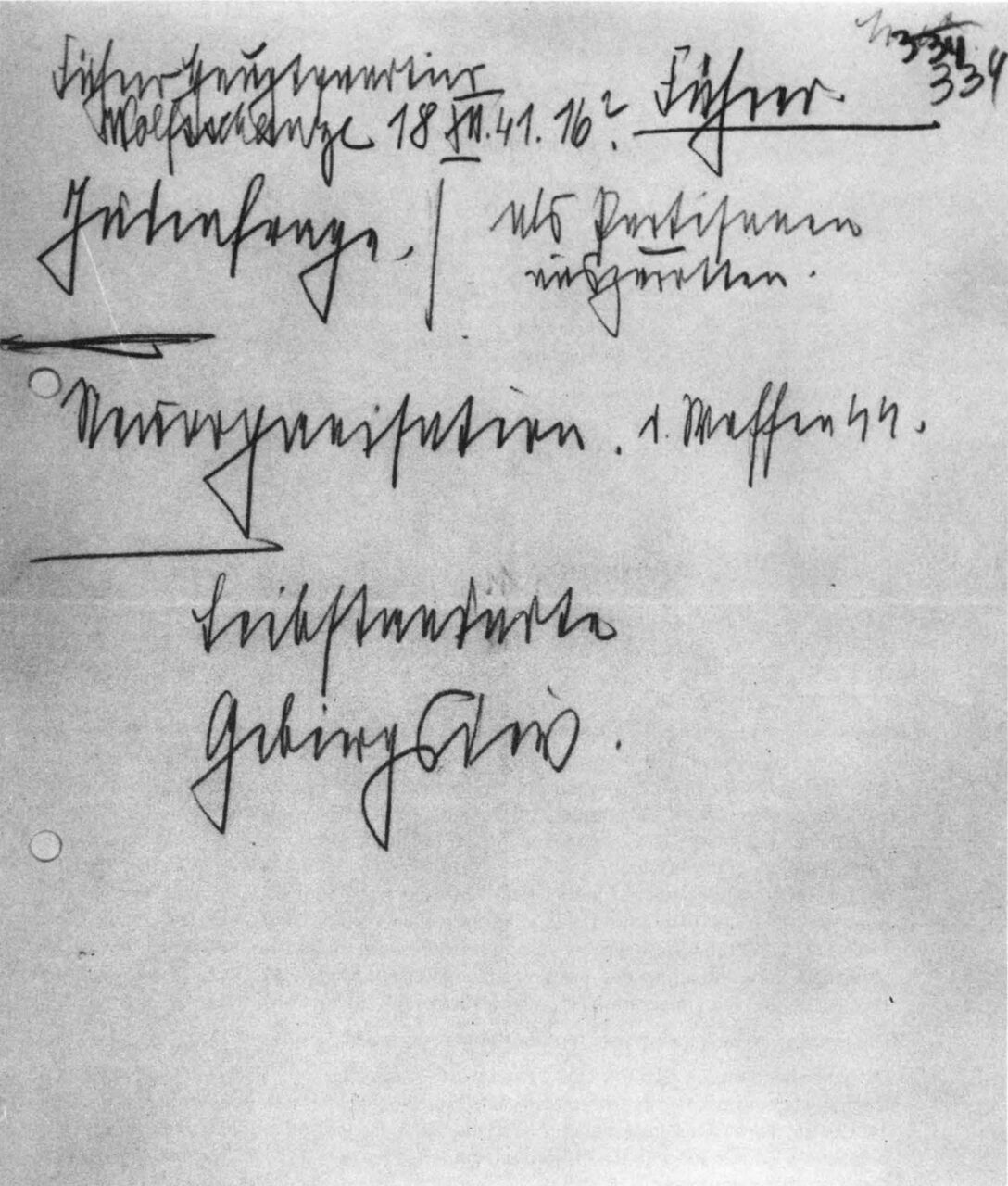
«The gassing is not carried out as it should be. With the aim of finishing as quickly as possible, the driver presses the accelerator to the maximum. In doing so, the individuals to be executed die of asphyxiation instead of dying through loss of consciousness as planned»139.

Read the report on PHDN…


The Berlin soldier of Army Group Centre, Heinz S., a 28-year-old bachelor, an insurance agent in civilian life, writes from Russia to his sister on 20 May 1942:

«I do not believe there will be another winter of war in Russia. We are going to, and must, prevail, otherwise it will go badly for us. The vengeance of the Jews abroad would fall terribly upon our people — for, in order to bring at last rest and peace to the world, hundreds of thousands of Jews have been killed here»140.

Heinz S. has totally internalised the paranoid, redemptive topoi of Nazi antisemitism: peace in the world can be attained only through the complete disappearance of the Jews, accomplished here — he writes it in black and white — through the murder of hundreds of thousands of Jews. Victory is a vital necessity in order to escape the vengeance of the Jews (a pure Nazi delusion hammered home throughout the war to justify a preventive mass massacre). In short, the Jews must be massacred to prevent them from taking revenge for the massacre committed against them…


Strassburger Neueste Nachrichten, p. 2
Scan Strassburger Neueste Nachrichten du 20 mai 1942 page 2 avec transcription discours de Robert Ley

In May 1942, Robert Ley, the head of the Labour Front, delivers a speech at Karlsruhe. It is transcribed in the edition of 20 May 1942 of the Strassburger Neueste Nachrichten on page 2:

«We will wage the struggle […] against the Jews and their allies to the last consequences. It is not enough to isolate the Jewish enemy from humanity, the Jew must be annihilated (der Jude muß vernichtet werden)»141.

Ley justified this explicitly murderous extremism by a classic Nazi rhetoric, totally inverting reality: the Jews were the aggressors and, were they to prevail, they would exterminate the Germans (der Jude wird unser ganzes Volk ausrotten). This delirious fantasy of a Jewish threat to exterminate the Germans is hammered home publicly throughout the war to express the «necessity» of annihilating the Jews142.


On 23 May 1942, Hitler addressed the Reichsleiter and the Gauleiter for two hours, behind the closed doors of the Reich Chancellery. Goebbels was present and reported Hitler's words in his diary; for Hitler:

«He [Hitler] also knows, naturally, that the Jews are determined in all circumstances to wrest victory, for they know that defeat also means for them their personal liquidation»143.

Goebbels also reports that Hitler gave the explicit order to Himmler to have all the prisoners of concentration camps executed in case things should turn out badly144.


On 28 May 1942, Goebbels notes in his diary:

«The more people of this filthy race we eliminate, the better the prospects for the security of the Reich»145.


In the issue of 6 June 1942 of Das Reich, Goebbels's weekly, Robert Ley writes:

«The Jews will pay through the extermination (Ausrottung) of their race»146.


Pages of Himmler's two speeches of 9 June 1942
fin du passage cité du second discours d’Himmler, officiel, du 9 juin 1942début du passage cité du second discours d’Himmler, officiel, du 9 juin 1942Page 18 du discours secret d’Himmler du 9 juin 1942 contenant le passage cité (en un an)première page du discours secret d’Himmler du 9 juin 1942

Following the wounds resulting from his attack by Czech resistance fighters, Heydrich dies on 4 June 1942. On 9 June 1942, at 19:40, at the airmen's house (Haus der Flieger), Himmler delivers a secret speech in his honour before high-ranking SS officials (SS-Obergruppenführer and SS-Gruppenführer)147. In it he declares:

«We must absolutely have completed the migration of the Jewish people within one year; thereafter, there will be none left to migrate. For from now on, a complete clean sweep must be made»148.

Himmler's use of a classic euphemism for camouflaging the massacre of the Jews, belonging to the lexical field of migration/displacement/expulsion/evacuation, barely conceals the murderous character of this directive, reinforced by the announcement that not a single Jew will then be able to «migrate» and by the radicality of the will to «make a clean sweep». This last expression very probably refers to Hitler's words of 12 December 1941 reported by Goebbels the following day (see above), very clear about his will to annihilate the Jews. Another speech delivered the same day a little earlier, at 15:00 — an official commemorative speech149 and a public one, this one, during Heydrich's funeral — published in the German press on 10 June 1942, does not contain this passage. However, this first speech, the official one, in fact makes perfectly explicit the meaning of this «migration» of the Jews which must be completed within one year in order to «make a clean sweep». It contains, indeed, another passage that seems to substitute for it and reveals its deadly character:

«We now have the sacred duty to avenge his death, to take up his mission and therefore to annihilate without pity or weakness the enemies of our people»150.

In Nazi vocabulary in general, and Himmlerian vocabulary in particular, the phrase «enemies of our people» (or «enemies of the German people», «of the Reich», even «of humanity») always designates the Jews151, who were, in any case, the object of Heydrich's mission.

The public remarks made by Himmler on 9 June, published the next day in the Nazi press, notably in the Völkischer Beobachter, the official organ of the Nazi party, are not the fruit of improvisation (which the secret speech of 9 June obviously confirms), as is illustrated by a long article by the SS-Oberst-Gruppenführer and Generaloberst der Polizei, Kurt Daluege, which also appeared in the Völkischer Beobachter on the 8 June previous, to the glory of Heydrich (whom Daluege succeeds in the post of deputy governor of Bohemia-Moravia). The conclusion of this article is explicit in expressing that Heydrich's death:

«[…] only strengthens our determination to exterminate definitively the elements of organised crime in Europe»152.

Now it happens that in Nazi vocabulary, these «elements of organised crime in Europe» always designate the Jews. This was already the case in the article in Das Schwarze Korps of 24 November 1938, and the present collection of quotations offers other examples of it. Thus, the will to exterminate the Jews of Europe expressed by Himmler following Heydrich's death in his two speeches of 9 June does indeed correspond to elements circulating among the highest Nazi leaders, perhaps for having been shared by Himmler before 9 June, or even set out by Hitler (the one not precluding the other).

It will be remembered that Heydrich had been at the head of the Reichszentrale für jüdische Auswanderung (the Central Office for Jewish Emigration) since 1939, whose principal task had in the meantime become the conveyance of the Jews towards the killing centres. The emigration of the Jews was formally forbidden on 23 October 1941 by an order of Himmler circulated in a memorandum to the offices and agencies of the Sipo-SD153. Even though the term «evacuation» is supposed to replace the term «migration» since the Wannsee Conference of January 1942 — where Heydrich establishes himself as the pilot of the «final solution» —, one sees that they remain interchangeable for Himmler (even though he himself forbade all emigration). Heydrich, responsible for «the emigration of the Jews», had, in the very terms used by Himmler, the mission to «annihilate the enemies of our people» — the Jews — which it is therefore now appropriate to carry through to completion in order to avenge Heydrich, within one year.

It is in this context of radical acceleration of the extermination of the Jews of Europe that a well-known order of Himmler to Friedrich-Wilhelm Krüger, the HSSPF (Höherer SS- und Polizeiführer: supreme chief of the Police and the SS) of the General Government (the part of occupied Poland annexed to the Reich), of 19 July 1942, is to be placed. This order concerns the extermination of the Jews of the General Government, to be completed even more rapidly:

«I order that the resettlement of the entire Jewish population of the General Government be implemented and completed before 31 December 1942. From 31 December 1942, no person of Jewish origin must remain in the General Government»154.

The context of this order makes it possible to understand that the «resettlement» in question obviously designates the mass massacre of the Jews of the General Government. Besides this context, we provide numerous examples in the present page making it possible to demonstrate that the concept of transfer/resettlement designates collective killing.

This order of July 1942 clearly shows that for Himmler, his June speeches constitute a genuine directive and not a rhetoric of circumstance. We have other documentary elements that confirm it: the Obersturmführer Heinz Röthke, appointed head of the Jewish Office of the Gestapo (Judenreferates der Gestapo) in Paris in July 1942, writes in a report on 9 September 1942 that «According to the plan announced confidentially by the Reichsführer SS [Himmler], the territories occupied by Germany must be free of Jews by the middle of the year 1943»155. This is obviously the announcement made by Himmler on 9 June previous.

In fact, the rhythm of the massacres (which Heydrich was already endeavouring to intensify in the spring of 1942) undergoes a draconian acceleration in the summer of 1942: «by mid-March 1942, some 75 to 80 % of the victims of the Shoah were alive; less than a year later, by mid-February 1943, the proportion had reversed» writes the historian Christopher Browning156. From the summer of 1943, Nazis begin to speak of the extermination of the Jews in the past tense, as something accomplished (thus Hans-Joachim Kausch for Ukraine in June 1943, Himmler on 6 October 1943, Julius Streicher on 4 November 1943, Wilhelm Loebsack for Germany and Eastern Europe in May 1944, or Hans Frank for Poland in June 1944).


Jean Mamy (Paul Riche), L’Appel 11/06/1942 p. 2
L’Appel, 11 juin 1942, article de Paul riche (Jean Mamy), La guerre juive

The filmmaker Jean Mamy, the paid Gestapo informer to whom he handed over Jews or resistance members from networks he infiltrated, wrote in the press, under the pseudonym Paul Riche, violently antisemitic diatribes. One recalls his call for the collective murder of the Jews of March 1941. In the newspaper of the collaborationist organisation the Ligue française, L’Appel, of 11 June 1942, he expresses, in an article entitled «La guerre juive», once again his desire for massacre, under the pretext of reprisals, tending quite naturally towards extermination. We must quote it at some length to grasp the full violence of it:

«In the Paris suburbs, many French people were struck by the English bombs which contained Jewish powder, Talmudic violence. Little children of ours sleep today beneath the earth, who had committed no other crime than to have blond hair, blue eyes, and white skin. At this same hour, the frizzy-haired kikes snigger in London, insulting the mothers of the victims, over the radio. […] European blood, our pure blood, has been flowing for a fortnight, on the “second front” of Stalin-Churchill! But Jewish blood is still not flowing. A little harmless square of cloth is placed on the chest of the “youdis”, and then they are left free to run the black market, or to lie in wait in the corners of the capital, to gun down men of our race. And yet it seemed to us – since the speech of the sieur Roosevelt, jew-ridden if ever there was, that war had been declared between the Jews and the white race. […] Let us repeat it: We are against the Jews. We are making war on the Jews. We wish, not to create, or to provoke, or to permit a “Jewish order”, but to destroy Jewish parasitism, everywhere. Wherever he is, the Jew remains the Jew: a malevolent, useless, dangerous being. Contrary to what the tormented little delicate ones may think — the imbecile metaphysicians mad with terror at the idea that one might touch a hair of a Jewish beard — the Jew is not a man; he is a half-breed! He is the repugnant caricature of the man of breeding. Moreover, the Jew has himself declared himself the sworn enemy of the white race. He wants our total destruction. He does not allow – in his petty morbid imagination – that we should exist. If he won the war we would be annihilated, without recourse. We would have to be his slaves or die. […] One cannot cry it loudly enough: We are in the midst of a Jewish war, here, in Paris. One must fight, answer blow for blow. Aryan blood has flowed. Jewish blood must be made to flow. …And to make it flow abundantly: ten for one, thirty for one, a hundred for one, until the Jews understand, until they recognise the strength of the Aryan, his superiority, his will to live. The Jews must yield or disappear. »157.

Several features of this diatribe are remarkable: the delirious racism that makes of the Jews («the frizzy-haired kikes»!), paradigmatic non-whites, whom their «mixed blood» excludes from humanity, «sworn enemies of the white race», whose «total destruction» they desire — a destruction, moreover, already under way since all the «Aryan» deaths are attributed by Paul Riche to a «Jewish» responsibility; the delirious alternative hammered home by Nazi discourse — the victory of the Jews automatically meaning the death of the Germans / of the Aryan race induces the «preventive» necessity of their destruction — is taken up here to demand, in fine, the extermination of the Jews, likewise presented from the sanitary angle of parasites.


On 12 June 1942, Karl Dürkefälden, an engineer from Lower Saxony who kept a diary, notes:

«This evening, 12 June 1942, shortly before 8 p.m., in a radio speech, it was declared that the Jews were being exterminated in Europe and perhaps beyond. The Jews were also accused of being responsible for the violent attacks currently being carried out by the English air force on the cities of northern and western Germany. Today, I was told that here, soldiers have recounted on several occasions that last autumn, thousands of Jews had been shot in Poland: first they had to dig graves for the others, then one day they dug their own grave and were shot from behind. The next day, I again heard from a completely different source that thousands of Jews had been shot.»158.


It is possible that the speech heard by Karl Dürkefälden was delivered by Goebbels, for the latter, on 14 June 1942, used exactly the same formula (with the same geographical scope), in Das Reich, his propaganda weekly:

«In this war, the Jews are pushing their most ignoble pawns and they will have to pay the price for it through the extermination of their race in Europe and perhaps well beyond»159.

The article would be reprinted in a collection published by Goebbels in 1943. It must be stressed that the extermination (Ausrotttung) of the Jews is indeed the signifier of a mass death (Goebbels speaks «of their race», a biological motif) since it is to come about «well beyond» Europe. This passage was brought to the attention of the President of the United States, Franklin Roosevelt, on 8 December 1942, in a memorandum handed to him during a meeting with American Jewish organisations, in the course of which he was alerted to the extermination process under way (Hitler's role, the gas vans of Chelmno, the gas chambers, Auschwitz, etc.)160.


Robert Ley, showing that his article of 20 May was not a slip, and doubtless taking up Hitler's own rhetoric, wrote on 14 June 1942, in Goebbels's weekly, Der Angriff:

«The war will end with the extermination of the Jews»161.


On 7 July 1942, at 20:15, Cairo time, the Voice of Free Arabism, a Nazi radio station broadcasting from Berlin in Arabic towards the countries of North Africa and the Middle East, broadcasts a message that begins with a pure lie, namely that the Jews of Egypt had supposedly received weapons to be used against the (non-Jewish) Egyptians. This message continued thus:

«We think it is preferable that the Egyptians rise up as one man in order to kill the Jews before they have the opportunity to betray the Egyptian people. It is the duty of the Egyptians to annihilate the Jews and to destroy their property. […] The Jews are the source of all the disasters that have befallen the countries of the Levant. […] You must kill the Jews before they open fire on you […] Arabs of Syria, Iraq and Palestine, what are you waiting for? The Jews are planning to violate your women, to kill your children, to destroy you. According to the Muslim religion, the defence of your life is a duty that you can fulfil only by annihilating the Jews. Here is your best chance to rid yourselves of this filthy race which has usurped your rights and brought about the misfortune and ruin of your countries. Kill the Jews, burn their property, destroy their shops, annihilate these accomplices of British imperialism. Your only hope of salvation lies in the annihilation of the Jews before they annihilate you»162.

Nazi propaganda towards the Arab countries used the same procedures as that intended for the Europeans: delirious accusations against the Jews attributing to them by projection the projects and methods that the Nazis reserved for the Jews, and calls for mass murder as a consequence, justified moreover by the invocation of Islam.


Philipp Bouhler, head of the «Führer's Chancellery», writes to Bormann on 10 July 1942:

«I placed at the disposal of the Reichsführer [Himmler] a large part of [my teams] for a solution of the Jewish question going to the ultimate consequences»163.

Bouhler was the person responsible for Operation T4, known as «euthanasia», the murder of the disabled in killing centres located in Germany. The principal method employed, perfectly mastered by Bouhler's teams: the gas chamber. What he did in such matters could be accomplished only with Hitler's approval, if not his direct orders. On 31 January 1941, Joseph Goebbels had explicitly mentioned in his diary the murder of 40 000 disabled people by Bouhler's services (see above).


Maurice de Séré, a pro-Nazi journalist and soon political director of the antisemitic weekly Au Pilori, publishes there for three weeks in a row, on 16, 23 and 30 July 1942, three very virulent articles in which, despite semi-coded terms, a very clear vision of the reality of the extermination under way breaks through:

«We now know that the reign of the Jew is going to come to an end. World events under way — whose very importance is beyond us, and which will only be able to be judged in their titanic power much later — have already decided the fate of the Jewish race in Europe, in Asia and in Africa». «We repeat that all the measures currently being taken, though they appear to be of little account to the initiated, to the convinced, to virile Frenchmen, have their immediate usefulness and will make possible the realisation of a general and definitive plan.» «The nations of one part of the world have ended up understanding the Jewish question to such a point that it is no longer even discussed among them, that the decisions taken towards the accursed race are inescapable, without appeal, and that measures guaranteeing even the most distant future are perfectly established» «The [Jewish] race is on the point of disappearing absolutely [underlined in the text] from Europe, from Asia and from Africa, and the «preliminary measures» aiming to separate the Jews from the French only prepare «the general and definitive measures that are going to be applied. And let this assertion not be taken for idle words. We are not in the habit of speaking to say nothing»164.


On Saturday 18 July 1942, a paymaster at the Army Command in Poland writes:

«at Bereza-Kartuska, where I halted at midday, the day before 1 300 Jews had just been shot. They had been led into a hollow outside the locality. Men, women and children had had to undress completely and were killed with a single shot to the back of the neck. The clothes were disinfected and reused»165.


In France, during a meeting on the deportation of the Jews with the Secretary of State for Police, René Bousquet, it had been decided (more or less unilaterally by Dannecker, head of the Jewish affairs service within the Sipo-SD) on an inspection tour of the «concentration camps for Jews» in the unoccupied zone, administered by the Vichy regime. Carried out by the SS-Haupsturmführer Dannecker and the SS-Unterscharführer Heinrichsohn from 11 to 19 July 1942, this tour was the subject of a report drawn up by Dannecker on 20 July 1942. The context is important; it is that of a hardening of German demands: on 1st July, Eichmann transmitted an order of Himmler demanding the most rapid possible deportation of the Jews found in France. This was obviously not displeasing to Dannecker, who expressed on 13 May 1942, in a report quoted above, his desire to carry through «a final solution of the Jewish question having as its aim the total annihilation» of the Jews. The agreements between the Vichy regime and the Nazis concerned at that moment the deportation of stateless and foreign Jews. Dannecker came, in a way, to «do his shopping» in the southern zone. Let us recall that since October 1941, all emigration of the Jews was forbidden by the Nazis. Dannecker's long report is interesting on more than one count. He notes, indeed, that conditions in the camps in the southern zone were particularly harsh. It has since been known that deaths from starvation there were numerous. Dannecker provides for the camps visited the number of «deportable Jews». He is visibly disappointed by the rather low figures he can report. He notes, however, his hope:

«to have in hand the Jews for the imminent execution of the planned scheme».

In the context of his report, it is clear that this concerns, a minima, the deportations demanded by Himmler. Towards the end of his report, Dannecker takes up the «problem» (the word is Dannecker's) of Jewish emigration. Given the motives of his journey and the context — the prohibition of Jewish emigration since October 1941, the will to deport a maximum of Jews — Dannecker does not rejoice at this emigration (difficult, as Dannecker notes). He observes it. He has, however, a reason for satisfaction. He notes, indeed:

«As soon as a possibility of embarkation presents itself, the Jewish emigration society HICEM pays any sum to enable Jews to emigrate. This is a proof that for world Jewry it is clear that the Jews found at the mercy of the Germans are heading for their total annihilation (Dies ist ein Beweis dafür, daß das Weltjudentum sich darüber klar ist, daß die im deutschen Machtbereich befindlichen Juden ihrer restlosen Vernichtung entgegengehen)»166.

Besides the fact that Dannecker decodes once again (see his report of 13 May 1942, quoted above) the real meaning of the deportation of the Jews, their «total annihilation», Dannecker's satisfaction does not concern the fact that there is still an emigration that deprives him of «deportable» Jews, but the fact that the Jews are ready to pay any price to leave, and that this proves, in Dannecker's eyes, that the Jews are aware that the fate awaiting them in German hands is death. Dannecker rejoices at their terror and stresses that this terror is well-founded. A typical example of Nazi Schadenfreude167


A veteran of the First World War initially won over to the Nazi cause, a captain in the Wehrmacht during the war, Wilm Hosenfeld was stationed in Warsaw. He kept a diary that he had conveyed to his family. On 23 July 1942, he writes:

«There is an enterprise of extermination of the Jews under way. Such has been the objective of the German civil administration since the occupation of the eastern regions, and this with the active help of the police and the Gestapo, but it seems that it must now be applied, in a radical way, on a still vaster scale. From different and all trustworthy sources, we learn that the ghetto of Lublin has been emptied, that the Jews have been killed en masse or driven into the forests, and that some of them have been imprisoned in a nearby camp. Witnesses from Lietsmannstadt and Kutno recount that the Jews, men, women and children, are asphyxiated in mobile gassing units, that the corpses are stripped of their clothes before being thrown into the common grave and that these clothes are then recycled in textile factories»168.


1st page of Luther's letter to Ribbentrop
1re page de la lettre de Martin Luther à Ribbentrop du 24/07/1942

In the summer of 1942, the Independent State of Croatia (Nezavisna Država Hrvatska, NDH) is not under direct German control, but under Italian military occupation, especially in the «second zone» (notably part of Dalmatia, Dubrovnik, Mostar, etc.). The Germans wanted to deport quickly the Jews found there, but came up against reluctance on the Italian side. Martin Luther, under-secretary of the Ministry of Foreign Affairs, whom we have already encountered above regarding the Jews of Serbia, had taken part in the Wannsee Conference in January 1942 and had there expressed his concerns regarding the Jews of South-Eastern Europe. He draws up a report for his superior, Minister Joachim von Ribbentrop, on 24 July 1942. In it he writes notably:

«In Croatia, the resettlement of the Jews is the object of a general consensus. In particular, the deportation of the 4 to 5,000 Jews of the second zone occupied by the Italians (centres of Dubrovnik and Mostar) is considered essential, for they represent a political burden and their elimination would contribute to general calm. […] The Italian chief of staff […] explained that it was “incompatible with the honour of the Italian army to take special measures against the Jews”»169.
We will pass over the justifications, as fictitious as they are antisemitic, about the dangers the Jews of Croatia supposedly represented — a mere hammering of a Nazi begging of the question making of every Jew an existential threat. This letter is interesting because it establishes (like many other documents in the present collection, but rarely for all the terms simultaneously) the equivalence between «resettlement» (Aussiedlung), «deportation» (Abtransport), «special measures» (Sondermaßnahmen) and «elimination» (Beseitigung), as well, moreover, as «action» (which appears further on in the same document170). The murderous character of this «elimination» is confirmed perfectly explicitly by Otto von Bimarck to high officials of the Italian Ministry of Foreign Affairs in Rome, on 18 August 1942 (see below).


On 26 July 1942, Eichmann addressed a report to Himmler concerning an agreement reached with the head of the Romanian regime allied to the Nazis, Marshal Mihai Antonescu, regarding the forthcoming deportation of the Jews of Romania towards the region of Lublin (in Poland) where, this report specified:

«the able-bodied will be put to work, and the rest will be subjected to special treatment (der Rest der Sonderbehandlung unterzogen werden soll)»171.

One will note the reference to the «special treatment» reserved for those unfit for work, that is to say murder (as is illustrated notably by an Einsatzkommando report of 13 July 1941 quoted above, as well as the correspondence between Arthur Greiser and Himmler, quoted below). The murder of the «unfit for work» is regularly evoked in Nazi documents, as in the report of Wilhelm Kube of 31 July 1942, quoted below, or in the letter of the Sturmbannführer Rolf-Heinz Höppner to Eichmann of 16 July 1941, quoted above, in the letter of Wetzel to Lohse of 25 October 1941 (which mentions the method: gassing), quoted above, or in Goebbels's own diary on 27 March 1942 (quoted above), or again in the report sent by the Swedish consul Karl Ingve Vendel of 20 August 1942, quoted below. The «special treatment» of the «unfit for work» designates nothing other than their murder…


The complete Kube report
Le rapport Kube à Lohse en entier

Wilhelm Kube was a Nazi of the first hour, Gauleiter of Brandenburg in 1928. After the invasion of the USSR, he is appointed Commissar General of Belarus (renamed White Ruthenia by the Nazis, Weißrussland). After the first massacres of the summer of 1941, the surviving Jews are gathered in ghettos that Himmler had progressively liquidated. On 31 July 1942, Wilhelm Kube writes from Minsk to the Reichskommissar Lohse:
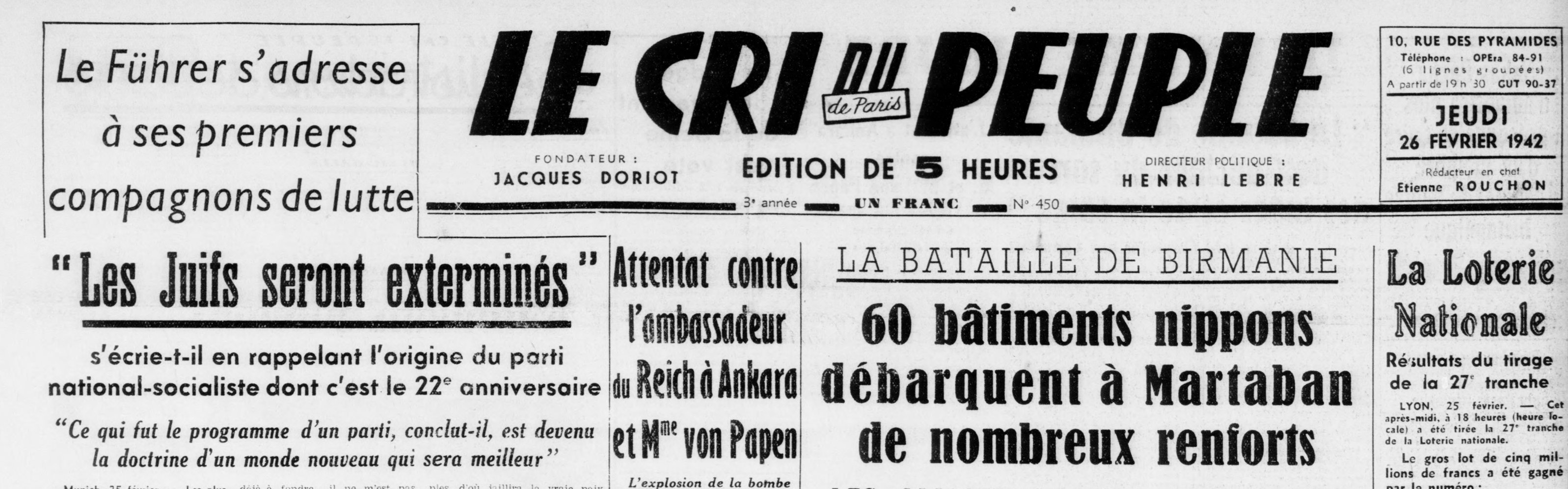
«After having minutely studied the situation in the course of several conversations on this subject with the SS-Brigadeführer Zenner and the SS-Obersturmbannführer Dr. Jur. Strauch, the extremely capable head of the SD, we have liquidated (liquidiert) in the course of the last ten weeks about 55 000 Jews in Belarus […] At Minsk, approximately 10 000 Jews were liquidated on 28 and 29 July, of whom 6 000 Russian Jews, in the majority elderly people, women and children; the rest composed of Jews unfit for work. The greater part of them had been deported to Minsk last November, by order of the Führer, from Vienna, Brünn, Bremen and Berlin»172.

The report is quoted more fully on PHDN. See the report…


The Swedish consul of Stettin, Karl Ingve Vendel, was secretly in contact with members of the German military opposition to the Nazi regime. During a stay in East Prussia, on 9 August 1942, at the home of one of them, Count Heinrich von Lehndorff, a reserve lieutenant of the Army, he probably met, among others, Lieutenant-Colonel Henning von Tresckow, and gathered from him information about the fate of the Jews. On 20 August 1942, he drew up a seven-page report that he transmitted to his government. On the situation of the Jews of Poland, notably in the ghettos, he writes:

«The treatment [of the Jews] depends on the place and the number of Jews […]. However the objective is the extinction of them all. […] Jews over fifty years of age and children under ten are quite particularly targeted by the extermination. The others are left alive in order to serve as a labour force; they will be exterminated as soon as they are no longer useful, and their property confiscated, mainly by the SS. In the towns, all the Jews are gathered, officially for delousing. […] But in the guise of delousing, they are gassed, after which they are thrown into common graves prepared in advance. The source from which I have all this information about conditions in the General Government is such that the veracity of the descriptions it gave me does not admit the shadow of a doubt»173.


On the morning of 18 August 1942, Prince Otto von Bismarck, counsellor at the German embassy in Rome, presented to Roberto Ducci, the Italian senior official responsible for occupied Croatia, as well as to the Marquis Blasco Lanza d’Ajeta, secretary of the Foreign Minister Ciano, a telegram signed Ribbentrop asking the Italian government to permit the mass handover of the Jews of Croatia to the Germans for their deportation to the East. Roberto Ducci reported the same day on his interview with Bismarck in a note whose original has come down to us. In it one reads:

«Bismarck declared that it concerned several thousand people and he made me understand that such a measure [the handover of the Jews of Croatia to the Germans] would lead in practice to their dispersion and their liquidation [a term replacing annihilation, struck out in the original]»174.

Roberto Ducci also informed his hierarchical superior, Count Luca Pietromarchi, who, in the diary he kept, noted on 20 August 1942 that Bismarck had requested the handover of the Jews of Croatia:

«with the aim of destroying them»175.

Ducci's note, and what it reports of Bismarck's words, served as the basis for a memorandum intended for Mussolini (see below).


Pages 1 and 2 of Blasco Lanza d'Ajeta's note of 18/08/1942
Pages 1 et 2 du rapport du 28 juillet 1941Pages 1 et 2 du rapport du 28 juillet 1941

Ducci's note (see above), co-drafted with Luigi Vidau, head of the «Ufficio IV», the office of «reserved affairs» (that is to say secret), mentioned explicitly «to be retyped, but for the chief of staff who will sign»176. Blasco Lanza d’Ajeta then draws up a note — stating explicitly that Bismarck's request amounts to a «complete elimination of the Jews»177:
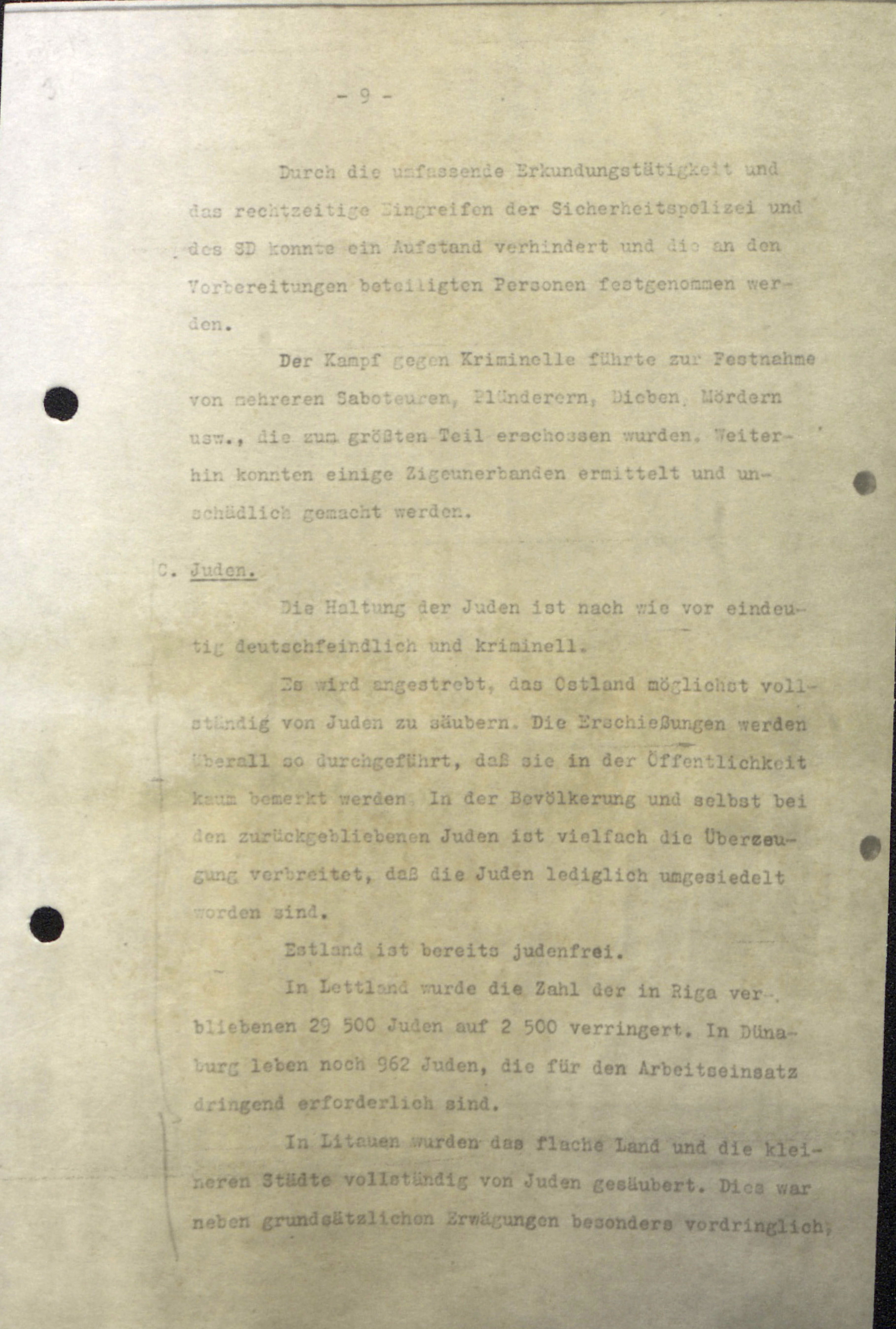
«Bismarck read me a telegram signed by Ribbentrop, in which the German embassy asked me to transmit instructions to the competent Italian military authorities in Croatia so that the measures envisaged by the Germans and the Croats for the mass transfer of the Croatian Jews towards the territories of the East might also be implemented in the zones under our occupation. Bismarck declared that this would concern several thousand people and gave to understand that these measures would aim at, in practice, their dispersion and their complete elimination [underlined in the original].»178.

Blasco Lanza d’Ajeta recommends, however, in his note to make a provisional proposal to the Germans: a re-examination of the situation of the Jews and, simultaneously, a stricter control over them. However, Ciano adds by hand on this note that he wishes the words of von Bismarck to be transmitted to Mussolini without «comments or proposals»179.


Ciano's note of 21/08/1942
Note de Ciano à Mussolini du 21/08/1942

A simplified version of Blasco Lanza d’Ajeta's note is thus elaborated and gives rise to a memorandum intended for Mussolini («Appunto per il Duce») that Ciano transmits to the latter, dated 21 August 1942, which also mentions explicitly that Bismarck had expressed that the deportation meant «in pratica […] eliminazione», the «liquidation of the Jews»:

«Bismarck communicated a telegram signed Ribbentrop asking the German embassy to transmit instructions to the competent Italian military authorities in Croatia so that, even in the zones under our occupation [the south-western part of the Independent State of Croatia], the measures planned by the Germans and the Croats for the mass transfer of the Jews of Croatia towards the eastern territories might be implemented. Bismarck declared that it would concern several thousand people and gave to understand that these measures would tend, in practice, towards their dispersion and their elimination. The competent service [of the Ministry of Foreign Affairs] points out that the reports of the Royal Legation [of Italy] at Zagreb suggest that, in conformity with the German wish, to which the Ustaše government rallies, the question of the liquidation of the Jews in Croatia would now be on the way to being settled. We submit the foregoing to your decision, Duce»180.

Mussolini wrote in his own hand «nulla osta»: no objection181. Mussolini thus gave his agreement in full knowledge of the facts for measures that he knew would lead to the death of the Jews concerned.


Wilhelm Cornides's notes
Notes de Wilhelm Cornides été 1942

Wilhelm Cornides was a 22-year-old German non-commissioned officer. During a journey in Galicia on 31 August and 1st September 1942, he passes very close to the Belzec killing centre. What he sees and hears strikes him so much that he takes note of his observations. He talked with several people — passengers of the trains in which he travelled, and policemen encountered along the way. Here are some passages from the observations of Wilhelm Cornides:

«And where do they go [the Jews packed into a goods train that Cornides crossed] next?, I asked. Belzec, he said [a policeman on duty at the station of Rawa-Ruska] And afterwards?. Poison. By gas?, I asked. He shrugged his shoulders. Then he merely said: As far as I believe, at the start they were always shot. […] Yesterday, six children's corpses were found along the train's route. The railway police officer […] confirmed the woman's statements about the children's corpses […] We passed by the Belzec camp. […] One distinctly perceived a sweetish and penetrating odour. They are already starting to stink, said [a woman]. No, that's the gas, replied the officer, laughing. In the interval — we had covered about 200 metres — the sweetish odour had turned into an acrid smell of burning. That comes from the crematorium said the officer. [Account given to Wilhelm Cornides:] Recently, we had a completely drunk SS man at our canteen, he was weeping like a child. He said he was on duty at Belzec and that if it went on like this for another two weeks, he would kill himself because he could not bear it any more. […] I asked [a policeman] in what manner the Jews were killed, he replied: They are told they must go to the delousing and that they must remove their clothes, then they enter a room, into which warm air is first introduced, into which a small quantity of gas has already been mixed. That is enough to put them to sleep. The rest comes afterwards. They are burned immediately after»182.

PHDN provides the full translation and the facsimiles of Wilhelm Cornides's notes. See the section devoted to Cornides's observations…


On 2 September 1942, the non-commissioned officer H. H of the 3rd company of territorial battalion 990 writes:

«It is already two and a half years that I have been in the East. Believe me that here we have fully taken the measure of the danger that the Jew represents. Only their extermination and their annihilation are fitting, and we hope that the hour is no longer far off when the last of them will have dug his grave (Über 2½ Jahre befinde ich mich jetzt schon im Osten. Sie dürfen glauben, daß wir hier die ganze Gefährlichkeit der Juden erkannt haben. Die Ausrottung und Vernichtung ist das einzige am Platze, und wir hoffen, daß die Stunde nicht mehr fern liegt, wo auch der letzte sein eigenes Grab schaufelt)»183.


Pages 1 and 2 of the Berliner Börsen Zeitung and article (on page 2) of 9 September 1942
Article Südoseuropa wird Judenrein du Berliner Zeitung du 9 septembre 1942Page 2 du Berliner Zeitung du 9 septembre 1942Page 1 du Berliner Zeitung du 9 septembre 1942

On 9 September 1942, the Berliner Börsen Zeitung publishes an article entitled «South-Eastern Europe is purified of Jews. Planned elimination of the dangerous internal enemy». In it one reads:

«Serbia and the Banat are purified of their Jews and thus the first countries of South-Eastern Europe where there are no longer any Jews»184.

The terms of this passage are astounding, not for what they express in themselves, but by their public character and their extreme proximity to those of the report of the Staatsrat and SS-Gruppenführer Harald Turner, head of the military administration in Serbia who had organised there the systematic murder of the Jews, dated 29 August 1942, quoted above («Jewish question, like the Gypsy question, completely liquidated: Serbia, the only country where the Jewish question and the Gypsy question are solved»). In barely more than a week, the terms of a report that gave an account of the murder of all the Jews of Serbia were found in the public space. This can only be a matter of political will. It is not an accident, since the article in the Berliner Börsen Zeitung is explicitly reproduced in another newspaper, Deutsche Justiz, on 18 September 1942, an article noticed, cut out and commented on by the diarist Friedrich Kellner on 25 September 1942185.

page 621 of the Internationale Agrar Rundschau of October 1942
page 621 du numéro d’octobre 1942 de l’Internationale Agrar-Rundschau

One finds again almost the same expression («Serbia and the Banat are purified of their Jews») in the October 1942 issue of a journal devoted to agriculture, the Internationale Agrar-Rundschau186. As often, the Nazi leaders had chosen to make known the what (the Jews are being exterminated) while maintaining the greatest secrecy about the how.


Otto Hofmann, one of the participants in the Wannsee conference, sets out before an audience of SS around the end of September 1942 his views on future generations. He specifies:

«They will practically no longer know the Jewish danger. In twenty years, the Jews will perhaps no longer exist. There are in European Russia a total of 11 million Jews [!]. There thus remains work to be done. I do not think we have eliminated more than a million of them. It is time that Europe be rid of this plague»187.

This speech contains two errors. The figure of 11 million Jews had been put forward at the Wannsee conference as the total of Jews in Europe. On the other hand, the extermination in reality proceeded more rapidly than Hofmann thinks.


Giovanni Malvezzi, the Italian entrepreneur who serves as courier and informant to the Vatican, makes in September 1942 a journey to Warsaw. He reports on it to Giovanni Battista Montini, the Substitute for Ordinary Affairs and head of Section I of the Secretariat of State of the Vatican, and future Pope Paul VI (in 1963). Montini draws up a report dated 18 September 1942. In it one reads:

«These last weeks, two grave facts must be mentioned: the bombardment of the Polish cities by the Russians and the systematic massacre of the Jews. The cities are defenceless: more than a thousand dead and hundreds of wounded are counted at Warsaw; panic reigns; discouragement can be read in everyone. […] The massacres of Jews have reached proportions, and have taken on frightful and horrifying forms. Frightful massacres are perpetrated every day; it seems that by mid-October, entire ghettos of hundreds of thousands of weakened wretches [will be] emptied to make way for the Poles displaced from their homes, where the Germans, become homeless as a result of the war, are transported. Terror reigns everywhere.»188.

The situation described by Malvezzi seems to concern at least the Warsaw ghetto. It is probable that the expression «frightful and horrifying forms» («forme esecrande e spaventose») is an allusion to the fact that part of the massacres were carried out by gassing — information held by Giovanni Malvezzi since he confided it to Kazimierz Papée (see below) and which one can suppose almost certainly that he must also have shared with Montini, who therefore chose not to state it directly.


Kazimierz Papée's note of 23/09/1942
Scan Das Schwarze Korps, 4/11/1938

Kazimierz Papée, ambassador of the Polish government in exile in London to the Vatican, also meets Giovanni Malvezzi, on his return from his journey in Poland. On 23 September 1942, he sends a note to his superiors in London in which he informs his government of the substance of the information Malvezzi reported to him. This note brings not only additional information relative to the preceding document, Montini's account of 18 September 1942 (see above), but also concerning the information that the latter chose not to include in his own report. One reads, indeed, in Kazimierz Papée's note: :

«Almost every day, a few thousand Jews are taken towards the East, beyond Lublin. There, in separate barracks, they are stripped of their clothes, then gassed or shot. What is called the small ghetto [at Warsaw] has already been emptied of its Jews. And the large ghetto — it was unknown, but it is now certain — must be evacuated of all the Jews before 30 October. This means that by the end of October, some 300 000 Jews must be brutally exterminated and the ghetto will be intended for the Polish population»189.

One therefore understands that during his September journey to Warsaw, Giovanni Malvezzi had been informed not only of the principle of the mass massacres (which the future Paul VI, Giovanni Battista Montini, indeed reports in his report), but also of the modalities of these massacres, both by shooting and by gassing. It is almost certain that, just as he spoke of it to Kazimierz Papée, he very probably informed Giovanni Battista Montini of these modalities. Montini therefore chose to keep silent about that information in his report, but it is likely that his expression «frightful and horrifying forms» («forme esecrande e spaventose») designates the gassings reported by Malvezzi. The historian Monika Stolarczyk-Bilardie specifies that on 24 September 1942, Kazimierz Papée provided the same information to Myron Taylor, the personal representative of the President of the United States to the Holy See190.


On 25 September 1942, Jacques Doriot's PPF organises in Grenoble a conference devoted to «France in the new Europe». The poet Pierre-Émile Jalbert, close to the leading circles of the PPF, speaks there. An inspector of the Renseignements généraux attends the meeting and reports that for Jalbert «the Jews live as parasites». He notes above all:

«Mr Pierre-Émile Jalbert attacks violently from the start the leaders of the old regime and above all the Jews. He makes of them, in very fiery terms, those at fault for all our misfortunes and proposes against them, not sanctions but their extermination without humanitarian afterthought»191.

The historian Tal Bruttmann, who unearthed this account, notes that contemporary readers not infected by the ultra thought of the PPF speakers are particularly struck. He notes that «one of the members of the prefect's staff, who read the report, underlined two words of it: their extermination»192. It must be recalled that many members of the PPF, having enlisted in the LVF, including Doriot himself, witnessed and took part in the massacres of civilians, notably Jews, in the East. Pierre-Émile Jalbert cannot have escaped the information brought back by his comrades.


On 25 September 1942, the soldier Hans Lustig writes to his cousin B. Lustig in Frankfurt an der Oder:

«Today at Janów, the Jews are being cleared out. There were 5,000 inhabitants at Janów, of whom 3,000 Jews. But the General Government must be cleansed of the Jews […] They [the Jews] know that in two weeks, they will all be dead»193.

On 23 and 24 September 1942, almost all the Jews of the ghetto of Janów Podlaski were transferred to the ghetto of Biała Podlaska, from where they were taken to the ghetto of Międzyrzec Podlaski, from where, between 6 and 9 October 1942 — exactly two weeks after their expulsion from Janów Podlaski — they were conveyed to Treblinka to be murdered there194.


The Superior General of the Jesuits, the Pole Włodzimierz Ledóchowski, also meets Giovanni Malvezzi following his September 1942 journey to Poland (see above). It marks him to the point that he speaks of it in a letter addressed to Cardinal Luigi Maglione, the pontifical Secretary of State, on 26 September 1942. In it one reads:

«[Malvezzi] was above all overwhelmed by the inhuman treatment inflicted on the Jews, all condemned to death in one way or another. The Nazis hope that all the Jews [underlined by Ledóchowski] will be killed by the end of October; it goes without saying that this is true also for those who come from France. Asked about the question of why they also killed the children, a Nazi replied cynically: “Es gibt auch Himmel-Lager” [There are also camps in Heaven]. The ghettos will thus be cleared in order to put the Poles there, whose houses will be recovered by the Germans.»195.

There follows a fairly long development on the fate of the Catholic priests. The historian who reports the substance of Ledóchowski's letter, Monika Stolarczyk-Bilardie, writes: «In the same letter, Ledóchowski proposed to Maglione that Malvezzi be received in audience by Pius XII in order to give an account of what he had observed in Poland. Without doubt, he was alluding to the “barbaric” extermination of the Jews which, to judge from this same letter, had also made a strong impression on the Superior General of the Jesuits. This hardly fitted Ledóchowski, who was not known for being a great friend of the Jews. The question of antisemitism appears clearly in the cited letter, in particular in the words of Ledóchowski who tries somewhat to justify his disturbance and that of Malvezzi by human sentiments rather than by compassion for the Jews, and shows himself more concerned by the fate of the Catholic priests than by the total extermination of the Jewish victims. The next day, 27 September 1942, Ledóchowski's suggestion was submitted to the pope who decided not to grant an audience to Malvezzi196.». Finally, one may note that Włodzimierz Ledóchowski, like Montini, probably chose to keep silent about the mention of the murders by gassing that Malvezzi (see above) doubtless made to him (and which the allusive «in one way or another» could cover).


On 26 September 1942, the Corporal (Gefreiter) H. Hirschnik writes to his friend A. Werner at Neuhof über Moritzburg, Sachsen:

«At Sokolno, the Jews were put into two trains, to be then gassed and then burned. There are no more Jews at Sokolno. All this is accomplished by the Polish police and the [German] gendarmerie. You cannot imagine the kind of shit we are dealing with here»197.


When, on 30 September 1942, Hitler recalled once again, in a public speech at the Berlin Sportpalast, his «prophecy» that in case of a world war the Jews would be exterminated and that this prophecy was going to come true, he was perfectly understood by his audience. Thus, the Romanian novelist and playwright Mihail Sebastian noted on 1st October in his diary what he had retained from Hitler's speech:

«Jewry will be exterminated»198.


The soldier Lehr sends, during the first fortnight of October 1942, a letter to Sofie Lehr in Frankfurt:

«The Jews avoid us as much as possible here, and when they hear our steps, they step down from the pavements and remove their hats. With time, they will all disappear from the horizon. It is more than time that we finish with these dregs of society. We have shot 5,000 people of this breed 30 kilometres from Pinsk. They had to undress completely, men and women alike, and then it was over for them. This will be the fate of every one of them. I will write no more of it and I ask you to keep it to yourself, so that it does not get about, for you know what that could bring about»199.


Helmuth von Moltke, from the great Prussian aristocracy, was a member of the Abwehr (the secret services of the German army) and was one of the founders of an informal group of opposition to Hitler, the Kreisau Circle. Although opposed to the failed assassination attempt of July 1944 against Hitler, he was arrested, tried and condemned to death despite the total absence of proof of «treason». He is executed by the Gestapo in January 1945. Throughout the war he wrote letters to his wife, Freya. On 10 October 1942 he wrote her this:

«Yesterday, lunch was interesting because the man with whom I ate had just arrived from the Government [the General Government] and gave us an authentic report on the SS blast furnaces. Until now I had not believed in it, but he assured me it was true: 6 000 people are processed every day in these furnaces. He was in a prisoners' camp 6 km from the camp whose officers assured him that this was absolutely exact. They also recounted to him quite extraordinary stories about the people who work there»200.

The General Government, the part of occupied Poland annexed to the Reich, had been equipped with three extermination centres within the framework of Operation Reinhard — Belzec, Sobibor and Treblinka — which were added to Chelmno. Now at the beginning of October, the killing capacity of Treblinka had risen from 3 000 to 6 000.


The diplomat and novelist Paul Morand, who would be elected to the Académie française in 1968, is very close to the leaders of the Vichy regime (he would be its ambassador in Romania then in Switzerland) and to numerous collaborationist intellectuals, whom he frequents or with whom he corresponds regularly. He keeps a war diary that he would entrust, at his death in 1976, to the Bibliothèque nationale de France, with a prohibition on its communication before the years 2000. A first volume devoted to the years 1939-1943 is finally published in 2020. On 23 October 1942, Paul Morand notes in his Journal de Guerre:

«As for the Jews [of Poland], there are almost none left. It is commonly said at Vichy that they have been gassed»201.

The circulation of such information in the Vichy leadership circles cannot surprise if one refers to the content of the report of Louis Sadosky of April 1942 or to the words of the collaborationist Maurice de Séré of July 1942, quoted above.


A clandestine group of reflection and discussion in opposition to the Nazi regime, close to Carl Goerdeler, the Freiburg Circle was made up of economists and jurists. There were elaborated during the war plans for post-National-Socialist German policy. Wishing to bear witness to the state of their reflection in November 1942, members of the Freiburg Circle draw up a memorandum. The economist Constantin von Dietze drafts a part of it entitled «Proposals for the solution of the Jewish question in Germany». In it one reads:

«[The] persecutions [of the Jews] were without question willed by the central authorities […]. hundreds of thousands of human beings were systematically killed for the simple reason that they were of Jewish ancestry»202.

What is striking, as Friedländer emphasises, is that the rest of this passage is imbued with a strong antisemitism, of a non-Nazi but traditional stamp, which continues to consider the Jews as a «problem» to the point where, if, after the war, Dietze advocates that «the State renounce all the special regulations concerning the Jews», this is solely because «the number of Jews surviving and returning to Germany will not be so great that they could still [sic] cut the figure of a danger to the German Volkstum»203.


Two reproductions of the note of 4 November 1942
Reproductions noir et blanc de la note du 4 novembre 1942Reproductions couleur de la note du 4 novembre 1942

General Giuseppe Pièche represented the Italian carabinieri in northern Croatia and in Slovenia. A note of the Italian ministry of foreign affairs dated 4 November 1942 reports the content of a telegram sent the same day by General Pièche. He specifies, concerning the Jews deported towards the East from the German occupation zone:

«They are eliminated by means of toxic gases»204.

This note was read by Ciano, the minister of foreign affairs, by General Roatta, then by Mussolini: the note is stamped «SEEN BY THE DUCE» (VISTO DAL DUCE), without further comment205. This hardly surprises, insofar as Mussolini had given on 21 August 1941 his agreement for the handover of the Jews of Croatia to the Germans for deportation to the East even though he was informed that this meant their elimination (see above).


Alberto Pirelli is one of the principal leaders of the Italian industrial group Pirelli and a major figure of the Italian big business world. He plays a political role throughout the interwar period and becomes a regular interlocutor of the fascist power, maintaining sustained relations with Mussolini, including during the war. For two decades, he notes everything down in writing. His notes have been published. On 6 November 1942, he has an interview with Mussolini who reacts to a report that Pirelli drew up for his attention a few days earlier. In Pirelli's report figures notably the mention of the «inhuman exactions against the Jews» and of the «forced migrations of entire populations»206. The way Mussolini reacts to these evocations is reported by Pirelli in his notes. «Concerning the Jews, writes Pirelli, Mussolini declared»:

«They [the Germans] make them emigrate… to the other world»207.

By this reflection, Mussolini reveals that he knows perfectly (which one could suspect given the numerous other documents we cite) the Nazi enterprise of extermination of the Jews, that it does not trouble him more than that and that he is ready to share this information. Let us add that for him, and he makes it known, the concept of «emigration», when it is used by the Germans concerning the Jews, is transparent and no longer means anything but a policy of mass murder.


Great operations of «liquidation» of the Jewish population of Belarus are carried out in the autumn of 1942. Lieutenant (Bezirks-Leutnant) Ernst Deuerlein, Gendarmerie-Gebietsführer of the Gendarmerie battalion of the district of Brest-Litovsk (a Polish town annexed to Belarus by the Soviets in 1939, situated at its far West, attached by the Nazis to the General Commissariat of Volhynia-Podolia — Generalkommissariat Volhynia-Podolia, one also finds Generalkommissariat Volhynia-Podolia — within the Reichskommissariat Ukraine), reports on it in a report that he transmits to his commander at Luzk dated 8 November 1942:

«On 15 and 16 October 1942, the Jewish Action was carried out at Brest-Litovsk. At the same time, the total resettlement of the Jews of the district of Brest-Litovsk also took place. In all, about 20 000 Jews have been resettled so far»208.

One notes here the use of a coded language that has become transparent, of euphemisms that do not deceive about the reality they attempt to camouflage. The term «Action» — the violent operations conducted by the Nazis and their accomplices as immediate preludes to mass executions (roundups and transports of the Jews towards places of execution) — had become so transparent that it was even used, with dread, by the Jews themselves. The German term Umsiedlung (resettlement, transfer) almost always designates the physical elimination of the Jewish populations. Moreover, the documents that use this term never mention, and for good reason, the destination of these «resettlements», except when it is a matter of killing centres. We have, of course, numerous testimonies attesting to these coded usages, numerous other documents that make explicit the criminal substance of these events. However, in the present case, the decoding is carried out within the same document. Two pages after the passage of the report quoted above, the Gendarmerie-Gebietsführer Deuerlein draws up the balance sheet of the operations conducted by his unit:

«Participation in the action against the Jews of the town and district of Brest-Litovsk since 15 October 1942: up to the present, 20 000 Jews have been shot»209.

This document indeed offers a complete equation for the decoding of the Nazi camouflage expressions: «resettlement» = «Jewish action» = «action against the Jews» = «shooting the Jews». Here the very concrete meaning of the «resettlement» of the Jews reveals itself in all its clear monstrosity: it is indeed a matter of massacring them.


This meaning obviously does not escape – they are witnesses and party to these massacres – the soldiers present in the region. They moreover circulate the information. On 12 November 1942, the soldier Paul Schneider writes from Brest-Litovsk to the Gefreiter Karl Dorosh in Berlin:

«Until recently, all the arduous work here was done by Jewish men and women. At present, 16 000 [Jews] are dead. The second night, all, down to the smallest child […]; there were piles of corpses in the streets of the ghetto»210.

Nearly 18 000 Jews were in reality murdered on the occasion of the «liquidation» of the ghetto of Brest-Litovsk, on 15 and 16 October 1942. The documentation allows us to know with precision the number of victims. The state archives of the oblast (the region) of Brest, the Gosudarstvennyi Arkhiv Brestkoi Oblasti (GABO), have preserved the documents drawn up in 1942 by the Polish officials of the municipal statistics office, who recorded day after day, at the request of the German occupier, in writing the figures of the population living at Brest-Litovsk, distinguishing the «ethnic» groups. Dated 15 October 1942, the official charged with recording these figures notes the presence at Brest-Litovsk of 16 934 «permanent resident Jews» (stałych mieszkańców) and 959 «temporary resident Jews» (czasowych mieszkańców). The following day the same figures appear struck out. Finally on 17 October 1942, the column of resident Jews is left empty. 17 893 Jewish men, women and children thus disappear with a stroke of the pen211. A great number of the Jews of Brest-Litovsk, notably old people and children, were shot in the ghetto itself. The rest were transported by train to the shooting killing centre of Bronna Góra (not far from Byaroza) where they were executed by German police battalions212. The slightly higher toll that Lieutenant Ernst Deuerlein mentions in his report of 8 November (quoted above) comes from the fact that in the weeks that followed, the Germans hunted down the survivors of 15 and 16 October, adding a few hundred additional victims.


On 12 November 1942, the soldier Otto Heid writes, visibly shaken, from Minsk to Johann Mueller:

«Here, it is over for the Jews. They have been murdered in an inhuman manner. [Our] heroes killing defenceless women and children. All this is inhuman. The Jewish quarter is deserted and resembles a battlefield. There is the culture of the XXth century»213.

In fact, the 80 000 Jews of Minsk were liquidated in several great operations (notably in gas vans or in mass shootings at the killing centre of Maly Trostinets), the last of which took place in October 1943. One finds the mention of at least one of them in the report of Wilhelm Kube quoted above of the end of July 1942, perhaps the one that marked Otto Heid214.


Report of General Pièche of 14/11/1942
fac-similé du rapport du Général Pièche du 14/11/1942

On 14 November 1942, General Giuseppe Pièche (see above) confirms, in a report sent to Rome, his telegram of the 4 November previous. In it he writes that:

«The decision to hand [the Jews] over to the Ustaše [Croatian allies of the Nazis] was tantamount to condemning them to death»215.


For a month after the great massacres of Brest-Litovsk, of 15 and 16 October 1942 (mentioned above in the letter of the soldier Paul Schneider of 12 November) during which 16 000 Jews had been murdered, the survivors are hunted down, gathered, executed216. On 21 November 1942, the Gefreiter Press writes from Brest-Litovsk to Anna Press. He shares with her his Nazi vision of things and evokes one of these massacres:

«The war will probably last twice as long because the war continues as long as a single Jew remains alive. We took care of it a fortnight ago. 1,800 Jews were shot in Brest-Litovsk itself»217.

The same day, 21 November 1942, the SS man Schütze also sends a letter from Brest-Litovsk, to Marta Sutleben. He writes:

«There are no more Jews here. No more men, no more women, no more children — they are dead»218.


Curt Prüfer is an interesting figure. Born in 1881, he is, in 1942, a diplomat with a fine career behind him, begun as an intelligence agent in the Middle East before and during the First World War, where he crossed paths with Lawrence of Arabia. He is a man of the old world who nonetheless rallied to the Nazis, a convinced antisemite, active against the Jews within the Ministry of Foreign Affairs. He long kept a diary, notably during the war. He partly rewrote it after the war to give it more moderate colours219. However the original has come down to us. Given the high functions he held within Nazi diplomacy – he was ambassador of Germany to Brazil at the beginning of the war and returns to Berlin in the autumn of 1942 where he was for a few months the contact of Amin al-Husseini (it is through Prüfer that a famous request of Husseini to block any departure of Jews from the Axis countries towards Palestine passes in May 1943) – he may be considered as particularly well informed. What he learns in November 1942 shocks him so much that he records it in his diary in French and by trying to camouflage, in a transparent way however, that he speaks of the Jews (after the war, in the reworked version of his diary, he would restore the explicit mention of the Jews). Here is what he writes on 22 November 1942:

«I was told this morning frightful stories about the treatment of the Persians. They were massacred, men, women and children in great numbers by asphyxiating gases or by the machine gun»220.

Prüfer writes here «Persians» instead of «Jews»… Prüfer's preoccupation appears, however, immediately afterwards since he comments thus on this information: «the hatred which, necessarily, must arise from it, will never be extinguished». He adds, this time in German:

«All the children know about it in the smallest details»221.

His son, Olaf Herbert Prüfer, who is the first to cite his father's diary in the Spiegel in 1979, himself brings the following comment:

«I was then twelve years old. Among the Jungvolk and in the Hitler Youth of Baden-Baden, where I lived at that time, there were completely banal expressions such as: If you do not obey, you will go to the concentration camp and you will be gassed»222.


Count Luca Pietromarchi was a senior fascist official; he adhered to the project of the Italian conquest of the Mediterranean and, a convinced racist, he believed in the superiority of the «Italian race»223. Responsible, within Italian diplomacy, for all the occupied territories, he was introduced both into political and economic circles, as the former head of the economic warfare section of the ministry of foreign affairs. He was particularly well informed and kept a diary. This diary has taught us (see above) that he was informed by August 1942 at the latest of the fact that to hand the Jews over to the Germans amounted to sending them to their death. On 27 November 1942, he writes in it again:

«The Germans continue imperturbably to massacre the Jews»224.

Pietromarchi continues by mentioning the information made public by the Polish government in exile in London relating to the mass murders of the Jews of Warsaw by gassing225. He then reports an episode that the writer Curzio Malaparte recounted to him:

«Curzio Malaparte, who had gone to Poland and into the Warsaw ghetto, recounted to me that he had learned from the mouth of German officers that one day, in one of those macabre trains intended for the extermination of the Jews, an infant had been found alive who had survived by continuing to suckle the breast of his deceased mother. The sucking movement had acted like artificial respiration. The officer who reported the facts declared that the persons present were seized with a shudder of horror when they heard, on opening the wagon of that charnel house, the cry of the baby rise up in the midst of so many dead»226.

One notes in the successive accounts reported here an error, very common during the war, confusing the transport in cattle wagons of the Jews towards the places of killing by gassing and the murder by gas itself — a confusion all the more understandable in that, at the same moment, gas vans, which combined the two missions (transports and murders by gas), continued to be used in the East. However, the extremely high mortality among the Jews transported by rail towards the mass killing centres is a well-known reality, observed by contemporaries, which could obviously reinforce the confusion in question.


Letter from Greiser of 01/05/1942
Première page du courrier de Greisier à Himmler du 01/05/1942

On 1st May 1942, the Reich Statthalter and Gauleiter in western Poland of the Warthegau district (a part of Poland annexed to the Reich), Arthur Greiser, responsible for the implementation of the Chelmno killing centre, writes to Himmler to propose to him the «special treatment» of the some 35 000 tuberculosis sufferers recorded in his Gau, as a sanitary measure intended to protect the ethnic Germans in the incorporated territory227. The terms of his request throw light on the fate reserved for the Jews:

«The operation of special treatment of the hundred thousand Jews situated in the territory of my district, authorised by you in agreement with the head of the Reich security directorate, the Obergruppenführer SS Heydrich, can be completed within two to three months. I beg you to authorise me, moreover, to rid my district of a danger which, from week to week, threatens to take on the proportions of a catastrophe, and to use for this purpose the available special commando already engaged on the occasion of the Jewish operation.

There are, in the district, about two hundred and thirty thousand recognised cases of tuberculosis among the Polish population. Among these, the cases of open tuberculosis are estimated at thirty-five thousand. […] If in the old Reich it is not possible to intervene against this endemic disease with the draconian measures that would be appropriate, I believe I can take the responsibility of proposing to you to have exterminated [ausmerzen] in the Warthegau the cases of open tuberculosis existing in the Polish population»228. 

Letter from Himmler of 27/06/1942
Courrier de Himmler à Greisier du 27/06/1942

To summarise, Greiser explicitly proposes to Himmler the murder, the extermination of the tubercular Poles by using the «special commando» (that is to say the «special commando Lange») responsible for the «special treatment» of the Jews. Himmler's positive reply dated 27 June 1942 deserves to be quoted in its entirety:

«Dear comrade Greiser,
I have unfortunately had to wait until today to reply to your letter of 1st May 1942. I have nothing against the idea that in the region of the Reichgau of the Wartheland the protected citizens or stateless persons of Polish stock, obviously afflicted with tuberculosis, insofar as according to the medical diagnosis their affliction is incurable, be subjected to a special treatment as you understand it. I would ask, however, that the measures taken case by case be first very precisely concerted with the Security Police, in such a way that their execution be as discreet as possible.
Heil Hitler!
Yours, H. Himmler»229. 

Letter from Hagen of 07/12/1942
Première page du courrier de Hagen à Hitler du 07/12/1942

For Himmler, the extermination proposed by Greiser and the «special treatment» are one and the same; given Greiser's initial letter, the discretion requested by Himmler and the fact that this «treatment» deals with incurable cases, it is clear that all this indeed means the murder of the 35 000 tubercular Poles, that the «treatment» of the Jews by the Lange commando consisted in murdering them. We possess in all nearly a dozen documents constituting the correspondence between Greiser's services and Himmler's, each more explicit than the last, on this matter, finally ending with a backtracking by Himmler on 3 December 1942. They are entirely online on PHDN. They are completed, in our view, spectacularly by the letter of protest that the person responsible for public health in Warsaw, Doctor Wilhelm Hagen, who was unaware that Himmler had gone back on his authorisation on 3 December, sent to Hitler on 7 December 1942:

«At a meeting on tuberculosis the director of the Division of Population and Social Assistance, the oberwaltungsrat Weirauch, secretly informed us that, out of 200 000 Poles who are to be resettled to the East of the General Government to make room for the German cultivators working for national defence, a third — 70 000 elderly people and children under ten years of age — could be treated in the same way as the Jews, in other words that it is planned or envisaged to kill them (es sei beabsichtigt oder werde erwogen… so zu verfahren, wie mit den Juden, das heißt, sie zu töten)»230.

Wilhelm Hagen denounces the plan to treat the Poles (probably tubercular given the context) in the same way as the Jews, to apply to them the «special treatment» in Himmler and Greiser's terminology, which Hagen makes explicit without the slightest ambiguity: it is a matter of murders. Himmler considered, following Hagen's letter, sending him to a concentration camp… We must note that Wilhelm Hagen's solicitude did not extend to the Jews231. We provide the facsimile, the transcription and the complete translation of Wilhelm Hagen's letter on another page.


On 7 December 1942, the soldier S. M. writes:

«The Jews arrive here, that is to say at Auschwitz, at the rate of 7 to 8 000 per week, then die shortly afterwards a heroic death»232.

The antisemitic irony of the expression «heroic death» does not even seek to hide that it is obviously a matter of murder.


Hans Frank, later nicknamed the «butcher of Kraków», occupied the highest post in the General Government (the western part of occupied Poland). He gave a conference to his principal collaborators on 9 December 1942 and recorded his words in his diary:

«It is clear that the labour situation is made more difficult when, in the midst of the war effort, the order is given to prepare all the Jews for annihilation. The responsibility for this order does not come from the General Government. The directive concerning the annihilation of the Jews emanates from higher sources»233.


Kinna report
10 décembre 1942. rapport de Heinrich Kinna sur AUschwitz

Auschwitz was at once a concentration camp, to which numerous non-Jewish Poles were deported, and a killing centre to which Jews were conveyed to be, in the very great majority, directly murdered without either entering the camp or undergoing the fate of concentration-camp slaves. An employee of the Central Office of Population Displacement of Lodz, the SS-Untersturmführer Heinrich Kinna draws up, on 16 December 1942, a report concerning the fate of a convoy of non-Jewish Poles who arrived at Auschwitz on 10 December 1942. Heinrich Kinna writes:

«With reference to the deployment of those fit for work, the SS-Hauptsturmführer Haumeier explained that only fit Poles [non-Jewish] are to be supplied, so as to avoid as far as possible any unnecessary pressure on the camp and the supply of food. The imbeciles, the idiots, the disabled and the sick are to be eliminated from the camp by liquidation (Liquidation) as quickly as possible, in order to relieve the pressure on the camp. However this measure is made more difficult insofar as, according to the instructions of the RSHA [Reich Central Security Office under Himmler's authority], the Poles must die naturally, contrary to the measures applied to the Jews»234.

We provide the facsimiles of the original document.


On 14 December 1942, Goebbels notes in his diary:

«The Jewish race prepared this war, it is the spiritual instigator of all the misfortune that has fallen upon the world. Jewry must pay for its crimes, as the Führer prophesied in his Reichstag speech: by the annihilation of the Jewish race in Europe and, if possible, in the whole world (Die jüdische Rasse hat diesen Krieg vorbereitet, sie ist der geistige Urheber des ganzen Unglücks, das über die Welt hereingebrochen ist. Das Judentum muß für sein Verbrechen bezahlen, so wie der Führer es damals in seiner Reichstagsrede prophezeit hat: mit der Auslöschung der jüdischen Rasse in Europa und vielleicht in der ganzen Welt)»235.


Max Frauendorfer was a member of the SS, SS-Obersturmbannführer, gold badge of the Nazi party (Goldenes Parteiabzeichen der NSDAP), director (Präsident des Hauptamtes Arbeit) of labour within the administration of the General Government in Poland. This was one of the principal administrative divisions of occupied Poland236. There was only one person above him in the administration of the General Government, Hans Frank. Max Frauendorfer was therefore perfectly in a place and in a post that allowed him to know what was happening. He had spoken to Ulrich von Hassell, former ambassador of Germany to Italy, of scenes he had witnessed. Hassell kept a diary in which he reported one of these accounts. On 20 December 1942, he notes:

«Continual mass massacres of the Jews, indescribable. SS men, after the hour fixed for the curfew, roam the ghetto and fire with the machine gun on everything that shows itself, for example children playing, who unfortunately stay a little too long in the street. Because Groscurth, in his capacity as chief of staff, protested against the order to exterminate thousands of children, he is said to have been reprimanded by Reichenau»237.

The «incident» alluded to in fact goes back several months and is well known to historians since we have all the documents relating to it (see above). There is admittedly in Frauendorfer's account an error about the order of magnitude of the number of children involved (a few dozen and not a few thousand), but absolutely not about the nature of the event described: this confirms the degree of reliability of the information reported to von Hassell by Frauendorfer.


Through its intelligence service the SD (Sicherheitsdienst, security service), the SS exercised a close surveillance of public opinion in Germany. It thus regularly noted the state of the knowledge that the population might have of Nazi policy against the Jews. In a report dated 23 December 1942, the SD of Franconia, the central-southern region of Germany, noted:

«At the present time, one of the principal causes of unease in the circles still attached to the Church and in the rural population is due to the news arriving from Russia reporting the execution and extermination of the Jews (Erschießung und Ausrottung der Juden). This information often arouses in these strata of the population strong anguish and lively worry. According to an opinion widely spread among the rural population, it is not at all certain that we will win the war, and if the Jews return to Germany, their vengeance against us will be terrible»238.

Let us note that the dominant sentiment is not the surprise or indignation of the population faced with the extermination of the Jews, but the fear of a backlash: ordinary Germans knew where they stood on the reliability of the news that reached them and the radical nature of the regime's anti-Jewish policy.


The German diarist Karl Dürkefälden, always very attentive to the radio broadcasts and the accounts given to him by his various visitors, mentions in his diary in December 1942 British radio broadcasts in which the extermination of the Jews of Serbia was mentioned, as well as the fact that Poland had become «a great slaughterhouse to which most of the Jews are taken». He adds a piece of information, drawn this time from broadcasts of German stations:

«According to earlier information coming from local German radio stations, there is an order for the annihilation of the majority of the Jews before the end of 1942»239.

This information is interesting on two counts. It seems to us to be a distorted rendering of Himmler's well-known directive in his speech at Heydrich's funeral of 9 June 1942, in which he had called for finishing with the Jews within one year (see above). Above all it is remarkable that Nazi propaganda repeatedly judged it necessary to inform the population of the enterprise of extermination of the Jews under way (in its principle if not in its modalities), a will that could only emanate from the most highly placed Nazi decision-makers, as is shown here by what is in our view an allusion to a Himmler directive.


Josef Sommerfeldt, an official of the Institute for German Work in the East, writes in a publication in 1943:

«To solve the Jewish question, [there are] only two solutions: expulsion or physical destruction (nur zwei Möglichkeiten: die Aussiedlung oder die physische Vernichtung)»240.


In 1943, the director of the Deutsche Arbeitsfront, Robert Ley, publishes a collection of his speeches and articles since 1941. In it one can read:

«Judah is annihilated in Germany and in Europe and will be struck down in the rest of the world (Juda ist in Deutschland und Europa vernichtet und wird in der übrigen Welt fallen)»241.

The observation Ley draws of an effective realisation of the extermination of the Jews in 1943 corresponds well to what is known today of the rhythm of the murder of the Jews of Europe. It must be stressed that this observation is assumed in a work intended for wide distribution.


The posthumous diary of Karl Dürkefälden, written from 1933 to 1945, was published in 1985. Dürkefälden was an engineer from Lower Saxony, very careful not to defy the regime. On 17 January 1943, Dürkefälden receives the visit of a former colleague, a soldier stationed at Vilna, who provides him with precise information on the fate of the Jews. The historian Avraham Barkai reports:

«He had no personal contact with the Jews and did not refrain from resorting to stereotypes of the kind the Jews are thieves. He forbade himself to buy in the Jewish shops of the town where he resided because I do not think it is worth putting oneself in danger for the sake of the Jews. But Dürkefälden was obsessed with recording reality as it really was. […] In February 1942, Dürkefälden recorded the first rumours of gassings. He quoted word for word Hitler's speech of 24 February 1942, noting the caption Die Juden werden ausgerottet (The Jews are being exterminated) under which this part of the Führer's speech had been printed in the local Nazi newspaper. In January 1943 [17 January], a former colleague, come on leave from Vilna, informed him of the almost total extermination of the Jewish community of that town, as well as of the Jews sent to Poland from France and from other European countries, who were partly shot, partly gassed»242.


On 2 February 1943, Count Luca Pietromarchi, the Italian official responsible for the territories occupied by Mussolini's regime, noted in the diary he kept:

«Despite all the catastrophes that have struck the Germans, they continue to insist that the Jews of the territories we [the Italians] occupy be handed over to them. This confirms that by the end of 1943, there will no longer be a single Jew alive in Europe»243.


Zoom on part of Dino Alfieri's report of 03/02/1743
Zoom sur une partie de l’original du rapport de Dino Alfieri du 03/02/1743

The Italian ambassador in Berlin, Dino Alfieri, sent on 3 February 1943 a report to the Italian Minister of Foreign Affairs, Ciano. Mussolini also had knowledge of it. This report included notably this:

«Concerning the fate reserved for them [the German Jews] — as concerning that which the Polish, Russian, Dutch and even French Jews have undergone and still undergo — one can scarcely have doubts. The [German] authorities have done nothing and do nothing to leave the slightest doubt hanging over the objectives decided (thus Rosenberg, in a speech delivered at the end of last year at the congress of the German Labour Front, confirmed the will to exterminate completely the Jewish race, qualifying its total extermination as a “humanitarian action”, because it would be of a nature to sanitise the European peoples), it emerges that the ghettos of Lublin and Warsaw have supposedly rapidly emptied, as much because of the epidemics and hunger as of the executions. The source to which I have already alluded reported a few days ago that, of the 600 000 Jews gathered in the Warsaw ghetto alone — a quarter where fewer than a hundred thousand people previously lived — there would supposedly remain no more than 53 000.

Even the SS speak of mass executions […] and a person who had witnessed them recalled with dread certain scenes showing machine-gun executions of naked women and children, lined up at the edge of a common grave. Among the accounts that circulate on the whole range of tortures, I limit myself to citing the one made to my colleague by an SS officer: he confided to him that he had swung six-month-old babies against a wall to smash them, in order to set an example for his men, tired and distraught after a particularly appalling execution, so great was the number of victims.»244.

It must be stressed how remarkably precise the information gathered and transmitted by Dino Alfieri is, notably concerning the fate of the Warsaw Ghetto on the point of being liquidated by the Nazis and which was in fact going to rise up in April 1943: in a famous report of May 1943, quoted below, the SS-Brigadeführer Jürgen Stroop gave a figure of 56 000 Jews at the moment of the insurrection.


The SS-Obersturmbannführer Eduard Strauch directs, at the end of 1941, the Einsatzkommando 2 of Einsatzgruppe A in Latvia, at the head of which he takes part notably in the murder of more than ten thousand Jews of Riga in the Rumbula forest. This earns him promotion in December 1941 to the head of the Security Police of Minsk. The historian Christian Ingrao presents him thus: «Eduard Strauch, a jurist of the SD, succeeds Erich Ehrlinger at the head of the KdS Minsk (Kommando der Sicherheitspolizei und des Sicherheitsdienst — Command of the security police and the security service — often «Sipo-SD» in the literature — of Minsk). He takes charge of the extermination of the greater part of the Jewish communities of Belarus and plays a preponderant role in the setting up of the Nazi policy of struggle against the units of Russian partisans, on the occasion of which more than 600 Russian villages will be burned and their population massacred. Strauch moreover pushes local institutions — consenting ones — to rid themselves of already decimated Jewish communities. He thus organises at Maly-Trostinez, in the environs of Minsk, a camp that becomes a veritable centre of extermination of the Belarusian Jews. In all, Eduard Strauch is without doubt one of the men most compromised in the genocidal policies. He nonetheless draws upon himself, by his brutality, the complaints of a civil administration that was however an instigator of the massacre245». At the beginning of 1943, Eduard Strauch seizes the occasion of an anti-partisan operation (code name Hornung) to make the last Jews of the Sloutsk ghetto disappear246, a small town of Belarus a hundred kilometres to the south of Minsk. Sloutsk had already been the theatre of a first mass massacre, nearly 6,000 Jews murdered, on 27 and 28 October 1941247, the first of a series that culminated in these two days of February 1943. The operation, which consisted in the murder of at least 3,000 Jewish men, women and children, takes place on 7 and 8 February 1943248. It is carefully prepared by Eduard Strauch, who publishes on 5 February 1943 an order describing its unfolding in detail (planning, assembly, guards, escort, shooters, pits). The SS-Obersturmbannführer Strauch is so immersed in the routine of mass massacres that he has become negligent in the use of euphemisms and camouflage formulas supposed to conceal the murderous character of the operations he directs. Here is how some explicit information about the meticulous organisation of what is designated as an operation of «resettlement» (Umsiedlung) is presented:

«On 8 and 9 February, the local commando will undertake the resettlement [Umsiedlung] of the Jews of the town of Sloutsk. There will take part in this Aktion the officers listed below and about 110 members of the Latvian volunteer company […]

Resettlement site [Umsiedlungsgelände]:

There will be 2 pits at the resettlement site. At each pit will work a group of 10 non-commissioned officers and men who will relieve one another every 2 hours. Schedule 8-10h, 10-12h, 12-14h, 14-16h. […]

Pit 1:
1st group [composition of the group]
2nd group [composition of the group] […]

Pit 2:
1st group [composition of the group]
2nd group [composition of the group] […]

The SS-Untersturmführer Pierre and 10 Latvians are responsible for securing the resettlement site.

The SS-Unterstuf Wiechert will be responsible for the routing of the vehicles during the preparations at Minsk, during the transport to Sloutsk, and for supervising the transport of the Jews from the ghetto to the resettlement site. He will also be responsible for the supply of ammunition. The SS man Kraft and the Rottwachtmeister Altmann are responsible for the delivery of the cartridges at the resettlement site. […]

The transport of the Jews towards the resettlement site is carried out by means of 6 trucks, each accompanied by 4 Latvians. […]

There take part in the Special Action [Sonderaktion] all the non-commissioned officers and all the men present, with the exception of the following non-commissioned officers and men who remain at Minsk […]»249.

The substance of this document, besides the sober, detailed character of what announces itself as a cold and routine massacre, provides much precious information: in 1943 the killings by shooting continue. They were never replaced by the mass gassings. The method depends on the place and the circumstances. The participation of Latvian volunteers is to be stressed. It has long been known. Strauch insists that every German member of the armed forces under his command take part in the killing. Even though the term «resettlement» (Umsiedlung) is hammered home, it is here completely transparent: Jews are transported to pits dug beforehand, guarded by armed men, and the distribution of ammunition is organised for an Aktion that requires the men to be relieved every two hours: a mass shooting. Not only is the meaning of resettlement/Umsiedlung here fully unveiled, it is also explicitly associated with another Nazi camouflage term, «special action» (Sonderaktion), a classic variant of «special treatment», abbreviated moreover at the beginning of the document to a simple Aktion, which is found in numerous other Nazi documents to designate operations of mass murder or of transport towards sites of mass murder. The same decoding of «resettlement» takes place in the report of the Gendarmerie-Gebietsführer of the Gendarmerie battalion of the district of Brest-Litovsk, Ernst Deuerlein, of 8 November 1942, quoted above. Numerous documents relating to the process and the operations of extermination of the Jews are more discreet and limit themselves to the camouflage expressions, «Action», «Special action», «resettlement». Despite this discretion, it is known that they must generally be understood as relating to events that were to lead to the murder of the Jews.


On 11 March 1943, Count Luca Pietromarchi, a high dignitary of the fascist regime and a key figure of foreign policy in the Italian occupation zones, notes in his diary:

«Our Embassy in Berlin has reported macabre details about the mass executions of the Jews gathered in the places of massacre from all the occupied territories»250.


Captain Lucillo Merci is assigned, since September 1942, to the Italian consulate of Salonika, in Greece, as translator and liaison officer of the Italian fascist regime to the Nazi authorities in Greece. In this capacity, he takes part in all the meetings with the Germans, notably with Dieter Wisliceny, Eichmann's representative, arrived in February 1943 to prepare the deportation of the Jews of Salonika towards the extermination centres of occupied Poland. From March to May 1943, 47 000 of the 56 000 Jews of Salonika were deported to Auschwitz where 40 000 were murdered by gassing upon their arrival. Lucillo Merci kept a diary that has come down to us. On 21 March 1943 he notes in it:

«It is well known that the Jews of Salonika are sent to Poland. There, those who are physically fit are put to work while the rest are eliminated [eliminati]»251.


The Milanese industrialist Alberto Pirelli, who had played an important economic and diplomatic role before the war, was very well connected with the fascist leaders. For many years he noted all his activities and meetings, notes published since. On 26 March 1943, he meets, in Rome, Cardinal Luigi Maglione, the pontifical Secretary of State at the Vatican, in a confidential manner. Alberto Pirelli notes that «the conversation that followed was marked by an altogether exceptional frankness». Their long conversation bears on the course of the war, the possibilities of a separate peace, the conditions for preparing a post-war period for Italy. Alberto Pirelli records this declaration made to him by Maglione:

«As for the atrocities committed in Poland and everywhere else against the Jews, the proofs we possess are terrifying»252.

Given the information that has been flooding into the Vatican for many months, of which we report the most spectacular in the present collection, this hardly surprises. Maglione himself was the direct recipient of information on the extermination of the Jews — that is indeed what it is about — as early as March 1942 (see above) then again in September 1942 (see above). Pirelli could not be surprised: Mussolini had clearly declared to him in November 1942 (see above) that the Germans were sending the Jews into «the other world»… Maglione informs him not only that the Vatican too is perfectly aware, but that it possesses «terrifying proofs».


Giuseppe Bastianini was a secretary of state within the Italian fascist government. Governor of Yugoslav Dalmatia from June 1941, he was personally informed of the Nazi exactions against the Jews. On 18 March 1943 he meets Mussolini. Bastianini gave an account of his interview in memoirs published after the war. But it is not these memoirs that interest us. Indeed Giuseppe Bastianini reported to Count Luca Pietromarchi, that high dignitary of the Italian fascist regime who kept a diary, the course of his meeting with Mussolini and what he said to him. Pietromarchi notes in his diary on 31 March 1943:

«He [Bastianini] had just received from Vidau [Luigi Vidau, head of the bureau IV of the ministry of foreign affairs, the office of confidential affairs] the latest news from Berlin on the horrible massacres perpetrated against the Jews […] [Bastianini says to Mussolini:] We know the fate that awaits the Jews handed over to the Germans. They are all gassed without distinction, old people, women and children (Essi vengono tutti gassati, senza distinzione, di vecchi, donne e bambini)»253.


Nazi ideology hierarchised the European populations. At the top, the «Aryan» Germans; at the bottom the Jewish «sub-humans» (even the non-humans), to be eliminated. Just above the latter the Slavs, Poles, Russians, Ukrainians, etc. The Nazi «experts» reflected much and wrote much on what should be done with them, notably in times of war when pragmatic considerations were sometimes invoked. It is thus the pretext of provisioning that governs a famous declaration of Goering to Count Ciano on 25 November 1941, stipulating that «20 to 30 million people will die of hunger in Russia»254. However, the Nazi vision is articulated first and foremost around its project of racial expansion and eviction of the non-Germanic peoples. The Nazi intellectuals reflect much on this question. They make publications and conferences of it. Within Himmler's Reichsicherheithauptamt (RSHA, Reich Central Security Office), the office Amt IIIB is charged with questions of nationality, interethnic relations, public health and racial policy. Its director, the SS-Standartenführer Hans Ehlich, delivers at Salzburg on 11 December 1942 a lecture on the «treatment of foreign peoples». Among the four modalities of «treatment» envisaged as able to be conducted simultaneously, according to the context and the characteristics of the populations considered, Hans Ehlich identifies clearly and explicitly, without qualms, «physical annihilation» (physische Vernichtung), as a solution for the «undesirable ethnic groups»255. Locally, such a scenario would be part of the hypotheses set out over the months, in very elaborate reports drawn up by the Nazi experts. These reports sometimes inform us at the margin, but without ambiguity, about the fate «naturally» reserved for the Jews. In March 1943 (Hans Ehlich's lecture is the subject of an official internal RSHA publication at the end of the same month), Dr Friedrich Gollert, personal assistant to the governor of the Warsaw district, draws up a memorandum describing the conceivable «solutions» for the 15 million Poles of the General Government (a part of occupied Poland, destined in Nazi geography to be incorporated into the «Greater Reich»). Several solutions are proposed. The first, immediately rejected, consisted in incorporating the 15 million Poles into the Reich. The second is radical:

«[It] would consist in exterminating [ausmerzen] these 15 million by a radical remedy. This solution too must be rejected. No doubt one can justify before History taking, for biological motives, this type of radical measures as proved necessary, for example, for Jewry. But to eliminate [beseitigen] without further ado a foreign people of 15 million persons in this manner is unworthy of a civilised people»256.

The underlining figures in the original. In fine, Gollert proposes to exterminate «only» 2 to 3 million absolutely useless Poles257. Friedrich Gollert's words are remarkable: they clearly designate the treatment (which Gollert refuses to apply collectively to the Poles) applied to the Jews and, as a matter of course, collective and global murder. The «obvious» character of this extermination had already been evoked, in an analogous context by Wilhelm Hagen, on 7 December 1942, quoted above, and even more in the letter of Dr. Ehard Wetzel of 27 April 1942, quoted above.

The ideas Friedrich Gollert expresses are in fact discussed for several weeks in the Nazi administration of the General Government, to the point that the Poles themselves get wind, very precisely, of the deadly hypotheses formulated there. Fritz Prause, representative of Goebbels's propaganda ministry in the General Government, draws up on 15 February 1943 a report that he transmits to Berlin. In it one reads that among the Polish population:

«[…] the rumour circulates of a supposed plan intended to divide the Polish population into three classes […] The third class is doomed to extermination (vernichtung)»258.

It is remarkable to note how precise this «rumour» is and in conformity with the plan formalised shortly afterwards by Gollert. The report then noted that the Polish leaflets that took up this information drew from it the consequence of a call to resistance since «they have nothing to lose». Moreover, there are concrete examples of the nature of the Poles' worry. A Polish woman, Anna Lassota, who was in a relationship with the Obergefreiter Rudolf, had written to him on 10 November 1942 to ask him «whether it was true that the Germans were planning to act with the Poles as with the Jews». She pressed him to answer because, «in that case, she would not let herself be put to death in that way and would buy herself poison»259.


Deutscher Wochendienst 05/02/1943 p. 4, zoom
Deutscher Wochendienst 05/02/1943, directives

Every day, the SS-Obergruppenführer Otto Dietrich, responsible for the press of the IIIrd Reich, saw Hitler with whom he worked out the confidential directives transmitted to all the press organs published in Germany and in the occupied countries. Through his intermediary Hitler directly controlled the tone and content of the Nazi regime's press. The directives to the press were always accompanied by glosses intended to orient the editors. The first half of the year 1943 sees an inflation of extremely virulent anti-Jewish instructions. Thus, those of 5 February 1943 incite the diffusion of the delirious — and habitual — accusation attributing to the Jews a will to exterminate the Germans:

«To insist on this point: if we were to lose this war, we would not fall into the hands of just any other State, but we would all be annihilated by world Jewry — Jewry is firmly resolved to exterminate all the Germans — International law and customs are no protection against the will of the Jews to annihilate us totally»260.

Zeitschriften-Dienst 02/04/1943 p. 2, zoom
Deutscher Wochendienst 05/02/1943, directives

This kind of propaganda was obviously intended to justify the extermination of the Jews to the population. This was moreover often expressed very explicitly. Thus, in a directive entitled «The Jews are criminals», of 2 April 1943, among the explanations provided, one could read:

«The Jews are criminals […] it should be stressed that among the Jews there are no individual criminals, as is the case in other peoples, but that Jewry as a whole has criminal roots and is criminal by nature. The Jews are not a people like others, but they are the bearers of a hereditary criminality gathered into a fictitious people. The criminals of all countries speak a technical language whose principal components are Hebrew. The annihilation of the Jews is not a loss for humanity, but is as useful to the peoples of the earth as the death penalty […] for criminals»261.


1st page of Strauch's presentation (full pdf linked)
1re page de l’intervention de Strauch

From 8 to 10 April 1943 a meeting of the Gebeitskommissars of the Generalkommissariat of Belarus is held at Minsk. The SS-Obersturmbannführer Eduard Strauch makes a long intervention there which is the subject of an official transcription. Among the numerous points he addresses there figure the difficulties encountered in ridding the Generalkommissariat of the Jews, but Strauch nonetheless shows himself satisfied:

«The Jewish question has already been dealt with. There is no need to add to it. When the civil administration arrived, it found enterprises created by the Wehrmacht with Jews. Whereas the Belarusians wanted to kill the Jews, the Wehrmacht promoted them. It is thus that the Jews reached key positions, and it is difficult today to eliminate them completely because the enterprises would be paralysed overnight, and we cannot afford that. I think we can nonetheless be reassured because, whereas there were about 150 000 Jews, 130 000 have disappeared. We still have about 22 000 of them in the General Commissariat [of Belarus] […] I ask you at least to see to it that the Jew is made to disappear wherever he is superfluous. It is incomprehensible that there should be Jewish cleaning women, Jewish switchboard operators, etc., or that so many boot-blacks should be necessary. They are superfluous and must therefore disappear. We can well manage without the Jews. We are going to reduce this number by half without encountering economic difficulties.»262.

We have seen above what Eduard Strauch meant by making the «superfluous» Jews «disappear» (see his directives of 5 February 1943 for organising the murder of the Jews of Sloutsk). It is indeed the mass massacre of 130 000 Jews that the SS-Obersturmbannführer Strauch congratulates himself on, and the coming murder of 22 000, that is in question here.


The Jesuit father Pietro Tacchi Venturi is a seasoned diplomat of the Vatican, known for his closeness to the fascist elites, notably Mussolini. After having been close to Pius XI, he was so to Cardinal Luigi Maglione, the pontifical Secretary of State. The latter had solicited him on 17 March 1943 in order to intercede with the Italian authorities to avoid the deportation of the Jews of Croatia, which he qualifies as a «fate so cruel»263 (we have seen above that it was known that this meant their extermination). This «fate so cruel» is a transparent euphemism for Tacchi Venturi, since in the letter he addresses on 18 March to Umberto Albini, the Italian under-secretary of the Interior, he pleads that the Jews of Croatia «guilty of no offence be spared a penalty that amounts in substance to the extreme one of an immediate or slow death»264». Indeed, Tacchi Venturini considers it self-evident that the deportation of the Jews means in one way or another their being put to death, in the reply he makes to Maglione, on 14 April 1943. He writes notably:

«On 17 March […], Your Eminence charged me with taking all the measures I would judge appropriate to avoid the deportation of the Jews residing in Croatia, the first step, as everyone knows, towards an atrocious and imminent death»265.

This «as everyone knows» says much about the character, at once obvious and widespread, that one could have, at least in the leading circles of the fascist regime and the Vatican, of the deadly fate reserved for the Jews by the Germans.

Venturi continues by explaining that he had obtained the day before an audience with Giuseppe Bastianini, the under-secretary of State for Foreign Affairs. The latter had then affirmed to him that his government intended to distinguish itself categorically from the German methods, and in no way wished to behave like «executioners» towards Jews and, concerning the Jews of Croatia, that it was a matter of «removing them from the cruel fate reserved for them in some inhospitable land of Poland»266, thus marking, he too, his clear awareness that the deportation of the Jews was carried out in the direction of Polish territories where death awaited them.


Alberto Pirelli, a major figure of the Italian big business world who frequented the fascist elites, informed in November 1942 by Mussolini himself of the Nazi enterprise of extermination of the Jews (see above), took systematic notes of his activities and meetings. These notes were published. On 22 and 23 April 1943, Pirelli sets down in writing various reflections and observations relating to the German demands for the handover by the Italians of the Jews present in the territories they occupy. He ends this passage with:

«It would seem, according to a report of Alfieri also, that in Germany, numerous Jews have been “gassed”!!»267.

We have seen above that the Italian ambassador in Berlin Dino Alfieri possessed fairly reliable information on the policy and the modalities of the extermination of the Jews by the Nazis, which he had communicated to Ciano and Mussolini in a message of 3 February 1943. It seems therefore that in the meantime he obtained additional information, even if the precision «in Germany» is here erroneous, the mass murders by gassing taking place in killing centres further to the East, situated in historic Poland (even if, from the Nazi point of view, Auschwitz was on German territory). This imprecision (perhaps attributable to Alberto Pirelli's rendering) takes nothing away from the importance of Dino Alfieri's report nor from the observations that follow from it: not only did the fascist leadership know everything, but this information was spread to wider circles than Mussolini's close guard.


On 24 April 1943, Himmler expressed himself before SS men and delivered to them the following speech:

«It is with antisemitism as with delousing. Eliminating lice is not a matter of a world-view. It is a question of cleanliness. In exactly the same way, antisemitism was not for us a question of world-view, but a question of cleanliness that will soon be settled. We will soon no longer have any lice»268.


On 30 April 1943, the KdS (Kommandeur der Sicherheitspolizei und des Sicherheitsdienst — Commander of the security police and the security service) of Lithuania draws up a «situation report» (Lagebericht) intended for his superiors in Berlin and Riga, covering the period from 1st to 30 April 1943 for the region. In it he addresses in a dedicated section the question of the Jews («Juden»). Here is what one can read: :

«In the course of the month concerned, the territories of Belarus newly attached to the general district of Lithuania, namely the districts of Swencionis, Aschmena, Svir and Eischischkis, the cantons of Jaschunai and Turgelai of the district of Wilna [Vilnius], as well as the cantons of Rudischki, Onuschki, Aukstadvaris and Semelikis of the district of Traken, have been rendered free of Jews [judenfrei]. Wilna, the administrative districts of Rudischki, Onuschki, Aukstadvaris and Semelikis of the district of Traken have been cleared of their Jews. These zones, threatened by the partisans, have now been entirely cleansed of their Jews. There results a border strip 50 to 80 km wide declared free of Jews.

The Jews who resided in the aforementioned territories were gathered and those unfit for work separated. On 5 April 1943, at Panarai [Ponary/Paneriai] near Wilna [Vilnius], the Jews unfit for work — about 4 000 — were subjected to special treatment. Besides the commander of Vilnius, the SS-Obersturmführer Müller, there took part in the Special Action [Sonderaktion] of Kauen [Kaunas], the Sturmscharführer Porst, the Hauptscharführer Bornack and Stütz, the Unterscharführer Wille and the police sergeant Heck. The Unterscharführer Wille was attacked by a Jew and received two knife blows in the back and one to the head. He was immediately transported to the military hospital of Vilnius. His life is not in danger. During an escape attempt by some fifty Jews, a Lithuanian policeman was wounded by a bullet and gravely injured.

Two men [non-Jewish] and their Jewish wives tried by every means to pass off their half-Jewish children as Aryans, and had already partly succeeded. By procuring documents, falsifying CVs and filling out administrative forms, they managed to find employment with the German authorities and to obtain Aryan identity papers. In consequence, the husbands were sent to a concentration camp and the Jewish women and their children were subjected to special treatment [sonderbehandelt]»269.

Less than 10 km from Vilnius (in Lithuania), the Ponary (Paneriai) forest was a shooting killing centre, the place of the murder of 40 000 to 50 000 people, mainly Lithuanian Jews, by SS units, German police units and Lithuanian collaborators, from the end of June 1941 until the summer of 1944. The massacres took place mainly in pits that the Soviets had begun to dig and fit out in 1940 to install fuel reservoirs there. This work had been interrupted by the German invasion. From September 1943, the Germans undertook to exhume and burn the corpses of the victims (initially buried in the pits where they had been murdered) within the framework of Operation 1005. This passage offers much information and transparently decodes the expression «special treatment». It is remarkable that the massacre of 4,000 Jews of Vilnius of 5 April 1943 is reported in diaries written, during the events, by witnesses and victims, confirming here notably the meaning of the expression «special treatment». Thus the Polish journalist Kazimierz Sakowicz, a resident of Ponary, took daily notes that were published after the war. He gave a striking account of this episode and evokes, he too, the escape attempt of some fifty Jews270. Hermann Kruk, a Jew confined in the Vilnius Ghetto, also keeps a diary and mentions on 5 April 1943 the transport of 4,000 Jews of Vilnius to be murdered271. Kazimierz Sakowicz is murdered in July 1944 by Lithuanian collaborators who wanted to prevent him from testifying and Hermann Kruk was murdered by the Nazis in September 1944.


On 24 February 1943 the Institute for the Study of Jewish and Ethno-racial Questions (IEQJER) succeeds the Institute for the Study of Jewish Questions. Its objective is «the study of questions relating to races and peoples and in particular, in different domains of the field of activity of persons belonging to the people of the Jewish race in France and in the world». Its direction is entrusted to the racist anthropologist George Montandon, responsible for a course on «Jewish ethno-raciology and on genetics and eugenics»272. Montandon's scientific training has served him since the 1930s to spread a virulent biological antisemitism against the Jews, whom he designates as a «whore ethnicity». He is associated since 1941 with the pro-Nazi collaborationist circles by contributing to the antisemitic «scientific» discourses and gets himself paid to conduct anthropometric «examinations» where he decides the «Jewishness» of the persons examined, sent to death in case of a «positive» answer from Mondandon. Montandon's introductory course, at the inauguration of the IEQJER in March 1943, is published in May 1943. Montandon enumerates the solutions for «solving» the Jewish «problem» — assimilation, segregation, emancipation — which have, according to him, all failed. There remain two solutions, of which he excludes the first (gathering all the Jews in a single place) and retains, in fine, only the second, total extermination, in these terms:

«What is, for us, the normal solution applied to the problem posed by a band of gangsters [the Jews]? Only one: extirpation. You therefore realise that the social conception we have envisaged of the Jewish community would legitimise in advance all measures, going as far as the death of the herd, which would have as their aim to ensure the total elimination of the swindling association of our Western countries»273.

The comment Pierre-André Taguieff makes on this outburst seems to us altogether pertinent: «Montandon presents the genocidal project he envisages, namely the death of the herd, as a justified application of the death penalty to a whole people by reason of its intrinsically criminal, parasitic and predatory nature. The putting to death would constitute, according to him, the logical conclusion of his analysis of the Jewish people as a swindlers' association. It is difficult, given Montandon's close collaboration with the Nazi specialists of the Jewish question, not to see in this appeal an echo, at the same time as a legitimation, of the genocidal process then under way»274.


On 3 May 1943, Robert Ley, the director of the Deutsche Arbeitsfront, gives a speech before more than seven thousand workers of the armament industry in Berlin, broadcast on the radio as well as by loudspeakers in numerous factories. This speech runs through the habitual antisemitic motifs, making of the Jews at once the paradigmatic capitalists and Bolsheviks, ready to exterminate the Germans. He declares :

«But we want to say – let the Jews and the capitalists and the Bolsheviks hear it well – we want the Jews to be exterminated, and the Jews will be exterminated, we know it (prolonged applause). We swear that we will not cease the struggle until the last Jew in Europe has been annihilated, is dead (prolonged applause)»275.


On 5 May 1943, the Vatican Secretary of State, Cardinal Luigi Maglione, draws up a memorandum on the situation of the Jews in Poland, introduced by «Jews. Appalling situation». Maglione continues:

«In Poland there lived, before the war, about 4 500 000 Jews; it is estimated that there now remain (although others have come from other countries occupied by the Germans) not even 100 000. At Warsaw a ghetto had been created that contained about 650 000 of them: there will now be no more than 20 to 25 000. Certainly, a good number of Jews escaped the censuses; but it is hardly possible to doubt that the majority have been suppressed. After months and months of transports of thousands and thousands of people, these have given no further sign of life: which is not otherwise explained than by death, given especially the enterprising character of the Jews, who, in one way or another, if they are alive, make themselves known. Particular killing camps exist near Lublin (Treblinka) and near Brest-Litovsk. It is reported that they are shut up there several hundred at a time in large rooms, where they perish under the effect of gas»276.

It is probable that the part relating to the murders of the Jews of Warsaw at Treblinka is fairly old and comes from the information reported by Giovanni Malvezzi, the Italian entrepreneur who informed the Vatican, seen above277.


On 7 May 1943, Hitler gives a speech before high officials of the Nazi party, Reichsleiter and Gauleiter. Herbert Backe, secretary of state for supply, barely returned from a journey in Italy, attends this speech. He takes notes, on the very papers of his journey, part of them on an Italian menu, during Hitler's speech, and reports the latter's words on the Jews. Herbert Backe quotes Hitler, who declares:

«This whole war is an antisemitic war. […] The Jews must be exterminated in Europe. Everything that opposes this must be struck down. […] For the Jews, no pity. […] No excuse for those who do not defend themselves against the Jews»278.


On 9 May 1943, Goebbels publishes in his weekly Das Reich an editorial entitled «The War and the Jews». In it he declares:

«This war is a war of the Jewish race and of the peoples who support it against Aryan humanity […] This war is a racial war. It was unleashed, and is waged in its interest and in conformity with its plans, by Jewry, which has no other objective than the annihilation and extermination of our people. For we are the only obstacle that stands before Jewry on the path to world domination […] No prophetic word of the Führer has come true so inexorably […] as that announcing that if Jewry managed to provoke a second world war, it would bring about not the annihilation of Aryan humanity, but the annihilation of the Jewish race. […] We are confronted with a world problem of the first order that can be solved by the present generation, and that must be […] When they [the Jews] conceived their plan of total annihilation against the German people, they signed their own death sentence»279.


In May 1943, Goebbels had a long conversation with Hitler on the «Jewish question». One of the most interesting discussions Goebbels ever had with Hitler on the subject. It is moreover not excluded that this interview took place before 9 May, so closely do the terms of the previously quoted article stick to Hitler's words. Goebbels reported this conversation in his diary on 13 May 1943. They spoke of the Protocols of the Elders of Zion, that antisemitic forgery claiming to expose a Jewish plot of world domination. Hitler was convinced of their «absolute authenticity»280. For Hitler, Goebbels reports, the Jews followed not a fixed programme, but their «racial instinct». They were everywhere the same, from the ghettos of the East «to the sumptuous banks of the City or of Wall Street». To the question why there were Jews, Hitler replied that one might as well ask why there were Colorado beetles. Goebbels reports Hitler's words:

«Nature is governed by the law of struggle. There will always be parasitic forms of existence to accelerate the combat and intensify the process of selection between the strong and the weak. […] In nature, life always works immediately against the parasites; in the existence of peoples this is not exclusively the case. From this comes the Jewish danger. Modern peoples therefore have no other solution than to exterminate the Jews (Es bleibt also den modernen Völkern nichts anderes übrig, als die Juden auszurotten)»281.

The at once sanitary and paranoid, radical vision that Hitler expresses here is not at all a peculiarity of the Nazi leader. It is a world-view and a discourse formalised and officially spread by the Nazi apparatus to justify explicitly the extermination of the Jews, as we show on another page of PHDN.

The immediate continuation of this passage of Goebbels's diary is also interesting because, to the sanitary register, Hitler adds, to justify the extermination of the Jews, a racial-political argument of almost cosmic dimension and above all allows himself a rather spectacular inversion: whereas it is the war that offers him the occasion to exterminate the Jews, Hitler claims that «the Jews» are defending themselves from extermination by the war (even though, obviously, «the Jews» are in no way a constituted group having the slightest weight or significant role in the conflict under way and it is indeed Hitler who wanted and provoked the war). Goebbels therefore continues to report the words of his Führer:

«They [the Jews] fight by every means against this process of annihilation under way. One of these means is the war. We must therefore understand that in this conflict between Aryan humanity and the Jewish race, we still have to wage very difficult battles […] the Führer thinks that Jewry has often been on the brink of absolute domination of the world. But each time it was close to its goal, it suffered a failure that brought it back to the starting point of its most primitive racial life. […] It is almost incomprehensible that their setbacks do not make the Jews wiser […] There is therefore no hope of bringing the Jews back into the circle of civilised humanity by means of an extraordinary chastisement. They will remain Jews for ever, just as we are eternally members of Aryan humanity. […] The peoples who have best understood the Jew and are most likely to fight him will take his place as master of the world»282.

These words are remarkable: in Hitler's delirious eyes, there is a war for the domination of the world between Jews and Aryans, the latter (obviously incarnated by the Nazis) aiming at this domination explicitly. Goebbels also repeats Hitler's explicit credo in a malevolent Jewish nature that nothing can modify, not even «an extraordinary chastisement», hence the necessity of exterminating the Jews, the only measure going beyond «an extraordinary chastisement». These words suffer no ambiguity and clearly expose the Hitlerian antisemitic «logic» of extermination — sanitary, racial, political.


The art historian Udo von Alvensleben, a veteran of the First World War, is again a soldier during the Second and finds himself on several theatres of the conflict, from France to Russia by way of Poland and the Balkans. He keeps a diary that he publishes after the war. At the end of April 1943 he is assigned for three weeks to Posen. On 11 May he makes there the acquaintance of the SS-Standartenführer Professor Hans Holfelder, surgeon, professor of medicine at the University of Medicine of Frankfurt, a recognised expert in radiology, a veteran Nazi close to Himmler, assigned to the University of Posen since January 1942. During a radiology course in 1936, Hans Holfelder presented the Jews as cancerous tumours, and the X-rays charged with destroying them had the features of Nazi assault sections283. In a project approved by Himmler for the sterilisation of Jewish men by X-rays, he was to be the expert charged with carrying out the experiments284. Holfelder He was also a specialist in the diagnosis of Tuberculosis by X-rays. In this capacity, he had been involved, in 1942, in the project of identification and murder of several tens of thousands of Poles afflicted with incurable Tuberculosis285. Holfelder is, through his friendships, his ideology, his practice, at the heart of the Nazi crimes. On 13 May 1943, Udo von Alvensleben spends the evening with Hans Holfelder and reports the same day in his diary the latter's words:

«[Hollfelder] defends the extermination of the Jews with extreme virulence and finds it more humane to kill even the children than to let them live as Jews. There is in him, in his conversation, which I contradict with caution, something like a cruel fanaticism»286.

One may note that the fact of the extermination of the Jews is mentioned without further comment, as an obvious given for the two interlocutors. Let us also note the strict equivalence here between to kill (töten, the children) and to exterminate/extermination (ausrotten/ausrottung, the Jews).


von Thadden's note of 15/05/1943
Note de Eberhard von Thadden du 15 mai 1943

Eberhard von Thadden, successor to Rademacher at the D III office (Jewish affairs) of the ministry of foreign affairs, records on 15 May 1943, in a note (marked «secret»), the «incident» that occurred a few months earlier, on the occasion of a visit by a group of Italian fascists to Minsk, in September 1942, to the Generalkommissar Wihlelm Kube. Kube showed them a church transformed into a depot…:

«The Italians asked what the little packages and the trunks piled up in the church were. Kube replied that it was all that remained of the Jews who had been deported to Minsk. Then he showed them a gas chamber (eine Gaskammer) in which he said that Jews had been put to death. The fascists were very deeply shaken»287.

Insofar as there was never a permanent gas chamber at Minsk, it is very probably a gas van, whose use is attested at the camp (and killing centre) of Maly Trostenets, not far from Minsk.


von Thadden's note of 15/05/1943
Note de Eberhard von Thadden du 17 mai 1943

Eberhard von Thadden returns to the episode in a letter («secret») of 17 May 1943 addressed to Adolf Windecker, representative of the German Ministry of Foreign Affairs in the Ostland, in practically the same terms. He writes that Wilhelm Kube had explained concerning the packages mentioned:

«It was what remained of the Jews deported and killed in a gas chamber. Apparently such a gas chamber was then shown to the fascists»288.


Ulrich von Hassell, long the ambassador of Germany to Italy, and one of the participants in the assassination attempt of July 1944 against Hitler, writes in his diary on 15 May 1943 at Ebenhausen:

«Overwhelming reports on Poland from the good Frauendorfer. While Frank publicly proclaims that the Poles are going to be given a life worthy of free human beings and that the world's attention is being sought — in vain — to be diverted with the Soviet massacres at Katyn, the SS continues to behave in Poland in a shameful manner that surpasses the imagination. Innumerable Jews, in any case hundreds of thousands, are gassed in rooms specially built for this purpose [Unzählige Juden werden in besonders dazu gebauten Hallen vergast]. But moreover, the Polish intelligentsia is still being systematically decimated. Frauendorfer and his friend Berthold, unable to continue to bring their collaboration to the General Government, enlisted as simple soldiers. Whereas Frank declares he finds this very understandable, and recommended to them only to enlist in the army, not in the SS, the SS officially and in writing asked Frauendorfer why he had enlisted in the army, whereas he was SS, and announced to him the harshest sanctions. Meanwhile, the unfortunate Jewish survivors of the Warsaw ghetto have gone over to armed struggle, which has led to violent fighting whose probable outcome is their total extermination by the SS [völliger Ausrottung durch die SS]. Hitler has made of the German a wild beast execrated throughout the world»289.

Fiedrich-Joseph Berthold, a lawyer, was seconded to the administration of the General Government of Poland. Let us recall above all that Max Frauendorfer was an eminent member of the SS and occupied a very important post in the administration of the General Government. He was therefore perfectly in a position to know what was taking place. Hassell could not hope for a better witness…


Johann von Leers is one of the principal antisemitic agitators of the IIIrd Reich. He is a close collaborator of Goebbels, specialised in the most delirious accusations against the Jews (notably the old topos of ritual murder), who called for their extermination before the war. On 16 and 17 May 1943 there appears from his pen, in several newspapers, a very violent article entitled «It is the Jew's fault». Under this title, in the newspaper Der Führer (published in the Gau of Baden) of 17 May 1943, one can read:

«The Jewish question [has become] the central question for our people. There are today quite a few people who complain that we are exterminating the Jews of Europe — they ought first to complain of the nameless misery into which the Jews plunged our people and all of Europe with the collapse of 1918. Yes, but the methods? Whoever speaks of method is always mistaken. What counts is the result. For the physician, the result must be the total elimination of cholera. For our people, the result must be the total elimination of the Jews. This struggle unfolds on the razor's edge. Between us and the Jews, it is who will survive whom. If the Jews prevail, our whole people will be massacred as the Polish officers were in the Katyn forest — and if we want to deprive the Jews of the possibility of concocting another war after this war, then another, and yet other wars and other revolutions, all directed against us and having no aim but to accomplish Jewish vengeance against us — then we must not permit Jewry to exist in our midst. These things are perhaps appalling, but they are inevitable. We did not choose the era in which we live, but we have our backs to the wall. Jewry, which we always treated well until the [First] World War, […] murdered us with a stab in the back. And it comes back to the charge to murder us again. It is Jewry that hates us — and one should not be surprised that, faced with its thirst for murder, we are in a state of legitimate self-defence. It is Jewry that willed it.»290.

The German Jewish philologist Victor Klemperer, married to a non-Jewish German woman and remained in Dresden, keeps a diary throughout the war. He noticed and rendered the content of this spectacular article from the version that appears on 25 May in the Dresden newspaper the Freiheitskampf. He notes from it, on 29 May 1943, the most salient features, notably the observation made by Leers: «we are exterminating the Jews of Europe»291.

This article, published in several newspapers, and therefore the fruit of a probable commission, is remarkable on several counts. Von Leers writes in black and white, and has published as a natural thing, known to all (which he states explicitly), that the Nazis are in the process of exterminating the Jews in Europe. There is thus no secret about the «what»: the Jews are being murdered en masse (obviously the secret about the «how» remains, namely the modalities and methods of this mass massacre). What is more, it is publicised to share the knowledge with the greatest number, at the same time as the extermination is justified by the habitual procedures of projection (as paranoid as it is mendacious) onto the Jews of what the Nazis reserve for them. The sanitary rhetoric underlines the radical (and «biological») character of the elimination undertaken. It is indeed a matter of exterminating, of making disappear en masse. The description of what the Jews have done (the stab in the back), do or would do (the Katyn massacre or new massacres) justifies the «preventive» putting to death of the Jews (the «legitimate self-defence»). Leers says it: it is a fight to the death that justifies everything, even the most appalling methods. One cannot be clearer: not only does Leers here confirm the rumours or the knowledge of the German readership of the extermination of the Jews, but he justifies it as a legitimate policy of survival of the German people.

A final point must be mentioned: Johann von Leers has a rich career after the Second World War. He takes refuge first in Perón's Argentina, where he directs a Nazi monthly distributed throughout the world, Der Weg, which publishes the first negationist articles in German (in the 1950s), even though Leers, as one sees here, is perfectly aware of the extermination of the Jews. Then he flees to Nasser's Egypt where he joins other former Nazis, converts there to Islam under the name of Omar Amin von Leers. He becomes close to the former Mufti, Amine al-Husseini, and directs the antisemitic propaganda under Nasser while inspiring a State negationism. He also maintains a correspondence with the French fascist and negationist Maurice Bardèche as well as with the negationist Paul Rassinier, whom he supplies both with negationist materials, taken up, translated, plagiarised by these two pioneers of French negationism.


Erich Koch, Gauleiter of East Prussia and Reichskommissar of Ukraine, expresses himself on 18 May 1943 in the press in a perfectly clear manner:

«Either the international Jew prevails, and then Germany dies. Or we believe that Adolf Hitler will prevail and that the international Jew will die, because he must die! […] If we do our duty with loyalty and obedience, then in the end good will vanquish evil, Adolf Hitler will vanquish the international Jews»292.


p. 34 of the Stroop report
p. 34 du rapport Stroop

The Warsaw ghetto uprising (19 April-16 May 1943) was the desperate gesture of the last Jews of the ghetto whom the Nazis were preparing to liquidate. The man responsible for crushing this uprising, the SS-Brigadeführer und Generalmajor der Polizei Jürgen Stroop, took pleasure in compiling the telegrams exchanged on this occasion in a very long report. Among other details he provides very precise information on what transport to Treblinka means. He noted for example on 25 April 1943:

«The immediate liquidation [of the captured Jews] could not be carried out because of nightfall. I will try to obtain for tomorrow a train for T II [Treblinka], failing which the liquidation will take place tomorrow (Die sofortige Liquidierung wurde wegen Eintritt der Dunkelheit nicht mehr durchgefuhrt. Ich werde versuchen, fur morgen einen Zug nach T II zu erhalten, andernfalls die Liquidierung morgen durchgefuhrt wird)»293.

p. 75 of the Stroop report
p. 75 du rapport Stroop

Facsimile online. This first extract is very clear: the alternative to the (Jews') liquidation impossible in the evening is a transport to Treblinka, which, if it cannot take place, will be replaced by a liquidation. Which shows that deportation to Treblinka is implacably synonymous with murder. The SS-Brigadeführer Jürgen Stroop is again very clear in his concluding remarks of 24 May 1943:

«Out of a total of 56 065 Jews on whom it was possible to lay hands, about 7 000 were annihilated in the former ghetto in the course of the main operation. 6 929 Jews were annihilated by transport to T II [Treblinka], so that, in all, 13 929 Jews were annihilated. In addition to these 56 065, about 5 000 to 6 000 Jews died in explosions or fires. (Von den 56 065 insgesamt erfaßten Juden sind ca. 7 000 im Zuge der Großaktion im ehem. jüd. Wohnbezirk selbst vernichtet. Durch Transport nach T. II wurden 6 929 Juden vernichtet, so daß insges. 13 929 Juden vernichtet wurden. Über die Zahl 56 065 hinaus sind schätzungsweise 5 - 6 000 Juden bei Sprengungen und durch Feuer vernichtet worden)»294.

Facsimile online. Here again, the transfer to Treblinka means that the Jews are «vernichtet» (from the verb vernichten, to annihilate, to exterminate), that is, annihilated, as 7 000 were («vernichtet», in this case very probably shot) in the ghetto itself and as 5 to 6 000 Jews were in explosions and fires (that is, set off by the Germans), violent deaths designated by the same term, «vernichtet», which always means, both in ordinary language and in the Nazi vocabulary, the putting to death. A second time, from the pen of the SS-Brigadeführer Jürgen Stroop, transport to Treblinka clearly means a putting to death.


On 24 May 1943, the SS and Police Tribunal of Munich handed down its judgment, secret, against the SS-Untersturmführer Max Täubner. The latter had taken it upon himself to execute Jews without permission. The verdict clearly stipulates that the fact of murdering Jews is not a problem. It was the lack of discipline that posed a problem. Here is a passage from this verdict:

«The accused cannot be sanctioned on account of Jewish operations as such. The Jews must be exterminated and a Jew killed is never a loss. Even if the accused ought to have known that the extermination of the Jews falls to the mission of certain commandos assigned to these tasks, the fact that he considered it within his competence to participate in the extermination of Jews pleads in his favour»295.

Long extracts from the secret proceedings against Max Täubner, as well as testimonies of his men, are online on phdn…


Pages 1 and 16 of the Kausch report of 26 June 1943
Scan page 16 du rapport Kausch du 26 juin 1943Scan page 1 du rapport Kausch du 26 juin 1943

Dr Hans-Joachim Kausch, attached to Goebbels's propaganda ministry, travels through Ukraine and Crimea from 3 to 22 June 1943. On his return, he draws up a confidential report, dated 26 June 1943. Of the twenty pages this report comprises, only a brief passage concerns the Jews. It is chilling:

«As for the Jewish question, we gathered declarations as clear as they were laconic. Of the 16 million inhabitants that the territory of the Ukrainian civil administration comprised, there were 1.1 million Jews. They were totally liquidated (Sie sind restlos liquidiert). Concretely, throughout our journey, we saw only four Jews, and they worked as tailors in an SD camp. The last to be liquidated were the Jewish artisans»296.

Hans-Joachim Kausch, who spoke with a high official of the Reich commissariat, recorded in his report the words of this high official, summarising in a brutal manner the passage we have just quoted:

«The Jews were exterminated like bedbugs»297.


Pages 1 and 2 of Strauch's report of 20/07/1943
Scan page 2 du rapport de Strauch du 20/07/1943Scan page 1 du rapport de Strauch du 20/07/1943

A long conflict sets the SS-Obersturmbannführer Eduard Strauch, head of the KdS of Minsk (see above), against Wilhelm Kube from the end of 1941 and 1943, head of the civil administration of Minsk, a Nazi altogether convinced of the necessity of the extermination of the Jews — he congratulates Strauch on the murder of fifty-five thousand Jews in a letter of July 1942 — but who tried to preserve those who were (still) useful to him from Strauch's exterminatory voracity298. On 20 July 1943, Strauch has seventy Jews who worked within Wilhelm Kube's administration arrested and murdered. The latter summons him the same day and gives him a dressing-down, sharply reproaching him for overstepping his competence, considering himself personally insulted, in terms that Strauch decides to report immediately to his hierarchy:

«On Tuesday 20 July 1943, in accordance with orders, I arrested and subjected to special treatment 70 Jews employed by the General Commissioner [Wilhelm Kube] of White Ruthenia. […] He [Kube] asked me how I dared to arrest the Jews he employed. I explained that I had strict orders to undertake this action. He demanded of me a written order. I replied that an oral directive sufficed for me since I had to execute it as rigorously as a written order. […] He [Kube] must suppose that the Jewish action was thus conceived as a particular affront towards him. […] I stressed that it was incomprehensible to me that Germans could quarrel over a few Jews. I was able to observe that we were continually reproached, my men and I, for being barbarians and sadists, whereas I was only doing my duty. Even the mere fact that specialist doctors had removed, according to the rules, the gold prostheses from the mouths of the Jews destined for special treatment was the pretext for discussions. Kube retorted that our way of proceeding was unworthy of a German man and of the Germany of Kant and Goethe; that if Germany's reputation was ruined throughout the world, it was our fault. He added that, moreover, it was established that my men literally got excited during these executions. I vigorously protested against this accusation and stressed that it was regrettable that, in addition to having to accomplish this dirty work, we were furthermore dragged through the mud. This put an end to our conversation»299.

One may here note the strict equivalence between the fact of subjecting Jews to «special treatment» (Sonderbehandlung), «Jewish action» (Judenaktion) and the fact of proceeding to executions (Exekutionen) of Jews. The mention of the theft of the dental gold, torn from the Jews before their execution, obviously removes any possibility of ambiguity. It will be noted that for the SD (the security services under Himmler's authority) it was necessary to kill Jews (in 1943 very few remained) who represented no danger and were considered useful by other Nazi services otherwise favourable to the extermination policy, and that the recovery of the dental gold of the still-living Jews destined to be executed constitutes only «a mere fact», banal, which should in no way constitute, in the eyes of the Nazi Eduard Strauch, a subject of discussion… Finally, it must be noted that the orders given to Strauch for the execution of the Jews were oral orders, which confirms that this was indeed the mode of transmission by far preferred to writing by the Nazis for everything concerning all the murder operations.


The anger of the SS-Obersturmbannführer Eduard Strauch against Wilhelm Kube does not content itself with his dispatch of 20 July 1943. On 25 July 1943 he draws up a very long report setting out the history of the conflict that has opposed him to Wilhelm Kube since 1942. In it he provides important quotations from documents emanating from himself and from Kube, commenting on them at length and relating in detail the various occasions on which Kube opposes, according to him, the policy of extermination of the Jews. In reality Kube tried to preserve only the Jews he employed in his service. But Strauch's orders were strict and radical: all the Jews were concerned by his mission of mass putting to death. His great loquacity leads him, as already several times before, to set down in black and white the reality of the Nazis' behaviour to dupe the Jews about their true intentions. The report of 25 July 1943 drawn up by Strauch, which teems with information, contains notably a passage of a cynicism rarely expressed so brutally in the documents: the written admission of the lie aimed at concealing from their victims the objective of the operations he conducts. Strauch writes:

«During a large-scale Aktion in the ghetto (Ghetto-Großaktion), informers let us know that the order service of the German Jews was made up above all of war veterans and that it wanted to put up armed resistance. In order to avoid German blood being shed, the men of the order service were concentrated in another place. It was explained to them that a fire had broken out in town and that they were to help extinguish it. The Jews were loaded into trucks, then were subjected to special treatment (sonderbehandelt). This matter also reached the ears of the Gauleiter in an inexplicable manner. He first got worked up, finding it cruel to liquidate (beseitigen) front veterans, then he protested, calling this procedure inadmissible. […]

An action (Aktion) against the Russian ghetto of Minsk was to take place on 1st March 1942. The general commissioner had been warned of it beforehand. The action (Aktion) was to be camouflaged in the form of a communiqué to the Council of Elders announcing that 5000 Jews of the Minsk ghetto were to be resettled (umgesiedelt). The Council of Elders was to select them and place them at our disposal. Each Jew had the right to take five kilos of baggage.

We can prove that the general commissariat betrayed the real intentions of the Sicherheitspolizei. For several days, the Jews employed at the G.K. could not go to the ghetto, but were held at the G.K. This was enough for the Jews of the ghetto to understand that the Sicherheitspolizei's declarations were false. Moreover, according to the information an informer gave us, other indiscretions were committed. At the time, it was impossible for us to elucidate this matter. But one fact remains established: the Gauleiter used his information to save his Jews.

Because of this betrayal, not a single Jew was present on the agreed date. Nothing else was left for us to do than to gather the Jews by force. They put up resistance and the men assigned to this mission had to make use of their weapons.»300.

Once again, Strauch's negligences are spectacular. It is true that he is so implicated in the mass killings for so long that it is understandable that he expresses himself without taking the slightest precaution. Here are again confirmed the equivalences between «special treatment», «action» and murders. One will note the cynicism and fanaticism of the Nazis who murder those who were their own compatriots, who were German soldiers during the First World War, but Jews, therefore condemned. More interesting still is the explicit admission from the pen of the SS-Obersturmbannführer Eduard Strauch that the Germans lied to the Jews by presenting the «actions» organising a mass massacre under the fiction of «resettlement». Strauch complains, accusing — whether the accusation is founded or not matters little — Kube of having voluntarily revealed to Jews the fictitious character of this «resettlement» (the fiction is elaborate since the communiqué claims to bolster its credibility by authorising the Jews to take baggage) and of having thus «saved» some, which obviously means that they were in fact condemned. The term «resettlement» (Umsiedlung) appears at once as a way of deceiving the Jews and a term of the coded language of the Nazi documents designating the implementation of the mass massacre.


The quotation that follows, by its nature, stands apart from the present collection. Indeed, it is not, strictly speaking, a quotation contemporary with the genocide of the Jews. But the personality of the one who reports it marks it indisputably with the seal of the most absolute authenticity. The former mufti of Jerusalem, Amin al-Husseini, after having been a fanatical adversary, with a clearly antisemitic rhetoric, not only of the Zionist project but also of the Palestinian moderates, allied himself with Hitler. One knows well, moreover, Hitler's declarations to Husseini, mentioning his project of extermination of the Jews at the end of 1941. After the end of the Second World War, Husseini would remain a visceral antisemite. Amin al-Husseini wrote his memoirs. These recollections are therefore posterior to the war. Nevertheless he relates in them an interview with Himmler in the summer of 1943. Himmler declared to him:

«We have decided to make them [the Jews] pay in advance, during this war, the price of their harmful actions. We have already exterminated nearly three million of them»301.

In November 1943, Amin al-Husseini, expressing himself publicly in Berlin in a speech broadcast on the radio, would enunciate very brutally his knowledge of the extermination of the Jews under way, and almost completed at the end of 1943 (see below).


On 4 October 1943, the Reichsfürher SS Heinrich Himmler expressed himself before an audience of Nazi dignitaries, Gruppenführers at Posen, for three hours. His speech was recorded and this recording has come down to us (it is preserved by the American National Archives in Maryland) and the speech transcribed. The violence and radicality of Himmler's words, notably but not solely about the Jews, are particularly explicit in these extracts:

«A principle must serve as an absolute rule for the SS: we must be honest, correct, loyal and good comrades towards people of our blood, to the exclusion of all others. What happens to the Russians or the Czechs does not interest me at all. The good-quality blood, of the same nature as ours, that the other nations can offer us, we will take it, and, if need be, we will take their children from them and raise them among us. It is totally indifferent to me whether the other peoples live prosperously or die of hunger. This interests me only insofar as these peoples are necessary to us as slaves of our culture. That ten thousand Russian women perish digging an anti-tank ditch is totally indifferent to me, provided the ditch is dug. […]

I also wish to speak to you in all frankness of a particularly grave subject… before you, publicly. Among us, it is possible to speak of it, but we will never speak of it in public. Just as we did not hesitate on 30 June [1934, during the «Night of the Long Knives»] to execute the order that had been given us to put against the wall and shoot comrades [the SA] who had failed, so we have never spoken of it and we will never speak of it. […]

I speak of the evacuation of the Jews, of the extermination of the Jewish people (die Ausrottung des jüdischen Volkes). It is one of the things easy to express: The Jewish people is in the process of being exterminated, (Das jüdische Volk wird ausgerottet) declares every member of the Party, Indeed, it is part of our plans, the elimination of the Jews, the extermination (Ausschaltung der Juden, Ausrottung, machen wir), we are accomplishing it… pah! A trifle! And then they come, 80 million good Germans, and each has his good Jew. Obviously, the others are swine, but this one is a first-quality Jew. Not one of them saw [the corpses], not one was on the spot. Most of you know what it is to see a heap of a hundred corpses, or of five hundred, or of a thousand. To have gone through that, and at the same time, save the exceptions due to human weakness, to have remained correct, that is what has hardened us. This is a page of glory of our history, a page unwritten and that will never be written.[…]

We had the moral right, we had the duty towards our people, to kill (umbringen) this people that wanted to kill us. […] we are exterminating a bacillus (den Bazillus ausrotten)»302.


More than 90% of the speeches Himmler delivered between 1942 and 1944 are extant. The documentation referring to them is abundant and varied: Himmler's diary mentioning the occasions of his speeches, more or less detailed preparatory notes by Himmler who did not draft them completely in advance, sound recordings facilitating the elaboration of the transcriptions of these speeches (which cross-check with the preparatory notes in Himmler's hand), even transcriptions stylistically reworked and sometimes even printed versions303.

Himmler returns to the subjects addressed on 4 October, in another speech, two days later, on 6 October 1943, again at Posen, this time before an audience of Reichsleiter and Gauleiter, the cream of the Nazi hierarchy. Again, Himmler addresses the extermination of the Jews in perfectly clear terms:

«on this subject and in this extremely restricted circle, I will allow myself to address a question that perhaps seems to you self-evident, comrades, but that has been the most difficult question to resolve of my whole life: the Jewish question. That there are no more Jews in your province is for you a satisfying and obvious thing. All Germans — save a few rare exceptions — have well understood that we would not have borne and would not bear the bombardments nor the difficulties of four, perhaps five or six years of war if this all-decomposing plague were still in the body of our people. The sentence «the Jews must be exterminated» (Die Juden müssen ausgerottet werden) comprises few words, it is quickly said, gentlemen. But what it requires on the part of the one who puts it into practice is the hardest and most difficult thing in the world. […]

I insistently ask you simply to listen to what I say here in a small committee and never to speak of it. The following question was put to us: What is to be done with the women and children? - I made up my mind and here too found an obvious solution. I did not in fact feel I had the right to exterminate (auszurotten) the men — that is to say, then, to kill them (umbringen) or to have them killed — and to let the children grow up who would take revenge on our children and our descendants. It was necessary to take the grave decision to make this people disappear from the earth (dieses Volk von der Erde verschwinden). For the organisation that had to accomplish this task, it was the hardest thing we have had until now. This has been accomplished. […] We will have settled the Jewish question in the countries we occupy by the end of the year. […]

I have finished with the Jewish question. You are now aware of it, and you will keep all this to yourselves. Much later, one may perhaps ask oneself whether more should be said to the German people about it. I believe it was better that we — all of us — took this upon our shoulders for our people, that we took the responsibility (the responsibility for an act and not for an idea) and that we carried our secret with us to the grave»304.


The propaganda minister, Joseph Goebbels, attended Himmler's conference to the Gauleiter of 6 October. He gives an account of it the very next day in his diary. What he notes there on 7 October 1943 confirms the explicit tenor of Himmler's words quoted above:

«As regards the Jewish question in Europe, he [Himmler] engages in a frank and unvarnished overview. He is convinced that we can resolve the Jewish question in Europe in its totality by the end of the year. He is in favour of the most radical and harshest solution, namely to exterminate the Jews with all their descendants. Even if it is the most brutal solution, it is also the most logical. For we must assume the responsibility of having entirely settled this question for our time. Future generations will certainly no longer dare to approach this problem with the same courage and the same determination as we still can today»305.

Goebbels insists on several occasions on the radicality, the brutality of the «solution»: to exterminate the Jews «mit Kind und Kegel», which literally means children and bastards included, that is, the widest possible family. Himmler was already perfectly explicit. Goebbels cannot be clearer.


Eitel Friedrich Möllhausen was one of the principal German diplomats in place in Rome, after the Nazis occupied Italy. On 6 October 1943, he writes to Ribbentrop, to protest:

«The Obersturmbannführer Kappler has received from Berlin the order to arrest the 8 000 Jews of Rome and to transport them to Northern Italy, where they will be liquidated»306.


Telegram from Himmler to the mufti 2/11/1943
Télégramme d’Himmer au mufti 2/11/1943

On 2 November 1943, the former mufti of Jerusalem, Amin al-Husseini, allied with the Nazis who pay and house him in Berlin, takes the floor at a rally denouncing the Balfour Declaration at the Luftwaffe Hall before an audience of hundreds of Arab and Muslim notables and supporters, from Morocco to India by way of Yemen and Iran. Also present in this audience are SS officials, diplomats and even Japanese representatives307. His speech is broadcast live and broadcast again on 3 November on the Nazi airwaves in Arabic. Amin al-Husseini reads a warm telegram of support sent the same day by Heinrich Himmler308. Amin al-Husseini shows himself particularly loquacious about his knowledge of the Nazi enterprise:

«The Treaty of Versailles was a disaster for Germany as well as for the Arabs. But the Germans know how to get rid of the Jews. […] The Germans have never done harm to a single Muslim and they are again fighting our common enemy (applause), the one who has persecuted the Arabs and the Muslims. But above all, they have definitively resolved the Jewish problem»309.

Amin al-Husseini's declarations are of a remarkable frankness and brutality: he publicly enunciates without hesitation the fact, and his own knowledge of the fact, that the Nazis have undertaken to definitively get rid of the Jews, expressions whose meaning is obviously without the slightest ambiguity. He expresses himself using a Nazi vocabulary («resolution of the Jewish problem») before an applauding audience. The meaning of this speech is obviously to be related to the very concrete confidences that Himmler had made to the Mufti during the summer of 1943 («we have already exterminated nearly three million of them»), quoted above. If Amin al-Husseini knows the reality of the extermination of the Jews, it is indeed because his friend, Heinrich Himmler, made the confidence to him himself. Let us note finally that, in November 1943, Amin al-Husseini speaks in the past tense, expressing thereby, as we know today, that the extermination of the Jews of Europe was three-quarters accomplished at the end of 1943. Other passages of al-Husseini's speech show how much he adheres to the delirious paranoid — and genocidal — vision of Nazi antisemitism, while attempting to give it an Islamic coloration310.


On 3 November 1943, the Voice of Free Arabism, a Nazi radio station broadcasting from Berlin in Arabic towards the countries of North Africa and the Middle East, broadcasts the following message:

«The Jews contrived this war in the interest of Zionism. The Jews are responsible for the blood shed […] This world will not be at peace until the Jewish race has been exterminated […] The Jews are the germs at the origin of all the world's problems»311.


Der Stürmer 04/11/1943 p. 1
Der Stürmer 04/11/1943 p. 1

In the issue of 4 November 1943 of his newspaper Der Stürmer, Julius Streicher publishes an article entitled «The new Jewish order. What the Jews demand». Faithful to his habit, Streicher reports on the reading he regularly does of the foreign press, notably the newspapers of the various Jewish communities. He glosses here at length on the issue of 27 August 1943 of the Swiss newspaper, Israelitische Wochenblatt, which he notably undertakes to quote:

«The Swiss-Jewish newspaper continues: So to speak, the Jews of Europe have disappeared, except as regards England as well as a few unimportant Jewish communities in neutral countries. The Jewish reservoir of the East, which was able to counterbalance the phenomena of assimilation in the West, no longer exists»

This rather realistic observation (at that moment, more than three-quarters of the Jews finally murdered had already been), what can Julius Streicher possibly have to say about it? It is simple, he confirms, ironises and justifies:

«This is not a Jewish tall tale. It is a true truth that the Jews have so to speak disappeared from Europe and that the Jewish reservoir of the East, from which the Jewish epidemic had spread for centuries over the European peoples, has ceased to exist. If the Swiss-Jewish organ wants to claim that the Jews did not envisage such a development when they precipitated the peoples into the second world war, one can believe it. But the Führer of the German people prophesied, from the beginning of the war, what has now come to pass. He said that the second world war would engulf those who wanted it […] So the cause, the Jew, is annihilated (vernichte), and the world is freed from Jewish animosity. One understands that the Jews do not wish for such a solution. They demand rather the extermination (Ausrottung) of all non-Jews, who necessarily become enemies of the Jews, by the fact of the presence of the Jews»312.

One will have recognised at the end of this passage the very classic rhetoric of Nazi antisemitism that attributes to the Jews a (chimerical) project of extermination of others in order to justify the effective policy of extermination of the Jews, of which Streicher here takes very brutally note by writing in black and white that Europe is rid of its Jews via their annihilation (Vernichtung), their extermination (Ausrottung). Let us insist again on the fact that Streicher makes the satisfied observation that this extermination is almost completed and that he does so publicly in a press organ intended for the greatest number.


On 16 December 1943, Himmler delivers a speech before commanders of the War Navy at Weimar. In it he declares:

«When I was obliged to give in a village the order to march against the partisans and the Jewish commissars — I say it before this audience, and my words are exclusively destined for it —, I systematically gave the order to kill also the women and the children of these partisans and these commissars. I would be a coward and a criminal towards our descendants, if I let grow up the hate-filled children of these sub-humans struck down in the combat of man against sub-man»313.

There is here a half-lie on Himmler's part, namely that he ordered the murder of all Jewish women and all Jewish children and not only the women and children of the Jewish commissars or partisans (unless one considers that all Jews are either political commissars or partisans, which is, it is true, not far from the Nazi vision of the world). Moreover, in analogous speeches, before and after, he does not encumber himself with this mendacious distinction.


On 11 January 1944, Himmler addresses the 13th SS volunteer division, the «Handschar» division, made up of Muslims of Bosnia (then included in the independent State of Croatia):

«What should separate the Muslims of Europe and of the whole world from us Germans? We have the same objectives. There can be no better basis for a common life than common objectives and ideals. In 200 years, Germany has not had the slightest cause of discord with Islam […] Today, we Germans and you in this division, you Muslims, share a common feeling of gratitude towards God — you say Allah, but it is the same thing — for having sent the Führer to the tormented European peoples, the Führer who will rid first Europe then the whole world of the Jews, those enemies of our Reich who stole victory from us in 1918, thus rendering vain the sacrifice of two million dead. They are also your enemies, for the Jew has at all times been your enemy»314.


On 29 January 1944, the Voice of Free Arabism, a Nazi radio station broadcasting from Berlin in Arabic towards the countries of North Africa and the Middle East, broadcast a message that presented the hostility between Jews and Arabs in racial terms:

«Whereas the Arabs are courageous and have a warrior soul, the Jews are cowardly and fearful. The differences between the two races furnish the explanation for the permanence of their reciprocal hostility. Thus we think that the hostility and the combat between the Arabs and the Jews will endure until one of the two races is destroyed. This struggle, this war between the Arabs and the Jews is founded on beliefs, and such conflicts can only end with the destruction of one of the parties. We must also recognise that the responsibility for this racial war between Arabs and Jews falls to the Jews. The characteristics of the Arabs, their generosity, their goodness and their spirit of sacrifice cannot lead to war»315.


On 1st March 1944, the former mufti of Jerusalem, Amin al-Husseini, allied with the Nazis and a refugee in Berlin from where he often intervened on the Nazi radio stations broadcasting in Arabic, makes, at the microphone of the Berlin in Arabic station, the following declaration:

«The diabolical Americans […] are plotting the establishment of a Jewish empire over the Arab world […] Arabs! Rise up as one man and fight for your sacred rights. Kill the Jews wherever you find them. This pleases God, history and religion. This serves your honour. God is with you»316.

It must be stressed that Husseini's call for the murder of the Jews applies everywhere and that it takes place after Himmler had, by Husseini's own admission, informed him of the extermination of the Jews of Europe, in the summer of 1943. It must be noted however that Husseini was probably aware of this policy well before that date given the circles in which he moved in Berlin and his unfailing ideological commitment to antisemitism of Nazi make.


On 4 March 1944, Hans Frank, on the occasion of a meeting with members of the Nazi party, holds forth in terms that he records in his diary:

«The Jews are a race that must be exterminated; when we catch one anywhere, it is over for him (Die Juden sind eine Rasse, die ausgetilgt werden muß; wo immer wir nur einen erwischen, geht es mit ihm zu Ende)»317.


On 19 March 1944, Robert Ley declared in an article in the newspaper published by Goebbels, Der Angriff, that:

«humanity would know no rest until Judah and its Bolshevism were completely annihilated and exterminated (vollkommen vernichtet und ausgerottet»318.


On 19 March 1944, the head of the Hungarian state, Admiral Miklos Horthy, back from a meeting with Hitler where the latter constrained him to set up a government at the Nazis' orders, declared to the crown council:

«Hitler also protested against the fact that Hungary had not yet taken the necessary measures to settle the Jewish question. We are thus accused of the crime of not having executed Hitler's wishes, and I am reproached for not having allowed the Jews to be massacred»319.


Summary of the seminar and pages 2 and 3 of the record of Franz Alfred Six's presentation
Sommaire du séminaire d’avril 1944pages 2 du compte-rendu de l’intervention de Franz Alfred Sixpages 3 du compte-rendu de l’intervention de Franz Alfred Six

Dr. Franz Alfred Six gave the opening speech of a conference of the experts on the Jews from the German embassies, which was held at Krummhübel on 3 and 4 April 1944. There he made an intervention on «the political structure of world Jewry». He declared on this occasion:

«The political and biological role of Jewry is finished in Europe. […] The physical elimination of the Jewry of the East deprives the Jews of their biological reserves (Das Judentum in Europa habe seine biologische und gleichzeitig seine politische Rolle ausgespielt […] Die physische Beseitigung des Ostjudentums entziehe den Judentum die biologischen Reserven).»

Directly after Six, von Thadden took the floor. The record of the conference notes:

«Insofar as the details the speaker delivered on the current state of the executive measures in the different countries must remain secret, they were not included in the record»320.

Franz Alfred Six had exercised a command within Einsatzgruppe B. Sentenced to 20 years in prison in 1948, he was released in 1952.


On 5 May 1944, Himmler is at Sonthofen, in a National Socialist political training centre. There he declares before generals of the Wehrmacht:

«The Führer had announced it to the Jews, at the beginning of the war or before the war. If you again push the peoples of Europe into war, this will mean not the extermination of the German people, but the extermination of the Jews. The Jewish question is resolved in Germany and in the whole of the countries occupied by Germany. It was resolved without any compromise […] You can understand how difficult it was for me to execute this order […] If you say to me: we admit this for the men, but not for the children, I must remind you what […] we had no right […] to let grow up avengers filled with hatred»321.

It is interesting to note that Himmler speaks in the past tense: in the spring of 1944, he considers that the extermination of the Jews is completed. This corresponds to reality. Moreover, he indeed insists (as often since 1943) on the fact that he executed an order, which underlines the direct and personal responsibility of Hitler in the policy of extermination of the Jews.


Der Danziger Vorposten 13/05/1944
Der Danziger Vorposten 13 mai 1944

The Gauleiter of the Reichsgau Danzig Westpreußen, the Nazi Albert Forster, published during the war a newspaper, Der Danziger Vorposten, which was the local voice of the Nazi party. A close collaborator of Forster, Wilhelm Loebsack, local ideologue of the party nicknamed «the Goebbels of Danzig», publishes on 13 May 1944 an article on the front page totally explicit about the fate of the Jews:

«Jewry has suffered devastating blows in Germany since the seizure of power. There is no more Jewish problem in the Reich. […] Jewry has suffered further grave losses in other regions of Europe. The central zones of Jewish concentration that we discovered in Poland, such as Warsaw or Lublin, are today neutralised, just as are currently the settlement colonies of a million and a half Jews in Hungary. This means that five million Jews have been eliminated in these countries alone»322.

Even if the distribution of the Jewish victims by country leaves something to be desired, the order of magnitude of the number of victims for Europe is particularly accurate at this moment of the war. Wilhelm Loebsack speaks in the past tense: there are no more Jews in the Reich, there are no more Jews in Poland. In the spring of 1944, Hungary was indeed the theatre of one of the largest operations of mass murder of Jews, in the course of being conveyed to Auschwitz where they were in their overwhelming majority murdered upon their arrival. The principle of the extermination of the Jews and its almost-completed character are thus here expressed, printed in a widely-distributed newspaper.


On 24 May 1944, Himmler is again at Sonthofen, and once more expresses himself unambiguously before generals of the Wehrmacht:

«Another question was decisive for the internal security of the Reich and of Europe: it was the Jewish question. It was resolved according to rational thought and in accordance with orders: without compromise [applause]. I believe, gentlemen, that you know me well enough to know that I am not a man thirsty for blood or who feels joy or pleasure when he must accomplish something cruel. But on the other hand, I possess nerves solid enough and a sense of duty great enough — I claim it — when I judge a task necessary, to carry it through without compromise. I did not feel I had the right, as regards the Jewish women and children, to let the children grow up and become avengers who would then have murdered our fathers [sic] and our grandchildren. That I would have held to be cowardly. Consequently, the question was resolved without compromise»323.

Himmler once again speaks in the past tense and underlines again that the women and children were also murdered. He hammers the term kompromißlos (without compromise) in such a way that it is not difficult to understand that it is indeed murder that is at issue (he did not let the children grow up…). The term kompromißlos is often used by the Nazi dignitaries in their description of the fate reserved for the Jews. Here, Himmler openly delivers the key to it.


Frank's diary, 9.6.1944
page du journal de Frank, 6.9.1944

On 9 June 1944, Hans Frank gives a speech at Kraków. His words, which take note of a completed extermination of the Jews of Poland, are recorded in his diary:

«To fight against the Jews it was indispensable that we take Poland, for it is here, in Poland, that the natural fecundity of the Jewish people is found, which no longer exists anywhere else. Since the extermination (Ausrottung) of the Jews in Poland, from a strict point of view of blood, the future of the Jews is completely finished, for it is only here that there were Jews who made children»324.


On 21 June 1944, Himmler again delivers a speech at Sonthofen:

«It was necessary to resolve also another important question. It was the most frightful task and the most terrible mission ever assigned to an organisation: the mission of resolving the Jewish question. I also have a few words to address in all frankness to this circle. It is good that we had the strength to exterminate (auszurotten) the Jews on our territory. […] I also want to answer a question that you must surely ask yourselves too. This question, here it is: yes, certainly, that you kill (umbringen) the adult Jews, I understand it, but the women and the children, how can you…? — I must tell you something: one day, the children will have grown up. Do we want to push indecency so far as to say: no, no, we are too weak to do that, but our children, they will be able to take care of it. They will have to struggle in their turn. Then the Jewish hatred of these avengers, small today and later grown up, will attack our children and grandchildren, in such a way that they will have to resolve this problem once again. I am convinced that this would happen thus, even if Hitler did not survive. No, we cannot answer that. That would be to be cowardly and it is for that reason that we prefer a clean solution, however hard it must be»325.

Himmler does nothing but repeat what he has already said. The decision to kill the Jewish women and children, in addition to the adults, was taken and executed. Let us note (once more) the equivalence between «exterminating» (ausrotten) the Jews and «killing» (umbringen) adults, women and children.


Pages of C. de Charmasse's dispatch of 1st July 1944
Scan page 3 de la dépêche de C. de Charmasse du 01/07/1944Scan page 2 de la dépêche de C. de Charmasse du 01/07/1944Scan page 1 de la dépêche de C. de Charmasse du 01/07/1944

Christian Desplaces de Charmasse, born in 1895, is a career diplomat. Throughout the war he is embassy attaché in Hungary. He is well placed to witness the sending of the Hungarian Jews to Auschwitz by the Nazis and their Hungarian collaborators in the spring and summer of 1944. On 1er July 1944 he addresses to Pierre Laval from Budapest a dispatch taking up the information that had appeared since March in the Hungarian press about this event, or of which he is aware otherwise. Above all, he adds to it extremely precise information confided to him by «a diplomat known for his germanophile sentiments». Here is what Christian de Charmasse writes:

«First of all, it should be noted that the provincial ghettos were created in conditions of discomfort and lack of hygiene that defy all indignation. Removed from their homes without being able to take the slightest baggage, men, women, children, old people, were penned by the thousands in narrow spaces, generally former brickworks, where they have no other shelter than the sheds used for drying bricks. The overcrowding is such that many cannot even shelter under these sheds.

Elsewhere, an eyewitness told me he had seen a ghetto organised in a portion of forest, surrounded by barbed wire; the Jews crowded in this “zoological park” (that is my interlocutor's expression) are there without shelter and without care. For all, it is for several weeks the heat of the day, the cold of the nights, the mud, the vermin, the refuse of every kind, the lack of food and clothing. The Jewish doctors who are in the ghettos have no equipment, no pharmacy to treat the sick.

Moreover, and this is the second point of which the press has not spoken, but which is nonetheless rigorously exact, residence in the ghettos is, in most cases, only temporary. Already, several have been emptied. The Jews who were in them were taken by rail towards an unknown destination. One could see, at Kolozsvar, Jews being loaded, always without distinction of sex or age, into cattle wagons, where they were piled up and shut in, unable to get out, even for the most imperious needs. The loading took place around noon, in view of a departure that was to take place the following night. Meanwhile, the wagons remained in full sun.

What is the destination of these convoys? According to certain information, it would be a matter of sending the Israelites to work in Germany and in Poland. A neutral diplomat affirmed to me on the contrary that he possessed proofs that the Jews are directed by the thousands towards special establishments, situated in Poland, where they are asphyxiated en masse in gas chambers. After which, the bodies are subjected to a perfected crematory system that makes them disappear without leaving any trace. This testimony has all the more value in that it emanates from a diplomat known for his germanophile sentiments»326.

This dispatch with so spectacular a conclusion was sent not only to Laval, at Vichy, but also to Algiers, Bucharest, Sofia and Ankara327!


On 6 September 1944, the Executive Committee (Oberpräsidium) of Kattowitz (in Upper Silesia), under the responsibility of Fritz Bracht, reports on what became of «the Jewish element» in the region:

«The Jewish element […] has been resettled, that is to say eliminated (ausgesiedelt bzw. beseitigt worden)»328.

Once more (Dannecker and Himmler had already done so in reports and speeches already quoted), the lexical camouflage «resettled» (ausgesiedelt) is explicitly decoded, which designates, in the case of the Jews, collective murder.


The theme of the parasitic Jew to be exterminated is a cliché of the sanitary vision of Nazi antisemitism, declined throughout the war by the Hitlerian regime. Even as the war is lost, in September 1944, the Wehrmacht still publishes for its soldiers a booklet justifying the mass murder of the Jews:

«We speak of the extermination [Ausrottung] of the Jews in our living space. The Jews hope to constrain us to a life of slaves in order to prosper on our backs as parasites […] our people revolts against the parasitic form of life of the Jew. We have only one choice […] this parasite, to annihilate it [vernichten]. The Jew must be annihilated [vernichtet] wherever we find him»329.


On 21 September 1944, the former mufti of Jerusalem, Amin al-Husseini, expresses himself once more on the frequency of Radio Berlin. He then pronounces a few words that, for once, seem very largely below the virulence that was customary to him, but furnish a capital piece of information:

«Is it not in your power, O Arab [brothers], to push back the Jews whose number does not exceed eleven million?»330.

Amin al-Husseini here in fact lets slip a terrible piece of information: five million Jews have been murdered.

Indeed, there are in the world, according to the former mufti, in the autumn of 1944, at most eleven million Jews. Now, in 1940, there were in the world a little more than sixteen million Jews331. Amin al-Husseini, obsessed with the Jews since the 1920s, cannot fail to have been perfectly informed of world Jewish demography, the reservoir from which his Zionist enemies counted on drawing to establish a Jewish State. This is information all the easier to know in that it is widely disseminated each year by the American Jewish Committee, one of the oldest and most important American Jewish associations, in its notably demographic assessment of world Jewry, the American Jewish Year Book, which is the reference. That of 1940 mentioned the figure of 16 180 000 Jews332. One knows from Amin al-Husseini's own mouth that Himmler kept him informed of the progress of the massacre (see above). There is every reason to think that, given the excellent relations the two men maintained, and their ideological convergence as to the fate to be reserved for the Jews, Himmler was able to continue to inform him. Perhaps even the figure of five million victims had been circulating for some time in the Nazi circles, as its publication in an article of the Danziger Vorposten on 11 May 1944 seems to suggest (see above). Husseini does nothing but furnish us the result of a subtraction he makes spontaneously, without realising the nature of the admission he thus makes publicly, an assessment perfectly coherent with what we know today of the extermination of the Jews333. His interest in Jewish demography and the toll of the extermination would not weaken, since he would estimate, in his memoirs written in the 1950s, with much precision, that «their losses in the course of the Second World War represented more than thirty per cent of the whole of their people»334.


Robert Carron, a volunteer enlistee in the LVF, testifies on 24 September 1944 for a court martial about what he saw when he was on the Eastern front:

«We saw with our own eyes 600 to 650 men, women, infants at the breast, old people who were peacefully working their land to eat, gathered up in the surrounding villages. Passing them off as Jews, [they] penned them like beasts in kolkhozes (hay barns), then the next day, made them dig their graves. [They] made them strip to the waist, then a first row on their knees before the hole, and the [sic] SS shot them with revolver shots in the nape of the neck. Then, [they] made a second row lie on the first, face against the ground, and killed also in the nape of the neck. Until the pit was full. Then other Russians filled in the pit»335.

It is interesting to see clearly that Carron does not here affirm that these hundreds of innocent civilians were Jews, but that a minima it is by claiming that they were (and perhaps they were) that their massacre was justified and triggered, whose modalities described here are indeed part of the methods used in the mass shootings of the Jews in the East.


Werner Otto Müller-Hill was born at Fribourg-en-Brisgau (Freiburg im Breisgau) on the edge of the Black Forest, in 1885. He pursued a career as a military judge during the First World War and after. He is a very conservative patriot and even though he hardly appreciates the Nazis, he re-enlists in the Wehrmacht in 1940, at fifty-five, and serves again as a military judge. Sensing defeat near, he undertakes to write a diary from May 1944 to set down there reflections on what he obviously experiences as a catastrophe, but which he is aware he cannot express publicly336. Werner Otto Müller-Hill is a conservative imbued with a solid antisemitism, classic in his milieu but also contaminated by the Nazi vision: for the judge Müller-Hill there is indeed a «Jewish question» (Judenfrage) and the Jews are naturally hostile to the Germans337. If Mülller-Hill is revolted by the massacre of the Jews, he makes his own the Nazi certainty of a Jewish will to massacre the Germans. Werner Otto Müller-Hill, if he voluntarily keeps himself distant from the Nazi elites, is nonetheless informed of the fate reserved for the Jews. On 30 September 1944, he confides to his diary:

«It is clear that the Jewry we have maltreated so radically is determined to take a revenge worthy of the Old Testament. If they have the possibility, as many Germans will be killed as we massacred Jews in cold blood in Poland and in Russia. Captain S., who commands a station in Poland, confided to me that each day a goods train arrives there with about fifty wagons filled with Jews who are gassed then incinerated [vergast und verbrannt]. According to the Führer's orders, these trains had priority over the Wehrmacht transports. During our advance in Russia, a so-called special commando was sent to the general staff at Welisch. As one of its commanders recounted to my roommate, the Lieutenant-Colonel Kohlscharfer, their mission consisted in the execution of all the Jews. In a small town behind the front lines, from which he had just returned, they had killed two hundred Jews. Such is the truth […] And in the light of these atrocities, which are anti-heroic, anti-military and absolutely anti-German, it would be simply sickening to the point of vomiting to pour out lamentations about our fate in case of defeat»338.


In March 1943, the Clermont native Jean Vernières is requisitioned for the STO and sent to Auschwitz as a labourer then storekeeper. He offers, out of political conviction, his services to the Germans who charge him with spying on the other French and foreign workers. He thus denounces at least sixty people for «sabotage», of whom a significant number were executed. His services allow him to obtain the freedom to move about the Auschwitz complex (which also comprised «workers'» camps). Vernières can therefore at leisure inform himself and observe the concentration camps we know, and not only the workers' camps. In February 1944, he is sent back to Clermont-Ferrand. There he enlists in the Milice and puts himself at the service of the Gestapo. He infiltrates resistance networks, has their members arrested, participates very actively in the tortures. He is the most sadistic and most violent of the Milice torturers. At his trial it was revealed that he regularly raped the women he tortured. After the departure of the Germans, he goes to Nancy where he passes himself off as an escapee from Auschwitz, where his knowledge of the camp almost managed to deceive everyone. He is nonetheless recognised and arrested on 9 October 1944. During his interrogations and his trial, he brazenly affirms he regrets nothing and completely assumes his commitment to the Nazis, his denunciations, his tortures. He is sentenced to death and executed on 19 December 1944. From his arrest, Jean Vernières knows himself lost. His depositions are factual, as sincere as possible; he has nothing to lose, so he recounts everything he knows, everything he did, everything he saw. He furnishes numerous details then unknown about Auschwitz and that we now know well thanks to the work of historians. If the fate of the Jews visibly interests him little, he observed enough at Auschwitz to make, on 13 October 1944, the following declaration:

«if [a] prisoner could no longer provide work because too old or worn out by the efforts he had already provided, the question was quickly resolved, he was sent to the big camp of Auschwitz (the one that is behind the station of that town) where gas chambers operated: he was killed by asphyxiation and then placed in a crematory oven, which simplified things»339.

On 13 October 1944, at the moment when Jean Vernières, a Milice torturer assuming having put himself at the service of the Gestapo, mentions in passing, without seeming to attach particular importance to it, the gas chambers of Auschwitz, there remain still more than three months before the Soviets enter Auschwitz, in January 1945. Vernières knows, Vernières recounts because he assumes it and has nothing more to lose.


The failure of the assassination attempt of 20 July 1944 against Hitler had as a consequence, notably, to throw into the hands of the Gestapo almost all the high-placed opponents of the Hitlerian regime. The Gestapo carried out numerous interrogations whose records have come down to us. There is confirmed the «traditional» antisemitism of these opponents, favourable on the whole to measures of exclusion, but hostile to the radical modalities that the anti-Jewish persecutions took under the Nazi regime. It is thus that in these documents emanating from the Gestapo, of confidential distribution, the extermination of the Jews is mentioned several times unambiguously. One can read in a report of 16 October 1944:

«Count Yorck [von Wartenburg], for example, declared that the extermination measures against the Jews, which exceeded law and justice, had pushed him to break with National Socialism (So gibt zum Beispiel graf Yorck an daß die über Recht und Gesetz hinausgehenden Ausrottungsmaßnahmen gegen das Judentum bei ihm einen innerlichen Bruch mit dem Nationalsozialismus herbeigeführt hätten)»340.


In November 1944, a soldier from Saxony sent to Ribbentrop's wife a letter containing the following question:

«Do you really think that we, the soldiers, were unaware of what bestial murders have been committed by our SS in Russia? Where are, for example, the 145 000 Jews of Lemberg who were there when they were transported little by little in trucks and shot not far from Lemberg?»341


At the end of the Second World War, the Allies had taken prisoner numerous high-ranking officers of the German army. The British Secret Services (the SIS, Secret Intelligence Service) entrusted one of their sections, MI19, with the clandestine mission of recording the conversations of these officers. 64 427 conversations between prisoners of war were the subject of recordings, without their suspecting it in the least. It is only recently that these documents have been made public. Very numerous conversations demonstrate without the slightest ambiguity that the German generals were perfectly aware of the policy of extermination of the Jews by the Nazi regime, several officers recounting to their companions the massacres of which they had been directly witnesses. On 24 December 1944, Lieutenant-General Heinrich Kittel has a conversation with Lieutenant-General Hans Schäffer, in which numerous atrocities against the Jews are evoked. Kittel declares:

«In Upper Silesia [region where Auschwitz was], they simply massacred the people systematically. They were gassed in vast rooms. […] The greatest secrecy surrounds these things»342.


The military judge Werner Otto Müller-Hill, of whom we saw above that he knew the conveying-gassings-incinerations operations of the Jews, again drew up a bitter observation in his diary, on 6 February 1945:

«The government is clever enough […] to incite the people to believe that a formidable extermination would follow the capitulation. Even if that were the case, have we not done the same thing in the most appalling forms with the Jews of Germany and Europe? Have we not murdered them — which no denial in the world will manage to deny — by the hundreds of thousands: the “treatment” of the defenceless Jews consisted in their putting to death!»»343.


In 1939, the SS-Hauptsturmführer Heinrich May, though too old to fight (he is then 44), is a convinced Nazi, officer of the political police of the Nazi party (Politischer Leiter of the NSDAP). In 1940, he is transferred to the annexed Polish territories where he is named chief forester of the district of Koło. Within the framework of this assignment, he is responsible for the forest where the victims of the killing centre of Chelmno – first gassed in vans – were buried at first, before their bodies were exhumed and incinerated. Despite his Nazi commitment, Heinrich May is very deeply shocked by what he witnessed. Even before the end of the war, from February 1945, completely free, he writes memoirs, and devotes an entire chapter to Chelmno. We have integrally translated it for PHDN. One reads there for example:

«In the spring of 1944, Bothmann suddenly reappeared with the Sonderkommando and again demanded very large quantities of firewood. The victims were now led to the immediate vicinity of the pits by the narrow-gauge railway after the repair of a railway bridge that had been blown up. The gassing took place on the site itself»344.


The military judge Werner Otto Müller-Hill again confides to his diary on 18 February 1945:

«[On Goebbels] He is perhaps a fellow of unlimited humour, but he has too many “brilliant ideas”, beginning with the anti-Jewish riots of 9 November 1938, the most shameful day for Germany, and continuing with the liquidation of the Jews in Europe by bullet and by gassing, which we are now paying for in blood […] [A future dismemberment of Germany] absolutely does not prejudge in any way a liquidation of a more or less large number of “high-placed” Germans in the same way that we liquidated the Jews, which would be but the price of the blood we shed. Perhaps I too will be liquidated as an accomplice of the bloody Nazi tyranny, how do I know? No one will ask me whether I approved these horrible things or whether I was implicated in them. Such is the infamy of our acts: they dragged the entire people into a collective complicity and we cannot complain if it is explained to us: you liquidated the Jews by bullet and by gas in the name of a world-view under the pretext of the preservation of world peace, so we allow ourselves to liquidate you in the name of a world-view and under the pretext of the preservation of world peace»345.


On 14 March 1945, Joseph Goebbels notes in his diary:

«These Jews, if you have the power, you must do them in like rats. In Germany, we dealt with it frankly, thank God. I hope the world will take example from it»346.

Not only does Goebbels, when all is over for Nazi Germany, continue to advocate the extermination of the Jews (if possible throughout the world), but he explicitly specifies that this is indeed what the Germans did, that them, the Jews, they had (he speaks in the past tense) «done them in like rats» (wie die Ratten totschlagen)…


Other documents illustrating the extermination of the Jews and the will of the principal Nazi leaders to exterminate the Jews are available: https://phdn.org/negation/documents/volonte.html

Les propos mortifères d’Hitler contre les Juifs ont été rassemblés ici: https://phdn.org/histgen/hitler/declarations.html


Notes

1. Memorandum by J. K. Roberts of 21/11/1938 (FO, 371/21638), cited by Russell Wallis «The Alexander memorandum», Patterns of Prejudice, vol. 53, no. 1, 2019, p. 55. Russell Wallis offered a first discussion of the memorandum in his Britain, Germany and the Road to the Holocaust: British Attitudes towards Nazi Atrocities, London: I. B. Tauris, 2014, p. 191-193. Franz Pfeffer von Salomon was supreme chief of the SA between 1926 and 1930 and a Nazi deputy in the Reichstag from 1932. He was expelled from the Nazi party and the Reichstag after Rudolf Hess's flight to Great Britain in 1941. Nonetheless, he had indeed been, during the first years of the Nazi party, a close associate of Hitler. In 1929, in the issue of 3 August of the Völkischer Beobachter, he wrote in an article calling the members of the SA to discipline: «Beware of all confrontations, do not forget that our settling of scores with the Jews will not take place in ridiculous individual confrontations, but in the future extermination of these international enemies of the peoples, carried out by our public power» (»Parteigenossen! SA- und SS-Mann! Hitlerjunge!«, Völkischer Beobachter, 3.8.1929, cited by Mark A. Fraschka, Franz Pfeffer von Salomon. Hitlers vergessener Oberster SA-Führer, Göttingen: Wallstein Verlag, 2016, p. 384: «Hüte Dich vor allen Zusammenstößen, vergiss weiter nicht, dass unsere Abrechnung mit den Juden nicht in lächerlichen Einzelzusammenstößen erfolgt, sondern in einer dereinstigen durch unsere staatliche Gewalt durchgeführten Vernichtung dieser internationalen Völkerfeinde»).

2. Norbert Frei & Johannes Schmitz, Journalismus im Dritten Reich, München: Beck, 1999, p. 102.

3. «Juden, was nun?», Das Schwarze Korps, Zeitung der Schutzstaffeln der NSDAP und Organ der Reichsführung SS, no. 47, 24 November 1938. The article is legible on the (unpublished) scan of the original that we provide. It is quoted in full in Götz Aly et alii, (ed.), Die Verfolgung und Ermordung der europäischen Juden durch das nationalsozialistische Deutschland 1933–1945, Band 2: Deutsches Reich 1938—August 1939, München: Oldenbourg Verlag, 2009, dok. 176, p. 498-503 (p. 500 for the passage translated here). Below the complete German extract containing this passage in question (the bold figures in the original article and we have italicised the parts we have translated): «Weil es notwendig ist, weil wir das Weltgeschrei nicht mehr hören und weil uns schließlich auch keine Macht der Welt daran hindern kann, werden wir also die Judenfrage nunmehr ihrer totalen Lösung zuführen. Das Programm ist klar. Es lautet: völlige Ausscheidung, restlose Trennung! Was bedeutet das? Das bedeutet nicht nur die Ausschaltung der Juden aus der deutschen Volkswirtschaft, die sie durch ihren Mordanschlag und durch ihre Kriegs- und Mordhetze verwirkt haben. Das bedeutet viel mehr! Es kann keinem Deutschen zugemutet werden, daß er länger mit Juden als mit einer abgestempelten Rasse von Mördern und Verbrechern und Todfeinden des deutschen Volkes unter einem Dach lebt. Die Juden müssen daher aus unseren Wohnhäusern und Wohnvierteln verjagt und in Straßenzügen oder Häuserblocks untergebracht werden, wo sie unter sich sind und mit Deutschen so wenig wie möglich in Berührung kommen. Man muß sie kennzeichnen und ihnen ferner das Recht nehmen, in Deutschland über Haus- und Grundbesitz oder über Anteile an diesem zu verfügen, denn es kann einem Deutschen nicht zugemutet werden, daß er der Gewalt eines jüdischen Grundherren untersteht und diesen durch seiner Hände Arbeit ernährt. In die Kriminalität Das in jeder Beziehung auf sich beschränkte Parasitenvolk wird aber in dieser Isolierung, da es zu eigener Arbeit weder willens noch fähig ist, verarmen. Mögen die Juden heute auch noch Milliarden ihr eigen nennen, mag es unter ihnen auch noch viele hundert Millionäre geben, mag der einzelne sogenannte „arme“ Jude auch noch hinreichend viel verschoben und versteckt haben, so werden sie, da ihnen die Lebensader des Parasiten abgeschnitten ist, ihr Kapital doch sehr bald aufgezehrt haben. Und wenn wir, was sich als notwendig erweisen wird, die reichen Juden zwingen werden, ihre „armen“ Rassegenossen zu erhalten, werden sie allesamt ihrer ureigensten, blutbedingten Veranlagung gemäß in die Kriminalität absinken. Dann möge aber niemand glauben, daß wir dieser Entwicklung ruhig zusehen können. Das deutsche Volk hat nicht die geringste Lust, in seinem Bereich Hunderttausende von Verbrechern zu dulden, die durch Verbrechen nicht nur ihr Dasein sichern, sondern auch noch Rache üben wollen! Am wenigsten haben wir Lust, in diesen Hunderttausenden verelendeten Juden eine Brutstätte des Bolschewismus und eine Auffangorganisation für das politisch-kriminelle Untermenschentum zu sehen, das durch den natürlichen Ausleseprozeß am Rande unseres eigenen Volkstums abbröckelt. Wollten wir das dulden, so wäre das Ergebnis eine Verschwörung der Unterwelt, wie sie vielleicht in Amerika, gewiß aber nicht in Deutschland möglich und denkbar ist. Im Stadium einer solchen Entwicklung ständen wir daher vor der harten Notwendigkeit, die jüdische Unterwelt genau so auszurotten, wie wir in unserem Ordnungsstaat Verbrecher eben auszurotten pflegen: mit Feuer und Schwert. Das Ergebnis wäre das tatsächliche und endgültige Ende des Judentums in Deutschland, seine restlose Vernichtung». The entirety of this passage is rarely quoted in the literature. It was however, at the latest in 1973, by B. A. Sijes, «Die Endlösung der Judenfrage» in B. A. Sijes et alii, Essays über Naziverbrechen Simon Wiesenthal gewidmet, Amsterdam/Wien: Wiesenthal Fonds/Bund Jüdischer Verfolgter des Naziregimes, 1973, p. 61-63. Let us note however that this passage is identified and also figures in the documents produced in 1947 for the sixth of the «minor» Nuremberg trials, the IG Farben Trial, which one can consult in the NARA roll M892 roll 31, on the 9th and 10th pages of the series NI-12333 (views 56 and 57 of the roll). Since 2025, one can finally find online the entirety of the original text of the article: https://www.jugend1918-1945.de/ND/default.aspx?root=29189&id=33632. The American national archives (NARA: National Archives and Records Administration) carried out, from the 1950s, an immense campaign of microfilming (photographs and storage of the images on microfilms) of the documents produced mainly by Nazi Germany and Fascist Italy, including the documentary corpus assembled for the Nuremberg trials. About seventy thousand reels of microfilm, each able to comprise up to one thousand five hundred views, were produced. Historians have since explored this documentary ocean and cite the documents they find there by referring to the NARA, to the name of the collection or to its numerical abbreviation (for example M892), to the reel number (roll 31 or R 31, for example) then, in principle, to the number of the view (the image in the microfilm) corresponding to the document cited.

4. Translated from the German original, Robert Ley, speech at Innsbruck (Anprache auf der Konstituierenden Sitzung des Gauarbeitskammer), 10 May 1939, 19th minute of the speech, transcribed in Walter Roller & Susanne Höschel (eds), Judenverfolgung und jüdisches Leben unter den Bedingungen der nationalsozialistischen Gewaltherrschaft, vol. 1, Tondokumente und Rundfunksendungen 1930-1946, Potsdam: Verlag für Berlin-Brandenburg, 1996, no 82a, p. 151 (it is an altogether remarkable collection of transcriptions of 160 Nazi antisemitic speeches broadcast on the radio, preserved by the archives of the German Radio, the Deutsche Rundfunkarchiv of Frankfurt am Main). Also translated in part (in a different way) in Peter Longerich, «Nous ne savions pas»: Les Allemands et la Solution finale 1933-1945, Editions Héloïse d’Ormesson, 2008, p. 184.

5. Ley declared: «If the Jew wants to fight, that fulfils our own long-standing desire. There is no more place for the Jews in the world. It is us or the Jew, one of us must clear off. And we want the Jew to clear off, to be annihilated, he and his diabolical doctrine of decay and negation of life» («Wenn der Jude den Kampf will, wir wollen ihn schon lange. Es gibt in der Welt keinen Raum mehr für den Juden. Entweder der Jude oder wie, einer von uns muß weichen. Und wir wollen, daß der Jude weicht, daß er vernichtet wird und mit ihm seine teuflifche, lebenverneinende und knochenerweichende Lehre): Robert Ley, «Wir oder die Juden…», speech of 31 March 1939 quoted in Die Hoheitsträger, 3, May 1939, p. 4. To our knowledge, the German original has never been quoted before us. This speech is integrally translated into English by Randall L. Bytwerk, here.

6. German original, document 2278-PS, Trial of the Major War Criminals before the International Military Tribunal, IMT Nuremberg, vol. XXX, p. 84 et seq., p. 95 for the quoted passage (Dieses Gebiet mit seinem stark sumpfigen Charakter könnte nach den Erwägungen des Distriktsgouverneurs Schmidt als Juden-reservat dienen, welche Maßnahme womöglich eine starke Dezimierung der Juden herbeiführen könnte, also here…). The complete original document is available in the form of the photostat made for the framework of the Nuremberg Trial. It is online (pointed out by Nicolas Bernard) here… We draw from it the reproductions presented (re-cropped and inverted by us).

7. Jürgen Hagemann, Die Presselenkung im Dritten Reich, Bonn, 1970, p. 146. German original: «Vertrauliche Information: Neben den polnischen Flüchtlingsstrom tritt der jüdische Flüchtlingsstrom. Die Juden werden nach Möglichkeit in das Gebiet um Lublin verpflanzt. Es sind bereits von der SS Anordnungen getroffen, daß noch in dieser Woche z.B. aus Lodz 20 000 Juden den Marsch in das Innere des Landes antreten müssen… Für diese Völkerwanderung sind die Ernährungsgrundlagen nicht vorhanden». Cited notably (in English) by Peter Longerich, Holocaust. The Nazi Persecution and Murder of the Jews, New York: Oxford University Press, 2010, p. 154.

8. Cited by Christopher Browning, Nazi Policy, Jewish Workers, German Killers, Cambridge University Press, 2000, p. 8. German original in Faschismus-Getto-Massenmord. Dokumentation uber Ausrottung und Widerstand der Juden in Polen während des Zweiten Weltkrieges, Jüdisches historisches Institut, Tatiana Berenstein, Artur Eisenbach et alii (eds.), Frankfurt am Main, 1962, p. 46, cited notably by Michael Wildt, Geschichte des Nationalsozialismus, Vandenhoeck & Ruprecht, Göttingen 2008, p. 150. Same pagination in the 1960 edition of Faschismus-Getto-Massenmord… The passage is quoted at the latest in 1957 in T. Berenstein, A. Eisenbach, A. Rutkowski (eds.), Eksterminacja Żydów na ziemiach polskich w okresie okupacji hitlerowskiej (Zbiór dokumentów), Warszawa: Żydowski Instytut Historyczny, 1957, p. 34.

9. Cited by Sybille Steinbacher, Musterstadt Auschwitz. Germanisierungspolitik und Judenmord in Ostoberschlesien (Darstellungen und Quellen zur Geschichte von Auschwitz, Institut für Zeitgeschichte, Band 2), K. G. Saur Verlag, Munich, 2000, p. 120. English version in Peter Longerich, Holocaust. The Nazi Persecution and Murder of the Jews, New York: Oxford University Press, 2010, p. 154.

10. Cited by Götz Aly and Susanne Heim, Vordenker der Vernichtung: Auschwitz und die deutschen Pläne für eine neue europäische Ordnung, Hamburg: Hoffmann und Campe, 1991, p. 204: «Viele Deutsche sehen wohl zum ersten Mal in ihrem Leben Juden in solchen Massen. Die Ghettos gehören zu dem Schmutzigsten, was man sich vorstellen kann. […] Die Vernichtung dieses Untermenschentums läge im Interesse der ganzen Welt. Diese Vernichtung ist aber eines der schwierigsten Probleme. Mit Erschießungen kommt man nicht durch. Auch kann man Frauen und Kinder nicht schießen lassen. Da und dort rechnet man auch mit Verlusten bei den Evakuierungstransporten, und auf dem Transport von 1 000 Juden, der von Lublin aus in Marsch gesetzt wurde, seien 450 umgekommen. […] Sämtliche mit der Judenfrage befaßten Stellen sind sich über die Unzulänglichkeit all dieser Maßnahmen im Klaren. Doch ist eine Lösung dieses komplizierten Problems noch nicht gefunden».

11. Translated from the German original, Robert Ley, speech before German workers at Lodz (first 5 minutes of the speech), December 1939, transcribed in Walter Roller & Susanne Höschel (eds), Judenverfolgung und jüdisches Leben unter den Bedingungen der nationalsozialistischen Gewaltherrschaft, vol. 1, Tondokumente und Rundfunksendungen 1930-1946, Potsdam: Verlag für Berlin-Brandenburg, 1996, 91, p. 158. One finds the English translation of the same passage in Jeffrey Herf, «The Jewish War: Goebbels and the Antisemitic Campaigns of the Nazi Propaganda Ministry», Holocaust and Genocide Studies, vol. 19, n. 1, spring 2005, p. 57.

12. Karl Haushofer: Leben und Werk, vol. ii: Ausgewählter Schriftwechsel, 1917-1946, ed. Hans-Adolf Jacobsen, Boppard am Rhein, 1979, no. 226, cited by Peter Longerich, Politik der Vernichtung. Eine Gesamtdarstellung der nationalsozialistischen Judenverfolgung, Piper Verlag, 1998, p. 261.

13. Dieter Pohl, Von der "Judenpolitik" zum Judenmord: Der Distrikt Lublin des Generalgouvernements 1939-1944, Frankfurt: Peter Lang, 1993, p. 52: «die evakuierten Juden und Polen sollten sich selbst ernähren und von ihren Landsleuten unterstützen lassen, da diese Juden genug hätten. Falls dies nicht gelänge, sollte man sie verhungern lassen». French version in Saul Friedländer, Les Années d’Extermination, Editions du Seuil, 2008, p. 71-72.

14. «Die Juden interessieren mich überhaupt nicht. Ob die etwas zu futtern haben oder nicht, ist für mich die allerletzte Frage». Hans Frank, Das Diensttagebuch des deutschen Generalgouverneurs in Polen 1939-1945, Werner Präg and Wolfgang Jacobmeyer (eds), Stuttgart: Deutsche Verlags-Anstalt, 1975, p. 186. See also Peter Longerich, Holocaust. The Nazi Persecution and Murder of the Jews, New York: Oxford University Press, 2010, p. 154.

15. Cited by Christopher Browning, The Origins of the Final Solution. The Evolution of Nazi Jewish Policy, September 1939-March 1942, University of Nebraska Press, Yad Vashem, 2004, p. 120. Browning provides the German original: «Völlig gleichgültig, um nicht zu sagen wünschenswert, ist uns das rasche Absterben der Juden insolange als die Begleiterscheinungen das öffentliche Interesse des deutschen Volkes unberührt lassen; sofern jedoch weisungsgemäss (Reichsführer SS) dieses Volk staatlichen Interessen dienstbar zu machen ist, müssen die primitivsten Voraussetzungen hierzu geschaffen werden».

16. Ibid., p. 460. Original: «Tuberkulose und außerdem nicht übertragbare Kinderkrankheiten, sowie andere Krankheiten, die ein rapides Ansteigen der Sterblichkeitsziffer zur Folge haben interessieren die deutsche Gesundheitsbehörde nicht.» (Peter Klein, Die »Gettoverwaltung Litzmannstadt« 1940-1944. Eine Dienststelle im Spannungsfeld von Kommunalbürokratie und staatlicher Verfolgungspolitik, Hamburger Edition, 2009, p. 210).

17. Walter Manoschek, ed., »Es gibt nur eines für das Judentum: Vernichtung«: Das Judenbild in Deutschen Soldatenbriefen, 1939-1944, Hamburg, 1997, p. 17, cited by Saul Friedländer, Les Années d’Extermination. L’Allemagne nazie et les Juifs 1939-1945, éditions du Seuil, 2008, p. 216. In German: «Wenn man diese Menschen so betrachtet, bekommt man so den Eindruck, daß die wirklich keine Berechtigung haben, überhaupt auf Gottes Erdboden zu leben» (cited after the edition Walter Manoschek, Ibid., Hamburger Edition, 1995 p. 17).

18. Such a mention of the murders of the disabled is not isolated in Goebbels's diary. On 1st May 1940, he already noted: «At the Führer's. Bouhler reports on the procedures for liquidating the insane, so necessary and currently underway. Still secret. It raises great difficulties» («Beim Führer. Bouhler berichtet über das Liquidationsverfahren an Irren, das so notwendig ist und jetzt durchgeführt wird. Noch geheim. Es bereitet große Schwierigkeiten»), Joseph Goebbels, Die Tagebücher von Joseph Goebbels, Teil I, Aufzeichnungen 1923-1941, Band 8, April - November 1940, ed. Elke Fröhlich, München: K. G. Saur, 1998, p. 87. Passage already cited in 1987 in an older and partial edition of the Goebbels Diary. One notes the involvement of Hitler in this explicitly secret operation. On 5 September 1941, Joseph Goebbels returns to these murders: «Bouhler is preparing a film on euthanasia: in a cultural film, he wants to show the appalling clinical pictures that can be observed in the asylums for the insane. […] I think the essential thing is to give the whole German population an idea of this problem, so that the liquidation of persons who are no longer fit for life is made psychologically a little easier for us» («Bouhler bereitet einen Film über die Euthanasie vor, d. h. er will in einem Kulturfilm die grauenvollen Krankheitsbilder zur Darstellung bringen, die man in den Irrenanstalten beobachten kann. […] ich bin der Meinung, es ist die Hauptsache, der deutschen Bevölkerung überhaupt einen Eindruck in dieses Problem zu verschaffen, damit uns die Liquidierung dieser nicht mehr lebensfähigen Menschen psychologisch etwas leichter gemacht wird»), Joseph Goebbels, Die Tagebücher von Joseph Goebbels, Teil II. Band 1, Diktate 1941-1945. Juli-September 1941, ed. Elke Fröhlich, München: K. G. Saur, 1996, p. 364. Our translation is slightly different from the one proposed for this entry in Journal de Joseph Goebbels, 1939-1942, Paris: Tallandier, 2009.

19. Our translation from the German original: «Mit Bouhler Frage der stillschweigenden Liquidierung von Geisteskranken besprochen. 40 000 sind weg, 60 000 müssen noch weg. Das ist eine harte, aber auch eine notwendige Arbeit. Und sie muß jetzt getan werden. Bouhler ist der rechte Mann dazu» (Joseph Goebbels, Die Tagebücher von Joseph Goebbels, Teil I, Aufzeichnungen 1923-1941, Band 9, Dezember 1940 - Juli 1941, ed. Elke Fröhlich, München: K. G. Saur, 1998, p. 119). In earlier editions of the Goebbels Diary, based on materials of poorer quality than the scholarly edition we cite, begun in 1993, one sometimes finds the figure of 80 000 instead of 40 000. This is the case in Elke Fröhlich (ed.), Die Tagebücher von Joseph Goebbels. Sämtliche Fragmente, Teil I, Band 4 1.1.1940-8.7.1941, Munich: K.G. Saur, 1987 p. 485 and in Ralf Georg Reuth (ed.), Joseph Goebbels Tagebücher, Band 4: 1941-1942, München: Piper, 1992, p. 1525 (which relies in part on Elke Fröhlich's 1987 edition). This leads us to put forward the hypothesis that the source used by these first editions presented a legibility problem which the discovery of a nearly complete copy of the Goebbels Diary in the Moscow archives in spring 1992 made it possible to resolve, allowing an erroneous 80 000 to be corrected to 40 000, in the edition produced from 1993 onwards. This figure of 40 000 is moreover more consistent with what is known of the pace of the murders. For the complex history of the sources and editions of the Goebbels Diary, see Hörst Möller, «Le Journal de Goebbels. Histoire d’un texte», in Hörst Möller & Pierre Ayçoberry (eds.), Joseph Goebbels. Journal 1943-1945, Paris: Tallandier, 2005. These are extracts from the Goebbels Diary, translated from the German edition we cite, coordinated by Elke Fröhlich from 1993, which has long been authoritative among the historian community. The study by Hörst Möller that we cite is the translation of his «Die Tagebücher von Joseph Goebbels. Quelle, Überlieferung, Edition», in Klaus Oldenhage, Hermann Schreyer & Wolfram Werner (eds.), Archiv und Geschichte. Festschrift für Friedrich P. Kahlenberg, Düsseldorf: Droste Verlag, 2000. In the passage of the Goebbels Diary that we quote, we found it difficult to translate the adjective «stillschweigenden», stricto sensu «tacit» in the sense of passed over in silence, informal, unofficial. We think that here the term designates both the secret and illegal character of the measure (even if it was ordered, in secret, by Hitler), hence our choice to render it by «confidential». A partial edition of Goebbels's diary in French offers for the same passage the following translation: «Discussed with Bouhler the silent liquidation of the mentally ill. 40 000 have already been eliminated, 60 000 still have to be. It is hard work but also necessary. And it must be done now. Bouhler is the right man» (Joseph Goebbels, Journal. 1939-1942, Paris: Tallandier, 2009, p. 238).

20. Cited in Pierre-André Taguieff (dir.), L’antisémitisme de plume, 1940-1944, études et documents, Berg International, Paris, 1999, p. 535-536 (partial facsimile on p. 534). The facsimile presented here was made by us. It is entirely unpublished. The vociferations of Jean Mamy/Paul Riche had been pointed out at the latest in 1964 in Michèle Cotta, La Collaboration, 1940-1944, Paris: Armand Collin, 1964, p. 141.

21. Walter Gross, «Die Rassenpolitischen Voraussetzungen zur Lösung der Judenfrage», Welkampf, April-September 1941, p. 52, cited by David Bankier, «The Use of Antisemitism in Nazi Wartime Propaganda», in Michael Berenbaum and Abraham J. Peck (editors), The Holocaust and History. The Known, the Unknown, the Disputed and the Reexamined, Indiana University Press, 1998, p. 45. In German: «Und soweit es sich um die historische Erscheinung des Juden in Europa handelt, glauben wir, dass diese Todesstunde unwiderruflich gekommen ist» (Dirk Rupnow, Vernichten und Erinnern. Spuren nationalsozialistischer Gedächtnispolitik, Wallstein Verlag, Göttingen, 2005, p. 217).

22. Walter Manoschek, ed., »Es gibt nur eines für das Judentum: Vernichtung«: Das Judenbild in Deutschen Soldatenbriefen, 1939-1944, Hamburger Edition, 1995 p. 25. French translation in Walter Manoschek, «Il n’y a qu’une seule solution pour les Juifs: l’extermination. L’image du Juifs dans les lettres des soldats allemands (1939-1944).», Revue d’Histoire de la Shoah, no 187, July-December 2007, p. 25. German original (complete, without the interpolations): «Während ich noch beim Abendessen saß, wurde auch über die Judenfrage im Generalgouvernement und überhaupt in der Welt gesprochen; für mich ist es sehr interessant, solche Gespräche anzuhören. Zu meinem Erstaunen waren sich schließlich doch alle einig, daß die Juden ganz von der Welt verschwinden müßten. Ja, die Engländer und die Juden sollten den Bombenangriffen ihrer Landsleute ausgesetzt werden, aber das sind alles nur Wünsche. Die Juden müßten mal alle weg bezw. kaltgestellt werden, dann würde es bald anders aussehen in der Welt.»

23. Robert Ley, Schmiede des Schwertes - Der deutsche Arbeiter im Großdeutschen Freiheitskampf - Reden und Reportagen aus der Kriegsarbeit Dr. Leys, Zentralverlag der NSDAP., Franz Eher Nachf., München, 1942, p. 231. The Nazis' will to exterminate the Jews was expressed publicly and published officially (in this instance the collection in question carries a preface by Reichsmarshall Hermann Göring). This passage is quoted partially in Stéphane Bruchfeld & Paul A. Levine, Erzählt es euren Kindern: der Holocaust in Europa, Bertelsmann, 2000, p. 59, English version in Stéphane Bruchfeld, Paul A. Levine, Tell ye your children. A book about the Holocaust in Europe 1933-1945, Regeringskansliet, Stockholm, 1998, p. 33. A French edition of this work exists: Dites-le à vos enfants. Histoire de la Shoah en Europe, 1933-1945, Ramsay, 2000.

24. Jean Méricourt, «Les Juifs vont payer», Au Pilori, 26 June 1941, cited by Laurent Joly, Dénoncer les Juifs sous l’Occupation, Paris: CNRS Éditions, p. 140. Laurent Joly does not fail to mention also «the sadly famous eulogy, of the extermination of the jews by sterilisation and extinction, Jacques BOUVREAU, 14 juillet 2142. Le dernier Juif vient de mourir!, Au Pilori, 23 July 1942» (p. 204).

25. Cited by Philippe Marguerat, «Le IIIe Reich, l’invasion de l’URSS et le génocide juif (juin-juillet 1941)», Revue Historique, no. 597, January-March 1996, p. 158. German original: «Den Selbstreinigungsbestrebungen antikommunistischer und antijüdischer Kreise in den neu zu besetzenden Gebieten ist kein Hindernis zu bereiten. Sie sind im Gegenteil, allerdings spurenlos auszulösen, zu intensivieren wenn erforderlich und in die richtigen Bahnen zu lenken, ohne daß sich diese örtlichen Selbstschutzkreise später auf Anordnungen oder auf gegebene politische Zusicherungen berufen können.» (Peter Longerich & Dieter Pohl (ed.), Die Ermordung der europäischen Juden. Eine umfassende Dokumentation des Holocaust 1941-1945, Munich: Piper, 1989, p. 118-119. The document is quoted in full by Bert Hoppe et alii, (ed.), Die Verfolgung und Ermordung der europäischen Juden durch das nationalsozialistische Deutschland 1933–1945, Band 7: Sowjetunion mit annektierten Gebieten I, München: Oldenbourg Verlag, 2011, p. 137).

26. Monika Stolarczyk-Bilardie, «La rétention de l’information en provenance de Pologne, 1941-1942», Revue d’Histoire de la Shoah, 2023/2, no 218, p. 212-213.

27. Monika Stolarczyk-Bilardie, art. cit., p. 218. Monika Stolarczyk-Bilardie provides the shelfmark of the document: ASRS [Historical Archives of the Secretariat of State of the Vatican, Section for Relations with States], AA.EE.SS., Stati Ecclesiastici 688a, fo 385-386, Seconda relazione del Sig. Malvezzi su la situazione religiosa in Polonia, 7 July 1941.

28. Monika Stolarczyk-Bilardie, art. cit., p. 219.

29. Cited by Christopher Browning, The Origins of the Final Solution. The Evolution of Nazi Jewish Policy, September 1939-March 1942, University of Nebraska Press, Yad Vashem, 2004, p. 260 and 314. «Die Juden sind Freiwild […] Man kann den Juden nur noch einen gut gemeinten Rat geben: Keine Kinder mehr in die Welt zu setzen. Sie haben keine Zukunft mehr.»

30. Cited by Christopher Browning, The Origins of the Final Solution. The Evolution of Nazi Jewish Policy, September 1939-March 1942, University of Nebraska Press, Yad Vashem, 2004, p. 267. In German: «[…] daß auf diese Weise die Judenfrage wohl nicht gelöst werden kann. Am sichersten wäre sie durch Sterilisierung aller männlichen Juden zu lösen.» (in Helmut Krausnick & Hans-Heinrich Wilhelm, Die Truppe des Weltanschauungskrieges: die Einsatzgruppen der Sicherheitspolizei und des SD, 1938-1942, Stuttgart: Deutsches Verl, 1981, p. 208).

31. German original: «Auf Grund der vom RSHA gegebenen Weisungen wurden in allen genannten Städten Weißrußlands die Liquidierungen an Funktionären des Staats- und Parteiapparats vorgenommen. Betreffs der Juden wurde im gleichen Sinne nach den Befehlen gehandelt.». Ereignismeldung UdSSR no. 17 of 9 July 1941, Adalbert Rückerl, NS-Prozesse. Nach 25 Jahren Strafverfolgung: Möglichkeiten — Grenzen — Ergebnisse, Karlsruhe: Verlag C.F. Müller, 1971, p. 90. Numerous works in German offer this passage and more or less complete extracts of the report of 9 July 1941. A complete translation of this report into English figures in Yitzak Arad, Shmuel Krakowski & Shmuel Spector (ed.), The Einsatzgruppen Reports, New York: Holocaust Library, 1989, p. 13-15, available online. A French translation of the passage we quote is offered by Marie Moutier-Bitan, Les Champs de la Shoah. L’extermination des Juifs en Union soviétique occupée 1941-1944, Paris: Passés/Composés, 2020, p. 131. The complete transcription of the German original of the report Ereignismeldung UdSSR no. 17 of 9 July 1941 is provided in Klaus-Michael Mallmann, Andrej Angrick, Jürgen Matthäus and Martin Cüppers (ed.), Dokumente der Einsatzgruppen in der Sowjetunion, vol. I: Die „Ereignismeldungen UdSSR“ 1941, Darmstadt: WBG (Wissenschaftliche Buchgesellschaft), 2011, p. 94-99 (p. 95 for the passage we quote). The work provides (p. 99) the archival reference: BAB [BArch], R 58/214, which enabled Nicolas Bernard to trace the original, from which he provided us the scans we present here.

32. Ereignismeldung UdSSR no. 21 of 13 July 1941, cited in Justiz und NS-verbrechen: Sammlung deutscher Strafurteile wegen nationalsozialistischer Tötungsverbrechen 1945-1966, vol. 20, Die vom 12.04.1964 bis zum 03.04.1965 ergangenen Strafurteile Lfd. Nr. 569-590, Fritz Bauer (ed.), University Press/K.G. Saur, Amsterdam, 1979, p. 420. Our translation from the German original: «In Wilna hat das dortige Einsatzkommando zunächst bis zum 8.7. 321 Juden liquidiert. Der Litauische Ordnungsdienst, der nach Auflösung der litauischen politischen Polizei dem Einsatzkommando unterstellt worden ist, wurde angewiesen, sich an der Liquidierung der Juden zu beteiligen. Hierfür wurden 150 litauische Beamte abgestellt, die die Juden festnehmen und sich in Konzentrationslager schaffen, wo sie nach am gleichen Tag der Sonderbehandlung unterzogen werden. Diese Arbeit hat jetzt begonnen und so werden laufend täglich nunmehr etwa 500 Juden u.a. Saboteure liquidiert.». In reality, Justiz und NS-verbrechen contains a misprint mentioning «320 Juden» whereas the original document (which we consulted, see below in the present note) mentions «321 Juden». This passage is partially translated into French (approximately in our view) in Saul Friedländer, Les Années d’Extermination. L’Allemagne nazie et les Juifs 1939-1945, Editions du Seuil, 2008, p. 289-290, a translation we provide, for what it is worth: «At Vilna […], the Ordnungspolizei, placed under the authority of the Einsatzkommando, […] received instructions to take part in the actions of liquidation of the Jews. Consequently, 150 Lithuanians take part in the arrest and the internment of the Jews in a concentration camp, where after one day they are subjected to special treatment (Sonderbehandlung). […] About 500 Jews […] are liquidated every day» (let us note that Friedländer makes an error in attaching the Einsatzkommando 9 to the Einsatzgruppe A, an error that does not figure in his source). The complete transcription of the German original of the report Ereignismeldung UdSSR no. 17 of 9 July 1941 is provided in Klaus-Michael Mallmann, Andrej Angrick, Jürgen Matthäus and Martin Cüppers (ed.), Dokumente der Einsatzgruppen in der Sowjetunion, vol. I: Die „Ereignismeldungen UdSSR“ 1941, Darmstadt: WBG (Wissenschaftliche Buchgesellschaft), 2011, p. 111-116 (p. 114 for the passage we quote). The work provides (p. 116) the archival reference: BAB [BArch], R 58/214, which enabled Nicolas Bernard to trace the original, from which he provided us the scans we present here.

33. Also in Justiz und NS-verbrechen […], ibid. (see previous note), as well as in Peter Longerich, Politik der Vernichtung. Eine Gesamtdarstellung der nationalsozialistischen Judenverfolgung, Piper Verlag, 1998, p. 332. In fact Longerich mentions liquidiert instead of exekutiert, but the original does contain exekutiert (as do all the other sources citing the same document, for example, Justiz und NS-Verbrechen […], vol. 20, op. cit, p. 420): Longerich makes a venial transcription error (understandable insofar as liquidiert and exekutiert both figure in the documentary corpus with rigorously the same meaning). See also, Eberhard Jäckel, Jürgen Rohwer, Der Mord an den Juden im Zweiten Weltkrieg: Entschlussbildung und Verwirklichung, Frankfurt: Fischer Taschenbuch Verlag, 1988, p. 232. The passage figures on p. 115 in Klaus-Michael Mallmann et alii (see previous note). This Ereignismeldung UdSSR no. 21 of 13 July 1941 contains numerous other remarkable passages. It notably explains that, following the establishment of a camp for civilian prisoners at Minsk, «1050 Jews were initially liquidated. Others are executed each day. As for the non-Jews remaining in the camp, the liquidation of criminals, officials, Asiatics, etc. has begun» (Klaus-Michael Mallmann et alii, p. 113-114: «1050 Juden wurden zunächst liquidiert. Weitere werden täglich laufend zur Exekution gebracht. Hinsichtlich der noch im Lager verbliebenen Nichtjuden wurde mit der Liquidierung der Kriminellen, der Funktionäre, der Asiaten usw. begonnen»). One understands that the Jews were murdered as a priority, even before the other «enemy» categories defined in a quasi-hierarchical way (criminals, Party officials, «Asiatics»). Moreover, the report distinguishes almost naturally the Jews from the non-Jews, this latter category being much more heterogeneous (though referring to the Bolshevik enemy as a whole), which underscores, in the negative, the specificity of the Jews in the Nazi exterminatory intentions. I thank Nicolas Bernard for drawing my attention to this passage.

34. Aktenvermerk des Leiters des SD-Abschnitts, Posen, Höppner, betr., überlegungen zu einer «Lösung der Judenfrage», im Warthegau mit Anschreiben an Eichmann, 16/07/1941; cited by Götz Aly, «Judenumsiedlung, überlegungen zur politischen Vorgeschichte des Holocaust», in Ulrich Herbert (ed.), Nationalsozialistische Vernichtungspolitik 1939-1945. Neue Forschungen und Kontroversen, Fischer, 1998, p. 83-84 and Christopher Browning, The Origins of the Final Solution. The Evolution of Nazi Jewish Policy, September 1939-March 1942, University of Nebraska Press, Yad Vashem, 2004, p. 321. Original: «Es besteht in diesem Winter die Gefahr, daß die Juden nicht mehr sämtlich ernährt werden können. Es ist ernsthaft zu erwägen, ob es nicht die humanste Lösung ist, die Juden, soweit sie nicht arbeitseinsatzfähig sind, durch irgendein schnellwirkendes Mittel zu erledigen. Auf jeden Fall wäre dies angenehmer, als sie verhungern zu lassen. Im übrigen wurde der Vorschlag gemacht, in diesem Lager sämtliche Jüdinnen, von denen noch Kinder zu erwarten sind, zu sterilisieren, damit mit dieser Generation tatsächlich das Judenproblem restlos gelöst wird. […] Die Dinge klingen teilweise fantastisch, wären aber meiner Ansicht nach durchaus durchführbar.». A complete translation of Höppner's letter to Eichmann figures in Eugen Kogon, Herrmann Langbein, Adalbert Rückerl, Les chambres à gaz secret d’état, Seuil, Points Histoire, 1987, p. 98. We publish the reproduction of the original document on PHDN: https://phdn.org/histgen/documents/hoppner19410716.html.

35. Cited by Walter Manoschek, «Il n’y a qu’une seule solution pour les Juifs: l’extermination. L’image du Juifs dans les lettres des soldats allemands (1939-1944).», Revue d’Histoire de la Shoah, no 187, July-December 2007, p. 33. Original: «Hier wird auch die Judenfrage etwas anders als bei uns gelöst. Da treiben die Rumänen alle Juden zusammen und erschießen sie, ganz gleich, ob Mann, Frau oder Kinder, denn zuerst war es umgekehrt» (Walter Manoschek, ed., »Es gibt nur eines für das Judentum: Vernichtung«: Das Judenbild in Deutschen Soldatenbriefen, 1939-1944, Hamburger Edition, 1995, p. 36 – also in Michaela Kipp, «The Holocaust in the letters of German soldiers on the Eastern front (1939-44)», Journal of Genocide Research, vol. 9, no. 4, november 2007, p. 613 note 16).

36. Cited by Dieter Pohl, Die Herrschaft der Wehrmacht. Deutsche Militärbesatzung und einheimische Bevölkerung in der Sowjetunion, 1941-1944, Munich: R. Oldenbourg Verlag, 2009, p. 254. Dieter Pohl dates the document to 19 July, but the original does indeed mention the 18th; 19 July corresponds to the date of the covering letter from the Ministry of Propaganda to the OKW, as Nicolas Bernard, who consulted the original document, points out to us.

37. «zur schnellen Durchführung Judenproblem etwa 100 Mann SS und 50 Mann Schupo [erbat], die gleichzeitig ordnungspolizei liche Aufgaben durchführen. Hier etwa 8000 Juden. Bei z. Zt [zur Zeit] hier vorhandener SS würde Durchführung Judenproblem etwa 1 Jahr dauern, was im Interesse Befriedigung Libaus untragbar» (Heinz-Ludger Borgert, «Die Kriegsmarine und das Unternehmen “Barbarossa”», Mitteilungen aus dem Bundesarchiv, 1 (1999), p. 61, cited by Nadine Fresco, La Mort des Juifs, Paris: Seuil, 2008, p. 70-71 and n. 145, p. 280; as well as Edward Anders & Juris Dubrovskis, «Who Died in the Holocaust? Recovering Names from Official Records», Holocaust and Genocide Studies, Volume 17, Number 1, Spring 2003. Online… and here, p. 126-127 whose English translation we adapt, departing slightly from Nadine Fresco's translation.

38. «Judenfrage Libau durch Erschiessung von etwa 1100 männl.[ichen] Juden durch Riga’er SS Kommando [am] 24. und 25.7 grössenteils erledigt. SS Kdo wieder abgerückt. Für Erledigung von Restaufgaben ist weiteres Verbleiben des Libauer SS-Kommandos erforderlich» (Heinz-Ludger Borgert, art. cit.,, p. 61, cited by Nadine Fresco, La Mort des Juifs, op. cit., p. 70-71 and n. 147, p. 280).

39. For the genesis and the transmission of these images, see Joshua Hirsch, Afterimage. Film, Trauma and the Holocaust, Philadelphia: Temple University Press, 2004, p. 1-3. This film was put online by the United States Holocaust Memorial Museum: https://encyclopedia.ushmm.org/content/fr/film/einsatzgruppen-mobile-killing-units. One will note that at this moment, collective murders of civilians can take place in public.

40. Cited by Christopher Browning, The Origins of the Final Solution. The Evolution of Nazi Jewish Policy, September 1939-March 1942, University of Nebraska Press, Yad Vashem, 2004, p. 278. Original: «souveräne Beherrschung dieses Volkstumskampfes unter gleichzeitiger Ausmerzung des Judentums». The archival source provided by Browning (note 177, p. 501) is «BA-MA RH 26-221/70» (namely BArch, RH 26-221/70) of which we provide here the reproduction of the two pages (obtained by Nicolas Bernard). The quoted passage figures on the second page.

41. Translated from the German original cited by Christopher Browning, The Origins of the Final Solution. The Evolution of Nazi Jewish Policy, September 1939-March 1942, University of Nebraska Press, Yad Vashem, 2004, p. 281 and 310. Let us note that this document has long been known. The Spiegel reported it in 1964, quoting the passage in question at the trial in Germany of an SS man, Hans Walter Zech‐Nenntwich, implicated in the massacres committed in 1941 by his unit, the 2nd SS Cavalry Regiment, in the Pripet Marshes, not far from Pinsk in Belarus («Weiber in die Sümpfe», Der Spiegel, 4/1964, 21.01.1964, p. 30).

42. Ibid., p. 281. German original in Peter Longerich, Politik der Vernichtung. Eine Gesamtdarstellung der nationalsozialistischen Judenverfolgung, Piper Verlag, 1998, p. 368: «Weiber und Kinder in die Sümpfe zu treiben hatte nicht den Erfolg, den er haben sollte, denn die Sümpfe waren nicht so tief daß ein Einsinken erfolgen konnte. Nach einer Tiefe von 1 Meter kam man in den meisten Fällen auf festen Boden (wahrscheinlich Sand), so daß ein Versinken nicht möglich war.». As before, this document has long been known, at least since the 1965 publication of the war diaries of several SS combat units, Fritz Baade (ed.), Unsere Ehre heisst Treue. Kriegstagebuch des Kommandostabes Reichsführer SS, Tätigkeitsberichte der 1. und 2. SS-Inf.-Brigade, der 1. SS-Kav.-Brigade und von Sonderkommandos der SS, Vienna: Europa Verlag, 1965 (the passage figures on p. 220). It has since continued to be regularly cited by historians.

43. «Sage mir keiner: Wir können sie doch nicht in den Morast schicken! Wer kümmert sich denn um unsere Menschen? Es ist gut, wenn uns der Schrecken vorangeht, daß wir das Judentum ausrotten. Der Versuch, einen Judenstaat in Afrika oder Asien zu gründen, wird ein Fehlschlag sein […] Wir schreiben die Geschichte auch wieder neu: vom Rassestandpunkt aus». Adolf Hitler, Monologue im Führerhauptquartier 1941-1944, ed. Werner Jochmann, Hamburg, 1980, p. 106, cited by Christopher Browning, The Origins of the Final Solution. The Evolution of Nazi Jewish Policy, September 1939-March 1942, University of Nebraska Press, Yad Vashem, 2004, p. 370 (our French translation is based on the German original cited by Browning and conforms to his English translation). Let us note that these words of Hitler's were very widely disseminated from 1980, since this passage is quoted in full by the German magazine Der Spiegel on two occasions in March 1980 (Rudolf Augstein, «“Feldherr bin ich wider Willen” Rudolf Augstein über Hitlers Monologe im Führerhauptquartier», Der Spiegel, 10/1980, 2 March 1980, p. 180, and «“Feldherr bin ich wider Willen” Adolf Hitlers Monologe im Führerhauptquartier 1980 Albrecht Knaus Verlag, Hamburg», Der Spiegel, 11/1980, 9 March 1980, p. 198).

44. Cited by Ian Kershaw, Hitler. 1936-1945: Némésis, Flammarion, 2000, p. 1388, n. 71. Original version: «Die Juden sind ja immer Träger ansteckender Krankheiten gewesen. Man muß sie entweder in einem Ghetto zusammenpferchen und sich selbst überlassen oder liquidieren» (Joseph Goebbels, Die Tagebücher von Joseph Goebbels, Teil II. Band 1, Diktate 1941-1945. Juli-September 1941, ed. Elke Fröhlich, München: K. G. Saur, 1996, p. 189).

45. Cited by Christopher Browning, Nazi Policy, Jewish Workers, German Killers, Cambridge University Press, 2000, p. 152. Same quotation in Christopher Browning, The Origins of the Final Solution. The Evolution of Nazi Jewish Policy, September 1939-March 1942, University of Nebraska Press, Yad Vashem, 2004, p. 314.

46. Report by Major Hans von Payr of 11 August 1941 on his visit to the Northern Economic Inspectorate, cited by Götz Aly, «Endlösung». Völkerverschiebung und der Mord an den europäischen Juden, Fischer Taschenbuch Verlag, 1995, p. 333. German original: «In Libau dagegen sind schon mehrere tausend Juden liquidiert worden […] Jüdische Frauen wurden bisher nicht erschossen. Man sprach davon, daß sie später durch Vergasung beseitigt werden sollen» (the document is quoted in full by Bert Hoppe et alii, (ed.), Die Verfolgung und Ermordung der europäischen Juden durch das nationalsozialistische Deutschland 1933–1945, Band 7: Sowjetunion mit annektierten Gebieten I, München: Oldenbourg Verlag, 2011, p. 240 for the present passage). The archival shelfmark is provided on p. 238: BArch RW 19/473, Bl. 100-107.

47. Alex J. Kay, The Making of an SS Killer. The Life of Colonel Alfred Filbert, 1905–1990, Cambridge: Cambridge University Press, 2016, p. 57-60.

48. Extract from «Tätigkeits–und Lagebericht Nr. 2 der Einsatzgruppen der Sicherheitspolizei und des SD in der UdSSR (Berichtszeit v. 29.7.– 14.8.1941)», reproduced in Peter Klein (ed.), Die Einsatzgruppen in der besetzten Sowjetunion, 1941/42: die Tätigkeits- und Lageberichte des Chefs der Sicherheitspolizei und des SD, Berlin: Ed. Hentrich, 1997, p. 136, cited by Alex J. Kay, The Making of an SS Killer. The Life of Colonel Alfred Filbert, 1905–1990, Cambridge: Cambridge University Press, 2016, p. 170, note 22.

49. Cited by Christopher Browning, Nazi Policy, Jewish Workers, German Killers, Cambridge University Press, 2000, p. 35. See also Peter Longerich, «Nous ne savions pas»: Les Allemands et la Solution finale 1933-1945, Editions Héloïse d’Ormesson, 2008, p. 213-214. Original version: «Wir reden auch über das Judenproblem. Der Führer ist der Überzeugung, daß seine damalige Prophezeiung im Reichstag, daß, wenn es dem Judentum gelänge, noch einmal einen Weltkrieg zu provozieren, er mit der Vernichtung der Juden enden würde, sich bestätigt. Sie bewahrheitet sich in diesen Wochen und Monaten mit einer fast unheimlich anmutenden Sicherheit. Im Osten müssen die Juden die Zeche bezahlen; in Deutschland haben sie sie zum Teil schon bezahlt und werden sie in Zukunft noch mehr bezahlen müssen.» (Joseph Goebbels, Die Tagebücher von Joseph Goebbels, Teil II. Band 1, Diktate 1941-1945. Juli-September 1941, ed. Elke Fröhlich, München: K. G. Saur, 1996, p. 269).

50. Cited by Peter Longerich, Holocaust. The Nazi Persecution and Murder of the Jews, New York: Oxford University Press, 2010, p. 201. In German: «In der Nähe von Pinsk wurde ein Milizangehöriger aus dem Hinterhalt erschossen. Dafür wurden 4 500 Juden liquidiert» (Peter Longerich, Politik der Vernichtung. Eine Gesamtdarstellung der nationalsozialistischen Judenverfolgung, Piper Verlag, 1998, p. 342).

51. See principally, Ernst Klee, Willi Dressen, Volker Ries (ed.), Pour eux «c’était le bon temps» La vie ordinaire des bourreaux nazis, Plon, 1989, p. 127-144, which provides the full set of these documents«Schöne Zeiten»: Judenmord aus der Sicht der Täter und Gaffer, Fischer, 1988, p. 131-145 for the German originals —, and Raul Hilberg, Exécuteurs, Victimes, Témoins. La Catastrophe Juive 1933-1945, Gallimard, 1944, p. 77-79 for a very good summary. See also Saul Friedländer, Les Années d’Extermination…, op. cit., p. 283-285. It was the German officer Helmut Groscurth, opposed to the massacre of the children, who secured several documents that have come down to us (he himself died in 1943 while a prisoner of the Soviets). His diary appeared in 1970 (Helmut Groscurth, Tagebücher eines Abwehroffiziers, 1938-1940. Mit weiteren Dokumenten zur Militäropposition gegen Hitler. Herausgegeben von Helmut Krausnick und Harold C. Deutsch unter Mitarbeit von Hildegard von Kotze, Stuttgart: Deutsche Verlags-Anstalt, 1970). There are two other good accounts of these events, one by Wolfram Wette (Die Wehrmacht-Feindbilder, Vernichtungskrieg, Legenden, Frankfurt am Main: S. Fischer Verlag GmbH, 2002; French translation by Olivier Manoni, Les Crimes de la Wehrmacht, Paris: Perrin, 2009; repr. 2013, collection tempus, p. 122-126) preceded by Bernd Boll and Hans Safrian («Auf dem Weg nach Stalingrad Die 6. Armee 1941-1942», in Klaus Naumann and Hannes Heer, Vernichtungskrieg. Die Verbrechen der Wehrmacht 1941-1944, Hamburg: Hambourg Edition, 1995; French translation: «Sur le chemin de Stalingrad. La 6e armée en 1941-1942», in Anne Duménil, Nicolas Beaupré & Christian Ingrao (eds.), 1914-1945 L’ère de la guerre, Tome 2, 1939-1945, Nazisme, occupations, pratiques génocides, Paris: A. Viénot, 2004, p. 180-183 for the episode that concerns us), online on PHDN. Research on this subject must take account of the fact that the spelling of the place name varies according to language, sources and historians: Bjelaja or Belaja, Zerkow or Zerkov, Bila Tserkva, Bila Zerkwa, Belaya Tserkov, Belaïa Tserkov, Bielaïa Tserkov, Bialacerkiev or Biała Cerkiew (in Ukrainian) Біла Церква, (in Russian) Белая Церковь…

52. Report by chaplain Reuss addressed to lieutenant-colonel Groscurth on 20 August 1941, cited by Klee, Dressen, Riess, Pour eux «c’était le bon temps»…, op. cit., p. 131-132.

53. Report by lieutenant-colonel Groscurth to the commander-in-chief of the 6th army, Field Marshal von Reichenau, dated 21 August 1941, cited by Klee, Dressen, Riess, Pour eux «c’était le bon temps», op. cit., p. 138-139. Original versions of the three quotations: «Er [Riedl] erklärte, daß er die Ausrottung der jüdischen Frauen und Kinder für dringend erforderlich halte, gleichgültig in welcher Form diese erfolgte.», «Der Standartenführer [Blobel] erklärte bei der Beratung über die weiteren zu treffenden Maßnahmen, daß der Herr Oberbefehlshaber [Reichenau] die Notwendigkeit der Beseitigung der Kinder anerkenne und durchgefuhrt wissen wolle, nachdem diese Maßnahmen in vorliegendem Falle einmal eingeleitet seien», and «der Feldkommandant [Riedl] mehrfach erklärte, diese Brut müsse ausgerottet werden.» (Ernst Klee, Willi Dressen, Volker Ries (ed.), «Schöne Zeiten»: Judenmord aus der Sicht der Täter und Gaffer, Fischer, 1988, p. 141-142). The complete facsimile of this Groscurth report, as well as an English translation, are provided on the EHRI website: https://training.ehri-project.eu/b01-report-lieutenant-groscurth

54. Decision by Field Marshal von Reichenau of 26 August 1941, cited by Klee, Dressen, Riess, Pour eux «c’était le bon temps»…, op. cit., p. 141-142. German original in Ernst Klee, Willi Dressen, Volker Ries (ed.), «Schöne Zeiten»…, op. cit., p. 144). The complete facsimile of this document, as well as an English translation, are provided on the EHRI website, https://training.ehri-project.eu/b02-statement-von-reichenau

55. Mihail Sebastian, Journal, Stock, 1998, p. 354; cited by Saul Friedländer, Les Années d’Extermination…, op. cit., p. 296-297. Romanian original: «Dejun la Alice cu Vicky Hillard, locotenent de cavalerie, întors ieri de pe front, din Ucraina. Judecata lui generală asupra războiului nu e prea interesantă (de altfel nu diferă prea mult de tot ce poţi auzi la Bucureşti), dar simpla relatare a faptelor mici e precisă. Multe lucruri despre masacrul evreilor dincoace şi dincolo de Nistru. Zeci, sute, mii de evrei împuşcaţi. El, simplu locotenent, ar fi putut ucide sau ordona să se ucidă oricâţi evrei. Şofeurul, care l-a adus până la Iaşi, a împuşcat patru.» (Mihail Sebastian, Jurnal: 1935-1944, București: Humanitas, 1996, p. 374).

56. Note de Hans Gewecke of 3 September 1941, cited by Christoph Dieckmann, «Der Krieg und die Ermordung der litauischen Juden», in Ulrich Herbert (ed.), Nationalsozialistische Vernichtungspolitik 1939-1945. Neue Forschungen und Kontroversen, Fischer, 1998, p. 322. This text was translated into French (by François Pastre), «La guerre et l’assassinat des Juifs lituaniens», in Anne Duménil, Nicolas Beaupré & Christian Ingrao (eds.), 1914-1945 L’ère de la guerre, Tome 2, 1939-1945, Nazisme, occupations, pratiques génocides, Paris: A. Viénot, 2004: online…

57. Operational situation report USSR No 106 of 8 October 1941, cited by Yitzhak Arad, Yisrael Gutman and Shmuel Spector (editors), The Einsatzgruppen Reports. Selection from the Dispatches of the Nazi Death Squads’ Campaign Against the Jews in Occupied Territories of the Soviet Union July 1941 - January 1943, Holocaust Library, New York, 1989, p. 174. Original version: «[…] in deren Ergebnis beschlossen wurde, die Judenschaft von Shitomir endgültig und radikal zu liquidieren […] Am 19.9.41 wurde das Judenviertel ab 4.00 Uhr früh geräumt […] Nachdem der Abtransport erfolgt war und die notwendigen Vorbereitungen […] wurden insgesamt 3145 Juden registriert und exekutiert.» (Ereignismeldung UdSSR, no 106, vom 7.10.1941, cited by Ernst Klee & Willi Dressen, «Gott mit uns»: der deutsche Vernichtungskrieg im Osten 1939-1945, Frankfurt Am Main: S. Fischer, 1989, p. 106. The nearly complete text of report no 106, which also contains information on the Babi-Yar massacre of 29 August and 1st September, also figures in Hans-Adolf Jacobsen, Der Zweite Weltkrieg: Grundzüge der Politik und Strategie in Dokumenten, Frankfurt am Main: Fischer, 1965, p. 383).

58. Christopher Browning, The Final Solution and the German Foreign Office, Holmes & Meier Publishers, Inc., 1978, p. 58. Eichmann was at the head of office IV B 4 (and not IV D IV) of the RSHA. Original version: «Nach Auskunft Sturmbannführer Eichmann RSHA IV D VI Aufnahme in Rußland und Generalgouvernement unmöglich. Nicht einmal die Juden aus Deutschland können dort untergebracht werden. Eichmann schlägt Erschießen vor.» (cited by Fritz Bauer, Justiz und NS-Verbrechen: Sammlung deutscher Strafurteile wegen nationalsozialistischer Tötungsverbrechen 1945-1966, Volume 28, Amsterdam University Press & K.G. Saur, 1968, p. 41 as well as Hans Safrian, Eichmann und seine Gehilfen, Fischer Taschenbuch Verlag, 1995, p. 113).

59. Cited by Marie Moutier (ed.), Lettres de la Wehrmacht, Paris: Perrin, 2014, p. 37.

60. Brigadebefehl Nr. 8 cited by Christian Gerlach, Kalkulierte Morde, Die deutsche Wirtschafts — und Vernichtungs-politik in WeissRussland. 1941 bis 1944, Hamburg: Hamburger Edition, 1999, p. 529. Original version: «Falls eine Einheit längere Zeit in einem Orte liegt, sind unmittelbar Judenviertel bezw. Ghettos anzulegen, falls sie nicht sofort ausgerottet werden können». Passage also cited in French by Marie Moutier-Bitan, Les Champs de la Shoah. L’extermination des Juifs en Union soviétique occupée 1941-1944, Paris: Passés/Composés, 2020, p. 278. Our translation differs slightly from that of Marie Moutier-Bitan.

61. Cited by Raul Hilberg, La destruction des Juifs d’Europe, Fayard, 1988, p. 593. Original version: «so muß meiner ansicht nach der Militärbefehlshaber für die sofortige Beseitigung dieser 8000 Juden Sorge tragen. In anderen Orten sind anderer Militärbefehlshaber mit einer wesentlich größeren anzahl von Juden fertig geworden, ohne überhaupt darüber zu reden.» (cited by Fritz Bauer, Justiz und NS-Verbrechen: Sammlung deutscher Strafurteile wegen nationalsozialistischer Tötungsverbrechen 1945-1966, Volume 28, Amsterdam University Press & K.G. Saur, 1968, p. 42).

62. Ulrich von Hassell, Journal d’un conjuré 1938-1944, l’insurrection de la conscience, Belin, 1996, p. 244. German original (without the interpolations): «ein Bericht von Auerley [Thomas], der wieder von der Front kam, bestätigen die Fortdauer der widerwärtigster Grausamkeiten vor allem gegen Juden, die reihenweise ohne Scham niedergeknallt werden, und auch gegen gefangene und sonstige Russen. Ein Oberstabsarzt, Dr. Panig oder so ähnlich, den man einmal nakt über den Kurfürstendamm, peitschen müßte hat berichtet, er habe russische Dum-Dum-Munition bei Judenexekutionen ausprobiert und dabei die und die Ergebnisse gehabt; er sei bereit, das fortzuführen und einen Bericht zu machen der zu Propaganda wegen dieser Munition verwendet werden könnte!» (Ulrich von Hassell, Friedrich Hiller von Gaertringen (ed.), Die Hassell-Tagebücher 1938-1944. Aufzeichnungen vom Anderen Deutschland, München: Goldmann-Taschenbuch, 1994, p. 277). It should be noted that Ulrich von Hassell's diary was published as early as 1946 and translated into French as early as 1948. Since 1990 there has been a biography of Ulrich von Hassell by Gregor Schöllgen, Ulrich von Hassell 1881-1944: ein Konservativer in der Opposition, München: Verlag C. H. Beck, 1990 (translated into English: A Conservative Against Hitler. Ulrich von Hassell: Diplomat in Imperial Germany, the Weimar Republic and the Third Reich, 1881-1944, Palgrave Macmillan, 1991).

63. Gerhart Panning, «Wirkungsform und Nachweis der sowjetischen Infantriesprengmunition», Der deutsche Militärarzt, Jan. 1942, Library of Congress, microfilm 0184, cited by Wendy Lower, Nazi Empire-Building and the Holocaust in Ukraine, Chapel Hill: University of North Carolina Press, 2005, note 38 p. 237 (p. 81-82 for the circumstances of Panning's «experiments»). See also Johanna Preuss, «Gerhart Panning (1900–1944): a German Forensic Pathologist and His Involvement in Nazi Crimes During Second World War», American Journal of Forensic Medicine & Pathology, March 2009 - vol. 30, no 1.

64. Helmuth James von Moltke, Briefe an Freya: 1939-1945, München: C. H. Beck, 2007, p. 286: «Here is what landed on my desk yesterday: an officer reports that ammunition produced in violation of international laws was found on Russians: dum-dum bullets. Their nature could be established by a medical officer, a certain Panning, who used the ammunition in a large-scale experimental execution of Jews. This produced the following results: such and such an effect when the projectile was fired into the head, such an effect when fired into the chest, another into the belly, such an effect when the ribs were hit. The results were available in the form of a scientific study so that the violation of international law was established beyond the slightest doubt. This is certainly a height of bestiality and depravity and there is nothing we can do. I hope, however, that one day it will be possible to bring before a court of justice the officer who authored this report and this Panning.». German original: «Gestern flatterte mir folgendes auf den Tisch: ein Offizier meldet, es sei völkerrechtswidrig hergestellte Munition bei den Russen gefunden worden: Dum-Dum-Geschosse. Daß es sich wirklich um solche handelt, lasse sich durch das Zeugnis des Oberstabsarztes Panning beweisen; dieser habe in einem Gross versuch diese Munition bei Judenexekutionen verwandt. Dabei habe sich folgendes herausgestellt: bei Kopfschüssen reagiere das Geschoss so und so, bei Brustschüssen so und so, bei Bauchschüssen so und so, bei Treffern auf die Gliedmassen so und so. Diese Ergebnisse lägen wissenschaftlich aufgearbeitet vor, so daß die Völkerrechtswidrigkeit einwandfrei nachzuweisen sei. Das ist doch ein Höhepunkt der Vertiertheit und Verkommenheit, und man kann nichts machen. Ich hoffe aber, daß es doch möglich sein wird, eines Tages den meldenden Offizier und den Herrn Panning vor ein Gericht zu bekommen.». The English version is found in Helmuth James von Moltke, Letters to Freya: 1939-1945, Collins Harvill, 1991, p. 160: «The following landed on my desk yesterday: An officer reports that ammunition produced in violation of international law was found on Russians: dum-dum bullets. That they were such could be proved by the evidence of the Medical Officer, one Panning, who used the ammunition in a large-scale experimental execution of Jews. This produced the following results: such and such was the effect of the projectile when fired at the head, such when fired at the chest, such in abdominal shots, such when limbs were hit. The results were available in the form of a scientific study so that the violation of international law could be proved without a doubt. That surely is the height of bestiality and depravity and there is nothing one can do. But I hope that one day it will be possible to get the reporting officer and Herr Panning before a court of law».

65. Original version: «Ich war also auch dabei bei dem grossen Massensterben am vorgestrigen Tage. Bei den ersten Wagen [die die Opfer brachten] hat mir etwas die Hand gezittert, als ich geschossen habe, aber man gewöhnt das. Beim zehnten Wagen zielte ich schon ruhig und schoss sicher auf die vielen Frauen, Kinder und Säuglinge. Eingedenk dessen, dass ich auch zwei Säuglinge daheim habe, mit denen es diese Horden genau so, wenn nicht zehnmal ärger machen würden. Der Tod, den wir ihnen gaben, war ein schöner, kurzer Tod, gemessen [an] den höllischen Qualen von tausenden [sic] und Abertausenden in den Kerkern der GPU. Säuglinge flogen in grossen Bogen durch die Luft und wir knallten sie schon im Fliegen ab, bevor sie in die Grube und ins Wasser flogen. Nur weg mit dieser Brut, die ganz Europa in den Krieg gestürzt hat und jetzt auch noch in Amerika schürt. […] Das Hitler-Wort wird wahr, der einmal sagte vor Beginn des Krieges: Wenn das Judentum glaubt, in Europa noch einmal einen Krieg anzetteln zu können, so wird nicht das Judentum siegen, sondern es wird das Ende des Judentums in Europa sein. […] Pfui Teufel! Soviel Blut, Dreck, Horn und Fleisch habe ich noch nie gesehen. Jetzt kann ich auch das Wort Blutrausch verstehen. — M. ist wieder um eine Zahl mit 3 Nulle[n] ärmer […] Ich freue mich eigentlich schon, und viele sagen hier das [sic] wir in die Heimat zurückkehren, dann kommen unsere heimischen Juden dran. Na, ich darf Dir nicht genug erzählen. Genug davon, bis [sic] ich heimkomme, mehr.» (Christian Gerlach, Kalkulierte Morde, Die deutsche Wirtschafts — und Vernichtungs-politik in WeissRussland. 1941 bis 1944, Hamburg: Hamburger Edition, 1999, p. 588-589, which Florent Brayard translates, La Solution Finale de la Question Juive: La Technique, le Temps et les Catégories de la Décision, Paris: Fayard, 2004, p. 575-576, note 41, whose French version we have taken up). See also Christopher Browning, The Origins of the Final Solution. The Evolution of Nazi Jewish Policy, September 1939-March 1942, University of Nebraska Press, Yad Vashem, 2004, p. 298. Browning erroneously dates the letter to 10 October (Ibid., p. 510 note 292).

66. Cited by Omer Bartov, L’Armée d’Hitler. La Wehrmacht, les Nazis et la Guerre, Hachette Littérature, 1999, p. 186. Original version: «Deshalb muß der Soldat für die Notwendigkeit der harten, aber gerechten Sühne am jüdischen Untermenschentum volles Verständnis haben. Sie hat den weiteren Zweck, Erhebungen im Rücken der Wehrmacht, die erfahrungsgemäß stets von Juden angezettelt wurden, im Keime zu ersticken.» (Bert Hoppe et alii, (ed.), Die Verfolgung und Ermordung der europäischen Juden durch das nationalsozialistische Deutschland 1933–1945, Band 7: Sowjetunion mit annektierten Gebieten I, München: Oldenbourg Verlag, 2011, p. 373, which quotes this very well-known document in full. The complete original text is available online). The facsimiles we provide here come from the Bunderarchiv and have the archival shelfmark BArch, RH 20-6/493 fol. 169.

67. Translated by us from the German original: «Die uns gestellte Aufgabe […] verlangt von uns, dass wir ohne Rücksicht jeden Herd des Widerstandes beseitigen und in schärfster Form Feinde des deutschen Volkes der gerechten Todesstrafe zuführen», transcribed from the facsimile presented in the central photo insert in Raul Hilberg, Holocauste: les sources de l’histoire, Gallimard, 2001. See also note 78.

68. Walter Stahlecker, Einsatzgruppe A. Gesamtbericht bis zum 15.0ktober 1941, German original in Trial of the Major War Criminals before the International Military Tribunal, IMT Nuremberg, Document L-180, vol. XXXVII, p. 682 & p. 687. French translation in Philippe Marguerat, «Le IIIe Reich, l’invasion de l’URSS et le génocide juif (juin-juillet 1941)», Revue Historique, no. 597, January-March 1996, p. 159. Philippe Marguerat points out that the drafting date of this first report is indeed most probably October 1941 and not January 1942, as sometimes appears in the literature, which is the date of retransmission of the report stipulated on the copy of it (see note 11 of P. Marguerat's article). There exist several online facsimile versions of the Stahlecker report. The two pages we provide are taken from the one put online by Yad Vashem.

69. Cited by Christopher Browning, The Path to Genocide, Cambridge University Press, 1997, p. 157-158. Original version: «Natürlich wäre es das beste und einfachste, den Leuten ausreichende Ernährungsmöglichkeiten zu geben, das geht aber nicht, das hängt eben mit der Ernährungs- und Kriegslage im allgemeinen zusammen. Deshalb wurde jetzt die Maßnahme des Erschießens angewandt, wenn man einen Juden außerhalb des Ghettos ohne besondere Erlaubnis antrifft. Man muß sich, ich kann es in diesem Kreise offen aussprechen, darüber klar sein, es gibt nur zwei Wege: wir verurteilen die Juden im Ghetto zum Hungertode oder wir erschiessen sie. Wenn auch der Endeffekt derselbe ist, das andere wirkt abschreckender. Wir können aber nicht anders, wenn wir auch möchten, denn wir haben einzig und allein die Aufgabe, dafür zu sorgen, dass das deutsche Volke von diesen Parasiten nicht infiziert und gefährdet wird, und dafür muss uns jedes Mittel recht sein» (cited by Ernst Klee, Was sie taten, was sie wurden: Ärzte, Juristen und andere Beteiligte am Kranken- oder Judenmord, Frankfurt am Main: Fischer Taschenbuch, 1986, p. 228. The minutes of the meeting are quoted in full in Klaus-Peter Friedrich (ed.), Die Verfolgung und Ermordung der europäischen Juden durch das nationalsozialistische Deutschland 1933–1945, Band 9: Polen: Generalgouvernement August 1941–1945, München: Oldenbourg Verlag, 2014, p. 100 for the quoted passage).

70. Cited by Raul Hilberg, La destruction des Juifs d’Europe, Fayard, 1988, p. 595-596. Original version: «Habe ich dann in den letzten 8 Tagen 2000 Juden und 200 Zigeuner erschiessen lassen nach der Quote 1:100 für bestialisch hingemordete deutsche Soldaten und weitere 2200, ebenfalls fast nur Juden, werden in den nächsten 8 Tagen erschossen. Eine schöne Arbeit ist das nicht! Aber immerhin muß es sein, um einmal den Leuten klar zu machen, was es heißt, einen deutschen Soldaten überhaupt nur anzugreifen, und zum anderen löst sich die Judenfrage auf diese Weise am schnellsten. Es ist ja eigentlich falsch, wenn man es genau nimmt, daß für ermordete Deutsche, bei denen ja das Verhältnis 1:100 zu Lasten der Serben gehen müßte, nun 100 Juden erschossen werden, aber die haben wir nun mal im Lager gehabt – schließlich sind es auch serbische St[aats-]A[ngehörige], und sie müssen ja auch verschwinden.» (Nuremberg Document NO-5810: Turner to Hildebrandt, 17.10.1941 cited by Christopher R. Browning, «Wehrmacht Reprisal Policy and the Mass Murder of Jews in Serbia», Militärgeschichtliche Mitteilungen 33/1 (june 1983), p. 39-40. also reproduced by Ernst Klee & Willi Dressen, «Gott mit uns»: der deutsche Vernichtungskrieg im Osten 1939-1945, Frankfurt Am Main: S. Fischer, 1989, p. 107).

71. Christopher Browning, The Origins of the Final Solution. The Evolution of Nazi Jewish Policy, September 1939-March 1942, University of Nebraska Press, Yad Vashem, 2004, p. 339 et seq.

72. Walter Manoschek, «“Gehst mit Juden erschießen?” Die Vernichtung der Juden in Serbien», in Hannes Heer, Klaus Naumann (ed.) Vernichtungskrieg. Verbrechen der Wehrmacht, Hamburg: Hamburger Edition, 1995, p. 45-46 (translated into French: «Tu viens fusiller des juifs avec moi? L’extermination des juifs en Serbie», in Anne Duménil, Nicolas Beaupré & Christian Ingrao (eds.), 1914-1945 L’ère de la guerre, Tome 2, 1939-1945, Nazisme, occupations, pratiques génocides, Paris: A. Viénot, 2004, p. 122 for the passage mentioned. This translation is online on PHDN…).

73. Cited by Raul Hilberg, La destruction des Juifs d’Europe, Fayard, 1988, p. 671. Original version: «Wie Generaldirektor Lecca heute mitteilte, werden 110.000 Juden aus der Bukowina und aus Bessarabien evakuiert, und zwar in zwei Wäldern in der Gegend des Bug. Soweit er erfahren konnte, sei diese Aktion auf einen Befehl des Marschall Antonescu zuruckzufuhren. Sinn der Aktion sei die Liquidierung dieser Juden.» (Trial of the Major War Criminals before the International Military Tribunal, IMT Nuremberg, Document 3319-PS, vol. XXXII, p. 183-184, also available in the French edition of the Proceedings of the Nuremberg Trial, same volume and page numbering, vol. XXXII (32), p. 183-184). The facsimile we produce comes from the Nuremberg Archives held at the Institut für Zeitgeschichte of Munich (Staatsarchiv Nürnberg Institut für Zeitgeschichte München) and put online by the Arolsen digital Archives.

74. Cited by Peter Longerich, Politik der Vernichtung. Eine Gesamtdarstellung der nationalsozialistischen Judenverfolgung, Piper Verlag, 1998, p. 454.

75. Transcription from the original document (see below in the note). Cited by Christopher Browning, The Origins of the Final Solution. The Evolution of Nazi Jewish Policy, September 1939-March 1942, University of Nebraska Press, Yad Vashem, 2004, p. 369. See also Christopher Browning, «La décision concernant la décision finale», in the Proceedings of the Colloquium of the École des Hautes Études en Sciences Sociales (1982), L’Allemagne nazie et le génocide juif, Le Seuil/Gallimard/EHESS, 1985, p. 202. Browning makes two small transcription errors, without consequence, of the German original since he rendered meine Rückreise instead of meiner Rückreise and Ungezeifer instead of Ungeziefer (vermin). The correct transcription generally appears in the literature (for example in Peter Longerich, Politik der Vernichtung. Eine Gesamtdarstellung der nationalsozialistischen Judenverfolgung, Piper Verlag, 1998, p. 447 (which renders Massnahmen as Maßnahmen like many authors). It was correct in Browning in 1981 in his «Zur Genesis des „Endlösung“. Eine Antwort an Martin Broszat», Vierteljahrshefte für Zeitgeschichte 27/1 (1981), p. 101. Paul Wurm, head of the «foreign» desk of the Stürmer, was a close associate of Julius Streicher and a fanatical antisemite, founder of a world anti-Jewish League (Antijüdische Weltliga). See Pierre-André Taguieff, Court Traité de Complotologie, Paris: Fayard, 2013, p. 348 and Wolfgang Benz (ed), Handbuch des Antisemitismus, Band 5, Organisationen, Institutionen, Bewegungen, München: De Gruyter Saur, 2012, p. 27-28. On Paul Wurm, see also, Magnus Brechtken, «Madagaskar für die Juden». Antisemitische Idee und politische Praxis, 1885-1945, Munich: Oldenbourg, 1997, p. 72-74 (cited by Florent Brayard, «La longue fréquentation des morts. Browning, Kershaw, Friedländer», Annales, 64th year, no 5, September-October 2009, p. 1062, note 41). The archival reference provided by Browning is «PA, Inland II A/B 59/3», but the site that provides the facsimile of the original document specifies «Politisches Archiv des Auswärtigen Amts (PAAA), RZ 214/99398».

76. Translated from the German original, Nürnberg Dok. No. 365, cited in Anatomie des SS-Staates, Munich, DTV, 1994, p. 649: «…der Oberdienstleiter Brack von der Kanzlei des Führers bereit erklärt hat, bei der Herstellung der erforderlichen Unterkünfte sowie der Vergasungsapparate mitzuwirken […] Ich darf darauf hinweisen, daß Sturmbannführer Eichmann, der Sachbearbeiter für Judenfragen im Reichs- sichherheitshauptamt, mit diesem Verfahren einverstanden ist […] Nach Sachlage bestehen keine Bedenken, wenn diejenigen Juden, die nicht arbeitsfähig sind, mit den Brackschen Hilfsmitteln beseitigt werden. Auf diese Weise dürften dann auch Vorgänge, wie sie sich bei den Erschießungen von Juden in Wilna nach einem mir vorliegenden Bericht ergaben, und die auch im Hinblick darauf, daß die Erschießungen öffentlich vorgenommen wurden, kaum gebilligt werden können, nicht mehr möglich sein.».

77. Translated from the original: «Ein in Urlaub befindlicher Soldat berichtet als Augenzeuge fürchterliche Grausamkeiten in dem besetzten Gebiet in Polen. Er hat gesehen wie nackte Juden u. Jüdinnen, die vor einem langen, tiefen Graben aufgestellt wurden, auf Befehl der SS von Ukrainern in den Hinterkopf geschossen wurden u. in den Graben fielen. Der Graben wurde dann zugeschaufelt. Aus den Gräben drangen oft noch Schreie!», in Friedrich Kellner, “Vernebelt, verdunkelt sind alle Hirne”. Tagebücher 1939-1945, Band 1, Göttingen: Wallstein Verlag, 2011, p. 191-192. Friedrich Kellner's diary was the subject of an English translation: My Opposition: The Diary of Friedrich Kellner. A German against the Third Reich, Robert Scott Kellner (ed.), New York: Cambridge University Press, 2018.

78. Our translation from the German original: «Ich höre zum ersten Mal das Entsetzliche, das hinter unserem Rücken in dem von uns eroberten Gebiet mit den Juden geschieht. Hier in Mariupol wurden allein 12000 bis 15000 Juden umgebracht. Man erstarrt. Von diesem Augenblick an ist jede Freude, jede wahre Hoffnung zerstört. Verbrechen heftet sich an unsere Fersen.» (Udo von Alvensleben, Lauter Abschiede. Tagebuch im Kriege, Frankfurt am Main: Propyläen, 1971, p. 206).

79. Joseph Goebbels, Die Tagebücher von Joseph Goebbels, Teil II. Band 2, Diktate 1941-1945. Oktober-Dezember 1941, ed. Elke Fröhlich, München: K. G. Saur, 1996, part II, vol. 2, p. 221-222: «Die Juden sind die Läuse der zivilisierten Menschheit. Man muß sie irgendwie ausrotten, sonst werden sie immer wieder ihre peinigende und lästige Rolle spielen. Nur wenn man mit der nötigen Brutalität gegen sie vorgeht, wird man mit ihnen fertig. Wo man sie schont, wird man später ihr Opfer sein». See also Ian Kershaw, Hitler. 1936-1945: Némésis, Flammarion, 2000, p. 676 (we depart slightly from the translation proposed by Kershaw).

80. Konrad H. Jarausch, “Das stille Sterben…”: Feldpostbriefe von Konrad Jarausch aus Polen und Russland, Paderborn: Schöningh, 2008, p. 86. German original: «Das Eigentlich-Bolschewistische wird rücksichtslos ausgemerzt, wo es in unsere Hände fällt. Ebenso das jüdische Element». The work by Konrad H. Jarausch (the son of the soldier in question here) was partially translated into English: Reluctant Accomplice. A Wehrmacht Soldier’s Letters from the Eastern Front, Princeton: Princeton University Press, 2011.

81. Rademacher's notes on the results of his official visit to Belgrade. Cited by Walter Manoschek, «Die Vernichtung der Juden in Serbien», in Ulrich Herbert (ed.), Nationalsozialistische Vernichtungspolitik 1939-1945. Neue Forschungen und Kontroversen, Fischer, 1998, p. 227. Original: «Die männlichen Juden sind bis Ende dieser Woche erschossen, damit ist das in dem Bericht der Gesandtschaft angeschnittene Problem erledigt» (also in Walter Manoschek, »Serbien ist judenfrei« Militärische Besatzungspolitik und Judenvernichtung in Serbien 1941/42, München: R. Oldenbourg Verlag, p. 107). An earlier version of Walter Manoschek's study («“Gehst mit Juden erschießen?” Die Vernichtung der Juden in Serbien», in Hannes Heer, Klaus Naumann (ed.) Vernichtungskrieg. Verbrechen der Wehrmacht, Hamburg: Hamburger Edition, 1995) was translated into French (by François Pastre): «Tu viens fusiller des juifs avec moi? L’extermination des juifs en Serbie», in Anne Duménil, Nicolas Beaupré & Christian Ingrao (eds.), 1914-1945 L’ère de la guerre, Tome 2, 1939-1945, Nazisme, occupations, pratiques génocides, Paris: A. Viénot, 2004. This translation is online on PHDN…

82. ibid., p. 228.

83. Cited by Christopher Browning, The Origins of the Final Solution. The Evolution of Nazi Jewish Policy, September 1939-March 1942, University of Nebraska Press, Yad Vashem, 2004, p. 422. Original: «Schon vor Monaten habe ich alles an Juden im hiesigen Lande griefbare erschiessen und sämtliche Judenfrauen und -Kinder in einem Lager konzentrieren lassen und zugleich mit Hilfe des SD einen Entlausungswagen angeschafft, der nun in etwa 14 Tagen bis 4 Wochen auch die Räumung des Lagers endgültig durchgeführt haben wird» (cited by Ino Arndt & Wolfgang Scheffler, «Organisierter Massenmord an Juden in nationalsozialistischen Vernichtungslagern. Ein Beitrag zur Richtigstellung apologetischer Literatur», Vierteljahrshefte für Zeitgeschichte, vol. 24 n. 2, Apr. 1976, p. 115, note 22).

84. Cited by Walter Manoschek, art. cit., p. 232. Original: «die Judenfrage ebenso wie die Zigeunerfrage völlig liquidiert. Serbien einziges Land, in dem Judenfrage und Zigeunerfrage gelöst.» (Walter Manoschek, »Serbien ist judenfrei« Militärische Besatzungspolitik und Judenvernichtung in Serbien 1941/42, München: R. Oldenbourg Verlag, p. 195).

85. Cited by Christopher Browning, The Origins of the Final Solution. The Evolution of Nazi Jewish Policy, September 1939-March 1942, University of Nebraska Press, Yad Vashem, 2004, p. 391. See also Gerald Fleming, Hitler et la solution finale, Commentaire/Julliard, 1988, p. 98. German original (complete passage): «Aber es bewahrheitet sich an ihnen auch die Prophezeiung, die der Führer am 30. Januar 1939 im Deutschen Reichstag aussprach, daß, wenn es dem internatio­nalen Finanzjudentum gelingen sollte, die Völker noch einmal in einen Weltkrieg zu stürzen, das Ergebnis nicht die Bolschewi­sierung der Erde und damit der Sieg des Judentums sein werde, sondern die Vernichtung der jüdischen Rasse in Europa. Wir erleben eben den Vollzug dieser Prophezeiung, und es erfüllt sich damit am Judentum ein Schicksal, das zwar hart, aber mehr als verdient ist. Mitleid oder gar Bedauern ist da gänzlich unangebracht. Das Weltjudentum hat in der Anzettelung dieses Krieges die ihm zur Verfügung stehenden Kräfte vollkommen falsch eingeschätzt, und es erleidet nun einen allmählichen Vernichtungsprozeß, den es uns zugedacht hatte und auch bedenkenlos an uns voll­strecken ließe, wenn es dazu die Macht besäße.» (Joseph Goebbels, «Die Juden sind schuld!», Das Reich, 16. November 1941, reprinted in Joseph Goebbels, Das eherne Herz. Reden und Aufsätze 1941/1942 von Joseph Goebbels, Munich: Zentralverlag der NSDAP / Franz Eher Nachf., 1943, p. 85).

86. Cited by Christopher Browning, Nazi Policy, Jewish Workers, German Killers, Cambridge University Press, 2000, p. 48. See also Christian Streit, «Wehrmacht, Einsatzgruppen, Soviet POWs and anti-Bolchevism in the emergence of the Final Solution», David Cesarani, The Final Solution, Origins and Implementation, Routledge, 1994, p. 107. German original text: «Zugleich ist dieser Osten berufen, eine Frage zu lösen, die den Völkern Europas gestellt ist: das ist die Judenfrage. Im Osten leben noch etwa sechs Millionen Juden, und diese Frage kann nur gelöst werden in einer biologischen Ausmerzung des gesamten Judentums in Europa. Die Judenfrage ist für Deutschland erst gelöst, wenn der letzte Jude das deutsche Territorium verlassen hat, und für Europa, wenn kein Jude mehr bis zum Ural auf dem europäischen Kontinent steht. Das ist die Aufgabe, die das Schicksal uns gestellt hat […] Und dazu ist es nötig, sie über den Ural zu drängen, oder sonst irgendwie zur Ausmerzung zu bringen.» (cited by Benno Müller-Hill, Tödliche Wissenschaft: die Aussonderung von Juden, Zigeunern und Geisteskranken, 1933-1945, Rowohlt, 1984, p. 50. Rosenberg's speech is quoted there more fully. French translation, slightly different from ours, in Benno Müller-Hill, Science nazie, science de mort. L’extermination des juifs, des tziganes et des malades mentaux de 1933 à 1945, Odile Jacob, 1989, p. 48-49).

87. «Hinsichtlich der Judenfrage bemerkte Reichsminister Rosenberg, daß der Ostfeldzug auch diese Frage für Europa zur Lösung bringen werde; das Judentum werde, wenn es in Europa auch noch viele Millionen Köpfe zähle, diesseits des Ural völlig ausgemerzt werden». Cited by Hans-Heinrich Wilhelm, Rassenpolitik und Kriegführung: Sicherheitspolizei und Wehrmacht in Polen und in der Sowjetunion 1939-1942, Passau: R. Rothe, 1991, p. 132 (Hans-Heinrich Wilhelm also quotes Rosenberg's speech in full, p. 131). See also Christian Streit, «The German Army and the Policies of Genocide», in Gerhard Hirschfeld (ed.), The Policies of Genocide: Jews and Soviet Prisoners of War in Nazi Germany, London: Allen & Uwin, 1986, p. 14, note 44.

88. «Jäger Report», translated from the German original cited by Ernst Klee, Willy Dressen, Volker Riess, «Schöne Zeiten». Judenmord aus der Sicht der Täter und Gaffer, S. Fischer Verlag GmbH, Frankfurt am Main, 1988, p. 52-62. German original of the quoted extracts: «Übernahme der sicherheitspolizeilichen Aufgaben in Litauen durch das Einsatzkommando 3 am 2.Juli 1941. […] Ich kann heute feststellen, dass das Ziel, das Judenproblem für Litauen zu lösen, vom EK. 3 erreicht worden ist. In Litauen gibt es keine Juden mehr, ausser den Arbeitsjuden incl. ihrer Familien. […] Das Ziel [war] Litauen judenfrei zu machen […] Ich betrachte die Judenaktionen für das EK.3 in der Hauptsache als abgeschlossen. Die noch vorhandenen Arbeitsjuden und Jüdinnen werden dringend gebraucht und ich kann mir vorstellen, dass nach dem Winter diese Arbeitskräfte dringendst weiter gebraucht werden. Ich bin der Ansicht, dass sofort mit der Sterilisation der männlichen Arbeitsjuden begonnen wird, um eine Fortpflanzung zu verhindern. Wird trotzdem eine Jüdin schwanger, so ist sie zu liquidieren».

89. Translated by us from the German original: «Die uns gestellte Aufgabe […] verlangt von uns, dass wir ohne Rücksicht jeden Herd des Widerstandes beseitigen und in schärfster Form Feinde des deutschen Volkes der gerechten Todesstrafe zuführen», transcribed from the facsimile presented in the central photo insert in Raul Hilberg, Holocauste: les sources de l’histoire, Gallimard, 2001. Raul Hilberg provides, p. 123, a slightly different, indeed watered-down in our view, translation, which is given here for what it is worth: «The task that has been assigned to us […] requires that we eliminate every locus of rebellion and bring all the enemies of the German people to their just punishment, death». The manifestly watered-down character of this translation compared to its German original is not attributable to the French translator, since Hilberg's (English) original for this passage is as follows: «The task assigned to us […] demands that we remove every locus of rebellion and convey every enemy of the German people to a just punishment of death» (Raul Hilberg, Sources of Holocaust Research: an Analysis, Chicago: Ivan R. Dee, 2001, p. 115). The German original is also cited by Klaus Meyer & Wolfgang Wippermann (ed.), Gegen das Vergessen: Der Vernichtungskrieg gegen die Sowjetunion 1941-1945. Deutsch-Sowjetische Historikerkonferenz im Juni 1991 in Berlin über Ursachen, Opfer, Folgen des deutschen Angriffs auf die Sowjetunion, Frankfurt am Main: Haag-Herchen, 1992, p. 64 and Wolfgang Benz, Konrad Kwiet & Jürgen Matthaus (ed.), Einsatz im Reichskommissariat Ostland: Dokumente zum Völkermord im Baltikum und in Weißrußland 1941-1944, Berlin: Metropol Verlag, 1998, p. 28.

90. Ibid., p. 124. German original: «Ebenso aber wünsche ich, daß es grundsätzlich als unmöglich und unanständig gilt, über Tatsachen und damit zusammenhängende Zahlen sich zu unterhalten oder darüber zu sprechen. Lebensnotwendige Befehle und Pflichten für ein Volk müssen erfüllt werden. Sie sind hinterher aber kein Gesprächs- oder Unterhaltungsstoff» (ibid, transcribed from the facsimile in the central insert).

91. German original: «Bezüglich der Judenfrage ist der Führer entschlossen, reinen Tisch zu machen. Er hat den Juden prophezeit, daß, wenn sie noch einmal einen Weltkrieg herbeiführen würden, sie dabei ihre Vernichtung erleben würden. Das ist keine Phrase gewesen. Der Weltkrieg ist da, die Vernichtung des Judentums muß die notwendige Folge sein. Diese Frage ist ohne jede Sentimentalität zu betrachten. Wir sind nicht dazu da, Mitleid mit den Juden, sondern nur Mitleid mit unserem deutschen Volk zu haben. Wenn das deutsche Volk jetzt wieder im Ostfeldzug an die 160 000 Tote geopfert hat, so werden die Urheber dieses blutigen Konflikts dafür mit ihrem Leben bezahlen müssen». Goebbels's diary, on Hitler's statements at a meeting of the Nazi party's Reichsleiter and Gauleiter, held on 12 December 1941 (in Joseph Goebbels, Die Tagebücher von Joseph Goebbels, ed. Elke Fröhlich, Munich, 1996, part III, vol. 2: Oktober-Dezember 1941, p. 498). Also cited by Christian Gerlach, Krieg, Ernährung, Völkermord. Deutsche Vernichtungspolitik im Zweiten Weltkrieg, Zürich, Pendo, 2001 (1st ed., Hamburger Edition, 1998), p. 114 and Peter Longerich, Politik der Vernichtung. Eine Gesamtdarstellung der nationalsozialistischen Judenverfolgung, Piper Verlag, 1998, p. 467. See also Christian Gerlach, Sur la conférence de Wannsee, Liana Levi, 1999, p. 59.

92. Report dated 16 December 1941 of Rosenberg's meeting with Hitler on the 14 December preceding, BDC, SL 47F (copy) & Nuremberg document PS-1517, IMT, vol. 27, p. 270, cited by Christian Gerlach, Krieg, Ernährung, Völkermord. Deutsche Vernichtungspolitik im Zweiten Weltkrieg, Zürich, Pendo, 2001, p. 112 (1st ed., Hamburger Edition, 1998, p. 121-122). See also Christian Gerlach, Sur la conférence de Wannsee, Liana Levi, 1999, p. 57. German original: «Über die Judenfrage sagte ich, daß die Anmerkungen über die New Yorker Juden vielleicht jetzt nach der Entscheidung etwas geändert werden müßten. Ich stände auf dem Standpunkt, von der Ausrottung des Judentums nicht zu sprechen. Der Führer bejahte diese Haltung und sagte, sie hätten uns den Krieg aufgebürdet und sie hätten die Zerstörung gebracht, es sei kein Wunder, wenn die Folgen sie zuerst träfen.»

93. Translated from the German original, extract from Hans Frank's diary, Das Diensttagebuch des deutschen Generalgouverneurs in Polen 1939-1945, Werner Präg and Wolfgang Jacobmeyer (eds), Stuttgart: Deutsche Verlags-Anstalt, 1975, p. 457-58: «Mit den Juden – das will ich ganz offen sagen – muß so oder so Schluß gemacht werden […] Man hat uns in Berlin gesagt: […] liquidiert sie selber! […] Wir müssen die Juden vernichten, wo immer wir sie treffen und wo es irgend möglich ist […] Diese 3,5 Millionen Juden können wir nicht erschießen, wir können sie nicht vergiften, werden aber trotzdem Eingriffe vornehmen können, die irgendwie zu einem Vernichtungserfolg führen, und zwar im Zusammenhang mit den vom Reich her zu besprechenden großen Maßnahmen.». Read the full quotation…

94. Radu Ioanid, «When Mass Murderers Become Good Men», Journal of Holocaust Education, vol. 4, 1995, p. 10, cited by Raul Hilberg, Holocauste: les sources de l’histoire, Gallimard, 2001, p. 116.

95. Auszüge aus dem Kriegstagebuch des SS- und Polizeistandortführers für Dezember 1941, cited by Wolfgang Benz, Konrad Kwiet & Jürgen Matthäus (ed.), Einsatz im “Reichskommissariat Ostland”. Dokumente zum Völkermord im Baltikum und in Weißrussland 1941–1944, Berlin: Metropol, 1998, Dok. 66, p. 97-98. Benz et alii cite from a copy at the Bundesarchiv (BA, R 70 Sowjetunion/12), but Wolfgang Curilla provides the original shelfmark in the Latvian National Archives (Latvijas Valsts Vestures Arhivs), LVVA P-83 apr. 1 Akte 21, S. 23R (Wolfgang Curilla, Die Deutsche Ordnungspolizei und der Holocaust im Baltikum und in Weissrussland 1941-1944, 2nd ed., Paderborn: Ferdinand Schöningh, 2006, p. 195). Complete original text of the entries of 15, 16 and 17 December 1941: «15.12.41 — Beginn der Judenaktion. Es wurden am selben Tage 270 am Strande bei Libau hinter dem Kriegshafengelände erschossen — Kalt, leichter Frost; 16.12.41 — Fortsetzung der Judenaktion. … Beschlagnahme von 425 kg Fleisch und 40 kg Speck … — Frost; 17.12.41 — Beendigung der Judenaktion. Insgesamt wurden 2.746 Juden erschossen. Kurland ist mithin judenfrei, bis auf etwa 350 jüdische Handwerker, welche zu dringenden Arbeiten benötigt werden — Leichter Frost». This 159-page diary can also be consulted at the USHMM, RG-18.002M Reel 10 Fond R-83 (Opis 1 SS–und Polizeistandortführer Libau Folder 21 Kriegstagebuch SSPF Libau, Dietrich, 20 September 1941 - 30 November 1943).

96. Tätigkeitsbericht des SS- und Polizeistandortsführers Libau vom 29. Dezember 1941 (LVVA Riga, P-83, 1, 25, S. 50) cited by Katrin Reichelt, Lettland unter deutscher Besatzung 1941–1944. Der lettische Anteil am Holocaust, Berlin: Metropol, 2011, p. 191 (source provided in note 181). German original: «In der Zeit vom 14. Bis 17.12.41 wurden 2749 Juden evakuiert».

97. Cited by Christopher Browning, The Origins of the Final Solution. The Evolution of Nazi Jewish Policy, September 1939-March 1942, University of Nebraska Press, Yad Vashem, 2004, p. 405.

98. Peter Witte et alii (ed.), Der Dienstkalender Heinrich Himmlers 1941/42, Hamburg: Christians, 1999, p. 294 (a facsimile is presented on page 293, which we reproduce). Also cited by Christopher Browning, The Origins of the Final Solution. The Evolution of Nazi Jewish Policy, September 1939-March 1942, University of Nebraska Press, Yad Vashem, 2004, p. 410. The editors of the Dienstkalender specify that the meeting of the 18th was a follow-up meeting to Hitler's speech at the conference of the Reich leaders and the Gauleiter on 12 December and to Himmler's meeting with Hitler, Bouhler and Brach on 14 December 1941 (note 60, p. 294).

99. Translated from the German original (see below). Lionel Richard and Pierre-André Taguieff both mention Rosenberg's reuse of the Lagarde passage. Taguieff mentions that it was published in the Volkischer Beobachter of 22 December 1941 («Rosenberg sprach über Lagarde» Völkischer Beobachter, no. 356, 22 December 1941, p. 3, cited by Pierre-André Taguieff, La Judéophobie des Modernes: des Lumières au Jihad mondial, Odile Jacob, 2008, note 169 p. 590; the passage is quoted p. 233), whereas Lionel Richard mentions the issue of 23 December 1941 (p. 1, cited by Lionel Richard, Nazisme et Barbarie, Editions Complexe, 2006, note 13 p. 263; the passage is quoted p. 29). Insofar as the Völkischer Beobachter had numerous local editions that could differ in their content, it is likely that Lionel Richard and Pierre-André Taguieff consulted distinct editions. It is fitting to quote Paul de Lagarde more fully. He thus wrote in 1887: «One must have a heart as hard as crocodile skin not to feel pity for the poor Germans bled white and — which amounts to the same thing — not to hate the Jews, not to hate and despise those who — out of humanity! — speak in their favour or are too cowardly to crush this swarming vermin. One does not negotiate with trichinae and bacilli. Trichinae and bacilli, one does not educate them, one annihilates them as rapidly and as radically as possible (Es gehört ein Herz von der Härte der Krokodilhaut dazu, um mit den armen, ausgesogenen Deutschen nicht Mitleid zu empfinden, und — was dasselbe ist — um die Juden nicht zu hassen, um diejenigen nicht zu hassen und zu verachten, die — aus Humanität! — diesen Juden das Wort reden oder die zu feige sind, dies wuchernde Ungeziefer zu zertreten. Mit Trichinen und Bazillen wird nicht verhandelt, Trichinen und Bazillen werden auch nicht erzogen, sie werden so rasch und so gründlich wie möglich vernichtet)» (Paul de Lagarde, «Juden und Indogermanen», Göttingen, 1887, p. 339, cited by Helmut Berding, Moderner Antisemitismus in Deutschland, Suhrkamp, Frankfurt am Main, 1988, p. 148). Trichinae are parasites.

100. Lionel Richard, op. cit., p. 263.

101. Cited by Gerald Fleming, Hitler et la solution finale, Commentaire/Julliard, 1988, p. 98. German original: «Wenn die Gefahr der Fortpflanzung dieses Fluches Gottes im jüdischen Blut endlich zu einem Ende kommen soll, dann gibt es nur einen Weg: die Ausrottung dieses Volkes, dessen Vater der Teufel ist» (cited in Gerald Fleming, Hitler und die Endlösung, Munich: Limes Verlag, 1982, p. 80).

102. Cited by Gerald Fleming, ibid.. Original: «Was Streicher im Stürmer getan hat: Er hat den Juden zeichnerisch idealisiert; der Jude ist viel gemeiner, viel blutgieriger, satanischer, als Streicher ihn dargestellt hat.» (Adolf Hitler, Monologue im Führerhauptquartier 1941-1944, ed. Werner Jochmann, Hamburg, 1980, p. 158).

103. Translated from the German original cited by Christopher Browning, The Origins of the Final Solution. The Evolution of Nazi Jewish Policy, September 1939-March 1942, University of Nebraska Press, Yad Vashem, 2004, p. 515, note 359. Our translation follows the spirit of the one proposed by Philippe Marguerat, («Le IIIe Reich, l’invasion de l’URSS et le génocide juif (juin-juillet 1941)», Revue Historique, no. 597, January-March 1996, p. 160-161) and remains consistent with the translation proposed as early as 1985 in Christopher Browning, «La décision concernant la décision finale», in Actes du Colloque de l’École des Hautes Études en Sciences Sociales (1982), L’Allemagne nazie et le génocide juif, Le Seuil/Gallimard/EHESS, 1985, p. 197: «The goal that Einsatzkommando 2 had set itself from the outset was a radical solution of the Jewish question through the execution of all the Jews».

104. Monika Stolarczyk-Bilardie, «La rétention de l’information en provenance de Pologne, 1941-1942», Revue d’Histoire de la Shoah, 2023/2, no 218, p. 214.

105. Italian original: «Oltre i confini dell’Italia, nei Paesi del Reich o alleati del Reich od occupati, la questione ebraica è di una gravità eccezionale. […] A Cracovia, a Leopoli e nelle principali città della Polonia sono stati relegati in un ghetto dove evidentemente regna il sudiciume e lo squallore. Non debbono uscire dal recinto prima dell’alba, né rientrarvi dopo il tramonto. La mancanza del bracciale o della tessera di riconoscimento, o il trovarli in giro fuori orario, può determinare l’immediata uccisione. […] È evidente, nell’intenzione del Governo occupante, di eliminare il più che sia possibile gli ebrei uccidendoli secondo i vari sistemi di cui il più frequente e il più conosciuto è quello del mitragliamento in massa. Per queste esecuzioni gruppi di famiglie ebraiche (uomini, donne e bambini anche lattanti), sono deportati a qualche chilometro dalla città, vicino ai trinceroni della guerra oppure in luoghi dove precedentemente sono state fatte scavare delle enormi fosse costringendo a questo lavoro gli uomini stessi ebraici. Presso l’orlo delle trincee o delle fosse, questi gruppi di centinaia e centinaia e talvolta di migliaia, vengono inesorabilmente mitragliati e gettati nelle fosse stesse. Questo racconto è stato fatto da un ufficiale dell’esercito germanico e da cittadini polacchi. […] Il numero delle uccisioni di ebrei si fa ascendere fino ad ora a circa un milione» (after Michele Manzo, Don Pirro Scavizzi. Prete romano (1884-1964), Casale Monferrato: Edizione Piemme, 1997, reproduced on the site Il Centro culturale Gli scritti, see below in the note). The French translation presented here is taken from Monika Stolarczyk-Bilardie, «La rétention de l’information en provenance de Pologne, 1941-1942», Revue d’Histoire de la Shoah, 2023/2, no 218, p. 220-221. Monika Stolarczyk-Bilardie provides the shelfmark of the document: ASRS, AA.EE.SS., Russia 695, fo 3, letter from Scavizzi to Pius XII, 6 January 1942, fo 16-18 for the passages we quote. In note 51 page 220, Monika Stolarczyk-Bilardie notes that this report does not figure in the compilation published by the Vatican supposed to cover the period, Pierre Blet, S.J., Angelo Martini, S.J., Burkhart Schneider, S.J., and Robert Graham, S.J. (eds.), Actes et Documents du Saint Siège relatifs à la Seconde Guerre mondiale, 11 vol., Vatican, 1965-1981. She emphasises however that this report as well as three others by Pirro Scavizzi were accessible since they were published in 1997 by Michele Manzo, Don Pirro Scavizzi. Prete romano (1884-1964), Casale Monferrato: Edizione Piemme, 1997, p. 205-221, while expressing surprise that they have received no dissemination whatsoever since. Let us note however that the present report of 6 January 1942 is partially cited by David Bidussa, La misura del potere: Pio XII e i totalitarismi tra il 1932 e il 1948, Milan: Solferino, 2020, p. 121-123 in particular. David Bidussa provides the shelfmarks of the original documents. The original Italian verbatim texts of the four reports by don Pirro Scavizzi cited in Michele Manzo's work are reproduced in full online since 2015 on the Italian Catholic site Il Centro culturale Gli scritti on a page entirely dedicated to these reports entitled «Il testo integrale delle relazioni di don Pirro Scavizzi, cappellano militare sul fronte russo, che informarono Pio XII non solo dello sterminio degli ebrei, ma anche dello sterminio dei polacchi cattolici che si andava preparando. Vietate erano le comunicazioni fra il Vaticano ed i vescovi e sacerdoti polacchi»: https://www.gliscritti.it/blog/entry/2911 On this page the dates indicated for the reports are those of their reception by the Vatican (and not those of their drafting). The report drafted on 6 January 1942 by Pirro Scavizzi is thus presented under 13 January 1942, the date of its reception.

106. Monika Stolarczyk-Bilardie, art. cit., p. 221.

107. Cited by Christian Gerlach, Sur la conférence de Wannsee, Liana Levi, 1999, n. 150, p. 124. German original in Christian Gerlach, «Die Wannsee-Konferenz, das Schicksal der deutschen Juden und Hitlers politische Grundsatzentscheidung, alle Juden Europas zu ermorden», Werkstatt Geschichte no 18, Ergebnisse Verlag, Hamburg 1997, p. 30 (note 134), as well as in Christian Gerlach, Krieg, Ernährung, Völkermord: Forschungen zur deutschen Vernichtungspolitik im Zweiten Weltkrieg, Hamburg: Hamburger Ed., 1998, p. 133 (note 150). The archival source provided by Gerlach is «BA D-H ZM 1454 , A. 1 , Bl. 245 f.».

108. Letter from Captain Otto Schulz-Du Bois to his wife, Erika Ilse Schulz-Du Bois, January 1942, cited by Gerald Fleming, Hitler et la solution finale, Commentaire/Julliard, 1988, p. 119. German original (complete, without the interpolation): «Man hatte den Bericht, der immerhin auch für diese an allerhand Scheußlichkeiten gewöhnte Stelle ein Maximum in qualitativer Hinsicht und in der Gemeinheit der Liquidierungen dargestellt hatte, an die oberste Stelle für derartige Dinge, einem im Generalsrang stehenden Offizier, dem obersten Abwehrbeauftragten weitergegeben. Und zwar mit der Begründung, daß diese Dinge die Moral der Truppe, die derartiges sieht und hört, gefährden. Dieser, der beim Führer aus- und eingeht, sollte dem F. (= Führer) die Folgen und Scheußlichkeiten dieser Methoden noch einmal eindringlich dargestellt haben, worauf dieser gesagt haben soll: Sie wollen wohl weich werden, mein Herr! Ich muß das tun, denn nach mir wird es doch kein anderer mehr tun!» (cited in Gerald Fleming, Hitler und die Endlösung, Munich: Limes Verlag, 1982, p. 98).

109. ibid., p. 129.

110. Our translation from the German original: «In Kowno sind Transporte von Berlin. Aber es wird bezweifelt, ob noch einer Leben ist. — In Minsk und Riga keine bestimmten Nachrichten. Viele erschossen. Es besteht wohl der Plan die Juden ganz auszurotten.», cited by Bernward Dörner, Die Deutschen und der Holocaust. Was niemand wissen wollte, aber jeder wissen konnte, Berlin: Propylaën Verlag, 2007, p. 436. This passage from Wilhelm Berning's diary has been known since 1980 at the latest (cited by Ulrich von Hehl, «Bischof Berning und das Bistum Osnabrück im „Dritten Reich“», Osnabrücker Mitteilungen, 1980, Bd. 86, p. 103), and subsequently taken up in numerous works (including, as early as 1983, Ludwig Volk (dir.), Akten deutscher Bischöfe über die Lage der Kirche 1933-1945, Bd. 5, 1940-1942, Mainz: Matthias-Grünewald Verl., 1983, p. 675). Saul Friedländer offers a translation that seems to us more approximate: «The transports [of Jews] from Berlin arrive at Kovno, but it is doubtful whether anyone is still alive […]. Many have been executed. The intention is to exterminate the Jews entirely» (Saul Friedländer, Les Années d’Extermination…, op. cit., p. 386).

111. Robert Ley, «Schulungsappell der politischen und wirtschaftlichen Unterführer des Hauses Siemens im Berliner Sportpalast.», 6.2.1942, cited by Walter Roller, Tondokumente zur Zeitgeschichte, Volume 2, Deutsches Rundfunkarchiv, 1975, p. 135-136. See also Walter Roller & Susanne Höschel (eds), Judenverfolgung und jüdisches Leben…, op. cit., p. 206-207. Partial quotation in English in Jeffrey Herf, The Jewish Enemy: Nazi Propaganda During World War II and the Holocaust, Harvard University Press, 2006, p. 155. The passage for which we provide the complete audio file is the following: «[Die] Juden […] als den Vampir der Menschheit, als den Ausbeuter der Menschheit, Juda als den Vernichter der Menschheit. Will man das anklagen? Der Himmel öffnete Adolf Hitler die Augen dafür und der Herrgott gab uns dieses Erkennen. Juda als den wirklichen Feind der Menschheit zu sehen. Aber der Jude verzeiht das nicht. Wir Deutsche könnten heute tun. was wir wollten, wir könnten feige sein, erbärmlich winseln, um Gnade bitten – Juda wurde uns das nicht verzeihen, sondern Juda würde uns dann erst recht ausrotten. Und wir wollen das auch bekennen, mein Freund: Wir danken dem Himmel für die Erkenntnis. Es ist die größte Gnade des Himmels, uns das offenbart zu haben, daß wir endlich den wirklichen Feind der Menschheit erkannt zu haben. Auch wir wollen ein Entweder – Oder, eine Entscheidung der Menschheit. Juda wird und muß fallen. Juda wird und muß vernichtet werden, das ist unser heiliger Glaube (Beifall). Daher dieser Krieg» (Tondokumente…, 1996, p. 206-207). At the time of its last check (July 2023), the German Wikipedia article on Robert Ley gave an erroneous date for the speech of 6 February 1942, namely 2 June 1942, and this since 3 September 2014, the date on which the correct date of the speech was replaced by the wrong one by an anonymous contributor who did not see fit to specify why he had made this modification. Clearly, this contributor was of American culture since he confused the continental convention day.month.year (6.2.1942) used notably in German sources and works with the Anglo-Saxon convention month.day.year.

112. «Und wenn Du mich fragst, weshalb dieser Kampf überhaupt, so frage den Himmel und nicht mich. Weshalb es Juden und Bakterien und Läuse und Flöhe und Ungeziefer aller Art gibt, weiß ich nicht, aber es ist da, und ich muß dagegen kämpfen, wenn ich leben will. Das muß ich und auch Du mußt es.» (Tondokumente…, 1996, p. 207).

113. Cited by Laurent Joly, «Au Pilori (1940-1944). Journal de lutte contre le Juif et officine de délation», Revue d’Histoire de la Shoah, 2013/1, no 198), p. 166. Read the article online. Also in Laurent Joly, Dénoncer les Juifs sous l’Occupation, Paris: CNRS Éditions, p. 140.

114. Walter Stahlecker, Meldung der Einsatzgruppe A, German original in Trial of the Major War Criminals before the International Military Tribunal, IMT Nuremberg, Document PS-2273, vol. XXX, p. 72-80. Although the document is undated, the mention it contains of the arrival of 20 000 German Jews at Riga shows that it is later than this arrival documented for 10 February 1942 (see Andrej Angrick and Peter Klein, The Final Solution in Riga: Exploitation and Annihilation, 1941-1944, New York, Berghahn Books 2009, p. 264 note 12. The original text is available online, including the map in question. A partial English translation of document PS-2273 is also online.

115. Joseph Goebbels, Die Tagebücher von Joseph Goebbels, ed. Elke Fröhlich, Munich, 1994, part II, vol. 3, p. 335.

116. Völkischer Beobachter, no. 56 of 25 February 1942, p. 2 (qui inclut le passage «der Jude ausgerottet werden wird»). We provide an exact translation as well as the original passage on our page devoted to Hitler's statements calling for the death of the Jews, for the entry of 24 February 1942:
https://phdn.org/histgen/hitler/declarations.html#hitler-19420224.

117. Le Cri du Peuple, no 450, Thursday 26 February 1942, p. 1. For the numerous other French newspapers that report Hitler's proclamation, see our page devoted to this subject:
https://phdn.org/histgen/vichy/hitler-24-fevrier-1942.html.

118. Our translation from the German original: «Die Haltung der Juden ist nach wie vor eindeutig deutschfeindlich und kriminell. Es wird angestrebt, das Ostland möglichst vollständig von Juden zu säubern. Die Erschießungen werden überall so durchgeführt, daß sie in der Öffentlichkeit kaum bemerkt werden. In der Bevölkerung und selbst bei den zurückgebliebenen Juden ist vielfach die Überzeugung verbreitet, daß die Juden lediglich umgesiedelt worden sind. Estland ist bereits judenfrei. In Lettland wurde die Zahl der in Riga verbliebenen 29 500 Juden auf 2 500 verringert. In Dünaburg leben noch 962 Juden, die für den Arbeitseinsatz dringend erforderlich sind. In Litauen wurden das flache Land und die kleinen Städte vollständig von Juden gesäubert. Dies war neben grundsätzlichen Erwägungen besonders vordringlich, weil kommunistische Elemente, insbesondere Terrorgruppen und Kreise der polnischen Widerstandsbewegung, Verbindungen zu den Juden aufnahmen. Die Juden wiederum versuchten mehrfach, in an sich aufbauwilligen litauischen Kreisen eine deutschfeindliche Stimmung zu erzeugen. Eine besondere Aktivität zeigten die Juden in Zagare. Dort brachen 50 Juden aus dem Ghetto aus, die jedoch wieder ergriffen und erschossen werden konnten. Bei der daraufhin vorbereiteten Erschießung sämtlicher Juden in Zagare griffen die Juden mit den Worten: "Es lebe Stalin" und "Nieder mit Hitler" die Wachmannschaften an. Der Widerstand wurde sofort gebrochen. In Litauen befinden sich nunmehr noch in Kauen 15 000, in Schaulen 4 500 und in Wilna weitere 15 000 Juden, die ebenfalls für den Arbeitseinsatz benötigt werden. In Weißruthenien ist die Säuberung von Juden im Gange. Die Zahl der Juden in dem bisher der Zivilverwaltung übergebenen Teil beläuft sich auf 139 000 Juden. 33 210 Juden wurden inzwischen von der Einsatzgruppe der Sicherheitspolizei und des SD erschossen.» (passage cited in the documents produced at Nuremberg, here, PS-3876 (document USA 808), International Military Tribunal of Nuremberg, Procès des grands criminels de guerre devant le tribunal militaire international: Nuremberg, 24 novembre 1945 - 1er octobre 1946, tome XXXIII, p. 200-201, reproduced here…). These passages relating to the Jews (notably the paragraph that decodes the Nazi euphemisms) were moreover read publicly during the trial, on 13 April 1946, during an interrogation of Ernst Kaltenbrunner (International Military Tribunal of Nuremberg, Procès des grands criminels de guerre devant le tribunal militaire international: Nuremberg, 24 novembre 1945 - 1er octobre 1946, tome XI, 8 April 1946-17 April 1946, p. 383, in a translation slightly different from ours). The original document is only partially cited in the Nuremberg Trial proceedings we cite, but it is reproduced in full in Peter Klein (ed.), Die Einsatzgruppen in der besetzten Sowjetunion, 1941/42: die Tätigkeits- und Lageberichte des Chefs der Sicherheitspolizei und des SD, Berlin: Ed. Hentrich, 1997, p. 276 and following, p. 280-281 for the passage we cite. A French translation (from which we depart) of the passages we cite is offered as early as 1949 by Henri de Monneray, La Persécution des Juifs dans les Pays de l’Est, Centre de Documentation Juive Contemporaine: Paris, 1949, document 99 p. 305. I thank Nicolas Bernard who drew my attention to this remarkable document. We draw the facsimiles of pages 1, 9 and 10 (which concern the Jews) from the collections of the Harvard Law School Nuremberg Trials Project, (HLSL Item No.: 605279, pages 18, 32 and 33 of the pdf file, bearing the title, erroneous, in the PS-3876 collection, of «Erfahrungsberichte uber die bisherigen Kampfe in Caten»). Note: we have re-cropped the original scans and modified their contrast and brightness in order to improve their legibility.

119. Joseph Goebbels, Die Tagebücher von Joseph Goebbels, ed. Elke Fröhlich, Munich, 1994, part II, vol. 3, p. 425-426. An English translation can be found in Jeffrey Herf, The Jewish Enemy: Nazi Propaganda During World War II and the Holocaust, Harvard University Press, 2006, p. 146.

120. Jeffrey Herf, The Jewish Enemy: Nazi Propaganda During World War II and the Holocaust, Harvard University Press, 2006.

121. «Information has leaked that the mass deportation of all Slovak Jews to Galicia and the Lublin region is imminent, without distinction of age, sex or confession», translated by us from the Italian original: «È trapelata notizia essere imminente deportazione in massa di tutti gli ebrei slovacchi in Galizia et regione Lublino senza distinzione età, sesso, confessione» («Le chargé d’affaires à Presbourg Burzio au cardinal Maglione», in Pierre Blet, Angelo Martini et Burkhart, ed., Actes et Documents du Saint Siège relatifs à la Seconde Guerre mondiale, Vatican, 1974, vol. VIII, doc. 298, p. 453. The shelfmark of the archival source provided is: «Tel. nr. 19 (A.E.S. 2141/42)»).

122. Our translation from the Italian original: «Deportazione 80 000 persone in Polonia alla mercé dei tedeschi equivale condanarne gran parte morte sicura.» («Le chargé d’affaires à Presbourg Burzio au cardinal Maglione», in Pierre Blet, Angelo Martini et Burkhart, ed., Actes et Documents du Saint Siège relatifs à la Seconde Guerre mondiale, Vatican, 1974, vol. VIII, doc. 298, p. 453. The shelfmark of the archival source provided is: «Tel. nr. 19 (A.E.S. 2141/42)»). Saul Friedländer cites this same passage (from the same source) in a slightly different translation: «The deportation of 80 000 people to Poland, at the mercy of the Germans, amounts to condemning a large part of them to certain death» (Saul Friedländer, Les Années d’Extermination…, op. cit., p. 575).

123. Translated from the original cited by Peter Longerich, «Davon haben wir nichts gewusst!»: die Deutschen und die Judenverfolgung 1933-1945, Siedler, 2006, p. 202. French translation in Peter Longerich, «Nous ne savions pas»: Les Allemands et la Solution finale 1933-1945, Editions Héloïse d’Ormesson, 2008, p. 262. Peter Longerich speaks of the Münchner Neuesten Nachrichten but the name of the newspaper is indeed Münchner Neueste Nachrichten.

124. «bei Lublin beginnend, die Juden nach dem Osten abgeschoben. Es wird hier ein ziemlich barbarisches und nicht näher zu beschreibendes Verfahren angewandt, und von den Juden selbst bleibt nicht mehr viel übrig. Im großen kann man wohl feststellen, daß 60% davon liquidiert werden müssen, während nur noch 40% in die Arbeit eingesetzt werden können […] Die Juden würden, wenn wir uns ihrer nicht erwehren würden, uns vernichten […] Es ist ein Kampf auf Leben und Tod zwischen der arischen Rasse und dem jüdischen Bazillus», cited in Joseph Goebbels, Die Tagebücher von Joseph Goebbels, ed. Elke Fröhlich, Munich, 1994, part II, vol. 3, p. 561. For transcriptions in French and English, see Raul Hilberg, La destruction des Juifs d’Europe, Fayard, 1988, p. 349; Ytzhak Arad, Belzec, Sobibor, Treblinka - the Operation Reinhard Death Camps, Indiana University Press, 1987, p. 68; G. Miedzianagora and G. Joffer, Objectif Extermination, Frison Roche, 1994, p. 102-103.

125. Italian original: «Le condizioni degli ebrei nella Germania, nella Polonia e nell’Ucraina, è sempre più tragica. La parola d’ordine è: “Sterminarli senza pietà”. Gli eccidi in massa si moltiplicano ovunque. […] Un giovane ufficiale tedesco si gloriava di aver imparato a uccidere con un colpo solo, mamma e bambino e diceva che sarebbe capace di ucciderne anche tre in fila, […] eppure questo ufficiale si commuoveva parlando della propria moglie e dei propri bambini, mostrandone le fotografie. […] Il sistema del grande fosso fatto scavare per ordine della “SS” dagli ebrei, è ormai comune in Ucraina, vi si sospingono a gruppi uomini, donne e bambini, e poi si mitragliano e si fanno cadere nel fosso stesso che ne diventa la tomba. […] In Ucraina lo sterminio degli ebrei è ormai quasi terminato» (after Michele Manzo, Don Pirro Scavizzi. Prete romano (1884-1964), Casale Monferrato: Edizione Piemme, 1997, reproduced on the site Il Centro culturale Gli scritti). On the site, the dates of Scavizzi's reports are those of their reception by the Vatican (here 11 April 1942 for the report drafted on 6 April 1942). Monika Stolarczyk-Bilardie also cites this report («La rétention de l’information en provenance de Pologne, 1941-1942», Revue d’Histoire de la Shoah, 2023/2, no 218, p. 222) in these terms: «“The conditions of the Jews in Germany, Poland and Ukraine are increasingly tragic. The recurrent phrase is ‘Let us exterminate them without pity’. Mass killings are multiplying everywhere”. After providing some atrocious details on the massacre of Jewish women and children, he concluded that the extermination of the Jews in Ukraine was “almost complete”». Monika Stolarczyk-Bilardie provides the shelfmark of the document: ASRS, AA.EE.SS., Russie 695, fo 44, letter from Scavizzi to Pius XII (seconda relazione), 5 April 1942.

126. Report by Louis Sadosky, 20 July 1942, cited by Laurent Joly, Berlin 1942. Le voyage d’un collabo au cœur de la Gestapo, CNRS Éditions, 2009, p. 137-138.

127. Stellungnahme und Gedanken zum Generalplan Ost des Reichsführer SS, Berlin, 27 April 1942. NG-2325, cited by J. Billig, L’Allemagne et le génocide (plans et réalisations nazis), éditions du Centre, Paris, 1949, p. 28. This document, often designated by the shorthand «General Plan Ost», was published in full by Helmut Heiber, «Der General Plan Ost», Vierteljahreshefte für Zeitgeschichte, vol. 6 no 3, July 1958, p. 308 for the quoted passage: «Daß man die Polenfrage nicht in dem Sinne lösen kann, daß man die Polen, wie die Juden, liquidiert, dürfte auf der Hand liegen. Eine derartige Lösung der Polenfrage würde das deutsche Volk bis in die ferne Zukunft belasten und uns überall die Sympathien nehmen, zumal auch andere Nachbarvölker damit rechnen müßten, bei gegebener Zeit ähnlich behandelt zu werden».

128. «Bericht im Völkischen Beobachter über Einsatz der SD im Osten Erfurt, 30.4.1942», reproduced in Otto Dov Kulka and Eberhard Jäckel, Die Juden in den geheimen NS-Stimmungsberichten 1933-1945, Droste-Verlag, 2004, p. 491 (document 628); Florent Brayard rightly points out (Auschwitz, enquête sur un complot nazi, Paris: Seuil, 2012, p. 479) that the historian Saul Friedländer errs in attributing the content of the report to the initial article of the Völkischer Beobachter (Les Années d’Extermination…, op. cit., p. 427).

129. Cited by David Bankier, «The Use of Antisemitism in Nazi Wartime Propaganda», in Michael Berenbaum and Abraham J. Peck (editors), The Holocaust and History. The Known, the Unknown, the Disputed and the Reexamined, Indiana University Press, 1998, p. 45. Translation revised from the original German version («Das richtige Begreifen des Judentums muß seine völlige Vernichtung fordern»), cited by Benno Müller-Hill, Tödliche Wissenschaft: die Aussonderung von Juden, Zigeunern und Geisteskranken, 1933-1945, Rowohlt, 1984, p. 108. French translation in Benno Müller-Hill, Science nazie, science de mort. L’extermination des juifs, des tziganes et des malades mentaux de 1933 à 1945, Odile Jacob, 1989, p. 218.

130. «Los und Zwang des Judentums ist unabhängig von seinem Willen ein Angriff auf die menschliche Gesellschaft. Diese eindeutige Standortbestimmung erklärt auch die Unmöglichkeit der Lösung der Judenfrage»: G. Teich, Volk und Rasse, 17, 92 (1942), cited by Benno Müller-Hill, Tödliche Wissenschaft: die Aussonderung von Juden, Zigeunern und Geisteskranken, 1933-1945, Rowohlt, 1984, p. 108. French translation in Benno Müller-Hill, Science nazie, science de mort. L’extermination des juifs, des tziganes et des malades mentaux de 1933 à 1945, Odile Jacob, 1989, p. 217-218.

131. Robert Ley, speech at Amsterdam, 10 May 1942, transcribed in Walter Roller & Susanne Höschel (eds), Judenverfolgung und jüdisches Leben…, op. cit., p. 210, cited by Jeffrey Herf, «The Jewish War: Goebbels and the Antisemitic Campaigns…, art. cit., p. 58 and 75. Also cited in Jeffrey Herf, The Jewish Enemy. Nazi Propaganda during World War II and the Holocaust, Harvard University Press, 2006, p. 155. A French edition is available, Jeffrey Herf, L’ennemi juif. La propagande nazie, 1939-1945, Calmann-Lévy, 2011.

132. Monika Stolarczyk-Bilardie, «La rétention de l’information en provenance de Pologne, 1941-1942», Revue d’Histoire de la Shoah, 2023/2, no 218, p. 222.

133. Translated by us from the Italian original: «La lotta antiebraica è implacabile e va sempre più aggravandosi con deportazioni ed esecuzioni anche in massa. […] La strage degli ebrei in Ucraina è ormai al completo. In Polonia e in Germania la si vuole portare ugualmente al completo col sistema delle uccisioni in massa.» (after Michele Manzo, Don Pirro Scavizzi. Prete romano (1884-1964), Casale Monferrato: Edizione Piemme, 1997, reproduced on the site Il Centro culturale Gli scritti). Monika Stolarczyk-Bilardie (art. cit., p. 222) specifies that this is document 374 in the Actes et Documents and that the quoted passages appear in Michele Manzo, Don Pirro Scavizzi, op. cit., p. 234 and 239. The site provides the shelfmark of the document: Ass, As, b. Russia 695, prot. 2614/42. A French translation of the same passages is offered by Saul Friedlander who refers for the source to Pierre Blet, Angelo Martini et Burkhart, ed., Actes et Documents du Saint Siège relatifs à la Seconde Guerre mondiale, Vatican, 1974, vol. 8, p. 534 (Saul Friedländer, Les Années d’Extermination…, op. cit., p. 575 and 911 for the sources). Friedländer makes an error on Pirro Scavizzi's first name, which he writes «Pierro» (in the French edition, «Piero» in the English edition) and does not specify the exact date (12 May) of the drafting of the report. This date is indeed mentioned by the author whom Saül Friedlander cites to borrow the translation of these passages, Susan Zucotti, Under His Very Windows: The Vatican and the Holocaust in Italy, New Haven (Conn.): Yale university press, 2000, p. 353. The passage appears in English in Susan Zuccotti (p. 102) with, alas, an important error that recurs in Friedlander's French version. Indeed, Zuccotti translates «La strage degli ebrei in Ucraina è ormai al completo» as «The massacre of the Jews in Ukraine is by now nearly complete» which is rendered in Friedlander as «The massacre of the Jews of Ukraine is now nearly complete» whereas the passage indeed means that the massacre is totally complete (Monika Stolarczyk-Bilardie, art. cit., p. 222, indeed translates this passage as «the massacre of the Jews in Ukraine is now complete»). It is likely that Susan Zucotti confused it with Pirro Scavizzi's report dated 5 April 1942 (see above) in which he wrote «In Ucraina lo sterminio degli ebrei è ormai quasi terminato» (In Ukraine, the extermination of the Jews is almost finished). Unfortunately his error was reproduced by Saül Friedlander. For what it is worth, here is the passage as it appears in Friedlander (op. cit. p. 575), bearing in mind that it contains an error: «The [Germans'] fight against the Jews is implacable and constantly intensifying with deportations and mass executions. The massacre of the Jews of Ukraine is now almost complete. In Poland and in Germany, they also want to finish it, through a system of murders». Let us note that John F. Morley is one of the first, in 1980, to note this passage and to cite the Italian original taken from the Actes et Documents (vol. 8) published in 1974, in Vatican Diplomacy and the Jews During the Holocaust, 1939-1943, New York: Ktav Publishing House, 1980, p. 300.

134. Monika Stolarczyk-Bilardie, «La rétention de l’information en provenance de Pologne, 1941-1942», Revue d’Histoire de la Shoah, 2023/2, no 218, p. 215.

135. Monika Stolarczyk-Bilardie, «La rétention de l’information en provenance de Pologne, 1941-1942», Revue d’Histoire de la Shoah, 2023/2, no 218, p. 223.

136. Monika Stolarczyk-Bilardie, «La rétention de l’information en provenance de Pologne, 1941-1942», Revue d’Histoire de la Shoah, 2023/2, no 218, p. 224.

137. Translated from the German original: «Dabei konnte ich feststellen, daß er ein kompromißloser Judengegner ist und einer Endlösung der Judenfrage mit dem Ziel restloser Vernichtung des Gegners 100%ig zustimmt», cited by Serge Klarsfeld (ed.), Die Endlösung der Judenfrage in Frankreich: deutsche Dokumente 1941-1944, Paris: Beate & Serge Klarsfeld, 1977, p. 56. Translation in Serge Klarsfeld, La Shoah en France, vol. 2, Le calendrier de la persécution des Juifs de France, juillet 1940 – août 1942, Fayard, 2001, p. 373-374. A complete translation (slightly different) is provided by Maxime Steinberg, Les yeux du témoin et le regard du borgne. L’Histoire face au révisionnisme, Les Éditions du Cerf, Paris 1990, p. 204 (reproduced on PHDN).

138. Walter Bargatzky, Hotel Majestic, Ein Deutscher in besetzten Frankreich, Herderbücherei, Freiburg im Breisgau, 1987, p. 103-104 and 105. Original version: «Busse, die für den Transport von Juden bestimmt sind, vom Bahnhof zum Lager, vom Lager zur Arbeitsstätte, und in die man während der Fahrt tödliches Gas einströmen läßt. Ein Versuch, der zum Leidwesen Heydrichs an unzureichender Technik scheitert. Die Busse sind zu klein, die Todesraten zu gering, dazu kommen noch andere ärgerliche Mängel. Weshalb er zum Schluß größere, perfektere, zahlenmäßig ergiebigere Lösungen ankündigt […] Wie über die russischen Juden in Kiew, ist auch über die Gesamtheit der europäischen Juden ist das Todesurteil gesprochen. Auch über die französischen Juden, deren Deportation in diesen Wochen beginnt». A historian as seasoned as Ulrich Herbert considers Walter Bargatzky's account to be impressive and particularly precise (Ulrich Herbert, «Die deutsche Militärverwaltung in Paris und die Deportation der französischen Juden», in Christian Jansen (ed), Von der Aufgabe der Freiheit: politische Verantwortung und bürgerliche Gesellschaft im 19. und 20. Jahrhundert; Festschrift für Hans Mommsen zum 5. November 1995, Berlin: Akad.-Verl., 1995, p 430, n. 5). A contextualisation of the role and testimony of Walter Bargatzky is provided by Gaël Eismann in her fundamental study of the German military administration in France, Hôtel Majestic: ordre et sécurité en France occupée, 1940-1944, Paris: Tallandier, 2010. Gaël Eismann expresses, without deciding, reservations about the passage we cite (p. 346-349), but does not take into account, in our view, the fact that the elements reported by Bargatzky are extremely plausible for two reasons. The first is that the modalities of execution by gas that he describes correspond well to those principally then at work, notably at Chelmno, gassings in trucks during the journeys. In 1987, one would have had to be a sharp and motivated specialist, in order, out of a desire to embellish, to limit oneself to this description when memory and public discourse had long been saturated by the image of gassings in permanent installations as at Auschwitz or in the killing centres of Operation Reinhard. Bargatzky is moreover hardly precise since he mentions «buses» and not trucks. Had he wished to enrich his account with details gleaned after the war, it seems to us that he would rather have avoided such an approximation. Moreover the technical difficulties reported by Bargatzky in Heydrich's mouth correspond well not only to the testimonies but also to the documentary corpus, however incomplete it may be, that we have on this method at the very moment when Heydrich is supposed to mention it (see typically the report of 16 May 1942 by Dr August Becker cited on the present page). The new methods announced by Heydrich clearly correspond to Operation Reinhard which begins to function at that moment (Belzec: March 1942, Sobibor: May, Treblinka: July). The second point that convinces us of the reliability of Bargatzky's account lies in a detail that a historiography later than his account has been able to interpret. Walter Bargatzky writes: «As for the Russian Jews of Kiev, the death sentence of the totality of the Jews of Europe has been pronounced». The current historiographical consensus, expressed by Christian Gerlach (The Extermination of the European Jews, Cambridge University Press, 2016, notably chapter 4) is that there were two decisions on Hitler's part (or in any case, in our view, explicit expression by Hitler of such decisions for the purposes of concrete realisation, which does not prejudge earlier plans, if not decisions earlier than their communication), one concerning the extermination of the Soviet Jews, at the latest in the summer of 1941 (earlier in our view), the other in December 1941 concerning all the European Jews, including the Jews «of the West», the two probably separated by more «local» decisions (Chelmno for the Warthegau, the centres of Operation Reinhard for the General Government). Now it is precisely such an articulation that Heydrich, reported by Bargatzky, expresses. The chronological gap that might appear troublesome for our reasoning is not so and confirms the testimony of Edmund Bälz: we know indeed that Heydrich made a European tour among the Nazi cadres in the spring of 1942, precisely to inform them of the extension of immediate extermination to all the Jews of Europe (He goes to Belarus in April 1942 for this purpose: «Heydrich came personally to Minsk in April 1942 and informed the commander of the security police and SD Strauch that the German and European Jews were henceforth to be exterminated. At the same time, he announced the resumption of the transport of the Jews from the West to Minsk, which had been cancelled at the end of November 1941. He ordered that they be killed upon their arrival», Justiz und NS-verbrechen: Sammlung deutscher Strafurteile wegen nationalsozialistischer Tötungsverbrechen 1945-1966, vol. 19, Fritz Bauer (ed.), University Press/K.G. Saur, 1968, p. 192. This account, which is that of a German court of justice in the context of trials against SS members at Koblenz in 1963-1965, is confirmed by Christian Gerlach who provides the sources and the elements (concordant testimonies, Heydrich's schedule, etc.) that make it possible to establish the findings in Kalkulierte Morde, Die deutsche Wirtschafts — und Vernichtungs-politik in WeissRussland. 1941 bis 1944, Hamburg: Hamburger Edition, 1999, p. 694-695. Gerlach specifies that Heydrich's trip to Minsk took place at the beginning of April 1942). Bargatzky could not, in 1987, anticipate such fine historiographical developments. He merely reliably reported the speech given by Heydrich, corresponding to reality. We thus observe that, via Bälz and Bargatzky, German officials who are not fanatical Nazis are made aware in May 1942 of concrete details on the modalities of the extermination of the European Jews. One can then legitimately ask the question: is it improbable that they spoke about it to those around them?

139. Nuremberg Document PS 501, cited by Ernst Klee, Willy Dressen, Volker Riess, «Schöne Zeiten». Judenmord aus der Sicht der Täter und Gaffer, S. Fischer Verlag GmbH, Frankfurt am Main, 1988, p. 72. German original: «Die Vergasung wird durchweg nicht richtig vorgenommen. Um die Aktion möglichst schnell zu beenden, geben die Fahrer durchweg Vollgas. Durch diese Maßnahme erleiden die zu Exekutierenden den Erstickungstod und nicht wie vorgesehen, den Einschläferungstod». Read the full report on PHDN…

140. Cited by Marie Moutier (ed.), Lettres de la Wehrmacht, Paris: Perrin, 2014, p. 39. The rest of the letter is worth quoting: «There are two mass graves on the outskirts of our town. In one of them lie 20 000 Jews. In the other, 40 000 Russians. One might be moved by it, but when one thinks of the great idea that drives us, one judges it necessary. In any case the SS did all the work and we must be grateful to it. Perhaps later one will grasp this era in its magnitude, or perhaps never. But history will bring us answers» (ibid.).

141. «Das Judentum trägt die Schuld am neuen Weltbrand. Reichsorganisationsleiter Dr. Ley sprach vor Betriebsführern und Betriebswaltern in Karlsruhe», Strassburger Neueste Nachrichten, no 138 of 20 May 1942, p. 2. We translate directly from the original (below, without the interpolations): «So wollen wir dankbar, tapfer und mutig den Kampf aufnehmen gegen den Juden und seine Trabanten bis zur letzten Konsequenz. Es genügt nicht, den jüdischen Feind der Menschheit zu isolieren, sondern der Jude muß vernichtet werden». This passage is cited in 1981 by Walter Laqueur in Le terrifiant secret. La solution finale et l’information étouffée , Gallimard, 1981, p. 44 (until 2019 we offered on this page the following less literal translation provided by Laqueur: «We must fight the Jews to the very end. It is not enough to isolate the Jews from humanity; the Jew must be completely eliminated». In April 2019 we were able to trace back to the original source, apparently never cited before in the literature, unless we are mistaken). It is also cited by C. C. Aronsfeld, The Text of the Holocaust. A Study of the Nazis’ Extermination Propaganda: 1919-1945, Micah Publications, Marblehead 1985, p. 44 (a doubtless typographical error mentions 2 May instead of the 20th). The German historian Klaus Gerbet offers a paraphrase of it («es reiche nicht, die Juden zu isolieren, man Müsse sie ausrotten») in his work Carl-Hans Graf von Hardenberg. 1891-1958. Ein preußischer Konservativer in Deutschland, Berlin: Edition Hentrich, 1993, p. 35.

142. Here is the passage in question (never cited before): «Er [Ley] erklärte, daß es im heutigen Kriege nicht um Eroberungen, sondern um Sein oder Nichsein des deutschen Menschen gehe. Schwer und lang ist der Kampf , und unser Feind ist grausam; wie noch nie ein anderer. Zum ersten Male ist der Jude in seiner ganzen grausamen Nacktheit gegen uns angetreten. Wenn wir in diesem Kampf schwach werden, werden wir kein neues Versailles erleben und Provinzen verlieren, sondern der Jude wird unser ganzes Volk ausrotten. Der Jude will seine Rache haben. Das Schicksal hat uns aber sehend gemacht» (Ley, Strassburger Neueste Nachrichten of 20 May 1942, ibid.). Our translation: «He [Ley] explained that what is at stake in the present war is not conquests, but the existence or non-existence of the German man. The battle is long and difficult, and our enemy is cruel as no other. For the first time, the Jew, in all his cruelty, attacks us. If we weaken in this struggle, we shall not experience a new Versailles nor lose territories: the Jew will entirely exterminate our people. The Jew wants to have his revenge. But fate has made us clear-sighted».

143. From the German original: «Er [Hitler] weiß natürlich auch, daß die Juden entschlossen sind, unter allen Umständen diesem Krieg für sie zum Siege zu bringen, da sie wissen, daß die Niederlage fur sie auch die persönliche Liquidation bedeutet.» (Joseph Goebbels, Die Tagebücher von Joseph Goebbels, ed. Elke Fröhlich, Munich: K.G. Saur, 1995, part II, vol. 4, p. 355). Also cited partially (slightly different translation) in Ian Kershaw, Hitler. 1936-1945: Némésis, Flammarion, 2000, p. 747. Kershaw emphasises that it appears clearly in Goebbels's account that Hitler unquestionably and explicitly associated his «prophecy» of 30 January 1939 with the physical liquidation of the Jews.

144. Florent Brayard, La Solution Finale de la Question Juive: La Technique, le Temps et les Catégories de la Décision, Paris: Fayard, 2004, p. 174.

145. Cited by Gerald Fleming, Hitler et la solution finale, Commentaire/Julliard, 1988, p. 154. German original: «Je mehr von diesem Dreckzeug beiseitegeschafft wird, um so besser für die Sicherheit des Reiches» (Gerald Fleming, Hitler und die Endlösung, Munich: Limes Verlag, 1982, p. 128).

146. Cited by David Bankier, «The Use of Antisemitism in Nazi Wartime Propaganda», op. cit., p. 46.

147. Peter Witte et alii (ed.), Der Dienstkalender Heinrich Himmlers 1941/42, Hamburg: Christians, 1999, p. 456.

148. Our translation from the original in Bradley F. Smith and Agnes F. Peterson (ed.), Heinrich Himmler Geheimreden 1933 bis 1945, Propylaën Verlag, 1974, p. 159: «Die Völkerwanderung der Juden werden wir in einem Jahr bestimmt fertig haben; dann wandert keiner mehr. Denn jetzt muß eben reiner Tisch gemacht werden»). This document is preserved at the Bundesarchiv in Berlin under the shelfmark BArch NS 19/4009, from which we take the reproduction of the first page and of the page containing the quoted passage. We do not agree with the translation given by the historian Florent Brayard of the segment «dann wandert keiner mehr», namely: «then there will be no one left to wander» (for example in Auschwitz, enquête sur un complot nazi, Paris: Seuil, 2012, p. 85, 250, 412 but also in his previous work, in numerous passages of La Solution Finale de la Question Juive: La Technique, le Temps et les Catégories de la Décision, Paris: Fayard, 2004, in which Florent Brayard says explicitly that his «errer» [to wander] is equivalent to «vagabonder» [to roam]). This is, in our view, an interpretation on Florent Brayard's part that over-translates «wandern». It seems to us difficult to attribute to Himmler the assertion that at the end of spring 1942 the Jews could move about (wander) spontaneously and that he would deplore this deleterious activity. It seems to us much more coherent, and closer to the original meaning of wandern, that once the (forced) «migration» of the Jews — that is, their murder — is completed (in a year), there will indeed be none left «to [be made to] migrate» (capable of migrating), none left to murder. A part (only a part) of the thesis defended by Florent Brayard in the two cited works rests on this translation, which we regret, insofar as his hypothesis does not need, in our view, what we judge to be an over-translation. The historian Robert Gerwarth, in his biography of Heydrich, translates, from the German original, this same segment of the sentence as «Then no more of them will be migrating» (Robert Gerwarth, Hitler’s hangman: the life and death of Reinhard Heydrich, London: Yale University Press, 2011, p. 286), consistent with our own translation. The majority of historians who write in English translating this passage directly from the German offer translations close to ours. We shall spare the reader the list, but one may still mention the German historian Peter Longerich, who translates this passage, in a work written directly in English (with the assistance of the specialist of the German documentary corpus Jeremy Noakes), as «then no more will migrate» (Holocaust. The Nazi Persecution and Murder of the Jews, New York: Oxford University Press, 2010, p. 332).

149. Peter Witte et alii (ed.), Der Dienstkalender Heinrich Himmlers 1941/42, Hamburg: Christians, 1999, p. 456.

150. This passage appears in numerous newspapers the following day, for example on the front page of the issue of 10 June 1942 of the Völkischer Beobachter: «Unser ist aber die heilige Verpflichtung, seinen Tod nun zu sühnen, seine Aufgabe zu übernehmen und erst recht ohne Gnade und Schwäche die Feinde unseres Volkes zu vernichten». It also appears in Himmler's papers preserved at the Bundesarchiv in Berlin under the same shelfmark BArch NS 19/4009 as previously, from which we also take the two reproduced pages. Let us stress that these are indeed two different speeches, as the editors of the previously cited Dienstkalender clearly express (and the Himmler papers from which our facsimiles are taken). However, apart from these and the historian Ralf Georg Reuth (Hitler. Eine politische Biographie, München: Piper Verlag, 2003, p. 569), very few historians seem to have noted the existence of the two different speeches. Most cite only the secret speech of 7.40 p.m. (this is the case of Florent Brayard in the two works cited in the previous note, and again in an article in 2026, «Décider le meurtre des Juifs d’Europe», Sens-Dessous, no 37, March 2026), a minority the official commemorative speech of 3 p.m., without ever bringing together the two passages we cite. Volker Ulrich, for his part, cites the two passages but seems to consider, wrongly, that they both appear in the secret evening speech (Adolf Hitler Die Jahre des Untergangs 1939-1945. Biographie, Fischer, 2018). Robert Gerwarth, in his biography of Heydrich, clearly makes the same error (Hitler’s hangman: the life and death of Reinhard Heydrich, London: Yale University Press, 2011, p. 286). In his biography of Himmler, Peter Longerich, for his part, clearly distinguishes the two speeches (Heinrich Himmler, Oxford: Oxford University Press, 2012, p. 570).

151. One must refer here to the fundamental article by Pierre Ayçoberry, «Des ennemis, un ennemi: l’amalgame hitlérien», Raisons politiques, 2002/1 no 5, which studies the transformation/construction by the Nazis of the Jews into a paradigmatic enemy. One can find numerous examples of uses of the term «enemy» to designate the Jews in Jeffrey Herf (The Jewish Enemy: Nazi Propaganda During World War II and the Holocaust, Harvard University Press, 2006) who makes it the theme of his book. The present corpus offers several examples. Let us mention that of Himmler's secret order of 12 December 1941, cited above.

152. Our translation from the German original: «Die Trauer der ϟϟ um diesen letzten Gemordeten der Bewegung macht uns nur entschlossener, die Elemente der Unterwelt in Europa endgültig auszurotten» (Kurt Daluege, «ϟϟ=Obergruppenführer Heydrich», Völkischer Beobachter, Monday 8 June 1942, p. 2. We cite from the Vienna edition of the VB). Robert Gerwarth notes and translates (into English) the same passage (Hitler’s hangman: the life and death of Reinhard Heydrich, op. cit., p. 350, note 33) dating the article to 7 June 1942. We cannot exclude that he relies on a different edition of the VB than we do, in which Daluege's oration would have appeared a day earlier than for the Vienna copy we consulted. We have found no trace of any other mention of these words of Kurt Daluege in the literature.

153. Christopher Browning, The Origins of the Final Solution. The Evolution of Nazi Jewish Policiy, September 1939-March 1942, University of Nebraska Press, Yad Vashem, 2004, p. 369. A complete transcription of the directive signed by the head of the Gestapo, Heinrich Müller, is found in Reinhard Rürup (ed.), Topographie des Terrors Gestapo, SS und Reichssicherheitshauptamt auf dem »Prinz-Albrecht-Gelände« Eine Dokumentation, Berlin: Verlag Willmuth Arenhövel, 1987, p. 117. We identify a first publication, at the latest, of the document in Wolfgang Scheffler, Judenverfolgung im Dritten Reich 1933 bis 1945, Frankfurt am Main: Gutenberg, 1965, p. 163 (however absent from previous editions of the same work), also online…

154. Our translation from the German original: «Ich ordne an, daß die Umsiedlung der gesamten jüdischen Bevölkerung des Generalgouvernements bis 31. Dezember 1942 durchgeführt und beendet ist. Mit dem 31. Dezember 1942 dürfen sich keinerlei Personen jüdischer Herkunft mehr im Generalgouvernement aufhalten» (The document is quoted in full in Klaus-Peter Friedrich (ed.), Die Verfolgung und Ermordung der europäischen Juden durch das nationalsozialistische Deutschland 1933–1945, Band 9: Polen: Generalgouvernement August 1941–1945, München: Oldenbourg Verlag, 2014, p. 337 for the quoted passage). This document is part of the corpus assembled during the Nuremberg trials. It is known under the shelfmark NO-5574. It is cited in the literature for the first time, at the latest, in 1952 by Karol Marian Pospieszalski, Documenta Occupationis. Hitlerowskie “prawo” okupacyjne w Polsce, Część II, Generalna Gubernia. Wybór dokumentów i próba syntezy, Poznan: Instytut Zachodni, 1952, p. 593-594. Historiography has since cited it at length (notably in the famous collection of Tatiana Berenstein, Artur Eisenbach et alii (eds.), Faschismus-Getto-Massenmord. Dokumentation uber Ausrottung und Widerstand der Juden in Polen während des Zweiten Weltkrieges, Frankfurt am Main: Jüdisches historisches Institut, 1960, p. 303), discussed and analysed. A facsimile of the original document is found online…

155. Translated from the German original: «Nach dem vom Reichsführer SS vertraulich bekannt gegebenen Plan sollen die von Deutschland besetzten Gebiete bereits bis zur Mitte des Jahres 1943 judenfrei sein», cited by Serge Klarsfeld (ed.), Die Endlösung der Judenfrage in Frankreich: deutsche Dokumente 1941-1944, Paris: Beate & Serge Klarsfeld, 1977, p. 140. The document is provided in French translation in Serge Klarsfeld, La Shoah en France, vol. 3, Le calendrier de la persécution des Juifs de France 1940-1944: 1er septembre 1942 – 31 aout 1944, Fayard, 2001, p. 1065. Florent Brayard presents other documents very probably referring to the same timetable in La Solution Finale de la Question Juive: La Technique, le Temps et les Catégories de la Décision, Paris: Fayard, 2004, p. 17 et seq.

156. Christopher R. Browning, Des hommes ordinaires: le 101e bataillon de réserve de la police allemande et solution finale en Pologne, Paris: Les Belles Lettres, 2004, p. 3 (1st edition 1994).

157. Paul Riche (pseudonym of Jean Mamy), «La guerre juive», L’Appel, 11 June 1942, p. 2, of which we provide a full facsimile, from which we take our quotation. Previously only a shorter passage had been cited in the literature, namely by Philippe Burrin, «Que savaient les collaborationnistes?», in Stéphane Courtois and Adam Rayski, Qui savait quoi? L’extermination des Juifs, 1941–1945, Paris: La Découverte, 1987, p. 78. The extract offered by Burrin was the following: «Aryan blood has flowed. Jewish blood must be made to flow. And made to flow abundantly: ten for one, thirty for one, a hundred for one, until they recognise the strength of the Aryan, his superiority, his will to live. The Jews must yield or disappear». It is this short extract that we presented on the present page until November 2025, before being able to access the full original article that we now cite at much greater length.

158. Herbert and Sibylle Oberhausen, «Schreiben wie es wirklich war…», Aufzeichnungen Karl Dürkefäldens aus den Jahren 1933-1945, Hanover: Fackelträger, 1985, p. 111: «Heute, am 12. Juni 1942, kurz vor 20 Uhr, wurde in einem Vortrage durch Radio gesagt, die Juden würden in Europa und vielleicht noch darüber hinaus ausgerottet. Dabei wurde den Juden die Schuld an den augenblicklichen heftigen Angriffen englischer Flieger auf nord- und westdeutsche Städte gegeben. Heute wurde mir gesagt, daß hier Soldaten mehrfach erzählten, im vorigen Herbst seien in Polen Juden zu Tausenden erschossen: Erst hatten sie für andere Gräber zu schaufeln und eines Tages hatten sie ihr eigenes Grab gegraben und wurden von hinten erschossen. Daß die Juden zu Tausenden erschossen wurden, habe ich am folgenden Tage auch noch von ganz anderer Seite gehört.».

159. Joseph Goebbels, «Der Luft- und Nervenkrieg», Das Reich, 14 June 1942, reprinted in Joseph Goebbels, Das eherne Herz. Reden und Aufsätze 1941/1942 von Joseph Goebbels, Munich: Zentralverlag der NSDAP / Franz Eher Nachf., 1943, p. 350. German original: «Die Juden treiben in diesem Kriege ihr frevelhaftestes Spiel, und sie werden das mit der Ausrottung ihrer Rasse in Europa und vielleicht weit darüber hinaus zu bezahlen haben.» Also cited by Walter Laqueur, Le terrifiant secret. La solution finale et l’information étouffée , Gallimard, 1981, p. 44 (slightly different translation: «The Jews will pay us for it with the extermination of their race in Europe and perhaps even beyond»). The previously cited German original is also found in various works (for example Bernhard Chiari, Die Deutsche Kriegsgesellschaft, 1939 bis 1945: Ausbeutung, Deutungen, Ausgrenzung, Deutsche Verlags-Anstalt, 2005, p. 198). A complete English translation of the article is provided by Randall Bytwerk on his site German Propaganda Archive, https://research.calvin.edu/german-propaganda-archive/goeb9.htm

160. This memorandum was immediately the subject of several publications, notably Memorandum Submitted to the President of the United States at the White House, on Tuesday, December 8, 1942, at Noon. By a Delegation of Representatives of Jewish Organizations…, New York: Institution for Research and Training in the Jewish Social Studies, 1942. Goebbels's speech is cited in the third paragraph of the first page reproduced online. It is interesting to stress that the number of victims mentioned at the beginning of the memorandum, two million Jews murdered, is already underestimated. The entirety of the memorandum was published in early 1943 in Z. H. Wachsman, Trail Blazers for Invasion, New York: Frederick Ungar, 1943 (online…), p. 259-270 (the citation from Goebbels's article appears p. 260). The interview is also mentioned and the memorandum widely cited in very early 1943 by Zachariah Shuster, «The passion of a people: Anno MCMXLII», Contemporary Jewish Record, vol. 6, no 1 (February 1943). This article is itself remarkable for the portrait it draws of the catastrophe at the date of its publication. It mentions notably Belzec, Sobibor and Treblinka as sites of mass massacres (p. 26).

161. Robert Ley, «Terror, Mord und Hunger!», Der Angriff, 14 June 1942, cited by David Bankier, «The Use of Antisemitism in Nazi Wartime Propaganda», op. cit., p. 45-46. In a previous version of the present page we had attributed this passage to Robert Ley's article «Die Macht der Idee!», Der Angriff, 24/25/26 May 1942, which constituted an error attributable to too hasty a reading of David Bankier's text.

162. «Dispatch No. 502 from the American Legation at Cairo, Egypt, Axis Broadcasts in Arabic for the Period July 3 to 9, 1942, Cairo, July 21, 1942,» 1, NARA, RG 84 Foreign Service Posts of the Department of State, General Records, Cairo Embassy, 1942, 815.4-820.02, Box 77, cited by Jeffrey Herf, «Nazi Germany’s Propaganda Aimed at Arabs and Muslims During World War II and the Holocaust: Old Themes, New Archival Findings», Central European History, December 2009, vol. 42, n. 4, p. 724-725. Jeffrey Herf has developed the recent research findings concerning Nazi propaganda directed at the Arab countries in his Nazi Propaganda for the Arab World, Yale University Press, 2009 (French translation, Hitler, la propagande et le monde arabe, Calmann-Lévy, 2012). Also available in French is Jeffrey Herf, «La propagande nazie destinée au monde arabe pendant la Seconde Guerre mondiale et la Shoah: ses conséquences», Revue d’Histoire de la Shoah, 2016/2 no 205, online. Fascist Italy and Nazi Germany both sought and found allies in the Arab-Muslim world. Both North Africa and the Near and Middle East constituted political and strategic stakes for these two nations before and during the war. A large-scale communication and propaganda enterprise was implemented both by Italy, which broadcast radio programmes in Arabic as early as 1934, and by Hitler's Germany. The latter began broadcasting on short wave in Arabic in October 1939 and continued until March 1945. The two stations «Berlin in Arabic» and «The Voice of Free Arabism» broadcast music, news and propaganda speeches seven days a week (Jeffrey Herf, art. cit., p. 714). Given the illiteracy in the Near and Middle East, the presence of tens of thousands of radio sets, and the collective practices of listening to these sets, it was a very broad audience that was exposed to this propaganda for several years. Among the regular speakers who appeared on the German radio stations in Arabic was the former mufti of Jerusalem, Amin al-Husseini, a radical enemy of the Zionists and of the Palestinian moderates, rallied to Hitler, a refugee, housed in Berlin and paid by the Nazi regime from the end of 1941. From the summer of 1941 the staff of the American embassy in Cairo undertook to transcribe and translate the speeches in Arabic given on the German and Italian stations (Jeffrey Herf, art. cit., p. 715). Most of the speeches broadcast by the German stations took up the clichés of Nazi propaganda, trying to adapt them to an Arab and Muslim audience. The Mufti proved particularly obstinate in demonstrating that Nazism and Islam were not only compatible but that they both apprehended the «Jewish problem» in the same way. Among the Nazi clichés adapted to the Arab world figures prominently the hammering of the horrible plans that the Jews would have against the Arabs and the Muslims if the Axis lost the war, domination, persecution, extermination, not only in Palestine, but everywhere, in Egypt, in Syria, in Lebanon, in Iraq… On 8 September 1943, for example, Berlin in Arabic broadcast a programme devoted to the «Ambitions of the Jews». The goal of the Jews, in the event of an Allied victory, according to Berlin in Arabic, is to appropriate «all the territories between the Tigris and the Nile», to «empty all the Arab countries of the Cross and the Crescent». In the event of success, «there would remain no Muslim Arab nor Christian Arab in the Arab world». The programme called on its listeners: «Arabs! Imagine that Egypt, Iraq and all the Arab countries become Jewish without either Christianity or Islam remaining there» (cited by Jeffrey Herf, art. cit., p. 730 as well as Jeffrey Herf, Three Faces of Antisemitism. Right, Left and Islamist, New York: Routledge, 2024, p. 75. Herf seems to cite, without distinguishing it from the first, a second programme with an identical theme, from The Voice of Free Arabism of 24 September 1943 which we cite below, but this changes nothing in the words spoken). One will note the irony of the observation that today it is the Arab countries that have been emptied of their thousand-year-old Jewish communities. On 24 September of the same year, the Voice of Free Arabism continued along the same line, namely that the goal of «international Zionism» was not only Palestine, but the «possession of all the Arab countries, from East to West» as far as the Atlantic Ocean, including Algeria, Morocco, Tunisia, Syria, Lebanon (Jeffrey Herf, art. cit., p. 730). It is not insignificant to note that this paranoid disqualification of Zionism (in this instance of a delirious vision of Zionism) is found today in «anti-Zionist» discourses not solely originating from radical Islamism. The travesty of antisemitism into anti-Zionism is thus a Nazi invention. It is important to note that it was then taken up by Soviet propaganda (see on this subject, Léon Poliakov, De l’antisionisme à l’antisémitisme: la polémique arabe, Calman-Lévy, 1969 — online… — and Léon Poliakov, De Moscou à Beyrouth, essai sur la désinformation, Calman-Lévy, 1983 — online…), which allowed a passage of these discourses into intellectual circles a priori right-thinking. One may note that Amin al-Husseini's role is noted as early as January 1942 by the bulletin of the Jewish Telegraphic Agency of 21 January 1942. A dispatch mentions broadcasts in Arabic transmitted by the German and Italian stations towards Syria and Palestine asserting that the British intended to include Syria in a future Jewish State or recycling the delirious accusations of ritual crimes of the Damascus Affair (JTA Daily News Bulletin, vol. IX, no. 17, Wednesday 21 January 1942, p. 3, online). Finally, one may note that the passage from Arab-Nazi antisemitic rhetoric to Arab anti-Zionist-antisemitic rhetoric takes place, seamlessly, as early as 1945, since in a leaflet distributed by students in Cairo in November 1945, one can read «Today is Palestine Day, 2 November is the anniversary of the greatest imperialist crime committed against the Arabs and humanity. […] The hidden designs of colonialist Zionism which aim, well beyond Palestine, to dominate all the Arab countries, have now become transparent. They want to seize our lands from the Euphrates to the Nile to bring back to life the kingdom of Solomon» (cited by Georges Bensoussan, Juifs en Pays Arabes. Le grand déracinement 1850-1975, Paris: Tallandier, 2012, p. 666). It is very exactly the same discourse as that held on the Nazi airwaves in Arabic in September 1943, the same talking points, the paranoid denunciation of a chimerical Zionist plan of domination «from the Nile to the Euphrates» (or to the Tigris), a denunciation that is found in strictly identical terms in the Hamas Charter of 1988.

163. Cited by Christian Gerlach, Sur la conférence de Wannsee, Liana Levi, 1999, p. 56. German original: «ich [habe] einen großen Teil der mir unterstehenden Organisationen dem Reichsführer zu einer bis in die letzte Konsequenz gehenden Endlösung der Judenfrage zur Verfügung gestellt» (Christian Gerlach, «Die Wannsee-Konferenz, das Schicksal der deutschen Juden und Hitlers politische Grundsatzentscheidung, alle Juden Europas zu ermorden», Werkstatt Geschichte no 18, Ergebnisse Verlag, Hamburg 1997, p. 23. Also in C. Gerlach, «The Wannsee Conference, the Fate of German Jews, and Hitler’s Decision in Principle to Exterminate All European Jews», The Journal of Modern History, Vol. 70, No. 4 (December 1998), p. 782, note 106).

164. Maurice de Séré, «Peuple français, réveille-toi!», Au Pilori, 16 July 1942; «La mesure à prendre», 23 July 1942, p. 6; «Le Juif, être cruel», 30 July 1942, p. 4, cited by Philippe Burrin, «Que savaient les collaborationnistes?», in Stéphane Courtois and Adam Rayski, Qui savait quoi? L’extermination des Juifs, 1941–1945, Paris: La Découverte, 1987, p. 76-77. Pierre-André Taguieff & Annick Duraffour (Céline, la race, le Juif. Légende littéraire et vérité historique, Paris: Fayard, 2017) partially take up the same passages (p. 583) but a typo makes them attribute these quotations to another work by Philippe Burrin (La France à l’Heure Allemands, cited in note 41 p. 1010; it is indeed a typo since the page number cited, 77, is the correct one). Passages also partially cited by Laurent Joly, Dénoncer les Juifs sous l’Occupation, Paris: CNRS Éditions p. 141 (Joly refers to Burrin, «Que savaient les collaborationnistes?», op. cit.).

165. Cited by Walter Manoschek, «Il n’y a qu’une seule solution pour les Juifs: l’extermination. L’image du Juifs dans les lettres des soldats allemands (1939-1944).», Revue d’Histoire de la Shoah, no 187, July-December 2007, p. 45. German original: «In Bereza-Kartuska, wo ich Mittagsstation machte, hatte man gerade am Tag vorher etwa 1300 Juden erschossen. Sie wurden zu einer Kuhle außerhalb des Orte gebracht, Männer, Frauen und Kinder mußten sich dort völlig ausziehen und wurden durch Genickschuß erledigt. Die Kleider wurden desinfiziert und wieder verwendet» (Michaela Kipp, «The Holocaust in the letters of German soldiers on the Eastern front (1939-44)», Journal of Genocide Research, vol. 9, no. 4, november 2007, p. 615 note 42).

166. Translated from the German original, Doc. CDJC XXVb-87, IV-J, cited in Serge Klarsfeld (ed.), Die Endlösung der Judenfrage in Frankreich: deutsche Dokumente 1941-1944, Paris: Beate & Serge Klarsfeld, 1977, p. 95. Complete translation (slightly different for the quoted passage) in Serge Klarsfeld, La Shoah en France, vol. 2, Le calendrier de la persécution des Juifs de France, juillet 1940 – août 1942, Fayard, 2001, p. 545-549.

167. On the summer of 1942 in France, one may refer to Michaël R. Marrus and Robert O. Paxton, Vichy et les Juifs, Calmann-Lévy, 1981, chapter VI and to Florent Brayard, La Solution Finale de la Question Juive: La Technique, le Temps et les Catégories de la Décision, Paris: Fayard, 2004, chapter III.

168. Le Journal du Capitaine Wilm Hosenfeld, Warsaw 23 June 1942 [note, this is a date error in the French translation, see below], cited in Wladyslaw Szpilman, Le pianiste, L’extraordinaire destin d’un musicien juif dans le ghetto de Varsovie 1939-1945, Robert Laffont, 2001, p. 232-233. German original: «Gegenwärtig läuft eine Vernichtungsaktion der Juden, die zwar seit der Besetzung der Ostgebiete Ziel der deutschen zivilen Verwaltung unter Zuhilfenahme von Polizei und der G.Sta.Po war, aber jetzt scheinbar großzügig und radikal gelöst werden soll. Es wird glaubhaft von verschiedenen Leuten berichtet, daß man das Ghetto in Lublin ausgefegt hat, die Juden daraus vertrieben, sie massenweise ermordet, in die Wälder getrieben und zu einem kleinen Teil in einem Lager eingesperrt hat. Vom Litzmannstadt, von Kutno wird erzählt, daß man die Juden, Männer, Frauen und Kinder, in fahrbaren Gaswagen vergiftet, den Toten die Kleider auszieht, sie in Massengräber wirft und die Kleider zur weiteren Verwendung den Textilfabriken zuführt.» (Auszüge aus dem Tagebuch von Hauptmann Wilm Hosenfeld, in Wladyslaw Szpilman, Das wunderbare Überleben. Warschauer Erinnerungen 1939-1945, Düsseldorf, 1998, p. 193, cited by Bogdan Musial, Deutsche Zivilverwaltung und Judenverfolgung im Generalgouvernement. Eine Fallstudie zum Distrikt Lublin 1939-1944, Wiesbaden, 1999, p. 324. Musial mentions that the date of the diary entry that concerns us is 23 July and not 23 June as the French version indicates. The date of 23 July is confirmed by the edition of Wilm Hosenfeld's diary, «Ich versuche jeden zu retten»: das Leben eines deutschen Offiziers in Briefen und Tagebüchern, Munich: Deutsche Verlags-Anstalt, 2004, which mentions the quoted passage on page 627 under an entry dated 23 July 1942. The date error is thus attributable to the French translation of Wladyslaw Szpilman's book).

169. Our translation from the German original: «In Kroatien ist man mit der Aussiedlung der Juden grundsätzlich einverstanden. Im besonderen hält man den Abtransport der 4–5000 Juden aus der von den Italienern besetzten zweiten Zone (Zentren Dubrovnik und Mostar) für wichtig, die eine politische Belastung darstellen und deren Beseitigung allgemeiner Beruhigung dienen würde. […]diesem wurde durch den italienischen Stabschef erklärt, es sei „mit der Ehre der italienischen Armee nicht vereinbar, gegen die Juden Sondermaßnahmen zu ergreifen”» (cited in Sara Berger, Erwin Lewin & Sanela Schmid (eds.), Die Verfolgung und Ermordung der europäischen Juden durch das nationalsozialistische Deutschland 1933–1945, Band 14: Besetztes Südosteuropa und Italien, Berlin: Walter de Gruyter GmbH, 2017, dok. 154, p. 444-445 (p. 444 for the passage translated here). The document was already reproduced in full in 1955 in Léon Poliakov and Jacques Sabille, Jews under the Italian occupation, Paris: Editions du Centre, 1955, via a facsimile (of the photostat) of the two pages of the document, p. 202 and 203. The transcription of it appears in 1956 in Léon Poliakov and Josef Wulf, Das Dritte Reich und seine Diener, Dokumente, Berlin: Arani Verlags-GmbH, 1956, p. 39-40. The colour facsimile of the first page that we provide comes from Sara Berger & Marcello Pezzetti, Solo il dovere oltre il dovere. La diplomazia italiana di fronte alla persecuzione degli ebrei (1938-1943), Rome: Gangemi Editore, 2019, p. 135. Our translation draws on the elements offered by this publication on the same page. A complete translation into French (to which we are fairly close on the most important elements) is offered as early as 1951 by Jacques Sabille, «L’attitude des Italiens envers les Juifs persecutés en Croatie», Le Monde Juif, 1951/8 no 46-47, p. 7.

170. «Aktion» appears in the last sentence of the document: «Man könne es darauf ankommen lassen, ob sich im Zuge der Aktion Schwierigkeiten ergeben, soweit es sich um die von Italienern besetzte Zone handelt» («One could wait and see whether difficulties arise in the course of the action, as regards the zone occupied by the Italians»), ibid.

171. Report cited by Christopher Browning, The Final Solution and the German Foreign Office, Holmes & Meier Publishers, Inc., 1978, p. 116 (German original text cited by Peter Longerich, Politik der Vernichtung. Eine Gesamtdarstellung der nationalsozialistischen Judenverfolgung, Piper Verlag, 1998, p. 522). Léon Poliakov reports this document and cites the same passage as early as 1951 (Bréviaire de la haine, Paris: Calmann-Lévy, 1951, p. 171). He mentions in a note that it is a «Diplomatic dispatch sent by Rintelen to Luther, Feldmark, 20 August 1942 (NG 3559)» (ibid., note 204, p. 369). In reality, it is indeed a telex sent on 20 August by Enno von Rintelen to his superior within the German Ministry of Foreign Affairs, Martin Luther, which included a citation from Eichmann's report to Himmler of 26 July 1942. See the complete transcription of the document in Léon Poliakov and Josef Wulf, Das Dritte Reich und seine Diener, Dokumente, Berlin: Arani Verlags-GmbH, 1956, p. 66-67. One notes that this telex is marked «Geheime Reichssache!» (Reich State secret). This document had been produced as early as 1948 at the eleventh Nuremberg trial known as the «Ministries» trial under the number 1781 (NG 3559).

172. Report from Kube to Lohse of 31 July 1942. Translated from the German original text, International Military Tribunal of Nuremberg, Procès des grands criminels de guerre devant le tribunal militaire international: Nuremberg, 24 novembre 1945 - 1er octobre 1946, tome XXXII, Doc. PS-3428, p. 280.

173. Report by Karl Ingve Vendel of 20 August 1942 (Riksarkivet Stockholm, HP 324-84), cited by Jozef Lewandowski, «Early Swedish Information about the Nazis’ Mass Murder of the Jews», Polin: Studies in Polish Jewry, 13, 2000.

174. Note cited by Jonathan Steinberg, All or Nothing: The Axis and the Holocaust, 1941-1943, Routledge, 1990, p. 56. The first version was the following:: «Bismarck […] made me understand that such measures would tend, in practice, towards their annihilation» («Bismarck […] mi ha lasciato comprendere che tali provvedimenti tenderebbero, in pratica, al loro annientamento», cited by Michele Sarfatti, I confini di una persecuzione. Il fascismo e gli ebrei fuori dItalia (1938-1943) 2023, Roma: Viella, p. 130. A handwritten correction changed the last three words to: «their dispersion and their elimination» («alla loro dispersione ed eliminazione», ibid.).

175. Luca Pietromarchi, «Estratti del diario privato» in Joseph Rochlitz, The Righteous Enemy. The Italians and Jews in Occupied Europe 1941-43. A collection of notes and research materials for the documentary film, Rome, 1988, p. 7; cited by Jonathan Steinberg, All or Nothing, ibid (in some editions of Steinberg's book, one finds «diario private» instead of «privato. This is a typo that we correct in all our notes). Pietromarchi notes that «Bismarck turned to the Ministry of Foreign Affairs and demanded the handing over of the Jews of the regions of Croatia under our domination, with the aim of destroying them» («Bismarck si è rivolto al Ministero degli Esteri e ha preteso la consegna degli ebrei nelle regioni sotto il nostro dominio in Croazia per distruggerli», cited by Alessandro Olearo, I processi di Norimberga e Olocausto, self-published, 2002, p. 460. This is a self-published work, with an ideological aim seeking to whitewash Mussolini's responsibility in the Shoah, which draws its quotation from an edition of Pietromarchi's Diary, but without correctly citing this source, of which only the publisher, Olschki, is mentioned. The only corresponding work we have identified, published by Olschki in 2002, concerns the years 1958-1961, which leaves us perplexed, having been unable to consult it). Michele Sarfatti provides the archival shelfmark of this document, «Luca Pietromarchi, Diario, 20 agosto 1942, in AFLE, Fondo Luca Pietromarchi» (Michele Sarfatti, I confini di una persecuzione. Il fascismo e gli ebrei fuori d’Italia (1938-1943), Roma: Viella, 2023, p. 130, note 34). Sarfatti confines himself to citing Pietromarchi's conclusion: «per distruggerli» (ibid.).

176. cited by Jonathan Steinberg, All or Nothing: The Axis and the Holocaust, 1941-1943, Routledge, 1990, note 26 p. 276.

177. Sara Berger & Marcello Pezzetti, Solo il dovere oltre il dovere. La diplomazia italiana di fronte alla persecuzione degli ebrei (1938-1943), Rome: Gangemi Editore, 2019, p. 136.

178. Translated by us from the Italian original, «Bismarck mi ha dato lettura di un telegramma a firma Ribbentrop con il quale questa Ambasciata di Germania viene richiesta di provocare istruzioni alle competenti Autorità Militari italiane in Croazia affinché anche nelle zone di nostra occupazione possano essere attuati i provvedimenti divisati da parte germanica e croata per un trasferimento In massa degli ebrei di Croazia nei territori orientali. Bismarck ha affermato che si tratterebbe di varie migilaia di persone e mi ha lasciato confidenziamente comprendere che tali provvedimenti tenderebbero, in pratica, alla loro dispersione ed alla loro completa eliminazione», appearing on the facsimile offered by Sara Berger & Marcello Pezzetti, Solo il dovere oltre il dovere. La diplomazia italiana di fronte alla persecuzione degli ebrei (1938-1943), Rome: Gangemi Editore, 2019, p. 136. We take the facsimiles we provide here from pages 136 and 137 of this catalogue of an eponymous exhibition organised by the Fondazione Museo della Shoah at the Casina dei Vallati in Rome in 2019-2020. This catalogue does not provide the archival shelfmark that is found however in Anna Pizzuti, Dalla Jugoslavia occupata. Ebrei profughi, rifugiati, internati (1941-1943), 2015, p. 10 (note 16) «Affari Esteri, MAE, Gabinetto 1930-43, Ufficio armistizio-pace, b. 42 (AG Croazia 35)», online…

179. One can read in Ciano's hand «Appunto al Duce senza commenti o proposte da parte degli Esteri» («Note to the Duce without comments or proposals from the Ministry of Foreign Affairs», Sara Berger & Marcello Pezzetti, Solo il dovere oltre il dovere…, p. 136, also cited by Anna Pizzuti, Dalla Jugoslavia occupata. Ebrei profughi, rifugiati, internati (1941-1943), 2015, p. 10, note 16). The historian Michele Sarfatti explains: «The note expressed without any doubt the decision of the minister [Ciano], who therefore wished Mussolini to be confronted with the ally's request without intermediaries, or who did not want to be, nor to appear to be, a defender of the Jews persecuted by the ally» (Michele Sarfatti, I confini di una persecuzione. Il fascismo e gli ebrei fuori d’Italia (1938-1943), Roma: Viella, 2023, p. 131).

180. Our translation from the Italian original: «Bismarck ha dato comunicazione di un telegramma a firma Ribbentrop con il quale questa Ambasciata di Germania viene richiesta di provocare istruzioni alle competenti Autorità Militari italiane in Croazia affinché anche nelle zone di nostra occupazione possano essere attuati i provvedimenti divisati da parte germanica e croata per un trasferimento in massa degli ebrei di Croazia nei territori orientali. Bismarck ha affermato che si tratterebbe di varie migliaia di persone ed ha lasciato comprendere che tali provvedimenti tenderebbero, in pratica, alla loro dispersione ed eliminazione. L’Ufficio competente fa presente che segnalazioni della R. Legazione a Zagabria inducono a ritenere che, per desiderio germanico, che trova consenziente il Governo ustascia, la questione della liquidazione degli ebrei in Croazia starebbe ormai entrando in una fase risolutiva. Si sottopone, Duce, quanto precede per le Vostre decisioni.», drawn from the facsimile of Ciano's note offered by Jonathan Steinberg, op. cit., p. 2. Steinberg provides the archival shelfmark (p. 269, note 2): ‘Appunto per il Duce’, 21 August 1942, Ministero degli Affari Esteri (MEA), Archivio Storico Diplomatico (ASD) Gab AP 35. ‘Croazia’. This document is cited in full at the latest in 1977 by Daniel Carpi, who also provides the facsimile (Daniel Carpi, «The Rescue of Jews in in the Italian Zone of Occupied Croatia», in, Yisrael Gutman, Efraim Zuroff (eds.), Rescue Attempts during the Holocaust; Proceedings of the Second Yad Vashem International Historical Conference, Jerusalem, April 1974, Jerusalem: Yad Vashem, 1977, p. 475 for the quotation and p. 512 for the facsimile, as «document no. 3»). Daniel Carpi's study is reproduced (with the facsimiles) in Michael R. Marrus (ed.), The Nazi Holocaust. Historical Articles on the Destruction of European Jews, part 5., Public opinion and relations to the Jews in Nazi Europe, volume 2, Westport & London: Meckler, 1989 (p. 680 and p. 717). The colour facsimile that we present is not the one offered by Daniel Carpit in 1977, but is drawn from Sara Berger & Marcello Pezzetti, Solo il dovere oltre il dovere. La diplomazia italiana di fronte alla persecuzione degli ebrei (1938-1943), Rome: Gangemi Editore, 2019, p. 137.

181. See previous note. In French, this «nulla osta» for the «eliminazione» of the Jews is mentioned by Walter Laqueur, Le terrifiant secret. La solution finale et l’information étouffée , Gallimard, 1981, p. 47. However, as early as 1951, Mussolini's «nulla osta» is cited by Jacques Sabille, «L’attitude des Italiens envers les Juifs persecutés en Croatie», Le Monde Juif, 1951/8 no 46-47, p. 8. Without «nulla osta» being explicitly cited, one may however note that the episode is related as early as 1946, in a publication emanating from the Italian Ministry of Foreign Affairs (Ministero degli Affari Esteri), often mentioned in the literature, but seldom cited textually. It seems to us pertinent to cite the passage corresponding to this episode of August 1942: «In August 1942, the news spread like wildfire: the Croatian Jews interned in these camps were to be handed over to the German authorities to be transferred to Poland. For each Jew handed over, the Croatian government would pay the German government the sum of 30 marks. It is pointless to dwell on the infamous character of such a contract, which corresponded to the price of a journey to death. […] On the morning of 17 August 1942, the counsellor of the German embassy in Rome presented himself at the Ministry of Foreign Affairs with a telegram from von Ribbentrop : he asked the Italian government to instruct its military commands in Croatia to ensure that the Jews who had taken refuge in the zone occupied by Italy be handed over to the German or Croatian authorities, who would inflict on them the same fate as those of the other zone. This fate, as everyone knows, consisted of their extermination. The matter was brought to Mussolini's attention by the competent ministry, by means of a note announcing the tragic fate awaiting the 3000 Jews if they were handed over. Despite this, Mussolini decided to proceed with the handover, and this decision had to be communicated to the Reich embassy. That such a crime could be perpetrated as the mere extension of a bureaucratic procedure appeared inadmissible and unacceptable to the conscience of the competent officials of the ministry. This decision also met with the firmest opposition from the Italian military authorities as soon as they were informed of it» (our translation from the Italian original: «Nell’agosto 1942 si diffondeva fulminea la notizia che gli ebrei croati internati in tali campi dovevano essere consegnati alle autorità tedesche per il loro trasferimento in Polonia. Per ogni ebreo consegnato il governo croato avrebbe versato a quello tedesco la somma di 30 marchi. E inutile commentare il carattere infame di simile contratto che corrispondeva al prezzo del viaggio di un essere umano per essere portato alla morte. […] La mattina del 17 agosto 1942 il Consigliere dell’Ambasciata di Germania a Roma si presentava al Ministero degli Esteri con un telegramma di von Ribbentrop: il quale chiedeva al Governo italiano di impartire istruzioni ai suoi Comandi militari in Croazia affinche gli ebrei rifugiati nella zona di nostra occupazione vomissero consegnati alle antorità tedesche o croate che li avrebbero assoggettati allo stesso trattamento di quelli dell’altra zona. Questo trattamento, come è noto, consisteva nella loro sopressione. La questione fu sottoposta a Mussolini dall’Ufficio competente del Ministero con un promemoria nel quale si faceva noto quale tragica sorte attendeva i 3.000 ebrei qualora fossero stati consegnati. Ma, nonostanto questo, Mussolini deciso di effettuarne la consegna o di tale decisione si dovette dare comunicazione all’Ambasciata del Reich. Che un tale delitto potesse esser perpetrato come il naturale complemento di una pratica burocratica sembro inammissibile e inaccettabile per la coscienza dei fizionari competenti del Ministero. come pure incontro la pii ferma resistenza delle antorità militari italiane non appena ne furono informate»), in RELAZIONE sull’opera svolta dal Ministero degli Affari Esteri per la tutela delle comunità ebraiche 1938-1943, 1946, p. 19. This booklet provides neither publisher, nor place nor date of publication, but the literature agrees in dating it to 1946 and in mentioning Rome as its place of publication. It is obviously a pro domo plea by the institution that publishes it, but this in no way diminishes the fact that this information is published and available in the immediate post-war period. One may note that a significant number of documents emanating from the Gestapo archives in Paris, translated into French, appear in the appendix (p. 61-85). We were unable to consult an article published as early as 1944 (after the liberation of Rome) by Roberto Ducci, under the pseudonym «Verax», «Italiani ed ebrei in Jugoslavia», Politica Estera, I, Rome, September 1944, which deals with the subject that concerns us here. Finally, for an up-to-date historiographical assessment of the question of Italian policy towards the Jews in their zones of occupation, see Davide Rodogno, «Histoire et historiographie de la politique des occupants italiens à l’égard des Juifs dans les Balkans et la France métropolitaine (avril 1941-septembre 1943)», Revue d’Histoire de la Shoah, 2016/1 no 204.

182. Translated from the German original, Wilhelm Cornides, «Observations on the transfer of the Jews within the General Government» («Beobachtung über die Umsiedlung der Juden im Generalgouvernement»), archives of the Institut für Zeitgeschichte of Munich, document ED-81. See also, for a summary of Cornides's observations, Raul Hilberg, La destruction des Juifs d’Europe, Fayard, 1988, p. 835.

183. Walter Manoschek, ed., »Es gibt nur eines für das Judentum: Vernichtung«: Das Judenbild in Deutschen Soldatenbriefen, 1939-1944, Hamburger Edition, 1995 p. 62. A slightly different translation appears in Walter Manoschek, «Il n’y a qu’une seule solution pour les Juifs: l’extermination. L’image du Juifs dans les lettres des soldats allemands (1939-1944).», Revue d’Histoire de la Shoah, no 187, July-December 2007, p. 48.

184. Translated from the original: «Serbien und das Banat sind judenrein und die ersten Landschaften in Südosteuropa, in denen es keinen Juden mehr gibt», «Südosteuropa wird judenrein. Planmäßige Beseitigung des gefährlichen inneren Feindes», Berliner Börsen-Zeitung, Nr. 424 of 9 September 1942, p. 2, article reprinted under the title «Bereinigung Südosteuropas von Juden» (The cleansing of the Jews in South-East Europe) in Deutsche Justiz, Nr. 38 of 18 September 1942, p. 611, article cut out by the diarist Friedrich Kellner and pasted into his diary on 25 September 1942 (Friedrich Kellner, “Vernebelt, verdunkelt sind alle Hirne”. Tagebücher 1939-1945, Band 1, Göttingen: Wallstein Verlag, 2011, p. 314). The Deutsche Justiz article makes an error in dating issue 424 of the Berliner Börsen-Zeitung to 8 September and not the 9th (we have verified on an original copy of the Berliner Börsen-Zeitung, from which the reproductions provided, made by us, are taken). On 16 September 1942, Kellner had noted in his diary: «I have heard from a well-informed source that all the Jews would be taken to Poland and murdered by SS formations. This cruelty is terrible. Such atrocities can never be erased from the memory of humanity. Our murderous government has forever defiled the name “Germany”» («Von gut unterrichteter Seite hörte ich, daß sämtliche Juden nach Polen gebracht u. dort von SS- Formationen ermordet würden. Diese Grausamkeit ist urchtbar. Solche Schandtaten werden nie aus dem Buche der Menschheit getilgt werden können. Unsere Mörderregierung hat den Namen ‚Deutschland‘ für alle Zeiten besudelt», Friedrich Kellner, Tagebücher…, op. cit., p. 311). The Berliner Börsen-Zeitung article of which Kellner had cut out the reproduction from Deutsche Justiz mentioned that for Slovakia «65 000 Jews had been expelled in transport». Kellner noted in the margin a question relating to it, laconic and transparent as to what he thought of it: «Where?» (ibid.). The discovery and publication of Kellner's diary are late (early 2000s, see notably Markus Roth, Chronist der Verblendung – Friedrich Kellners Tagebücher 1938/39 bis 1945. Beiheft zur Ausstellung: Die Last der ungesagten Worte. Die Tagebücher Friedrich Kellners 1938/39 bis 1945, Bonn: Friedrich-Ebert-Stiftung, 2009) but the Berliner Börsen-Zeitung article is in fact a rediscovery since as early as 1951, the historian Léon Poliakov mentioned in these terms the passage in question: «As early as September 1942, the Berlin press could announce to its readers: “Serbia is the first region of Europe to be cleansed of its Jews”» which Poliakov accompanies with the following note: «1. Boersenzeitung of Berlin, 9 September 1942. The formula is found in a report by State Councillor Turner, on the political situation in Serbia, addressed to the “military commander South-East”, dated 29 August 1942» (Léon Poliakov, Bréviaire de la haine, Paris: Calmann-Lévy, 1951, p. 180). Poliakov provides the correct date (9 September 1942): he evidently consulted an original copy. No other historian since, until the discovery and publication of Friedrich Kellner's diary, more than half a century later, had noted the Berliner Börsen-Zeitung article. The author of these lines cannot conceal his admiration for Poliakov's research talents, and for his talents as a historian, since he also makes, as early as 1951, the connection with Harald Turner's report of 29 August 1942.

185. Deutsche Justiz, Nr. 38, 18 September 1942, p. 611 (see previous note).

186. «Serbien und das Banat sind judenrein», a sentence which appears in a paragraph entitled «Die Entjudung Südosteuropas» (The de-Judaisation of South-East Europe) in a section «Siedlung und Bodenverfassung» (Habitat and state of the territory) of issue 10 of the year 1942 (October) of Internationale Agrar Rundschau, p. 621. The paragraph in question presents figures which indicate that its content almost certainly originates from the Berliner Börsen Zeitung article. The scan presented was made by us. The journal does not yet seem to have been exploited by historians. Our examination of several issues seems to suggest that it would be pertinent for it to be.

187. Christian Gerlach, Sur la conférence de Wannsee, Liana Levi, 1999, p. 78-79. Original: «Sie werden die Judengefahr kaum mehr kennen. In 20 Jahren werden vielleicht keine Juden mehr existieren. Im europäischen Russland sind es insgesamt 11 Millionen Juden [!]. Also wird es noch einige Arbeit geben. Ich kann mir nicht vorstellen, dass wir mehr als 1 Millionen beseitigt haben. Es wird Zeit dass wir von dieser Pest in Europa befreit werden» (Christian Gerlach, «Die Wannsee-Konferenz, das Schicksal der deutschen Juden und Hitlers politische Grundsatzentscheidung, alle Juden Europas zu ermorden», Werkstatt Geschichte no 18, Ergebnisse Verlag, Hamburg 1997, p. 37, as well as Christian Gerlach, Krieg, Ernährung, Völkermord: Forschungen zur deutschen Vernichtungspolitik im Zweiten Weltkrieg, Hamburg: Hamburger Ed., 1998, p. 146).

188. Monika Stolarczyk-Bilardie, «La rétention de l’information en provenance de Pologne, 1941-1942», Revue d’Histoire de la Shoah, 2023/2, no 218, p. 226. There is a transcription or translation error in the paper version of Monika Stolarczyk-Bilardie's article because the original Italian passage «pare che per la metà di ottobre si vogliano vuotare interi ghetti di centinaia di migliaia di infelici» (see below in the note for the source) is there rendered in the past tense: «it seems that by mid-October, entire ghettos of hundreds of thousands of weakened unfortunates have been emptied» whereas the correct translation (consistent with the fact that the trip and the report date from September, before October) must be «will be emptied». We have consequently replaced «have been» with «[will be]» in the quotation. Following our reporting of this error to the editorial staff of the Revue d’Histoire de la Shoah in early November 2023, the online version (including the downloadable pdf of the article) was corrected in the sense we proposed. We have the Italian original of part of the quotation (from «The massacres of Jews…»): «I massacri sistematici degli Ebrei […] hanno raggiunto proporzioni e forme esecrande e spaventose. Incredibili eccidi sono operati ogni giorno; pare che per la metà di ottobre si vogliano vuotare interi ghetti di centinaia di migliaia di infelici languenti» (Michele Sarfatti, I confini di una persecuzione. Il fascismo e gli ebrei fuori d’Italia (1938-1943), Roma: Viella, 2023, p. 70). A translation of this passage closer to the Italian original would in our view be «it seems that by mid-October they want to empty entire ghettos of hundreds of thousands of weakened unfortunates». This passage has been known since 1974, the publication date of Michele Sarfatti's source (which he provides in note 14): Pierre Blet, Angelo Martini et Burkhart (eds.), Actes et Documents du Saint Siège relatifs à la Seconde Guerre mondiale, Vatican, 1974, vol. VIII, p. 665-666. We referred to this work and noted with some astonishment that these notes by Montini were relegated to a footnote. For what it is worth, we cite the passage in full (less complete than the one cited by Monika Stolarczyk-Bilardie, who notes it, but does not provide the original Italian version): «Vi sono in queste ultime settimane due fatti gravi da notare: i bombardamenti delle città polacche da parte dei russi e i massacri sistematici degli ebrei… I massacri degli ebrei hanno raggiunto proporzioni e forme esecrande spaventose. Incredibili eccidi sono operati ogni giorno; pare che per la metà di ottobre si vogliono vuotare interi ghetti di centinaia di migliaia di infelici languenti per far posto ai Polacchi, che sono sloggiati dalle loro case, ove tedeschi rimasti in Germania senza tetto a causa della guerra vengono trasportati» (ibid., p. 666).

189. Dariusz Libionka, «Materials: Banging One’s Head Against a Brick Wall. Interventions of Kazimierz Papée, Polish Ambassador at the Holy See regarding German Crimes in Poland», Zagłada Żydów: studia I materiały, no 2, 2006, p. 303-304, cited by Monika Stolarczyk-Bilardie, «La rétention de l’information en provenance de Pologne, 1941-1942», Revue d’Histoire de la Shoah, 2023/2, no 218, p. 230. In reality, Monika Stolarczyk-Bilardie cites from the Polish version of Dariusz Libionka's article («Głową w mur. Interwencje Kazimierza Papée, polskiego ambasadora przy Stolicy Apostolskiej, w sprawie zbrodni niemieckich w Polsce, listopad 1942–styczeń 1943», Zagłada Żydów. Studia i Materiały, Nr 2, 2006 — the passage indeed appears on pages 303-304) translated into English in 2008 («Against a Brick Wall. Interventions of Kazimierz Papee, the Polish Ambassador at the Holy See with Regard to German Crimes in Poland, November 1942–January 1943», Holocaust Studies and Materials, 2008), the quoted passage appearing there p. 281-282. One may cite the Polish original (which we take from Dariusz Libionka, 2006): «Wiadomo, że niemal co dzień z getta warszawskiego wywożą po kilka tysięcy Żydów na wschód za Lublin i tam ich w osobnych barakach obdzierają z ubrań a potem zagazowują albo masowo rozstrzeliwują. Tak zwane małe getto zostało już z Żydów opróżnione. Zaś wielkie getto i to jest wiadomość nieznana a pewna, ma być opróżnione z Żydów do 30 października. Czyli do końca października ma być w sposób bestialski wytraconych około 300 000 Żydów a getto przeznaczone zostało dla ludności polskiej», of which we offer, for what it is worth, our own translation, more faithful, in our view, to the original: «It is known that, almost every day, several thousand Jews are deported from the Warsaw ghetto towards the East, beyond Lublin, where they are stripped of their clothes in separate barracks, then gassed or shot en masse. The so-called small ghetto has already been emptied of its Jews. As for the large ghetto, and this is a little-known but certain piece of information, it is to be emptied of its Jews by 30 October. This means that by the end of October, about 300 000 Jews are to be brutally exterminated and that the ghetto is to be reserved for the Polish population». The archival source provided by Dariusz Libionka, «AIP, A44.49/6» refers to the Archives of the Polish Institute in London, which allowed us to trace back to the facsimile we provide (page 142 of the file A44.49/6).

190. Monika Stolarczyk-Bilardie, «La rétention de l’information en provenance de Pologne, 1941-1942», Revue d’Histoire de la Shoah, 2023/2, no 218, p. 230. One reads with a certain perplexity the reflection of the artisans of the monumental publication of the Actes et Documents du Saint Siège relatifs à la Seconde Guerre mondiale, 11 vol., Vatican, 1965-1981, in volume 9 (1975) the following remark on the murders by gassing: «Even in August 1943 there was still no sure proof» (p. 274, note 2).

191. The report of the commissioner dated 26 September 1942 is cited by Tal Bruttmann, «Du militantisme à l’action. L’activisme antisémite des ultras de la Collaboration», Revue d’Histoire de la Shoah, no 198, March 2013, p. 185. Online…

192. Ibid.

193. Cited by Jan Grabowski, Hunt for the Jews: Betrayal and Murder in German-Occupied Poland, Bloomington: Indiana University Press, 2013, p. 40. See also, Marcin Zaremba. «“That load of Jews is finally dead.” Extermination of Jews as presented in 1942 letters of German soldiers», Holocaust Studies and Materials 4, 2017, document 3, p. 479-480. Hans Lustig provides details on the course of the operation: «First three open wagons of a narrow-gauge line were loaded [with Jews] followed by a long column on foot, with carts full of junk, bedding, etc., drawn by horses, women with children, old women, old men, all of it with sobbing, whimpering and shouting. During the march, two women were breastfeeding their babies. Then the people were thrown into railway wagons pell-mell, in heaps, a metre high, some pushing others, with terrible screams, a horrible scene.» (ibid.)

194. Marcin Zaremba, ibid., p. 480, note 20.

195. Monika Stolarczyk-Bilardie, «La rétention de l’information en provenance de Pologne, 1941-1942», Revue d’Histoire de la Shoah, 2023/2, no 218, p. 228. Archival source cited by the author: «ASRS, AA.EE.SS., Polonia 216, fo 593, handwritten letter from Ledóchowski to Maglione, 26 September 1942» (ibid., p. 229).

196. Ibid., p. 229. One must of course refer to this article by the historian Monika Stolarczyk-Bilardie to become acquainted with the interpretation she gives of Pope Pius XII's refusal to receive Malvezzi.

197. Cited by Jan Grabowski, Hunt for the Jews: Betrayal and Murder in German-Occupied Poland, Bloomington: Indiana University Press, 2013, p. 40. See also, Marcin Zaremba. «“That load of Jews is finally dead.” Extermination of Jews as presented in 1942 letters of German soldiers», Holocaust Studies and Materials 4, 2017, document 3, p. 479. There is probably an error in the name of the town, even though a village of Sokolna exists in western Poland. It is more probably Sokołów Podlaski in the district of Warsaw, whose Jewish ghetto was liquidated on 22 and 23 September 1942 and its 6000 Jewish inhabitants sent to Treblinka (Marcin Zaremba, ibid., note 19).

198. Cited by Saul Friedländer, Les Années d’Extermination…, op. cit., p. 503. Romanian original: «Evreimea va fi exterminată, a spus Hitler în discursul de ieri.» (Mihail Sebastian, Jurnal: 1935-1944, București: Humanitas, 1996, p. 474).

199. Marcin Zaremba. «“That load of Jews is finally dead.” Extermination of Jews as presented in 1942 letters of German soldiers», Holocaust Studies and Materials 4, 2017, document 19, p. 484-485.

200. Helmuth James von Moltke, Briefe an Freya: 1939-1945, C. H. Beck, München, 1991, letter of 10 October 1942, p. 250, cited by Saul Friedländer, Les Années d’Extermination, Editions du Seuil, 2008. Original: «Gestern mittag war es insofern interessant, als der Mann, mit dem ich ass, gerade aus dem Gouvernement kam und uns authentisch über den SS Hochofen berichtete. Ich habe es bisher nicht geglaubt aber er hat mir versichert, daß es stimmte: in diesem Hochofen werden täglich 6000 Menschen »verarbeitet«. Er war in einem Gefangenenlager etwa 6 km entfernt, und die Offiziere dieses Lagers haben es ihm als absolut sicher berichtet. Ausserdem haben sie ganz phantastische Geschichten über einige der dort eingesetzten Herren erzählt.» (Helmuth James von Moltke, Briefe an Freya: 1939-1945, Munich: C. H. Beck, 2007, p. 420).

201. Paul Morand, Journal de Guerre. Tome I. Londres, Paris, Vichy (1939-1943), edited by Bénédicte Vergez-Chaignon, Paris: Gallimard, «Les Cahiers de la NRF», p. 564. The fact that Morand speaks of the Jews of Poland can be deduced from the remarks preceding the quoted passage: «He [Drieu la Rochelle] met […] French engineers who had contracts in Poland […] The rumour has been circulating for some time that the Poles are being treated very harshly […]» (ibid.).

202. Cited by Saul Friedländer, Les Années d’Extermination…, op. cit., p. 632. Original (complete): «Diese Verfolgungen waren unverkennbar von zentraler Stelle gewollt. Sie führten nicht nur zu unzähligen Zwangsverschickungen, bei denen viele Juden umkamen. Hunderttausende von Menschen sind lediglich wegen ihrer jüdischen Abstammung systematisch umgebracht worden.» (Helmut Thielicke and Philipp von Bismarck (ed.), In der Stunde Null. Die Denkschrift des Freiburger Bonhoeffer Kreise: Politische Geselischaftsordnung. Ein Versuch zur Selbstbesinnung des christlichen Gewissens in den politischen Nöten unserer Zeit, Tübingen: Mohr, 1979, p. 149. The complete original text of Constantin von Dietze's Memorandum is found in this work).

203. Ibid.

204. Cited by Walter Laqueur, Le terrifiant secret. La solution finale et l’information étouffée , Gallimard, 1981, p. 47. Italian original: «stati eliminati mediante l’impiego di gas tossico» (Giuseppe Mayda, Ebrei sotto Salo. La persecuzione antisemita 1943-1945, Milan: Feltrinelli Editore, 1978, p. 23, to which Walter Laqueur refers). On Giuseppe Pièche, see also Jonathan Steinberg, All or Nothing: The Axis and the Holocaust, 1941-1943, Routledge, 1990, p. 75-77. The archival source of the original document is provided by Jonathan Steinberg, All or Nothing: The Axis and the Holocaust, 1941-1943, op. cit., p. 269 (note 4): MEA ASD Gab A.P. 35 ‘Croazia’, 4 November 1942 (MEA for «Ministero degli Affari Esteri», ASD for «Archivio Storico Diplomatico», GAB-AP for «Gabinetto – Ufficio Armistizio-Pace», the storage unit 35 is classically also designated by «busta 1500» or «b. 1500», this shelfmark will sometimes be found in the form «GAB-AP 1923-1943, b. 1500»). Steinberg provides a facsimile of it (p. 78). This document is cited at the latest in 1977 by Daniel Carpi, who also provides the facsimile (Daniel Carpi, «The Rescue of Jews in in the Italian Zone of Occupied Croatia», in, Yisrael Gutman, Efraim Zuroff (eds.), Rescue Attempts during the Holocaust; Proceedings of the Second Yad Vashem International Historical Conference, Jerusalem, April 1974, Jerusalem: Yad Vashem, 1977, p. 490 for the quotation and p. 520 for the facsimile, as «document no. 9»). Daniel Carpi's study is reproduced (with the facsimiles) in Michael R. Marrus (ed.), The Nazi Holocaust. Historical Articles on the Destruction of European Jews, part 5., Public opinion and relations to the Jews in Nazi Europe, volume 2, Westport & London: Meckler, 1989 (p. 695 and p. 725). The complete text of the note is as follows: «Il generale Pièche riferisce risultargli che gli ebrei croati delle zone di occupazione tedesca deportati nei territori orientali, sono stati ‘eliminati’ mediante l’impiego di gas tossico nel treno in cui erano rinchiusi», namely: «General Pièche reports that the Croatian Jews of the German occupation zones deported to the territories of the East were “eliminated” by means of toxic gas in the train in which they were confined» (original text drawn from the reproduction taken from Carpi, 1977, p. 520). The mention of gassing in the deportation trains is obviously erroneous but this can be understood insofar as the Jews transported in this way were in their overwhelming majority murdered by gassing upon their arrival. It seems to us however more probable that there is in fact here a confusion with the murders in the gas vans, of which it is documented that at least one group of Italian fascists was informed at Minsk (in Belarus) in September 1942, that is, shortly before this 4 November. We provide two reproductions of the original document, the first in black and white, taken from the study by Daniel Carpi of 1977 cited above, and the second, in colour, comes from the catalogue of the eponymous exhibition organised by the Fondazione Museo della Shoah at the Casina dei Vallati in Rome in 2019-2020, published under the direction of Sara Berger & Marcello Pezzetti, Solo il dovere oltre il dovere. La diplomazia italiana di fronte alla persecuzione degli ebrei (1938-1943), Rome: Gangemi Editore, 2019 (p. 131 for the reproduction).

205. Walter Laqueur, Le terrifiant secret. La solution finale et l’information étouffée , Gallimard, 1981, p. 47.

206. Alberto Pirelli, Taccuini. 1922/1943, Bologna: Il Mulino, 1984, p. 365: «gli eccessi inumani contro gli ebrei […] le forzate migrazioni di masse di popolo dalle loro terre e via dicendo».

207. Alberto Pirelli, Taccuini. 1922/1943, Bologna: Il Mulino, 1984, p. 365: «A proposito degli ebrei M. dice: “Li fanno emigrare… all’altro mondo”». Alberto Pirelli confirmed this testimony in a handwritten note written in the 1950s (ibid.).

208. «Am 15. und 16.10.42 wurde in Brest-Litowsk die Judenaktion durchgeführt. Anschliessend erfolgte auch die restlose Umsiedlung der Juden im Kreisgebiet Brest-Litovsk. Im ganzen sollen bis jetzt etwa 20 000 Juden umgesiedelt worden sein», Tätigkeitsbericht 372/42, cited by Bert Hoppe et alii, (ed.), Die Verfolgung und Ermordung der europäischen Juden durch das nationalsozialistische Deutschland 1933–1945, Band 8: Sowjetunion mit annektierten Gebieten II, München: Oldenbourg Verlag, 2016, dok. 221, p. 533). Wolfgang Curilla cites the same document, noting, note 251, that the beginning of the text of the document would in fact be «Am 15. und 16.11.42», but that this is a typo, which the date of the document and what follows evidently confirm (Wolfgang Curilla, Die Deutsche Ordnungspolizei und der Holocaust im Baltikum und in Weissrussland 1941-1944, 2nd ed., Paderborn: Ferdinand Schöningh, 2006, p. 379. Curilla provides the shelfmark of the document: BAR 94 Bd. 7). Ernst Deuerlein (1897-1956) who signs this report must not be be confused with his namesakes, the chemistry professor born in 1893 and the historian born in 1918.

209. «Einsatz bei der Aktion gegen die Juden in der Stadt und im Kreisgebiet Brest-Litowsk vom 15.10.42 ab. Bis jetzt sind etwa 20 000 Juden erschossen worden», cited by Bert Hoppe et alii, (ed.), Die Verfolgung und Ermordung der europäischen Juden durch das nationalsozialistische Deutschland 1933–1945, Band 8: Sowjetunion mit annektierten Gebieten II, München: Oldenbourg Verlag, 2016, dok. 221, p. 535 and Wolfgang Curilla, ibid.).

210. Marcin Zaremba. «“That load of Jews is finally dead.” Extermination of Jews as presented in 1942 letters of German soldiers», Holocaust Studies and Materials 4, 2017, document 13, p. 483.

211. Martin Holler, «Deadly Odyssey: East Prussian Sinti in Białystok, Brest-Litovsk, and Auschwitz-Birkenau», in Alex J. Kay and David Stahel (eds.), Mass violence in Nazi-occupied Europe, Bloomington: Indiana University Press, 2018, p. 117 note 59. Martin Holler seems to have consulted a more complete document than the one cited by John Garrard & Carol Garrard («Barbarossa’s first victims: The Jews of Brest», East European Jewish Affairs, 1998, 28/2, p. 33). Garrard and Garrard do not mention the 959 temporary resident Jews noted by Martin Holler, who uses the same archive. One may moreover observe that the facsimile provided in the appendix of their article by John & Carol Garrard does indeed present the figure 16 934 crossed out but not 959. This document remains no less chilling: the total of 41 091 for the number of inhabitants of Brest-Litovsk on 16 October is crossed out and replaced the following day by the near-result of the abject subtraction, 24 157. Their study remains fundamental. Marcin Zaremba remains slightly imprecise when he mentions that 16 000 Jews were murdered (ibid., note 24).

212. Marcin Zaremba cites two other letters sent at about the same date mentioning a number of Jewish victims evoking the toll of Brest-Litovsk (but without Brest being explicitly mentioned, which is why we place these two extracts in a note rather than in the body of our page). Around 12 November, the soldier Boiek (no. 34448) writes to Berlin: «17 000 Jews have been killed. It was such a pleasure!» (ibid, document 20, p. 485). Around 12 November 1942 as well, the soldier Hunwald (no. 34446) writes to Fritz Bieten: «That load of Jews is finally dead. In fact, there were not that many, just about 17 000. It was more than time for this rabble to be liquidated. They would surely have brought us even more misfortune» (ibid, document 22, p. 485). Bronna Góra (or Bronnaya Gora) was a clearing surrounded by barbed wire in a forest located on the border of the Reichskommissariat Ostland and the Reichskommissariat Ukraine, halfway between Brest-Litovsk and Baranovichi, 117 kilometres from Brest-Litovsk on the Brest-Minsk railway line. It was the site of the shooting murder of about 50 000 people, a majority of them Jews, who were transported there from the surrounding towns and villages by train in cattle wagons (Marie Moutier-Bitan, Les Champs de la Shoah. L’extermination des Juifs en Union soviétique occupée 1941-1944, Paris: Passés/Composés, 2020, p. 306). In addition to the Jews of Brest-Litovsk, those of Kobrin, Pinsk, Domachevo, Tomashevka, etc. were murdered there (John Garrard & Carol Garrard, «Barbarossa’s first victims: The Jews of Brest», East European Jewish Affairs, 1998, 28/2, p. 32). Bronna Góra constitutes a veritable killing centre, on the same footing as the industrial killing centres by gas.

213. Cited by Jan Grabowski, Hunt for the Jews: Betrayal and Murder in German-Occupied Poland, Bloomington: Indiana University Press, 2013, p. 41. See also, Marcin Zaremba. «“That load of Jews is finally dead.” Extermination of Jews as presented in 1942 letters of German soldiers», Holocaust Studies and Materials 4, 2017, document 9, p. 481.

214. Marcin Zaremba, ibid., p. 481, note 22.

215. Translated by us from the Italian original: «la decisione della consegna agli ustascia equivalente alla condanna a morte» (text that we take from the copy of the original document, see below and the facsimile that we provide). An English translation is provided by Jonathan Steinberg, All or Nothing, op. cit., p. 77. Steinberg provides the following archival shelfmark as source: «NA T-821, R. 405 It 5283a Comando 2a Armata, Pièche to MEA, 14 November 1942» (ibid., note 107 p. 276). It is thus reel 405 of the Collection of Italian Military Records, 1935-1943 (T-821) of the NARA. Unfortunately, J. Steinberg's mention of item 5283a is very vague — it is just the generic designation of all the documents within the reel — and does not refer to the frame number in the reel (which contains more than 1400 frames…). By consulting the entirety of reel 405, we found the document in frame 829 from which we take the original text and the facsimile that we provide here. To our knowledge, such a facsimile had never been the subject of a publication. Davide Rodogno partially cites this passage in indirect speech, in Italian, in 2003, but does not provide his archival source (Davide Rodogno, Il nuovo ordine mediterraneo. Le politiche di occupazione dell’Italia fascista in Europa (1940-1943), Turin: Bollati Boringhieri, 2003, p. 403). From the context in which this passage is found in Rodogno and the other associated documents for which he provides the archival shelfmarks, one can make the hypothesis — which will have to be verified — that the original document (a copy of which appears in the cited NARA reel) is in the same corpus as the other documents, in the shelfmark «ASMAE, GABAP, b. 27», namely in the Archivio Storico del Ministero degli Affari Esteri (ASMAE), the historical archives of the Italian Ministry of Foreign Affairs, in the Gabinetto Armistizio e Pace collection (GABAP, files from the Gabinetto in charge of armistice and peace questions during the war), in box (or carton) 27 (busta 27).

216. Yitzhak Arad, The Holocaust in the Soviet Union, Lincoln: University of Nebraska Press, 2009, p. 267.

217. Marcin Zaremba. «“That load of Jews is finally dead.” Extermination of Jews as presented in 1942 letters of German soldiers», Holocaust Studies and Materials 4, 2017, document 16, p. 483-484.

218. Marcin Zaremba, ibid., document 14, p. 483.

219. For some examples of these sugar-coatings, sometimes bordering on lies, see Richard J. Evans, «The German Foreign Office and the Nazi Past», Neue Politische Literatur, vol. 56 (2011), no 2, p. 165-167. For what it is worth, let us note that the severe criticisms Evans directs at the historians' report on the history of the German Ministry of Foreign Affairs during Nazism (Eckart Conze, Norbert Frei, Peter Hayes & Moshe Zimmermann, Das Amt und die Vergangenheit: Deutsche Diplomaten im Dritten Reich und in der Bundesrepublik, Munich: Karl Blessing Verlag, 2010) find responses in Norbert Frei and Peter Hayes, «The German Foreign Office And The Past», Bulletin of the German Historical Institute, no 49, fall 2011. Donald M. McKale & Judith M. Melton published (in English) the two versions of Curt Prüfer's diary (Rewriting History: The Original and Revised World War II Diaries of Curt Prüfer, Nazi Diplomat, Kent: Kent State University Press, 1988).

220. The passage appears as such, in French, in the original, cited (for the first time) by Curt Prüfer's son, Olaf Herbert Prüfer, in Der Spiegel, 10, 5 March 1979, p. 14. It is cited in its original version by Donald M. McKale & Judith M. Melton, Rewriting History: The Original and Revised World War II Diaries of Curt Prüfer, Nazi Diplomat, Kent: Kent State University Press, 1988, p. 11, as well as Hans-Jürgen Döscher, SS und Auswärtiges Amt im Dritten Reich: Diplomatie im Schatten der Endlösung, Berlin: Siedler Verlag, 1991, p. 253. It is cited (in English) by Donald M. McKale, «Traditional Antisemitism and the Holocaust: The Case of the German Diplomat Curt Prüfer», Simon Wiesenthal Center Annual, vol. 5, 1988 (online). The original contains three French spelling errors that we have not reproduced in the quotation. Prüfer in fact writes: «massacres [without é] par des gas [instead of gaz] asphysiants [instead of asphyxiants]» (Olaf Herbert Prüfer moreover corrected, no doubt unintentionally, the first two in his letter to the Spiegel, but the triply erroneous original version does appear in McKale, Rewriting History…, op. cit. Döscher for his part «corrected» the three errors in his version of the quotation. Let us note that «asphysiant» is sometimes found in the press and texts of the 19th century and the early 20th). Florent Brayard devotes several pages to the entry in Curt Prüfer's diary of 22 November 1942 (Auschwitz, enquête sur un complot nazi, Paris: Seuil, 2012, p. 308-311). Brayard reports that according to the version reworked after the war, Prüfer specifies that he was supposedly informed at a private dinner the previous day, 21 November (Brayard, op. cit, p. 310). Strangely, Brayard omits the word «gas» from his quotation (p. 309), no doubt a typo. On Curt Prüfer's career one may consult Donald M. McKale, Curt Prüfer. German Diplomat from the Kaiser to Hitler, Kent: Kent State University Press, 1987. Prüfer's early years as a brilliant Arabist spy/diplomat in the service of the Wilhelmine Reich in the Middle East are skimmed over by Arnoud Vrolijk, «From Shadow Theatre to the Empire of Shadows. The Career of Curt Prüfer, Arabist and Diplomat», Zeitschrift der Deutschen Morgenländischen Gesellschaft, Vol. 156, No. 2 (2006). Arnoud Vrolijk attempts to qualify the negative image of Curt Prüfer given by Donald M. McKale by recalling Prüfer's closeness to Jews during his Arab years. However, the documents produced by Donald M. McKale can hardly be sugar-coated and trace an antisemitic/conspiracist vision of Prüfer back to 1915 at the latest (see also, by the same author, «From Weimar to Nazism: Abteilung III of the German Foreign Office and the Support of Antisemitism, 1931-1935», Leo Baeck Institute Yearbook, vol. 32, no. 1, 1987). Information on this early career is provided in a book by the journalist Scott Anderson, Lawrence in Arabia: War, Deceit, Imperial Folly and the Making of the Modern Middle East, New York: Doubleday, 2013. Part of Prüfer's notes on this period was the subject of a publication in English by the journalist Kevin Morrow: Curt Prüfer, Germany’s Covert War in the Middle East: Espionage, Propaganda and Diplomacy in World War I, London: I.B. Tauris, 2016. See also Marc Hanisch, «Curt Prüfer – Orientalist, Dragoman und Oppenheims man on the spot», in Wilfried Loth & Marc Hanisch (ed.) Erster Weltkrieg und Dschihad. Die Deutschen und die Revolutionierung des Orients, Munich: Oldenbourg Verlag, 2014.

221. «Dies weiß jedes Kind in allen Details», Der Spiegel, 1979, ibid.

222. «Ich war damals zwölf Jahre alt. Im Jungvolk und in der Hitlerjugend in Baden-Baden, wo ich damals lebte, waren Aussprüche wie Wende nicht gehorhest, kommste in KZ und wirst vergast, völling an der Tagesordung», Der Spiegel, 1979, ibid. The Jungvolk were the groups of the Hitler Youth taking in young boys aged 10 to 14. We are the first (in 2018) to cite this reflection by Olaf Herbert Prüfer in its original German version since its publication in 1979. Before us it had been noted (and cited in English) only by Donald M. McKale, Rewriting History…, op. cit., p. xviii, note 39, but seems otherwise to have been ignored by the historical literature on the genocide and its awareness by German society under Nazism.

223. David Rodogno, «La politique des occupants italiens à l’égard des Juifs en France métropolitaine. Humanisme ou pragmatisme?», Vingtième siècle, 2007, no 93, p. 66.

224. Luca Pietromarchi, «Estratti del diario privato» in Joseph Rochlitz, The Righteous Enemy, The Italians and Jews in Occupied Europe, Bologna, 1984, p. 8; cited by Jonathan Steinberg, All or Nothing: The Axis and the Holocaust, 1941-1943, Routledge, 1990, p. 85. The Italian original is: «Intanto i Tedeschi continuano imperturbabilmente i massacri di Ebrei.» (Luca Pietromarchi, Pagine inedite dal Diario, presented by Paolo Soddu, Annali della Fondazione Luigi Einaudi, vol. XXXI, 1997,p. 486).

225. Luca Pietromarchi, Pagine inedite dal Diario, presented by Paolo Soddu, Annali della Fondazione Luigi Einaudi, vol. XXXI, 1997,p. 486: «Secondo rivelazioni del Governo polacco a Londra la polizia germanica deporterebbe dai 6.000 ai 7.000 Ebrei al giorno dal ghetto di Varsavia. I deportati sono caricati su treni speciali le cui vetture durante il viaggio sono interamente impregnate di gas letali. I pochi che sopravvivono sono uccisi al termine del viaggio. Interi collegi di ragazzi hanno subito la stessa sorte. E fatta eccezione per gh abili al lavoro. Dei 250.000 Ebrei del ghetto di Varsavia solo 4.000 sono stati conservati per i lavori forzati. Si calcola che siano stati uccisi un milione di Ebrei» («According to revelations from the Polish government in London, the German police would be deporting between 6000 and 7000 Jews per day from the Warsaw ghetto. The deportees are loaded onto special trains whose wagons are entirely filled with deadly gases during the journey. The few survivors are killed at the end of the journey. Entire boarding schools of young boys have suffered the same fate, with the exception of those fit for work. Of the 250 000 Jews of the Warsaw ghetto, only 4000 have been spared for forced labour. It is estimated that one million Jews have been killed»). One notes here the then-classic error confusing transport with murder by gassing, for which the Jews thus transported were indeed destined. This passage is cited in 1989 in its original Italian version by Liliana Picciotto Fargion, «Le informazioni sulla “Soluzione Finale” Circolanti in Italia nel 1942-1943», La Rassegna Mensile di Israel, terza serie, vol. 55, no. 2/3, Scritti in memoria di Primo Levi (Maggio-Dicembre 1989), p. 333.

226. Our translation from the Italian original: «Curzio Malaparte che ha visitato la Polonia e il ghetto di Varsavia mi ha riferito di aver appreso da ufficiali tedeschi che un giorno in uno dei macabri treni destinati all’esterminio degli Ebrei fu rinvenuto vivo un lat- tante che si era salvato per aver continuato a succhiare alla mammella della madre morta. Il movimento di succhiare aveva agito come la respirazione artificiale. L’ufficiale che riferì il fatto dichiarò che gli astanti ebbero un brivido di orrore quando nell’aprire il vagone del carnaio sentirono elevarsi da tanta morte il vagito del bimbo» (Luca Pietromarchi, Pagine inedite dal Diario, ibid.). A translation into French (different) of the same passage is offered in Annalisa Capristo, «La presse italienne et la persécution des Juifs d’Europe de l’Est en 1941», Revue d’Histoire de la Shoah, no 204, 2016, p. 184.

227. See notably Raul Hilberg, La destruction des Juifs d’Europe, Fayard, 1988, p. 446.

228. Cited by by Eugen Kogon, Herrmann Langbein, Adalbert Rückerl, Les chambres à gaz secret d’état, Seuil, Points Histoire, 1987, p. 14. German original: «Die von Ihnen im Einvernehmen mit dem Chef des Reichssicherheits-Hauptamtes, SS-Obergruppenführer Heydrich, genehmigte Aktion der Sonderbehandlung von rund 100 000 Juden in meinem Gaugebiet wird in den nächsten 2-3 Monaten abgeschlossen werden können. Ich bitte Sie um die Genehmigung, mit dem vorhandenen und eingearbeiteten Sonderkommando im Anschluß an die Judenaktion den Gau von einer Gefahr befreien zu dürfen, die mit jeder Woche katastrophalere Formen annimmt. Es befinden sich im Gau etwa 230 000 bisher erkannte Tbc-Kranke polnischer Volkszugehörigkeit. Von diesen wird die Zahl der mit offener Tuberkulose behafteten Polen auf etwa 35 000 geschätzt. […] Wenngleich auch im Altreich mit entsprechend drakonischen Maßnahmen gegenüber dieser Volkspest nicht durchgegriffen werden kann, glaube ich es doch verantworten zu können, Ihnen vorzuschlagen, hier im Warthegau die Fälle der offenen Tbc. innerhalb des polnischen Volkstums ausmerzen zu lassen» (Nationalsozialistische Massentötungen durch Giftgas, S. Fischer Verlag GmbH, Frankfurt am Main, 1983, p. 18). The full text is available online: http://www.ns-archiv.de/nmt/no0001-no0500/no-246.php. A reproduction of the original document is also available online.

229. Cited by Nobert Frei, L’état hitlérien et la société allemande, Seuil, 1994, p. 271-272. Norbert Frei (or the French edition) erroneously dates this letter to 22 July 1942. The original does indeed mention 27 June. German original: «Lieber Parteigenosse Greiser, Es ist mir leider erst heute möglich, abschließend auf Ihren Brief vom 1.5.1942 zu antworten. Ich habe keine Bedenken dagegen, daß die im Gebiet des Reichsgaues Wartheland lebenden, mit offener Tuberkulose behafteten Schutzangehörigen und Staatenlosen polnischen Volkstums, soweit ihre Krankheit nach amtsärztlicher Feststellung unheilbar ist, der Sonderbehandlung im Sinne Ihres Vorschlages unterzogen werden. Ich würde jedoch bitten, daß die einzelnen Maßnahmen vorher mit der Sicherheitspolizei eingehend besprochen werden, damit die Durchführung möglichst unauffällig erfolgen kann. Heil Hitler! Ihr gez. H. Himmler» (Document Nuremberg NO-244, also Berlin Document Center, Greiser's personal file.

230. Cited by Raul Hilberg, La destruction des Juifs d’Europe, Fayard, 1988, p. 447. Complete original version of the quoted passage in Benno Müller-Hill, Tödliche Wissenschaft: die Aussonderung von Juden, Zigeunern und Geisteskranken, 1933-1945, Rowohlt, 1984, p. 57 (French translation in Benno Müller-Hill, Science nazie, science de mort. L’extermination des juifs, des tziganes et des malades mentaux de 1933 à 1945, Odile Jacob, 1989, p. 56). German original version: «Bei einer Regierungsbesprechung über die Tuberkulosebekämpfung wurde uns von dem Leiter der Abteilung Bevölkerungswesen und Fürsorge, Oberwaltungsrat Weirauch, als Geheime Reichssache mitgeteilt, es sei beabsichtigt oder werde erwogen, bei der Umsiedlung von 200 000 Polen im Osten des Generalgouvernements zwecks Ansiedlung deutscher Wehrbauern mit einem Drittel der Polen - 70 000 alten Leuten und Kindern unter 10 Jahren so zu verfahren, wie mit den Juden, das heißt sie zu töten». This document has been known for a long time. The complete German version of Wilhelm Hagen's letter was published at the latest in 1958 in the Polish history journal Przegląd Zachodni (Karol Marian Pospieszalski, «Protest dra Wilhelma Hagena przeciw zamierzo nemu wymordowaniu czesci ludnosci zamojszczyzny w latach 1942-1943» [Dr Hagen's protest against the collective murder of part of the population of Zamosc in 1942-1943], Przegląd Zachodni, March 1958, vol. 14 no 1, p 120 for the quoted passage). As early as October 1958 the article in question is mentioned in French («Bibliographie», Revue d’histoire de la Deuxième Guerre mondiale, no 32, p. 106). In early 1959 Hagen's correspondence is specifically presented in the same journal (Jean B. Neveux, «Sur la Pologne occupée», Revue d’histoire de la Deuxième Guerre mondiale, January 1959, no 33, p. 106) and again in 1960 (K. M. Pospieszalski, «Le statut du peuple polonais sous l’occupation allemande», Revue d’histoire de la Deuxième Guerre mondiale, January 1960, no 40, p. 20). In June 1959, the Przegląd Zachodni article and Hagen's protest are presented in German in Historische Zeitschrift (section «Neueste Geschichte (1871-1945)», Historische Zeitschrift, Bd. 187, H. 3, p. 724). A complete translation of Wilhelm Hagen's letter published by Karol Marian Pospieszalski appears in issue 2 (July-August-September 1959) of the journal Cahiers Pologne Allemagne (p. 92-96). Other mentions follow in other languages (notably in English), but the passage we cite from Wilhelm Hagen's letter is really the object of wide dissemination from 1965 onward with the publication of the very well-known Anatomie des SS-Staates - Gutachten des Instituts für Zeitgeschichte. Hagen's letter is cited in the first volume, Hans Buchheim, Martin Broszat, Hans-Adolf Jacobsen, Helmut Krausnick (eds.), Anatomie des SS-Staates, vol. 1, Hans Buchheim. Die SS, das Herrschaftsinstrument, Befehl und Gehorsam, Olten: Walter-Verlag, 1965, p. 358).

231. In July 1941 Hagen had recommended to Hans Frank the execution for sanitary reasons of any Jew caught outside the Warsaw ghetto (Nicolas Berg, The Holocaust and the West German Historians. Historical Interpretation and Autobiographical Memory, Madison: University of Wisconsin Press, 2015, p. 220). Wilhelm Hagen died in 1982.

232. «Juden kommen hier, das heißt in Auschwitz, wöchentlich 7-8000 an, die nach kurzem den Heldentod sterben». Cited by Walter Manoschek, ed., »Es gibt nur eines für das Judentum: Vernichtung«: Das Judenbild in Deutschen Soldatenbriefen, 1939-1944, Hamburger Edition, 1995 p. 63. French translation in Walter Manoschek, «Il n’y a qu’une seule solution pour les Juifs: l’extermination. L’image du Juifs dans les lettres des soldats allemands (1939-1944).», Revue d’Histoire de la Shoah, no 187, July-December 2007, p. 48.

233. Cited by Raul Hilberg, La destruction des Juifs d’Europe, Fayard, 1988, p. 454. The text of the conference is reproduced by Hans Frank himself in his diary. Original: «Es ist klar, daß der Arbeitsprozeß erschwert wird, wenn mitten in dieses Arbeitsprogramm des Krieges der Befehl kommt, alle Juden sind der Vernichtung anheim zu stellen. Die Verantwortung hierfür trifft nicht die Regierung des Generalgouvernements. Die Weisung der Judenvernichtung kommt von höherer Stelle» (Hans Frank, Das Diensttagebuch des deutschen Generalgouverneurs in Polen 1939-1945, Werner Präg und Wolfgang Jacobmeyer (eds), Stuttgart: Deutsche Verlags-Anstalt, 1975, p. 588). This passage is known at the latest in 1946, since it is part of document PS-2233 produced at the Nuremberg trial (and cited in in the French edition of the Proceedings of the Nuremberg Trial, Procès des grands criminels de guerre devant le tribunal militaire international: Nuremberg, 14 novembre 1945 - 1er octobre 1946, tome XXIX (29), p. 582). It has not ceased to be cited since in well-disseminated works (1963 edition of Frank's diary by Stanisław Piotrowski, also in Martin Broszat, Hans-Adolf Jacobsen, Helmut Krausnick (eds.), Anatomie des SS-Staates, vol. 2, Konzentrationslager. Kommissarbefehl. Judenverfolgung, Olten: Walter-Verlag, 1965, p. 407, reprinted many times, etc.).

234. Report by SS-Untersturmführer Heinrich Kinna «on the transport of 644 Poles (from Zamosc) to the Auschwitz labour camp on 10 December 1942», cited by Götz Aly, «Endlösung». Völkerverschiebung und der Mord an den europäischen Juden, Fischer Taschenbuch Verlag, 1995, p. 381. A complete Polish translation of the report appears as early as 1947 in Biuletyn Głównej Komisji Badania Zbrodni Niemieckich w Polsce (Warszawa: Wydawnictwo), II, 1947, p. 114-115 (it is also mentioned p. 55). The passage we mention is cited in German in 1957 by Jan Sehn, in Konzentrationslager Oświe̜cim-Brzezinska (Auschwitz-Birkenau), Wydawn. Prawnicze: 1957, p. 134. The Kinna report has been known in its complete original version since 1960 at the latest (reproduced in facsimiles in Biuletyn Glównej Komisji Badania Zbrodni Hitlerowskich w Polsce, Warszawa: Wydawnictwo Prawnicze, 1960, vol XIII, Dokument 6, p. 18 F-19 F. We provide the facsimiles of the original document). It has been accessible to a French-speaking public since 1961 since the facsimiles are published that year in a French-language work (Janusz Gumkowski & Kazimierz Leszczyński, L’occupation hitlérienne en Pologne, Warsaw: Polonia, 1961, photo section preceding p. 193), offering its own French translation of the passage cited here (p. 182).

235. Joseph Goebbels, Die Tagebücher von Joseph Goebbels, ed. Elke Fröhlich, Munich, 1998, part II, vol. 6, p. 445-446.

236. Hilberg, op. cit., p. 172.

237. Ulrich von Hassell, Journal d’un conjuré 1938-1944, l’insurrection de la conscience, Belin, 1996, p. 297. Original: «Dauernde unaussprechliche Judenmorde in größen Gebinden. SS-Leute fahren mit Maschinenpistolen nach der Stunde, die als Aufhören der Ausgehfreiheit festgesetzt ist, durchs Ghetto und schießen auf alles, was sich zeigt, zum Beispiel spielende Kinder, die sich unglücklicherweise etwas länger auf der Straße befinden […] [Weil] Groscurth als Chef des Stabes gegen des Befehl, Tausende von Kindern umzubringen, remonstriert habe, sei er von Reichenau schwer gerüffelt und strafversetzt worden.» (Ulrich von Hassell, Friedrich Hiller von Gaertringen (ed.), Die Hassell-Tagebücher 1938-1944. Aufzeichnungen vom Anderen Deutschland, Munich: Siedler Varlag, 1989, p. 339-340. Let us recall that von Hassell's diary was published as early as 1946, and a first French translation as early as 1948).

238. German original: «Eine der stärksten Beunruhigungen in kirchlich gebundenen Kreisen und in der Landbevölkerung bilden z. Z. [zur Zeit] Nachrichten aus Rußland, in denen von Erschießung und Ausrottung der Juden die Rede ist. Diese Mitteilung hinterläßt in den genannten Bevölkerungskreisen vielfach große Angst, Kummer und Sorgen. Nach Ansicht weiter Kreise der Landbevölkerung steht es heute noch nicht fest, daß wir den Krieg gewinnen und daß dann einmal, wenn die Juden wieder nach Deutschland kommen, [diese] fürchterliche Rache an uns nehmen»: K/J 3545, SD-Außenstelle Schwabach, 23.12.1942 (StA Nü, LRA Hilpoltstein Abg. 1971 Nr. 1972), cited by Peter Longerich, »Davon haben wir nichts gewusst!« Die Deutschen und die Judenverfolgung 1933-1945, Pantheon Verlag, 2007, p. 221. This report had also been cited by Ian Kershaw in 1979, «Antisemitismus und Volksmeinung. Reaktionen auf die Judenverfolgung», in Martin Broszat & Elke Frohlich (eds.), Bayern in der NS-Zeit Band II. Herrschaft und Gesellschqft im Konflikt, Munich-Vienna 1979, p. 339. English translation in Ian Kershaw «The Persecution of the Jews and German Popular Opinion in the Third Reich», Leo Baeck Institute Yearbook, 1981, vol. 28 no. 1, p. 284. French translation, slightly different from ours, in Laurence Rees, Auschwitz. Les nazis et la «Solution finale», Albin Michel, Paris, 2005.

239. Herbert and Sibylle Oberhausen, «Schreiben wie es wirklich war…», Aufzeichnungen Karl Dürkefäldens aus den Jahren 1933-1945, Hanover: Fackelträger, 1985, p. 126 (we restore the passage in full): «Im Dezember 1942 brachte der engl[ische] Sender Zahlen über die bisher ermordeten Juden. Da war zum Beispiel von Serbien gesagt worden, daß die Deutschen dort von 75 000 oder 85 000 Juden 5000 bislang übrig gelassen hätten. Polen sei das große Schlachthaus, in das die meisten Juden gebracht würden. Nach früheren Angaben dortiger deutscher Rundfunksender müsse das Gros der Juden auf Befehl bis Ende 1942 vernichtet sei. ».

240. Josef Sommerfeldt, «200 Jahre Abwehrkampf gegen das Ostjudentum», Deutsche Post aus dem Osten 15, Heft 2/3, p. 12, cited by Götz Aly and Susanne Heim, Vordenker der Vernichtung: Auschwitz und die deutschen Pläne für eine neue europäische Ordnung, Hamburg: Hoffmann und Campe, 1991, p. 218.

241. Robert Ley, Die grosse Stunde. Das Deutsche Volk im totalen Kriegseinsatz. Reden und Aufsätze aus den Jahren 1941-1943, Zentralverlag der NSDAP, Franz Eher Nachf, München, 1943, p. 51.

242. Avraham Barkai, «Volksgemeinschaft, ‘Aryanisation’ and the Holocaust», in David Cesarani, The Final Solution, Origins and Implementation, Routledge, 1994, p. 42-43. Karl Dürkefälden's diary was published in Germany in 1985 by Herbert and Sibylle Oberhausen, «Schreiben wie es wirklich war…», Aufzeichnungen Karl Dürkefäldens aus den Jahren 1933-1945, Hanover, 1985. The information on the Jews of Vilna and on the gassings is provided to Dürkefäldens on 17 January 1943 by a former colleague now a soldier stationed in Vilna («17. Januar 1943. Bei mir im Büro war ein früherer Angestellter der Firma, jetzt schon lange Soldat in Wilna», p. 126). The passage appears on page 127: «Über die Juden gefragt, sagte der Soldat: Nach Angaben der Juden gab es vor diesem Kriege 70 000 bis 80 000 Juden in Wilna 8000 sind nur noch vorhanden. Der Soldat fügte hinzu, daß die Juden aus Frankreich und anderen besetzten Ländern nach Polen geholt und dort teils erschossen, teils vergast wurden».

243. Luca Pietromarchi, «Estratti del diario privato» in Joseph Rochlitz, The Righteous Enemy, The Italians and Jews in Occupied Europe, Bologna, 1984, p. 9; cited by Jonathan Steinberg, All or Nothing: The Axis and the Holocaust, 1941-1943, Routledge, 1990, p. 93. The original Italian version is provided by Liliana Picciotto Fargion, «Le informazioni sulla “Soluzione Finale” Circolanti in Italia nel 1942-1943», La Rassegna Mensile di Israel, terza serie, vol. 55, no. 2/3, Scritti in memoria di Primo Levi (Maggio-Dicembre 1989), p. 334: «[…]nonostante tutte le sciagure che si abbattono sui Tedeschi , questi continuano ad insistere perche vengano consegnati tutti gli ebrei dei territori da noi occupati. Si conferma che per la fine del 1943 non ci dev’essere piu un ebreo vivente in Europa» (Liliana Picciotto Fargion's source is the same as Jonathan Steinberg's, and provided as follows: «Pietromarchi Papers: Brani del diario di Luca Pietromarchi , giorni 2 febbraio e 11 marzo 1943 pubblicati in Joseph Rochlitz, The Righteous cit., p. 9», ibid., note 10. Her complete source is:Joseph Rochlitz, The Righteous Enemy Document Collection, Roma 1988»). Liliana Picciotto Fargion adds Pietromarchi's remark: «Evidentemente essi vogliono coinvolgerci nella brutalita della loro politica» («Evidently, they want to involve us in the brutality of their policy», ibid.).

244. Our translation from the Italian original: «Sulla sorte ad essi riserbata, come su quella cui sono andati e vanno incontro gli ebrei polacchi, russi, olandesi ed anche francesi, non possono nutrirsi molti dubbi. Mentre queste autorità non hanno fatto e non fanno mistero degli scopi prefissi (e cosi Rosenberg, in un discorso tenuto alla fine dello scorso anno al congresso del fronte tedesco del lavoro, ha confermato la volontà di sterminare appieno la razza ebraica, qualificandone lo sterminio totale come azione umanitaria, perché tale da risanare i popoli europei) consta che i ghetti di Lublino e di Varsavia sarebbero andati rapidamente svuotandosi, sia per le epidemie e la fame, sia per le esecuzioni. La fonte cui già ho accennato riferiva giorni fa che dei 600 mila ebrei riuniti nel solo ghetto di Varsavia, in quartiere ove prima abitavano meno di centomila persone, ne sarebbero rimasti soli 53 mila. Sulle esecuzioni in massa raccontano gli stessi SS […] e persona che vi ha assistito ricordava con raccapriccio alcune scene riproducenti esecuzioni con la mitragliatrice di donne e bambini ignudi allineati sull’orlo della fossa comune. Tra i racconti circolanti sulla gamma dei supplizi mi limito a citare quello fatto ad un mio collaboratore da un ufficiale delle SS, che ha confidato di aver lanciato contro un muro, sfracellandoli, bambini di sei mesi, per dare l’esempio ai suoi uomini, stanchi e scossi da una esecuzione particolarmente raccapricciante per il numero dei giustiziati.» (Alfieri to Ciano, 3 February 1943, in Ministero degli Affari Esteri, Commissione per la pubblicazione de i documenti diplomatici, I Documenti diplomatici italiani, Nona Serie: 1939-1943, vol. IX (21 luglio 1942 - 6 febbraio 1943), Rome: Istituto Poligrafico e Zecca dello Stato P.V., 1989, p. 582-583). Saul Friedländer partially cites this passage in the following translation : «Concerning the fate [of the deported German Jews], like that of the Polish, Russian, Dutch and even French Jews, there is hardly any possible doubt… Even the SS speak of mass executions… A person who was there recounted with horror certain scenes of machine-gun executions of naked women and children lined up at the edge of a mass grave. As for tortures of every kind, I will content myself with the story reported to my colleague by an SS man who confided that he had thrown six-month-old babies against a wall, smashing them, in order to set an example for his men, weary and shaken after a particularly horrible execution because of the number of victims» (Saul Friedländer, Les Années d’Extermination…, op. cit., p. 564. The author makes an error in dating this letter to 3 January 1943 and not 3 February, an error not made by the secondary source from which he takes this extract, Susan Zuccotti, Under His Very Windows. The Vatican and the Holocaust in Italy, New Haven, 2000, p. 108-109). We take the partial reproduction of the original document that we provide from an online article on the Italian exhibition «Solo il dovere, oltre il dovere. La diplomazia italiana di fronte alla persecuzione degli ebrei 1938–1943», online…

245. Christian Ingrao, Croire et détruire: Les intellectuels dans la machine de guerre SS, Paris: Fayard, 2010, p. 337. Strauch's career was not limited to Belarus. From 23 May 1944 he headed the Sipo-SD of Liège (Belgium). On this period, see Fabien Theofilakis & Patrice Arnaud, Gestapo et polices allemandes - France, Europe de l’ouest 1939-1945, Paris: CNRS Éditions, 2017.

246. One finds in the literature very heterogeneous spellings, according to the languages and habits of the authors, Slutzk, Sluzk, Sluck, Slutsk, Slusk…

247. See notably the report of the Gebietskommissar of Sloutsk, Heinrich Carl of 30 October 1941, in Pour eux «c’était le bon temps» La vie ordinaire des bourreaux nazis, Plon, 1989, p. 161sq, which provides the entirety of these documents«Schöne Zeiten»: Judenmord aus der Sicht der Täter und Gaffer, Fischer, 1988, p. 164sq for the original German versions. We reproduce both versions on PHDN accompanied by an introduction and a bibliography. The toll of 5900 victims is provided by Hannes Heer, «Killing Fields. Die Wehrmacht und der Holocaust», in Klaus Naumann et Hannes Heer, Vernichtungskrieg. Die Verbrechen der Wehrmacht 1941-1944, Hamburg: Hambourg Edition, 1995, p. 57; French translation: «Killing Fields. La Wehrmacht et l’Holocaust», in Anne Duménil, Nicolas Beaupré & Christian Ingrao (eds.), 1914-1945 L’ère de la guerre, Tome 2, 1939-1945, Nazisme, occupations, pratiques génocides, Paris: A. Viénot, 2004, p. 151. This translation is online on PHDN…

248. Justiz und NS-verbrechen: Sammlung deutscher Strafurteile wegen nationalsozialistischer Tötungsverbrechen 1945-1966, vol. 19, Fritz Bauer (ed.), University Press/K.G. Saur, 1968, p. 198-200. See also Wolfgang Curilla, Die deutsche Ordnungspolizei und der Holocaust im Baltikum und in Weissrussland: 1941 - 1944, München: Ferdinand Schöningh, 2006, p. 257-259. Curilla specifies that the number of victims determined at trials held in Germany (1600) is underestimated and proposes a toll of 3300 victims (ibib., p. 259). Gert Röbel advances the same figure in «Sowjetunion», in Wolfgang Benz, Dimension des Völkermords. Die Zahl der jüdischen Opfer des Nationalsozialismus, Munich: R. Oldenbourg Verlag, 1991, p. 546. Explicit mentions of the liquidation of the Sloutsk ghetto appear in letters sent to Efim Temtchine, a native of Sloutsk, in 1944 (published in 1947), cited in Vassili Grossman & Ilya Ehrenbourg (ed.), Le Livre Noir. Textes et témoignages, Actes Sud, 1995. Thus his neighbour Soulkovski writes to him on 29 August 1944: «Pinhas had managed to become a worker and he escaped the first group of the condemned. He was transferred with the whole family to the town, where he remained until the last moment, that is, until 8 February 1943, the date on which the town ghetto was completely liquidated» (Le Livre Noir…, op. cit., p. 410). Leïzer Temtchine writes to his brother on 23 October 1944: «I am returning from Sloutsk where I was on leave. The town has been almost entirely burned […] Mother, Pinhas, Freïda, Rosa and Nekhama were shot in February 1943» (ibid., p. 411-412). Mania Temtchine writes to her brother Efim on 28 October 1944: «On Monday 6 February 1943, the whole neighbourhood was surrounded and they began to load the people into trucks. Pinhas was taken first, then mother with the children. It was nine o'clock in the morning. Me, they took me at one o'clock in the afternoon. I still have in my ears the cries of my little sisters when they were taken away to be shot. Rosa was hit by a bullet. There were with me in the truck children and men who had been wounded trying to resist. We took the road to Bobrouïsk. The truck was covered with a tarpaulin. Two Germans were with us. I decided to jump. It was still better to die on the road. The truck was going very fast. I had a penknife, I made a slit in the tarpaulin starting from the window downward, and I jumped» (ibid., p. 413).

249. Our translation from the German original: «Am 8. und 9. Februar 1943 wird in der Stadt Sluzk von dem hiesigen Kommando eine Umsiedlung der dortigen Juden vorgenommen. An der Aktion nehmen die unten namentlich aufgeführten Angehörigen des Kommandos sowie rund 110 Angehörige der lettischen Freiwilligenkomp. […] Umsiedlungsgelände: Auf dem Umsiedlungsgelände befinden sich 2 Gruben. An jeder Grube arbeitet je eine Gruppe von 10 Führern und Männern, die sich alle 2 Stunden ablösen. Zeiten 8–10 Uhr, 10–12 Uhr, 12–14 Uhr, 14–16 Uhr.[…] Grube I: […] Grube II: […] Die Sicherung auf dem Umsiedlungsgelände übernimmt SS-Untersturmführer Pierre mit 10 Letten. Für das Kraftfahrwesen während der Vorbereitungen in Minsk, während des Transportes nach Sluzk und für die Aufsicht der Transporte der Juden vom Ghetto zum Umsiedlungsgelände ist SS-Unterstuf. Wiechert verantwortlich. Gleichzeitig ist Vorgenannter für die Gestellung der Munition zuständig. Als Patronenausgeber auf dem Umsiedlungsgelände sind SS-Mann Kraft und Rottwachtmeister Altmann zuständig. […] Der Abtransport der Juden zum Umsiedlungsplatz geschieht mittels 6 Lkws, die von je 4 Letten begleitet werden.[…] An der Sonderaktion nehmen sämtl. Führer und Männer der hiesigen Dienststellen, außer folgenden Führern und Männern, die in Minsk bleiben,…», cited in Justiz und NS-verbrechen: Sammlung deutscher Strafurteile wegen nationalsozialistischer Tötungsverbrechen 1945-1966, vol. 19, Fritz Bauer (ed.), University Press/K.G. Saur, 1968, p. 199-200, as well as in Bert Hoppe et alii, (ed.), Die Verfolgung und Ermordung der europäischen Juden durch das nationalsozialistische Deutschland 1933–1945, Band 8: Sowjetunion mit annektierten Gebieten II, München: Oldenbourg Verlag, 2016, dok. 242, p. 581-583). Additional information on Strauch and extracts from his depositions will be found in Trials of War Criminals before the Nuernberg Military Tribunals under Control Council Law No. 10, October 1946 – April 1949, volume IV: The Einsatzgruppen Case, Washington, D.C.: Nuernberg Military Tribunals, United States Government Printing Office, 1952, p. 564-565. In 1948, for example, Strauch obviously confirms that the Jews were massacred because they were Jews (p. 565). This document is cited very partially in Eugen Kogon, Herrmann Langbein, Adalbert Rückerl, Les chambres à gaz secret d’état, Seuil, Points Histoire, 1987, p. 22 in an erroneous translation, which however does not harm the point.

250. Our translation from the Italian original: «La nostra Ambasciata a Berlino ha riferito dettagli macabri sulle esecuzioni in massa degli Ebrei concentrati nelle localita di massacro da tutti i territori occupati» (Pietromarchi Papers: Brani del diario di Luca Pietromarchi, giorni 11 marzo 1943, cited by Liliana Picciotto Fargion, «Le informazioni sulla “Soluzione Finale” Circolanti in Italia nel 1942-1943», La Rassegna Mensile di Israel, terza serie, vol. 55, no. 2/3, Scritti in memoria di Primo Levi (Maggio-Dicembre 1989), p. 334. The source of the extracts from Pietromarchi's diary used by Liliana Picciotto Fargion is the collection already encountered, Joseph Rochlitz, The Righteous Enemy Document Collection, Roma 1988, here p. 9). The passage by Luca Pietromarchi on the information transmitted by the Italian embassy in Berlin was preceded by the following remark: «Information from London indicates that the massacres of Jews are continuing in Poland» («Da Londra giunge notizia che continuano i massacri degli ebrei in Polonia», ibid.). Jonathan Steinberg briefly evokes the passage we cite (All or Nothing: The Axis and the Holocaust, 1941-1943, op. cit., p. 119), but his translation is faulty (he writes that Pietromarchi mentions «des macabre details of the mass execution of Jews in occupied countries»).

251. Diary of Captain Lucillo Merci, 21 March 1943, cited by Joseph Rochlitz, «Excerpts from the Salonika Diary of Lucillo Merci (February-August 1943)», Yad Vashem Studies, 18, 1987, p. 303-304. In 1993 a few extracts from the Italian text of Lucillo Merci's diary appear. The entry of 21 March 1943 corresponds fairly closely to the rendering found in Joseph Rochlitz's article but departs from it nonetheless. One reads in fact: «It is now established that the deportation of the Greek Jews to Poland is under way — these being destined, if they are robust, for forced labour, otherwise to be eliminated» (our translation from the Italian original: «Ormai è noto che è in atto la deportazione degli Ebrei greci in Polonia per essere destinati, se robusti, ai lavori, altrimenti venir eliminati»), cited in Marco Nozza, Hotel Meina; la prima strage di ebrei in Italia, Milano: A. Mondadori, 1993, p. 294. The text rendered by Marco Nozza in fact corresponds to the handwritten copy of extracts from his diary that Lucillo Merci made for Yad Vashem in 1983, which was the subject, in 2019, of a complete good-quality facsimile reproduction by Nico Pirozzi (Salonicco 1943. Agonia e morte della Gerusalemme dei Balcani, Sarno: Edizioni dell’Ippogrifo, 2019, p. 141-214). A partial reproduction of it is found (pages 6, 7, 28, 29 are missing) online… However, the text offered by Joseph Rochlitz departs from it (the 1983 Italian text speaks of the «Greek Jews» and not of the «Jews of Salonika»; Rochlitz adds afterwards the sentence «In the end, even the physically fit will be eliminated» which does not appear in the 1983 manuscript nor in Marco Nozza and seems a repetition of the end of the quotation found in the 1983 version). In his introduction to Joseph Rochlitz's compilation, Menachem Shelach clearly indicates that Rochlitz relies on the 1983 copy (art. cit., p. 293) and one can observe that the dates of the diary entries appearing in the 1987 compilation all appear in the partial 1983 copy made by Lucillo Merci. In 2005, the historian Daniel Carpi himself moreover noted problematic aspects of the 1987 compilation and of the 1983 copy. Carpi, who consulted, but unfortunately does not cite, a copy of the original version of the diary (and not of the 1983 copy) warns of the fact that «this copy [of 1983] is a later and largely corrected version of the original source [which must be] used with great caution, or even avoided entirely […] [The] 1987 publication apparently relied largely on the 1983 copy. Whether for this reason or another, this publication contains numerous serious errors liable to mislead anyone who relies on it […] The translation, too, does not conform to the original and even alters its meaning on several occasions». Daniel Carpi, despite these reservations, describes Lucillo Merci's diary as a «very interesting and very important source» (Daniel Carpi, «A new approach to some episodes in the history of the Jews in Salonika during the Holocaust: memory, myth, documentation», in Minna Rozen (ed.), The last Ottoman Century and Beyond: the Jews in Turkey and the Balkans 1808-1945, Tel Aviv: Tel Aviv University 2005, p. 272). While no critical edition of the original version of Lucillo Merci's diary exists, in 2019, Nico Pirozzi provided fundamental information on the two versions (op. cit., chapter «Un diario e tanti misteri», p. 19-33). Only 48 pages of the original version are accessible to the researcher (provided by Lucillo Merci's widow after his death). Nico Pirozzi notes disparities of content and dates (of which he draws up an exhaustive inventory), but considers that the 1983 extracts are reliable enough to be used (which he does in his book where he cites both the original diary and the 1983 extracts) by historians. He puts forward the hypothesis that the 1983 copy was made not only from the original diary but also with the help of other notes. One may regret qye Nico Pirozzi offers only a few facsimiles (barely legible!) of the original diary, virtually unusable… (notably eight pages, op. cit.,p. 215-216). Concerning the entry of 21 March, Nico Pirozzi identifies it only in the 1983 version.

252. Alberto Pirelli, Taccuini. 1922/1943, Bologna: Il Mulino, 1984, p. 423: «Quanto alle atrocità commesse in Polonia e dappertutto contro gli ebrei, le prove che abbiamo sono terrificanti». The passage on the frankness of their conversation («Il discorso che è seguito è dopo ciò improntato ad una fran­ chezza veramente eccezionale») appears p. 418.

253. Luca Pietromarchi, «Estratti del diario privato» in Joseph Rochlitz, The Righteous Enemy. The Italians and Jews in Occupied Europe 1941–43. A collection of notes and research materials for the documentary film, Rome, 1988, p. 10, cited by Jonathan Steinberg, All or Nothing: The Axis and the Holocaust, 1941-1943, Routledge, 1990, p. 126. Jonathan Steinberg's unpublished source consists of the preparatory notes of the documentary maker Joseph Rochlitz for his 1987 film on the attempts to rescue certain Jews by Italian fascists (of which a French version, shorter, exists). Jonathan Steinberg does not produce the original Italian version and his English translation contains an error that we correct from this original Italian version (in fact published in 1987, see below). He translates «Essi vengono tutti gassati, senza distinzione, di vecchi, donne e bambini» as «They will all be gassed without distinction, the old women, babies» whereas this means «They are all gassed without distinction, old people, women and children». Here is the original Italian version (complete passage): «Bastianini si e riservato di parlare di nuovo al Duce della cosa con elementi piu precisi. Ed infatti ha avuto da Vidau le ultime notizie ricevute da Berlino degli orrendi massacri perpetrati contro gli ebrei e le ha portate al Duce. “La vera ragione dell’atteggiamento dei nostri ufficiali, non vi è stata detta da Ambrosio ma ve la dirò io Duce, i nostri sanno quale la sorte che attende gli ebrei che verranno consegnati ai tedeschi. Essi vengono tutti gassati, senza distinzione, di vecchi, donne e bambini. è perciò che i nostri non permetteranno mai che con la loro connivenza si compiano simili atrocità. E Voi, Duce, non dovete acconsentirvi. Perché volete assumervi questa responsabilità che ricade interamente su di Voi?” Questo è stato il coraggioso di Bastianini» (Luca Pietromarchi, «Frammenti delle memorie dell’ambasciatore Luca Pietromarchi. La difesa degli ebrei nel ’43», Nuova Antologia, 2161, January-March 1987, p. 245-246). The passage in its original version is partially cited («tutti gassati, senza distinzione, di vecchi, donne e bambini», from the same source) by Renzo De Felice, Mussolini l’alleato 1940-1945. I. L’Italia in guerra 1940-1943, Torno primo, Dalla guerra «breve» alla guerra lunga, Turin: Giulio Einaudi editore, 1990, p. 458.

254. Ciano reports in his diary what Goering confided to him: «In the Russian prisoner-of-war camps, after having eaten everything possible, including the soles of their shoes, they have now begun to eat one another, and what is more serious, they have also eaten a German sentry. This year 20 to 30 million people will die of hunger in Russia. Perhaps it is well that it should be so, for certain peoples must be decimated». Les archives secrètes du comte Ciano 1936-1942, French trans., Paris, Plon 1948, p. 479; cited by Jean Stengers «Himmler et l’extermination de 30 millions de Slaves», Vingtième Siècle. Revue d’histoire, 2001, no. 71, p. 8. Ciano specifies that Goering had said this to him «with the most absolute indifference» (Comte Galeazze Ciano, Journal politique 1939-1943, t. 2, Neuchâtel, La Baconnière, 1946, p. 86; cited by Jean Stengers, ibid.)

255. The most accessible and up-to-date presentation of the emergence of these discourses within the RSHA is offered by Christian Ingrao, Croire et détruire: Les intellectuels dans la machine de guerre SS, Paris: Fayard, 2010. Part of the passage from Hans Ehlich's lecture is moreover cited by Ingrao, who already mentioned it in «Entre mémoire de guerre et génocide. La planification SS des déplacements de populations», in Anne Duménil, Nicolas Beaupré & Christian Ingrao (eds.), 1914-1945 L’ère de la guerre, Tome 2, 1939-1945, Nazisme, occupations, pratiques génocides, Paris: A. Viénot, 2004, p. 35. We take the German original from Klaus Bochmann, «Racism and/or Nationalism: Minorities and Language Policy under Fascist Regimes», in Guðmundur Hálfdanarson (dir.), Racial Discrimination and Ethnicity in European History, Pisa: PLUS, Università di Pisa, 2003, p. 137-138. It should be specified that this document is noted (and cited) at the latest in 1975 in Tradition und Neubeginn: internat. Forschungen zur dt. Geschichte im 20. Jh., Referate u. Diskussionen e. Symposiums d. Alexander von Humboldt-Stiftung Bonn-Bad Godesberg, veranst. vom 10. bis 15. September 1974 in Bad Brückenau Alexander von Humboldt-Stiftung, Heymann, 1975 (p. 340). It has since been regularly cited in the historiography. Hans Ehlich's lecture is entitled Die Behandlung des fremden Volkstums. It would be published in March 1943 (Reichsstudentenführer, Vertrauliche Berichte no 1, 31 March 1943). Here is our translation of the most interesting passage of this document: «The political and military developments since 1938 have resulted in the occupation and incorporation of all the territories of the East and South-East of the Reich. This has introduced into the Reich, besides a considerable number of Germans, numerous foreign peoples. […] What are the general possibilities of mutual relations when two peoples meet? Relations between peoples are founded on ethno-racial forces. Relations between the German people and the foreign ethnic groups on its sovereign territory are therefore a problem of national and racial policy and only secondarily of constitutional law or power politics. There are four ways of confronting this situation: 1. A coexistence with ethnic groups equal on the racial and ethnic plane; 2. An incorporation of the foreign people into the German people; 3. A territorial expulsion of the foreign people and 4. the physical annihilation of undesirable foreigners in the zones of power of the German Reich. These four possibilities can be implemented and they can be so simultaneously. It is however crucial that once the path is chosen, it be followed to the end without compromise and that one not be obliged to turn back on account of insufficient prior preparation and reflection. It is clear that such a renunciation will always be interpreted as a sign of weakness by the foreign peoples.». German original version: «Die politische und militärische Entwicklung seit dem Jahr 1938 hat es mit sich gebracht, dass die Besetzung und Eingliederung alle Gebiete im Osten und Südosten des Reiches ausser einer erheblichen Anzahl deutscher Menschen im wesentlichen aber dem Reiche Menschen fremden Volkstums zugeführt hat. […] Welche Möglichkeit ergeben sich nun, ganz allgemein gesehen, bei dem Zusammentreffen zweier Völker in ihrem gegenseitigen Verhältnis? Die Beziehungen zwischen den Völkern beruhen auf völkisch-rassischen Kräften. Die Beziehungen zwischen dem deutschen Volke und fremdvölkischen Gruppen in seinem Hoheitsbereich sind daher ein völkisches und rassenpolitisches Problem und erst in zweiter Linie ein staatsrechtliches oder machtpolitische. 4 Möglichkeiten der Auseinandersetzung sing gegeben: 1. ein Zusammenleben mit rassisch und völkisch gleichen Volksgruppen; 2. eine Umvolkung fremden Volkstums in das deutsche Volkstum; 3. eine räumliche Verdrängung fremden Volkstums und 4. die physische Vernichtung des fremden, in Machtbereiche des Deutschen Reiches unerwünschten Volkstums. Alle 4 Wege können beschritten werden, sie können auch nebeneinander gegangen werden. Entscheidend aber ist, das einmal eingeschlagene Wege auch kompromisslos bis zum Ende durchmarschiert werden und dass man nicht gezwungen ist, auf Grund ungenügender vorheriger Vorbereitungen und Überlegungen auf halbern Wege umzukehren. Es ist klar, dass ein solches Ausweichen von dem fremden Volkstum immer als Schwäche ausgelegt werden muss.» (Klaus Bochmann, p. 137-138).

256. Memorandum by Friedrich Gollert of 29 March 1943, cited (partially) by Götz Aly and Susanne Heim, Vordenker der Vernichtung: Auschwitz und die deutschen Pläne für eine neue europäische Ordnung, Hoffman und Campe, Hamburg, 1991, p. 430. See also Benno Muller-Hill, Science nazie, science de mort: l’extermination des juifs, des tziganes et des malades mentaux de 1933 à 1945, Odile Jacob, 1989, p. 56. Friedrich Gollert's memorandum is cited in full by Léon Poliakov, Josef Wulf, Das Dritte Reich und seine Denker, Arani Verlags-GmbH, 1959 (repr. 1978) p. 508-514 (p. 510 for the quoted passage) and Wolfgang Michalka, Das Dritte Reich: Dokumente zur Innen- und Aussenpolitik, Deutscher Taschenbuch Verlag, 1985, p. 218. The original passage is as follows: «Eine zweite Lösung würde darin bestehen, diese 15 Millionen durch eine Radikalkur auszumerzen. Auch diese Lösung ist abzulehnen. Gewiß kann es vor der Geschichte gerechtfertigt werden, einmal aus biologischen Gründen zu derartigen Radikalmaßnahmen zu schreiten, wie es beispielsweise gegenüber dem Judentum notwendig gewesen ist. Aber ein fremdes Volkstum von 15 Millionen einfach auf diese Weise zu beseitigen, ist einer Kulturnation unwürdig». Léon Poliakov and Josef Wulf mention (p. 508) the existence in the YIVO archives of a second version of Friedrich Gollert's memorandum. Despite minimal differences, this version deserves to be cited notably for the equivalence – certainly obvious to a German-speaker – between ausmerzen and ausrotten (to exterminate). The solution, rejected by Gollert, is formulated thus in its second version: «die Polen radikal auszurotten. Wenn es gewiß auch einmal vor der Geschichte gerechtfertigt werden kann, aus biologischen Gründen zu derartigen Radikalmaßnahmen zu schreiten, wie es beispielsweise gegenüber den Juden notwendig gewesen ist, so scheint doch eine solche Lösung bei einem Volke, von dem große Bestandteile noch innerhalb der Reichsgrenzen wohnen, der Tradition des deutschen Volkes unwürdig», which has the same meaning as the first version cited. It should be emphasised that Gollert rejects «durch eine Radikalkur auszumerzen» the Poles, that is, «radikal auszurotten» (to exterminate them radically) as was, according to Gollert, «gegenüber den Juden notwendig», necessary against the Jews… Friedrich Gollert's memorandum was noted as early as 1946 by Max Weinreich in his Hitler’s professors, the part of scholarship in Germany’s crimes against the Jewish people, New York: Yiddish scientific institute-Yivo, 1946 (repr. New Haven: Yale University Press, 1999 – French trans.: Hitler et les professeurs: le rôle des universitaires allemands dans les crimes commis contre le peuple juif, Paris: les Belles lettres, 2013), p. 181. Max Weinreich also noted the existence of the two versions mentioned by Wulf and Poliakov. Moreover, Weinreich provides the facsimile of part of the original document (of the part we cite).

257. This passage is worth citing. After describing at length the categories – and their uses – of racially assimilable Poles or, failing that, those exploitable as servile labour, Gollert comes to a third category (neither assimilable nor usable, then) from which nothing could be hoped, or rather from which the worst is to be feared. He writes: «As for the remaining third category of about 2 to 3 million, which comprises all those who are of no value whatsoever to us Germans: it is not only a matter of the Polish fanatics, who must obviously be totally exterminated, but also of all the asocial elements, of all the sick and others to be excluded who present for us only a mediocre interest in terms of labour value. Against this third category, numerically much less significant than the other two, the employment of radical means cannot be avoided» («Zur restlichen dritten Kategorie von etwa 2-3 Millionen gehören alle diejenigen, die für uns Deutsche ohne jeden Wert sind. Das sind nicht nur die polnischen Fanatiker, die natürlich restlos ausgemerzt werden müssen, sondern es sind weiter alle asozialen Elemente, alle Kranken und sonstigen Personen, die auch arbeitsmäßig für unsere Interessen nicht in Frage kommen. Gegenüber dieser dritten Kategorie, die zahlenmäßig erheblich kleiner als die beiden anderen Kategorien ist, werden Radikalmittel nicht zu vermeiden sein», cited by Léon Poliakov & Josef Wulf, Das Dritte Reich un seiner Denker, Berlin-Grunewald: arani-Verlag-GmBH, 1978 p. 511 as well as by Wolfgang Michalka, Das Dritte Reich: Dokumente zur Innen- und Aussenpolitik, Deutscher Taschenbuch Verlag, 1985, p. 219 or again Susanne Heim and Götz Aly, Bevölkerungsstruktur und Massenmord. Neue Dokumente zur deutschen Politik der Jahre 1938-1945, Berlin: Rotbuch, 1991, p. 149.

258. Cited by Götz Aly and Susanne Heim, Vordenker der Vernichtung…, op. cit., p. 431: «[…] verbreitete sich das Gerücht von einer angeblich beabsichtigten 3-Klassen-Teilung der polnischen Bevölkerung […] 3. Klasse sei zur Vernichtung bestimmt». Max Weinreich had noted this report as early as 1946 (Hitler’s professors…, op. cit.).

259. Marcin Zaremba. «“That load of Jews is finally dead.” Extermination of Jews as presented in 1942 letters of German soldiers», Holocaust Studies and Materials 4, 2017, document 11, p. 482.

260. We depart from the French translation provided from Deutscher Wochendienst, 5 February 1943, NG-4714, cited by Raul Hilberg, La destruction des Juifs d’Europe, Fayard, 1988, p. 880, relying on the original German version: «Betonen: Würden wir diesen Krieg verlieren, so fallen wir nicht in dir Hände irgendwelcher anderer Staaten, sondern werden alle vom Weltjudendum vernichtet. — Das Judentum fest entschlossen, alle Deutschen auszurotten. — Völkerrecht und Völkerbrauch schützen nicht vor dem totalen Vernichtungswillen der Juden.» (which we take from the original we consulted: Deutscher Wochendienst of 5 February 1943, 8314, «Wenn der Juden an der Macht ist», NG 4714, Prosecution exhibit no 1265, NARA, Record Group 238 (Collection of World War II War Crimes Records), Prosecution Exhibits in Case No. 11, United States v. Ernst von Weizsaecker, et al., Prosecution Exhibits 1211 thru 1365, M 897, roll 34, frame 324). This original German version had already been cited in 1969 in Norman Cohn, Die Protokolle der Weisen von Zion: der Mythos von der jüdischen Weltverschwörung, Kiepenheuer & Witsch, 1969, p. 264, after Hilberg, in his 1961 English edition (which is surprising, since Hilberg does not cite the original in full). For all useful purposes, the English version of Raul Hilberg's work: «Stress: If we lose this war, we do not fall into the hands of some other states but will all be annihilated by world Jewry. Jewry firmly decided [fest entschlossen] to exterminate all Germans. International law and international custom will be no protection against the Jewish will for total annihilation [totaler Vernichtungswille der Juden]» (Raul Hilberg, The Destruction of the European Jews, third edition, volume III, New Haven: Yale University Press, 2003, p. 1094).

261. Our translation from the German original we consulted: «Juden sind Verbrecher. […] ist zu betonen, daß es im Judentum nicht, wie das in anderen Völkern der Fall ist, einzelne Verbrecher gibt, sondern daß das Judentum als Ganzes aus verbrecherischer Wurzel stammt und seiner Anlage nach verbrecherisch ist. Die Juden sind kein Volk wie andere Völker, sondern Träger einer zum Scheinvolk zusammengeschlossenen Erbkriminalität. Das Verbrechertum aller Länder spricht eine Fachsprache, deren wichtigste Bestandteile hebräisch sind. Die Vernichtung des Judentums ist kein Verlust für die Menschheit, sondern für die Völker der Erde ebenso nützlich wie Todesstrafe […] für kriminelle Verbrecher» («Themen die Zeit» 8615, Zeitschriften-Dienst, 204/73, 2 April 1943, no. 8613-8647, p. 2, NG 4710, Prosecution exhibit no 1266, NARA, Record Group 238 (Collection of World War II War Crimes Records), Prosecution Exhibits in Case No. 11, United States v. Ernst von Weizsaecker, et al., Prosecution Exhibits 1211 thru 1365, M 897, roll 34, frame 330). The whole passage deserves to be cited: «Juden sind Verbrecher. In Fortsetzung seiner augekündigten Beitragsreihe über die kriminellen Elemente in den Reihen der Feinde Deutschlands und seiner Verbündeten (vgl. „DW“ 8513 und 8575) beschäftigt sich der „Deutsche Wochendlenstienst“ abermals mit dem Judentum. Als aktueller Anlaß für die Behandlung können die Erwähnung des Judentums in der letzten Führerrede genommen werden, weiter die Verbrechen des Bolschewismus und die jüdischen Haß-Orgien gegen Deutschland in Großbritannien und den USA. In den Arbeiten, für die der „Deutsche Wochendlenstienst“ umfangreiche Anregungen und Themenvorschläge bringt, ist zu betonen, daß es im Judentum nicht, wie das in anderen Völkern der Fall ist, einzelne Verbrecher gibt, sondern daß das Judentum als Ganzes aus verbrecherischer Wurzel stammt und seiner Anlage nach verbrecherisch ist. Die Juden sind kein Volk wie andere Völker, sondern Träger einer zum Scheinvolk zusammengeschlossenen Erbkriminalität. Das Verbrechertum aller Länder spricht eine Fachsprache, deren wichtigste Bestandteile hebräisch sind. Die Vernichtung des Judentums ist kein Verlust für die Menschheit, sondern für die Völker der Erde ebenso nützlich wie Todesstrafe oder Sicherungs­verwahrung für kriminelle Verbrecher. Auch machen wir keine Unterschiede zwischen dem biblischen Volk Israel und den heutigen Juden, denn beide sind kriminell. Sittlich wertvolle Stellen der jüdischen Ueberlieferung erwähnen wir nicht, weil sie Lehngut aus dem aëgyptischen und babylonischen Kulturkreis sind» (ibid.). The same document is cited more partially by Jeffrey Herf («Juden sind Verbrecher»Zeitschriften-Dienst, 204/73, no 8615 (2 April 1943), cited by Jeffrey Herf, The Jewish Enemy: Nazi Propaganda During World War II and the Holocaust, Harvard University Press, 2006, p. 199). See also, Randall L. Bytwerk, «The Argument for Genocide in Nazi Propaganda», Quarterly Journal of Speech, Vol. 91, No. 1, February 2005, p. 49. This document had already been noted by Léon Poliakov and Josef Wulf, Das Dritte Reich und seine Denker, Berlin: arani-Verlag, 1959, p. 455. It should be noted here that there are two weekly directive publications, the Zeitschriften-Dienst and the Deutscher Wochendienst, both confidential, intended for the editors of German publications, who were to keep them under lock and key and use them to guide them in their work. The Deutscher Wochendienst took up the content of the Zeitschriften-Dienst supplementing it with generally (but not systematically) more detailed information to guide the editorial line advocated in the latter. One thus finds in the literature passages that are close or identical but drawn, depending on the authors, rather from the Zeitschriften-Dienst or the Deutscher Wochendienst, according to the sources they consulted. Thus Raul Hilberg cites, as early as 1961, the equivalent passage drawn from the Deutscher Wochendienst of 2 April 1943 (Raul Hilberg, The Destruction of the European Jews, Chicago: Quadrangle Books, 1961, p. 656). In note 2 (same page), Hilberg clearly specifies that these are the «Deutscher Wochendienst» directives of 2 April 1943, presented at the second series of the Nuremberg trials in document NG-4713. In later editions, from 1985 onward, Raul Hilberg introduces an error of one year in the date, given as 2 April 1944 and not 2 April 1943; this is notably the case for the French editions of 1988, La destruction des Juifs d’Europe, Fayard, 1988, p. 880, note 81 and 2006, Gallimard, Folio Histoire, tome III, p. 1890, note 128. We have verified on the original, document NG-4713 (NARA, RG 238, M897, roll 34, view 335): the passage cited by Hilberg is indeed drawn from the directives of 2 April 1943. A large extract of the German original of the directives of 2 April 1943 (in their Zeitschriften-Dienst formulation, including the passage we cite) was provided to the public as early as 1950, in the German publication of the judgment of the eleventh trial of the second series of the Nuremberg trials, known as the «Wilhelmstraße Trial», during which Otto Dietrich was among the defendants. The directive of 2 April is cited at length there, unfortunately with a date error (it is dated there 5 February 1943), Robert M. W. Kempner & Carl Haensel, Das Urteil im Wilhelmstrassen-Prozess, Schwäbisch Gmünd, 1950, p. 133. The English version of the judgment of the «Wilhelmstraße Trial» does mention 2 April 1943 (and not 5 February 1943 as the version published in German does). It is indeed the text of the directives of 2 April 1943 and not those of 5 February 1943, which we have carefully verified on the originals appearing in the famous reel 34. One will consequently find, alas, often in the literature this second erroneous date, in reference to this quotation. This is the case in Joseph Billig, «The Launching of the “Final Solution”», The Holocaust and the Neo-Nazi Mythomania, New York: The Beate Klarsfeld Foundation, 1978, p. 69 and 103a, which takes up the entire passage published in 1950; or again in Bernward Dörner «Der Holocaust. Die „Endlösung der Judenfrage“», in Wolfgang Benz (ed.), Vorurteil und Genozid. Ideologische Prämissen des Völkermords, Vienna: Böhlau, 2010, p. 110. Other authors cite the document directly (NG 4710), but without providing either the date or the context (Josef Ackermann, Heinrich Himmler als Ideologue: Nach Tagebüchern, stenographischen Notizen, Briefen und Reden, Göttingen: Musterschmidt, 1970, p. 162 including note 27). The collection by Jacob Robinson and Henry Sachs (eds), The Holocaust: The Nuremberg Evidence - Part One: Documents (Jerusalem: YIVO and Yad Vashem, 1976), mentions, p. 73, for entry 0520 «NG 4713. Apr. 2, 1943. Instruction for the exploitation of anti-Semitism in the press» and for entry 0521 «NG 4714. Feb. 5, 1943. Ditto»), which is consistent with the collection of documents we consulted (NARA, RG 238, M897 roll 34). It should be noted that few authors provide an archival source allowing one to trace back to the original documents and to carry out verifications. This is the case of Stefan Krings who, for the directives of 2 April 1943, which he cites, mentions the Bundesarchiv of Koblenz: «Zeitschriftendienst v. 2.4.1943, in: BArch Koblenz, AllProz 2/417, NG 4710» (Stefan Krings, Hitlers Pressechef. Otto Dietrich (1897-1952). Eine Biografie, Wallstein Verlag, 2011, p. 436, note 67), and another for the same date: «Deutscher Wochendienst vom 2.4.1943, in: IfZ, NG 4713» (ibid., note 105). All these documents appear in document book number 13 of the eleventh trial, as is mentioned by Alexander G. Hardy, Hitler’s Secret Weapon: The “Managed” Press and Propaganda Machine of Nazi Germany, New York: Vantage, 1967, who cites an English translation of the directive of 2 April 1943, p. 292, and provides its origin: «Periodical Press Directive — excerpts from Wochendienst, Series 8613-8630, Document NG-4713, Prosecution Exhibit 1267, Document Book 13 C, Case No. 11, NWCT», note 18, p. 326. Jeffrey Herf also mentions their archival origin in the document collections of the National Archives, namely «War Crimes Records Collection, U.S. Nuerenberg War Crimes Trials, United States of America v. Ernst von Weizsäcker et al., case 11, in NARA, RG 238, M 897, roll 34) War Crimes Records Collection, M 897, roll 34» (Jeffrey Herf, The Jewish Enemy, op. cit., p. 342). It is these references that put us on the track of the originals we consulted (see above) by obtaining the reel 34 already mentioned. For all useful purposes, within reel 34 (NARA, RG 238, M897 roll 34) we have, for what concerns us here: Zeitschiften-Dienst, 196./65., 5 februar 1943, nummer 8312-8351: doc NG-4715 - Prosecution exhibit no. 1264, views 320-321 (partial reproduction); Deutscher Wochendienst, 196./65., 5 februar 1943, nummer 8312-8337: doc NG-4714 - Prosecution exhibit no. 1265, views 324-326 (partial reproduction); Zeitschiften-Dienst, 204./73., 2 april 1943, nummer 8613-8647: doc NG-4710 - Prosecution exhibit no. 1266, views 329-330 (partial reproduction); Deutscher Wochendienst, 204./73., 2 april 1943, nummer 8613-8630: doc NG-4713 - Prosecution exhibit no. 1267, views 333-338 (complete reproduction).

262. Cited by Helmut Krausnick & Hans-Heinrich Wilhelm, Die Truppe des Weltanschauungskrieges: die Einsatzgruppen der Sicherheitspolizei und des SD, 1938-1942, Stuttgart: Deutsches Verl, 1981, p. 539. German original: «Zur Judenfrage wurde schon Stellung genommen. Ich brauche nicht mehr zu sagen nur noch das: Als die Zivilverwaltung kam, fand sie Betriebe vor, die von der Wehrmacht mit Juden in Gang gebracht waren. Während die Weißruthenen die Juden totschlagen wollten, hat die Wehrmacht die Juden an die Spitze gebracht. So kamen die Juden in Schlüsselstellungen, und es ist heute schwierig, sie wieder völlig herauszubekommen, denn sonst werden Betriebe von heute auf morgen zerschlagen, und das können wir uns nicht leisten. Ich glaube, wir können trotzdem beruhigt sein, denn vorhanden waren schätzungsweise 150.000, und es sind nun schon 130.000 verschwunden. Wir haben noch etwa 22.000 im Bereich des Generalkommissariates. Meines Wissens ist allein diese Anzahl in Kauen vorhanden. Immerhin bitte ich Sie dahin zu wirken, daß der Jude zum mindesten da verschwindet, wo er überfällig ist. Wir können nicht einsehen, daß es jüdische Putzfrauen, Telefonistinnen usw. geben soll, und können auch nicht einsehen, daß so viele Stiefelputzer gebraucht werden; diese sind überflüssig und müssen daher verschwinden. Wir kommen auch da ohne Juden weiter. Wir werden die Zahl auf die Hälfte erniedrigen, ohne wirtschaftliche Schwierigkeiten zu haben» (we correct the faulty transcription Generalkommisariats to Generalkommissariates which appears in the original). The document is also cited by Wolfgang Benz, Konrad Kwiet, Jürgen Matthäus, Einsatz im “Reichskommissariat Ostland”: Dokumente zum Völkermord im Baltikum und in Weissrussland, 1941-1944, Berlin: Metropol Verlag - 1998 (doc 221 which begins p. 234; the archival reference provided is «ZSA Minsk, 370-1-53, fol. 137, 144; Kopie im Archiv des USHMM, RG 53.002M, Rolle 11».). The facsimile of the complete document that we provide is drawn from the Yad Vashem archives. The quoted passage appears there on the eighth page.

263. Letter from Cardinal Maglione to Father Tacchi Venturi of 17 March 1943, Pierre Blet, Angelo Martini and Burkhart, ed., Actes et Documents du Saint Siège relatifs à la Seconde Guerre mondiale, Vatican, 1975, vol. IX, doc. 104, p. 195. Maglione writes: «Numerous voices are rising to ask the Holy See to intervene in favour of the Jews residing in Croatia, threatened with deportation. I therefore entrust [to you] the task of interceding, in the manner you judge most appropriate, with the competent Italian authorities, so that so many persons may be spared such a cruel fate» («Sono fatte da varie parti vive istanze alla Santa Sede di volersi adoperare a favore degli ebrei residenti in Croazia, di cui si minaccerebbe la deportazione. Affido, pertanto, al buon cuore sacerdotale di Vostra Paternità e al Suo ben noto tatto di intercedere, nel modo che crederà più opportuno, presso le competenti autorità italiane, affinché venga risparmiata a tante persone una così dura sorte»).

264. Cited by Nina Valbousquet, Les âmes tièdes. Le Vatican face à la Shoah, Paris: La Découverte, 2024, p. 215. One may refer to this work to follow in particular the action of Father Pietro Tacchi Venturi.

265. Our translation from the Italian original: «Il 17 marzo (n. 1565/43) Vostra Eminenza Rev.ma commettevami di adoperarmi nel modo che avessi creduto più opportuno per ottenere che agli ebrei residenti in Croazia, fosse risparmiata la deportazione, primo passo, come è noto, di una non lontana stentatissima morte» (Letter from Father Tacchi Venturi to Cardinal Maglione of 14 April 1943, Pierre Blet, Angelo Martini and Burkhart, ed., Actes et Documents du Saint Siège relatifs à la Seconde Guerre mondiale, Vatican, 1975, vol. IX, doc. 152, p. 254).

266. Ibid., p. 255. The original passage deserves to be cited in full: «Il governo italiano nella questione di che si tratta, dicevami dunque l’onorevole sottosegretario, non ha voluto imitare il suo alleato germanico; anzi ha nettamente ricusato di adottare i suoi procedimenti. Mussolini ha stabilito questa massima: con gli ebrei separazione, non persecuzione. Non vogliamo (mi usò precisamente questo forte termine) essere carnefici. I fatti fin qui sono stati in piena armonia con l’enunciato principio; anche la Chiesa tenne sempre alla separazione dalla sinagoga. Gli ebrei croati, emigrati in più di quattromila nella Dalmazia, non vennero ricacciati donde erano venuti, per salvarli dalla dura sorte loro riserbata in qualche inospite landa della Polonia».

267. Alberto Pirelli, Taccuini. 1922/1943, Bologna: Il Mulino, 1984, p. 430: «Risulterebbe, anche secondo un rapporto di Alfieri, che in Germania molti ebrei sono stati “gassati”(!!)». This passage is also noted by Liliana Picciotto Fargion, «Le informazioni sulla “Soluzione Finale” Circolanti in Italia nel 1942-1943», La Rassegna Mensile di Israel, terza serie, vol. 55, no. 2/3, Scritti in memoria di Primo Levi (Maggio-Dicembre 1989), p. 335.

268. Cited in Bradley F. Smith and Agnes F. Peterson, Heinrich Himmler Geheimreden 1933 bis 1945, Propylaën Verlag, 1974, p. 200-201: «Mit dem Antisemitismus ist es genauso wie mit der Entlausung. Es ist keine Weltanschauungsfrage, daß man die Läuse entfernt. Das ist eine Reinlichkeitsangelegenheit. Genauso ist der Antisemitismus für uns keine Weltanschauungsfrage gewesen, sondern eine Reinlichkeitsangelegenheit, die ja jetzt bald ausgestanden ist. Wir sind bald entlaust.»

269. German original: «Im Berichtsmonat wurden die dem Gen.Bez. Litauen neu angegliederten Gebiete von Weissruthenien, die dem Kreise Swencionis, Aschmena, Swir und Eischischkis, die Amtsbezirke Jaschunai und Turgelai des Krs. Wilna, die Amtsbez. Rudischki, Onuschki, Aukstadvaris und Semelikis des Landkreises Traken judenfrei gemacht. Es handelt sich hier um partisanenbedrohte Gebiete, die nun restlos von Juden gesäubert sind. Es entstand dadurch ein 50 bis 80 km breiter Grenzstreifen, der judenfrei geworden ist. Die in den obenerwähnten Gebieten wohnhaft gewesenen Juden wurden zusammengezogen und nach arbeitseinsatzfähigen Kräften gesichtet. Die nicht einsatzfähigen Juden – rund 4000 – wurden am 5.4.1943 in Panarai bei Wilna sonderbehandelt. Ausser dem Kom. Wilna nahmen an der Sonderaktion von Kauen SS-Obersturmführer Müller, Sturmscharführer Porst, die Hauptscharführer Bornack und Stütz, Unterscharführer Wille und Pol. Wachtmeister d. Res, Heck teil. Unterscharführer Wille wurde dabei von einem Juden angefallen und erhielt mit dem Messer zwei Stiche in den Rücken und einen in den Kopf. Er wurde sofort in das Kriegslazarett in Wilna eingeliefert. Lebensgefahr besteht nicht. Beim Ausbruchsversuch von etwa 50 Juden wurde ein lit. Polizeibeamter angeschossen und schwer verletzt. 2 Männer und deren jüdische Frauen versuchten mit allen Mitteln, ihre Mischlingskinder als Arier zu tarnen, was ihnen auch zum Teil schon gelungen war. Durch Beschaffung von Urkunden, falsche Lebensläufe und Ausfüllung von behördlichen Fragebogen, gelang es ihnen, bei deutschen Behörden eine Anstellung zu finden, sich Ausweise als Arier zu verschaffen. Die Jüdinnen und ihre Kinder wurden daher sonderbehandelt, die Ehemänner in ein KZ im Reich eingewiesen», drawn for the most part from the facsimile provided by Osias Kaplanas in his Russian-language work, O. Капланас (O. Kaplanas), IX Форт Обвиняет (The Fort IX accuses), Vilnius: Mintis, 1970, p. 38. The work had a first edition in 1962, as well as a Lithuanian edition the same year, Devintasis fortas kaltina, an English edition as early as 1964 (The 9th fort accuses, Vilnius: Mintis) and another in German the same year. The facsimile appears at least also in the 1976 English edition (The ninth fort accuses, Vilnius: Mintis, p. 33). In 1965, a Lithuanian work offered a partial (Lithuanian) translation of the same extract, providing the archival reference of the document in the State Archives of Lithuania: «Lietuvos TSR CVA, f. 1399, ар. 1, b. 26, l. 55» (G. Erslavaitė, Masinės žudynės Lietuvoje 1941-1944, Dokumentų rinkinys, vol. 1, Vilnius: Mintis, 1965,, p. 117). A partial English translation (without the last two sentences which appear on a second leaf of the original document) appeared in 1970 in Boleslovas Baranauskas & Kazys Rukšėnas, Documents accuse, Vilnius: Gintaras, 1970, p. 271 which also provides the reference «LTSR CVA, f. 1399,ар. 1, b. 26, l. 55»). We take the last sentence of our extract (Die Jüdinnen und ihre Kinder wurden daher sonderbehandelt, die Ehemänner in ein KZ im Reich eingewiesen) from the more complete transcription provided by Sergey Romanov and Roberto Muehlenkamp (of the Holocaust Controversies team) who also provide the archival reference of the document: LCVA-R1399-1-26, fls. 55, 56 (Lietuvos Centrinis Valstybės Archyvas — Central State Archives of Lithuania) as well as the colour scans of the two pages that we provide, here… Apart from the monographs cited here (and a Hebrew-language work published in 1974), we know of no work that cites large extracts of this document, and none that cites it as completely as the transcription provided by Sergey Romanov and Roberto Muehlenkamp (we have not however consulted Christoph Dieckmann, Deutsche Besatzungspolitik in Litauen, 1941-1944, Göttingen: Wallstein, 2011).

270. See for example, extracts, in Yitzhak Arad, «La réécriture de la Shoah en Lituanie d’après les sources lituaniennes», Revue d’Histoire de la Shoah, 2012/2 no 197, p. 643-644, online… See also the very detailed notes in Kazimierz Sakowicz, Yitzhak Arad (ed.), Ponary Diary, 1941-1943. A Bystander’s Account of a Mass Murder, New Haven: Yale University Press, 2005, p. 71-83. The diary was the subject of a French translation (directly from the Polish original): Kazimierz Sakowicz, Journal de Ponary, 1941-1943. Un témoignage oculaire unique sur la destruction des Juifs de Lituanie, Paris: Bernard Grasset, 2021.

271. Herman Kruk, The Last Days of the Jerusalem of Lithuania. Chronicles from the Vilna Ghetto and the Camps, 1939-1944, New Haven: Yale University Press, 2002, p. 500.

272. Marc Knobel, «L’ethnologue à la dérive: George Montandon et l’ethnoracisme», Ethnologie française, April-June 1988, t. 18, n. 2, p. 112. Online…

273. George Montandon, La Question juive en France et dans le monde, no 9, April-May 1943, p. 3-5, 6-14; also published in Montandon, «Ethno-raciologie judaïque (Sociologie de l’ethnie juive)», L’Ethnie Française, no 8, May 1943, p. 5-9, cited by Asher Cohen, Persécutions et sauvetages: juifs et français sous l’occupation et sous Vichy, Paris: Cerf, 1993, p. 354. The passage is also cited by Marc Knobel, «George Montandon et l’ethno-racisme», in Pierre-André Taguieff (dir.), L’antisémitisme de plume. 1940-1944: études et documents, Paris: Berg international ed., 1999, p. 284; also in Pierre-André Taguieff & Annick Duraffour, Céline, la race, le Juif. Légende littéraire et vérité historique, Paris: Fayard, 2017, p. 398.

274. Pierre-André Taguieff & Annick Duraffour, Céline, la race, le Juif. Légende littéraire et vérité historique, op. cit., p. 398-399.

275. Our translation from the German original: «Aber wir wollen sagen – Juda und Kapitalisten und Bolschewisten, hört es – wir wollen, daß Juda vernichtet wird und Juda wird vernichtet werden, das wissen wir. (langanhaltender Beifall) Wir schwören, wir werden nicht eher den Kampf aufgeben, bis der letzte Jude in Europa vernichtet ist und gestorben ist. (langanhaltender Beifall)»: Robert Ley: Ansprache in einem Berliner Rüstungsbetrieb zum 10. Jahrestag der Deutschen Arbeitsfront, Deutsches Rundfunkarchiv Frankfurt DRA 52.8918 (3.5.1943), transcribed in Walter Roller & Susanne Höschel (eds), Judenverfolgung und jüdisches Leben unter den Bedingungen der nationalsozialistischen Gewaltherrschaft, vol. 1, Tondokumente und Rundfunksendungen 1930-1946, Potsdam: Verlag für Berlin-Brandenburg, 1996, no 142, p. 229. One may note that the transcription made in the Tondokumente differs very slightly from the speech delivered by Ley (): «Auch wir wollen sagen – Juda und Kapitalismus Bolschewisten […]». Here we translate Juda as les Juifs because it is indeed this collective that Robert Ley always refers to when he uses this term. The whole 40-minute speech is remarkable in how it runs through all the themes of Nazi antisemitic propaganda in order to justify the extermination of the Jews. This speech was moreover noticed and cited, notably in Great Britain where it is mentioned a few days later. The London Jewish News of 10 May 1943 thus reports Robert Ley's words: «We swear we are not going to abandon the struggle until the last Jew in Europe has been exterminated and is actually dead» (Cited by C. C. Aronsfeld, The Text of the Holocaust. A Study of the Nazis’ Extermination Propaganda: 1919-1945, Micah Publications, Marblehead 1985, p. 44). Let us note that, apart from the collection of speeches from which our quotation is drawn, the historical literature has been content to cite only the second part of the passage («Wir schwören, wir werden nicht eher den Kampf aufgeben, bis der letzte Jude in Europa vernichtet ist und gestorben ist»). This is the case for example of Wolfgang Benz, «Vernichtung als politische Kategorie im Denken des 20. Jahrhunderts», in Mihran Dabag & Kristin Platt (ed), Genozid und Moderne, Band 1, Strukturen kollektiver Gewalt im 20. Jahrhundert, Leske + Budrich, Opladen 1998, p. 134. Finally, one will have noticed (an obvious point for any Germanist) that vernichten (to annihilate, to exterminate) signifies indeed the putting to death (gestorben ist).

276. Our translation from the Italian original: «Ebrei. Situazione orrenda. In Polonia stavano, prima della guerra, circa 4.500.000 di ebrei; si calcola ora che non ne rimangano (con tutto che ne vennero dagli altri paesi occupati dai tedeschi) neppure 100.000. A Varsavia era stato creato un ghetto che ne conteneva circa 650.000: ora ce ne saranno 20-25.000. Naturalmente parecchi ebrei sono sfuggiti al controllo; ma non è da dubitare che la maggior parte sia stata soppressa. Dopo mesi e mesi di trasporti di migliaia e migliaia di persone, queste non hanno fatto sapere più nulla: cosa che non si spiega altrimenti che con la morte, atteso sopratutto il carattere intrapprendente degli ebrei, che in qualche modo, se vive, si fa vivo. Speciali campi di morte vicino a Lublino (Treblinka) e presso Brest Litowski. Si racconta che vengono chiusi a parecchie centinaia alla volta in cameroni, dove finirebbe sotto l’azione di gas.» (Notes of the Secretariat of State of 5 May 1943, Pierre Blet, Angelo Martini and Burkhart, ed., Actes et Documents du Saint Siège relatifs à la Seconde Guerre mondiale, Vatican, 1975, vol. IX, doc. 174, p. 274). This volume offers its own French translation of the same passage, p. 39, from which we depart. The note of the Secretariat adds: «Trasportati in carri bestiame, ermeticamente chiusi, con pavimento di calce viva» («Transported in cattle wagons hermetically sealed with a floor of quicklime», ibid.). We have an interesting piece of information with the mention of Brest-Litovsk (in Belarus). While there are no mass murders by gassing in this region, one does however find there a mass killing centre, by shooting, at Brona Góra not far from Brest-Litovsk. Between June and October 1942, about 50 000 Jews had been brought there, notably by rail, to be murdered (see on this subject, Tal Bruttmann «La “solution finale”, des groupes mobiles de tueries aux centres de mise à mort», Chapter XXIII in Alya Aglan and Robert Frank (éd.), 1937-1947 La Guerre-Monde I, Paris: Gallimard, 2015, online…). We confirm here with this mention, in our view, the probable chronological gap between the events reported and the moment when they are mentioned.

277. The editors of the collection of documents we cite write: «The information, probably brought by an Italian businessman, would seem rather old» (Pierre Blet et alii., op. cit., p. 39). It is probable that the businessman in question is Giovanni Malvezzi and we are surprised that his name is not mentioned on this occasion by the authors.

278. Cited by Christian Gerlach and Götz Aly, Das Letzte Kapitel. Der Mord an den ungarischen Juden, Stuttgart München, DVA, 2002, p. 87-88, notably note 271, p. 88. Original version: «Der ganze Krieg ist ein antisemitischer Krieg […] Judentum muß in Europa ausgerottet werden. Was sich dem entgegenstellt, muss fallen […] Bei Juden aber kein Mitleid […] Nicht entschuldigen die die sich gegen Juden nicht verteidigen.» The authors moreover correct, in note 271, an error of judgment in an earlier work by Götz Aly and Susanne Heim (Vordenker der Vernichtung…, op. cit., 1991) in which Hitler's remarks reported by Backe had been improperly attributed to the latter (on page 393 of the work in question, Aly and Heim dated these remarks, which they attributed to Backe, from his trip to Italy. The attribution error was already present in the chapter signed by the same authors, «Ökonomie der ‘Endlösung’: Menschenvernichtung und wirtschaftliche Neuordnung», in Götz Aly et alii, Sozialpolitik und Judenvernichtung: Gibt es eine Ökonomie der Endlösung?, Berlin: Rotbuch Verlag, 1987, p. 44. Let us note that the editions later than that of 1991 of Vordenker der Vernichtung… correct this error… by deleting the passage concerned). Note 271 mentions other remarks by Hitler reported by Backe which are extremely interesting. Backe, on the same occasion, reporting Hitler's remarks, writes: «Everything must be done now — which presupposes these sacrifices. […] Thankless task undertaken. “The children should take it on.” “The Jewish problem must be solved.” It is the same in the East. We must make the task easier for future generations» («So muß jetzt alles gemacht werden — setzte eben voraus diese Opfer. […] Undankbare Aufgabe übernommen ›Kinder sollen es machen‹ ›Judenproblem muß gelöst werden‹ genauso im Osten. Wir müssen kommenden Geschlechtern die Arbeit erleichtern», ibid.. These passages were already cited in 1987, but attributed to Backe, in Aly & Heim, «Ökonomie der ‘Endlösung’…» — see above in the present note —, ibid.). This passage uses elements of rhetoric and language that will be found in Himmler in very well-known speeches, from October 1943 onward: the immediate necessity of the extermination of the Jews, the «thankless» character of this task, the sacrifices it demands, the fact of sparing future generations, the children, from having to undertake it. The author of the present lines is rather surprised that Christian Gerlach and Götz Aly do not seem to have noted this spectacular proximity — and this anteriority — of Hitlerian rhetoric, which demonstrates fairly clearly that it is indeed from Hitler that Himmler will draw for his speeches on the extermination of the Jews that he delivers from October 1943 before fairly wide audiences of Nazi officials. We are moreover not aware of historians having made before us (April 2026) these connections, even if they are numerous in having put forward the hypothesis that Himmler was indeed a spokesman for a Hitlerian vision.

279. German original: «Dieser Krieg ein Krieg der jüdischen Rasse und ihrer Hilfsvölker gegen die arische Menschheit […] Denn dieser Krieg ist ein Rassenkrieg. Er ist vom Judentum ausgegangen und verfolgt in seinem Sinne und nach seinem Plan kein anderes Ziel als die Vernichtung und Ausrottung unseres Volkes. Wir stehen dem Judentum doch als einziges Hindernis gegenüber auf seinem Wege zur Weltherrschaft […] Kein prophetisches Wort des Führers bewahrheitet sich mit einer so unheimlichen Sicherheit und Zwangsläufigkeit wie das, wenn das Judentum es fertig bringen werde, einen zweiten Weltkrieg zu provozieren, dieser nicht zur Vernichtung der arischen Menschheit, sondern zur Auslöschung der jüdischen Rasse führen werde. […] Es handelt sich hier um ein Weltproblem erster Ordnung, das von der heute lebenden Generation gelöst werden kann und auch gelöst werden muss […] « Als sie [die Juden] gegen das deutsche Volk den Plan einer totalen Vernichtung fassten, unterschrieben sie damit ihr eigenes Todesurteil»: cited by Peter Longerich, »Davon haben wir nichts gewusst!« Die Deutschen und die Judenverfolgung 1933-1945, München: Siedler Verlag, 2006, p. 271-272. A more complete translation of the same passage is provided online…

280. This very well-known passage on the Protocoles des Sages de Sion is as follows: «I am again studying the Zionist Protocols [The Protocols of the Elders of Zion]. Until now, they did not seem suitable to be the object of effective propaganda. I deduce from my reading that we can very well use them. The Protocols of the Elders of Zion are as modern today as on the day of their first publication. One is astonished to see the extraordinary consistency with which the Jewish pursuit of world domination is described in them. If the Protocols of the Elders of Zion are not authentic, they were devised by a brilliant critic of the time. I broach this theme at noon with the Führer. The Führer holds the view that the Protocols of the Elders of Zion can claim absolute authenticity.» (our translation from the German original: «Ich studiere noch einmal eingehend die Zionistischen Protokolle. Bisher war mir immer entgegengehalten worden, sie eigneten sich nicht für die aktuelle Propaganda. Ich stelle bei meiner Lektüre fest, daß wir sie sehr wohl gebrauchen können. Die Zionistischen Protokolle sind heute so modern wie an dem Tage, an dem sie zum ersten Mal publiziert wurden. Man ist erstaunt über die außerordentliche Konsequenz, mit der hier das jüdische Weltherrschaftsstreben charakterisiert wird. Wenn die Zionistischen Protokolle nicht echt sind, so sind sie von einem genialen Zeitkritiker erfunden worden. Ich komme mittags beim Führer auf dies Thema zu sprechen. Der Führer vertritt den Standpunkt, daß die Zionistischen Protokolle absolute Echtheit beanspruchen könnten..», Goebbels's diary, 13 May 1943: Joseph Goebbels, Die Tagebücher von Joseph Goebbels, ed. Elke Fröhlich, Munich: K.G. Saur, 1993, part II, vol. 8, p. 287).

281. Goebbels's diary, 13 May 1943 (Joseph Goebbels, Die Tagebücher von Joseph Goebbels, ed. Elke Fröhlich, Munich: K.G. Saur, 1993, part II, vol. 8, p. 287-288). For the context and a (partial) quotation see Ian Kershaw, Hitler. 1936-1945: Némésis, Flammarion, 2000, p. 847. See also Saul Friedländer, Les Années d’Extermination, Editions du Seuil, 2008, p. 589. The passage cited is as follows: «Die Natur ist vom Gesetz des Kampfes beherrscht. Immer wieder wird es parasitäre Erscheinungen geben, die den Kampf beschleunigen und den Ausleseprozess zwischen den Starken und den Schwachen intensivieren. […] In der Natur handelt das Leben immer gleich gegen den Parasitismus; im Dasein der Völker ist das nicht ausschließlich der Fall. Daraus resultiert eigentlich die jüdische Gefahr. Es bleibt also den modernen Völkern nichts anderes übrig, als die Juden auszurotten». This passage is partially cited in 1977 by Martin Broszat, «Hitler und die Genesis der „Endlösung“. Aus Anlaß der Thesen von David Irving», Vierteljahrshefte für Zeitgeschichte, vol. 25, no 4, 1977, note 68, p. 771-772. The last sentence is cited in French as early as 1949 in Droit et Liberté, no 34, 1st September 1949, p. 7. Given the interest of the Goebbels diary entry of this 13 May 1943 (see notably what follows below), the author of the present lines remains perplexed by the fact that the French edition (Journal de Goebbels, Paris: Tallandier, 4 tomes, 2006-2009) almost completely passes over it. Not only was it not judged worthy of being published in the fourth tome (1943-1945), but Florent Brayard, in his very pertinent «Goebbels et l’extermination des Juifs» (third tome, 1939-1942) does not even allude to it. Only Elke Fröhlich cites in passing a single sentence (les peuples modernes etc.) in her «Joseph Goebbels, un propagandiste profiteur de guerre» (third tome, 1939-1942, p. XLV).

282. Goebbels's diary, 13 May 1943 (Joseph Goebbels, Die Tagebücher von Joseph Goebbels, ed. Elke Fröhlich, Munich: K.G. Saur, 1993, part II, vol. 8, p. 288-290). The passage is worth citing more completely: «They [the Jews] fight by every means against this ongoing process of annihilation. One of these means is war. We must therefore understand that in this conflict between Aryan humanity and the Jewish race, we still have very difficult battles to fight, because Jewry has managed to bring important members of the Aryan race, consciously or unconsciously, into its service. In any case, the Führer thinks that Jewry has often been on the brink of absolute domination of the world. But each time it was close to its goal, it experienced a fall that brought it back to the starting point of its most primitive racial life. This will again be the case this time. We have only to continue the work with patience and tenacity and must not let ourselves be discouraged by occasional setbacks. It is almost incomprehensible that their misfortunes do not make the Jews wiser […] There is therefore no hope of bringing the Jews back into the circle of civilised humanity by means of an extraordinary punishment. They will remain Jews forever, just as we are eternally members of Aryan humanity. […] The Führer is firmly convinced that world Jewry faces a historic fall. […] Such is our historic mission, which cannot be stopped by the war, but only accelerated. World Jewry thinks it is on the verge of winning world victory. This world victory will not come, but a world fall. The peoples who have best understood the Jew and are most likely to fight him will take his place as master of the world» (our translation from the German original: «Sie werden sich mit allen Mitteln gegen diesen allmählichen Vernichtungsprozeß zur Wehr setzen. Eines dieser Mittel ist der Krieg. Wir müssen uns also darüber klar sein, daß wir in dieser Auseinandersetzung zwischen der arischen Menschheit und der jüdischen Rasse noch sehr schwere Kämpfe zu bestehen haben, weil das Judentum es verstanden hat, große Völkerschaften aus der arischen Rasse bewußt oder unbewußt in seine Dienste zu bringen. Jedenfalls meint der Führer, daß das Judentum schon oft vor der absoluten Weltherrschaft gestanden habe. Aber auch jedesmal, wenn es nahe am Ziel war, erlebte es einen Engelssturz, der es wieder auf die primitivsten Anfänge seines rassischen Lebens zurückwarf. Das wird auch diesmal wieder der Fall sein. Wir müssen nur mit Geduld und Zähigkeit am Werke bleiben und dürfen uns durch gelegentliche Rückschläge nicht beirren lassen. Es ist fast unverständlich, daß die Juden niemals durch Schaden klug werden. […] Es besteht deshalb auch nicht die Hoffnung, die Juden durch eine außerordentliche Strafe wieder in den Kreis der gesitteten Menschheit zurückzuführen. Sie werden eben ewig Juden bleiben, so wie wir ewig Mitglieder der arischen Menschheit sind. […] Das Weltjudentum steht nach der festen Überzeugung des Führers vor einem geschichtlichen Sturz […] Das ist unsere geschichtliche Mission, die durch den Krieg nicht aufgehalten, sondern nur beschleunigt werden kann. Das Weltjudentum glaubt vor einem Weltsieg zu stehen. Dieser Weltsieg wird nicht kommen, sondern ein Weltsturz. Die Völker, die den Juden am ehesten erkannt haben und ihn am ehesten bekämpfen, werden an seiner Stelle die Weltherrschaft antreten»).

283. Robert N. Proctor, The Nazi War on Cancer, Princeton University Press, 1999, p. 46.

284. See report by Rudolf Brandt of 8 July 1942, cited in Andrea Rudorff et alii, (ed.), Die Verfolgung und Ermordung der europäischen Juden durch das nationalsozialistische Deutschland 1933–1945, Band 16: Das KZ Auschwitz 1942−1945 und die Zeit der Todesmärsche 1944/45, Berlin: Walter de Gruyter GmbH, 2009, p. 137. This document constitutes above all the letter of mission authorising Carl Clauberg to carry out sterilisation experiments on Jewish women at Auschwitz. It is known under the reference Nuremberg NO-216, available online. Brandt there insists on the most absolute secrecy that must surround this subject. See notably Raul Hilberg, La destruction des Juifs d’Europe, III, Éditions Gallimard, 2006, p. 1740 (passage reproduced online). In the documentation, Holfelder is very often spelled Hohlfelder.

285. His name appears in a famous corpus of documents drawn from the correspondence between Himmler, Greiser and various Nazi services involved, which we reproduce, and Holfelder's involvement is confirmed by the testimonies of the actors of this project, notably during the trial known as the «Doctors' Trial». See, for example, the deposition of Rudolf Brandt of 24 October 1946, document NO-441, cited in Trials of War Criminals Before the Nuernberg Military Tribunals, Volume I: The Medical Case, Washington D.C.: U.S. Government Printing Office, 1950, p. 775.

286. Our translation from the German original, hereafter the complete passage «Am Abend noch einmal mit Hollfelder. Er ist ein erbitterter Gegner der katholischen Kirche, verteidigt mit äusserster Schärfe die Ausrottung der Juden und findet es humaner, auch Kinder zu töten, als sie als Juden leben zu lassen. Er hat bei diesem Gespräch, bei dem ich die Gegenpartei mit Vorsicht einnehme, etwas grausam Fanatisiertes» (Udo von Alvensleben, Lauter Abschiede. Tagebuch im Kriege, Frankfurt am Main: Propyläen, 1971, p. 273).

287. Cited by Eugen Kogon, Herrmann Langbein, Adalbert Rückerl, Les chambres à gaz secret d’état, Seuil, Points Histoire, 1987, p. 83. On this episode and this entry of von Thadden's diary, see also Christopher Browning, The Final Solution and the German Foreign Office, Holmes & Meier Publishers, Inc., 1978, p. 150-151. Facsimile online. Original version: «Auf die Frage der Italiener, was die kleinen Pakete und Koffer, die dort aufgestapelt waren, bedeuteten, habe Kube erklärt, das seien die einzigen Überbleibsel nach Minsk deportierter Juden. Anschließend habe Kube den Italienern eine Gaskammer gezeigt, in der angeblich die Tötung der Juden durchgeführt würde. Die Faschisten sollen auf das Tiefste erschüttert gewesen sein» (Nationalsozialistische Massentötungen durch Giftgas, S. Fischer Verlag GmbH, Frankfurt am Main, 1983, p. 92). Holocaust Controversies discusses it. Florent Brayard cites, gives an account of this document and specifies that von Thadden launched an investigation into this «incident». Brayard reports its stakes and conclusions in Auschwitz, enquête sur un complot nazi, Paris: Seuil, 2012, p. 340-343. The original of the note is cited in full in Bert Hoppe et alii, (ed.), Die Verfolgung und Ermordung der europäischen Juden durch das nationalsozialistische Deutschland 1933–1945, Band 8: Sowjetunion mit annektierten Gebieten II, München: Oldenbourg Verlag, 2016, dok. 254, p. 612. The archival reference provided is «PAAA, R 206 919» (PAAA refers to the Political Archive of the German Federal Foreign Office, the Politisches Archiv des Auswärtigen Amts). This document is cited in the literature at the latest since 1970, notably (though partially) by Reinhard Bollmus, Das Amt Rosenberg und seine Gegner. Studien zum Machtkampf im nationalsozialistischen Herrschaftssystem, Stuttgart: Deutsche Verlags-Anstalt, 1970, p. 292. The author refers to document 203 produced at the Eichmann trial in 1961 («Eichmann-Prozeß Jerusalem, Dokum. 203»). In 1974, from the same source, the document is more completely cited by Hans G. Adler, Der verwaltete Mensch. Studien zur Deportation der Juden aus Deutschland, Tübingen: J. C. B. Mohr, 1974, p. 327. It is possible that a mention earlier than 1970 has escaped us.

288. «[…] es seien die letzten Überbleibsel deportierter Juden, die in einer Gaskammer getötet worden seien. Angeblich ist den Faschisten sodann eine solche Gaskammer gezeigt worden», cited by Holocaust Controversies, «Contemporary German Documents on Homicidal Gas Vans», 2015-2020, online… We borrow the facsimile from the same source. Florent Brayard (see previous note) mentions this document but does not provide its content (Auschwitz, enquête sur un complot nazi, op. cit., p. 341, 504 note 111). The archival source mentioned by Brayard («Archives de l’Auswärtige Amt, r100.848») obviously corresponds to the one, more precise however, provided by Holocaust Controversies («PA AA, RZ 214, R 100848b, p. 276»).

289. Ulrich von Hassell, Friedrich Hiller von Gaertringen (éd.), Die Hassell-Tagebücher 1938-1944. Aufzeichnungen vom Anderen Deutschland, Munich: Siedler Varlag, 1989, p. 365: «Erschütternde Berichte des braven Zähringer [Frauendorfer] aus Polen. Während Frank öffentlich erklärt, man wolle Polen ein menschenwürdiges freies Dasein geben und während man – vergeblich – die Welt durch die bolschewistischen Morde in Katyn abzulenken sucht, haust die SS in Polen weiter in unvorstellbarer beschämendster Weise. Unzählige Juden werden in besonders dazu gebauten Hallen vergast, jedenfalls Hunderttausende. Aber auch die Polnische intelligenz wird nach wie vor systematisch dezimiert. Zähringer [Frauendorfer] und sein Freund [Berthold] haben sich, außerstande im Generalgouvernement weiter mitzuarbeiten, als einfarte Soldaten gemeldet. Während Fr[ank] eklärte, das sehr begreiflich zu finden, und sie nur ermahnte, zum Heer, aber nicht zur SS zu gehen, hat die Z[ähringer] amtlich und schriftlich zur Rede gestellt, weil er sich zum Heere gemeldet habe, obwoher SS-Mann sei, und hat ihm schärfste Maßnahmen angekündigt. Das sind Zunstände, die unglaublich klängen, wenn man nich schon so abgestumpf wäre. Inzwischen setzte sich der unglückliche Judenrest im Warschauer Ghetto zur Wehr, und es kam zu schweren Kämpfen, die wohl mit völliger Ausrottung durch die SS führen [= enden] werden. Hitler hat den deutschen zum verabscheuten wilden Tier in der ganzen Welt gemacht». Our translation differs slightly from that of the French translation which in places distorts the original (Ulrich von Hassell, Journal d’un conjuré 1938-1944, l’insurrection de la conscience, Belin, 1996, p. 323). The very first edition, as early as 1946, of von Hassell's diary presents very slight differences from the text published in later versions. Thus «die wohl mit völliger Ausrottung durch die SS führen werden» of the 1989 edition appears there as «die wohl zur völligen Ausrottung durch die SS führen werden» (Ulrich von Hassell, Vom anderen Deutschland. Aus den nachgelassenen Tagebüchern 1938-1944, Zürich: Atlantis Verlag, 1946, p. 314).

290. Our translation from the German original of the article entitled «Schuld ist der Jude», which we reconstitute from two sources: Peter Longerich, «NS-Propaganda in Vergangenheit und Gegenwart Bedeutung der nationalsozialistischen Tagespresse für Zeitgenossen und Nachgeborene», in Christian Kuchler (ed.), NS-Propaganda im 21. Jahrhundert Zwischen Verbot und öffentlicher Auseinandersetzung, Köln Weimar Wien: Böhlau Verlag GmbH, 2014, p. 16-17, and Martin Finkenberger, Johann von Leers (1902–1965). Propagandist im Dienste von Hitler, Perón und Nasser, Göttingen: Vandenhoeck & Ruprecht, 2023, p. 445-446. Martin Finkenberger provides the different editions of the article: Lippische Staatszeitung of 16.05.1943, Bremer Zeitung of 16.05.1943, Neue Leipziger Tageszeitung of 17.05.1943, Freiheitskampf of 25.05.1943, Westfälische Landeszeitung of 28.05.1943 (ibid., p. 446). German original: «Die Judenfrage [ist die] Kern- und Zentralfrage unseres Volkes geworden. Es gibt heute Menschen genug, die sich darüber beklagen, dass wir die Juden aus Europa ausrotten – sie sollten sich erst einmal darüber beklagen, in welch namenloses Elend die Juden mit dem Zusammenbruch 1918 unser Volk und ganz Europa hineingetrieben haben. Ja, aber die Methoden? Wer Methode sagt, hat immer Unrecht. Es kommt auf das Ergebnis an. Das Ergebnis für den Arzt muss die restlose Ausschaltung der Cholera sein, das Ergebnis für unser Volk die restlose Ausschaltung der Juden sein. Der Kampf steht “Spitz auf Knopf”. Es geht zwischen uns und den Juden darum, wer wen überlebt. Wenn die Juden siegen, wird unser ganzes Volk so nieder- gemetzelt wie die polnischen Offiziere im Walde von Katyn – und wenn wir den Juden die Möglichkeit nehmen wollen, nach diesem Krieg wieder einen Krieg und noch einen neuen Krieg und immer neue Kriege und Revolutionen zusammenzubrauen, von denen sich jeder gegen uns richtet und alle nur den Zweck haben, jüdische Rache an uns zu vollziehen – dann dürfen wir das Judentum zwischen uns nicht existieren lassen. Mögen diese Dinge schrecklich sein. Sie sind aber unausweichlich. Wir haben uns die Zeit nicht ausgesucht, in der wir leben, aber wir stehen mit dem Rücken gegen die Wand. Das Judentum, dem wir bis zum Weltkrieg nichts als Gutes erwiesen haben, […] ist uns damals in den Rücken gefallen wie ein Mörder. Und es ist wieder dabei und möchte uns ermorden. Die Feindschaft ist von ihm ausgegangen – und es kann nicht wundern, dass für uns seiner Mordlust gegenüber Notwehrrecht gilt. Es hat es selbst gewollt».

291. Klemperer also summarises Leers's article, noting that for the latter «Everything is therefore the fault of the Jew, we must exterminate him in Europe», that «they started it» and that «our extermination of the Jews is not at all popular in Germany itself» («An allem also nur der Jude schuld, wir müssen ihn in Europa ausrotten», «Sie haben angefangen», «Unsere Judenvertilgung ist in Deutschland selber gar nicht populär», Victor Klemperer, Ich will Zeugnis ablegen bis zum letzten. Tagebücher 1933-1945, Walter Nowoski (ed.), Band 2, Tagebücher 1942-1945, Berlin: Aufbau-Verl., 1996, entry of 29.5.1943, p. 385).

292. Preußische Zeitung, issue 136 of 18 May 1943: «Entweder siegt der internationale Jude, dann stirbt Deutschland. Wir glauben aber, daß Adolf Hitler siegt und der internationale Jude sterben wird, weil er sterben muß! […] Wenn wir in Treue und Gehorsam unsere Pflicht tun, dann steht am Ende der Sieg des Guten über das Böse, der Sieg Adolf Hitlers über den internationalen Juden.», cited in Ralf Meindl, Ostpreußens Gauleiter. Erich Koch – eine politische Biographie, Einzelveröffentlichungen des DHI Warschau, no 18, Osnabrück: fibre Verlag, 2007, p. 413.

293. Stroop Report, page 34, facsimile online. The whole report and the facsimiles were published in «Es gibt keinen jüdischen Wohnbezirk in Warschau mehr!», Andrzej Wirth (ed.), Neuwied, Hermann Luchterhand Verlag, 1960, as well as in Jürgen Stroop, The Stroop Report: The Jewish Quarter of the Warsaw Ghetto is no More!, Sybil Milton (ed. and Eng. trans.), New York, Pantheon Books, 1979. Partial reproduction in Document 1061-PS, Trial of the Major War Criminals before the International Military Tribunal, IMT Nuremberg, vol. XXVI, p. 628 et seq., p. 656 for the entry of 25 April. Extracts from the Stroop Report are published in «Le rapport Stroop», Le Monde Juif, 1993 (no 147-148), online…, as well as in «Télémessages quotidiens de Stroop durant les combats (extraits)», ibid, online…

294. Stroop Report, page 75, facsimile online. This passage is cited verbatim during the proceedings of the Nuremberg Trial, on 14 December 1945 (International Military Tribunal at Nuremberg, Procès des grands criminels de guerre devant le tribunal militaire international: Nuremberg, 24 novembre 1945 - 1er octobre 1946, Tome III, 1er Dec.1945-14 Dec. 1945, p. 561).

295. «Wegen der Judenaktionen als solcher soll der Angeklagte nicht bestraft werden. Die Juden müssen vernichtet werden, es ist um keinen der getöteten Juden schade. Wenn sich auch der Angeklagte hätte sagen müssen, daß die Vernichtung der Juden Aufgabe besonders hierfür eingerichteter Kommandos ist, soll ihm zugute gehalten werden, daß er sich befugt gehalten haben mag, auch seinerseits an der Vernichtung des Judentums teilzunehmen». Ernst Klee, Willy Dressen, Volker Riess, «Schöne ZeitenZeiten». Judenmord aus der Sicht der Täter und Gaffer, S. Fischer Verlag GmbH, Frankfurt am Main, 1988, p. 186-187. French version in Ernst Klee, Willy Dressen, Volker Riess, Pour eux «C’était le bon temps», La vie ordinaire des bourreaux nazis, Plon, 1990, p. 188, online on phdn…

296. Our translation from the German original of the original document (of which we present the facsimile) preserved at the YIVO (under the reference OCCE 4-11, page 16). Complete passage:«Über die Judenfrage hörten wir ganz eindeutige und lapidare Feststellungen. Unter den 16 Millionen Einwohnern des Zivilverwaltungsgebietes Ukraine gab es 1.1 Mill. Juden. Sie sind restlos liquidiert. Wir sahen tatsächlich auf unserer ganzen Reise nur 4 Juden, und diese waren in einem Straflager des SD als Schneider tätig. Jeweils zuletzt wurden die jüdischen Handwerker liquidiert. Bei einigen Exekutionen hatten ungarische oder slowakische Offiziere Aufnahmen gemacht, die dann nach Amerika gelangten. Diese wurde als besonders peinlich empfunden. Die Ukrainer haben der Exekution der Juden ziemlich gleichgültig zugesehen. Bei den letzten Exekutionen im vergangenen Winter wurde von einigen Dörfern Widerstand geleistet. Ein höherer Beamter vom Reichskommissariat fasste die Exekution mit den Worten zusammen: “Juden wurden wie die Wanzen vertilgt.”», of which the translation is: «As for the Jewish question, we gathered declarations as clear as they were laconic. Of the 16 million inhabitants that the territory of the Ukrainian civil administration numbered, there were 1.1 million Jews. They have been totally liquidated. Concretely, throughout our whole trip, we saw only four Jews, and they worked as tailors in an SD camp. The last to be liquidated were the Jewish artisans. During some executions, Hungarian or Slovak officers took photos, which were then sent to America. This was considered particularly awkward. The Ukrainians watched the execution of the Jews with relative indifference. During the last executions, last winter, some villages put up resistance. A senior official of the Reichskommissariat summed them up in these terms: “The Jews were exterminated like bedbugs”». This passage is partially cited by Dieter Pohl, Verfolgung und Massenmord in der NS-Zeit 1933-1945, Darmstadt: Wissenschaftliche Buchgesellschaft, 2003, p. 93. The same (partial) passage is cited by David Luck, «Use and Abuse of Holocaust Documents: Reitlinger and How Many?», Jewish Social Studies, vol. 41, no 2 (spring 1979), p. 119. It is more completely cited by Max Weinreich as early as 1946 (see below), who includes the passage on the photographs taken by Hungarians and Slovaks (Max Weinreich, Hitler’s professors, the part of scholarship in Germany’s crimes against the Jewish people, New York: Yiddish scientific institute-Yivo, 1946, p. 165-166 (repr. New Haven: Yale University Press, 1999, also p. 165-166). Our own translation departs slightly from the French translation (Hitler et les professeurs: le rôle des universitaires allemands dans les crimes commis contre le peuple juif, Paris: les Belles lettres, 2013, p. 235). Hans Joachim Kausch's report is cited at length, without its passages relating to the extermination of the Jews, concerning the treatment of the Ukrainians by the Reichskommissar Erich Koch, in Wolodymyr Kosyk, L’Allemagne national-socialiste et l’Ukraine, Paris: Publications de l’Est européen, 1986, p. 374-378. It is however a militant work (Ukrainian nationalist) which addresses the fate of the Jews in Ukraine very marginally. Its documentary aspect is however entirely pertinent (several dozen documents appear in appendix) despite slanted interpretations. Max Weinreich cites the document from the original preserved at the YIVO (like Raul Hilberg, see following note). The other authors cite the copy of this original preserved at the German Federal Archives (Bundesarchiv), under the reference BA R 55/1463. We take the German text and the facsimiles presented from the version preserved by the YIVO.

297. «Juden wurden wie die Wanzen vertilgt» (Ibid.). This passage is cited (in its original German version) by Raul Hilberg, La destruction des Juifs d’Europe, Fayard, 1988, p. 330, with a misprint in the reference, given by Hilberg as «Occ E-14-11» (instead of Occ E-4-11). Hilberg moreover cites this passage from the first edition of his work, of 1961. It seems to us rather strange that Hilberg is the only historian to have cited (with its original German version) this short passage, yet very significant in more than one respect, since, indeed, the authors we mention in the previous note (nor any other in the scholarly literature to our knowledge) do not report it. The situation is identical on the internet: the present page is the only one to cite this passage (in March 2025).

298. Besides the document we cite, the conflict between Strauch and Kube left an abundant documentary trail. Most of the documents were published, preceded by a long introduction by Helmut Heiber, «Aus den Akten des Gauleiters Kube», Vierteljahrshefte für Zeitgeschichte, Heft 1, 1956, online…. Some of them are found translated into French in Ernst Klee, Willi Dressen, Volker Ries (ed.), Pour eux «c’était le bon temps» La vie ordinaire des bourreaux nazis, Plon, 1989, p. 167-170 (mainly a very long report by Strauch charging against Kube of 25 July 1943).

299. Translated by us from the German original: «Am Dienstag, den 20. Juli 1943, habe ich befehlsgemäß gegen 7.00 Uhr die beim Generalkommissar Weißruthenien beschäftigten 70 Juden in Haft genommen und der Sonderbehandlung zugeführt. […] Er befragte mich, wie ich dazu käme, die bei ihm beschäftigten Juden festzunehmen. Ich erklärte, daß ich strikten Befehl gehabt habe, diese Aktion durchzuführen. Er verlangte von mir einen schriftlichen Befehl. Ich entgegnete, mir genüge ein mündlicher Befehl, da ich diesen ebenso korrekt durchzuführen hätte, wie einen schriftlichen. […] Er müsse daher annehmen, daß in diesem Zusammenhang die Judenaktion als besonderer Affront ihm gegenüber gedacht sei. […] Ich betonte, daß es mir unverständlich sei, daß deutsche Menschen wegen einiger Juden uneins würden. Ich könne immer wieder feststellen, daß man meinen Männern und mir Barbarei und Sadismus vorwerfe, während ich lediglich meine Pflicht täte. Sogar die Tatsache, daß Juden, die sonderbehandelt werden sollten, ordnungsmäßig durch Fachärzte Goldplomben entfernt worden seien, sei zum Gegenstand von Unterhaltungen gemacht worden. Kube entgegnete, diese Art unseres Vorgehens sei eines deutschen Menschen und eines Deutschlands Kants und Goethes unwürdig. Wenn der deutsche Ruf in aller Welt untergraben würde, so sei es unsere Schuld. Im übrigen sei es auch richtig, daß meine Männer sich an diesen Exekutionen geradezu aufgeilen würden. Ich habe gegen diese Darstellung energisch protestiert und betont, daß es bedauerlich sei, daß wir über diese üble Arbeit hinaus auch noch mit Schmutz übergossen würden. Damit war die Unterredung beendet.». The source is the Nuremberg document NO-4317, often transcribed in the literature, notably by Helmut Heiber, «Aus den Akten des Gauleiters Kube», art. cit., p. 78-79, taken up by Walther Hofer, Der Nationalsozialismus Dokumente 1933-1945, Frankfurt am Main: Fischer Bucherei, 1957, dok. 156, p. 277-279 (repr. Frankfurt am Main: Fischer Taschenbuch Verlag, 1982, same pages, French translation in Walther Hofer, Le national-socialisme par les textes, translated from the German by G. et L. Marcou, Paris: Plon, 1962). Raul Hilberg cites (translated differently) part of our passage in Raul Hilberg, La destruction des Juifs d’Europe, Paris: Gallimard, Folio Histoire, 2006, tome I, p. 693. The complete transcription of the document is online…. The facsimile we provide is drawn from the reproductions of the original document preserved at the German Federal Archives, obtained by Hans Metzner and which he has put online on Holocaust History Site. Hans Metzner informs us of the archival reference of the document (Bundesarchiv, NS 19/1770) and also offers a complete transcription and translation (into English). Until May 2026, we had provided a black-and-white facsimile of lesser quality coming from the archives of the Eichmann trial. The document is entirely translated into English in Trials of War Criminals before the Nuernberg Military Tribunals under Control Council Law No. 10, October 1946 – April 1949, volume XIII: The Ministries Case, Washington, D.C.: Nuernberg Military Tribunals, United States Government Printing Office, 1952, p. 523-525.

300. It is the document already mentioned above, known for a long time since it was produced at the Nuremberg trials under the reference NO-2262 and cited by numerous works since 1946. It is cited here from the original German text, cited by Helmut Heiber, «Aus den Akten des Gauleiters Kube», Vierteljahrshefte für Zeitgeschichte, Heft 1, 1956, p. 87, 91, online…. It is found translated into French in Ernst Klee, Willi Dressen, Volker Ries (ed.), Pour eux «c’était le bon temps» La vie ordinaire des bourreaux nazis, Plon, 1989, p. 167-170 (our translation departs from it very slightly). Original version of the quoted passages: «Bei einer Ghetto-Großaktion war durch V-Männer bekannt geworden, daß der Ordnungsdienst der deutschen Juden, der vorwiegend aus ehemaligen Kriegsteilnehmern bestand, gewillt war, mit der Waffe Widerstand zu leisten. Um Blutvergießen auf deutscher Seite zu vermeiden, wurde der Ordnungsdienst an anderer Stelle zusammengezogen. Ihm wurde erklärt, in der Stadt sei ein Brand ausgebrochen, sie hätten sich zur Löscharbeit zur Verfügung zu stellen. Die Juden wurden dann auf Lkw verladen und sonderbehandelt. Auch diese Angelegenheit kam dem Gauleiter auf unerfindliche Art zu Ohren. Er hat sich einmal darüber aufgeregt, daß es brutal sei, diese ehemaligen Frontkämpfer zu beseitigen, daß zum anderen aber die Art des Vorgehens unerhört sei […] Am 1.3.1942 sollte eine Aktion gegen das russische Ghetto in Minsk stattfinden. Der Generalkommissar war vorher benachrichtigt worden. Die Aktion sollte dadurch getarnt werden, daß dem Ältestenrat mitgeteilt wurde, 5000 Juden des Minsker Ghettos würden umgesiedelt. Sie seien vom Ältestenrat auszusuchen und bereitzustellen. Jeder Jude dürfe 5 kg Gepäck mit sich führen. Die tatsächlichen Absichten der Sicherheitspolizei sind nachweislich durch das Generalkommissariat verraten worden. Die im G. K. beschäftigten Juden wurden durch mehrere Tage hindurch nicht in das Ghetto gelassen, sondern im G. K. zurückbehalten. Schon dadurch wurde den Ghetto-Juden klar, daß die Darstellung der Sicherheitspolizei nicht richtig sei. Darüber hinaus sind aber weitere Indiskretionen begangen worden, wie aus V-Mann Meldungen hervorgeht. Eine einwandfreie Klärung dieser Vorgänge war damals nicht möglich. Fest steht aber, daß der Gauleiter sein Wissen dazu benutzt hat, seine Juden zu retten. Infolge des Verrats war kein Jude zum angegebenen Termin zur Stelle. Es blieb nun nichts mehr übrig, als mit Anwendung von Gewalt die Juden zusammenzutreiben. Hierbei wurde Widerstand geleistet. und es mußte von den eingesetzten Kräften von der Schußwaffe Gebrauch gemacht werden. In der schlimmsten Situation, als alles daran gesetzt werden mußte, um den Widerstand zu brechen, erschien der Gauleiter».

301. Amin al-Husseini, Mudhakkirat al-hajj Muhammad Amin al-Husayni, presented by Abd Al Karim al Umar, Al Ahali, Damascus, 1999, p. 126, cited by Wolfgang G. Schwanitz, «Amin al-Husaini und das Dritte Reich - Neues vom und zum Jerusalemer Großmufti», Kritiknetz.de, 7 April 2008. Husseini writes his memoirs in the 1950s and they appear first in serial form in 1957-1958 (Muhammad Amin Al-Husayni, «Mudhakkirat», Akhbar al-Yawm, nos 673-690). See also Henry Laurens, La Question de Palestine, Tome deuxième 1922-1947, Une mission sacrée de civilisation, Fayard, 2002, p. 469. The historiography on al-Husseini's role during the Second World War, notably in relation to the extermination of the Jews, remains a very polemical field, whose spectrum extends from theses as delirious as they are unworthy making the former Mufti of Jerusalem both the incarnation of the Arabs as a whole and the instigator of the genocide (in order to disqualify the entire Palestinian cause as tainted by an original sin), to those of his hagiographers or of authors seeking at all costs to purge the Palestinian cause of the character, who make him a minor Arab official, barely representative or even little known, driven solely by the interest of his people, acting only out of ill-advised political opportunism to be sure, but whose antisemitic sentiments and discourse are very carefully radically watered down (for example by carefully avoiding citing them), passing through all the intermediate nuances that sometimes see good authors adhere to theses that serve their political prejudices and not historical reality. Prudence and moderation must not however lead one to throw out the documentary baby with the bathwater of excessive interpretations. The author of the present page has observed that in the abundant literature that attempts to limit the damage regarding the Mufti, anti-mufti authors (to be brief) are very often disqualified by the mere use of the adjective «Zionist» toward them, as if that made it possible to pass over in silence the entirety of the documentary corpus they produce. On the other hand, the judgment one makes of a given publication must take into account the date and the state of the historiography at the moment it appeared. One cannot reproach Maurice Pearlman for drawing, in his polemical 1947 work, violently anti-mufti but very rigorously documented (Mufti of Jerusalem: The Story of Haj Amin el Husseini, London: Victor Gollancz, 1947), absolutely false conclusions as to al-Husseini's role in the genesis of the genocide. One can, on the other hand, legitimately reproach Barry Rubin and Wolfgang G. Schwanitz for it (Nazis, Islamists, and the Making of the Modern Middle East, New Haven: Yale University Press, 2014) in their work, to be used with caution in many respects, published more than sixty years later, not to mention the numerous works due to authors who are outside their field of competence. For a critique that is often justified, but unfortunately itself partisan, of this literature, see the important article by Michael A. Sells, «Holocaust Abuse. The Case of Hajj Muhammad Amin al-Husayni», Journal of Religious Ethics, 2015, vol. 43, n. 4. We absolutely cannot follow M. A. Sells when he wants to reduce the excesses he legitimately denounces to denialism, a position that reveals his own bias and scandalously waters down the nature and objectives of denialist discourse. The author of the present lines is moreover very surprised to see M. A. Sells describe as «vigorous» («robust», p. 726) al-Husseini's antisemitism, which is nothing less than radical and genocidal. On the side of the spectacular avoidances and documentary refusal, one may mention Taysir Jbara, Palestinian Leader Hajj Amin alHusayni, Mufti of Jerusalem, Princeton, NJ: Kingston Press, 1985 or Philip Mattar, The Mufti of Jerusalem: Al-Hajj Amin Al-Husayni and the Palestinian National Movement, Columbia University Press, 1988 which both treat al-Husseini's collaboration with the Nazi regime in a perfectly offhand manner. More recently, Gilbert Achcar (Les Arabes et la Shoah: la guerre israélo-arabe des récits, Arles: Sindbad-Actes Sud, 2009) attempts to confront the problem more seriously, succeeds most of the time, but goes astray in trying at all costs to strip al-Husseini (against the very documentation he produces) of the political importance that was his, or in unfairly maligning the authors with whom he disagrees (see on these points the sharp review by Jeffrey Herf, «Not in Moderation», The New Republic, 1st November 2010, online…), or in very carefully avoiding citing verbatim the Mufti's Nazi speeches. The most balanced synthesis presenting both the polemical aspects and the interpretation closest to historical reality seems to us the already old article by Philip Mendes, «A Historical Controversy: the Mufti of Jerusalem, the Palestinians and the Holocaust», Australian Journal of Jewish Studies, Vol. 12, 1998, online… Finally one may point to a good synthesis of the Mufti's trajectory (even if one may be surprised at the absence of the slightest mention of his antisemitism) in Chantal Metzger, «Amine el Husseini, Grand Mufti de Jérusalem, et le Troisième Reich», Les Cahiers de la Shoah, no 9, 2007, online…

302. From the original German text, Trial of the Major War Criminals before the International Military Tribunal, IMT Nuremberg, PS 1919, vol. XXIX, p. 110-173 (p. 133, 145-146 for the quoted passages) and original recording: US National Archives document, Himmler, Heinrich. "Speech to the SS Officers" ("Rede zu den SS Fuhrern"). Posen, Oct. 4, 1943. Approx. 190 min. Item 242-256, 242-259, 242-257, 242-251, 242-252, 242-249, 242-264, 242-263, 242-250, 242-266, 242-180.

303. See Heinrich Himmler, Discours secrets, edited by Bradley F. Smith and Agnes F. Peterson. Introduction by Joachim C. Fest. Paris, Gallimard, 1978. Collection Témoins, p. 253-255.

304. From the German original, Bradley F. Smith and Agnes F. Peterson, Heinrich Himmler Geheimreden 1933 bis 1945, Propylaën Verlag, 1974, p. 167-169.

305. «Was die Judenfrage anlangt, so gibt er darüber ein ganz ungeschminktes und freimütiges Bild. Er ist der Überzeugung, daß wir die Judenfrage bis Ende dieses Jahres für ganz Europa lösen können. Er tritt für die radikalste und härteste Lösung ein, nämlich dafür, das Judentum mit Kind und Kegel auszurotten. Sicherlich ist das eine wenn auch brutale, so doch konsequente Lösung. Denn wir müssen schon die Verantwortung dafür übernehmen, daß diese Frage zu unserer Zeit ganz gelöst wird. Spätere Geschlechter werden sich sicherlich nicht mehr mit dem Mut und mit der Besessenheit an dies Problem heranwagen, wie wir das heute noch tun können.», Joseph Goebbels, Die Tagebücher von Joseph Goebbels, Teil II, Diktate 1941-1945, Band 10, Oktober - Dezember 1943, ed. Elke Fröhlich, München: K. G. Saur, 1995, p. 72. We follow fairly closely (although we depart from it) the translation given by Florent Brayard, «Goebbels et l’extermination des juifs, 1939-1943», introduction to the Journal de Joseph Goebbels, 1939-1942, Paris: Tallandier, 2009, p. LXXXVI. We translate for example Besessenheit as determination and not conviction. Brayard translates mit Kind und Kegel as their brood. We render this idiomatic expression as all their offspring. In an older version of the present page we relied on Saul Friedländer, Les Années d’Extermination, Editions du Seuil, 2008, p. 670, who gave as the date, erroneously, of this entry of Goebbels's diary, 9 October 1943. Friedländer (or his translator…) offers a slightly different (and sometimes erroneous) translation: «As regards the Jewish question, he [Himmler] gives a frank and unvarnished account. He is convinced that we can solve the Jewish question throughout Europe by the end of the war. He proposes the hardest and most extreme solution: exterminating the Jews radically. It is assuredly a logical solution even if it is brutal. We must take upon ourselves to solve this problem completely in our time. Later generations will certainly not deal with this problem with the ardour and courage that are ours.»

306. Cited by Saul Friedländer, Les Années d’Extermination…, op. cit., p. 692. Original: «Obersturmbannführer Kappler hat von Berlin den Auftrag erhalten, die achttausend in Rom wohnenden Juden festzunehmen und nach Oberitalien zu bringen, wo sie liquidiert werden sollen.» (Akten zur deutschen auswärtigen Politik, 1918-1945. Serie E, 1941-1945. 7, 1. Oktober 1943 bis 30. April 1944, Göttingen: Vandenhoeck und Ruprecht, 1979, p. 31).

307. Mentioned by the Nazi radio announcer presenting Amin al-Husseini and his audience before the latter's speech, cited by Joel Fishman, «The Recent Discovery of Heinrich Himmler’s Telegram of November 2, 1943, the Anniversary of the Balfour Declaration, to Amin al-Husseini, Mufti of Jerusalem», Jewish Political Studies Review, 2016, Vol. 27, No. 3/4, p. 80.

308. «To the Grand Mufti Amin El Husseini, Berlin. Since its beginnings, the National-Socialist movement of Greater Germany has inscribed the struggle against world Jewry on its banner. Consequently, it has always followed with particular sympathy the fight of the freedom-loving Arabs against the Jewish invaders, especially in Palestine. The shared recognition of this enemy and our common struggle against him form the solid foundations of a natural alliance between National-Socialist Greater Germany and the freedom-loving Arabs of the whole world. On the occasion of the anniversary of the wretched Balfour Declaration, I send you in this spirit my greetings and my wishes for the happy continuation of your fight until its inevitable final victory. Signed the Reichsführer-SS Heinrich Himmler», cited (translated directly from the original German telegram) by Joel Fishman, «The Recent Discovery of Heinrich Himmler’s Telegram of November 2, 1943, the Anniversary of the Balfour Declaration, to Amin al-Husseini, Mufti of Jerusalem», art. cit., p. 79. This telegram is cited partially for the first time in 1947 (in English), most probably translated from its version broadcast on radio in Arabic, by Maurice Pearlman, Mufti of Jerusalem: The Story of Haj Amin el Husseini, London: Victor Gollancz, 1947, p. 50. Pearlman drew his quotation from the transcriptions of the radio-frequency interceptions carried out by the Allies during the war (he says so explicitly p. 53). One may hypothesise that the partial character of this version reflects a shortened reading by Husseini who no doubt summarised the content of the telegram. The original of Himmler's telegram to the Mufti was only recovered in 2016, spectacularly confirming Maurice Pearlman's work. Joel Fishman provides the facsimile of it (and thus the original German text) in his article cited above, p. 78. Let us stress that the materiality of the telegram was certain since it was produced at the UN in 1947 by Edgar Mowner, with a complete translation manifestly directly from the German, very close to the one offered by Joel Fishman (United Nations. General Assembly, and New York Nation Associates, The Palestine problem and proposals for its solution; memorandum submitted to the General Assembly of the United Nations, April, 1947, New York: Nation Associates, 1947, p. 50). This original was thus known, but had been in a sense lost for nearly seventy years. The UN publication we cite moreover makes it possible to know the origin of the document: the telegram was found among papers belonging to El Husseini in his villa in Oybin at Bad Gastein (ibid.). Let us finally note that the existence of the telegram was in no way open to doubt, since Husseini mentions it in a letter addressed to Himmler on 27 July 1944, reminding him that in it he affirmed that «the annihilation of the so-called Jewish national home in Palestine was an unalterable element of the policy of the Greater German Reich („die Vernichtung des sogenannten jüdischen Nationalheimes in Palästina ein unabänderlicher Bestandteil der Politik des Grossdeutschen Reiches ist“)» (Gerhard Höpp (ed.), Mufti-Papiere: Briefe, Memoranden, Reden und Aufrufe Amin al-Husainis aus dem Exil, 1940-1945 Berlin: K. Schwarz, 2001, p. 216). It should be stressed that Himmler's telegram did not contain this specific affirmation: it appeared however in another telegram addressed to Husseini on 2 November 1943, by Joachim von Ribbentrop (which Husseini had also read publicly that day: see Maurice Pearlman, op. cit., p. 50). However, in his letter to Himmler of 27 July 1944, Husseini also cites another passage of Himmler's telegram that does appear in it (Gerhard Höpp, ibid.).

309. Cited by Maurice Pearlman, Mufti of Jerusalem: The Story of Haj Amin el Husseini, London: Victor Gollancz, 1947, p. 49. This passage is often cited from Joseph B. Schechtman, The Mufti and the Fuehrer. The rise and fall of Haj Amin al-Husseini NY: Thomas Yoseloff, 1965 (p. 149, or 152 depending on the edition) who in fact cites Pearlman. The latter explicitly specifies that he cites from the Allies' transcriptions/translations (p. 53), which the mention of the applause confirms. We therefore present here a French translation of the English translation of the original version broadcast on radio in Arabic («The Treaty of Versailles was a disaster for the Germans as well as the Arabs. But the Germans know how to get rid of the Jews. That which brings us close to the Germans and sets us in their camp is that up to today, the Germans have never harmed any Moslem, and they are again fighting our common enemy (applause) who persecuted Arabs and Moslems. But most of all they have definitely solved the Jewish problem»). A somewhat modified version of the speech delivered by Husseini on the radio was printed in German and in Arabic and widely distributed (see below). The printed German version was the object of a complete re-edition in 2001 (in Gerhard Höpp (ed.), Mufti-Papiere: Briefe, Memoranden, Reden und Aufrufe Amin al-Husainis aus dem Exil, 1940-1945 Berlin: K. Schwarz, 2001, p. 192-197). Absent from the printed version are the introduction of the Mufti by a German presenter, cited by Pearlman, as well as the reading by the Mufti of Himmler's telegram (see below). This version, probably amended, adapted directly from the Arabic version, does contain a variant of the passage we cite («Die Schande von Versailles war ebenso ein Unglück für die Deutschen wie für die Araber, aber das nationalsozialistische Deutschland wußte, wie es sich von dem Unheil der Juden erretten konnte. […] Das, was die Deutschen uns nähert und uns auf ihre Seite bringt, ist die Tatsache, daß Deutschland in kein arabisches oder islamisches Land eingefallen ist und seine Politik seit altersher durch Freundschaft den Mohammedanern gegenüber bekannt ist. Deutschland kämpft auch gegen den gemeinsamen Feind, der die Araber und Mohammedaner in ihren verschiedenen Ländern unterdrückte. Es hat die Juden genau erkannt und sich entschlossen, für die jüdische Gefahr eine endgültige Lösung zu finden, die ihr Unheil in der Welt beilegen wird», Gerhard Höpp, Mufti-Papiere…, op. cit., p. 197) of which here is our translation: «The shameful Treaty of Versailles constituted a misfortune for the Germans as much as for the Arabs, but National-Socialist Germany knew how to deliver itself from the Jewish calamity. […] Germany has never invaded any Arab or Muslim country and its policy has been characterised since antiquity by friendship toward the Muslims. Germany also fights against the common enemy who has oppressed the Arabs and the Muslims in their various countries. It has perfectly unmasked the Jews and has decided to find a definitive solution to the Jewish danger, which will settle its catastrophic effects in the world.». One finds there, in fine, indeed the words cited by Pearlman. Pearlman's reliability is reinforced by the fact that the same passage is cited by the 1947 UN document we cite previously (The Palestine problem and proposals for its solution…, op. cit., p. 50, which mentions 3 November, the date of the rebroadcast of the Mufti's speech). Let us note that Pearlman was also the only one to cite Himmler's telegram, whose physical existence the same UN document confirmed until Joel Fishman's 2016 article. The 2 November speech is most often cited from the printed version (see below) without the authors ever noting that it differs (as we believe we have established) from the broadcast version. It could be interesting to find the complete transcription in order to carry out a fine comparison of the versions and to do the same with the printed Arabic version.

310. The Central Islamic Institute (Islamische Zentral-Institut) of Berlin printed and distributed a German version of al-Husseini's speech of 2 November 1943, while the Ministry of Foreign Affairs printed an Arabic version which it had distributed in thousands of copies in the Middle East. Husseini there mixes Nazi antisemitism and Islamist antisemitism. He declares: «[the Jews] live like sponges among the peoples, sucking their blood, appropriating their goods, undermining their values while demanding the same rights as the natives. They want all the advantages without assuming any obligations! All this has aroused the world's hostility toward them and the hatred of the Jews […] against all peoples for two thousand years». This properly Nazi part of his speech is followed by its «Muslim» counterpart. Al-Husseini indeed explains: «[The Jews who have] tormented the world since the dawn of time have been the enemies of the Arabs and of Islam since its emergence. The Holy Quran expressed this old opposition in these terms “you will find that those most hostile to the believers are the Jews”. They tried to poison the great and noble prophets. They resisted them, were hostile to them, intrigued against them. This happening 1300 years ago. Since then, they have not ceased to weave intrigues against the Arabs and the Muslims» (cited by Jeffrey Herf, «Nazi Germany’s Propaganda Aimed at Arabs and Muslims During World War II and the Holocaust: Old Themes, New Archival Findings», Central European History, December 2009, vol. 42, n. 4, p. 732). Another passage of this speech, not cited by Herf, spectacularly confirms that Husseini's hostility to Zionism is only a modality of his radical antisemitism. He indeed declares: «It is the duty of every Muslim in general and of the Arabs in particular to set themselves an objective from which they must not deviate and which they must pursue with all their strength. It is the expulsion of all the Jews from the Arab and Muslim countries. It is the only remedy. It is what the Prophet accomplished thirteen centuries ago» (cited by Gilbert Achar, The Arabs and the Holocaust: The Arab-Israeli War of Narratives, New York: Metropolitan Books, Henry Holt and Company, 2009, p. 157; translation revised by us from the German original cited by Gerhard Höpp, Mufti-Papiere…, op. cit., p. 196: «Den Arabern im besonderen und den Mohammedanern im allgemeinen obliegt es, sich ein Ziel vorzunehmen, von dem sie nicht abweichen und das sie mit allen ihren Kräften erlangen müssen. Es ist die Vertreibung aller Juden aus allen arabischen und mohammedanischen Ländern. Dies ist das einzige Heilmittel, und es ist das, was der Prophet vor 13 Jahrhunderten getan hat»). It is therefore not Palestine alone that Husseini called upon to be emptied of its Jews. One is forced to note that a little more than thirty years later, Husseini's wish was granted: the thousand-year-old Jewish communities of the Arab and Muslim countries, which numbered hundreds of thousands of members, had well and truly disappeared, except in Palestine… It should be noted that al-Husseini had expressed this injunction to make all the Jews of the Arab-Muslim countries disappear as early as 1937 (Amin al-Husaini, «Islam-Judentum: Aufruf des Großmuftis an die islamische Welt 1937», in Muhammad Sabri, Islam-Judentum-Bolschewismus, Berlin: Juncker & Dünnhaupt, 1938, p. 22-32, cited by Barry Rubin & Wolfgang G. Schwanitz, Nazis, Islamists, and the Making of the Modern Middle East, New Haven: Yale University Press, 2014, p. 94). Husseini then repeats in substance what he has already said (see above): «[Germany] has very clearly identified the Jews for what they are and has resolved to find a definitive solution [endgültige Lösung] to the Jewish danger which will remove the scourge that the Jews represent in the world» (ibid.). One will note the global («in the world») and definitive character of this «solution» praised by al-Husseini. Finally one may note that Jeffrey Herf cites from the original source («Haj Amin el-Husseini, Rede S. Em. [Sein Eminenz] Des Grossmufti anlasslich der Protestkundgebung gegen die Balfour-Erklärung am 2. November 1943, Berlin: Islamische Zentral-Institut, 1943, PAAA R27327», cited by Herf, ibid., p. 723, note 77) whereas Achcar cites from Gerhard Höpp, Mufti-Papiere…, op. cit.. Achcar does not moreover seem clear (he does not mention it) on the fact that the version of the speech he cites is the printed version and not the broadcast version, since Höpp does not specify it in his source citation, contenting himself with giving the archival reference of his source («PArchAAB, R 27327, Bl. 297878-297886; BArchB, NS 19/2637, Bl. 24-28», p. 198) although he precedes the speech itself with the facsimile of the first page of the German brochure (p. 191), but without explanation. «PAAA» and «PArchAAB» designate the Politisches Archiv des Auswärtigen Amtes of Berlin preserved at the German Federal Archives (Bundesarchiv, BArch).

311. Cited by Jeffrey Herf, «Nazi Germany’s Propaganda Aimed at Arabs and Muslims During World War II and the Holocaust: Old Themes, New Archival Findings», Central European History, December 2009, vol. 42, n. 4, p. 730. This paranoid vision of the Jews is shared and spread by Amin al-Husseini from Berlin.

312. Julius Streicher, «Jüdische Neuordnung. Was die Juden für sich fordern», Der Stürmer, 4 November 1943, p. 2, our translation from the original. For the quoted passages, German original: «Das Schweizer Judenblatt schreibt weiter [Israelitische Wochenblatt, 27.8.1943]: Sozusagen verschwunden sind die Juden Europas, mit Ausnahme von England und den unbedeutenden jüdischen Gemeinden in den wenigen neutralen Ländern. Das jüdische Reservoir des Ostens, das imstande war, die Assimilationserscheinungen des Westens auszugleichen, besteht nicht mehr. Das ist kein Judenschwindel. Es ist wirklich Wahrheit, daß die Juden, sozusagen aus Europa verschwunden sind und daß das jüdische Reservoir des Ostens, aus dem die Judenseuche seit Jahrhunderten über die europäischen Völker gekommen ist, aufgehört hat, zu bestehen. Wenn das Schweizer Judenblatt behaupten will, daß die Juden eine solche Entwicklung nicht in Rechnung gestellt hatten, als sie die Völker in den zweiten Weltkrieg stürzten, so ist dies ihnen zu glauben. Aber, der Führer des deutschen Volkes hat schon zu Beginn des Krieges das nun Gekommene prophezeit. Er sagte, daß der zweite Weltkrieg die verschlingen werde, die ihn haben wollten […] Man vernichte also die Ursache, den Juden, und die Welt ist von Judenfeindschaft befreit. Es ist begreiflich, daß die Juden eine solche Lösung nicht wünschen. Sie verlangen vielmehr die Ausrottung jender Nichtjuden, die durch das Vorhandensein der Juden zwangsläufig zu Judengegnern geworden sind». This Stürmer article constitutes exhibit PS-1965 at the Nuremberg trial, and is cited in full in Procès des grands criminels de guerre devant le tribunal militaire international: Nuremberg, 14 novembre 1945 - 1er octobre 1946, vol. XXIX, p. 182-183. A partial French translation (different from ours) appears in vol. XII, p. 378. This Streicher article had been noted in 1977 by Joseph Billig, in La Solution finale de la Question juive. Essai sur ses principes dans le IIIe Reich et en France sous l’Occupation, Paris: Serge et Beate Klarsfeld, 1977, p. 82 (in a slightly different translation). The German original also appears in Joseph Billig, «The Launching of the Final Solution», in Serge Klarsfeld (ed.), The Holocaust and the Neo-Nazi Mythomania, New York: Beale Klarsfeld, 1978, p. 104a. An English translation appears in the same work on page 71. The German original is partially cited by Bernward Dörner, Die Deutschen und der Holocaust. Was niemand wissen wollte, aber jeder wissen konnte, Berlin: Propylaën Verlag, 2007, p 484 and by Daniel Roos, Julius Streicher und Der Stürmer 1923-1945, Paderborn: Ferdinand Schöningh, 2014, p. 486.

313. Cited by Bradley F. Smith and Agnes F. Peterson, Heinrich Himmler Geheimreden 1933 bis 1945, Propylaën Verlag, 1974, p. 201. French edition: p. 205. Original: «Wenn ich irgendwo gezwungen war, in einem Dorfe gegen Partisanen und gegen jüdische Kommissare vorgehen zu lassen — ich spreche dies in diesem Kreise aus, als lediglich für diesen Kreis bestimmt —, so habe ich grundsätzlich den Befehl gegeben, auch die Weiber und Kinder dieser Partisanen und Kommissare umbringen zu lassen. Ich wäre ein Schwächling und ein Verbrecher an unseren Nachkommen, wenn ich die haßerfüllten Söhne dieser von uns im Kampfe von Mensch gegen Untermensch erledigten Untermenschen groß werden ließe. Glauben Sie mir: Dieser Befehl ist nicht so leicht gegeben und wird nicht so einfach durchgeführt, wie er konsequent richtig gedacht und in der Aula ausgesprochen ist. Aber wir müssen immer mehr erkennen, in welch einem primitiven, ursprünglichen, natürlichen Rassenkampf wir uns befinden.» (Bradley F. Smith and Agnes F. Peterson, Heinrich Himmler Geheimreden 1933 bis 1945, Propylaën Verlag, 1974, p. 201).

314. Cited by Peter Longerich, Heinrich Himmler: Biographie, Pantheon Verlag: Berlin, 2010, p. 697. German original: «Was sollte den die Muselmane in europa und in der ganzen Welt von uns Deutschen trennen! Wir haben gemeinsame Ziele. Es gibt keine solidere Grundlage für ein Zusammenleben als gemeinsame Ziele und gemeinsame Ideale Deutschland hat seit 200 Jahren mit dem Islam nicht die geringste Reinbungfläsche gehabt. […] Heute haben wir Deutschen und Ihr in dieser Division, Ihr Mohammedaner, ein einziges gemaeinsames Gefühl des Dankes an das Schicksal das der Herrgott — Ihr sagt Allah, es ist doch dasselbe — diesen gequälten Völkern Europas den Führer geschenkt hat, den Führer, der zunächst einmal Europa und später die ganze Welt von den Juden befreien wird, diesen Feinden unseres Reiches, die uns im Jahre 1918 den Sieg aus den Händen wanden und das Opfer von zwei Millionen Toten umsonst sein ließen. Sie sind auch die Feinde von Euch, denn der Jude war von jeher Euer Feind».

315. Cited by Jeffrey Herf, «Nazi Germany’s Propaganda Aimed at Arabs and Muslims During World War II and the Holocaust: Old Themes, New Archival Findings», Central European History, December 2009, vol. 42, n. 4, p. 732-733.

316. «Weekly Review of Foreign Broadcasts, F.C.C., No. 118, 3/4/44, Near and Middle East,» NARA, RG165 MID, «Regional File.» 1922-1944 Palestine, Folder 2930, cited by Jeffrey Herf, «Nazi Germany’s Propaganda Aimed at Arabs and Muslims During World War II and the Holocaust: Old Themes, New Archival Findings», Central European History, December 2009, vol. 42, n. 4, p. 733.

317. Cited by Léon Poliakov and Josef Wulf, Das Dritte Reich und die Juden, Dokumente und Aufsätze, Arani Verlag, Berlin, 1955, p. 185.

318. Robert Ley, «Von Moses bis Stalin», Der Angriff, 19 March 1944, cited by David Bankier, «The Use of Antisemitism in Nazi Wartime Propaganda», op. cit., p. 46.

319. Cited by Raul Hilberg, La destruction des Juifs d’Europe, Fayard, 1988, p. 714.

320. Cited by Benno Müller-Hill, «The idea of the final solution and the role of experts», David Cesarani, The Final Solution, Origins and Implementation, Routledge, 1994, p. 66-67. The source is document PS-3319 presented at Nuremberg. The German original is cited in full by Léon Poliakov and Josef Wulf, Das Dritte Reich und seine Diener, Dokumente, Berlin-Grunewald, Arani Verlags-GmbH, 1956, p. 158-168 (p. 161 for the quoted passage). Available online. Document PS-3319 is reproduced in the Proceedings of the Nuremberg Trial (French edition), tome XXXII (32), notably p. 165-166 for the quoted passages. An (approximate) English translation is found in Nazi Conspiracy and Aggression ("Red Series"), Nuremberg, Germany (1945-1946), vol. VI, p. 12-13 for the quoted passages. The original of the second part of our quotation is «Da die von dem Referenten vorgetragenen Einzelheiten über den Stand der Exekutiv-Maßnahmen in den einzelnen Ländern geheim zu halten sind, ist von der Aufnahme ins Protokoll abgesehen worden». We reproduce here the scans of the original document made by Hans Metzner for Holocaust Controversies from the copy preserved at the Yad Vashem archives (reference O.18/117) and put online in 2017 («Seminar Talk of SS leader Franz Six on "the Physical Elimination of the Jewry in the East», Holocaust Controversies, 12 March 2017).

321. Our translation from the original cited in Bradley F. Smith and Agnes F. Peterson, Heinrich Himmler Geheimreden 1933 bis 1945, Propylaën Verlag, 1974, p. 202. The full passage is interesting for the protestations of kindness that Himmler multiplies and for its convoluted side, habitual in Himmler's prose: «The Führer had announced it to the Jews, at the beginning of the war or before the war. If you once again drive the peoples of Europe into war, this will not mean the extermination of the German people, but the extermination of the Jews. The Jewish question is solved in Germany and in the whole of the countries occupied by Germany. It was solved without any compromise, in accordance with the struggle for the life of our people in which the existence of our blood is at stake. I confide this to you as comrades. We are all soldiers, whatever the uniform we wear. You can understand how difficult it was for me to carry out this order that I received as a soldier, and which I obeyed and which I carried out out of a sense of duty and out of the most absolute conviction. If you say to me: we accept this for the men, but not for the children, I must remind you of what I said in my first accounts: in this confrontation with Asia, we must write off the rules and customs of past European wars, which we cherished and much preferred. I think that we did not have the right either, as Germans, however deep our goodness of soul may be, to let vengeful haters grow up, whom our children and grandchildren would have been obliged to confront later because we, the fathers or grandfathers, would have been too weak and too cowardly to spare them such an inheritance. (Den Juden war es vom Führer angekündigt worden, bei Beginn des Krieges oder vor dem Kriege: Wenn ihr noch einmal die europäischen Völker in einen Krieg gegeneinander hetzt, dann wird das nicht die Ausrottung des deutschen Volkes bedeuten, sondern die Ausrottung der Juden. Die Judenfrage ist in Deutschland und im allgemeinen in den von Deutschland besetzten Ländern gelöst. Sie wurde entsprechend dem Lebenskampf unseres Volkes, der um die Existenz unseres Blutes geht, kompromißlos gelöst. Ich spreche das zu Ihnen als Kameraden aus. Wir sind alle Soldaten, ganz gleich, welchen Rock wir tragen. Sie mögen mir nachfühlen, wie schwer die Erfüllung dieses mir gegebenen soldatischen Befehls war, den ich befolgt und durchgeführt habe aus Gehorsam und aus vollster Überzeugung. Wenn Sie sagen: Bei den Männern sehen wir das ein, nicht aber bei Kindern, dann darf ich an das erinnern, was ich in meinen ersten Ausführungen sagte. In dieser Auseinandersetzung mit Asien müssen wir uns daran gewöhnen, die Spielregeln und die uns lieb gewordenen und uns viel näher liegenden Sitten vergangener europäischer Kriege zur Vergessenheit zu verdammen. Wir sind in E. auch als Deutsche bei allen so tief aus unserer aller Herzen kommenden Gemütsregungen nicht berechtigt, die haßerfüllten Rächer groß werden zu lassen, damit dann unsere Kinder und unsere Enkel sich mit denen auseinandersetzen müssen, weil wir, die Väter oder Großväter, zu schwach und zu feige waren und ihnen das überließen.»)». Another translation is offered in the French version of the cited work, Heinrich Himmler, Discours secrets, edited by Bradley F. Smith and Agnes F. Peterson. Introduction by Joachim C. Fest. Paris, Gallimard, 1978. Collection Témoins, p. 206.

322. Wilhelm Loebsack, «Juda vor dem Fall», Der Danziger Vorposten, 13 May 1944, p. 1: our translation from the original cited by Ingo Loose, «Das Reichswirtschaftsministerium und die nationalsozialistische Judenverfolgung 1933-1945», in Werner Abelshauser, Stefan Fisch, Dierk Hoffmann, Carl-Ludwig Holtfrerich, Albrecht Ritschl, Wirtschaftspolitik in Deutschland 1917–1990, Band 1, Carl-Ludwig Holtfrerich, Das Reichswirtschaftsministerium der Weimarer Republik und seine Vorläufer — Strukturen, Akteure, Handlungsfelder, Oldenbourg: De Gruyter, 2016, p. 524: «Das Judentum hat in Deutschland seit der Machtübernahme vernichtende Schläge erlitten. Ein jüdisches Problem gibt es im Reich nicht mehr. […] Das Judentum hat weitere schwere Einbußen in anderen Räumen Europas zu verzeichnen. Die Kerngebiete jüdischer Zusammenballung, die wir in Polen, wie in Warschau oder Lublin fanden, sind heute ebenso neutralisiert, wie das zur Zeit mit den Siedlungen der 1½ Millionen Juden in Ungarn geschieht. Damit sind allein in diesen Ländern fünf Millionen Juden ausgeschaltet». Also cited (partially, the passage after the interpolation) by Bernward Dörner, Die Deutschen und der Holocaust. Was niemand wissen wollte, aber jeder wissen konnte, Berlin: Propylaën Verlag, 2007, p. 190. A reproduction of the article by Loebsack is found in Frank Bajohr & Dieter Pohl, Der Holocaust als offenes Geheimnis. Die Deutschen, die NS-Führung und die Alliierten. München: Beck, 2006, p. 58. It is remarkable that this article was mentioned as early as 1951 by Léon Poliakov in his Bréviaire de la Haine, Paris: Calmann-Lévy, p. 318. This quotation had not escaped Saul Friedlander, who mentions it in his Kurt Gerstein ou l’Ambiguité du Bien, Paris: Casterman, 1967, p. 125. Between 1967 and 2005, this article, yet spectacular for its outspokenness and its monstrous precision, seems to have escaped the perspicacity of most historians. One may however note that a few English-language authors pick up the article in the English translation of Poliakov's work (Harvest of Hate, New-York: 1956, several re-editions), thus Eugen Weber, The Western tradition: a book of readings from the Renaissance to the atomic age, Boston [Mass.]: D.C. Heath, 1959, p. 787 or John C. Zimmerman , in Holocaust denial: demographics, testimonies, and ideologies, Lanham, Md.: University Press of America, 2000, p. 10, 310.

323. Our translation from the original cited in Bradley F. Smith and Agnes F. Peterson, Heinrich Himmler Geheimreden 1933 bis 1945, Propylaën Verlag, 1974, p. 203: «Eine andere Frage, die maßgeblich für die innere Sicherheit des Reiches und Europas war, ist die Judenfrage gewesen. Sie wurde nach Befehl und verstandesmäßiger Erkenntnis kompromißlos gelöst. [Applaus] Ich glaube, meine Herren, daß Sie mich so weit kennen, daß ich kein blutrünstiger Mensch bin und kein Mann, der an irgendetwas Hartem, was er tun muß, Freude oder Spaß hat. Ich habe aber andererseits so gute Nerven und ein so großes Pflichtbewußtsein — das darf ich für mich in Anspruch nehmen —, daß ich dann, wenn ich eine Sache als notwendig erkenne, sie kompromißlos durchführe. Ich habe mich nicht für berechtigt gehalten — das betrifft nämlich die jüdischen Frauen und Kinder —, in den Kindern die Rächer groß werden zu lassen, die dann unsere Väter und unsere Enkel umbringen. Das hätte ich für feige gehalten. Folglich wurde die Frage kompromißlos gelöst.»). The continuation of the speech is also interesting: «However, at this very moment — it is unprecedented in this war —, we are bringing male Jews from Hungary into concentration camps: 100 000 to begin with, then 100 000 others, who will be assigned to the construction of underground factories. But not a single one of them will be glimpsed by the German people. I am however convinced that I would have viewed with a jaundiced eye the front to the east of the General Government, if we had not solved the Jewish question in that sector, if there still existed the Lublin ghetto and above all the giant Warsaw ghetto, with its 500 000 people, whose clearing, gentlemen, cost us last year five weeks of street fighting, with tanks and all kinds of weaponry. Inside this fenced-in ghetto, we stormed about 700 bunkered houses. (Zur Zeit allerdings — es ist eigenartig in diesem Krieg — führen wir zunächst 100000, später noch einmal 100000 männliche Juden aus Ungarn in Konzentrationslager ein, mit denen wir unterirdische Fabriken bauen. Von denen aber kommt nicht einer irgendwie in das Gesichtsfeld des deutschen Volkes. Eine Überzeugung aber habe ich, ich würde für die im Osten des Generalgouvernements aufgebaute Front schwarz sehen, wenn wir dort die Judenfrage nicht gelöst hätten, wenn also das Ghetto in Lublin noch bestünde und das Riesenghetto mit 500.000 Menschen in Warschau, dessen Bereinigung, meine Herren, uns im vorigen Jahr fünf Wochen Straßenkampf gekostet hat mit Panzerwagen und mit allen Waffen, wo wir inmitten dieses abgezäunten Ghettos rund 700 Häuserbunker gestürmt haben)».

324. «Für die Bekämpfung der Juden war es unerläßlich, daß wir Polen bekamen; denn hier in Polen lebte ja die natürliche Fruchtbarkeit des jüdischen Volkes, sie bestand ja sonst nirgendwo mehr. Seit der Ausrottung der Juden in Polen ist es, rein blutsmäßig gesehen, mit der jüdischen Zukunft vollkommen vorbei; denn nur hier gab es Juden, die Kinder hatten.», cited in Hans Frank, Das Diensttagebuch des deutschen Generalgouverneurs in Polen 1939-1945, Werner Prag and Wolfgang Jacobmeyer (eds), Stuttgart: Deutsche Verlags-Anstalt, 1975, p. 869. Facsimile online.

On 25 January 1944, Hans Frank had already publicly noted the disappearance of the Jews of Poland. In a speech given in Berlin, transcribed in his diary, he declared: «There are perhaps still 100 000 Jews at this moment in the General Government» (German original: «Juden haben wir im Generalgouvernement zur Zeit vielleicht noch 100.000», document PS-2233, Procès des grands criminels de guerre devant le Tribunal militaire international. Nuremberg, 14 novembre 1945-1er octobre 1946, tome 29, Nuremberg, 1947, p. 678). It should be remembered that in a speech of 16 December 1941, Hans Frank mentioned that there were 2.5 million Jews in the General Government. It is not uninteresting to note that these observations had already been explicitly made at the Nuremberg trial, on 14 December 1945 (International Military Tribunal at Nuremberg, Procès des grands criminels de guerre devant le tribunal militaire international: Nuremberg, 24 novembre 1945 - 1er octobre 1946, Tome III, 1er Dec. 1945-14 Dec. 1945, p. 571-572).

325. Our translation from the original cited in Bradley F. Smith and Agnes F. Peterson, Heinrich Himmler Geheimreden 1933 bis 1945, Propylaën Verlag, 1974, p. 203-204. The passage deserves to be cited in its entirety: «It was necessary to solve another important question as well. It was the most frightful task and the most terrible mission ever assigned to an organisation: the mission of solving the Jewish question. I also have a few words to address in all frankness to this circle. It is good that we had the strength to exterminate the Jews on our territory. Do not ask how painful it was, even if, as soldiers, I must say that you are able to understand how difficult it is to carry out such an order. You see nevertheless, in the light of a critical examination, as a soldier thinking only of Germany, that the logical conclusion to draw is that it was necessary. The bombing alone would have been unbearable if we had still had the Jewish people in our cities. I am also convinced that we could not have held the front at Lemberg in the General Government, if the great ghettos of Lemberg, of Kraków, of Lublin and of Warsaw had still existed. At the moment when we emptied the last great ghetto in Warsaw — I give you the figure with complete serenity — of more than 500 000 Jews after five weeks of street fighting in the summer of 1943, that was truly the final point. […] I also want to answer a question that you must surely be asking yourselves as well. This question is the following: yes, certainly, that you kill the adult Jews, I understand it, but the women and the children, how can you…? — I must tell you something: one day, the children will have grown up. Do we want to push indecency so far as to say: no, no, we are too weak to do that, but our children, they will be able to deal with it. They will have to fight in their turn. Then the Jewish hatred of these avengers, small today and later grown up, will attack our children and grandchildren, in such a way that they will once again have to solve this problem. I am convinced that it would happen thus, even if Hitler did not survive. No, we cannot answer that. That would be to be cowardly, and it is for this reason that we prefer a clean solution, however hard it may be.» («Eine andere große Frage war noch notwendig zu lösen. Es war die furchtbarste Aufgabe und der furchtbarste Auftrag, den eine Organisation bekommen konnte: der Auftrag, die Judenfrage zu lösen. Ich darf dies auch in diesem Kreis wieder in aller Offenheit mit ein paar Sätzen sagen. Es ist gut, daß wir die Härte hatten, die Juden in unserem Bereich auszurotten. Fragen Sie nicht, wie schwer das war, sondern haben Sie als Soldaten — ich möchte fast sagen - Verständnis dafür, wie schwer ein solcher Befehl durchzuführen ist. Ziehen Sie aber auch bei kritischster Prüfung, nur als Soldaten für Deutschland denkend, den logischen Schluß, daß es notwendig war. Denn allein der Bombenkrieg wäre nicht durchzuhalten wenn wir das jüdische Volk noch in den Städten gehabt hätten. Ich habe auch eine Überzeugung, die Front bei Lemberg im Generalgouvernement nicht zu halten gewesen, wenn die großen Ghettos in Lemberg, in Krakau, in Lublin und in Warschau noch da gewesen wären. Der Zeitpunkt, zu dem wir das letzte große Ghetto in Warschau — ich nenne Ihnen ruhig die Zahl — mit über 500.000 Juden in fünf Wochen Straßenkämpfen ausgeräumt haben im Sommer 1943, war gerade der letzte Zeitpunkt. […] Ebenso will ich auch gleich einen Gedanken, der sicherlich gedacht wird, gleich beantworten. Die Frage heißt: Ja, wissen Sie, daß Sie die erwachsenen Juden umbringen, das verstehe ich, aber wie können Sie die Frauen und Kinder…? — Da muß ich Ihnen etwas sagen: Die Kinder werden eines Tages groß werden. Wollen wir so unanständig sein, daß wir sagen: nein, nein, dazu sind wir zu schwach dazu, aber unsere Kinder, die können sich mit ihnen mal abgeben. Die sollen das auch einmal auskämpfen. Daß dann dieser jüdische Haß heute kleiner und später groß gewordener Rächer sich an unseren Kindern und Enkeln vergreifen, daß sie neumal das Problem zu lösen haben. Dann haben überzeugt, wenn kein Adolf Hitler überlebt. Nein, das können wir nicht beantworten. Das wäre feige gewesen und deswegen haben wir eine klare Lösung vorgezogen, so schwer wie sie war.»). Another translation is offered in the French version of the cited work, Heinrich Himmler, Discours secrets, edited by Bradley F. Smith and Agnes F. Peterson. Introduction by Joachim C. Fest. Paris, Gallimard, 1978. Collection Témoins, p. 207.

326. From the facsimiles reproduced in «Documents», Le Monde Juif, no 146, 1993, p. 31-33 (online). Catherine Nicault, who cites this document partially, provides its archival reference («MAE — that is to say, the Ministry of Foreign Affairs —, Guerre 1939-1945, Vichy Europe, vol. 412»), in her study «Que savaient les diplomates de Vichy?», Les Cahiers de la Shoah, no 3, 1995-1996, online on PHDN. Besides Catherine Nicault and Jean-Marc Dreyfus (see following note), only the historian Carol Iancu also cites, in 1998, this document (partially) (La Shoah en Roumanie: les Juifs sous le régime d’Antonescu (1940-1944): documents diplomatiques français inédits, Montpellier: Université Paul-Valéry Montpellier III, 1998, p. 46, 63, 186-187). He provides the reference «MAE, V.E., v. 412, fo 78-79» (p. 187).

327. According to Henri de Montety, La Nouvelle revue de Hongrie et ses amis français (1932-44), Doctoral thesis in religious, political and cultural history, under the direction of Régis Ladous and Ignác Romsics, 10 April 2009, p. 184 (Henri de Montety gives the reference «MAE (France Libre)- 1420-245/247» for the document) and Jean-Marc Dreyfus, L’Impossible Réparation: Déportés, biens spoliés, or nazi, comptes bloqués, criminels de guerre. Quand le Quai d’Orsay négociait avec l’Allemagne (1944-2001), Paris: Flammarion, 2015. Jean-Marc Dreyfus gives the reference «MAE, Guerre 1939-1945, Vichy, Hongrie, no 412, dépêche no 19 a.s.: Le gouvernement hongrois et les juifs, 1er juillet 1944».

328. «Das jüdische Element [sei] ausgesiedelt bzw. beseitigt», cited by Sybille Steinbacher, "Musterstadt" Auschwitz. Germanisierungspolitik und Judenmord in Ostoberschlesien (Darstellungen und Quellen zur Geschichte von Auschwitz, Institut für Zeitgeschichte, Band 2), K. G. Saur Verlag, Munich, 2000, p. 302. Also cited by Gerald Reitlinger, Endlösung: Hitlers Versuch der Ausrottung der Juden Europas, 1939-1945, Colloquium Verlag, 1956, p. 321. This quotation is also found, in English, in Sybille Steinbacher, «In the Shadow of Auschwitz. The Murder of the Jews of East Upper Silesia», in Ulrich Herbert (ed.), National Socialist Extermination Policies. Contemporary German Perspectives and Controversies, New York: Bergham Books, 2000, p. 293 («The “Jewish element,” it was prosaically reported, had been “deported, which is to say, eliminated.”»).

329. Politische Aussprache. Führungsunterlagen Folge 3. Herausgeber: Nationalsozialistischer Führungsstab der Wehrmacht, [September 1944], p. 55-56, cited by Max Weinreich, Hitler et les professeurs: le rôle des universitaires allemands dans les crimes commis contre le peuple juif, Paris: les Belles lettres, 2013, p. 301. The bold appears in the original document. Complete quotation and German original on PHDN, «the Jews as parasite of the peoples, to be exterminated»:
https://phdn.org/histgen/nazisme/juifsparasites.html

330. Cited by Maurice Pearlman, Mufti of Jerusalem: The Story of Haj Amin el Husseini, London: Victor Gollancz, 1947, p. 68. We have seen above that Pearlman cites in an entirely reliable manner from the Allies' interceptions of the Nazi frequencies in Arabic.

331. The American Jewish Year Book, Vol. 41, September 14, 1939 to October 2, 1940 / 5700, p. 583.

332. Ibid.

333. The German historian Klaus Gensicke notes the same passage in his work, Der Mufti von Jerusalem. Amin el-Husseini, und die Nationalsozialisten, Frankfurt/Main: Verlag Peter Lang, 1988, p. 163, but he interprets the figure of «eleven million Jews» in the world as that of the famous total of the statistics offered in the record arranged by Eichmann of the Wannsee Conference of 20 January 1942, without moreover providing any argument other than a very tautological «he must have known the decisions of the Wannsee conference» (ibid.). Gensicke seems to favour this hypothesis — moreover badly formulated: to have knowledge of decisions — let us rectify however here: no «decision» was taken at Wannsee… — in no way implies a detailed knowledge of the course or the content of the conference or of its record — over that of a knowledge by al-Husseini of the number of victims, arguing — rather weakly — that «it was possible that he did not know the exact number of persons murdered», which Gensicke in no way justifies (and who claims that it would be an «exact number»? Not to mention that Gensicke expresses himself in a way that suggests that it was no less «possible» that al-Husseini was aware of the figures…), and which is all the more erroneous in that we know, precisely, that Himmler did not hesitate to make known to al-Husseini where he stood in the extermination of the Jews. It should be added that it is on the contrary extremely improbable that al-Husseini had sufficient knowledge of the Wannsee conference, an ultra-secret event within the Nazi ruling circles, and still less of its record, classified Geheime Reichssache! (Reich state secret), for him to be able to use, more than two and a half years later, a figure that he would have known to be perfectly erroneous at that moment (since, a minima, one would have had to subtract from it the three million that Himmler had confided to him having already exterminated by the summer of 1943). We have moreover no example of the circulation of the Wannsee figure of eleven million Jews outside very restricted Nazi ruling circles. Finally, we must stress that the countries listed in the statistics presented at Wannsee cover the Arab countries only very partially. In any case, our own interpretation of the former Mufti's words seems to us much more solid than that of Klaus Gensicke.

334. Abdul-Karîm al-‘Umar (ed.), Mudhakkirât al-Hâj Amîn al-Husayni, Damascus: Al-Ahâli, 1999, p. 170, cited by Gilbert Achcar, The Arabs and the Holocaust: The Arab-Israeli War of Narratives, New York: Metropolitan Books, 2010, p. 151.

335. Cited by Tal Bruttmann, «Du militantisme à l’action. L’activisme antisémite des ultras de la Collaboration», Revue d’Histoire de la Shoah, no 198, March 2013, p. 186-187. Online…

336. Frédéric Stroh, «MÜLLER-HILL (Werner Otto), „Man hat es kommen sehen und ist doch erschüttert“, Das Kriegstagebuch eines deutschen Heeresrichters 1944/45», Revue d’Alsace, 139, 2013, 469-472. Online…

337. Entry of 29 March 1944 (see following note).

338. Werner Otto Müller-Hill, »Man hat es kommen sehen und ist doch erschüttert«, Das Kriegstagebuch eines deutschen Heeresrichters 1944/45, München: Siedler, 2012, p. 92 (30. September 1944). German original: «Dass das Judentum dem wir so übel mitgespielt haben, alttestamentarische Rache zu üben entschlossen ist, ist klar. Wenn es nach ihnen ginge, würden ebenso viele Deutsche ermordet, wie wir kalten Blutes Juden in Polen und Russland umgelegt haben. Hauptmann S., der in Polen eine Bahnhofskommandantur befehligte, erzählte mir, dass in dem betreffenden Ort jeden Tag ein Güterzug mit etwa 50 Waggons voller Juden ankam, die vergast und verbrannt wurden. Diese Züge hatten auf Befehl des Führers das Vorrecht vor Wehrmachtstransporten. Beim Vormarsch in Russland kam in Welisch ein sog. Sonderkommando zum Korpsstab (wirtschaftlich zugeteilt). Ihre Aufgabe war, wie einer der Führer meinem Quartierkameraden Oberstleutnant Kohlscharfer erzählte, die Erledigung sämtlicher Juden; in einem kleinen Städtchen hinter der Front, woher sie gerade kamen, hatten sie 200 Juden umgelegt. So ist die Wahrheit […]. Und angesichts dieser Gräuel, die unheldisch, unmilitärisch und absolut undeutsch sind, nun Jammergesänge über unser Los bei der Niederlage anzustellen, ist einfach zum Erbrechen widerwärtig». Our translation differs slightly from the French version published in 2011, Werner Otto Müller-Hill, Journal de guerre d’un juge militaire allemand 1944-1945, Paris: Michalon, 2011, p. 117-118.

339. Deposition of Jean Vernières of 13 October 1944, cited by Gilles Lévy, L’Auvergne des années noires, Clermond-Ferrand: Éditions Gérard Tisserand, 2000, p. 25. All the information we present on Jean Vernières is drawn from this work.

340. Report reproduced in Hans-Adolf Jacobsen (ed.), Opposition gegen Hitler und der Staatsstreich vom 20. Juli 1944. Geheime Dokumente aus dem ehemaligen Reichssicherheitshauptamt, Stuttgart: Mundus Verlag, 1989, vol. 2, p. 449-450, cited by Jeremy Noakes and Geoffrey Pridham (ed.), Nazism 1919-1945. A documentary reader, University of Exceter Press, 1998, vol. 4, p. 633 (doc. 1366). A French translation of other passages of the same report will be found in Saul Friedländer, Les Années d’Extermination…, op. cit., p. 776-777.

341. David Bankier, «German public awareness of the Final Solution» David Cesarani, The Final Solution, Origins and Implementation, Routledge, 1994, p. 215.

342. «In Oberschlesien haben sie Leute einfach fabrikmässig abgeschlatet. In einer großen Halle sind sie vergast worden […] Über diesen Dingen schwebt tiefes Geheimnis». CSDIC (UK) SR Report, SRGG 1093(C) [TNA, WO 208/4169], cited by Sönke Neitzel, Abgehört - Deutsche Generäle in britischer Kriegsgefangenschaft 1942 - 1945, Propyläen Verlag, Berlin, 2005, p. 177 (document 120, p. 176). This is the transcription of 167 of these conversations. This work was the object of an English translation: Tapping Hitler’s Generals. Transcripts Of Secret Conversations 1942-45, edited by Sonke Neitzel with an introduction by Ian Kershaw, Barnsley, St. Paul (Frontline Books, MBI Publishing), 2007. A French review of this translation will be found by Olivier Wieviorka, in Francia-Recensio, 2008 no. 1. See also Andrew Roberts, «The Genocide Generals: secret recordings explode the myth they knew nothing about the Holocaust», Daily Mail, 21 July 2007. Online.

343. Werner Otto Müller-Hill, »Man hat es kommen sehen und ist doch erschüttert«, Das Kriegstagebuch eines deutschen Heeresrichters 1944/45, München: Siedler, 2012 (entry of 6 February 1945). Complete German original: «Dies wird dem Volke aber wohlweislich nicht mitgeteilt, es wird vielmehr im Glauben gelassen und bestärkt, dass nach der Kapitulation eine formidable Ausrottung stattfinden wird. Und wenn es so wäre, haben wir es mit den Juden in Deutschland und Europa nicht in den schauerlichsten Formen getan? Wir haben sie – was kein Dementi der Welt verleugnen kann – zu Hunderttausenden ermordet, denn die »Erledigung« der Juden, die sich ja nicht wehren konnten, war Mord!». Our translation differs from the published French version (Werner Otto Müller-Hill, Journal de guerre d’un juge militaire allemand 1944-1945, Paris: Michalon, 2011, p. 159). Commenting on a speech by Joseph Goebbels, on 28 February 1945, Werner Otto Müller-Hill further remarks: «What nerve! He speaks of the atrocities committed against women and children whereas that we ourselves easily killed hundreds of thousands of Jewish women and children in Poland and in Russia (Welche Stirn hat dieser Mann! Er redete von Gräueln an Frauen und Kindern angesichts der Tatsache, dass wir Hunderttausende jüdischer Frauen und Kinder in Polen und Russland glatt umgebracht haben)» (ibid.). Published French translation slightly different (Müller-Hill, Journal…, op. cit., p. 176).

344. Translated by us from the German original: Heinrich May, III. Kapitel, Der große Judenmord (drawn from his account, Die grosse Luege. Der Nationalsozialismus, wie ihn das deutsche Volk nicht kennt. Ein Erlebnisbericht), published by Karol Marian Pospieszalski, «Niemiecki nadleśniczy o zagładzie Żydów w Chełmnie nad Nerem», Przeglad Zachodni, 1962, vol. 18, n. 3, p. 104 for the quoted passage: «Im Frühjahr 1944 tauchte plötzlich Bothmann mit dem Sonderkommando wieder auf und forderte erneut grössere Brennholzmengen. Die Opfer wurden nunmehr mit der Kleinbahn nach Wiederherstellung einer gesprengten Kleinbahnbrücke bis in die unmittelbare nähe der Grabstätten gefahren. Die Vergasung erfolgte auf dem Platze selbst.». We were able to consult a facsimile of the original to which Karol Marian Pospieszalski's edition of the text conforms. For the complete original, our translation and additional information, see the page of Heinrich May's account on PHDN.

345. Werner Otto Müller-Hill, »Man hat es kommen sehen und ist doch erschüttert«, Das Kriegstagebuch eines deutschen Heeresrichters 1944/45, München: Siedler, 2012 (entry of 18 February 1945). German original: «Er ist zwar ein Bursche von unendlichem Humor, aber er ist wohl voll “der herrlichsten Einfälle”, beginnend mit dem Volksaufstand gegen die Juden am 9. Nov. 1938, dem Tag tiefster Schande über Deutschland, und weitergehend mit der Liquidierung der Juden in Europa durch Kugel und Vergasung, die wir jetzt blutig auszubaden haben […] Ob man nun noch mehr oder weniger Deutsche “gehobener Stellung” liquidiert, wie wir die Juden liquidiert haben, hat damit nichts zu tun und ist nur eine Beigabe, die wir unserer Blutschuld zu verdanken haben. Vielleicht werde auch ich als Exponent nationalsozialistischer Willkür und Blutherrschaft liquidiert werden, was weiß ich? Es wird mich niemand fragen, ob ich diese schauerlichen Dinge gebilligt habe oder ob ich womöglich an ihnen beteiligt war. Das ist das Infame unserer Maßnahmen: Sie machen das ganze Volk zu einer einzigen Gesamtschuldnerschaft und wir dürfen uns nicht beklagen, wenn sie erklären: Ihr habt aus weltanschaulichen Gründen zur Erhaltung des Weltfriedens die Juden liquidiert durch Kugel und Gas, wir erlauben uns nun, Euch aus weltanschaulichen Gründen ebenso zur Erhaltung des Weltfriedens zu liquidieren». Our translation differs from the published French version (Werner Otto Müller-Hill, Journal de guerre d’un juge militaire allemand 1944-1945, Paris: Michalon, 2011, p. 170-172).

346. Our translation from the original: «Diese Juden muß man einmal, wenn man die Macht dazu besitzt, wie die Ratten totschlagen. In Deutschland haben wir das ja Gott sei Dank schon redlich besorgt. Ich hoffe, daß die Welt sich daran ein Beispiel nehmen wird» (Joseph Goebbels, Die Tagebücher von Joseph Goebbels, Teil II, Diktate 1941-1945, Band 15, Januar - April 1945, ed. Elke Fröhlich, München: K. G. Saur, 1995, p. 498). Also cited (slightly different translation) by Florent Brayard, Auschwitz, enquête sur un complot nazi, Paris: Seuil, 2012, p. 448. The passage mentioned here is preceded by «Die Juden melden sich wieder. Ihr Wortführer ist der bekannte und berüchtigte Leopold Schwarzschild, der jetzt in der amerikanischen Presse dafür plädiert, daß Deutschland unter keinen Umständen eine mildere Behandlung zuteil werden dürfte» (ibid.): «The Jews are showing themselves again. Their spokesman is the famous and infamous Leopold Schwarzschild, who today pleads in the American press for Germany to receive under no circumstances a more lenient treatment». This entry of Goebbels's diary has been known since at least 1977, when the entries of the year 1945 were published (Joseph Goebbels, Tagebücher 1945: die letzen Aufzeichnungen, Hamburg: Hoffmann und Campe Verlag, 1977, p. 223 for our passage) including in French translation (Derniers Carnets. Journal, 28 février-10 avril 1945, trans. J.-M. Gaillard-Paquet, Paris: Flammarion, 1977, p. 148 for our passage, translated differently). The same passage is republished in French, translated from Elke Fröhlich's edition, in Joseph Goebbels, Journal, 1943-1945, Paris: Tallandier, 2005, p. 717-718, in the translation that follows: «The Jews reappear in broad daylight. Their spokesman is this Léopold Schwarzschild, of sinister reputation, who pleads in the American press for Germany to be entitled under no pretext to favourable treatment. These Jews must be eliminated like rats as soon as one has the power. In Germany, thank God! we have already frankly seen to it. I hope that the world will take example from this.»

[ Documents  |  Génocide & 2e GM  |  Toutes les rubriques ]